
Facing a divorce can be one of life’s most difficult transitions—but understanding your rights under Texas law can make it less overwhelming. It’s an emotional storm, and the future can feel completely uncertain. In Texas, there’s a powerful and less confrontational alternative to a traditional courtroom battle: mediation. Think of it as a collaborative process where you and your spouse sit down with a neutral third party to work out a settlement on your own terms.
Choosing a More Peaceful Path in Your Texas Divorce
When a marriage is ending, it can feel like your future is in the hands of a stranger—a judge who doesn’t know you, your children, or your family’s story. Going to court can feel like a painful tug-of-war, where critical decisions about your children and property are made for you, not by you.
Mediation in a Texas divorce, on the other hand, flips that script entirely. It empowers you and your spouse to build a bridge to your new beginning, together.
It’s less of a fight and more of a guided conversation. Instead of battling it out in a public courtroom, you work together in a private, confidential setting. The goal is to craft solutions that are genuinely tailored to your family’s unique needs, prioritizing dignity and cooperation.
The Core Benefits of Divorce Mediation
Choosing mediation often leads to a more positive and sustainable outcome for everyone involved, especially your children. The main advantages are clear:
- You’re in Control: You and your spouse—not a judge—make the final decisions about your children, finances, and property. This opens the door for creative agreements that a court simply might not be able to order.
- It Saves Money: Litigation gets expensive, fast. Between mounting attorney’s fees, court costs, and expert witnesses, the bills can become overwhelming. Mediation is almost always a more cost-effective process, which means you preserve your family’s financial resources for the future.
- Your Privacy is Protected: Court proceedings are public record. Mediation is completely confidential, as outlined in the Texas Civil Practice and Remedies Code. This is a huge relief for families who want to keep their personal and financial lives out of the public spotlight.
- It’s Faster: A court battle can drag on for months, sometimes even years. Mediation is far more efficient, often helping couples reach a full agreement in a fraction of that time.
Before we dive deeper, let’s look at how these two paths compare side-by-side. It can help clarify which approach might be the right fit for your situation.
Mediation vs. Litigation: A Quick Comparison
| Aspect | Mediation | Litigation (Court) |
|---|---|---|
| Control | You and your spouse make the decisions. | A judge makes the final decisions. |
| Cost | Generally much lower; shared mediator fees. | High costs; attorney fees, court costs, expert fees. |
| Timeline | Can be resolved in weeks or a few months. | Can take many months, often over a year. |
| Privacy | Completely confidential and private. | Public record; proceedings are open to the public. |
| Tone | Collaborative and cooperative. | Adversarial; one side “wins,” the other “loses.” |
| Outcome | Creative, flexible, and mutually agreeable solutions. | A legally binding order imposed by the court. |
As you can see, mediation offers a fundamentally different experience, one focused on resolution rather than conflict.
In Texas, mediation has become the go-to method for resolving divorce disputes. In fact, many courts require couples to attempt mediation before they will set a final trial date, a practice supported by Texas Family Code § 6.602. This shift toward collaborative resolution has dramatically reduced the number of cases that end in a costly courtroom battle.
By choosing mediation, you’re choosing to invest in a peaceful resolution. It’s your chance to close this chapter of your life with respect and start the next one on a solid, mutually agreed-upon foundation.
Ultimately, mediation is about finding common ground. Yes, it requires compromise, but it provides a structured and supportive environment to get there. To get a better handle on this, you might want to read our detailed article on the key reasons to why choose mediation. It’s all about taking back control of your future and making this transition as smooth as possible for you and your children.
Your Step-by-Step Guide to the Mediation Process in Texas
Stepping into mediation can feel like walking into the unknown, and that uncertainty can breed a lot of anxiety. But it doesn’t have to be that way. The mediation process isn’t a mysterious legal ritual; it’s a structured negotiation designed to help you and your spouse find common ground. Knowing the roadmap ahead can make the entire journey feel more manageable and far less overwhelming.
The process usually begins after divorce papers have been filed. Many judges in Texas will order couples to try mediation before they’ll even consider setting a final trial date. This is grounded in Texas Family Code § 6.602, which gives courts the authority to refer divorce cases to mediation, encouraging a peaceful settlement over a courtroom battle.
This flowchart lays out the two main paths a divorce can take in Texas—the collaborative road of mediation versus the more adversarial route of litigation.
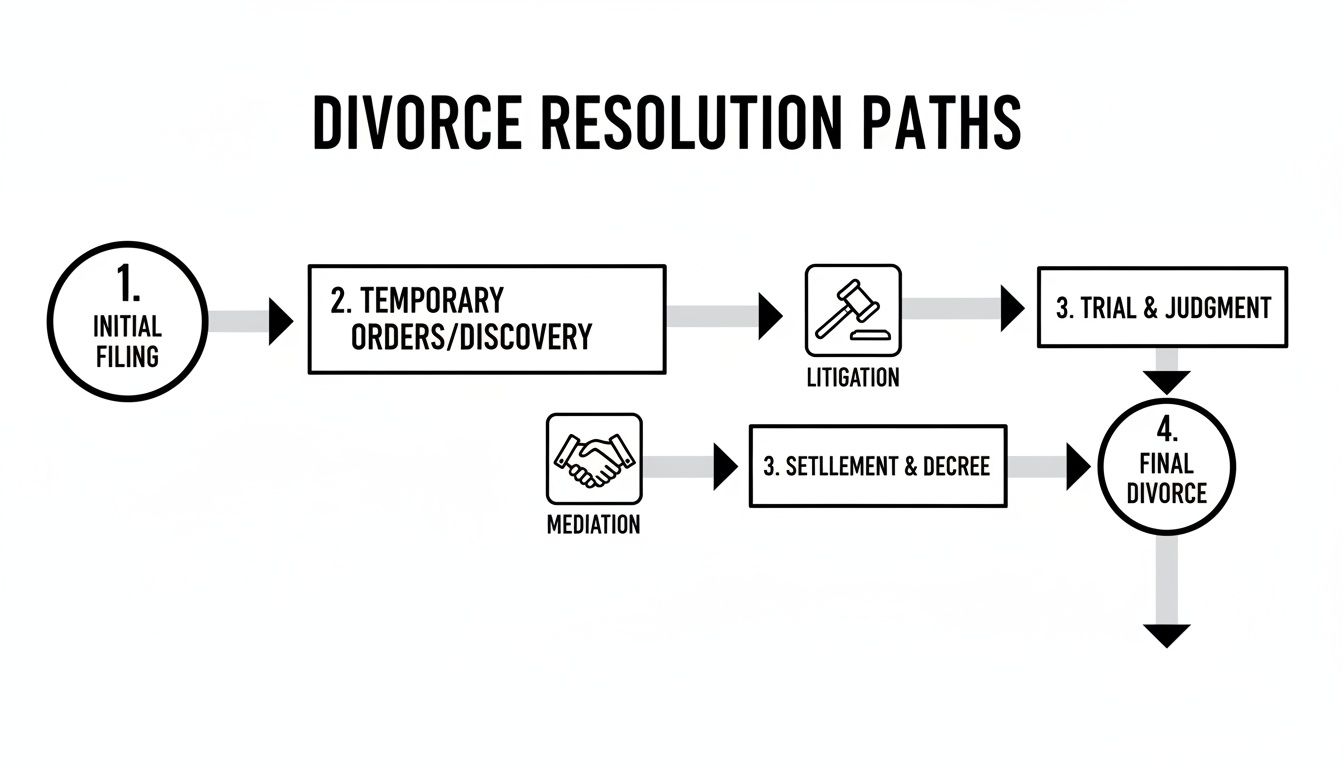
As you can see, mediation offers a more direct path to a final agreement. It’s a chance to sidestep the prolonged, unpredictable, and often draining experience of a courtroom fight. Let’s break down exactly what that journey looks like.
Step 1: Selecting Your Mediator
The first step is choosing the neutral third party who will guide the process. Typically, your attorney and your spouse’s attorney will discuss potential mediators and agree on a professional who is a good fit for your specific situation. A great mediator is much more than just a referee; they are a skilled facilitator who deeply understands Texas family law and knows how to steer difficult conversations toward productive solutions.
Mediators in Texas have different styles. Some are more direct and evaluative, offering insights based on how a judge might view certain issues. Others are more facilitative, focusing on helping you and your spouse improve communication and come up with your own solutions. Your attorney will be key in helping select a mediator whose approach aligns with the dynamics of your divorce.
Step 2: Pre-Mediation Preparation
Once you’ve booked a mediator and set a date, the real work begins. Your attorney will guide you through the preparation phase, and this is absolutely critical. This is where you organize financial documents, get crystal clear on your goals, and map out a negotiation strategy. You’ll sit down and figure out your priorities: what are your “must-haves” versus your “nice-to-haves”?
This practical preparation often involves a few key tasks:
- Gathering Key Documents: This means compiling everything from bank statements and retirement account summaries to property appraisals and a proposed parenting plan.
- Defining Your Goals: You’ll create a clear, concrete list of what you hope to achieve for both property division and any child-related issues.
- Anticipating Disagreements: You and your attorney will think through your spouse’s likely positions and prepare potential counter-offers.
Solid preparation ensures you walk into the mediation session feeling organized and empowered, not reactive and caught off guard.
Step 3: The Mediation Session Itself
When mediation day arrives, the setup is usually standard in Texas. You and your attorney will be in one room, while your spouse and their attorney will be in another. This “caucus” style is designed to give you the space to speak freely and confidentially with both your lawyer and the mediator.
The mediator acts as a go-between, moving from one room to the other. They’ll relay offers, highlight areas where you’re already in agreement, and help you find creative ways to bridge the gap on the more contentious issues. Their job is to facilitate, not to force an outcome. They listen, help manage the inevitable emotions that come up, and guide you toward solutions you might not have thought of on your own. Everything said during these talks is confidential and cannot be used against you in court if you don’t reach a deal.
Step 4: Reaching the Agreement
If you and your spouse successfully work through all the issues, the mediator will draft a Mediated Settlement Agreement (MSA). This is the official document that spells out every detail of your agreement, from who gets the house to the fine points of your parenting plan.
This document is critically important. Under the Texas Family Code, a signed MSA is legally binding and irrevocable once it’s signed by you, your spouse, and both attorneys. It is absolutely crucial to read it carefully and ensure it perfectly reflects your understanding before you put pen to paper.
Your attorney will review the MSA with you line-by-line, making sure your interests are protected. Once signed, this agreement becomes the blueprint for your Final Decree of Divorce. A judge will later sign that decree, making your private agreement an official, enforceable court order.
How to Prepare for a Successful Mediation Session

Walking into your mediation session shouldn’t feel like you’re walking into an ambush. It should feel like a decisive step toward your future. The single most important factor in a successful outcome is effective preparation. It’s what transforms anxiety into confidence and puts you in control of the negotiation.
Think of it this way: you wouldn’t show up to a critical business meeting without your notes and a clear agenda. Mediation in a Texas divorce is no different. This is your opportunity to advocate for your future, and being organized is your greatest asset.
Our team at The Law Office of Bryan Fagan guides clients through three core areas of preparation. This proactive approach ensures you walk into that room feeling organized, empowered, and ready to secure a fair agreement.
Gathering Your Essential Documents
Solid financial data is the foundation of any discussion about property division or support. Without complete and accurate information, negotiations can stall or become based on guesswork—which almost never works in your favor. Your attorney will be instrumental in helping you compile and organize these vital documents.
A complete financial portfolio for mediation usually includes:
- Income Verification: Recent pay stubs for both you and your spouse, plus the last two years of tax returns.
- Asset Statements: Up-to-date statements for every bank account (checking, savings), retirement accounts (401(k)s, IRAs), investment portfolios, and any pension plans.
- Property Records: Deeds for any real estate you own, titles for vehicles, and recent appraisals or county tax valuations for your home.
- Debt Information: Current statements for mortgages, car loans, credit card balances, and any other outstanding loans.
Having these documents ready allows the mediator to work with concrete numbers, making it much easier to explore fair and practical ways to divide your community estate.
Clarifying Your Personal Goals
Beyond the spreadsheets and bank statements, a successful mediation requires you to know what you truly want and need for your life after the divorce. This means taking the time for some honest self-reflection long before you sit down at the negotiation table.
Your attorney’s job is to help translate these personal goals into a tangible negotiation strategy. This involves figuring out what’s non-negotiable for you and where you have some room to be flexible.
A common mistake is focusing only on what you don’t want. The most productive mediations happen when both parties arrive with a clear vision of what a positive outcome looks like for them.
Here is some actionable guidance to help you get clear on your own goals:
- Create a Post-Divorce Budget: What will your monthly expenses look like on your own? This is crucial for determining your need for spousal support or figuring out how much you can realistically afford to pay.
- Draft an Ideal Parenting Plan: Sketch out a possession schedule that works for your children’s needs and your work life. Think through holidays, summer vacations, and how you’ll handle major decisions together.
- Make a Property Division Wish List: Make two columns. In one, list the assets you feel strongly about keeping (like the family home or a specific retirement account). In the other, list those you are willing to part with.
This isn’t about creating rigid demands. It’s about establishing a clear starting point for a productive conversation.
Cultivating a Constructive Mindset
Finally, your mindset can make or break the entire mediation process. It’s completely natural to feel hurt, angry, or resentful, but walking into the room focused on conflict will only lead to a stalemate. The goal of mediation is not to “win” or rehash old arguments—it’s to find a workable path forward.
A constructive mindset involves a commitment to:
- Focusing on the Future: Concentrate on building a stable future for yourself and your children, not on dwelling on past grievances.
- Practicing Active Listening: Make an effort to understand your spouse’s perspective, even if you disagree with it. Sometimes, this can reveal unexpected opportunities for compromise.
- Embracing Compromise: Remember that a successful agreement will almost certainly involve both of you making concessions. Know where you can be flexible to achieve your most important goals.
Your attorney will be your advocate and your shield, but your willingness to engage in good-faith negotiation is what ultimately opens the door to a resolution. Preparation across these three areas—documents, goals, and mindset—is your key to unlocking a successful mediation in a Texas divorce.
Understanding Confidentiality in Texas Mediation
Privacy is one of the biggest anxieties for anyone walking through a divorce. The thought of your personal financial details or sensitive family matters becoming a public spectacle is more than just unsettling—it’s a major roadblock to honest negotiation. This is exactly where mediation shines, offering a powerful, legally protected shield.
Think of mediation as a confidential bubble. Unlike a courtroom, which is open to the public, everything said during mediation in a Texas divorce is strictly private. And this isn’t just a gentleman’s agreement; it’s a hard-and-fast rule backed by state law.
The Legal Foundation for Privacy
The principle of confidentiality isn’t just a good idea—it’s written directly into the Texas Civil Practice and Remedies Code, Chapter 154. Specifically, Section 154.073 states that communications made during mediation are not subject to disclosure. They absolutely cannot be used as evidence against you if your case ever goes to court.
This legal protection is the bedrock of the entire process. It means you can have a real conversation, put a settlement offer on the table, or even admit a weak spot in your case without the paralyzing fear that it will be thrown back in your face at trial.
For example, imagine you need to talk about a financial mistake that’s embarrassing or voice your true concerns about your spouse’s new partner. In a courtroom, those statements are on the record and can be twisted into weapons. In mediation, they are protected conversations aimed at one thing and one thing only: finding a way forward.
“A communication relating to the subject matter of any civil or criminal dispute made by a participant in an alternative dispute resolution procedure… is confidential, is not subject to disclosure, and may not be used as evidence against the participant in any judicial or administrative proceeding.”
— Texas Civil Practice and Remedies Code § 154.073(a)
This legal safeguard is what allows for the transparency and spirit of compromise that makes mediation so successful.
What Confidentiality Means in Practice
So, what does this look like on the ground? The protection is incredibly comprehensive, covering nearly everything that happens during the session. Here’s what it means for you:
- Verbal Discussions: Any conversation you have—whether with the mediator in private, or with your spouse and their attorney—is completely confidential.
- Written Notes: The notes taken by you, your lawyer, or even the mediator can’t be subpoenaed or brought into court. They are for the room, and the room only.
- Settlement Offers: This is a big one. Any offers made and rejected during mediation are off-limits at trial. A judge will never hear that you were once willing to accept a certain dollar amount or property split.
- Mediator’s Testimony: The mediator is a neutral party and cannot be dragged into court to testify about what was said, who was more stubborn, or who seemed more willing to compromise.
This creates an environment where you and your spouse can get creative with solutions without taking on unnecessary risk. You could propose a truly unique way to divide a business or handle a difficult asset, knowing that if your spouse says no, the idea simply vanishes. It cannot be brought up again.
These confidentiality rules are the secret sauce that makes mediation so effective in family law. They allow for the kind of candid, productive dialogue that’s nearly impossible to have in a formal, public court setting. You can learn more about this in our full article on family law cases and confidentiality in Texas. Knowing these protections are in place can give you the confidence to enter the process ready to build a fair and lasting agreement.

Divorce is rarely simple, but when you add complex assets or your children’s future into the mix, the stakes can feel overwhelming. A common worry is that mediation might be too “soft” for these big-ticket issues. The reality is actually the complete opposite.
The unique structure of mediation in a Texas divorce—both formal enough to be productive and flexible enough to be creative—makes it the perfect setting for untangling even the most complicated family situations. A courtroom judge has to follow a rigid, one-size-fits-all legal standard, but mediation lets you craft solutions that actually fit your life.
Crafting a Child-Centered Parenting Plan
When you have children, their well-being is the top priority. In a courtroom, a judge will typically issue a Standard Possession Order. It’s functional, but it’s a generic template that might not work for your family’s actual day-to-day rhythm. Mediation gives you the power to create something better.
For example, a standard order might not account for a parent’s non-traditional work schedule or a child’s special needs. In mediation, you and your co-parent can build a parenting plan from the ground up, covering all the details a court order would miss:
- Custom Possession Schedules: You can design a schedule that works around school calendars, extracurricular activities, and your work shifts. Think mid-week dinners or unique holiday traditions that a court wouldn’t include.
- Clear Decision-Making Authority: Who gets the final say on major medical decisions or where the children go to school? Mediation lets you spell this out clearly, heading off future arguments before they start.
- Communication Protocols: You can agree on the ground rules for how you’ll communicate as co-parents, like using a shared app or setting up weekly phone calls to stay on the same page.
The goal isn’t just to check a legal box; it’s to create a living document that truly serves your children. Of course, financial support is a huge piece of this puzzle. To understand how that gets worked out, you can learn more by reading our guide on if you can negotiate child support during mediation.
Untangling High-Net-Worth and Complex Assets
High-asset divorces often involve a financial web that can’t be untangled with a simple 50/50 split. Dividing things like a family-owned business, rental properties, or complicated retirement plans requires nuance and creative thinking.
Mediation provides the confidentiality and flexibility necessary to preserve wealth and privacy. You can bring in neutral financial experts, such as business valuators or forensic accountants, to provide clarity without the adversarial posture of a courtroom battle.
This collaborative approach allows for innovative solutions that protect the value of what you’ve built together:
| Asset Type | Potential Mediation Solution | Benefit |
|---|---|---|
| Family Business | One spouse buys out the other over time, using a structured payment plan. | Preserves the business as a going concern and provides liquidity for the exiting spouse. |
| Stock Options | Agree on a formula for dividing unvested options as they become available in the future. | Avoids complex valuation disputes and shares both risk and potential reward fairly. |
| Real Estate Portfolio | Create a joint ownership entity to manage properties post-divorce or trade properties of equal value. | Maintains income streams and avoids a forced sale that could trigger significant tax liabilities. |
Litigation can force you to sell off assets—often at a loss—just to achieve a clean division. Mediation, on the other hand, focuses on preserving the value of your estate while still reaching a fair agreement. It equips you to handle the financial complexities of your divorce with skill and discretion, making sure your hard-earned assets are protected for the future.
The Financial Benefits of Choosing Mediation
Let’s be honest: facing a divorce is financially terrifying. You’re not just thinking about dividing up what you have now; you’re worried about your entire future. This is exactly why choosing mediation in a Texas divorce is one of the smartest financial decisions you can make. It’s a strategic choice designed to protect your family’s financial well-being, not drain it in a long, drawn-out legal war.
Taking a divorce to court is an incredibly expensive path. The costs stack up quickly: court filing fees, discovery expenses, paying for expert witnesses like appraisers or forensic accountants, and—the biggest one—the staggering number of hours your attorney will spend on hearings, depositions, and trial prep. These expenses can easily spiral into tens of thousands of dollars, eating away at the very assets you’re fighting over.
Avoiding the High Cost of Conflict
Mediation offers a much more direct and budget-friendly route. Instead of both you and your spouse paying separate attorneys to battle it out, you typically share the cost of a single, neutral mediator. That alone is a huge saving.
Because the whole process is built on collaboration and finding solutions, it wraps up much faster than litigation. Fewer hours spent arguing means fewer billable hours for everyone involved. The difference isn’t small; it’s substantial.
A contested divorce that goes to trial can be financially devastating. Mediation often slashes these costs dramatically, sometimes by half or more. For many families, this is a financial lifeline during a tough transition.
Preserving Your Assets for the Future
Think about what those savings really mean. The money you don’t spend on a bitter court fight could be a down payment on a new home, a contribution to your child’s college fund, or simply a safety net to give you a stable start to your new life. Mediation is an investment in your financial future, letting you put your resources toward rebuilding instead of tearing things down.
Beyond the immediate savings, solid financial planning is essential for your long-term stability after the divorce is final. Partnering with professional financial services can help you manage your settlement and build a secure foundation for the years to come. By choosing a less confrontational path like mediation, you not only save money but also create a cooperative spirit that makes future discussions, especially about co-parenting finances, much less stressful.
Common Questions About Divorce Mediation in Texas
After walking through the process, it’s completely normal for a few questions to still be floating around. Divorce is a complicated journey, and we find that clear, direct answers are the best way to replace anxiety with confidence. We’ve put together some of the most common questions we hear from clients about mediation in a Texas divorce to give you the clarity you need to take the next step.
What Happens If We Can’t Reach an Agreement in Mediation?
This is probably the most common worry we hear, but it’s important to know that mediation isn’t an “all-or-nothing” game. If you and your spouse can’t find common ground on every single issue, your case simply continues on the litigation track.
The good news? Any issues you did manage to agree on can still be finalized. This narrows down what a judge has to decide, saving you time and money. Because mediation is confidential under the Texas Civil Practice and Remedies Code, nothing you say or offer can be used against you in court. You literally lose nothing by trying.
Do I Have to Be in the Same Room as My Spouse?
Absolutely not. In fact, it’s rare for spouses to be in the same room in Texas. The overwhelming majority of divorce mediations here are done “caucus” style. This just means you and your lawyer will have your own private room, and your spouse and their lawyer will be in another.
The mediator acts as a neutral go-between, moving back and forth between the rooms to carry offers, counter-offers, and facilitate the conversation. This whole setup is designed to lower the tension and create a safe space where you can speak freely with your attorney and the mediator without feeling pressured or intimidated.
How Long Does Mediation Typically Take?
The timeline really depends on how many issues are on the table and how complex they are. Most divorce mediations are scheduled for either a half-day (four hours) or a full day (eight hours).
While that might sound like a long time to be in one place, it’s incredibly efficient. You have everyone’s undivided attention to hash out the details, without all the starting and stopping of the traditional court process. More often than not, this focused effort leads to a complete resolution in just that one session.
Is a Mediated Agreement Legally Binding?
Yes, absolutely. Once you, your spouse, and both attorneys sign the Mediated Settlement Agreement (MSA), it becomes a legally binding and irrevocable contract under the Texas Family Code. This is the document your lawyer will submit to the court, and it forms the blueprint for your Final Decree of Divorce.
Before you put pen to paper, your attorney will go over the MSA with you, line by line, to make sure it says exactly what you agreed to and that your interests are protected. Once it’s signed, that agreement provides the certainty and finality you need to close this chapter and start the next.
If you need help navigating divorce, custody, or estate planning in Texas, contact The Law Office of Bryan Fagan today for a free consultation for tailored guidance.