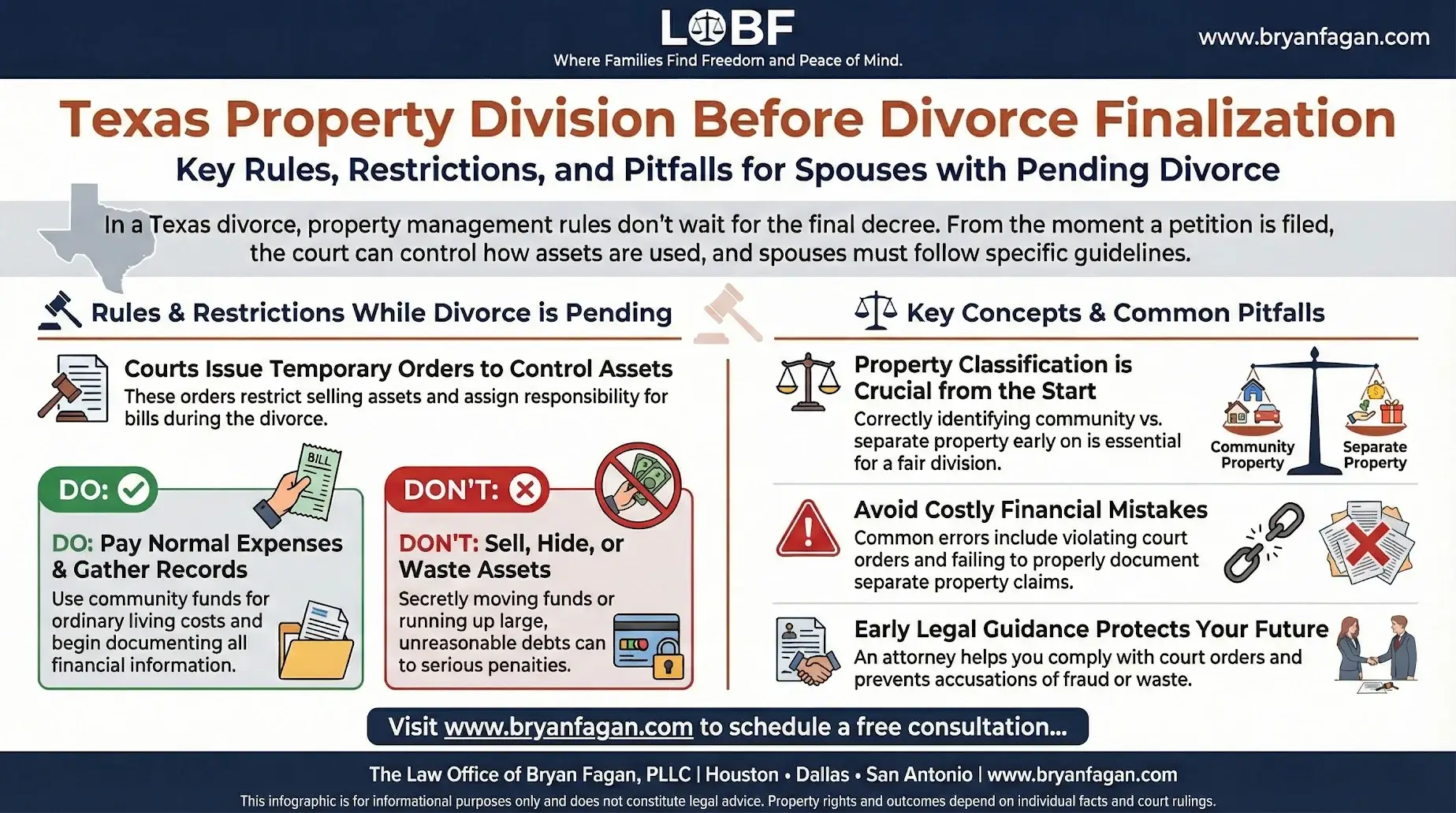

Texas Property Division Before Divorce Finalization is often the moment when families realize that divorce is not a single event, but a series of deeply personal decisions that quietly reshape daily life. One parent may still be paying the mortgage while wondering whether they should move out. Another may hesitate before touching a joint bank account, unsure whether paying a routine bill could later be used against them. These moments don’t happen in courtrooms—they happen in kitchens, late at night, when uncertainty feels heaviest.
At The Law Office of Bryan Fagan, PLLC, we regularly meet people who are trying to protect their family while standing on unfamiliar legal ground. Led by Bryan Joseph Fagan, a South Texas College of Law graduate and recognized authority on Texas divorce and custody law, our firm helps clients understand that Texas law places firm guardrails around property during divorce for a reason. Under Texas Family Code §7.001, community property cannot be permanently divided until a final decree is signed, even when spouses feel emotionally ready to move on. Acting too soon—selling property, moving money, or relying on informal agreements—can create long-term consequences that no one intended.
In this article, you’ll learn how Texas Property Division Before Divorce Finalization really works, why temporary orders exist to protect families during uncertainty, and how thoughtful legal guidance can prevent costly mistakes before they happen. More importantly, you’ll see how clear information and compassionate counsel can help restore a sense of control, stability, and peace of mind—so you can move forward with confidence during one of life’s most difficult transitions.
Key Takeaways
- Permanent property division in Texas occurs only in the final decree of divorce—not before, regardless of verbal agreements or informal arrangements between spouses.
- Temporary orders can control who uses property during divorce proceedings, but they do not transfer ownership or permanently divide assets.
- Informal property divisions without court approval carry significant legal and financial risks, including accidental waiver of rights, tax consequences, and enforcement problems.
- Community property includes most assets acquired during the marriage, and both spouses retain equal ownership until the court orders otherwise.
- Consulting an experienced family law attorney early protects your property rights and helps you avoid irreversible financial mistakes during separation.

Your Family’s Future Starts Here
Don’t navigate your legal journey alone. Schedule a consultation now and get the clarity and support you deserve.
What Does Texas Property Division Before Divorce Finalization Mean?
Texas Property Division Before Divorce Finalization describes how marital assets and debts must be handled, protected, and preserved while a Texas divorce is still pending and before a judge signs the final decree. This period often feels uncertain for families who are eager to move forward, but Texas law intentionally slows permanent decisions to prevent unfair outcomes. Many divorces take far longer than expected, and understanding why timing matters can be critical, especially during the months when nothing feels settled. For a deeper explanation of how long this process can realistically take, our firm breaks it down in Can Divorce Finalization in Texas Really Take a Year or More?.
Under Texas Family Code §7.001, courts are required to divide community property in a manner that is “just and right,” considering factors such as the length of the marriage, each spouse’s earning capacity, the needs of any children, and—where applicable—fault in the breakup of the marriage. Importantly, this legal division does not occur at the beginning of a divorce. It happens only after the court has reviewed the full financial picture and is prepared to enter a final decree consistent with current Texas law.
For families living through the divorce process, this means legal ownership of community property remains shared, even if daily life has already changed. One spouse may live in the marital home or primarily drive a vehicle, but possession alone does not determine ownership. Until the divorce is finalized, both spouses retain legal interests in community assets, and premature decisions involving property or finances can create lasting consequences.
A helpful way to think about this stage is as a legal holding pattern. Temporary orders may clarify who uses certain property and who pays specific bills, but they are designed to maintain stability—not to decide the final outcome. Our experienced Texas family law attorneys regularly guide clients through this phase with an emphasis on protection, education, and planning, so that when the court ultimately divides the estate, the result reflects fairness rather than avoidable missteps.

Can Property Be Divided Before a Texas Divorce Is Final?
Texas Property Division Before Divorce Finalization follows a strict legal rule in Texas: permanent division of property cannot occur until the divorce is officially finalized. Texas district courts do not have the authority to transfer ownership or change title to community property before the final decree is signed. This limitation is rooted in the Texas Family Code, which requires judges to review the entire marital estate before issuing a division that meets the “just and right” standard under Texas Family Code §7.001.
This rule exists to protect both spouses. Before making permanent decisions, the court must evaluate all assets, all debts, and all relevant circumstances surrounding the marriage. Moving too quickly toward division would increase the risk of unfair outcomes, overlooked liabilities, or even financial manipulation. For families trying to understand how community property works within this framework, our firm provides additional guidance in Understanding Your Texas Community Property Divorce: A Complete Guide to Asset Division Under Texas Law.
That said, Texas law recognizes that life does not pause during divorce. Temporary arrangements are often necessary to address practical needs while the case is pending. Under Texas Family Code §§6.501–6.502, courts may issue temporary orders allowing one spouse to use the marital home, designate a vehicle for work or childcare purposes, or control access to bank accounts so bills can be paid and assets preserved. These measures are especially important in contested cases, which commonly last six to twelve months or longer.
The key distinction families must understand is that temporary possession is not the same as ownership. Living in the marital home during the divorce does not mean you will ultimately receive it, and driving a vehicle under a temporary order does not transfer title. Until the court enters a final decree, all questions about who keeps which assets remain unresolved.
Informal agreements between spouses during this period carry significant risk. Verbal promises or “handshake deals” to divide retirement accounts or exchange property have no binding effect without court approval. Even written agreements may be rejected if they lack full disclosure, fairness, or voluntariness. Our experienced Texas family law attorneys regularly help families avoid these pitfalls by ensuring that temporary arrangements remain protective rather than premature, preserving both legal rights and financial stability until the divorce is properly finalized.
Temporary Orders and Property Use During Divorce
Texas Property Division Before Divorce Finalization often hinges on the role of temporary orders, which are court-issued directives designed to bring structure and stability to an otherwise uncertain period. These orders are put in place early in a divorce case to regulate how property is used, how bills are paid, and how assets are preserved while the divorce works its way toward final resolution. They are not meant to decide winners and losers, but to protect families from financial harm during the waiting period that can feel especially long, even in cases that are ultimately uncontested. For readers interested in how this early phase fits into the broader timeline of a Texas divorce, our legal team explains the process in detail in The Journey of an Uncontested Divorce in Texas: From Filing to Finalization.
Under Texas Family Code §§6.501–6.502, either spouse may request temporary orders shortly after a divorce is filed, often within the first few weeks. After a hearing, the court may issue orders that remain in effect until the final decree is signed. These orders commonly address who has exclusive use of the marital home, which spouse may use certain vehicles, how bank accounts are accessed, which party pays ongoing expenses such as mortgages, car loans, or credit cards, and whether insurance policies must be maintained. Courts may also restrict either spouse from selling, transferring, hiding, or destroying property while the case is pending, reflecting the Legislature’s focus on preservation rather than premature division.
It is equally important to understand what temporary orders do not do. They cannot permanently divide property, decide who ultimately receives major assets like the house, retirement accounts, or a business, resolve whether disputed property is community or separate, or lock in final asset values. A temporary order might allow one spouse to live in the marital residence and require the other to pay the mortgage from community funds, but it deliberately leaves the ultimate ownership decision for the final decree under Texas Family Code §7.001, when the court is required to divide the community estate in a manner that is “just and right.”
Courts take compliance with temporary orders seriously. When one spouse violates these orders by draining protected accounts, selling restricted assets, or refusing to pay required bills, judges have the authority to impose meaningful consequences. These can include findings of contempt, awards of attorney’s fees to the other spouse, and adjustments to the final property division to account for misconduct. Our experienced Texas family law attorneys routinely help clients understand both the protection and responsibility that temporary orders create, ensuring that short-term decisions do not undermine long-term financial security.

Risks of Informal Property Division Before Divorce Finalization
Texas Property Division Before Divorce Finalization becomes especially risky when couples rely on informal or verbal agreements to divide property before a court signs the final decree. While these arrangements may feel cooperative or efficient in the moment, Texas law is structured to prevent permanent property decisions until the court can review the full financial picture and issue a division that meets the “just and right” standard required by Texas Family Code §7.001. Skipping that process often exposes families to consequences they never anticipated, particularly when they are unfamiliar with the formal steps required to end a marriage, which our firm outlines in the steps to follow when seeking a divorce in Texas.
One of the most common dangers of informal property division is the accidental waiver of valuable rights. When a spouse agrees to let the other “keep” an asset, such as a retirement account, without understanding its true value, that decision can result in a permanent and disproportionate loss. Texas courts do not automatically undo these agreements simply because one spouse later realizes the deal was unfair, especially if the agreement influenced how assets were handled during the case.
Disputes also arise when property divisions are unequal or poorly documented. Without clear, written agreements, judges are often left with conflicting stories and no reliable way to determine what the parties intended. While Texas Family Code §6.602 provides a framework for enforceable mediated settlement agreements, informal side deals rarely meet those requirements and may also fail to satisfy broader Texas contract principles that favor written proof over verbal promises.
Financial fallout is another frequent surprise. Selling community property during a pending divorce can trigger tax consequences that affect both spouses, and debts incurred during separation may still be characterized as community obligations depending on the facts. These issues are often litigated later, increasing costs and prolonging an already stressful process.
Enforcement problems tend to surface when assets change hands without court oversight. Cash that was supposed to be transferred may be spent, property may never be retitled, or accounts may be depleted. Without enforceable court orders, remedies are limited, and judges may instead address the issue indirectly by adjusting the final property division or considering claims of waste or dissipation under Texas Family Code §7.001.
Our experienced Texas family law attorneys see this pattern repeatedly. One spouse agrees to take the house while the other keeps retirement assets, believing the exchange is fair. Months later, full disclosures reveal the retirement accounts are worth far more than the home, and the spouse who relied on the informal deal has little recourse. Data from Texas family courts consistently shows that claims of asset dissipation and unfair division frequently stem from these early, informal decisions, underscoring why education and proper legal guidance are essential before taking action.
How Courts Treat Early Agreements About Property
During Texas Property Division Before Divorce Finalization, Texas courts will recognize early property agreements only when they are carefully documented, voluntary, and based on full and honest financial disclosure. Judges are keenly aware that agreements reached before a final decree can shape the entire outcome of a case, which is why Texas law imposes strict requirements to ensure fairness and transparency. These safeguards exist to prevent one spouse from being pressured into an arrangement without fully understanding the financial picture or the long-term consequences.
The most reliable form of an early property agreement is a mediated settlement agreement executed under Texas Family Code §6.602. When both spouses and their attorneys sign a properly drafted mediated settlement agreement, it becomes binding and irrevocable, meaning neither party can later withdraw simply because they have second thoughts. Courts will set aside such agreements only in rare circumstances, such as clear evidence of fraud, duress, or coercion. For families seeking a deeper understanding of how Texas courts evaluate these agreements within the broader framework of property law, our legal team provides detailed guidance in Understanding Texas Divorce Property Laws: A Complete Guide to Property Division in Texas.
By contrast, informal or non-mediated agreements are reviewed far more skeptically. Even when these agreements are reduced to writing, courts may refuse to enforce them if all assets and debts were not disclosed, if one spouse felt pressured or intimidated, if the terms are grossly one-sided, or if the agreement fails to meet basic contract standards. Texas judges are not required to honor private arrangements that undermine the “just and right” division mandated by Texas Family Code §7.001.
Final court approval is always required before any property division becomes enforceable. Even when spouses believe they have resolved every issue, the judge must review the agreement and incorporate it into the final decree. Courts retain discretion to reject provisions that appear fundamentally unfair or inconsistent with Texas law, regardless of the parties’ intentions.
Vague or incomplete agreements are especially problematic. Statements such as “one spouse takes the business” without addressing valuation, liabilities, or transfer mechanics are often unenforceable. Courts require specificity, including clear identification of assets, assigned values, responsibility for debts, and precise instructions for transferring ownership. Our experienced Texas family law attorneys routinely help families refine and document agreements so they withstand judicial scrutiny and truly protect their financial futures.
Community vs. Separate Property Issues Before Finalization
Texas Property Division Before Divorce Finalization often turns on how property is classified while a case is still pending, making the distinction between community and separate property one of the most important issues families face during separation. How an asset is categorized directly affects what can be used, preserved, or protected before the divorce is complete, and mistakes made at this stage can have lasting financial consequences. This becomes even more critical when mediation is involved and there is a delay between reaching an agreement and the court signing the final decree, a timing gap our legal team explains in Why How Long After Mediation Is Divorce Final in Texas Is the Question Everyone’s Asking Now.
Under Texas Family Code §3.002, all property acquired during the marriage is presumed to be community property owned by both spouses equally. This presumption is broad and includes wages, income, property purchased with marital earnings, and retirement benefits accrued during the marriage. Because this presumption applies automatically, courts will treat most assets as community property unless proven otherwise, which is why careful handling during the pre-finalization period matters so much.
Separate property, by contrast, includes assets owned before marriage, property received by one spouse as a gift, and inheritances. Texas law requires the spouse claiming separate property to prove that status by clear and convincing evidence, a higher legal standard that demands thorough and well-organized documentation. Without that proof, even assets that feel personal or “obviously separate” can be swept into the community estate and divided at the end of the case.
The risk of commingling is especially high during separation, when day-to-day finances are often in flux. Depositing an inheritance into a joint account, using separate funds to pay community expenses, or mixing business income with personal accounts can blur ownership lines and make tracing difficult. Once commingling occurs, a court may determine that the asset lost its separate character, exposing it to division under Texas Family Code §7.001’s “just and right” standard.
How property is used or sold before finalization can also shape the ultimate outcome. Unauthorized sales or transfers of community property may lead to claims of waste, allowing the court to compensate the other spouse through an unequal division. Separate property generally remains under the owner’s control, but even then, depositing sale proceeds into a joint account can complicate proof and invite disputes. Our experienced Texas family law attorneys consistently advise clients that documentation is their strongest protection during this phase, including bank statements, account histories, deeds, gift letters, and inheritance records. For families navigating this process, staying organized and informed is not just good practice; it is often the key to protecting what matters most.

When Early Property Decisions Can Affect the Final Divorce Outcome
Early choices made during Texas Property Division Before Divorce Finalization often carry more weight than families realize, because Texas courts closely examine conduct that occurs before the final decree is signed. Under Texas Family Code §7.001, judges are required to divide the community estate in a manner that is “just and right,” and actions taken during separation can directly influence how that standard is applied. What may feel like a practical decision in the moment can later be viewed as unfair, wasteful, or even strategic misconduct once the court reviews the full picture of the marital estate.
Selling, refinancing, or otherwise disposing of assets while a divorce is pending almost always draws heightened scrutiny. When one spouse sells the family home, liquidates retirement funds, or cashes out investments without the other’s consent or court approval, judges may respond by awarding the non-consenting spouse a greater share of the remaining assets to restore balance. These principles are part of the broader framework governing Texas property division, which our legal team explores in depth in Texas Divorce Asset Division Rules: A Complete Guide to Property Division Laws.
Financial misconduct during separation can also lead to claims of dissipation. Draining joint bank accounts, hiding funds, or unilaterally freezing access to money may be characterized as waste of community property. Texas courts are permitted to consider fault-based conduct, including dissipation, when crafting a “just and right” division under Texas Family Code §7.001. When waste is proven, the innocent spouse may receive reimbursements or a disproportionate share of the remaining estate to offset the loss.
Use of the marital home during divorce is another area where early decisions can shape final outcomes. Courts often consider stability and practical needs when issuing temporary orders under Texas Family Code §§6.501–6.502, and the spouse who maintains the home and handles day-to-day responsibilities may later have a stronger argument for continued possession. While temporary use does not guarantee ownership, it can influence how judges view fairness and feasibility at the end of the case.
Business owners face additional risks during this phase. If a business is part of the community estate, major decisions made without transparency—such as taking on new debt, selling business assets, or altering ownership structures—can raise red flags. Courts may draw adverse inferences from these actions and adjust the final division accordingly. Appellate decisions across Texas consistently show that proven waste or dissipation can lead to significant disparities in property division, sometimes shifting outcomes by 20 to 25 percent. For families navigating this uncertainty, informed guidance and restraint during the pre-finalization period are often the best protections against unintended and lasting consequences.
How a Texas Divorce Attorney Helps Protect Property Before Finalization
A skilled Texas divorce attorney serves as a critical safeguard during Texas Property Division Before Divorce Finalization, helping families avoid costly mistakes before a judge signs the final decree. During this interim period, emotions often run high and financial decisions can feel urgent, but Texas law intentionally delays permanent division until the court can apply the “just and right” standard required by Texas Family Code §7.001. Having experienced legal guidance at this stage helps ensure that short-term actions do not undermine long-term financial security, whether the case is contested or ultimately resolved by agreement.
One of the first priorities our legal team often addresses is securing protective temporary orders under Texas Family Code §§6.501–6.502. These orders can freeze accounts, restrict the sale or transfer of property, require ongoing bills to be paid, and establish clear rules for how assets are used while the divorce is pending. By creating structure and accountability, temporary orders reduce uncertainty and protect the marital estate until the court is ready to make final decisions. For families considering cooperative resolutions, understanding how property issues are handled in agreed cases can be especially helpful, as explained in Uncontested Texas Divorce Property Division: A Complete Guide to Fair and Legal Asset Division.
Equally important is guidance on what not to do. Many people unintentionally create legal problems by taking actions that seem reasonable, such as paying off shared debt, making improvements to the marital home, or moving money between accounts. Without proper advice, these steps can trigger disputes over reimbursement, commingling, or waste. An experienced Texas family law attorney helps define clear boundaries, ensuring that everyday decisions stay within the limits of current Texas law.
Proper documentation is another area where legal counsel makes a meaningful difference. Any agreement reached between spouses should be put in writing, clearly explained, and structured to meet legal requirements so it can be enforced if needed. Once an asset is sold at an undervalued price, separate funds are commingled, or rights are waived without full understanding, the damage is often permanent. Our experienced Texas family law attorneys focus on prevention and education, helping clients move through the divorce process efficiently and with confidence. For readers seeking a broader understanding of how legal guidance supports families at every stage, our resource on the Texas divorce process offers additional insight into how informed planning can protect your future.
Why Choose The Law Office of Bryan Fagan, PLLC
Guiding families through Texas Property Division Before Divorce Finalization requires more than knowledge of the law; it demands practical experience, strategic judgment, and genuine compassion. Our legal team has spent years helping Texans navigate the uncertainty that comes with a pending divorce, particularly when questions about property, finances, and temporary arrangements arise before anything is truly final. We understand how easy it is to make decisions too quickly during this stage, and how costly those missteps can become once a judge applies the requirements of Texas Family Code §7.001 and orders a “just and right” division of the community estate.
The reason we do this work is simple. Families deserve protection from avoidable financial harm during one of the most difficult transitions they will ever face. Texas law provides tools to preserve stability during a pending divorce, including temporary orders under Texas Family Code §§6.501–6.502, but those tools are only effective when they are used thoughtfully and correctly. Acting without guidance can expose assets to unnecessary risk, especially when emotions are running high and the future feels uncertain.
Our approach focuses on clear strategy and informed decision-making. Through careful planning, straightforward explanations of your rights, and timely requests for protective court orders, we help clients maintain control while their case moves forward. Temporary orders often play a central role in this process, and our attorneys regularly advise clients on how courts use them to regulate property use, bill payment, and asset preservation without deciding final ownership. For a deeper look at how Texas courts handle this stage, readers may find our resource on temporary orders in Texas family law courts especially helpful.
What we provide goes beyond legal paperwork. Our firm offers comprehensive divorce representation, focused advocacy at temporary order hearings, tailored property protection strategies, and skilled mediation when appropriate, all delivered with respect for what families are going through. Serving clients across Texas, our experienced family law attorneys combine deep knowledge of the Texas Family Code with a risk-aware, human-centered approach designed to protect futures, not just resolve cases.

Actionable Checklist: Texas Property Division Before Divorce Finalization
Protecting yourself during Texas Property Division Before Divorce Finalization starts with understanding that every financial decision you make while a divorce is pending can affect the outcome of your case. Texas law is designed to preserve the marital estate until a judge can divide it in a manner that is “just and right” under Texas Family Code §7.001, which means informal shortcuts often create more risk than relief. One of the most effective ways to stay grounded during this stage is to follow a clear, intentional approach that aligns with the legal process, something our firm regularly explains to families navigating the Texas divorce process from start to finish.
Avoid relying on verbal or informal property agreements, even if communication with your spouse feels cooperative. Texas courts place far greater weight on written, court-approved arrangements, and off-the-record deals can lead to accidental waivers of rights or disputes that are difficult to resolve later. Any agreement involving property or debt should be documented and reviewed by an attorney to ensure it complies with current Texas law and protects your interests.
Staying organized is equally important. Keeping detailed records of bank accounts, financial statements, retirement balances, and property documents can make a meaningful difference if questions arise about characterization or value. Under Texas Family Code §3.002, property acquired during marriage is presumed to be community property, and documentation is often the key to rebutting that presumption when separate property claims are involved.
It is also critical to resist the urge to sell, transfer, or refinance property without legal guidance. Actions that feel practical, such as paying off debt or listing a home, may violate temporary orders issued under Texas Family Code §§6.501–6.502 or complicate the court’s ability to fairly divide assets later. Temporary orders can regulate use and payment responsibilities, but they do not grant permanent ownership, a distinction that often surprises families who act too soon.
Finally, seeking guidance from an experienced Texas divorce attorney early in the process can provide clarity and peace of mind. Early legal advice helps families understand what temporary orders can and cannot do, how to properly document separate property, and how to avoid missteps that could undermine financial security. Our experienced Texas family law attorneys focus on education and protection, helping clients move through this uncertain period with confidence while safeguarding what matters most.
Conclusion
Divorce brings enough uncertainty on its own without adding avoidable stress over property, finances, and the ripple effects those decisions can have on your family’s sense of stability. The heart of this conversation isn’t just about legal rules or court procedures—it’s about making thoughtful choices that protect your peace of mind now and your future later. When you understand how Texas law approaches property division before a divorce is finalized, you put yourself in a position to move forward with clarity instead of reacting out of fear or frustration.
If you’re facing these decisions right now, remember that you don’t have to navigate them alone or guess your way through them. Speaking with an experienced Texas family law attorney can help you slow the process down, spot risks before they become problems, and create a plan that fits your life—not just your case. The right guidance often makes the difference between feeling overwhelmed and feeling prepared.
At The Law Office of Bryan Fagan, PLLC, our team believes that good legal advice should leave you feeling informed, supported, and confident about what comes next. If this article raised questions or helped you see your situation more clearly, consider reaching out for a conversation about your options. Sometimes the most powerful step forward is simply choosing clarity over uncertainty—and giving yourself permission to move ahead with confidence.
Frequently Asked Questions
Texas follows a community property system, which generally means that most property acquired during the marriage belongs to both spouses. In a divorce, a judge must divide the community estate in a manner that is “just and right,” taking into account the specific facts of the case. Separate property—such as assets owned before marriage or received as a gift or inheritance—is typically not divided, but the spouse claiming it must be able to prove it clearly.
One of the most common and costly mistakes is making major financial or parenting decisions too quickly. Acting out of fear or frustration—such as selling property, draining accounts, or relying on informal verbal agreements—can create legal and financial problems that are difficult to fix later. Slowing down and getting accurate legal guidance early often prevents long-term consequences.
In Texas, filing for divorce does not automatically end the community estate. Income earned and assets acquired before the divorce is finalized may still be considered community property, depending on the circumstances. Temporary orders or standing orders may limit how property can be used during this time, and the court will ultimately determine how those assets are characterized and divided.
The 10-10-10 rule is not a legal standard, but a personal decision-making tool. It encourages you to consider how a decision will affect you in 10 days, 10 months, and 10 years. During divorce, this approach can help you avoid impulsive choices that feel right in the moment but lead to regret or financial stress later.
Moving out of the marital home is not always a mistake, but doing so without a clear plan can create complications. When children are involved, leaving the home may affect the existing routine that courts often consider when issuing temporary custody orders. From a property perspective, moving out does not mean giving up ownership, but it can make access, documentation, and daily logistics more difficult
Separate property funds—such as money owned before marriage, inheritances, or gifts made to one spouse—may be protected from division if they can be properly traced. Even then, court orders may restrict transferring or spending funds while the divorce is pending. Certain retirement accounts also require court approval and specific legal documents before they can be divided.
There is no universal answer. The financial impact of divorce depends on income levels, debts, child-related expenses, and the need to maintain two households. Many people feel they “lost more” when expectations do not align with what Texas law allows. Careful planning and full financial disclosure can reduce surprises and help protect long-term stability.
While definitions vary, the three C’s are often described as communication, cooperation, and consistency. Clear communication reduces misunderstandings, cooperation helps resolve issues more efficiently, and consistency supports both finances and family stability during the transition. Even when cooperation is difficult, staying organized and informed can make a meaningful difference.
The 7-7-7 rule is a relationship guideline, not a legal rule. It suggests spending intentional time together through regular date nights, short getaways, and longer trips. While it doesn’t apply directly to divorce law, it highlights the importance of structure and communication—qualities that also help reduce conflict and stress when couples are separating.