

Texas community property divorce often begins quietly, in moments that don’t feel legal at all. It might be a tense family dinner where no one knows what to say, or a late night staring at bank statements while the house is finally silent. You’re not arguing about grades or teachers—you’re wondering how life is going to look next month, where everyone will live, and whether you’re making the right decisions for your family when everything feels uncertain.
Under Texas law, divorce is not just the end of a marriage; it is a restructuring of a family. Texas courts divide marital assets under the “just and right” standard in Texas Family Code §7.001, while simultaneously making custody decisions based on the best interest of the child under Texas Family Code §153.002. These legal frameworks exist to create fairness and stability, but when you’re living through the process, the law can feel overwhelming, impersonal, and hard to connect to real life. Understanding how these rules work together is often the first step toward regaining a sense of control.
At The Law Office of Bryan Fagan, PLLC, we understand that divorce is deeply human before it is ever legal. Founded by Bryan Joseph Fagan, a South Texas College of Law graduate and a recognized authority on Texas divorce and custody law, our Houston-based firm is built around a single purpose: empowering families to reclaim freedom and peace of mind during life’s hardest transitions. In this article, we’ll walk you through how Texas community property divorce decisions ripple through everyday family life, how courts balance financial division with parenting realities, and how informed legal guidance can help you move forward with clarity, confidence, and compassion.
Key Takeaways
- Texas community property law presumes all assets and debts acquired during marriage are equally owned by both spouses, regardless of whose name is on the title or account
- Courts divide community property using a “just and right” standard under Texas Family Code §7.001, which means division doesn’t have to be exactly 50/50
- Separate property owned before marriage, inherited, or received as gifts remains with the original owner but must be proven with clear and convincing evidence
- Commingling separate and community property can change ownership classification and affect division outcomes significantly
- Understanding these rules before agreeing to any property settlement can protect your financial future and prevent costly mistakes

Your Family’s Future Starts Here
Don’t navigate your legal journey alone. Schedule a consultation now and get the clarity and support you deserve.
What Is a Texas Community Property Divorce?
A Texas community property divorce requires the court to first identify whether each asset and debt belongs to the community estate or qualifies as separate property, and then divide only the community estate in a manner that is “just and right” under Texas Family Code §7.001. Texas remains one of the few states that follows a true community property system, meaning marital ownership is governed by statute rather than broad equitable discretion. This legal framework makes property characterization the foundation of every Texas divorce involving assets or debt.
Under the current Texas Family Code §§3.002–3.003, community property is defined as property, other than separate property, acquired by either spouse during the marriage. The law establishes a powerful presumption that all property possessed by either spouse at the time of divorce is community property. If one spouse claims an asset is separate, that claim must be proven by clear and convincing evidence. Without sufficient documentation, courts are required to treat the asset as jointly owned—regardless of whose name appears on a deed, title, or account. This presumption remains one of the most impactful and frequently misunderstood aspects of Texas divorce law.
This statutory approach differs significantly from “equitable distribution” states, where judges have broader discretion to divide marital property based on general notions of fairness. In Texas, courts cannot award one spouse the other spouse’s separate property, even if doing so might seem equitable. Judges may only divide community property and assign community debts in a just and right manner while respecting the protections granted to separate property by statute. For readers who want a deeper explanation of how Texas marital property law works and why it differs from other states, this internal resource provides helpful context: Is Texas a Community Property State?.
The attorneys at the Law Office of Bryan Fagan, PLLC routinely help clients navigate these rules by translating the Texas Family Code into practical guidance that applies to real families. By explaining how courts apply §§3.001–3.003 and §7.001 in modern divorce cases—and how those rules affect homes, retirement accounts, businesses, and debt—the firm empowers clients to move forward with clarity and confidence. This educational, client-centered approach reflects the firm’s commitment to protecting futures by ensuring families understand not just what the law says, but how it works in everyday life.

What Is Considered Community Property in a Texas Divorce?
Under Texas community property law, almost all income and assets acquired by either spouse during the marriage are considered community property, regardless of whose name appears on the paycheck, bank account, or title. Community property can include homes, vehicles, retirement savings, bank accounts, investments, and debts that arise during the marriage.
Income earned during marriage: Wages, salaries, bonuses, commissions, and tips earned by either spouse after the wedding date are community property—even if deposited into an account titled only to one spouse. If your spouse’s paycheck goes into “their” checking account, that money still belongs to the marriage.
Homes and real estate: Real estate purchased during marriage with community funds is generally community property, even if only one spouse is on the deed. The timing of acquisition and source of funds matter far more than the name on the title.
Retirement contributions: Contributions made during marriage to 401(k) plans, IRAs, Texas Teacher Retirement System benefits, and other retirement accounts are typically community property. Even if the plan started before the marriage, the portion contributed during the marriage—and its growth—belongs to the community estate.
Businesses started or grown during marriage: A business formed during marriage with community funds or labor is generally community property, even if only one spouse’s name appears on the LLC or corporation.
Debts incurred during marriage: Credit cards, car loans, mortgages, and other debts acquired during the marriage that benefited the community are often treated as community obligations under Texas Family Code §§3.201–3.203.
The key principle to remember: title alone does not determine ownership under Texas community property law. A truck purchased during marriage and financed in only the husband’s name is still community property. A bank account in only the wife’s name, funded with marital paychecks, contains community funds.
What Is Separate Property in a Texas Community Property Divorce?
Under Texas law, separate property is legally off-limits for division in a divorce—but the spouse claiming separate property must prove it with clear and convincing evidence. Texas Family Code §3.001 defines separate property as:
Property owned before marriage: Houses, land, vehicles, bank accounts, retirement balances, investments, and personal property owned before the wedding remain separate property. The inception of title rule means the character of property is determined when the right to acquire it first arose.
Gifts and inheritances: Assets acquired during marriage by gift, devise, or descent are separate property. If your parents give you $50,000 as a gift to you alone, that money is your separate property. Inheritances through wills, trusts, and intestate succession also remain separate.
Certain personal injury recoveries: Personal injury settlements are generally separate property, except for portions allocated to lost wages during marriage or medical expenses paid with community funds.
The burden of proof falls entirely on the spouse claiming separate property. Under Texas Family Code §3.003(b), you must prove your claim by clear and convincing evidence—a higher standard than simply “more likely than not.” This means you need:
- Deeds and closing documents showing purchase dates and funding sources
- Bank statements from before and after marriage
- Gift letters, wills, or probate records
- Settlement agreements in personal injury cases
Texas divorce attorneys routinely tell clients: “Separate property is only as good as your paper trail.” Without proper documentation, judges often cannot characterize property as separate, even if you insist it should be.
How Texas Courts Divide Property in a Community Property Divorce
In a Texas community property divorce, courts do not simply split everything in half. Texas Family Code §7.001 requires judges to divide the community estate in a manner that is “just and right,” considering the rights of each spouse and any children of the marriage. A 50/50 division happens in many cases, but courts often adjust the split to 55/45, 60/40, or other proportions when circumstances warrant.
The “just and right” standard is a flexible fairness principle developed by Texas appellate courts. It authorizes disproportionate divisions when justified by evidence. Many Texans believe “community property = automatic 50/50,” but this is a misconception. Texas is a community property state, but not a rigid equal-split state.
Factors That Influence Property Division
When courts evaluate a Texas community property divorce, they do not simply split marital assets down the middle. Instead, Texas Family Code §7.001 requires judges to divide the community estate in a manner that is “just and right,” allowing them to account for the real financial and personal circumstances each spouse will face after divorce. One of the most significant factors is income disparity and earning capacity. If one spouse earns substantially more or has far greater future earning potential, the court may award a larger share of community property to the lower-earning spouse to help balance post-divorce stability.
The length of the marriage is another important consideration. Long-term marriages often involve deeply intertwined finances, shared debt, and career sacrifices made by one spouse for the benefit of the family. In these cases, courts may take a more nuanced approach than they would in short-term marriages where financial lives remained relatively separate. Texas law also allows courts to consider fault in the breakup of the marriage, including adultery, cruelty, or abandonment. While fault alone does not dictate the outcome, credible evidence of misconduct can influence how community property is divided under the just and right standard.
Custody arrangements and housing needs frequently intersect with property division. When one parent is named primary conservator, courts often look at whether awarding the marital home or additional assets will help maintain stability for the children. This consideration aligns with Texas Family Code §153.002, which places the best interest of the child at the center of custody decisions, even while property issues are governed by §7.001. Courts may also weigh the age and health of each spouse, particularly when one spouse faces medical challenges or limited remaining earning years that affect long-term financial security.
Judges may further consider the size of each spouse’s separate estate when dividing community property. If one spouse has substantial separate assets while the other has little or none, the court may award a greater share of community property to the spouse with fewer personal resources. These decisions become even more critical when debt and credit exposure are involved, topics explored in depth in this internal resource on community property and credit in Texas divorces. Attorneys with The Law Office of Bryan Fagan, PLLC regularly help clients understand how these financial factors interact with Texas Family Code §§7.001 and 153.002, providing clear guidance that supports informed decisions and long-term peace of mind.

Tracing and Commingling in Texas Community Property Divorce Cases
In a Texas community property divorce, tracing and commingling often determine whether an asset remains separate or becomes subject to division. Tracing is the legal process of following the path of money or property over time to show that an asset currently in existence originated from a spouse’s separate property. This concept is rooted in Texas Family Code §§3.001–3.003, which define separate and community property and establish the presumption that property possessed at the time of divorce is community unless proven otherwise. When tracing is done correctly, it allows courts to identify and protect a spouse’s separate property interest.
Commingling, on the other hand, occurs when separate and community funds are mixed together so thoroughly that they can no longer be distinguished. In these situations, Texas courts apply the community property presumption under Texas Family Code §3.003, meaning the entire asset may be treated as community property unless the spouse claiming a separate interest can prove otherwise by clear and convincing evidence. A helpful way to think about tracing is as a visible thread running from the past to the present. If the thread remains intact through bank statements, deeds, and records, a judge can separate what belongs to one spouse alone. If that thread disappears into a tangled mix of funds, the law treats the asset as jointly owned.
Certain mistakes frequently lead to commingling problems. Depositing inheritance funds into a joint checking account used for daily expenses, adding a spouse’s name to the deed of property owned before marriage, or using premarital savings to pay for jointly titled assets without documentation can all undermine separate property claims. Texas courts have consistently held that when separate and community property become so commingled they cannot be distinguished, the entire mixture is presumed community property, placing a heavy evidentiary burden on the spouse asserting separate ownership.
Attorneys with the Law Office of Bryan Fagan, PLLC regularly help clients avoid these pitfalls by explaining how Texas courts analyze tracing and commingling in real cases. For a deeper explanation of when and how separate property can lose its protected status, readers may find this educational resource helpful: can separate property become community property in Texas. Additional guidance on protecting property rights during divorce is also available through the firm’s broader educational library, including articles on Texas community property law. By combining practical legal insight with compassionate guidance, the firm empowers families to protect what is theirs and move forward with confidence and clarity.
Division of Common Assets in a Texas Community Property Divorce
Courts approach different asset types with specific considerations in mind, and understanding these patterns helps you anticipate outcomes.
The Marital Home
The family home is often the largest community asset and most emotionally charged. Courts typically handle it in one of three ways:
One spouse keeps the home, refinances the mortgage, and buys out the other’s equity share. This approach often benefits the parent with primary custody, minimizing disruption for children. Alternatively, the home is sold and proceeds divided when neither spouse can afford it alone or both prefer cash to restart their lives. Some courts order deferred sales allowing children to remain until graduation, though this approach carries significant post-divorce conflict risks.
Retirement Accounts and Pensions
Retirement benefits are often second only to the home in value. The community portion of 401(k) plans, IRAs, and pensions is typically divided using a Qualified Domestic Relations Order (QDRO) for ERISA-qualified plans. Public pensions like the Texas Teacher Retirement System use specialized orders.
The community interest is calculated based on contributions and growth during the marriage. If you contributed to a retirement plan before marriage, that premarital portion remains your separate property—if you can prove it.
Business Assets and Professional Practices
Business valuation often requires expert testimony examining income approaches, market comparables, and asset-based methods. Courts typically award the business to the working spouse while compensating the other with offsetting assets or cash payments, sometimes structured over time.
Debts and Liabilities
Courts must address community debts including mortgages, car loans, credit cards, and tax liabilities. Debts are typically allocated alongside assets—the spouse keeping the home assumes the mortgage, each spouse keeps their vehicle and its loan.
Critical warning: The divorce decree can order how spouses handle debts between themselves, but creditors are not bound by your agreement. If your name remains on a loan, you remain responsible to the lender regardless of what the decree says. This is why refinancing or closing accounts is essential.
Common Myths About Texas Community Property Divorce
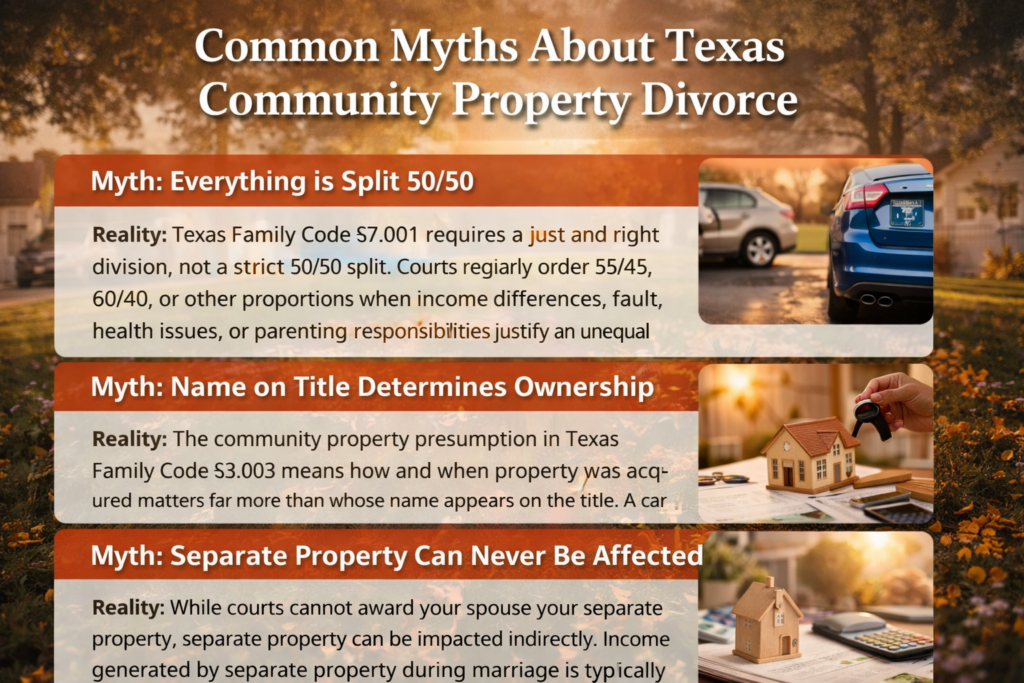
Many people enter a Texas community property divorce with assumptions that sound reasonable but do not reflect how Texas law actually works. One of the most persistent myths is that everything will automatically be divided 50/50. In reality, Texas Family Code §7.001 requires courts to divide the community estate in a manner that is “just and right,” not mathematically equal. Judges routinely approve disproportionate divisions—such as 55/45 or 60/40—when factors like income disparity, fault in the breakup of the marriage, health concerns, or primary parenting responsibilities justify an unequal outcome. Understanding this distinction early can prevent unnecessary conflict and unrealistic expectations.
Another common misconception is that ownership depends on whose name appears on the title. Texas law takes a very different approach. Under Texas Family Code §3.003, all property possessed by either spouse at the time of divorce is presumed to be community property unless proven otherwise by clear and convincing evidence. This means how and when property was acquired matters far more than whose name appears on a deed, title, or account. For example, a car titled only in one spouse’s name but purchased during the marriage with marital income is generally community property subject to division.
There is also widespread confusion about separate property. While courts cannot award one spouse the other spouse’s separate property under Texas Family Code §3.001, separate property can still be affected indirectly. Income generated by separate property during the marriage is typically considered community property, and the community estate may have reimbursement claims when marital funds were used to pay down debt, make mortgage payments, or improve a spouse’s separate asset. These reimbursement issues often become a central part of property division disputes.
Attorneys at the Law Office of Bryan Fagan, PLLC regularly help families navigate these misconceptions by explaining how Texas courts actually apply the Family Code in real cases. For a plain-English explanation of these concepts, readers may find it helpful to review the firm’s educational resource on what community property means in Texas. Additional guidance is also available through the firm’s broader library of educational materials, including insights on how Texas courts divide marital property. By combining legal precision with compassionate communication, the firm empowers families to replace confusion with clarity and make informed decisions that protect their financial futures.
Settling vs. Litigating Property Division in a Texas Community Property Divorce
Most families navigating a Texas community property divorce are able to resolve property division through negotiated settlement or mediation rather than proceeding to a full trial. Texas courts generally encourage and approve voluntary agreements so long as they are clearly written, legally sound, and not grossly unfair under Texas Family Code §7.001, which governs the “just and right” division of community property. Reaching an agreement outside the courtroom often allows spouses to maintain greater control over the outcome while reducing emotional strain and legal expense.
Mediation, in particular, offers meaningful advantages for divorcing spouses. It allows for flexibility and creativity that courts cannot always provide, such as staged buyouts of the marital home, tax-sensitive asset divisions, or customized timelines for transferring retirement funds. With the guidance of an experienced Texas divorce attorney, mediation can be used to protect long-term financial interests while minimizing uncertainty. For readers seeking a broader overview of how divorce and community property intersect under Texas law, this internal resource provides helpful context: what you should know about divorce and community property in Texas.
Trial litigation becomes necessary when spouses cannot agree on fundamental issues such as property characterization under Texas Family Code §§3.001–3.003, asset valuation, or when serious concerns like hidden assets, fraud on the community, or financial misconduct require court intervention. Informal agreements made without legal guidance can create significant risk, including unresolved creditor exposure, vague or unenforceable terms, and the failure to address essential documents like Qualified Domestic Relations Orders for retirement accounts. Additional insight into how Texas courts approach property division can be found in the firm’s educational materials on Texas community property law.
Attorneys with the Bryan Fagan law firm consistently remind clients of one critical reality: Texas judges can only enforce what is written in the final divorce decree. Private side agreements or handshake promises carry no legal weight once the divorce is finalized. By combining practical legal strategy with clear, compassionate communication, the firm helps families move through settlement or litigation with confidence, ensuring that agreements are enforceable, comprehensive, and aligned with long-term peace of mind.
How a Texas Divorce Attorney Helps in a Community Property Divorce
In a Texas community property divorce, experienced legal guidance can make the difference between uncertainty and confidence. A knowledgeable Texas divorce attorney helps clients identify and properly classify every asset and debt, apply the correct legal standards under Texas Family Code §§3.001–3.003, and advocate for a “just and right” division of the community estate as required by §7.001. This process includes gathering and organizing the documentation needed to prove separate property claims and ensuring that nothing of value is overlooked during negotiations or litigation.
A careful and methodical approach is essential, especially when the marital estate includes complex assets. Attorneys routinely prepare detailed inventories covering real estate, vehicles, bank and investment accounts, retirement plans, business interests, stock options, and even digital assets like cryptocurrency. When necessary, they coordinate appraisals and work with forensic accountants to trace funds and clarify ownership, always with an eye toward how today’s decisions will affect financial stability years down the road. Clients who want a clearer picture of how these steps fit into the broader legal timeline may find it helpful to review this internal resource on the Texas divorce process.
The consequences of mistakes during property division can be long-lasting. Errors in characterization, valuation, or documentation can impact home ownership, retirement security, and overall financial peace of mind well after the divorce is final. Attorneys with the Bryan Fagan law firm focus on reducing surprises by explaining the law in plain language and preparing clients for both immediate outcomes and long-term implications. This combination of practical legal strategy and compassionate guidance reflects the firm’s commitment to educating families and protecting futures at every stage of the divorce process.
Why Choose The Law Office of Bryan Fagan, PLLC
Attorneys at the Law Office of Bryan Fagan, PLLC bring extensive experience guiding families through the complexities of a Texas community property divorce, helping clients understand how assets and debts are characterized and divided under Texas law. Property division in Texas is governed primarily by Texas Family Code §§3.001–3.003, which define separate and community property, and §7.001, which requires courts to divide the community estate in a manner that is “just and right.” These statutes form the backbone of every property division case and are applied by judges throughout the Greater Houston area and across the state. A clear understanding of these rules is essential, especially when issues like commingling or reimbursement claims arise.
Rather than taking a one-size-fits-all approach, the firm emphasizes practical, financially informed strategies tailored to each family’s situation. By coordinating with CPAs, financial planners, and valuation professionals, the legal team works to protect retirement accounts, home equity, and long-term financial stability while anticipating creditor and reimbursement issues that frequently surface when community and separate property have been mixed. For readers seeking deeper insight into how commingling can affect ownership and division, this educational resource on what happens when spouses mix community and separate property offers helpful context grounded in Texas law.
Whether a case involves a family home, a closely held business, complex retirement benefits, or significant debt, attorneys with the Bryan Fagan law firm focus on explaining the law in plain English and advocating strategically for their clients’ best interests. This commitment to education and compassionate guidance reflects the firm’s mission to protect futures by empowering families with clarity, confidence, and informed decision-making during one of life’s most challenging transitions.

Texas Community Property Divorce Checklist
- Successfully navigating a Texas community property divorce begins with taking a clear and organized inventory of everything the marital estate includes. This means identifying all assets and debts—bank accounts, investments, retirement plans, real estate, vehicles, business interests, and outstanding liabilities—without regard to whose name appears on an account or title. Texas law presumes that property possessed at the time of divorce is community property, making a complete and accurate picture essential before meaningful negotiations can begin.
- Equally important is determining when and how each asset was acquired. Texas Family Code §§3.001–3.003 require courts to distinguish between separate and community property based on timing and source of funds, not assumptions or intent. Purchase dates, down payment sources, and contribution histories often control characterization, which is why gathering documentation early is critical. Deeds, account statements, tax returns, loan records, and proof of gifts, inheritances, or personal injury settlements can make the difference between protecting separate property and seeing it swept into the community estate.
- Avoiding commingling is another key step in preserving property rights. Mixing premarital or inherited funds with community accounts can erase the paper trail needed for tracing, triggering the community property presumption under Texas Family Code §3.003. Keeping separate funds segregated and well-documented helps maintain clarity and reduces the risk of disputes later in the process. Families looking for a deeper explanation of how courts approach fair division may find it helpful to review a complete guide to divorce property division in Texas, which walks through these principles in greater detail.
- Before agreeing to any property division, consulting with an experienced Texas divorce attorney is essential. Signing deeds, releases, or informal agreements without fully understanding how Texas community property law applies can create irreversible consequences. Attorneys with the Bryan Fagan law firm focus on educating clients about the legal framework governing property division under Texas Family Code §7.001 while offering compassionate, practical guidance tailored to each family’s situation. Additional educational resources, including insights on how Texas courts divide marital property, reflect the firm’s commitment to helping families protect their futures with clarity and confidence.
Conclusion
Divorce has a way of turning everyday life upside down, and when you’re navigating Texas community property rules alongside custody concerns, it can feel like you’re expected to make life-changing decisions while standing on unsteady ground. The good news is that clarity changes everything. When you understand how Texas law works and how courts view family stability, the process becomes less intimidating and far more manageable. Knowledge doesn’t remove the emotion, but it does give you something solid to stand on.
At The Law Office of Bryan Fagan, PLLC, we believe families deserve more than legal answers—they deserve reassurance, perspective, and a plan that protects what matters most. Working with an experienced Texas family law attorney means you don’t have to guess, assume, or hope you’re making the right moves. You get guidance grounded in real courtroom experience, clear explanations, and strategies designed around your family’s long-term well-being, not just the next court date.
If you’re facing a divorce or have questions about how Texas community property and custody decisions may affect your family, consider taking the next step and speaking with a legal professional who understands both the law and the human side of this process. Even one conversation can replace uncertainty with direction. And if nothing else, remember this: difficult chapters don’t define your story—they simply mark the point where you chose to move forward with intention and support.
Frequently Asked Questions About Texas Divorce and Property Division
In Texas, community property generally includes most income, assets, and debts acquired by either spouse during the marriage. This can include wages, bank accounts funded with marital income, retirement contributions made during the marriage, vehicles, real estate purchased during marriage, and many types of debt. Texas law starts with the presumption that property possessed at the time of divorce is community property unless a spouse can prove it qualifies as separate property.
Not necessarily. Texas does not rely solely on whose name appears on the deed. What matters most is when the house was acquired and what funds were used to purchase or pay for it. If the home was purchased during the marriage with community funds, it is usually considered community property—even if only one spouse’s name is on the title. If it was owned before marriage or acquired by gift or inheritance, it may be separate property, although reimbursement claims can still apply.
No. Texas courts divide community property in a manner that is “just and right,” which does not require a strict 50/50 split. Separate property is not divided at all and generally remains with the spouse who owns it. Factors such as earning capacity, fault in the breakup of the marriage, custody arrangements, health, and financial circumstances can all influence how community property is divided.
Only in certain situations. Texas allows spousal maintenance in limited circumstances, such as long-term marriages where one spouse cannot meet basic needs, cases involving disability, or situations involving family violence. Courts look at factors like education, employment history, income, and efforts to become self-supporting. Spousal maintenance is not automatic and is often temporary.
Moving out isn’t always a mistake, but doing so without legal advice can create unintended consequences. Leaving the marital home may affect property negotiations, parenting arrangements, and temporary court orders. In cases involving children, moving out can unintentionally establish a new routine that the court later continues. Speaking with an attorney before making this decision helps protect your rights and position.
Avoid draining accounts, hiding assets, taking on excessive debt, or making large financial decisions without legal guidance. It’s also important to avoid hostile communications, especially texts or social media posts that could be used in court. If children are involved, never involve them in adult conflict. Following temporary orders and staying organized with financial records can prevent serious problems later.
The biggest mistake is making decisions based purely on emotion rather than long-term consequences. Rushing into agreements, failing to understand your financial picture, or assuming things will “work out later” can lead to permanent setbacks. Divorce is both an emotional and legal process, and approaching it strategically—with experienced guidance—can make a significant difference in the outcome.
Separate property generally cannot be awarded to the other spouse. This may include assets owned before marriage, inheritances, and gifts given specifically to one spouse. However, these assets must be proven as separate with documentation. Mixing separate and community funds or using community money to benefit separate property can complicate things and lead to reimbursement claims.
A 70/30 division is not typical, but it does happen when the facts strongly justify it. Texas courts have discretion to award disproportionate divisions when factors like significant income disparity, fraud on the community, wasting marital assets, or major differences in separate property are present. Most cases settle before trial, and negotiated outcomes can vary widely depending on the circumstances.