
Navigating a custody case can be one of life’s most difficult transitions—but understanding your rights under Texas law can make it less overwhelming. Many fathers worry that the system is stacked against them, but the reality is that Texas law is built on the principle that both parents should be actively involved. While a true 50/50 custody split isn’t automatic, your chances improve dramatically when you can clearly show that equal possession is in the best interest of your child.
A Father’s Path to Equal Custody in Texas

Facing a custody case often brings a heavy weight of uncertainty. You may be worried about your future relationship with your child and whether the legal system will treat you fairly. These are completely valid concerns, and it’s important to separate myth from reality.
The Texas Family Code contains no built-in bias toward mothers. Instead, every decision a judge makes is guided by one powerful standard: the best interest of the child. This principle is gender-neutral, focusing entirely on creating a stable, supportive, and loving environment where your child can thrive.
For you as a father, this means the court isn’t looking at you as a secondary parent but as an equal contributor to your child’s well-being. Proving that you are an active, engaged, and capable parent is the absolute foundation of a successful case. The first step toward building that foundation is understanding your rights as a father in Texas.
A judge’s primary goal is to ensure a child maintains a strong, healthy relationship with both parents. Your actions before and during the case must prove that a 50/50 schedule supports this goal by providing stability, consistency, and active co-parenting.
This guide is designed to give you a clear roadmap. We’ll break down what Texas courts look for, the practical steps you can take to strengthen your position, and how to prepare for the legal process, empowering you to fight for an equal role in your child’s life.
How Texas Law Actually Views 50/50 Custody
Many fathers walk into a custody case thinking the deck is stacked against them. It’s a common fear, and frankly, it’s understandable given how things used to be. But that view is based on an outdated picture of family law.
Today, the Texas Family Code gives fathers a much stronger starting position. It all comes down to a foundational principle outlined in Texas Family Code § 153.002: the legal presumption that a Joint Managing Conservatorship is in the best interest of the child. That legal phrase is your single most important advantage. It means the court begins every case with the belief that both you and the child’s mother should share the rights and duties of parenthood.
This is a significant shift from the past when courts often just picked one primary parent. In Texas, this presumption has paved the way for more fathers to secure 50/50 custody, because the law itself defaults to shared decision-making. You can discover more insights about these legal presumptions in Texas and see how much they can bolster a father’s case.
To build the strongest argument for 50/50 time, you first need to understand that “custody” in Texas isn’t one single thing. It’s split into two distinct parts, and knowing the difference is critical.
Conservatorship vs. Possession and Access
Think of custody as having two components. Understanding this distinction is the first step toward building a winning strategy for equal parenting time.
- Conservatorship: This is about your rights and responsibilities as a parent. It’s the legal authority to make major decisions for your child—things like where they go to school, what doctor they see, or their religious upbringing. When the court orders a Joint Managing Conservatorship, it means you and the other parent share this decision-making power.
- Possession and Access: This is the practical, physical custody schedule. It’s the calendar that lays out exactly when your child is with you and when they’re with the other parent. This is where a true 50/50 schedule, like a week-on/week-off plan, fits in.
Here’s the key difference: while Texas law presumes you’ll have joint conservatorship, it does not automatically presume a 50/50 possession schedule. The default calendar in Texas is the Standard Possession Order, which more closely resembles a traditional every-other-weekend arrangement.
Key Takeaway: The law starts you off on the right foot by assuming you should be a joint decision-maker (a Joint Managing Conservator). Your job is to then provide evidence to the court showing why an equal, 50/50 possession schedule is also in your child’s best interest and provides them with the most stable and supportive home life.
This means the court isn’t looking for excuses to limit your time. Instead, it’s looking for compelling proof that your equal and active involvement is what’s best for your child. The entire focus is on the child’s well-being, not on playing favorites between parents based on gender. The path to an equal schedule is all about demonstrating that it’s practical, stable, and truly serves your child’s needs.
What ‘Best Interest of the Child’ Really Means

Every custody decision in Texas—from who makes medical decisions to the weekly possession schedule—boils down to one guiding principle: the best interest of the child. While that phrase sounds simple, it is a structured legal framework judges use to determine which environment will best help a child thrive physically, emotionally, and developmentally.
This standard isn’t about which parent loves the child more or who has a higher income. It’s a comprehensive evaluation of a child’s needs. If you want to build a strong case for 50/50 custody, you have to understand exactly how the court defines this.
The Holley Factors: A Judge’s Roadmap
To ensure decisions are fair and consistent, Texas courts rely on a specific set of criteria known as the “Holley Factors.” These factors come from a landmark Texas Supreme Court case, Holley v. Adams, and provide judges with a concrete checklist to evaluate what’s truly best for a child.
A judge will weigh these factors to paint a complete picture of the child’s world. They aren’t just looking at one or two things; they’re looking at the whole situation. For instance, courts often lean on established psychological principles like understanding attachment theory to evaluate the strength of parental bonds and the importance of stability.
For a father seeking a 50/50 split, the most critical Holley Factors usually include:
- The child’s emotional and physical needs, both now and in the future.
- Each parent’s proven ability to provide a stable, nurturing home.
- The stability of the home environment you offer.
- Any emotional or physical danger the child might face with either parent.
- The actual parenting skills of each person asking for custody.
- Any actions or inactions by a parent that indicate an improper parent-child relationship.
A judge’s decision isn’t based on a gut feeling. It’s a careful analysis of evidence. Your job is to provide clear, compelling proof that a 50/50 arrangement checks all these boxes and creates the best possible environment for your child.
How a Judge Might Weigh the Evidence: A Scenario
Let’s walk through a practical example. Imagine a father is requesting a 50/50 schedule. He has a stable job with flexible hours, lives just a few miles from the child’s school, and has consistently been the parent who helps with homework, takes the child to doctor’s appointments, and attends soccer practice. To prove this, he presents a detailed calendar from the past year documenting his involvement.
The mother, on the other hand, argues she has always been the “primary caregiver.” However, her work schedule is unpredictable, and she has moved twice in the last year, which has been disruptive for the child.
In this situation, a judge reviewing the Holley Factors might conclude that the father’s home offers more stability and predictability—two things that are crucial for a child’s best interest. This shows that the court cares less about traditional roles and more about current capabilities. Proving you provide a safe, stable, and loving home is far more powerful than relying on outdated gender stereotypes.
Practical Steps to Strengthen Your Case for 50/50 Custody

While legal principles set the stage, a judge’s final decision on a 50/50 schedule often comes down to your real-world actions. The court needs to see concrete evidence that you are more than just a “weekend dad.” They are looking for an equally involved, capable, and committed parent. This is where you can take control and build a powerful case through your daily life.
Your actions, both before and during the custody process, become the tangible evidence a judge relies on. By consistently showing up as a hands-on parent, you build a compelling argument that an equal schedule isn’t just fair to you; it’s genuinely in your child’s best interest.
Demonstrate Consistent Parental Involvement
Judges are far more impressed by what you do than what you say you’ll do. Your goal is to create an undeniable record of your deep involvement in every aspect of your child’s life. Think of it as building a portfolio of your parenting.
To accomplish this, be present and active in these key areas:
- Academic Life: Don’t just ask about grades. Attend parent-teacher conferences, communicate directly with teachers, and help with homework. This shows you’re invested in their education.
- Medical Care: Schedule and attend doctor and dentist appointments. Knowing your child’s medical history demonstrates that you are a responsible caregiver.
- Extracurricular Activities: Show up. Be the dad driving to soccer practice, sitting in the audience at dance recitals, and volunteering for school field trips.
- Daily Routines: Handle the small but essential tasks—packing lunches, managing bedtime routines, and getting them ready for school.
This consistent presence proves you are indispensable to your child’s stability and well-being. If you need more specific guidance, you can learn more about how a father can win child custody by digging into these practical steps.
Address the Logistical Realities
A 50/50 schedule must be practical, not just an idea on paper. The court will scrutinize your proposed arrangement to ensure it is feasible and doesn’t cause unnecessary disruption for your child. Proving that the logistics are manageable is a critical piece of your case.
You must show the court you’ve thought through the details:
- Proximity to the Other Parent: Living close to your child’s other parent and their school is a huge factor. It minimizes travel time and makes school transitions seamless, which is a major concern for any judge.
- A Flexible Work Schedule: Your job must accommodate your parenting duties. If you can show you have the flexibility to leave work for a sick child or attend a school event, it strengthens your case immensely.
- A Stable and Appropriate Home: Your home needs to be a safe, child-friendly environment. This means having a dedicated space for your child to live, play, and feel comfortable.
Key Takeaway: By proactively addressing the logistical challenges of a 50/50 split, you demonstrate to the court that you’re a thoughtful, prepared parent who prioritizes your child’s stability.
Foster a Positive Co-Parenting Relationship
How you interact with your child’s other parent speaks volumes. Courts want to see two adults who can put their personal differences aside and work together for the sake of their child. A judge is far more likely to grant a 50/50 schedule to parents who can communicate respectfully and effectively.
To present yourself as a stable and capable co-parent, it’s crucial to develop effective coping mechanisms, such as adopting practical anger management techniques. Your ability to co-parent calmly is a direct reflection of your ability to provide a stable home.
While the legal framework in Texas supports shared parenting, the reality on the ground can be different. A 2014 survey found that only 9% of separated parents actually chose a 50/50 custody arrangement, which shows it’s still less common than many other schedules. For fathers, this statistic underscores the importance of proving that an equal split is not only legally sound but also practically achievable. You can discover more insights about these custody trends to better understand the landscape.
Documenting Your Involvement to Build a Winning Case
In family court, showing is always more powerful than telling. A judge needs to see concrete, undeniable proof of your active role as a father, not just hear you talk about it. This is where meticulous documentation becomes your most powerful tool in improving the chances of a father getting 50 50 custody.
This evidence tells the story of your relationship with your child. It provides the court with a clear record of your stability, commitment, and ability to co-parent effectively. Think of it as building a portfolio of your parenting excellence—one that a judge can review and understand quickly.
Create a Comprehensive Parenting Journal
Your first and most important step is to start a detailed parenting journal. This isn’t a diary of your feelings; it’s a factual, objective log of your parental responsibilities and the time you spend with your child. A well-kept journal can be a game-changer in court.
Your journal should include daily entries detailing:
- Specific activities you did with your child (homework help, park visits, reading stories).
- Your involvement in their daily routines like meals, bath time, and bedtime.
- Any significant conversations or milestones you shared.
- The exact dates and times you had possession of your child.
This consistent record creates a powerful timeline of your hands-on involvement, directly countering any potential claims that you are not a primary caregiver.
Organize and Preserve Communications
How you communicate with the other parent is constantly under a microscope in a custody case. Saving every single text message and email is non-negotiable. These communications can clearly demonstrate your willingness to co-parent, your efforts to stay informed, and your unwavering focus on your child’s needs.
Organize these communications by date in a secure digital folder. Never delete anything, even if the conversation is difficult. A calm, child-focused communication style will reflect positively on you, while negative or aggressive messages from the other party can also become critical evidence in your favor.
A well-documented history of your involvement and your cooperative attitude provides a judge with the evidence they need to see that a 50/50 arrangement is not just a request, but a continuation of the stable and loving role you already play in your child’s life.
Maintain a Detailed Calendar
Alongside your journal, keep a calendar that highlights your participation in your child’s life, especially outside of your normal possession time. This calendar should track every school event, doctor’s appointment, and extracurricular activity you attend.
For example, make sure to note every:
- Parent-teacher conference you participated in.
- Medical or dental appointment you took them to.
- Soccer game, dance recital, or school play you attended.
This visual evidence proves your commitment extends far beyond just your designated weekends. It shows the court you are a deeply integrated part of your child’s entire world.
Knowing what to expect from the Texas legal system can reduce the stress and uncertainty of a custody case. It empowers you to make smarter decisions for your family. The journey toward a custody order follows a clear path designed to help parents find common ground before a judge has to make the decisions for them.
The process officially begins when one parent files an initial petition with the court. After that, in most Texas counties, the very next step is mediation. This is a private, confidential meeting where you, the other parent, and your lawyers sit down with a neutral third-party mediator to negotiate a parenting plan you can both agree on.
From Agreement to Court Order
If you and the other parent reach an agreement in mediation, you are in the home stretch. That agreement is drafted into a formal document, signed by a judge, and becomes a legally binding court order. This is often the best outcome because it keeps you—not a judge—in control of your family’s future. You can learn more about mediation in a Texas family law case to prepare for this crucial meeting.
But what if you can’t agree? If mediation is unsuccessful, your case will proceed toward trial. This usually involves a temporary orders hearing first, where a judge makes short-term rulings to maintain stability. The final step is a trial where both sides present their evidence and arguments, and the judge makes the final decision based on the child’s best interest.
This flowchart illustrates the importance of documenting your role as a father—keeping a journal, logging conversations, and maintaining a detailed calendar. This is the solid evidence you’ll need to build your case.
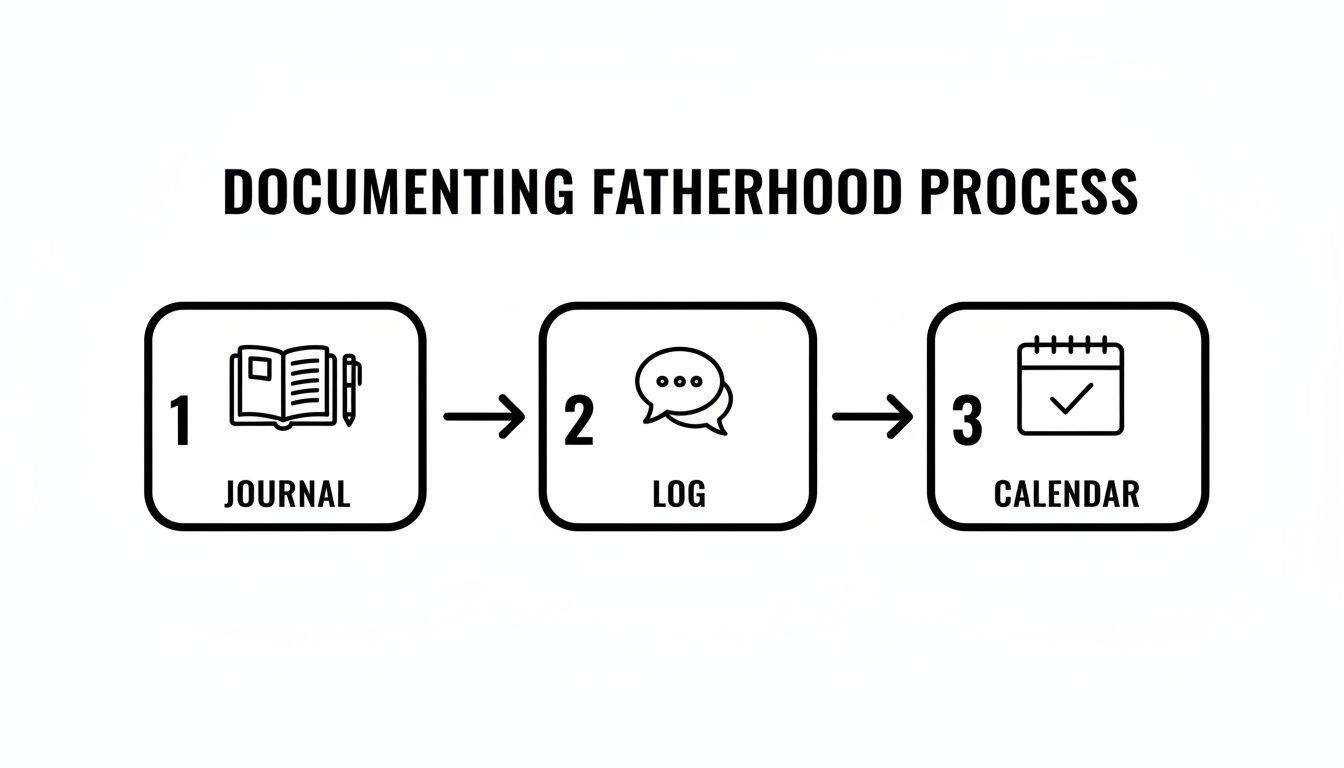
Each piece of documentation provides the court with tangible proof of your stability and commitment.
Key Takeaway: The Texas legal system strongly encourages parents to resolve disputes in mediation, but it has a structured process for a judge to decide when they cannot. Your preparation and the evidence you provide are vital at every stage.
Common Questions About 50/50 Custody for Fathers
As you move through your custody case, specific questions are bound to arise. Understanding the practical realities can help you set realistic expectations and build a stronger strategy. Here are some of the most common questions Texas fathers have when seeking an equal possession schedule.
Does My Income Affect My Chances of Getting 50/50 Custody?
While your ability to provide a stable home is important, your income is not the deciding factor for custody. The court is far more interested in your active involvement and your ability to meet your child’s emotional and physical needs.
Child support is calculated separately under Texas guidelines. In fact, it’s often still ordered in 50/50 arrangements to ensure the child’s needs are met consistently in both homes. The amount may be adjusted to reflect the equal possession time, but support obligations do not automatically disappear.
What if My Child’s Mother Is Against a 50/50 Schedule?
Disagreement is common in custody cases. If you and the other parent cannot agree on a possession schedule, the court will almost certainly order you to attend mediation. This is where a neutral third party helps you both try to find common ground.
If mediation is unsuccessful, a judge will make the final decision based on the “best interest of the child” standard. This is where your attorney’s role becomes critical. Their job is to present compelling evidence that shows why a 50/50 schedule is what’s best for your child, regardless of the other parent’s position.
Can I Get 50/50 Custody of a Very Young Child?
Yes, it is possible, but it often requires a more nuanced approach. For infants and toddlers (generally under three years old), courts place a high value on consistency and routine. This can make obtaining an immediate week-on/week-off schedule more challenging.
A common and effective strategy is to propose a “step-up” possession schedule. This is a plan that gradually increases your parenting time as your child gets older, eventually transitioning to a true 50/50 split. Proving that you are fully capable of handling the specific, hands-on needs of a very young child is absolutely essential here.
If you need help navigating divorce, custody, or estate planning in Texas, contact The Law Office of Bryan Fagan today for a free consultation.