
Facing a child custody battle can be one of life’s most difficult and overwhelming transitions. When you’re searching for a “child custody attorney near me,” you’re not just looking for a lawyer. You are searching for a dedicated advocate who will fight for your child’s future and help you understand your rights under Texas law. Taking this first step is the most important move you can make toward securing your family’s well-being and finding a path forward.
Your First Steps in a Texas Child Custody Case
When everything feels uncertain, focusing on what you can control right now provides a sense of stability. Taking a few practical, deliberate steps at the very beginning will prepare you for the legal journey ahead and empower you to make sound decisions for your family. This process begins with getting organized and understanding the core legal principle that will guide every aspect of your case.
Gather Your Essential Documents
Before your first meeting with an attorney, gathering key paperwork is a crucial first step. Having these documents organized and ready makes your initial consultation incredibly productive, giving your lawyer a clear and immediate picture of your situation. This preparation allows them to start building a tailored strategy from day one.
Start collecting these items now:
- Your child’s birth certificate: This is the primary document for establishing legal parentage.
- Proof of residence: Utility bills or a lease agreement can help confirm that Texas has jurisdiction over your case.
- Communication records: This is extremely important. Save every text message, email, and conversation from co-parenting apps with the other parent. These records create a timeline and provide essential context about your co-parenting relationship.
- Financial information: Your recent pay stubs and tax returns are essential for addressing child support matters that will arise during the case.
Understanding the “Best Interest of the Child” Standard
In Texas, every decision a judge makes—regarding custody, visitation, and parental rights—is governed by one guiding principle: the best interest of the child. This is not a vague concept; it is the legal standard defined in the Texas Family Code § 153.002.
A judge will evaluate numerous factors, including the emotional and physical needs of the child, each parent’s ability to provide a stable and nurturing home, and any history of conflict or danger. If a child is 12 years or older, the court will also consider their expressed wishes. Your entire case must be built around demonstrating how your proposed plan best serves your child’s physical, mental, and emotional well-being.
Do You Need an Attorney or is Mediation an Option?
Many parents hope to resolve their differences through mediation and avoid a contentious court battle. Mediation can be a highly effective tool when both parents are willing to communicate respectfully and find a mutually agreeable solution.
However, you absolutely need a lawyer in your corner if your situation involves:
- A history of domestic violence, substance abuse, or neglect.
- Serious concerns about your child’s immediate safety and well-being.
- A high-conflict relationship or a complete breakdown in communication.
- Complex financial matters, such as a family business, or plans to relocate out of state.
An experienced child custody attorney will not rush you into litigation. They will carefully assess your unique circumstances and advise you on the most strategic path forward, whether that involves negotiation, mediation, or preparing for trial.
If you need help navigating divorce, custody, or estate planning in Texas, contact The Law Office of Bryan Fagan today for a free consultation.
How to Vet and Shortlist Local Custody Lawyers
Choosing the right legal advocate for your child is one of the most critical decisions you will make. This process requires more than a quick online search; it involves carefully vetting potential attorneys to ensure your family’s future is in capable and compassionate hands. A little homework now will help you build a solid shortlist of qualified candidates who understand what you are going through.
An excellent and non-negotiable starting point is to verify an attorney’s credentials. The State Bar of Texas website is an invaluable resource where you can confirm that a lawyer is in good standing and check for any disciplinary history. This simple step provides a baseline for professionalism. From there, explore client reviews on independent platforms like Avvo and Google. Reading about other parents’ real-world experiences can offer insights into a firm’s approach that you cannot find anywhere else.
Creating Your Preliminary List
As you begin your research, your goal is to identify three to five attorneys who appear to be a strong fit. Look for lawyers who specialize in Texas family law. While a general practice attorney may handle a custody case occasionally, a dedicated family law attorney is immersed in the Texas Family Code every day. That depth of knowledge can make a significant difference in the outcome of your case.
Consider these factors as you build your list:
- Local Experience: How many years has the attorney been practicing family law specifically in your county? Local expertise is invaluable—they will be familiar with the local judges, opposing counsel, and courthouse procedures.
- Firm Resources: Is it a solo practitioner or a firm with a support team of paralegals and other attorneys? A robust support team ensures your case receives the attention it deserves, especially during critical moments.
- Communication Style: Review their blog posts or videos. Do they sound empathetic and focused on educating their clients, or does their tone feel overly aggressive? You need to find someone whose approach aligns with your needs and values.
This infographic summarizes the essential groundwork you should lay before making any calls.
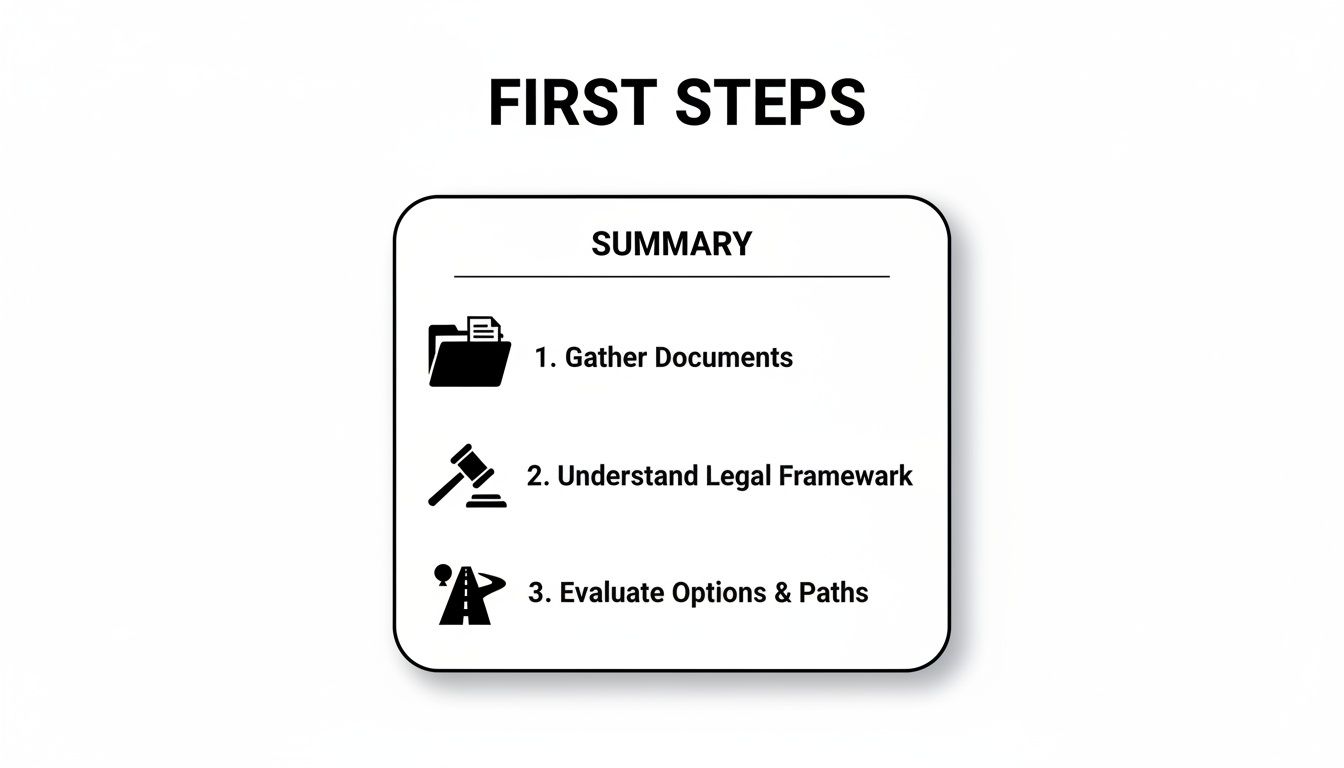
It serves as a great reminder that a successful search begins with organized preparation and a clear understanding of your goals.
Digging Deeper with a Vetting Checklist
Once you have your shortlist, it is time to be methodical. Creating a simple checklist helps you compare each candidate objectively, ensuring you don’t overlook crucial details. Remember, you are not just finding a qualified lawyer; you are finding the right partner for your specific situation.
Use this checklist to compare potential attorneys and make an informed decision for your family.
| Criteria | What to Look For | Red Flags to Watch Out For |
|---|---|---|
| Specialization | A primary focus on family law, specifically child custody cases in your county. | A "jack-of-all-trades" practice handling everything from DUIs to personal injury. |
| Communication | Clear, prompt, and empathetic responses. They explain complex legal concepts in plain English. | Vague answers, long delays in returning calls, or making you feel rushed. |
| Strategy & Approach | Asks detailed questions about your family's situation before suggesting a strategy. | Promises a specific outcome or pushes an overly aggressive strategy from the start. |
| Fee Structure | Transparent and easy-to-understand billing practices (retainer, hourly rates, etc.). | Reluctance to discuss costs or provides a confusing fee agreement. |
| Client Reviews | Consistent positive feedback mentioning communication, expertise, and compassion. | A pattern of complaints about poor communication, billing issues, or lack of attention. |
This table provides a solid framework, but it is equally important to trust your instincts during your consultations.
A key part of this process is understanding that the best attorney for someone else may not be the best one for you. Your goal is to find someone whose legal strategy, communication philosophy, and courtroom demeanor align with the unique dynamics of your family.
To help you get started, our team has created a detailed resource on how to choose the best attorney for your Texas divorce or custody case. This guide offers further insight to help you make this critical decision with confidence. With your research complete and your shortlist ready, you are prepared to schedule your initial consultations.
Making the Most of Your Initial Consultation
Your first meeting with a potential lawyer is far more than a simple meet-and-greet. Consider it an interview—you are vetting an advocate who will fight for your family. This is your opportunity to determine if a "child custody attorney near me" possesses the right blend of experience, strategic thinking, and genuine empathy to handle your case effectively.
When you arrive prepared, you can transform an anxious meeting into a powerful first step. You will leave with clarity, a sense of control, and a plan of action.

To make the consultation as productive as possible, you should provide the attorney with a clear snapshot of your situation. The more context you offer, the more specific and strategic their initial advice will be.
What to Bring to Your First Meeting
Treat this meeting as if you are building your case file from day one. Bringing organized documents allows the attorney to spend less time on basic fact-finding and more time delving into the unique legal issues you face.
Try to gather these items:
- Existing Court Orders: If you have any temporary orders, a final divorce decree, or a previous custody agreement, bring a copy. These documents are the legal starting point.
- A Brief Timeline of Events: Jot down a simple, chronological list of major events. Include the date of separation, any significant conflicts, or incidents relevant to your child's well-being. This helps the attorney quickly understand the history of your case.
- Key Financial Records: Recent pay stubs for both you and the other parent (if available) and your most recent tax return are crucial for discussions about child support.
With over one-quarter (26.5%) of U.S. children living in a single-parent household, the need for skilled legal guidance has never been greater. These are not just local issues; they are part of a national landscape involving millions of families navigating divorce and support.
Asking the Right Questions to Find the Right Fit
While discussing fees is necessary, the most insightful questions go deeper into an attorney's approach and philosophy. Your goal is to understand not just what they do, but how they do it. Their answers will reveal their thought process and whether their style is a good match for your needs.
The right attorney does more than just file paperwork. They listen, strategize, and provide a steady hand during one of life’s most difficult periods. Your comfort level and confidence in their approach are just as important as their legal credentials.
Here are a few powerful questions to begin the conversation:
- "Based on what I've shared, what is your initial strategic approach for a case like mine?" This question prompts them to move beyond generic advice and apply their expertise directly to your situation.
- "How do you handle communication with clients during high-stress periods?" Their answer reveals their firm's commitment to client service and accessibility.
- "What are the potential roadblocks you foresee in my case?" An experienced attorney can often identify challenges early on, demonstrating that they are already thinking several steps ahead.
- "Who will be my primary point of contact, and who else will be working on my file?" This clarifies whether you will be working directly with the attorney you are meeting with or with a broader team.
Our firm has assembled a helpful guide that provides more detail on what to expect during your initial consultation, offering additional tools to help you prepare. By arriving organized and armed with the right questions, you empower yourself to make a confident, informed decision for your family's future.
Understanding Legal Fees and Retainer Agreements
Let's address one of the biggest sources of stress in any custody case: the cost. It is a completely normal and valid concern. You are already navigating an emotional situation, and the last thing you need is a financial surprise. Understanding how legal fees work from the very beginning is key to feeling in control and budgeting for the road ahead.
Most family law attorneys work on an hourly rate. This means you pay for the time your attorney and their team spend working on your case, which includes everything from phone calls and drafting documents to representing you in court. An attorney’s rate will vary based on their experience and the complexity of your case.
Decoding the Retainer
To begin representation, you will almost always pay a retainer. It is easy to misunderstand what this is. A retainer is not a flat fee for your entire case. Instead, think of it as a down payment or a deposit that your attorney holds in a special trust account for you.
As your legal team works on your case, they will bill their time against that retainer. When the funds in the retainer are depleted, you will be asked to replenish it so that work can continue without interruption.
The retainer agreement is the formal contract that outlines the entire financial relationship between you and your attorney. It is one of the most important documents you will sign, as it details the scope of work, billing practices, and your rights as a client.
The initial retainer amount is tailored to your specific situation. For example, a simple, agreed-upon modification of a possession schedule will require a much smaller retainer than a high-conflict custody battle involving relocation and serious allegations. The second case will demand significantly more legal work—such as depositions, extensive discovery, and possibly a multi-day trial—and the retainer will reflect that from the outset.
What to Look For in Your Agreement
Your retainer agreement is a legally binding contract. Before you sign it, you must read every word and ensure you understand it completely. A clear, comprehensive agreement is the hallmark of a trustworthy law firm.
Here are the key elements that should be clearly spelled out:
- Scope of Services: The agreement must state exactly what legal work is covered. Does it only include negotiations, or does it cover representation through a final trial?
- Hourly Rates: It must list the specific hourly billing rates for everyone who may work on your case—the lead attorney, associate attorneys, and paralegals.
- Billing Increments: Most firms bill in small increments of time, such as six-minute intervals (0.1 of an hour). The agreement should specify this.
- Additional Costs: The contract should explain how other expenses, such as court filing fees, expert witness fees, or mediation costs, will be handled.
- Replenishment Policy: Look for the section that explains exactly when and how you will need to add funds to your retainer if the initial amount is used.
Understanding these financial details is not just about money; it is about building trust and transparency with your legal team. For a more detailed breakdown, you can learn more about how much a custody lawyer costs in Texas in our article. With this knowledge, you can focus your energy where it belongs: on securing the best possible future for your child.
Handling the Tougher Custody Battles in Texas
Not every child custody case is straightforward. Some are complicated by complex issues that require an attorney with more than a basic understanding of family law. When you search for a "child custody attorney near me," it is critical to find someone with proven, on-the-ground experience handling these challenging scenarios.

These complex cases demand a lawyer who knows how to protect your rights when the stakes are incredibly high. The right legal strategy can be the difference between a secure future for your child and an outcome you will regret for years to come.
Special Considerations for Military Families
Custody cases involving military families present a unique set of challenges. Deployments, relocations, and a permanent change of station (PCS) can disrupt an already stressful situation.
Federal laws like the Servicemembers Civil Relief Act (SCRA) offer important protections, such as the ability to pause legal proceedings during deployment. However, Texas law ultimately dictates the final custody orders. An attorney experienced in military custody cases knows how to navigate both state and federal rules to protect your parental rights, whether you are stationed in Texas or serving overseas.
High-Net-Worth and Business Ownership Cases
When significant assets, investments, or a family business are involved, custody disputes can become entangled with financial arguments. It is not uncommon for a business valuation to become a major point of contention in child support calculations. Sometimes, a parent’s demanding work schedule is used as a weapon to argue against them having primary custody.
A skilled attorney understands how these issues intersect. They often collaborate with forensic accountants and other financial experts to ensure financial matters are handled correctly, all while keeping the primary focus on the child's best interests, as required by the Texas Family Code.
Interstate Custody Disputes and the UCCJEA
What happens when you live in Texas, but your child’s other parent lives in another state? These situations are a legal minefield governed by the Uniform Child Custody Jurisdiction and Enforcement Act (UCCJEA). This complex law determines which state has the authority—or jurisdiction—to issue and enforce custody orders.
Your lawyer must correctly establish your child's "home state" from the very beginning. A single misstep here could cause your case to be dismissed, forcing you to start over and costing you precious time and money. Experience with the UCCJEA is not just a benefit; it is essential.
Cases Involving Serious Allegations
When accusations of substance abuse, domestic violence, or child neglect arise, the court's sole priority is to protect the child. These cases often move quickly and require a lawyer who can take decisive action. This may involve gathering evidence, filing for temporary restraining orders, or arguing for supervised visitation to ensure your child's safety.
In these high-stakes situations, the court's sole focus is protecting the child from physical or emotional harm. Your attorney’s role is to present clear, compelling evidence that demonstrates why your proposed custody arrangement provides the safest and most stable environment for your child.
It is a sobering fact that there are approximately 13 million custodial parents in the United States responsible for their children's daily care. While many cases are settled amicably, a significant number involve complex issues that demand specialized legal assistance. You can discover more insights about these child custody statistics and trends.
Navigating these challenges requires a legal team with the depth of experience to handle any complication that may arise.
If you need help navigating divorce, custody, or estate planning in Texas, contact The Law Office of Bryan Fagan today for a free consultation.
Common Questions We Hear From Texas Parents
When you are searching for the right child custody attorney, it is natural to have many questions. Getting clear, straightforward answers is the first step toward feeling in control and prepared for the journey ahead. Here are some of the most common concerns we hear from parents just like you.
How Soon Should I Hire an Attorney for a Custody Issue?
It is wise to speak with an attorney as soon as you anticipate a custody dispute. Early legal guidance helps you understand your rights under the Texas Family Code and, equally important, helps you avoid common mistakes that could harm your case later.
Even if you hope to resolve matters amicably with the other parent, an initial consultation can provide you with a strategic roadmap. If you are facing an urgent issue—such as concerns for your child's immediate safety or threats from the other parent to relocate with them—seeking legal advice is not just a good idea, it is absolutely critical.
What Is the Difference Between a Standard Possession Order and a Custom Schedule?
The Standard Possession Order (SPO) is the default visitation schedule outlined in the Texas Family Code. It is designed for parents who live within 100 miles of each other and specifies weekends, holidays, and summer possession periods. It is considered a "one-size-fits-most" solution.
However, the SPO does not work for every family. A custom possession schedule can be drafted to accommodate unique circumstances. For example, if you are a firefighter with an irregular shift schedule or your child has specialized medical needs, a custom order may be more appropriate. A good attorney can help you determine if the SPO is suitable or advocate for a custom order that truly serves your child's best interests.
Your family is unique, and your possession order should reflect that. While the SPO provides a solid framework, the ultimate goal is to create a stable, predictable routine that supports your child’s well-being.
Can I Get a Free Consultation to Discuss My Case?
Yes, absolutely. Many reputable family law firms, including The Law Office of Bryan Fagan, offer a free initial consultation. This is a no-risk opportunity to share your story, receive preliminary legal insights, and determine if an attorney is the right fit for you—all without any financial commitment.
We encourage parents to use this time to ask important questions about strategy, communication styles, and potential costs. The goal is to leave the meeting with a clear understanding of your options.
What Happens if My Child's Other Parent Lives in Another State?
When parents reside in different states, custody cases become more complex. These situations are governed by a federal law known as the Uniform Child Custody Jurisdiction and Enforcement Act (UCCJEA). This act establishes the rules for determining which state has the legal authority—or "jurisdiction"—to issue and enforce custody orders.
Typically, jurisdiction belongs to the child's "home state," which is defined as the state where the child has lived for the six consecutive months immediately before the case is filed. Navigating the UCCJEA is intricate and not something you should attempt alone. You will need an attorney with specific experience in interstate custody disputes to ensure your case is filed in the correct jurisdiction and your rights are protected, no matter where the other parent lives.
If you need help navigating divorce, custody, or estate planning in Texas, contact The Law Office of Bryan Fagan, PLLC today for a free consultation.



