
Divorce can be one of life’s most difficult transitions—but understanding your rights under Texas law can make it less overwhelming. When it comes to splitting a 401k in divorce, the rules are clear: retirement assets you and your spouse accumulated during the marriage are generally considered community property. This means they must be divided in a manner that is “just and right.”
This reality places the retirement savings you’ve worked so hard to build at the center of your divorce negotiations. For many, this isn't just about numbers on a page; it's about safeguarding a future you've spent years planning for.
Your 401k and Divorce: The Financial Crossroads
Navigating a divorce is an emotionally and financially taxing experience. The prospect of dividing retirement savings—the very funds meant to secure your future independence and peace of mind—can be one of the most stressful aspects of the entire process.
In Texas, the law distinguishes between assets you owned before your marriage and those you acquired during it. Our goal is to explain what this means for you in clear, simple terms, helping you feel supported and understood as you face these critical decisions.

The stakes are particularly high for couples nearing retirement age, a trend often called "gray divorce." Statistics show that a staggering 36% of U.S. adults going through a divorce are over the age of 50—a time when rebuilding a nest egg from scratch is a monumental challenge. It's no wonder that 56% of people believe a divorce would seriously derail their retirement strategy. This is a valid and common fear we hear from our clients every day. You can explore more data on how divorce impacts retirement plans for older Americans.
Understanding the Basics of Property Division
Facing the division of a 401(k) can feel overwhelming, but the process becomes much more manageable once you understand the key legal principles. Here are the core concepts you need to know:
- Community Property: Under the Texas Family Code § 3.002, almost everything you or your spouse earn or acquire from the date of marriage until the date of divorce is presumed to be community property. This includes contributions made to your 401(k) during the marriage.
- Separate Property: Anything you owned before the marriage, or received during the marriage as a gift or inheritance, is your separate property. The portion of your 401(k) that existed before you were married is yours alone, but the burden is on you to prove it.
- Just and Right Division: Unlike some states with a rigid 50/50 split, Texas courts must divide community property in a way that is "just and right" (Texas Family Code § 7.001). While this often results in an equal division, factors like fault in the divorce or disparate earning power can lead to an unequal split.
A Critical Note on QDROs: A Qualified Domestic Relations Order (QDRO) is the only legal instrument that can divide a 401(k) or similar retirement plan without triggering immediate taxes and early withdrawal penalties. Simply stating the division in your divorce decree is not enough—you need this separate, specific court order.
To help you become familiar with the terminology you'll encounter, here’s a quick-reference table.
Key Terms for Dividing Your Texas 401k
| Term | What It Means for Your Finances |
|---|---|
| Participant | The employee who owns the 401(k) account. |
| Alternate Payee | The non-employee spouse who is set to receive a portion of the 401(k). |
| Plan Administrator | The company or individual responsible for managing the 401(k) plan. They review and approve the QDRO. |
| Valuation Date | The specific date used to determine the total value of the 401(k) for division purposes. |
| Segregation | The process where the Alternate Payee's awarded share is separated from the Participant's account. |
This guide will walk you through these Texas-specific rules, the essential role of a QDRO, and the practical steps you can take to protect your financial future. We aim to demystify this process, replacing legal jargon with clear, actionable guidance to help you regain a sense of control during this uncertain time.
How Community Property Law Impacts Your 401k
When you are facing a divorce in Texas, one of the first legal concepts you will encounter is community property. Understanding this principle is essential, as it forms the foundation for how a 401(k) is divided and defines what is subject to division. While the law is designed to be fair, knowing your rights is the only way to protect the retirement funds you have worked so hard to accumulate.
Under the Texas Family Code, any asset acquired by either spouse from the wedding day until the day the divorce is finalized is presumed to be community property. This rule applies directly to your 401(k). It does not matter whose paycheck funded the account or whose name is on the statements. If the funds were contributed and the account grew during the marriage, that portion belongs to the marital estate.
Distinguishing Community from Separate Property
The key to a fair division lies in drawing a clear line between what part of the 401(k) is community property and what part is your separate property.
- Community Property: This includes all contributions to the 401(k) made during the marriage by both you and your employer. It also encompasses all interest, dividends, and market gains that accrued on those marital contributions.
- Separate Property: This is the portion of your 401(k) that you already had before you were married. Critically, it also includes any growth and earnings on that pre-marriage balance.
Example Scenario: Imagine your 401(k) as a layered cake. The bottom layer, representing the value you had before the wedding, is your separate property. Every layer added on top during the marriage—your contributions, the company match, and all investment growth on that new money—is community property, subject to division.
The Challenge of Proving Separate Property
Texas law presumes that all property is community property. The burden of proof falls on the spouse claiming a portion as their separate property, and they must prove it with “clear and convincing evidence.”
This process, known as tracing, requires a meticulous accounting of the plan’s value on your wedding day and tracking how that specific portion grew, separate from all community funds added later.
For instance, let’s say your 401(k) was worth $50,000 on your wedding day. Ten years later, at the time of divorce, the account is worth $300,000. To protect your separate property, you cannot simply claim the first $50,000. You will need to provide old account statements and likely work with a financial expert to trace how that initial $50,000 grew on its own over the decade. This detailed work is essential for protecting your pre-marital assets.
Of course, a divorce involves looking at the full financial picture, including all assets and debts. It’s wise to understand how legal tools work, like knowing whether a prenuptial agreement can a prenup protect you from a spouse’s debt in your specific situation.
A “Just and Right” Division in Texas
Unlike some states that default to a rigid 50/50 split, Texas courts are required to divide the community estate in a way that is “just and right.” While this frequently ends up being an equal division, judges have the authority to award a larger share to one spouse. They might do this based on factors like fault in the breakup, significant differences in earning power, or one spouse’s health needs.
A firm grasp of community versus separate property is your first and most powerful tool in this process. Having the right documents and the right legal advice can make all the difference in walking away with a settlement that truly protects your financial future.
The QDRO: A Non-Negotiable Step for Dividing a 401(k)
While your Final Decree of Divorce is a powerful legal document, it has one significant limitation: it cannot, by itself, instruct a 401(k) plan administrator to divide an account.
There is only one legally recognized method to accomplish this without incurring a substantial, and entirely avoidable, financial penalty: a Qualified Domestic Relations Order (QDRO).
A QDRO is a special set of instructions. It is a separate court order, distinct from your divorce decree, that is sent directly to the company managing the retirement plan. It tells the plan administrator exactly how to divide the asset between the employee spouse (the “Participant”) and the non-employee spouse (the “Alternate Payee”). This document is not a mere formality; it is an absolutely non-negotiable step in protecting your retirement assets.
Why You Cannot Skip the QDRO
Attempting to divide a 401(k) without a QDRO is a recipe for financial disaster. If you were to simply withdraw funds from your 401(k) to give to your ex-spouse, the IRS would treat it as a standard early distribution.
This misstep could trigger:
- A 10% early withdrawal penalty if you are under the age of 59 ½.
- Income taxes on the entire withdrawn amount, which could easily push you into a higher tax bracket for the year.
A properly drafted and executed QDRO completely bypasses these penalties, allowing the funds to be transferred from one spouse’s name to the other smoothly and legally. For anyone wanting to dive deeper into the mechanics, you can get more valuable details by reading our guide on how qualified plans like 401k plans are divided.
This flowchart helps visualize how a 401(k) transforms from separate to community property, underscoring why a formal legal division is so critical.
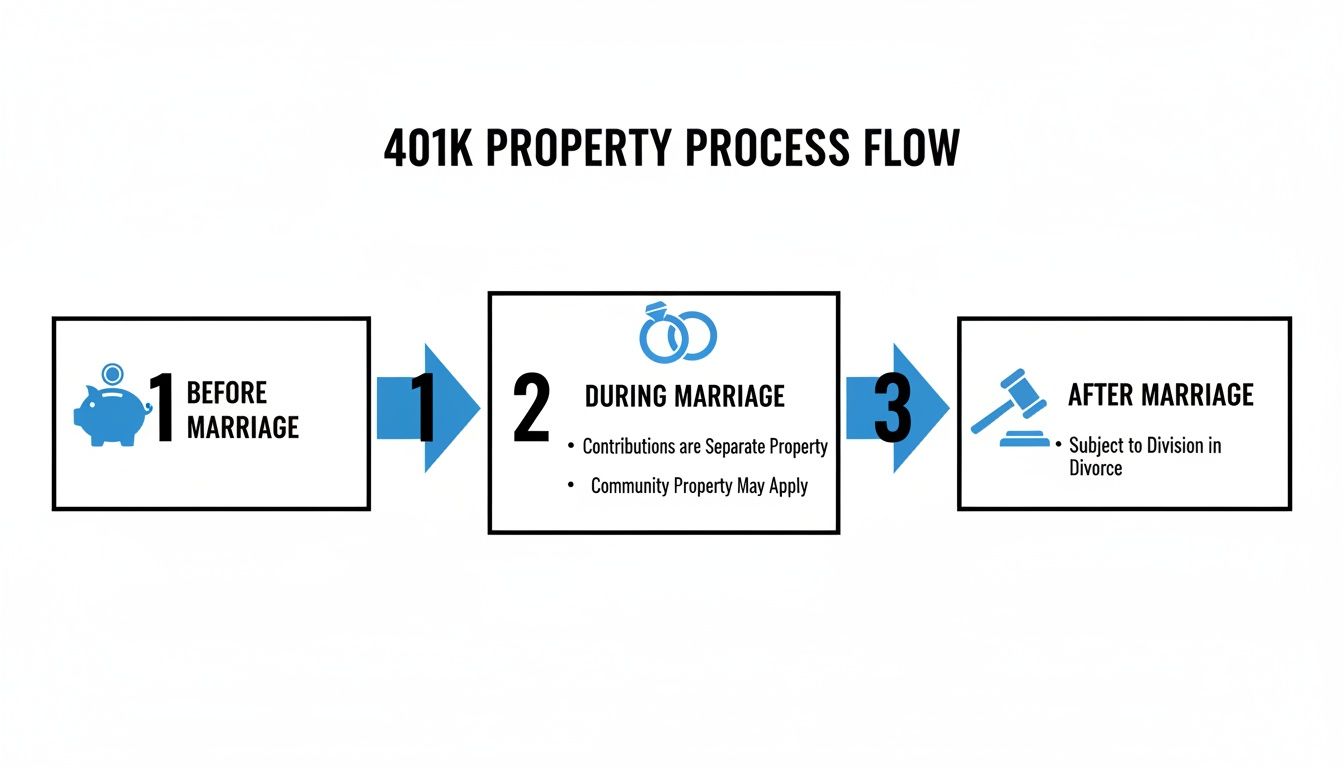
As you can see, funds that begin as separate property before marriage become intertwined with community assets during the marriage. This makes the QDRO process essential for a fair and legal separation of those funds after the divorce is final.
The Two-Step Approval Process
A QDRO is not a simple form you fill out and file. It is a highly technical legal document that must meet the strict requirements of both the court and the specific retirement plan. Getting it right involves a crucial two-step approval process.
First, the QDRO is drafted by an attorney—often one who specializes in this area—and then presented to the judge for signature. Once signed, it becomes an official court order.
Second, the signed order is sent to the 401(k) plan administrator. The administrator’s legal team will meticulously review the document to ensure it complies with both federal law (ERISA) and the plan’s specific rules. If it contains any errors or ambiguous language, it will be rejected, and you will have to restart the process. This is why professional drafting is so critical.
The QDRO serves as the legal and financial bridge between your divorce decree’s instructions and the actual division of your retirement funds. It ensures the process is fair, compliant, and protects both you and your former spouse from unnecessary taxes and penalties, allowing you both to move forward on solid financial footing.
Calculating the Split: How the Numbers Actually Work
Knowing that your 401(k) will be divided is one thing; understanding how the numbers are calculated is another. This is where many people begin to feel anxious, but the math is often more straightforward than you might think. Let’s look at how these calculations work in real-world scenarios, giving you the clarity needed to approach these discussions with confidence.
At the heart of any division is determining the community property portion of the 401(k)—the value built from your wedding day to the day the divorce is final. How we arrive at that number depends on when the account was opened.
Plan Started During the Marriage
This is the simplest scenario. If the 401(k) account was opened after your wedding day, the law presumes the entire account is community property. Every dollar contributed, every employer match, and all investment gains or losses that occurred during the marriage are subject to division.
Example Scenario: You married in 2015 and started a new job with a 401(k) in 2017. When you file for divorce in 2024, the account is worth $200,000. In this case, the entire $200,000 is considered a community asset and is subject to a “just and right” division.
Plan Started Before the Marriage
When the account existed before the marriage, the process is more complex. The pre-marriage portion is your separate property and not subject to division. The task is to precisely identify that separate portion and then calculate the community’s contribution on top of it.
Here’s a practical walk-through:
- Balance on Date of Marriage: You had $50,000 in your 401(k) on your wedding day. This is the starting point for your separate property claim.
- Balance on Date of Divorce: Today, the account is worth $350,000.
- Community Portion: The community property value is the difference between the final balance and what you started with, plus its growth. In this simplified view, that’s $300,000 ($350,000 – $50,000).
In this scenario, the $300,000 is the marital asset to be divided. Proving that initial balance with historical statements is crucial. You can learn more about this process in our guide to dividing retirement benefits upon divorce.
The Impact of Market Volatility: A 401(k) is an investment account with a fluctuating value. The final value used for the divorce is typically determined on a specific date, often the date the divorce is finalized. A sudden market surge or dip right before that day can significantly change the numbers for both spouses.
Addressing Complications Like 401(k) Loans
If a 401(k) loan was taken out during the marriage, it adds another layer to the calculation. Under Texas law, a debt incurred during the marriage is generally a community debt.
Therefore, an outstanding 401(k) loan balance is usually subtracted from the total account value before division. For instance, if an account has a balance of $200,000 but a $20,000 loan, the net value for division becomes $180,000. This ensures both spouses share responsibility for the community debt and divide only the net assets.
Life After the QDRO: Your Next Financial Moves
Once the judge signs the QDRO and the plan administrator gives their final approval, the legal process is complete. However, for the spouse receiving the funds—the “alternate payee”—this moment marks the beginning of a new chapter filled with critical financial decisions.
This is about more than receiving a check; it’s about taking control of your financial future and building a solid foundation for your life post-divorce.

This transition can be especially challenging for those ending long-term marriages, often called a “gray divorce.” The financial impact of splitting after 50 can be severe, potentially halving retirement assets while doubling living costs. When a $1 million 401(k) becomes $500,000 for each spouse under Texas community property rules, the timeline to rebuild is short, making your next steps absolutely crucial.
Your Two Main Choices: What to Do with the Funds
After the plan administrator segregates your awarded portion of the 401(k), you generally have two options. The choice you make will have long-lasting effects on your financial well-being.
Option 1: The Direct Rollover into an IRA (Highly Recommended)
In our experience, the most strategic and financially sound move is to execute a direct rollover of the funds into an Individual Retirement Account (IRA) in your name. This is a tax-free transfer that keeps your money in a retirement-focused account.
The benefits are significant:
- Continued Tax-Deferred Growth: Your money continues to grow without being taxed on the earnings each year.
- No Taxes or Penalties: The transfer is not a taxable event, and you completely avoid the 10% early withdrawal penalty.
- Control Over Your Investments: An IRA provides a wide range of investment choices, allowing you to build a portfolio that aligns with your new financial goals and risk tolerance.
This is the path we almost always recommend. It preserves the retirement savings you secured and positions you for future growth.
Option 2: Cashing Out (Use Extreme Caution)
Your other option is to take the funds as a cash distribution. While the QDRO provides a special exception that allows you to bypass the 10% early withdrawal penalty, this choice comes at a steep price.
The plan administrator is required by federal law to withhold a mandatory 20% for federal income taxes from the distribution. If your share is $100,000, you will only receive a check for $80,000. Furthermore, that 20% might not even cover your total tax liability for the year.
A Critical Housekeeping Task: Update Your Beneficiaries
Divorce effectively makes your previous estate plan obsolete. One of the most urgent—and often overlooked—tasks after a divorce is updating the beneficiary designations on all your financial accounts.
This includes:
- Your remaining 401(k) or the new rollover IRA you just established.
- Life insurance policies.
- Other investment accounts.
If your ex-spouse is still listed as the beneficiary, they could inherit those assets if you pass away, regardless of what your will says. Taking a few minutes to update these forms ensures your assets will go to your intended heirs. To understand how these accounts fit into your broader financial picture post-divorce, take a look at our article covering divorce and your retirement savings.
Don’t Want to Split Your 401(k)? Exploring Your Alternatives
While dividing a 401(k) with a QDRO is a common and effective approach, it is not the only option. Sometimes, the most creative and beneficial solution is to avoid touching the retirement account at all.
Through strategic negotiation, you can structure a settlement that provides a fair division of the community estate while allowing each spouse to keep the assets they value most. This often involves a strategy called an “asset offset,” where one spouse keeps their entire 401(k) in exchange for the other spouse receiving community assets of equal value.
How an Asset Offset Works in Practice
Let’s consider an example. Imagine the community property portion of your 401(k) is valued at $200,000. Instead of splitting it for $100,000 each, you might agree that one spouse will keep the full $200,000 in their retirement account.
To balance the division, the other spouse would receive $200,000 worth of equity from another marital asset, such as the family home. If your house has $400,000 in community equity, the spouse who forgoes their claim to the 401(k) might receive the house and assume the mortgage.
This can be a win-win solution:
- For the spouse with the 401(k): They avoid the QDRO process and keep their retirement strategy intact without the risks associated with liquidating investments.
- For the other spouse: They receive a tangible, immediate asset like the house, providing stability without waiting years to access retirement funds.
Why Negotiation and Valuation Are So Important
A successful asset offset depends on two key factors: accurate valuations and solid negotiation. You must have a precise, agreed-upon value for every asset involved in the trade.
This typically requires hiring professionals for real estate appraisals or business valuations to ensure the trade is truly equitable.
An asset offset allows you to customize the property division to fit your real-life goals. One person might prioritize long-term retirement security, while the other needs liquid assets or the stability of keeping the family home.
This flexibility is a hallmark of a well-negotiated divorce settlement. It moves beyond a rigid 50/50 split and allows you and your spouse to part ways with a financial foundation that works for your individual futures. An experienced attorney can guide you through the valuation process and advocate for a trade-off that protects your interests.
Common Questions About 401k Division in Texas
As you delve into the specifics of dividing a 401(k), practical questions will naturally arise. Drawing on our experience with countless clients, we’ve compiled answers to some of the most common questions we hear.
How Is a 401k Loan Handled in a Divorce?
This is a frequently asked question. If a 401(k) loan was taken out during the marriage, Texas law generally treats it as a community debt.
In practice, this means the outstanding loan balance is subtracted from the total account value before division. For example, if an account is worth $100,000 but has a $10,000 loan against it, the net value for division becomes $90,000. This ensures both spouses share responsibility for a debt that benefited the community.
Can My Spouse Get My 401k if Our Marriage Was Short?
Yes. The length of your marriage does not alter the fundamental community property rule in Texas. From the day of your marriage, any contributions, employer matches, and growth in the 401(k) are considered community assets.
Even in a marriage of just a few years, the portion of the 401(k) that accumulated during that specific period is subject to a “just and right” division. The total dollar amount may be smaller, but the legal principle remains the same as in a long-term marriage.
Is an IRA Divided Differently Than a 401k in Texas?
The core principle is the same: funds accumulated in an IRA or a 401(k) during the marriage are community property. The key difference lies not in what is divided, but how.
The legal instrument used for the division is critically different:
- 401(k) Plans: These accounts are governed by a strict federal law (ERISA) and always require a QDRO to be divided without tax penalties. There are no exceptions.
- IRA Accounts: These are simpler. An IRA does not require a QDRO. The division instructions can be written directly into the Final Decree of Divorce, ordering a trustee-to-trustee transfer.
Understanding this distinction is crucial to avoid unnecessarily paying taxes to the IRS.
How Long Does the QDRO Process Usually Take?
Patience is key, as this process is rarely quick. First, your divorce must be finalized. Only then can the QDRO be drafted, signed by the judge, and sent to the 401(k) plan administrator for approval.
This final step—the plan administrator’s review—is often the most time-consuming. It can take anywhere from a few weeks to several months, depending on their internal procedures and whether they require revisions. A meticulously drafted QDRO is your best strategy for expediting the process.
If you need help navigating divorce, custody, or estate planning in Texas, contact The Law Office of Bryan Fagan today for a free consultation.