
Divorce can leave you lying awake at night, doing mental math you never wanted to do. Can you keep the house. Will your paycheck stretch far enough. If you left work to raise children or support your spouse’s career, will the court require any financial support after the marriage ends.
Those questions are common, and in Texas, the answers are often more limited than people expect. Many clients come in asking how much is alimony in texas, only to learn that Texas law uses a narrower system called spousal maintenance. It exists, but it comes with strict rules about who qualifies, how much a court can order, and how long payments may last.
Facing Divorce and Financial Uncertainty
A familiar situation looks like this. One spouse handled most of the income. The other managed the home, cared for children, or worked in a lower-paying role that fit the family’s needs. Then the divorce begins, and both people realize one household is becoming two.
That financial fear is real. It often gets sharper when there is debt, a mortgage, or uncertainty about future income. Some families also worry about related financial fallout, including how one spouse's bankruptcy might affect the other, because divorce and debt problems often overlap in practical ways.
Texas does offer post-divorce support in limited cases. But unlike some states, Texas courts do not treat alimony as routine. A judge starts from a restrictive legal framework, and the spouse asking for maintenance must prove they meet the law’s requirements.
Key takeaway: In Texas, support after divorce is possible, but it is not automatic. The details matter, and early planning matters even more.
What Texas Law Calls Spousal Maintenance Not Alimony
A spouse may walk into a lawyer’s office asking, “How much alimony do I get in Texas?” That question makes sense. It is the term people hear in movies, from friends, and in news stories. In Texas courts, though, the legal term is spousal maintenance, and using the right label helps you ask the right questions from the start.
For a plain-language overview of the statute, this guide to alimony in Texas and what the law says is a helpful companion resource.
Why the term matters
Under Texas law, spousal maintenance usually means payments a judge orders after divorce, but only if the requesting spouse satisfies specific legal requirements. Lawyers and clients often use “alimony” as a casual umbrella term for any support paid after a marriage ends. That shorthand can cause problems, because it blends together two very different paths: support a court can order under strict statutes, and support spouses may agree to in settlement even when a judge could not have ordered it on the same facts.
That distinction affects strategy.
If you are trying to estimate what support may look like, you need to know whether you are discussing a narrow court remedy or a negotiated agreement with more flexibility. Texas is strict about court-ordered maintenance. Private settlement terms can be broader if both sides agree.
Spousal maintenance is separate from property division
Clients often mix these issues together, especially early in a divorce. The confusion is understandable because both affect monthly financial security.
They do different jobs:
- Property division addresses how the marital estate is divided, including assets and debts.
- Spousal maintenance addresses whether one former spouse should make future payments to help the other meet minimum reasonable needs after the divorce.
A spouse can receive retirement funds, home equity, or cash accounts in the property division and still have no right to court-ordered maintenance. The opposite can also happen. A spouse may receive property on paper but still lack enough usable income to cover rent, groceries, insurance, and other basic expenses. That issue becomes more complicated in high-asset divorces, where wealth may exist in businesses, investments, or illiquid property rather than in straightforward monthly income.
The practical point clients need to know
Texas uses a narrow statutory framework for judge-ordered support. In day-to-day practice, the conversation often turns on two separate questions. First, can you prove eligibility for court-ordered maintenance under the statute? Second, if the statute falls short, is there room to negotiate contractual alimony as part of the settlement?
That second question matters more than many spouses expect.
A court is limited by Texas law. Negotiation is different. Spouses can sometimes agree to payment terms, duration, or structures that better fit the family’s finances, especially where one spouse’s income is hard to pin down or compensation comes from bonuses, distributions, business ownership, or irregular draws. So the word “alimony” may still come up in real conversations, but in Texas practice, you need to separate what a judge may order from what a settlement may accomplish.
Who Qualifies for Spousal Maintenance in Texas
A common divorce scenario goes like this. One spouse handled more of the home life, spent years out of the workforce, and now worries about paying rent and utilities alone. The question is not merely, “Did I earn less?” The primary question is whether Texas law allows a judge to order support at all.
Texas sets a narrow entry gate for court-ordered spousal maintenance. The spouse asking for maintenance must show that, after the divorce, they will not have enough property or income to meet minimum reasonable needs. Courts also start from a presumption that maintenance should not be ordered unless the evidence fits one of the statutory paths.

The common eligibility rule
The path many spouses ask about first is the 10-year marriage rule. In general, a spouse may qualify if the marriage lasted at least 10 years and that spouse cannot meet minimum reasonable needs despite making a good-faith effort to earn enough income or develop job skills.
“Minimum reasonable needs” often causes confusion. It does not mean keeping the same standard of living from the marriage. It works more like a floor than a target. The court is looking at basic living expenses such as housing, food, transportation, insurance, and other necessary monthly costs.
That distinction matters in practice. A spouse may have lived in an expensive home during the marriage and still be limited to proving basic post-divorce need. In a high-asset case, a spouse may also appear “wealthy on paper” because of business interests or investment accounts, while still lacking dependable monthly cash flow.
The main exceptions
Texas law also allows maintenance in several situations where the 10-year rule is not the only path:
- Family violence: A recent conviction or deferred adjudication for family violence against the other spouse or a child of the marriage can support eligibility.
- Spouse’s disability: A physical or mental disability that prevents the spouse from earning sufficient income may justify maintenance.
- Care of a disabled child: A spouse who must provide substantial care for a child of the marriage with a disability may qualify if that caregiving limits the ability to work.
These exceptions reflect a practical reality. Texas courts focus heavily on whether a spouse can realistically become self-supporting, not just whether that spouse wants assistance.
What can block a claim
Eligibility depends on proof, and proof often turns on details clients do not expect.
A claim gets weaker if the spouse seeking maintenance will receive enough usable property in the divorce to cover basic needs. “Usable” is the key word. A retirement account, an interest in a closely held company, or equity tied up in real estate does not always solve a monthly cash shortage, but the court will still study those assets carefully.
Other facts can shape the result. Premarital or marital agreements may limit support rights. Fault issues may also affect the court’s evaluation in some cases. For a closer look at the factors Texas courts consider, see this explanation of what a Texas judge may consider in a spousal maintenance case.
What judges look for in real life
Judges want specifics. General statements such as “I cannot afford to live on my own” usually are not enough.
Helpful evidence often includes:
- Job search records: applications, interview notes, rejection emails, and retraining efforts
- Employment history: past wages, gaps in work, licenses, and current earning ability
- Medical or caregiving proof: records showing disability or the demands of caring for a disabled child
- Monthly budget documents: a realistic list of necessary expenses, not aspirational spending
- Income records from the other spouse: pay stubs, tax returns, business records, bonus history, and distributions when income is not straightforward
That last category can become the hardest part in high-asset divorces. A salaried employee’s income is usually easier to show than the income of a spouse who owns a business, receives irregular draws, or controls cash flow through entities. In those cases, qualification for maintenance may depend as much on tracing real income as on proving need.
A practical step helps. Start gathering records early if maintenance may be an issue. A clear budget, work history, medical records, and evidence of available cash flow can make the difference between a weak request and a credible one.
How Texas Courts Calculate the Maintenance Amount
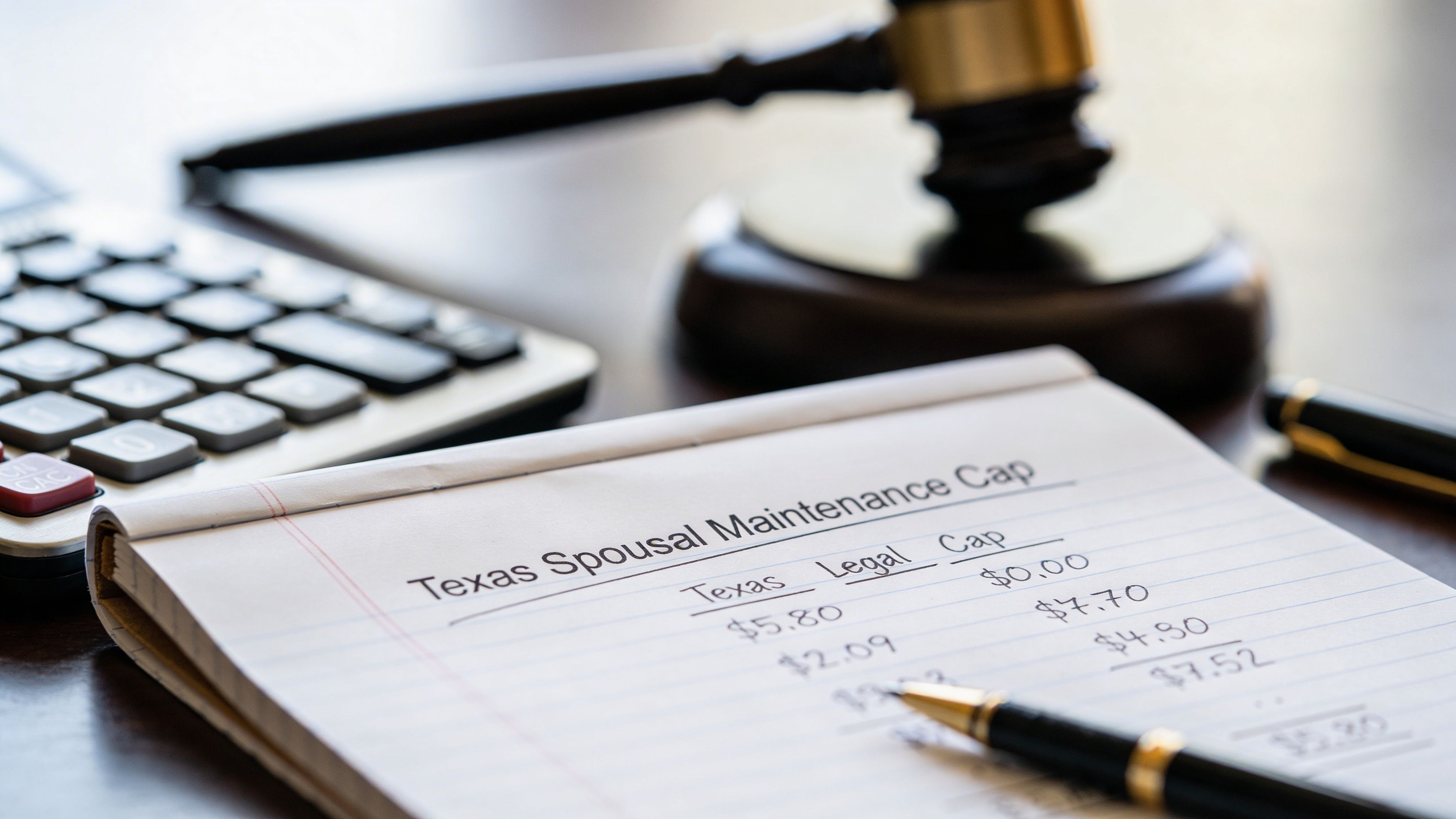
The amount question is where many people focus first. Texas gives a court a hard ceiling. Under Texas Family Code §8.055, court-ordered spousal maintenance is capped at the lesser of $5,000 per month or 20% of the paying spouse’s average monthly gross income, as explained in this breakdown of what disqualifies you from alimony in Texas.
The simple calculation
A judge generally starts by looking at the paying spouse’s average monthly gross income. Then the court calculates 20% of that figure. If that number is above $5,000, the cap is $5,000. If it is below $5,000, the lower number controls.
Here are two examples drawn from the verified rule set:
| Paying spouse income | Monthly gross income | 20% calculation | Maximum court-ordered maintenance |
|---|---|---|---|
| $120,000 annually | $10,000 monthly | $2,000 | $2,000 monthly |
| $400,000 annually | $33,333 monthly | $6,666 | $5,000 monthly cap |
That second example matters in high-asset divorces. Even when a spouse earns substantially more, the court cannot exceed the statutory ceiling for court-ordered maintenance.
The cap is not the automatic award
This is another major point of confusion. The statutory cap is a maximum, not a guaranteed amount.
The court still decides what amount, if any, is appropriate within that limit. Texas judges may consider factors such as education, employment history, earning ability, homemaker contributions, and the time needed for the requesting spouse to become more self-supporting. For a closer look at judicial decision-making, see this discussion of what factors a Texas judge will look at.
A brief video explanation can also help make the cap easier to understand.
Why negotiations often look different from court
In practice, the cap shapes settlement talks. A higher-earning spouse knows what a judge can order. A lower-earning spouse knows the same limit may not fully address real monthly expenses.
That shared reality often pushes both sides toward negotiation. In some cases, support becomes part of a broader package involving the house, retirement assets, business interests, or debt allocation.
Key takeaway: When people ask how much is alimony in texas, the legal answer is often two-part. There is the court’s maximum under the statute, and then there is the practical settlement range shaped by negotiation.
How Long Spousal Maintenance Payments Can Last
Amount is only half the question. Duration matters just as much, especially for someone trying to rebuild income after years out of the workforce.
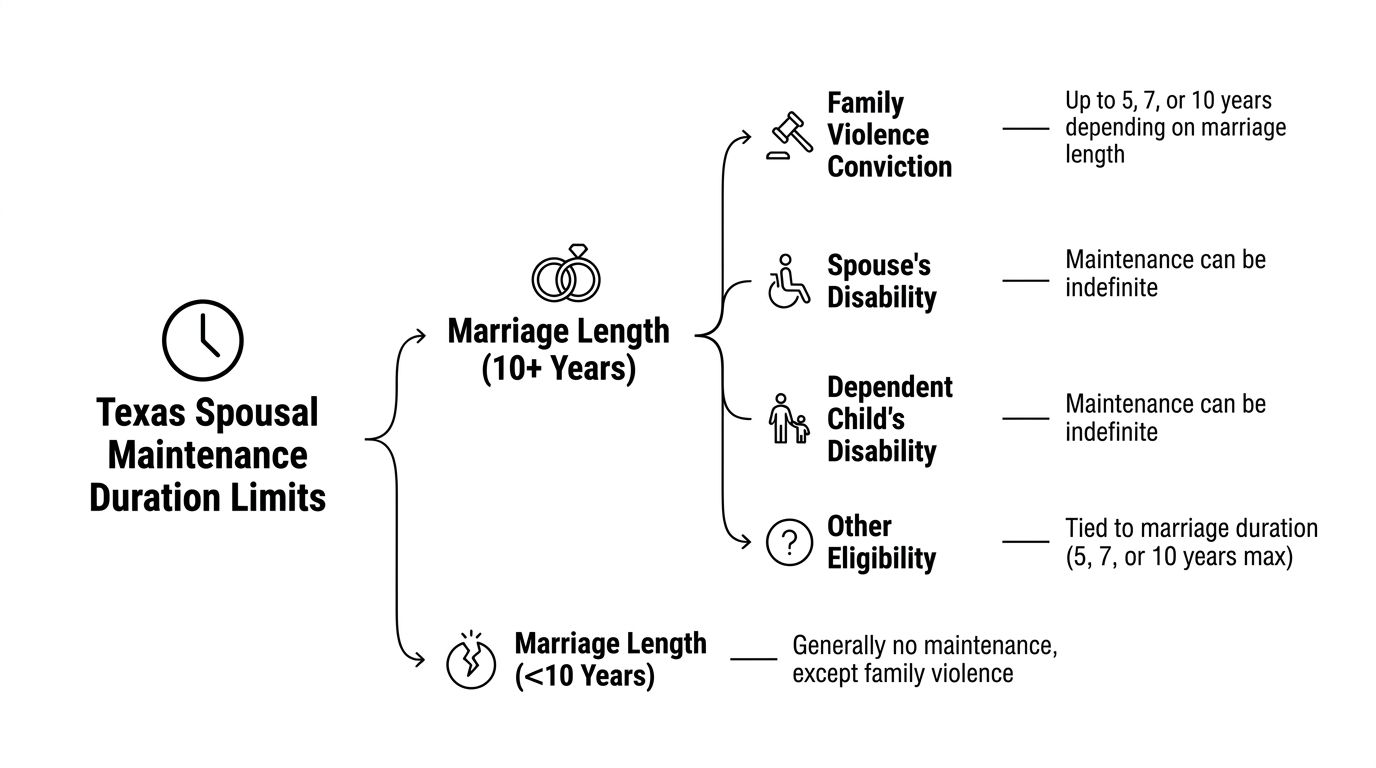
Texas uses a tiered system tied to marriage length. Under the Texas Family Code, marriages of 10 to 20 years can receive support for a maximum of 5 years, marriages of 20 to 30 years for a maximum of 7 years, and marriages of over 30 years for a maximum of 10 years, as summarized in this explanation of alimony qualifications in Texas.
The timeline most courts follow
A short reference chart helps:
| Marriage length or basis | Maximum duration |
|---|---|
| Less than 10 years with qualifying family violence basis | Up to 5 years |
| 10 to 20 years | Up to 5 years |
| 20 to 30 years | Up to 7 years |
| Over 30 years | Up to 10 years |
These are outer limits. A judge may order a shorter period if the evidence shows the requesting spouse can become self-supporting sooner.
Texas views maintenance as temporary help
Texas law treats maintenance as a bridge, not a lifelong entitlement in the ordinary case. The goal is usually rehabilitative support that helps a spouse move toward financial independence.
That means a person seeking maintenance should think carefully about:
- Job training needs: Is additional education or certification needed?
- Re-entry into work: Has the spouse been out of the labor market for years?
- Caregiving obligations: Do children or health issues limit available work hours?
A practical example
Suppose a couple was married long enough to fall into the 10 to 20 year bracket. Even if maintenance is awarded, the maximum duration would be 5 years under the tiered rule above. That does not mean the judge must order the full period.
A court may decide a shorter term is enough if the spouse can return to work more quickly. On the other hand, a more complicated medical or caregiving situation may justify a longer period within the legal limit.
Practical tip: Build a realistic transition plan before court or mediation. Judges respond better when a spouse can show how support will be used for housing, retraining, childcare coordination, or other concrete needs.
Defining Gross Income in Complex Divorce Cases
The phrase gross income sounds simple until the paying spouse owns a business, earns commissions, receives bonuses, or has multiple income streams. In those cases, the maintenance fight often turns into an evidence fight.
Texas Family Code §8.055 defines gross income broadly to include wages, salary, bonuses, self-employment income, and retirement benefits. For business owners, courts may review tax returns closely and may impute income based on earning capacity if income appears underreported. The source material also notes that this issue is a point of contention in 30-40% of contested maintenance cases, according to this discussion of how alimony is calculated in Texas.
Income is not limited to a paycheck
A W-2 salary may only tell part of the story. In more complex divorces, the court may need to evaluate income from:
- Business operations
- Bonuses or commissions
- Investment-related payments
- Retirement or pension distributions
- Other recurring compensation
That is why a pay stub alone may not answer the maintenance question.
Why self-employed cases are harder
Business owners often have legitimate deductions, fluctuating revenue, and irregular compensation. They may also receive value through benefits or business-paid expenses that do not look like ordinary salary at first glance.
A spouse who suspects income is understated usually needs more than suspicion. They need documents. Tax returns, bank statements, profit-and-loss records, and business ledgers can all matter. In some cases, lawyers also work with financial professionals, including CPAs, to organize and interpret the records in a way the court can understand.
A careful, practical approach works best
A careful, practical approach works best. Preparation can change the outcome.
If you are the spouse seeking support, gather financial records early and look for consistency between reported income and actual lifestyle. If you are the spouse paying support, keep clean records and be ready to explain variable earnings clearly.
One practical tool some Texas families use early in the process is the Law Office of Bryan Fagan, PLLC Alimony Support Calculator, which provides an estimate based on user inputs. It is not a substitute for a legal analysis, especially in a business-owner case, but it can help frame the discussion before formal financial discovery begins.
Contractual Alimony The Alternative to Court-Ordered Support
Court-ordered maintenance is only part of the Texas picture. Many divorcing spouses resolve support by agreement instead of asking a judge to impose it under Chapter 8.
That agreement is often called contractual alimony. It is private, negotiated support that becomes part of the divorce settlement. This article on contractual alimony as a form of spousal support explains the concept in more detail.

Why negotiated support can be more useful
A judge is bound by the statutory limits for court-ordered maintenance. Spouses negotiating a private agreement have more flexibility.
That flexibility can help when:
- one spouse wants certainty instead of litigation
- one spouse needs support terms that better fit their household budget
- the overall settlement includes tradeoffs involving property, debts, or a family business
What parties can negotiate
A well-drafted agreement may address more than just a monthly payment. It can also define timing, duration, security for payment, and what events will end the obligation.
That level of customization often matters in higher-asset cases. A spouse may accept a different property division in exchange for a stronger support arrangement. Or the paying spouse may prefer a structured agreement that resolves uncertainty and avoids a court fight.
Mediation often drives the best result
Many Texas divorces settle in mediation because mediation gives both sides control that a courtroom does not. Court rulings are limited by statute. Agreements are shaped by the parties’ actual goals.
For some families, contractual alimony is the only realistic way to create support that matches the household transition they are living through.
Key takeaway: If court-ordered maintenance feels too narrow for your situation, negotiated support may offer a more practical path.
Spousal Maintenance vs Child Support Key Differences
People often blend these two obligations together, especially when both may be discussed in the same divorce. Legally, they are very different.
Under Texas law, court-ordered spousal maintenance is capped at the lesser of $5,000 or 20% of the paying spouse's average monthly gross income, while child support is calculated using a different framework based on the obligor’s net monthly resources and the number of children, without that same fixed dollar cap, as explained in this overview of how alimony is determined in Texas.
A side-by-side view
| Issue | Spousal maintenance | Child support |
|---|---|---|
| Who it supports | A former spouse | A child |
| Primary purpose | Help with post-divorce basic needs | Support the child’s care and well-being |
| How it is calculated | Subject to the statutory maintenance cap | Based on a separate child support formula |
| How courts view it | Limited and harder to obtain | A core parental obligation |
Why the distinction matters
A spouse may owe child support and still dispute spousal maintenance. A spouse may receive child support and still not qualify for maintenance. They serve different legal purposes.
That distinction matters in negotiation too. When families build a settlement, they should not assume one payment can stand in for the other. The law treats them separately, and courts do too.
If you need help navigating divorce, custody, or estate planning in Texas, contact Law Office of Bryan Fagan, PLLC today for a free consultation. A careful review of your marriage length, income picture, property division, and settlement options can help you move from fear and uncertainty toward a clear plan.