
A living trust in Texas is a private legal arrangement that holds your assets for you while you’re alive and passes them to your loved ones without court-supervised probate after you die. In many estates, that matters because Texas probate can cost 4% to 8% of the estate’s value when it applies.
If you’re starting to think about what would happen to your home, bank accounts, business interests, or family finances if something happened to you, you’re not alone. Many people begin asking what is a living trust in texas after a life change such as marriage, remarriage, retirement, a new child, a divorce concern, or the understanding that they don’t want their family dealing with court paperwork during a hard time.
A trust isn’t just for the ultra-wealthy. For many Texas families, it’s a practical planning tool that can bring privacy, continuity, and clearer instructions. It can also be especially helpful where estate planning and family law overlap, such as blended families, separate property concerns, and community property questions.
Planning for Your Family’s Future with a Living Trust
Many individuals don’t delay estate planning because they don’t care. They delay it because the topic feels heavy. Thinking about illness, incapacity, or death is uncomfortable. But planning ahead is one of the clearest ways to protect the people you love.
A living trust helps turn vague worries into a workable plan. You place selected assets into the trust, keep control during your lifetime in most revocable trust arrangements, and leave instructions for what happens later. Instead of leaving your family to sort everything out in court, you create a private system for managing and passing on property.
A simple way to think about it
Think of a living trust like a personal treasure chest with written instructions attached. You choose what goes into the chest, who manages it, and who receives it later. While you’re alive, you can usually keep the key if the trust is revocable.
That image helps because many readers assume a trust means “giving everything away now.” Usually, that isn’t how a revocable living trust works. In most Texas plans, you still use your accounts, live in your home, and remain in charge of your finances.
A well-drafted trust isn’t about losing control. It’s about organizing control before your family needs it most.
Why Texans often consider one
Families often want three things from estate planning:
- Privacy: They don’t want family finances aired in a public court file.
- Smoother transitions: They want someone they trust to step in if they become incapacitated.
- Clarity for loved ones: They want fewer disputes and less confusion.
Those goals become even more important in Texas because property ownership can be more complicated for married couples. Community property rules, separate property claims, and second-marriage planning can all shape whether a trust makes sense and how it should be drafted.
What Exactly Is a Living Trust in Texas
A living trust is a trust created during your lifetime under Texas trust law. Texas Property Code Chapter 112 governs trust creation, and the practical effect is straightforward. You create the trust document, transfer assets into it, and set rules for how those assets will be managed and distributed.

The three main roles
Every trust has a few key players:
- Grantor: The person who creates the trust and transfers assets into it.
- Trustee: The person who manages the trust property.
- Beneficiary: The person who benefits from the trust property now or later.
In many Texas living trusts, the same person starts out as both the grantor and the initial trustee. That means you create the trust and keep managing the assets yourself while you’re alive and capable. You also name a successor trustee to step in later if needed.
What makes the trust legally useful
The part that confuses many people is ownership. A trust works because the assets are transferred into the trust’s name during your lifetime. That change in title is what allows the trust to function as a probate-avoidance tool.
For a living trust to be effective in Texas, it must be properly funded, meaning assets are retitled into the trust's name. The legal document alone is insufficient without the operational step of asset retitling. This is why many DIY trusts fail to avoid probate, as explained in this Texas overview of revocable living trust funding.
What “funding” actually means
Funding doesn’t mean adding cash only. It means changing ownership records so the trust, not you individually, owns the asset where appropriate.
Examples often include:
Real estate
A new deed may transfer the property into the trust.Bank or brokerage accounts
The financial institution may retitle the account to the trust.Personal property
Certain items may be assigned through a trust schedule or related transfer document.
This is also why a trust is different from relying only on beneficiary forms or joint ownership. Those tools can help in the right setting, but they don’t replace a coordinated plan. If you want a broader look at assets that pass outside probate, this discussion of non-probate transfers in Texas is useful context.
Practical rule: If the asset was never moved into the trust, the trust may not control it when your family needs it to.
Why privacy matters
A will generally has to be filed in probate court. A trust usually doesn’t. Texas Property Code § 114.086 allows use of a certification of trust that can confirm basic trust authority without exposing the full trust document. For families who value discretion, that’s a major advantage.
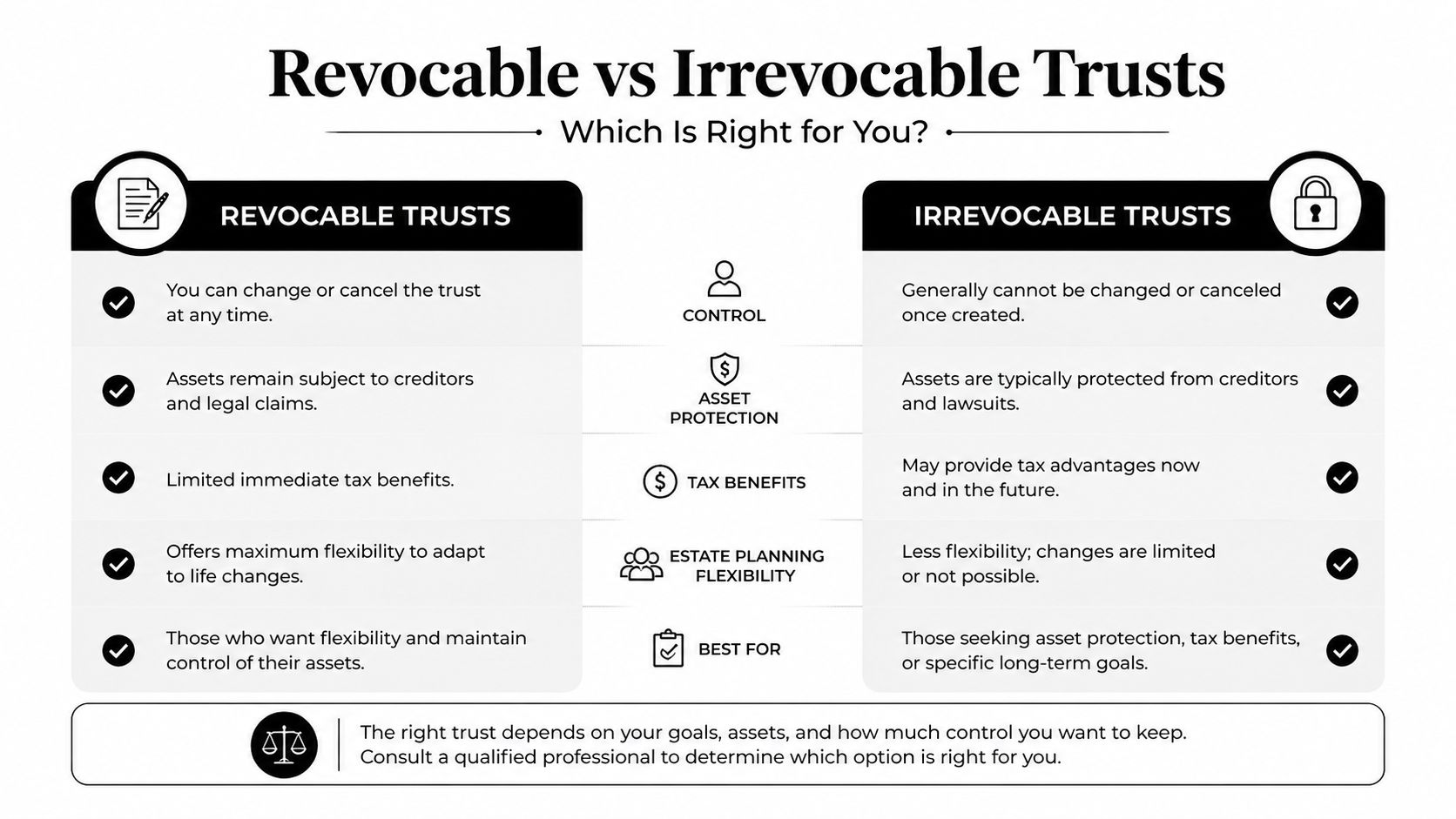
Revocable vs Irrevocable Trusts Which Is Right for You
A common Texas planning meeting starts this way: a couple wants to keep things simple, avoid court involvement where possible, and make sure children from a first marriage and a current marriage are both protected. Then the next question comes up quickly. Should the trust stay flexible, or should it lock in stronger protection?
That is the difference between a revocable trust and an irrevocable trust. One is built for control and change. The other is built for separation and long-term protection.
Start with the question you are trying to answer
A revocable living trust usually fits families who want to keep control of their property during life, update terms as life changes, and create a smoother handoff at death or incapacity. You can usually amend it, add property, remove property, or cancel it altogether.
An irrevocable trust usually asks more from you at the beginning. Once created and funded, it is much harder to change. That loss of flexibility is the trade. In return, some families use irrevocable trusts for stronger creditor planning, tax planning, or to place boundaries around how and when beneficiaries receive assets.
A simple comparison helps. A revocable trust works like a set of instructions you can keep editing. An irrevocable trust is closer to pouring concrete. You create structure first, and later changes are limited.
Revocable vs. Irrevocable Trusts in Texas at a Glance
| Feature | Revocable Living Trust | Irrevocable Trust |
|---|---|---|
| Control during your lifetime | You usually keep control | You usually give up substantial control |
| Ability to change terms | Usually yes | Usually very limited |
| Probate avoidance | Yes, if properly funded | Can also avoid probate if structured and funded properly |
| Privacy | Generally private | Generally private |
| Creditor protection | Generally no | Can be used for stronger protection planning |
| Tax planning role | Generally limited | Often considered in advanced tax planning |
| Best fit | Families who want flexibility and smoother administration | Families with more complex protection or tax concerns |
Why many Texas families start with revocable trusts
For many households, the revocable trust is the practical first choice. It lets you stay in charge while you are alive and competent. If you become incapacitated, a successor trustee can step in under the document you already signed. If family relationships shift because of remarriage, adoption, estrangement, or divorce, the trust can often be revised to reflect that new reality.
That flexibility matters even more in Texas because family law issues and estate planning issues often overlap. Community property, separate property claims, reimbursement claims between spouses, and children from different relationships can all change how a plan should be written. A revocable trust gives you room to respond while your life is still changing.
It also works well for people who are still deciding whether they even need a will-based probate plan. If you are weighing those options, this guide on whether you have to probate a will in Texas helps explain when probate becomes part of the picture.
When an irrevocable trust deserves a serious discussion
An irrevocable trust is usually not the first tool used for an average estate. It becomes more relevant when the goal is more specific.
Examples include a parent who wants to leave money to a child without handing over a lump sum at age 18, a business owner concerned about future liability, or a family trying to protect assets for children from a prior marriage while also providing for a current spouse. In blended family planning, an irrevocable structure can sometimes reduce later disputes because the rules are set in advance and are harder to rewrite under pressure.
That said, harder to change also means easier to regret if the trust was poorly designed. The document has to match the family situation, the property involved, and the long-term goal.
One mistake people make
People often hear the word “trust” and assume all trusts protect assets from creditors or divorce claims. They do not.
If you create a revocable trust and continue treating the property as your own, you usually have not created the kind of legal separation that asset protection planning requires. In many cases, you are still the one effectively holding the reins. An irrevocable trust may create more separation, but only if it is drafted and funded correctly.
This point matters in Texas divorces and second marriages. If separate property and community property have been mixed together, a trust does not automatically fix that problem. The trust has to be coordinated with title records, deeds, account ownership, and the broader marital property picture.
Which one is right for you
A revocable trust is often the better fit if your main goals are flexibility, incapacity planning, privacy, and easier administration for your family. An irrevocable trust may make more sense if you are trying to solve a narrower problem involving protection, taxes, or controlled distributions over time.
Many families need both a legal answer and a family answer. The legal answer asks what the trust can do. The family answer asks whether the structure will still work after remarriage, during conflict between adult children and a surviving spouse, or after a divorce decree changes beneficiary expectations.
If you want a broader consumer-friendly resource to compare Texas wills and trusts, that side-by-side explanation can help you frame the right questions before meeting with counsel.
A revocable trust usually preserves flexibility. An irrevocable trust usually trades flexibility for stronger long-term planning advantages.
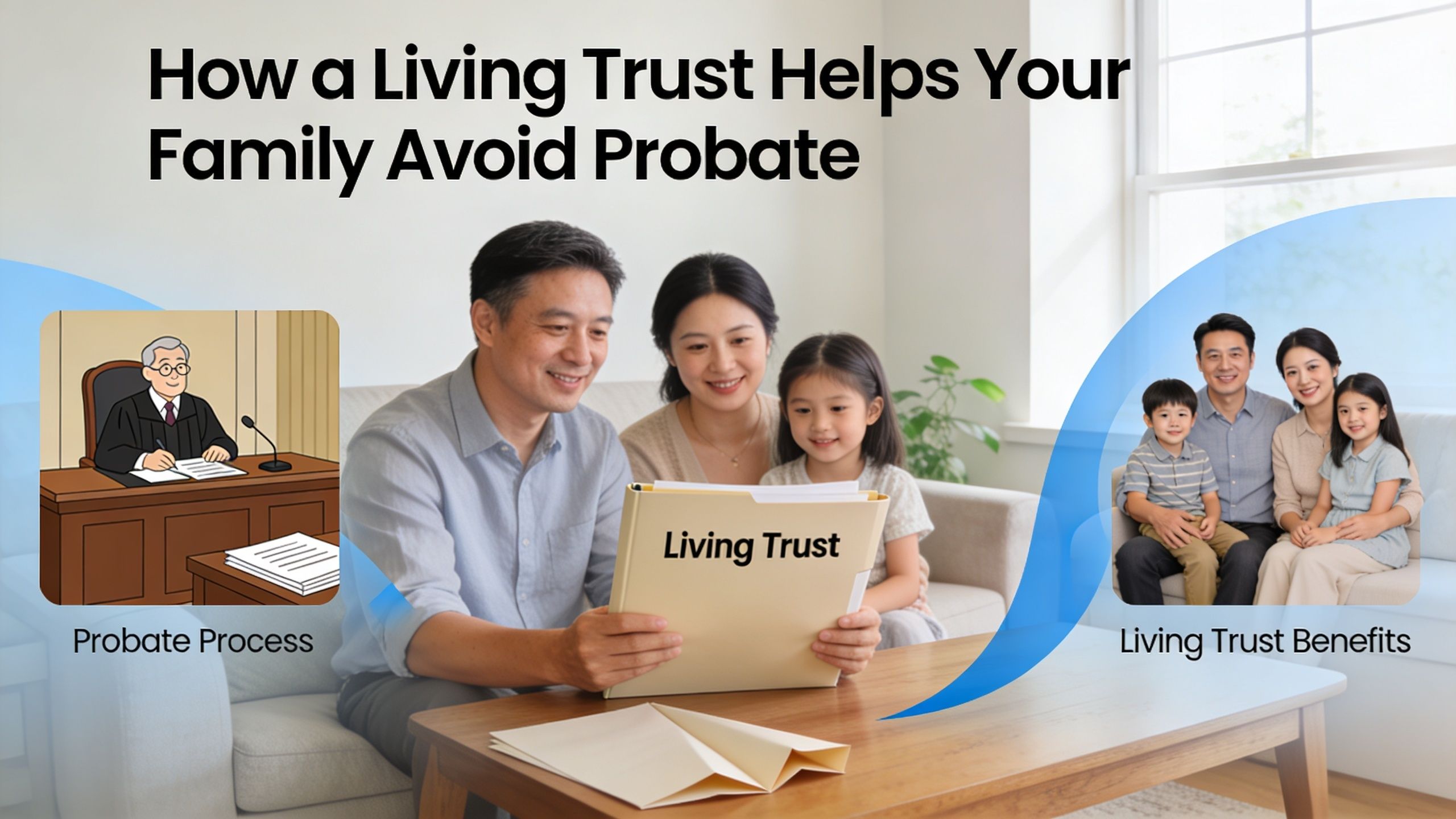
How a Living Trust Helps Your Family Avoid Probate
A Texas parent dies owning a house, a brokerage account, and a few bank accounts in their own name. The family has a will, so they assume the transfer will be simple. Then the surviving spouse or adult child learns an uncomfortable truth. A will usually does not avoid probate. It often sends the family into probate so the court can recognize the executor’s authority and clear the way for transfers.
That distinction matters.
In Texas, probate is often more efficient than in other states, but it is still a court process. Court filings may become part of the public record. Deadlines apply. Notices may need to be given. The person handling the estate may need certified copies, letters testamentary, and time to gather and transfer assets. For families who want privacy and fewer procedural steps, a living trust can remove much of that friction for assets titled in the trust.
What probate can look like in real life
Take a blended family. A husband and wife may own some assets together, while each also has children from prior relationships. If the deceased spouse kept separate-property assets in an individual name, the surviving family may need probate before anyone can sell property, access certain accounts, or complete distributions under the will.
The legal process is only part of the problem. The emotional side can be harder. Adult children may worry that a surviving spouse will control too much. A surviving spouse may worry that children from a prior marriage will challenge every step. In that setting, public filings and court timelines can add pressure to an already tense situation.
If you want a clearer sense of when a will still leads to court, this explanation of whether you have to probate a will in Texas lays out the basics.
How a living trust changes the handoff
A funded living trust works like a container that holds title to selected assets during your lifetime. You usually remain in control as trustee while you are alive and competent. At death, the successor trustee steps in under the trust document and follows its instructions for the assets already inside that container.
That can change the family’s experience in several practical ways:
- The successor trustee can act without first asking the probate court for authority over trust-owned assets
- The trust terms generally stay private, unlike many probate filings
- Property held in the trust can often be managed and distributed with fewer court procedures
- The family may avoid ancillary probate for out-of-state real estate if that property was titled in the trust
The key phrase is "funded living trust." If the trust exists on paper but the home, accounts, or other assets were never retitled into it, probate may still be needed for those assets.
Why this matters so much in Texas families
Texas estate planning often overlaps with family law more than people expect. Community property rules, remarriage, divorce decrees, and separate-property claims can all affect who believes they should receive what. A trust does not erase those issues, but it can create a clearer path for administration and reduce the number of disputes played out in a public court file.
Privacy is often a practical benefit, not just a personal preference. In second marriages and blended families, less public exposure can mean fewer opportunities for misunderstandings to grow into formal conflict. The trust gives the successor trustee a written roadmap. That roadmap can be especially helpful when a surviving spouse and adult children are trying to sort out which assets were community property, which were separate property, and which were meant to pass to children from a prior relationship.
A living trust is not a magic fix. It does not prevent every contest, and it does not avoid probate for assets left outside the trust. But when the trust is drafted carefully and funded properly, it often gives Texas families a quieter, more controlled way to transfer property after death.
The Critical Steps to Create and Fund Your Trust
A living trust only works if it’s created correctly and funded completely. Many clients are relieved to learn the process is manageable when broken into steps. The challenge isn’t understanding the idea. The challenge is carrying it through carefully.
Step one is defining the plan
Before drafting begins, you need clear answers to basic questions:
- Who will serve as trustee and successor trustee
- Which assets should be placed in the trust
- Who should inherit, and under what conditions
- How incapacity should be handled
- Whether there are family-law concerns involving separate or community property
Legal advice is of utmost importance. The trust should match your real family structure, not an internet template’s assumptions.
Step two is signing a valid trust document
The trust document must be written, and it should be executed properly. In practice, people usually sign before a notary and keep the original in a secure place along with related estate planning papers.
If you’re organizing your records, this guide on storing estate planning documents can help you think through access, backups, and what your family should know.
Step three is funding the trust
This is the part many people underestimate. “Funding” means changing title, ownership, or assignment so the trust holds the asset.
A trust might need one or more of the following actions:
Real estate transfer
A deed may need to be prepared and recorded so the trust becomes the owner of the property.Financial account retitling
Banks or brokerage firms may require their own forms before they’ll recognize the trust as account owner.Personal property assignment
Household valuables, collections, or other personal items may need an assignment document.Business interest review
Company documents may need to be checked before membership interests or shares can be transferred.
Why DIY trusts so often fail
One of the biggest pitfalls is incomplete funding. Industry surveys suggest that up to 70% of DIY trust creators fail to complete this critical step, which can render the trust useless and force the estate into probate, according to this review of Texas living trust pitfalls and setup issues.
That number tracks with what confuses many families in real life. They sign the trust, put it in a drawer, and assume the job is done. It isn’t.
Important: The document creates the trust. Funding makes the trust function.
What a careful process looks like
A thorough trust process often includes:
- Asset inventory: List real estate, accounts, business interests, and major personal property.
- Title review: Check how each asset is currently owned.
- Transfer plan: Decide which assets go into the trust, which pass by beneficiary designation, and which need special handling.
- Follow-through: Confirm every deed, account form, and assignment was completed.
Some families also need related documents, such as a pour-over will, powers of attorney, and incapacity planning forms, so the trust works as part of a complete estate plan rather than a stand-alone document.
One option for families seeking coordinated help with estate planning and related family-law concerns is the Law Office of Bryan Fagan, PLLC, which handles Texas estate planning, probate, and family law matters.
Living Trusts in the Context of Texas Family Law
A Texas couple in a second marriage may sit down to create a trust for one simple reason. They want to care for each other, but they also want to protect what should eventually pass to children from prior relationships. In Texas, that conversation quickly turns into a family-law conversation, because a trust has to fit around community property rules, separate property claims, prior divorce decrees, and beneficiary designations that may already be in place.
Texas law generally treats property acquired during marriage as community property unless it can be shown to be separate property. The Texas Constitution and Texas Family Code set the basic rules for that framework, including the separate-property categories and the community-property presumption, which you can review in the Texas Constitution, Article XVI, Section 15 and the Texas Family Code provisions on marital property. A living trust does not change those rules. It works more like a container. The label on the container matters, but so does what went into it and when.
Why this matters in marriage and divorce
A common point of confusion is ownership versus control. Putting an asset into a trust may change how it is managed, but it does not automatically erase a spouse’s property interest or solve a tracing problem.
Take a home one spouse owned before marriage. On paper, that house may have started as separate property. But if mortgage payments were made with community funds, improvements were paid from joint earnings, or title documents were changed carelessly, questions can arise about reimbursement claims or whether part of the value is tied to the marital estate.
That same issue shows up with brokerage accounts, businesses, and even ordinary bank accounts. Once separate and community funds are mixed together, proving what belongs to whom can become much harder. A trust can help organize ownership and management, but only if the drafting and funding match the family’s actual history.
Divorce adds another layer. A revocable trust created during marriage may need to be reviewed right away if a divorce is filed, because trustee roles, inheritance terms, and rights tied to community property may no longer reflect the family’s reality. The trust is part of the picture, not a shield against the family court process.
Blended families usually need clearer rules
Blended families often need more detailed trust language than first-marriage couples with identical goals. One spouse may want the surviving spouse to live comfortably for life while preserving certain assets for children from an earlier marriage. Another may want to keep premarital real estate separate, while still using a joint trust for selected community assets.
That can be done, but the plan has to be precise. Vague instructions such as “take care of my spouse and then split the rest among the kids” often create conflict because people hear that sentence in different ways. A better trust spells out who can use which assets, who serves as trustee, what happens if the surviving spouse remarries, and when children receive distributions.
The cost discussion also tends to change here. Families with remarriage concerns, children from different relationships, separate-property tracing issues, or business interests often need more drafting time and coordination, as discussed in this article on living trust cost and blended family planning in Texas.
Military families and families with court orders need extra review
Military families often move, buy property in different states, and update beneficiary forms many times over the years. Those changes can leave a trust plan out of sync with deeds, retirement accounts, or court orders.
The same is true for families who already have divorce decrees, child support obligations, or orders affecting property division. A living trust should be reviewed alongside those documents so the instructions do not conflict. If they do conflict, the family may leave behind a legal puzzle instead of a clear plan.
Careful trust planning is often at its best in these family-law-heavy situations. It brings order to a complicated record, separates what should remain separate, and gives the right person authority to act if illness, death, or family conflict puts pressure on everyone at once.
Common Scenarios Where a Texas Living Trust Is Used
A trust becomes easier to understand when you see where it fits in ordinary life.
Parents with young children
A married couple with young children may want to hold assets in trust so those assets can be managed for the children if both parents die unexpectedly. The trust can work alongside a will that names guardians for minor children. The trust handles property management. The will addresses guardianship nominations.
A business owner who needs continuity
A business owner may want a successor trustee ready to work with the company’s governing documents if incapacity occurs. Without planning, family members can end up trying to untangle authority while the business still has payroll, contracts, or customers to manage.
A retiree with property in more than one state
Someone who owns a Texas homestead and a vacation property elsewhere may use a trust to simplify transfer at death. Trust planning can be especially valuable where a family wants to avoid multiple probate proceedings tied to real estate in different places.
A blended family with separate property concerns
A spouse entering a second marriage may want to preserve certain premarital assets for children from a prior relationship while still providing for the current spouse. A trust can help set those boundaries more clearly than a handshake understanding ever could.
A person worried about incapacity
If illness or an accident leaves you unable to manage finances, a successor trustee can step in under the trust terms. That can reduce the chance that your family will need a court-managed guardianship just to pay bills, manage accounts, or handle trust-owned property.
One caution applies across all these examples. The choice of successor trustee matters. The right person should be organized, trustworthy, calm under pressure, and capable of following written instructions even in a tense family setting.
Get Help Protecting Your Texas Legacy
A living trust can give your family more privacy, more continuity, and a clearer plan for handling property during incapacity and after death. It can also be especially useful in Texas where community property rules, remarriage, separate property concerns, and blended family planning often complicate a simple will-based approach.
The right trust should fit your life as it exists now, not the life a form assumes you have. That includes your marriage, your children, your property titles, and your long-term goals.
If you need help navigating divorce, custody, or estate planning in Texas, contact The Law Office of Bryan Fagan today for a free consultation.
Frequently Asked Questions About Texas Living Trusts
Families usually reach this section after the same uneasy moment. A parent remarries, children from a first marriage are part of the picture, the family home may be community property, and someone asks, “Would a living trust make this simpler, or am I adding another layer of paperwork?” In Texas, that is the right question, because a trust does not work in isolation from marriage, divorce history, title to property, or homestead rights.
What’s the difference between a living trust and a will in Texas
A will gives instructions that take effect at death. A living trust is created during your lifetime and manages property that you transfer into the trust.
A simple way to view the difference is this. A will is a set of instructions for the probate court, while a living trust is a legal container that can hold assets now. In Texas, many people still need both. The trust can direct trust-owned assets, and a will can still handle issues a trust does not cover well, including guardianship nominations for minor children.
Does a revocable living trust protect my assets from creditors or lawsuits
Usually no. If you keep the power to change or cancel the trust, Texas law generally treats those assets as still under your control for creditor purposes.
That point causes a lot of confusion. Revocable living trusts are often used for management, privacy, and probate planning. They are usually not the tool for lawsuit protection. If asset protection, Medicaid planning, or tax planning is part of your goal, the discussion often shifts to whether a different trust structure is appropriate.
Can I be my own trustee
Yes. Many Texans who create a revocable living trust serve as their own trustee while they are healthy and able to manage finances.
The practical value is continuity. You stay in control, and the trust document names a successor trustee who can step in if you become incapacitated or after death. For blended families, that choice matters. The successor trustee should be someone who can follow the trust terms fairly, especially where a surviving spouse and children from a prior relationship both have interests to protect.
How much does it cost to set up a living trust in Texas
The cost depends on the work involved. A straightforward trust for one person with limited assets is usually less expensive than a plan for a married couple with separate property, community property, business interests, or children from different relationships.
The better question is not just “What does it cost to sign?” but “What does it take to do it correctly?” A trust that is poorly drafted or never funded can create more expense later. In Texas family situations, the drafting often needs to address title issues, beneficiary design, and how property should be characterized if there is a current marriage, a pending divorce, or a remarriage after divorce.
Do married couples in Texas need special trust drafting
Often, yes. Texas community property rules can change how assets should be titled, managed, and distributed, especially for married couples.
That is one area where estate planning and family law meet directly. Property acquired during marriage may be community property. Property owned before marriage, or received by gift or inheritance, may be separate property. A trust should reflect those distinctions clearly. If it does not, the plan can create conflict later, especially in second marriages or families trying to provide for a surviving spouse while preserving an inheritance for children from an earlier relationship.
Do I still need to think about my home separately
Yes. The family home deserves its own review because deed language, homestead rights, mortgage issues, and exemption questions can all affect whether transferring the property into a trust is wise and how it should be handled.
That review is especially important after marriage, divorce, or remarriage. A home may be one spouse’s separate property, community property, or subject to occupancy concerns that outlive the owner. If you are also reviewing ownership and tax planning for your residence, this guide on how to maximize your Texas property tax savings can help you spot questions to raise before changing title.
Is a trust always the right answer
No. A living trust is one planning tool. It works well for some Texas families and adds little value for others.
For example, a trust may make good sense if you want easier management during incapacity, privacy after death, or a clearer structure for blended family planning. A simpler will-based plan may be enough if your assets are limited, your beneficiary designations already do most of the work, and your family situation is straightforward. The right answer depends on your property, your marriage history, and who needs protection after you are gone.
If you are considering a living trust and want advice that accounts for your marriage, property character, children, or long-term family goals, schedule a free consultation with Law Office of Bryan Fagan, PLLC. Clear legal advice can help you choose a plan that fits your family as it exists, not as a generic form assumes it does.