
In Texas, a child under 18 cannot legally refuse court-ordered visitation. A child who is 12 or older may be interviewed by a judge about their preference, but that preference doesn't control the order, and parents still have to handle the situation carefully.
When your child stands at the door, backpack on, and says they're not going, the legal answer and the parenting reality collide fast. You may feel torn between respecting your child's emotions and complying with a court order. That tension is real, and it's one of the most difficult situations parents face after a custody case.
Some parents worry they'll traumatize the child by insisting. Others worry the other parent will file something in court if the visit doesn't happen. Both concerns are valid. Texas family law doesn't treat this as a simple question about what a child wants. It treats it as a question about what the court ordered, what each parent did in response, and whether someone needs to ask the court for a change.
A calm, practical approach matters most in this situation. The right next step usually isn't to panic, argue, or make side deals outside the order. It's to understand your legal duty, respond in a way a judge will see as reasonable, and start building toward a long-term solution that fits your family.
Introduction That Heart-Wrenching Moment When Your Child Says No
It often happens at the worst possible time. The other parent is on the way, the weekend bag is packed, and your child suddenly says, “I'm not going.” If you push, the child cries. If you back off, you worry you've just violated a court order.

Parents in this position often feel trapped. One side of the problem is emotional. Your child may be angry, anxious, stubborn, or upset. The other side is legal. A possession order is still in place, and the court expects parents to take it seriously.
Why this situation feels so overwhelming
Most parents aren't trying to break the rules. They're trying to make it through a hard moment without making things worse. The difficulty is that what feels compassionate in the moment can create serious legal problems if the pattern continues.
A common example is a parent who tells the other parent, “She just won't go, and I'm not going to force her.” That may sound understandable, but in court the focus often shifts to a different question: what did that parent do to encourage compliance?
A child's resistance may be emotional, but the court's analysis is practical. Judges look closely at the parent's response.
What concerned parents need most
You need two things at once. First, you need a clear understanding of your obligation under the order. Second, you need a realistic plan for what to do when a child refuses, especially if this has started happening more than once.
That's the balance this guide addresses. The law matters. Your child's experience matters too. The safest path is to treat both seriously instead of choosing one and ignoring the other.
The Unshakeable Rule of Texas Court Orders
Texas courts start from a simple position. If there is a possession or visitation order in place, that order must be followed unless it is changed by the court, the order itself allows flexibility, or both parents agree to a different arrangement. Texas Law Help explains that there is “no opting out” for a child under 18 unless the order allows it or the parents agree, and a parent who fails to make the child available can face an enforcement action under Texas Law Help's guidance on court-ordered visitation and child safety.
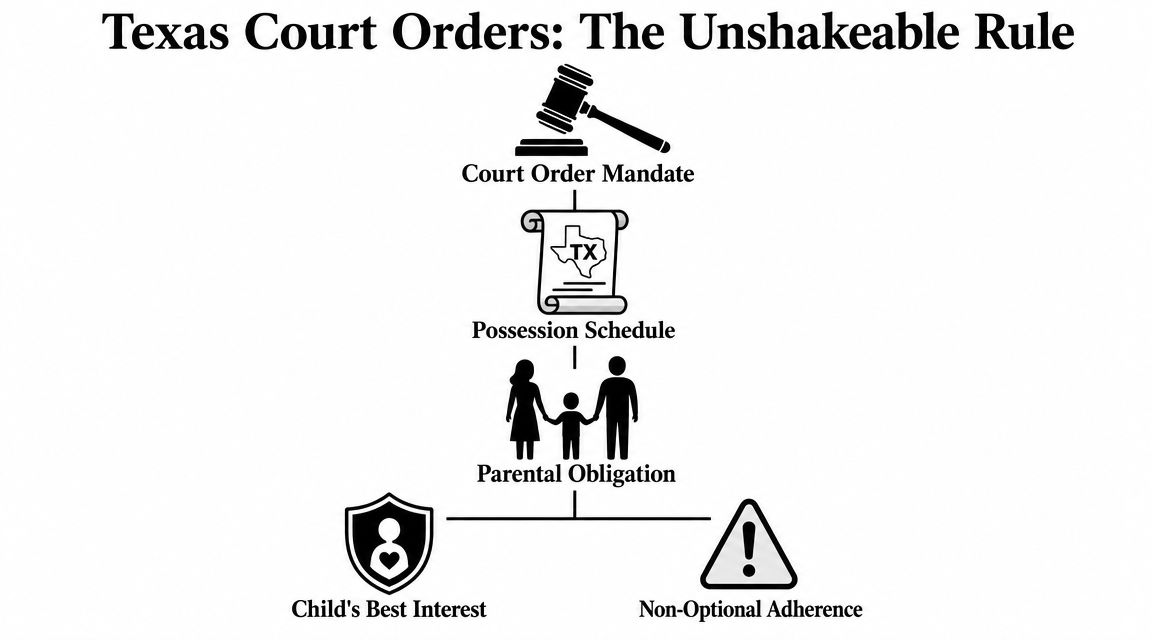
That rule applies whether the child is very young or nearly an adult. A teenager may be harder to manage in practical terms, but the legal framework doesn't create a free pass based on age alone.
What a possession order requires from parents
Many Texas families operate under a Standard Possession Order, though some have customized schedules. Whatever the wording, the order creates duties for both parents. One parent has the right to possession at certain times. The other parent has the duty to surrender the child according to the order.
That's why these disputes are so risky. The law doesn't ask whether the child likes the schedule. It asks whether the parents followed the court's directive. If you need a clearer picture of how these schedules work, Texas standard visitation rights can help you understand the structure many parents are expected to follow.
What doesn't work
Some responses create more problems than they solve:
- Letting the child decide each visit: That turns a court order into an optional arrangement.
- Sending a casual text canceling the visit: A text may document the event, but it doesn't change the order.
- Assuming age changes the rule: Parents often think older children can choose on their own. That belief causes avoidable enforcement disputes.
- Treating one missed visit as harmless: A single incident may become a pattern very quickly.
Practical rule: If the order says the visit happens, act from the starting point that the visit must happen unless you have a legally sound reason and the right court relief.
Why courts take this so seriously
Texas family courts rely on orders to create stability. If either parent could stop possession whenever a child objected, court orders would lose much of their force. That's one reason judges expect parents to make a real effort to comply even during conflict.
This doesn't mean the court ignores a child's distress. It means the court expects parents to use the proper process. If the schedule has become unworkable or unsafe, the answer is usually modification or emergency relief, not private suspension of visits.
Does My Child's Opinion Matter to the Court
Yes, your child's opinion can matter. It just doesn't decide the case by itself.
Texas Family Code Section 153.009 allows a child who is 12 or older to be interviewed by the judge if a parent requests it or the court orders it. As explained in this discussion of Texas Family Code Section 153.009 and child interviews, that means the child's preference can be heard, but it is not controlling, and Texas courts still expect possession orders to be followed until the child turns 18.
The age 12 misunderstanding
Parents hear “12” and understandably think it means the child gets to choose. That's not what the law says. Being heard at 12 is different from being able to refuse at 18.
A judge may want to know where the child wants to live, how the schedule is working, and what concerns exist in each home. But the judge still decides based on the child's best interests, not on a simple vote.
Here is the distinction that matters most:
| Issue | What Texas law allows |
|---|---|
| Child is 12 or older | The judge may interview the child under Texas Family Code Section 153.009 |
| Child wants to skip visitation | The preference may be considered, but it does not automatically change the order |
| Child turns 18 | The child can make their own visitation choices as an adult |
How judges usually look at a child's preference
Judges tend to evaluate the context, not just the words. A child's resistance may come from many different places. Sometimes it reflects ordinary teen frustration. Sometimes it points to a deeper issue in the parent-child relationship. Sometimes it raises concern about pressure from one household or the other.
That's why courts often focus on questions like these:
- Maturity: Is the child expressing a consistent, thoughtful concern, or reacting to a short-term conflict?
- Specificity: Can the child explain the problem in a meaningful way?
- Influence: Does the child seem coached, pressured, or caught in loyalty conflicts?
- Practicality: Is the current schedule no longer realistic for school, activities, or family dynamics?
A parent who assumes “my child is old enough to choose” can make a serious mistake. A parent who listens carefully, documents patterns, and uses lawful channels is in a much stronger position.
When a child's resistance points to a bigger problem
Sometimes refusal is part of an ongoing pattern between households. In those cases, parents should pay attention to signs of pressure, gatekeeping, or relationship damage. If that concern exists in your case, parental alienation in Texas is worth reviewing because the court may see repeated resistance very differently depending on its cause.
A judge may listen closely to a child. A judge still expects the adults to act like the adults.
A Parent's Practical Guide When a Visit is Refused
When a child refuses a scheduled visit, your job is to respond in a way that is calm, documented, and defensible. Texas family law treats this as a court-order issue, not an age-based exemption. Even a 14-year-old or 17-year-old cannot opt out at will when an order is in place, and the custodial parent is still expected to make a sincere effort to comply, as noted in Texas guidance on a child refusing visitation.
Start with the immediate response.
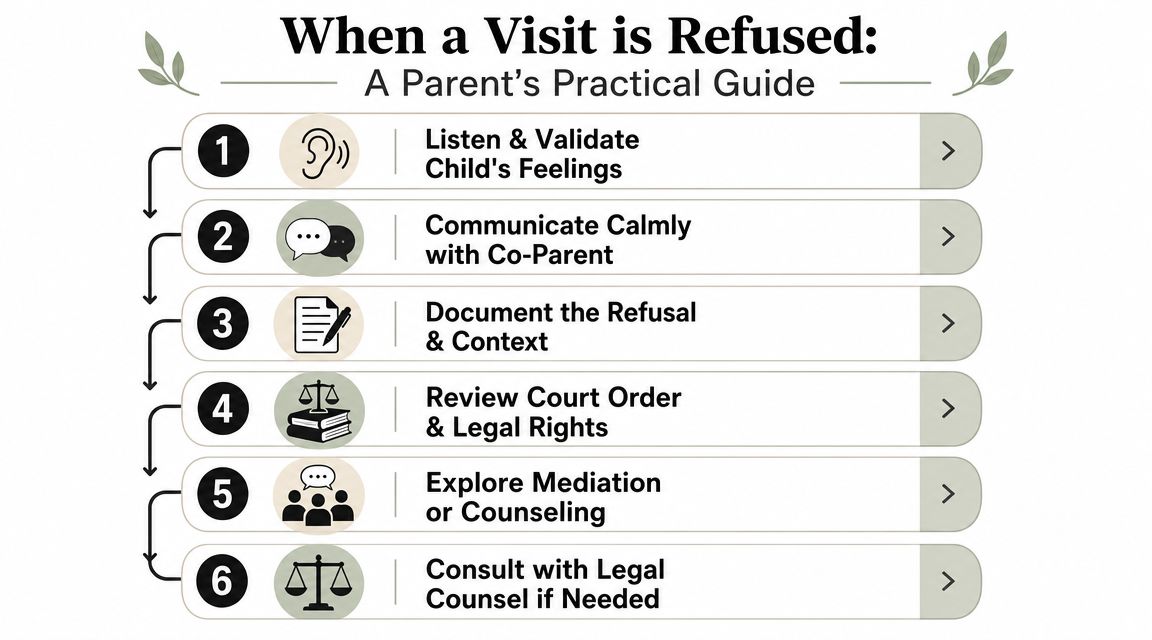
What to do in the moment
You don't need to escalate the scene to show good faith. You do need to show that you took the order seriously.
- Stay calm first. Don't match your child's emotion with your own. A heated argument usually makes compliance less likely and creates a worse record.
- Tell the child the visit is required. Use simple language. “The court order says it's time to go, and I need to follow it.”
- Encourage, don't physically force. Physical confrontation can create safety concerns and may backfire badly, especially with older children.
- Have the child ready anyway. Pack the bag, be at the exchange point, and act consistently with the order.
- Notify the other parent neutrally. Keep emotion out of it. State what happened and what you did.
“I'm encouraging compliance and have the child ready. I want to avoid escalating this, but I am not agreeing to cancel the visit.”
What good documentation looks like
If the visit fails, your records matter. Judges often care less about dramatic explanations and more about whether your notes show a sincere effort.
Document details such as:
- Date and time: When the refusal happened and when exchange was scheduled.
- Exact words used: What the child said, as accurately as you can remember.
- Your response: The steps you took to encourage the visit.
- Communication with the other parent: Save texts, emails, and call logs.
- Context: Any event that may have triggered the refusal, such as an argument, schedule change, or recurring complaint.
This can also be the right time to think more broadly about the emotional system around the child. If you're trying to understand recurring conflict patterns, outside resources on recognising family dynamics red flags can help you identify whether the refusal reflects anxiety, divided loyalty, conflict avoidance, or another issue that needs attention.
Later in the process, it can help to hear a practical discussion of visitation disputes from a legal perspective:
What judges usually want to see
A judge generally wants to see effort, consistency, and restraint. That often means:
- You didn't give in easily
- You didn't inflame the child
- You communicated with the other parent
- You kept records
- You moved toward a legal solution when the issue persisted
If you're stuck in repeated refusals, one option is to consult a Texas family law attorney. That can include the Law Office of Bryan Fagan, PLLC, which handles custody, visitation, and enforcement matters in Texas.
Using the Legal System to Find a Solution
When refusal becomes a pattern, the answer usually isn't more informal negotiation. It's using the court system correctly. Self-help tends to create more risk than relief.
Modification when the schedule no longer works
A modification asks the court to change the existing order because the current arrangement is no longer appropriate. This may make sense when the refusal reflects a persistent problem that won't be solved by repeating the same exchanges over and over.
Examples include a child whose needs have changed, a schedule that creates ongoing conflict, or a situation where a parent believes the current arrangement no longer serves the child's best interests. In a modification case, the court will look at the surrounding facts and decide whether a different possession schedule, exchange structure, or parenting arrangement is warranted.
A modification is often the right vehicle when the problem is long-term.
Enforcement when the other parent says you didn't comply
An enforcement case is different. This is the risk many parents overlook. If one parent claims the other failed to follow the possession order, the court may be asked to enforce the existing terms.
If you believe that risk is already developing, enforcing child custody orders in Texas and protecting your parental rights can help you understand what an enforcement claim may involve and what kind of preparation matters most.
Here is a simple comparison:
| Legal tool | When it fits | Main purpose |
|---|---|---|
| Modification | The schedule itself needs to change | Adjust the order to fit current circumstances |
| Enforcement | Someone says the order wasn't followed | Ask the court to compel compliance or address violations |
| Emergency relief | There is a serious safety concern | Get immediate court intervention |
Emergency relief when safety is the issue
Some refusals are not about preference at all. They are about fear, harm, or allegations of danger. In those situations, the right response may involve emergency legal relief, which can include seeking immediate court intervention depending on the facts.
That's a very different scenario from ordinary resistance or teen pushback. If a child reports abuse, threats, or unsafe conditions, parents should take that seriously and get legal advice quickly. The court has tools for urgent situations, but the facts need to be presented properly.
The legal system works best when parents bring the problem to the court before the pattern becomes entrenched.
Why informal fixes often fail
Parents often try side agreements because they want peace. The problem is that unwritten arrangements fall apart easily, especially when co-parenting communication is already strained. One parent thinks there was a temporary adjustment. The other thinks there was denial of possession. By the time it reaches court, the lack of structure creates even more conflict.
If you're asking, can a child refuse to visit a parent in Texas, the long-term answer usually depends less on what the child said that day and more on whether the parents used the right legal process afterward.
Exploring Solutions Beyond the Courtroom
A court order can require possession. It can't repair trust, improve communication, or help a child process divided loyalties on its own. That's why many families need more than a legal fix.
Tools that can reduce conflict
Some families make better progress through structured support than through repeated litigation.
- Mediation: This can help parents negotiate a schedule that fits the child's real life more closely while preserving predictability.
- Co-parenting counseling: When parents communicate poorly, even a workable order can fail in practice.
- Individual therapy for the child: A neutral professional may help uncover whether the refusal is driven by anxiety, anger, pressure, or a legitimate concern.
- Parenting coordination or facilitation: In higher-conflict cases, a neutral professional can help reduce recurring disputes and improve compliance.

Why these approaches often help more than pressure
Children usually don't benefit when they become the battlefield. If each exchange turns into a test of loyalty, the refusal often gets worse. Supportive intervention can lower that pressure and help the adults respond more consistently.
That doesn't mean you ignore the order. It means you address the reason the order keeps breaking down. In many cases, the healthiest path is a combination of legal structure and emotional support.
Sometimes the most effective custody strategy is not stricter pressure. It's better information, better communication, and a plan the child can realistically live with.
When parents take this route early, they often avoid turning every missed visit into a legal emergency.
Take Control of Your Custody Situation Today
When a child refuses visitation, the problem feels very personal. In court, though, the issue becomes very concrete. Was there an order, did the parents follow it, and if the arrangement stopped working, did someone take the right steps to fix it?
That's why the safest approach is usually the same. Take the refusal seriously. Don't casually suspend visits. Document what happened. Communicate carefully. If the issue keeps happening, pursue a modification or other appropriate relief instead of hoping it resolves on its own.
Parents are not powerless in this situation. You can protect yourself legally while still responding to your child with empathy and common sense. The key is to stop treating the refusal as a one-time emotional standoff and start treating it as a family law issue that needs a clear plan.
If you need help navigating divorce, custody, or estate planning in Texas, contact The Law Office of Bryan Fagan today for a free consultation.
If your child is refusing court-ordered visitation, you don't have to sort through the legal and emotional fallout alone. The attorneys at Law Office of Bryan Fagan, PLLC help Texas parents address custody disputes, visitation problems, enforcement concerns, and modification requests with clear, practical guidance. Schedule a free consultation to discuss your specific situation and the next step that makes sense for your family.