
Enforcing Child Custody Orders Texas often becomes real in the quiet, ordinary moments parents never expect to turn into breaking points. It’s a Sunday evening, the car seat is still in the driveway, and your phone stays silent long past the exchange time written into your court order. No dramatic confrontation. No explanation. Just the sinking realization that the other parent once again decided the rules didn’t apply—and you’re left wondering what power, if any, you actually have.
At The Law Office of Bryan Fagan, PLLC, we hear versions of this story every day from parents across Houston and throughout Texas. Led by Bryan Joseph Fagan, a South Texas College of Law graduate and widely recognized authority on Texas divorce and custody law, our firm understands that custody orders are not abstract legal documents. They are promises made under oath, designed to bring structure, predictability, and peace of mind to families navigating one of life’s most difficult transitions. Texas law is clear on this point: under Texas Family Code §153.002, every custody decision—and every enforcement action—must center on the best interest of the child, not the convenience or emotions of the adults involved.
This article will walk you through what enforcing child custody orders really looks like in Texas, why courts take violations seriously, and how proper enforcement can restore balance when co-parenting breaks down. More importantly, it will show how informed, compassionate legal guidance can help you move from frustration and uncertainty toward clarity and confidence—because reclaiming stability is often the first step toward reclaiming peace of mind.
Key Takeaways
- Texas custody orders are enforceable court orders, and violations can result in contempt findings, makeup visitation, fines, attorney’s fees, and even jail time in serious cases.
- Enforcement under the Texas Family Code requires proving a valid, specific order exists and that the other party violated it while having the ability to comply.
- Documentation is essential—keep detailed written records of every denied visitation, late return, or interference with your parenting time.
- Filing a motion for enforcement triggers a court hearing where Texas courts can compel compliance and impose penalties.
- Working with a Texas child custody attorney significantly increases your chances of a successful enforcement outcome and protects your parent child relationship.

Your Family’s Future Starts Here
Don’t navigate your legal journey alone. Schedule a consultation now and get the clarity and support you deserve.
What It Means to Enforce a Child Custody Order in Texas
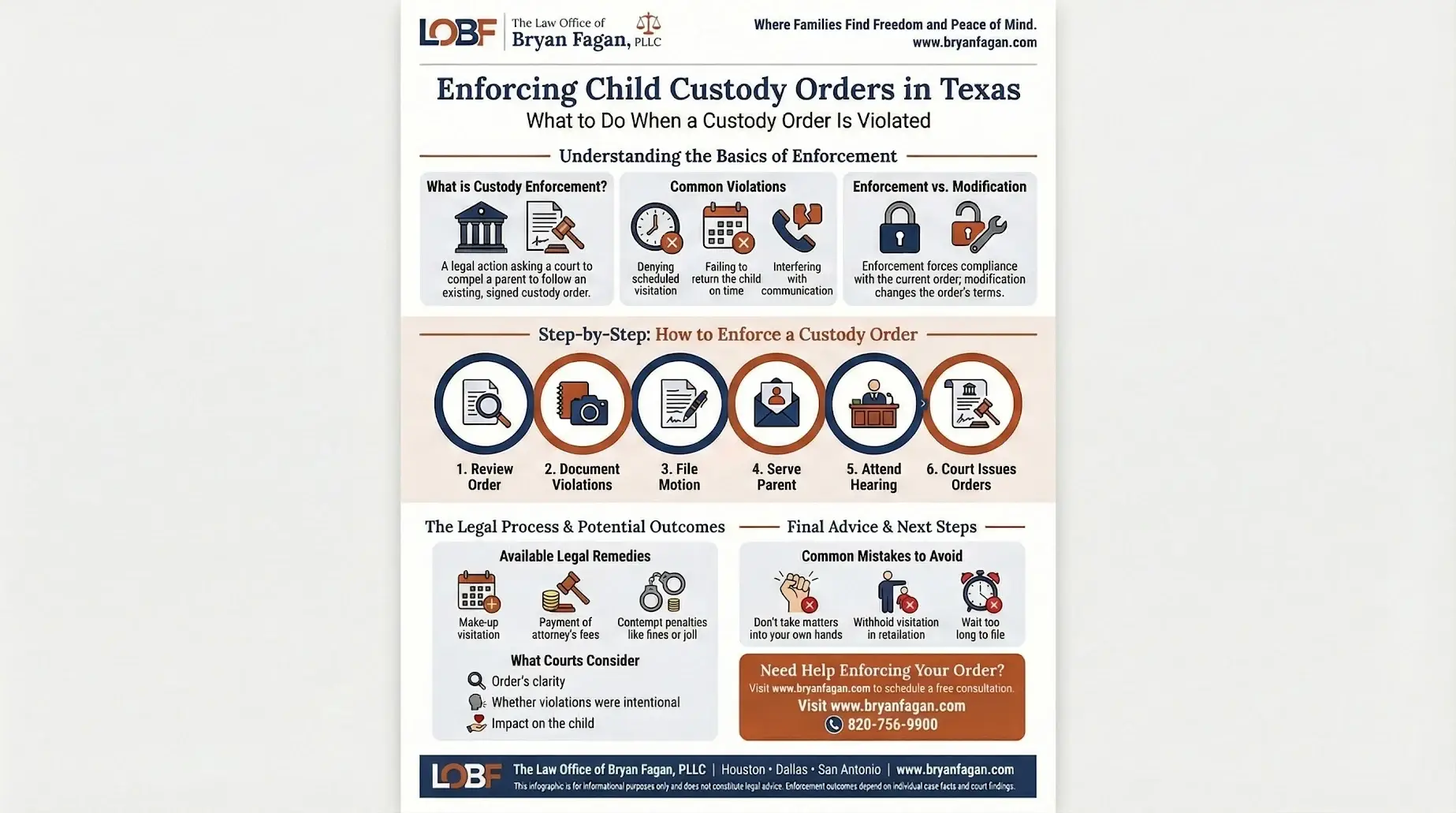
Enforcing Child Custody Orders Texas involves asking a court to step in when a parent fails to follow a legally binding custody or visitation order. It is the formal mechanism Texas law provides to restore accountability and stability when one parent disregards the rules set by the court. For many families, enforcement is not about escalating conflict; it is about protecting predictability, reducing stress, and preserving a child’s sense of security during an already challenging transition.
Under the Texas Family Code, enforcement of custody and visitation orders is primarily governed by Chapter 157, which addresses enforcement of orders in suits affecting the parent-child relationship, with Chapter 158 covering child support and medical support enforcement. These provisions outline how to file a motion to enforce, the strict pleading requirements under Section 157.002, and the remedies a court may order—such as make-up possession, attorney’s fees under Section 157.167, and contempt findings when violations are willful. Recent updates to the Code continue to emphasize specificity, due process, and the court’s broad authority to compel compliance when a parent has the ability to follow an order but chooses not to do so.
One of the most important points families need to understand is that Texas courts enforce signed, specific court orders, not informal side agreements or verbal understandings. An order that clearly states possession times, exchange locations, and responsibilities can be enforced because a judge can easily determine what was required and how it was violated. By contrast, vague language such as “reasonable visitation” or “as the parties agree” often leads to frustration, as the court has nothing concrete to measure compliance against. This is why precise drafting on the front end—and knowledgeable enforcement later—can make a meaningful difference for families seeking long-term stability.
At its core, enforcement is about compliance, not punishment. Texas courts want orders followed going forward, especially when a child’s routine and emotional well-being are at stake. That said, when a parent repeatedly or intentionally ignores a court order, consequences can escalate. Courts may impose fines, award make-up time, and hold a parent in contempt. For a clearer explanation of how contempt functions as an enforcement tool, see the firm’s resource on what contempt means in Texas custody cases. Families can also explore additional guidance on enforcement and compliance through the firm’s educational library, including resources like the Texas Child Custody Enforcement articles, which explain how Texas law balances accountability with compassion.
Whether enforcement is needed once or becomes part of an ongoing pattern, clear information and steady legal guidance help families move from uncertainty toward stability—one compliant step at a time.
Common Violations That Lead to Enforcement Actions
The most frequent violation triggering enforcement actions in Texas is denied visitation—when a custodial parent refuses to allow the non custodial parents their court-ordered time with the child.
Beyond outright denial, common violations include:
- Failure to return the child on time: Keeping the child past the scheduled end of your possession period, such as not returning them by Sunday at 6:00 PM
- Interference with school or extracurricular schedules: Not coordinating pickups, ignoring transportation responsibilities, or blocking participation in activities covered by the order
- Violating geographic restrictions: Moving the child outside the permitted area without court approval or consent
- Blocking communication: Preventing phone calls, video chats, or other contact between the child and the other parent when the order guarantees it
- Refusing to follow holiday or summer schedules: Ignoring specific provisions like 30-day summer possession or alternating holiday arrangements under the Standard Possession Order
Documentation matters enormously for each type of violation. The Texas Family Code requires that your motion for enforcement specify the date, time, place, and manner of each violation. Save text messages, emails, calendar entries, and witness information. These records transform a “he said, she said” situation into concrete evidence a court can act upon.
What does NOT constitute a violation? If the order is genuinely ambiguous, if compliance was truly impossible due to documented illness or emergency, or if both parents mutually agreed to a change (though verbal agreements are risky), these circumstances may provide defenses. However, unilateral decisions by one parent to “protect” the child without court involvement typically fail as justifications.
Legal Requirements for Enforcing Child Custody Orders Texas
When Enforcing Child Custody Orders Texas, courts require parents to meet specific legal standards before an enforcement action can succeed. Texas law does not assume wrongdoing lightly. Instead, the Texas Family Code—particularly Chapter 157—sets out clear elements that must be proven to ensure enforcement actions are fair, precise, and focused on restoring stability for the child rather than fueling unnecessary conflict.
First, a valid and signed court order must exist. This usually takes the form of a final divorce decree, a Suit Affecting the Parent-Child Relationship (SAPCR) order, or a later modification order. Under Texas Family Code §157.001, enforcement authority only exists when a signed order is on file with the court. Without that formal order, even serious parenting disputes cannot be enforced through contempt or other remedies.
Second, the order must be clear and specific enough that a reasonable person can understand exactly what is required. Texas courts consistently hold that vague phrases such as “reasonable visitation” or “as the parties agree” are difficult—if not impossible—to enforce. Section 157.002 requires enforcement pleadings to identify precise terms, dates, and conduct, which is why ambiguity in the original order is one of the most common obstacles families face. When clarity is lacking, parents may need to seek a clarification order before enforcement can move forward effectively, a topic discussed further in the firm’s Texas child custody enforcement resources.
Third, the evidence must show that the other parent violated the order while having the ability to comply. Texas courts recognize legitimate defenses such as medical emergencies or circumstances truly beyond a parent’s control, but routine explanations like forgetting an exchange or claiming the child refused to go rarely satisfy this standard. The court looks closely at whether noncompliance was willful, a factor that directly affects potential remedies under Texas Family Code §§157.166–157.167.
Fourth, the violation itself must be proven with evidence. Documentation is critical. Text messages, emails, calendars, witnesses, and records of missed exchanges help establish that noncompliance actually occurred and directly contradicted the order’s terms. In practice, experienced family law attorneys see that roughly 30 to 40 percent of initial enforcement motions struggle because the underlying order is too vague or the evidence is incomplete. When contempt becomes a possible outcome, families often benefit from deeper education on the process, such as the firm’s Contempt of Court eBook, which explains how Texas courts evaluate violations and impose consequences.
Understanding these requirements empowers parents to approach enforcement strategically and realistically. With clear orders, strong documentation, and informed legal guidance, enforcement becomes a tool for restoring compliance and protecting children—rather than another source of uncertainty in an already difficult chapter.
How Texas Courts Enforce Custody Orders
Texas district courts have substantial authority to enforce custody orders and impose meaningful consequences when a parent refuses to comply.
Available enforcement remedies include:
- Contempt of court: Both civil contempt and criminal contempt can apply, with fines ranging from $100 to $500 per violation and potential jail time
- Makeup visitation: Courts frequently award compensatory possession time equivalent to what was denied, allowing you to recover lost parenting time with your child
- Attorney’s fees: The court finds that the non compliant parent should pay your reasonable legal costs under Texas Family Code Section 157.167
- Clarification orders: When ambiguity exists, courts can clarify the order’s terms to prevent future disputes
- Jail time: In extreme cases involving willful, repeated violations, courts may impose fines and jail time—though incarceration remains a last resort
The enforcement process typically begins when you file a motion for enforcement in the court that issued the original order. After proper notice to the other party, a hearing is scheduled—usually within 30 days. At the hearing, both sides present evidence, and the court determines whether violations occurred and what remedies are appropriate.
Texas courts remain child-focused throughout this process. The goal is protecting the child’s stability and ensuring the parent child relationship isn’t severed by one parent’s misconduct.
The Role of Contempt in Custody Enforcement
Contempt is one of the most powerful tools Texas courts use when Enforcing Child Custody Orders Texas, and understanding how it works can help parents know what to expect when an order is ignored. Under the Texas Family Code, particularly Chapter 157, courts are authorized to hold a noncompliant parent accountable when they have the ability to follow a custody or visitation order but choose not to do so. The goal is not to escalate conflict, but to restore structure, predictability, and stability for the child.
Texas law recognizes two distinct forms of contempt: civil contempt and criminal contempt. Civil contempt is coercive in nature and is designed to compel future compliance with the court’s order. For example, a judge may impose daily fines or other conditional penalties until the parent complies by returning the child or following the visitation schedule as ordered. These remedies are grounded in Texas Family Code Sections 157.001 through 157.166, which give courts broad authority to fashion enforcement measures that encourage compliance rather than punishment.
Criminal contempt, by contrast, is punitive and addresses past violations of a custody order. When a court finds criminal contempt, penalties may include fines of up to $500 per violation and confinement in county jail for up to six months for indirect contempt. Because criminal contempt carries the potential loss of liberty, courts apply stricter procedural safeguards, ensuring due process protections consistent with the latest updates to the Texas Family Code and Texas case law. A more detailed discussion of how courts apply these penalties can be found in the firm’s resource on how contempt of court is enforced in Texas custody cases.
Texas courts generally prefer civil contempt because it aligns with the underlying purpose of family law enforcement: getting parents back into compliance so the order works moving forward. Jail time is considered a last resort and is typically imposed only after warnings, fines, and other enforcement measures have failed to change a parent’s behavior. This approach reflects the broader policy embedded in the Texas Family Code, which prioritizes the child’s best interests and long-term stability over punishment for its own sake.
For parents dealing with repeated, willful interference, recent legislative changes have strengthened enforcement options even further. Beginning in 2025, Senate Bill 2794—often referred to as the “three-strikes” law—creates escalating criminal consequences for repeated custody interference, ranging from a Class C misdemeanor for a first offense to a potential state jail felony by the third violation, carrying up to two years of confinement. Families seeking practical guidance on navigating enforcement and compliance can also explore educational resources such as the firm’s Texas child custody enforcement articles, which explain how courts balance accountability with compassion while protecting children and their futures.

What to Do If the Other Parent Violates a Custody Order
When the other parent violates your custody order, take these steps immediately to protect your rights and build the strongest possible case.
Step 1: Review your custody order carefully. Identify the exact provision being violated and confirm the language is specific enough to enforce.
Step 2: Document every violation meticulously. Record the date, time, and place of each incident. Save all communications—texts, emails, voicemails. Note any witnesses. This evidence forms the foundation of your enforcement case.
Step 3: Avoid self-help remedies. Do not withhold child support in retaliation, refuse your own court-ordered obligations, or take unilateral actions. Two wrongs don’t make a right, and you risk facing counter-enforcement actions that undermine your position.
Step 4: Consult a Texas child custody attorney. An experienced family law attorney can evaluate your order’s enforceability, advise on evidence gathering, and prepare proper pleadings that meet the Texas Family Code’s requirements.
Step 5: File a motion for enforcement in the issuing court. Your attorney will file the motion, ensuring it identifies the specific provisions violated and requests appropriate relief—makeup visitation, attorney’s fees, and contempt findings.
Time matters in these situations. Each week of denied visitation is lost bonding time with your child that you cannot recover. Cases with attorney involvement succeed at significantly higher rates than those attempted pro se, largely because proper pleading and evidence presentation are technical and unforgiving.
Defenses to Custody Enforcement Actions
If you’re responding to an enforcement action rather than filing one, understanding available defenses is essential.
Common defenses include:
- Order ambiguity: If the order’s language is genuinely unclear about what’s required, enforcement may fail. For example, if the pick up location wasn’t specified, courts may order clarification rather than finding contempt.
- Inability to comply: Documented emergencies, serious illness, or circumstances beyond your control may excuse non-compliance—but you must prove this with evidence, not assertions.
- Child safety concerns: In rare cases, legitimate safety concerns may justify protective actions. However, this defense requires substantial evidence (such as CPS reports or documented domestic violence), and unilateral decisions without court involvement typically fail.
- Mutual agreement or waiver: If both parents agreed in writing to modify the schedule, this may provide a defense—though courts scrutinize such claims carefully.
These defenses must be proven, not merely alleged. Courts presume parents have the ability to comply with their own custody orders unless demonstrated otherwise. If you’re facing enforcement and believe you have a valid defense, seek assistance from a qualified attorney immediately.
When Custody Enforcement Turns Into Modification
In some situations, Enforcing Child Custody Orders Texas is no longer enough to protect a child’s stability. When one parent repeatedly and willfully ignores court orders, Texas law recognizes that the ongoing pattern of noncompliance itself may justify changing the existing custody arrangement. Enforcement is designed to correct behavior, but when violations continue despite warnings and consequences, courts begin to look at whether the current order is still serving the child’s best interests.
Under Texas Family Code §156.101, a custody modification requires proof of a material and substantial change in circumstances and a showing that the requested change is in the child’s best interests. A documented history of denied visitation, persistent interference, or alienating conduct can meet this standard. Judges are particularly attentive when enforcement records show repeated contempt findings or multiple violations over time, because those patterns suggest the existing order is no longer workable for the child or the parents.
For example, if a custodial parent has denied visitation several times over the course of a year despite enforcement actions and court warnings, a judge may conclude that stronger intervention is necessary. In those cases, the court may modify conservatorship or possession terms, and in more serious situations, may even award primary conservatorship to the previously noncustodial parent to protect the parent-child relationship and restore consistency. These decisions are never made lightly, but Texas courts are guided by the mandate in Texas Family Code §153.002 to prioritize the child’s best interests above all else.
Recent legislative developments reinforce this approach. Beginning in 2025, the so-called “three-strikes” law creates a clearer evidentiary pathway by allowing three documented custody interference violations to support both criminal consequences and a strong modification case. For families navigating how enforcement, modification, and divorce intersect, additional context can be found in the Texas divorce process resource, which explains how custody orders evolve over time. Readers may also benefit from the firm’s broader educational materials, such as the Texas child custody modification articles, which walk through when and how courts consider changes to existing orders.
When enforcement reveals a deeper pattern rather than a one-time issue, modification may be the legal step that finally restores stability. With informed guidance and careful documentation, parents can move toward solutions that better protect their children and their futures.
How a Texas Child Custody Attorney Helps With Enforcement
When Enforcing Child Custody Orders Texas, having an experienced Texas child custody attorney on your side can make a meaningful difference in both the outcome of your case and the stress you carry along the way. Enforcement cases are rarely simple. They require a clear understanding of court orders, strict compliance with procedural rules, and a steady focus on restoring stability for the child rather than escalating conflict between parents.
A knowledgeable family law attorney will begin by carefully reviewing your existing custody or visitation order to determine whether it is enforceable as written and to identify any ambiguities that could limit the court’s ability to act. Texas courts require precise language, and under Texas Family Code Section 157.002, enforcement pleadings must clearly state the provisions violated, the manner of noncompliance, and the relief requested. Addressing these issues early helps avoid delays and increases the likelihood of meaningful relief.
Legal counsel also plays a critical role in preparing and presenting evidence. This includes organizing documentation, identifying witnesses, and building a clear record that shows the other parent had the ability to comply with the order but failed to do so. In many cases, attorneys are also able to negotiate practical resolutions—such as agreed make-up visitation or clarified schedules—without the need for prolonged litigation, which can reduce emotional strain on both parents and children. When violations rise to the level of contempt, additional guidance can be found in the firm’s resource on what to do if your ex is in contempt of your divorce decree in Texas, which explains how courts address repeated noncompliance.
Throughout the process, effective representation keeps the focus where Texas law intends it to be—on the child’s best interests, as emphasized in Texas Family Code Section 153.002. Rather than allowing enforcement cases to become personal battles, skilled attorneys help parents pursue compliance strategies that protect routines, reduce disruption, and promote long-term stability. Families looking for additional practical insight may also benefit from the firm’s broader educational resources, including the Texas child custody enforcement articles, which explain enforcement options in clear, compassionate terms.
Custody enforcement cases are both technical and deeply emotional. Representing yourself against a noncompliant parent who has legal counsel can place you at a significant disadvantage. In many situations, the investment in qualified legal representation pays for itself through stronger outcomes, potential recovery of attorney’s fees under Texas Family Code Section 157.167, and—most importantly—the resolution of disputes that allows families to move forward with greater clarity and peace of mind.

Why Choose The Law Office of Bryan Fagan PLLC
When it comes to Enforcing Child Custody Orders Texas, the team at this Houston-based family law firm brings decades of hands-on experience and a deep understanding of how Texas courts actually apply the law. Guided by the principles set out in the Texas Family Code, including Section 153.002’s mandate that every custody decision serve the child’s best interests, the firm approaches enforcement with a steady focus on protecting parental rights while minimizing unnecessary disruption for children.
Rather than fueling conflict, the attorneys here prioritize practical, child-centered solutions that promote consistency and accountability. Enforcement actions are built on clear legal foundations, including the precise pleading requirements of Texas Family Code Section 157.002, and are pursued with an eye toward restoring compliance—not escalating tension. This approach reflects an understanding that breakdowns in communication and cooperation are often at the heart of both custody disputes and divorce itself, a reality explored further in the firm’s resource on the number one indicator of divorce.
Families facing denied visitation, repeated schedule violations, or more complex patterns of interference are not left to navigate these challenges alone. With clear communication, honest explanations of legal options, and compassionate guidance, the firm helps parents move forward with confidence. Additional insight into enforcement strategies and parental rights can be found in resources like the Texas child custody enforcement articles, which are designed to educate families while empowering them to protect their futures throughout Texas.
Checklist: Enforcing Child Custody Orders Texas
Use this actionable checklist when facing custody violations:
- ☐ Confirm your custody order is signed, filed with the court, and contains specific terms
- ☐ Document each violation with dates, times, locations, and communications
- ☐ Preserve evidence—screenshots, emails, text messages, witness contact information
- ☐ Avoid retaliatory actions like withholding support or your own custody time
- ☐ Consult a Texas custody attorney to evaluate enforceability
- ☐ File a motion for enforcement in the court that issued your order
- ☐ Prepare for the hearing with organized evidence and clear testimony
Conclusion
Custody orders exist for a reason—to bring structure to an otherwise emotional and unpredictable chapter of life. When those orders are ignored, it’s not just frustrating, it’s destabilizing. The good news is that Texas law gives parents real tools to restore balance, protect their rights, and most importantly, safeguard their child’s sense of security. You don’t have to accept chaos as the new normal, and you don’t have to navigate enforcement alone.
If you’re feeling stuck, overwhelmed, or unsure of what step comes next, that’s completely understandable. Enforcement cases are as emotional as they are legal, and having an experienced Texas family law attorney in your corner can make all the difference. At The Law Office of Bryan Fagan, PLLC, we believe clarity creates confidence—and confident parents make better decisions for themselves and their children. Our role is to help you understand your options, avoid costly missteps, and move forward with purpose rather than pressure.
If this article sparked questions or helped you recognize what’s been missing in your own situation, consider it a sign to pause and reassess—not react. Sometimes the strongest move isn’t pushing harder, but getting the right guidance before taking action. When you’re ready, our team is here to listen, explain, and help you protect what matters most. And if nothing else, remember this: court orders are meant to bring peace, not constant conflict—and reclaiming that peace is always worth the effort.
Frequently Asked Questions About Enforcing Child Custody Orders in Texas
The biggest mistake parents make is treating custody like a competition instead of a responsibility. Texas judges are not looking for a “winner”—they are focused on which parent best supports the child’s stability, emotional well-being, and routine. Angry texts, retaliation, or ignoring court orders often damage credibility and can hurt your case far more than help it.
When a court order is violated, the court has the authority to enforce it. This may include ordering make-up parenting time, awarding attorney’s fees, imposing fines, or holding the non-compliant parent in contempt. The goal is usually to restore compliance and protect the child from ongoing disruption.
Judges respond best to calm, factual explanations that focus on the child’s needs rather than personal grievances. Be prepared to discuss your involvement in the child’s daily life, your ability to provide stability, and your willingness to co-parent appropriately. Avoid emotional attacks and let your actions and documentation speak for you.
Yes, Texas law allows parents to represent themselves in enforcement and contempt cases. However, these filings are highly technical and must meet strict legal requirements. Errors in wording, dates, or service can delay or derail your case. Many parents find that working with an experienced Texas family law attorney saves time, stress, and expense in the long run.
The 7-7-7 schedule is a co-parenting arrangement where a child spends seven days with one parent, seven days with the other, and then rotates again. It is not a Texas legal standard but can be used if both parents agree and the schedule serves the child’s best interests. Courts will always prioritize consistency and practicality over novelty.
Courts tend to view repeated lateness, missed exchanges, hostile communication, refusal to follow court orders, and involving children in adult conflict negatively. Social media behavior and impulsive messages can also be used as evidence. Judges generally favor parents who demonstrate maturity, reliability, and a child-focused mindset.
Court orders are enforced by filing a motion for enforcement in the court that issued the original order. At a hearing, the judge reviews evidence of the violation and may order remedies such as make-up possession, clarification of the order, attorney’s fees, fines, or contempt penalties when appropriate.
If an ex repeatedly ignores a court order, you may seek enforcement through the court system. Depending on the severity and frequency of violations, consequences can escalate. Consistent documentation and timely legal action are critical to protecting your rights and preventing ongoing disruption.
Start by reviewing the exact language of your order and documenting every violation with dates, times, and communications. Avoid retaliation or self-help actions, as these can weaken your position. If violations continue, speaking with a Texas family law attorney can help you determine the most effective enforcement strategy and next steps.