
Divorce can be one of life’s most difficult transitions, and worrying about the retirement savings you’ve worked so hard to build is completely understandable. Many people fear that their entire 401(k) is at risk, but understanding your rights under Texas law can make the process less overwhelming.
Let us put that fear to rest. Splitting a 401(k) during a Texas divorce doesn’t mean you lose everything. Under state law, only the portion of the retirement account earned during the marriage is considered community property and subject to division. Any contributions you made before the wedding, plus the growth on those specific funds, remain your separate property—as long as they can be clearly traced.
This process isn’t about one spouse taking everything from the other. It’s about fairly dividing the wealth you built together as a team. The key is to distinguish what you brought into the marriage from what you accumulated during it. Understanding these rules is the first step toward regaining control and building a secure financial future.

How Texas Law Views Your Retirement Savings
Texas is a community property state, a foundational concept that shapes every divorce here. The Texas Family Code § 3.002 presumes that all property acquired by either spouse during the marriage belongs to the “community estate.” This means it belongs to both of you, regardless of whose name is on the account.
When it comes to your 401(k), the community portion includes:
- Your 401(k) contributions made from your salary earned while you were married.
- Any employer matching funds you received during the marriage.
- Investment gains, interest, and dividends that accrued on that community portion of the account.
Conversely, any funds you contributed to your 401(k) before you got married are considered your separate property. The growth on those specific pre-marital funds is also yours alone. The real challenge, which we’ll get into later, is accurately tracing and proving the separate property portion of the account.
The core principle is simple: what you owned before marriage is yours, and what you earned together is shared. The goal of the legal process is to identify and divide only the shared portion in a “just and right” manner.
The Essential Tool: A Qualified Domestic Relations Order (QDRO)
So, how does this division actually happen without triggering a massive tax bill? The answer is a special court order known as a Qualified Domestic Relations Order (QDRO), pronounced “kwah-dro.”
This document is entirely separate from your final divorce decree. It provides direct, legally binding instructions to your 401(k) plan administrator on exactly how to divide the account. A properly executed QDRO is the only legal tool that allows for a tax-free transfer of funds from one spouse’s retirement account to the other’s.
Without a QDRO, moving those funds would be treated as an early withdrawal. That means triggering significant income taxes and a 10% early withdrawal penalty. The QDRO is absolutely essential for a smooth and lawful split, ensuring your nest egg is protected from a devastating and unnecessary financial hit.
Understanding Community Property and Your Retirement
When you get divorced in Texas, the law sees your marriage as a partnership. This core principle, laid out in the Texas Family Code, means that pretty much anything you and your spouse earned or acquired from your wedding day until the divorce is finalized belongs to the “community estate.” This absolutely includes your 401(k), which is often one of the most valuable assets a couple has.
Getting your head around this concept is the first, most crucial step to a fair split. Every dollar that went into your 401(k) from your paychecks during the marriage is considered community property. The same goes for any employer matching funds you received and all the investment gains that grew from those marital contributions. It makes no difference whose name is on the account or whose paycheck funded it; Texas law views it as the fruit of your joint efforts.
What’s Actually on the Table for Division?
The key is separating the timeline. The court is only interested in the slice of your retirement savings that was built during the marriage.
This divisible portion of your 401(k) is made up of a few key parts:
- Your Contributions: Every pre-tax or Roth dollar you put in from paychecks earned while you were married.
- Your Employer’s Contributions: All matching funds or profit-sharing deposits made by your employer during the marriage.
- Investment Growth: All the interest, dividends, and market gains that came from the community property portion of the funds.
Anything you contributed before you said “I do,” plus the growth on those specific funds, is presumed to be your separate property. But—and this is a big but—the burden is on you to prove it with clear and convincing evidence. Protecting that pre-marital portion requires careful documentation and often some expert help.
The Challenge of Tracing Your Separate Property
Figuring out the exact dollar value of the community portion isn’t always straightforward. While the goal is a fair division, the math can get tricky. Texas courts aim for a “just and right” division of the marital estate, which often means 50/50, but it only applies to the value built during the marriage. Any pre-marital money is yours to keep, as long as you can properly trace it.
This is where people get tripped up. Let’s say you walked into the marriage with $100,000 in your 401(k), and by the time of divorce, it’s worth $500,000. A simple subtraction suggests the community property piece is $400,000. But financial experts will tell you this “subtraction method” is flawed because it ignores the growth on your separate, pre-marital funds. You often need a financial analyst to accurately trace what belongs to whom. You can explore more about how retirement assets are divided by reviewing expert discussions on the topic.
Let’s look at a more practical example.
Imagine Sarah had $50,000 in her 401(k) when she married Tom. Over their 15-year marriage, diligent saving and market growth swelled the account to $400,000. Just subtracting her starting balance ($400,000 – $50,000) suggests the community has a $350,000 interest.
But that calculation misses a huge detail: Sarah’s initial $50,000 was also invested and growing for those 15 years. The growth on that original chunk of money is also her separate property. Accurately untangling that growth requires a detailed financial analysis, usually performed by a forensic accountant or a Certified Divorce Financial Analyst (CDFA).
Without proper tracing, you risk your separate property getting mixed in with the community estate. If that happens, your ex-spouse could walk away with a piece of the retirement funds that should have been yours alone.
This is why gathering your 401(k) statements is so critical. You absolutely need the statement from right before your marriage and the most current one you can get your hands on. These documents are the starting point for any expert analysis, ensuring the division is truly “just and right” under Texas law. Protecting your hard-earned retirement requires this level of diligence.
To make this clearer, let’s break down how the different parts of a 401(k) are typically classified under Texas law.
Community vs Separate Property in Your 401(k)
| Asset Component | Classification | Reasoning Under Texas Law |
|---|---|---|
| Pre-Marital Balance | Separate Property | Funds owned before the date of marriage are not part of the community estate. |
| Employee Contributions (During Marriage) | Community Property | Contributions from earnings during the marriage are considered community funds. |
| Employer Match (During Marriage) | Community Property | An employer match is a form of compensation earned during the marriage. |
| Growth on Pre-Marital Balance | Separate Property | Appreciation and earnings on separate property remain separate property. |
| Growth on Marital Contributions | Community Property | Gains derived from community assets are also considered community property. |
As you can see, the timeline is everything. The challenge lies in proving which growth belongs to which pot of money, which is why a detailed tracing analysis is often your best bet for ensuring a truly fair outcome.
Using a QDRO to Divide Your 401(k) Correctly
After you’ve figured out the community property slice of a 401(k), you might be tempted to think you can just write a check to your soon-to-be-ex. This is an incredibly common—and potentially very expensive—mistake. To split a 401(k) the right way without getting hit by a mountain of tax penalties, you need a very specific legal tool: the Qualified Domestic Relations Order, or QDRO (pronounced “kwah-dro”).
Think of a QDRO as a special set of instructions for the people managing the retirement account. It’s a separate court order, completely distinct from your final divorce decree, that goes directly to the 401(k) plan administrator. This document tells them exactly how to divide the account—who gets what, how much, and when.
Crucially, it is the only legal path to transfer retirement funds between spouses during a divorce without the IRS treating it as an early withdrawal. Without a QDRO, that transfer would trigger immediate income taxes and a nasty 10% penalty.
Why Your Divorce Decree Isn’t Enough
This surprises a lot of people, but simply writing “Spouse A gets 50% of Spouse B’s 401(k)” into your final divorce decree is completely useless on its own. The plan administrator cannot—and absolutely will not—act on that language. Retirement plans are governed by strict federal laws (ERISA), and they are legally required to have a signed QDRO before they can release funds to anyone other than the employee spouse.
Without a valid QDRO in hand, the plan administrator is legally bound to ignore whatever your divorce decree says about the 401(k). This creates a huge, dangerous gap where your agreement is basically unenforceable, leaving your share of the retirement money stuck in legal limbo. Starting the QDRO process early is one of the smartest things you can do to avoid headaches and delays after the divorce is final.
The visual below gives a simple overview of the journey from marriage to the legal division of assets in a divorce.
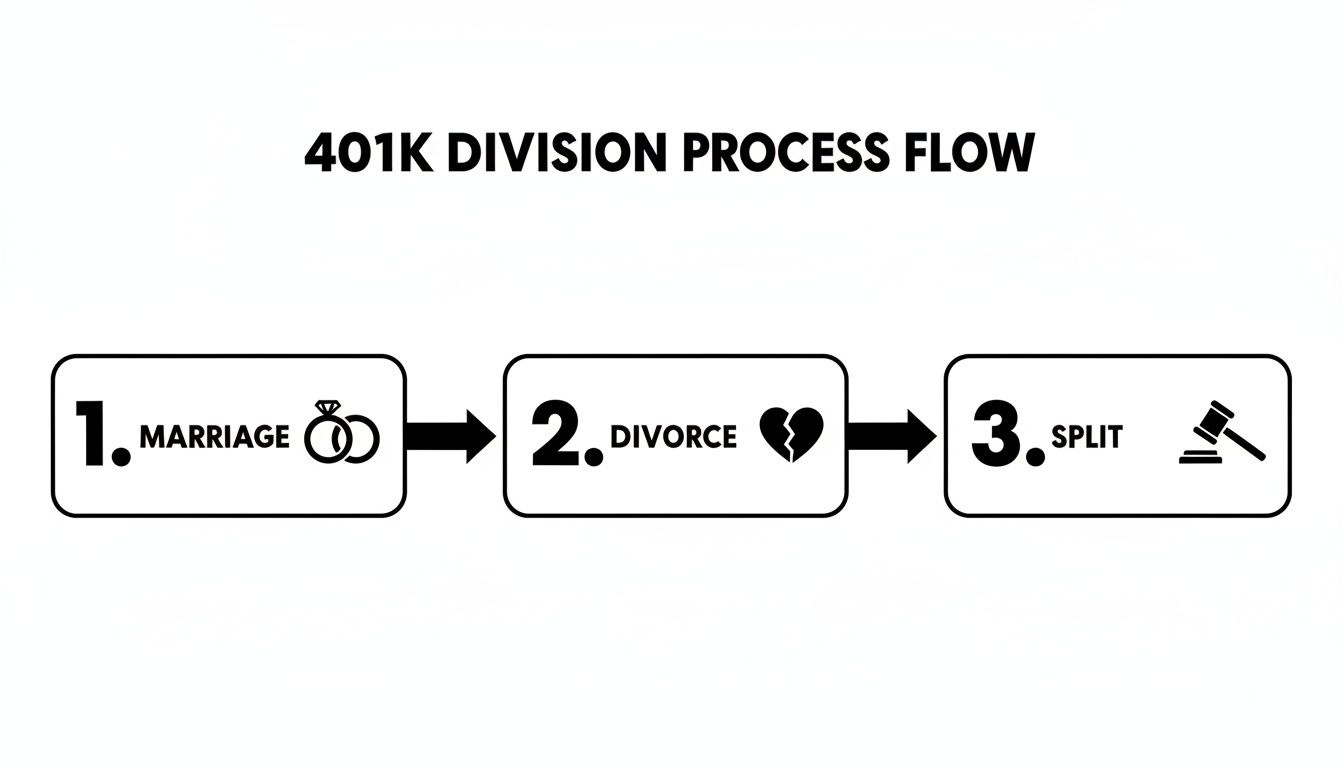
This process shows how the assets you build together during a marriage become subject to division under a court’s authority when you divorce.
The QDRO Drafting and Approval Process
Getting a QDRO isn’t a one-and-done task; it’s a multi-step process that demands precision. Every single retirement plan has its own unique rules, procedures, and required language for QDROs. An order that works perfectly for Fidelity might be instantly rejected by Vanguard.
Here’s a practical, step-by-step roadmap of what the process looks like:
- Gather Plan-Specific Info: The first move is to contact the 401(k) plan administrator. You need to request their QDRO procedures, guidelines, and any sample or model QDRO forms they can provide.
- Draft the QDRO: An attorney then drafts the QDRO, carefully weaving together the plan’s specific requirements with the terms you agreed on in your settlement (like a specific dollar amount or a percentage of the account).
- Submit for Pre-Approval: This step is critical. We always recommend submitting the draft QDRO to the plan administrator for a pre-approval before anyone signs it or it goes to a judge. This simple check catches potential errors and confirms the plan will accept the final order.
- Get Signatures and File with the Court: Once it’s pre-approved, the QDRO is signed by both spouses and their attorneys. Then it’s submitted to the court for the judge’s signature, turning it into an official order.
- Final Submission to the Plan: The final, court-certified QDRO is then sent back to the plan administrator, who will finally process the division of the funds.
This process is exactly why having an experienced legal guide is so important. For a deeper dive, you can learn more about how qualified plans like 401k plans are divided in our detailed article.
A poorly drafted QDRO can be rejected by the plan administrator, sending you right back to court to fix it. This can cause months, or even years, of delays and cost thousands in extra legal fees—all while your retirement money is locked up and out of reach.
A Real-World Example of a QDRO Gone Wrong
Let me share a scenario involving a hypothetical couple, Maria and David. In their divorce, they agreed David would receive $150,000 from Maria’s 401(k). Their divorce decree spelled this out, but they procrastinated and waited a full year before starting the QDRO process.
During that year, the stock market tanked, and the balance in Maria’s 401(k) dropped significantly.
Because their agreement specified a fixed dollar amount, Maria was still on the hook for the full $150,000. This amount now represented a much, much larger percentage of her depleted account than either of them had originally planned for. If they had instead specified a percentage (e.g., 50% of the community portion as of a specific date), they both would have shared in that market loss proportionally.
This story really drives home the importance of not just getting the QDRO drafted correctly, but also thinking through the specific language you use to define the split. Tiny details can have a massive financial impact. Working with an attorney who understands these nuances is absolutely essential for protecting your financial future.
Avoiding Costly Taxes and Early Withdrawal Penalties
One of the biggest anxieties we hear from clients about splitting a 401(k) is the fear of a massive, unexpected tax bill. It’s a completely valid concern.
If you don’t handle it the right way, dividing a retirement account can absolutely trigger significant income taxes and a painful 10% early withdrawal penalty from the IRS.
Fortunately, Texas law and federal regulations provide a specific, secure pathway to avoid these costs entirely. The key, as we’ve talked about, is the Qualified Domestic Relations Order (QDRO). This special court order is your shield against penalties.
When a QDRO is properly drafted and executed, it allows the receiving spouse (known as the “alternate payee”) to get their share of the 401(k) funds without it being considered a taxable event or an early distribution. This is a critical protection that preserves the value of your hard-earned retirement savings.
The Smart Move: Rollover vs. The Costly Cash-Out
Once the QDRO is approved by the plan administrator, the receiving spouse has a major decision to make. You’ll typically have two options for handling the awarded funds, and your choice has profound financial consequences.
- Option 1: The IRA Rollover (The Smart Move): The most common and financially sound choice is to directly roll the funds into your own individual retirement account (IRA) or another qualified retirement plan. This is a non-taxable transfer. The money continues to grow tax-deferred, preserving your long-term financial security and keeping your retirement goals on track.
- Option 2: The Cash Distribution (The Costly Mistake): The receiving spouse can also choose to take their share as a lump-sum cash payment. While a QDRO still protects you from that 10% early withdrawal penalty (a unique and valuable exception), the entire distribution is subject to a mandatory 20% federal income tax withholding, plus any state taxes that might apply. You lose a huge chunk of your settlement right off the top.
A Real-World Financial Comparison
Let’s put this into perspective with a clear example. Imagine you are awarded $100,000 from your ex-spouse’s 401(k) through a QDRO.
- If you choose the IRA Rollover: The full $100,000 is transferred directly into your retirement account. You lose nothing to immediate taxes, and the entire amount can be invested for your future.
- If you choose the Cash Payout: The plan administrator is required by law to withhold 20% for federal taxes. That means you would immediately lose $20,000. You’d walk away with only $80,000, and you might even owe more when you file your tax return, depending on your total income for the year.
This single decision can mean the difference of tens of thousands of dollars for your retirement. Choosing the rollover is almost always the best strategy for protecting your financial future.
The temptation for a cash payout is understandable, especially when you’re facing the immediate costs of starting over. Research shows that divorced households are 9.5% more likely to make early withdrawals from their 401(k)s for “fast cash” and 11.8% less likely to continue contributing. These decisions, often driven by post-divorce financial stress, can erode long-term security by triggering unnecessary taxes and depleting retirement funds when they are needed most. You can learn more about the research on 401k withdrawal behaviors and its impact.
Understanding the tax implications of every financial decision during a divorce is paramount. For more detailed guidance, check out our guide on how to avoid common tax mistakes during your divorce. Making informed choices now is the key to building a stable and secure financial foundation for your new life.
Is Splitting Your 401(k) the Only Option? Exploring Alternatives
While a QDRO is the standard way to divide a 401(k) in a divorce, it’s not always the best or only path forward. Many couples find a more straightforward and strategic solution by thinking outside the box: the asset offset. This approach gives you the flexibility to look at your entire community estate and make a trade, allowing one person to keep their retirement account completely intact.
The concept is pretty simple. Instead of going through the hassle of dividing the 401(k), one spouse keeps it. In exchange, the other spouse gets community assets of equal value. This can be a game-changer, letting you tailor a settlement that actually fits each person’s financial situation and future goals.

How an Asset Offset Works in the Real World
Let’s look at a common scenario. Imagine John and Lisa are divorcing. The community property portion of John’s 401(k) is worth $200,000, which means Lisa has a right to $100,000 of it. They also own their home, which has $100,000 in equity.
Instead of drafting a QDRO, they could agree to an offset. John keeps his entire 401(k) untouched, and Lisa gets the full $100,000 of equity from the house. This could mean John buys out her share, or she is simply awarded the house if its equity lines up with her share of the retirement funds. Just like that, both have received their fair portion of the community estate, but they’ve sidestepped the paperwork, fees, and potential delays that come with a QDRO.
Why Negotiating an Offset Can Be a Smart Move
Opting for an asset trade-off instead of a formal 401(k) split comes with some real advantages that can make the divorce process a whole lot smoother.
- It’s Simpler and Faster: You get to skip the entire QDRO process—no drafting, no pre-approvals, no waiting for the plan administrator. This saves a ton of time, cuts down on attorney’s fees, and eliminates the risk of the court or the plan rejecting your order.
- You Keep Financial Control: The spouse with the 401(k) can maintain their long-term investment strategy without cashing out or disrupting its growth. For the other spouse, receiving an asset like cash or home equity offers immediate financial power and flexibility that a locked-up retirement account just can’t provide.
- You Avoid Market Volatility: A QDRO can take months to finalize. If the stock market takes a nosedive during that waiting period, the value of the 401(k) share being transferred could shrink significantly. An offset locks in the asset values on a specific date, taking that market uncertainty completely off the table.
Potential Pitfalls and What to Watch Out For
As good as it sounds, an asset offset isn’t a one-size-fits-all solution. You have to weigh the pros and cons carefully, especially when it comes to the long-term financial picture.
The biggest mistake people make is failing to account for taxes. A dollar in a 401(k) is not the same as a dollar in your hand or in your house.
A $100,000 distribution from a 401(k) is pre-tax money. When you eventually withdraw it in retirement, you’re going to pay income tax on every penny. On the other hand, $100,000 in home equity is post-tax money—the taxes have already been paid.
This tax implication is huge. To ensure a truly “just and right” division, you have to factor in the future tax bite on those retirement funds. For instance, the spouse keeping the $100,000 pre-tax 401(k) share could rightly argue that its real, present-day value is closer to $75,000 after you account for future taxes. Getting this calculation right is tricky and often requires bringing in a financial advisor to make sure the trade is truly equitable.
Ultimately, the choice between a QDRO and an asset offset comes down to your unique financial landscape and what you need for your future. By understanding both paths, you can negotiate a settlement that not only divides your property fairly today but also helps you build a stable financial tomorrow.
Special Considerations in Gray and High Net Worth Divorces
Not all divorces are created equal, and the financial stakes can feel dramatically higher in certain situations. When a divorce happens later in life—often called a “gray divorce”—or involves a substantial marital estate, splitting a 401(k) requires a much more strategic and careful game plan.
For couples divorcing after 50, there’s simply less time on the clock to recover financially. The retirement nest egg you’ve spent decades building becomes the primary source of your future security. Protecting it isn’t just important; it’s everything.
The Unique Challenges of a Gray Divorce
Divorcing later in life means your 401(k) isn’t just a number on a statement; it’s the foundation of your entire post-career life. The financial impact can be absolutely devastating, especially when most of a couple’s wealth is tangled up in shared retirement accounts and the family home.
Research paints a stark picture: ‘gray divorces’ after age 50 can wipe out retirement savings. Women often bear the brunt, losing around 45% of their savings compared to men’s 21%.
There is one crucial benefit to keep in mind for long-term marriages (10 years or more): Social Security. A lower-earning spouse might be able to claim spousal benefits based on their ex-partner’s work record. This is a rare win-win, as it doesn’t reduce the paying spouse’s own Social Security benefits and can provide a vital income stream for both.
High-asset divorces bring their own brand of financial complexity. These cases often involve far more than a single 401(k). The marital estate could include multiple retirement plans, pensions, executive stock options, and intricate investment portfolios.
In these situations, the standard methods of valuation and division just won’t cut it. This is where a forensic accountant becomes indispensable. These financial experts are masters at tracing separate versus community property claims across countless accounts. They can uncover hidden or undervalued assets, ensuring the division is truly equitable. When the stakes are this high, expert analysis isn’t a luxury—it’s a necessity. You can explore our guide for more on the complexities of a high net worth divorce in Texas.
In high-asset cases, accurately tracing the character of each dollar—whether it’s community or separate property—is the most critical step in protecting your financial future. It requires a meticulous, evidence-based approach that leaves no stone unturned.
For those with complex financial pictures, more insights can be found in resources about strategic legacy planning for high-net-worth families. In these divorces, the goal isn’t just to split assets. It’s to do so in a way that preserves wealth and protects your long-term financial stability. A tailored legal strategy is absolutely essential.
Protecting Your Financial Future After Divorce
Navigating the division of a 401(k) during a divorce can feel like an overwhelming challenge, but it doesn’t have to be. By understanding how Texas community property laws apply, the critical role of a QDRO, and the different strategic options available, you can achieve a fair outcome that protects your financial future. This isn’t just about closing one chapter of your life; it’s about starting the next with the security and confidence you deserve.
The key is to be proactive and methodical. Gather your financial documents, learn the steps involved, and never hesitate to seek professional guidance from a family law attorney who can advocate for your best interests. You are not alone in this process. For many, divorce also means a new career path, and figuring out things like saving for retirement as a self-employed individual becomes a crucial part of rebuilding financial independence.
Your financial future is too important to leave to chance. Taking proactive steps today ensures you are positioned for stability and peace of mind tomorrow.
Our team is here to provide the clear, compassionate legal support you need to build that secure future. We will ensure you understand your rights and help you develop a strategy that protects the retirement savings you worked so hard to build.
If you need help navigating divorce, custody, or estate planning in Texas, contact The Law Office of Bryan Fagan today for a free consultation. You can reach us at https://www.bryanfagan.com.