
Yes, child support can be modified in Texas, but only under specific legal conditions. In many cases, that means showing a material and substantial change in circumstances, or showing that the order is at least 3 years old and the recalculated amount would differ by at least 20% or $100 per month.
If you're reading this because your income changed, your child's needs changed, or the current order no longer fits real life, you're not alone. Parents often assume they have only two choices: keep struggling under the old order or make a private agreement with the other parent. Under Texas law, there is a formal path forward, and that path matters because informal changes usually aren't enforceable unless a judge signs a new order.
Your Guide to Modifying Child Support in Texas
Texas family law recognizes something parents already know. Life doesn't stay still. A child support order that made sense when it was signed may stop making sense after a job change, a new medical issue, or a major shift in the child's daily needs.
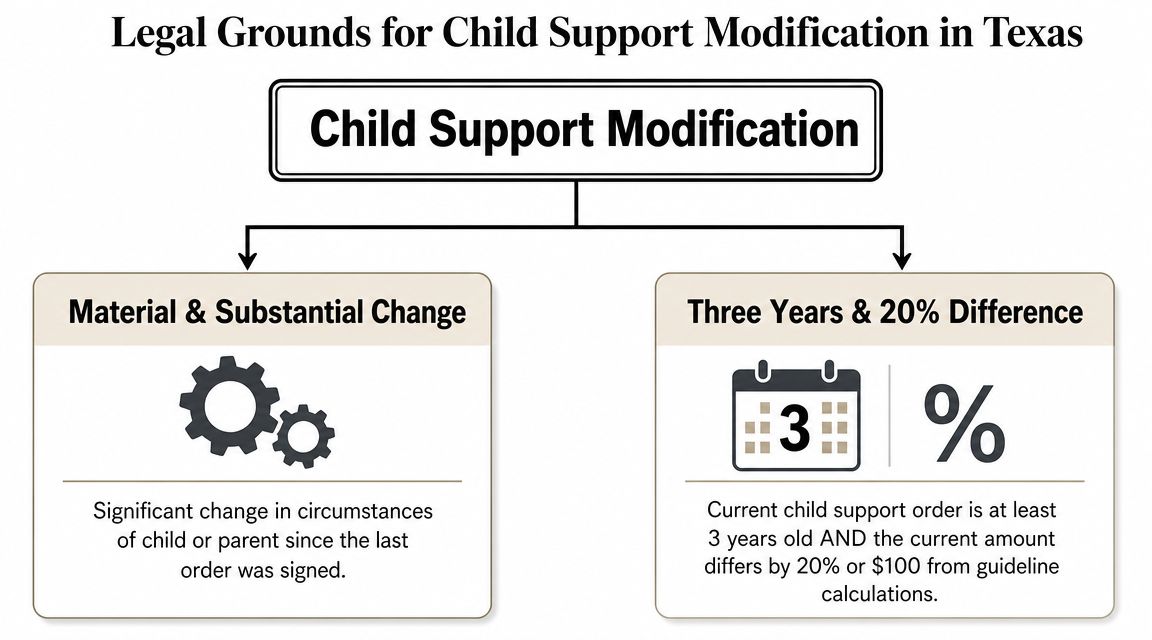
Under the Texas Family Code, courts can modify support when the legal standard is met. The most common standard is a material and substantial change in circumstances. In plain English, that means something meaningful has changed for a parent or the child since the last order.
There is also another route. Texas allows review when the order is old enough and the recalculated support amount is different enough under the legal threshold. That gives some families a path even when there hasn't been one dramatic event.
Practical rule: You can't usually change child support in Texas by agreement alone. The safer question isn't just "Do we both agree?" It's "Will a judge sign an enforceable order?"
The answer to whether can child support be modified in Texas applies to your situation often turns on two things: what changed, and how you ask for the change. That second issue confuses many parents, especially when they don't realize Texas may allow either a direct court filing or, in some cases, a review through the Office of the Attorney General.
The Legal Grounds for a Child Support Modification
A court won't change support because one parent feels the amount is unfair. Texas requires a legal basis for modification.
Material and substantial change
One path is proving a material and substantial change in circumstances. Texas legal sources describe this as a meaningful change affecting the child or a parent, with common examples including a documented income shift, a new dependent, changed medical needs, or incarceration, as discussed by UNT Dallas College of Law on child support modifications in Texas.
That phrase sounds technical, but judges look for practical facts. For example:
- Income changed in a real way. A parent lost a job, changed positions, or had earnings rise or fall in a documented way.
- The child's needs changed. Medical treatment, therapy, insurance costs, or educational needs may now be different.
- The family structure changed. The paying parent had another child to support, or the child's living arrangement changed.
A parent who was temporarily short on cash for one month usually won't persuade a court with that fact alone. A parent who can show an ongoing change supported by documents has a much stronger argument.
The three-year review rule
Texas also allows modification under a second route. According to this explanation of modifying child support in Texas, a child support order can be modified if there has been a material and substantial change in circumstances or if it has been at least 3 years since the order was last set and the recalculated guideline amount would differ from the current order by at least 20% or $100 per month.
This rule matters because not every valid modification case begins with a crisis. Sometimes the order is old, and applying current guideline calculations produces a legally meaningful difference.
What parents often misunderstand
Many parents think the court will automatically revisit support every few years. That's not how it works. A parent still has to request the change through the proper process.
Others think a handshake deal fixes the problem. It doesn't. Until a judge signs a new order, the old one usually controls.
If you want a closer look at examples that may justify a request, this article on top valid reasons for modifying Texas child support can help you compare your facts to common modification grounds.
Courts want proof tied to a legal trigger, not frustration tied to an old order.
The Step-by-Step Process for Requesting a Modification
Knowing that a change may be justified is only half the battle. The next question is procedural: How do you ask?
Texas law allows modification requests through the court system via a formal petition or, in many cases, through the Office of the Attorney General's Child Support Division review process. The path can affect timing and documentation, but any change still must be approved by a judge to be enforceable, as explained by TexasLawHelp's guide to changing a child support order.
Route one through the court
A formal court case is often the clearest path when the facts are disputed, the other parent isn't cooperative, or the situation is legally complex.
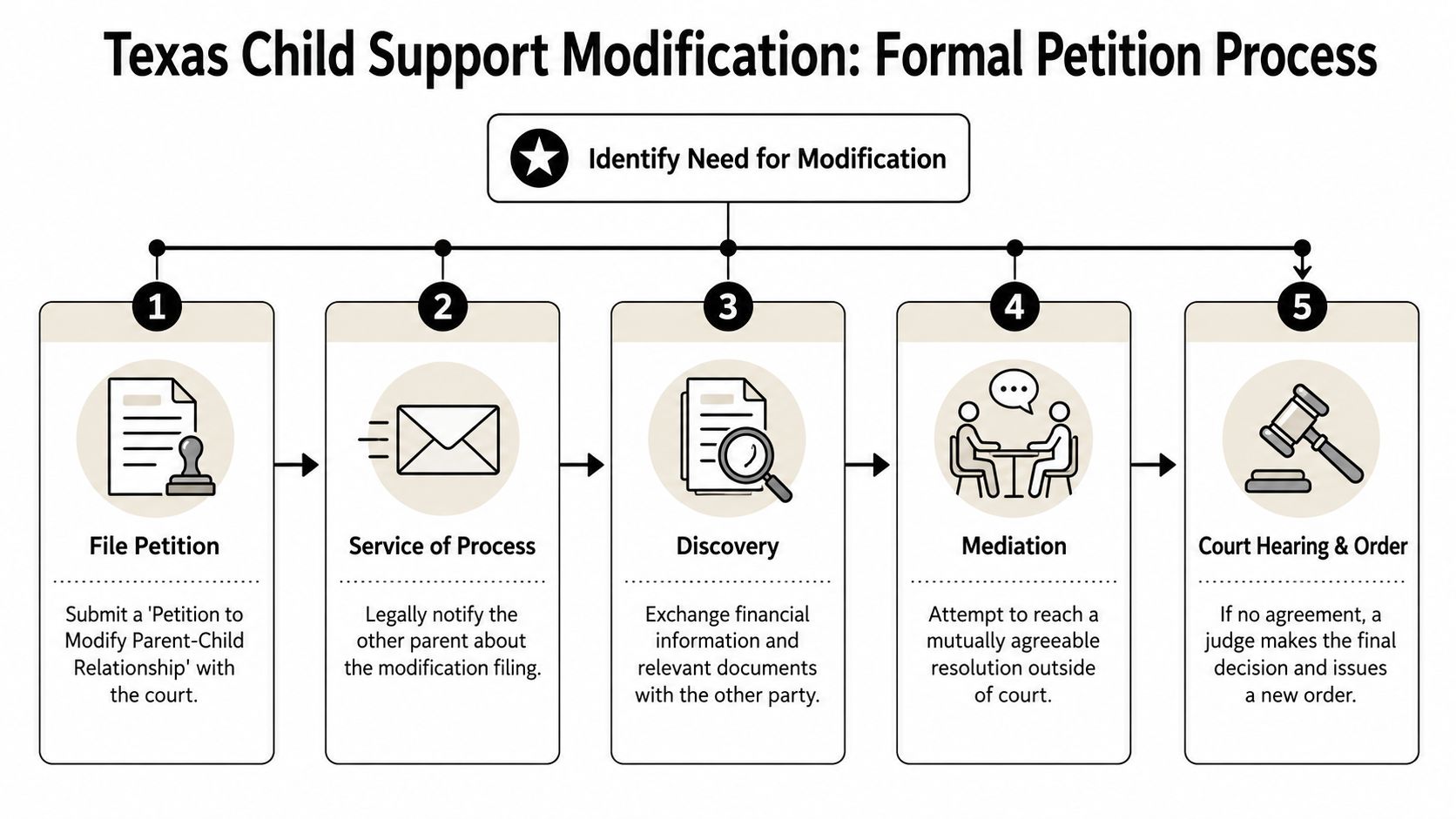
The process usually looks like this:
- File the petition. A parent files a Petition to Modify the Parent-Child Relationship.
- Serve the other parent. Formal notice matters. The other side has to be legally informed.
- Exchange information. Parents may need to share financial records and other documents.
- Negotiate or mediate. Many cases settle before a final hearing.
- Go before a judge if needed. If no agreement is reached, the judge decides.
A practical example helps. If you lost your job and your income fell, filing in court may be the right move when the other parent believes you're choosing not to work. In that setting, your records and testimony become central.
Route two through the OAG review process
If there is an active child support case, some parents may be able to request review through the Office of the Attorney General's Child Support Division instead of starting with a direct court filing. This option can be useful for parents asking, "Can I do this without going straight to court?"
That route may still require substantial paperwork. Parents are often asked for items such as pay stubs, tax returns, proof of insurance, and school records. And even if a negotiation happens through that process, a judge still has to approve the result.
A concise overview of that route appears in this post on the Texas child support review process.
For readers who prefer a visual explanation, this video gives a helpful overview of child support issues in Texas.
Choosing the right path
The better route depends on your facts.
- Use a court petition when the case is contested, urgent, or tied to broader custody issues.
- Consider OAG review when the case is active there and the issue is mainly support review rather than a larger courtroom dispute.
- Remember the final step. No matter how cooperative both parents are, a judge's approval is what makes the change legally enforceable.
The Law Office of Bryan Fagan, PLLC is one option for parents who need help evaluating which path fits their situation and preparing the paperwork that route requires.
Gathering the Right Evidence to Support Your Case
Judges don't modify child support because a parent says things are harder. They modify support because the evidence shows a legally recognized change. Good documents make the difference between a request that sounds understandable and one that is provable.
Match your evidence to your reason
If your claim is based on income, bring income proof. If your claim is based on your child's needs, bring records that show those needs clearly. If your claim is based on a change in living arrangements, gather records that confirm where the child is living and what expenses now exist.
Here's a helpful way to visualize it: every sentence in your request should have a document behind it.
| Reason for Modification | Examples of Required Evidence |
|---|---|
| Income decreased | Recent pay stubs, termination notice, tax returns, benefit statements, job search records |
| Income increased | Current pay records, tax returns, bonus or compensation documents |
| Child has new medical needs | Medical bills, insurance records, treatment plans, pharmacy records |
| Change in school or living arrangements | School records, attendance records, calendars, correspondence, housing records |
| New dependent child | Birth records and documents showing current support responsibilities |
| Incarceration or similar disruption | Official records, court documents, facility documentation |
What strong evidence looks like
Strong evidence is organized, current, and easy to follow. Bring clean copies. Put related records together. If your income changed over time, line up the documents in date order so the court can see the pattern.
Bring records that tell a story from beginning to end. Judges should not have to guess what changed or when it changed.
If financial hardship is part of your case, this guide on how to prove financial hardship for modifying child support in Texas can help you think through what paperwork may matter most.
Avoid common proof problems
Parents often hurt their own case by doing one of three things:
- Relying on general statements. Saying "money is tight" isn't the same as showing actual records.
- Bringing incomplete records. One pay stub rarely explains a full income picture.
- Mixing old and new facts. The court needs to know what has changed since the last order, not every difficulty you've ever faced.
If you're asking for relief, act like you're building a file for someone who knows nothing about your family. That mindset usually produces clearer evidence and better testimony.
Understanding Different Types of Modifications
Not every modification request is asking for the same outcome. Some parents need support increased. Others need it reduced. In active litigation, temporary relief may also become important while the case is pending.

Increase or decrease
An increase is often requested when the paying parent's income has risen or the child's needs have grown. A decrease is often requested after a job loss, a major income reduction, or a family change that affects support calculations, such as a new child to support.
The court still looks back to the legal basis discussed earlier. The label of "increase" or "decrease" doesn't matter as much as the proof behind it.
Temporary changes during a case
Sometimes a family can't wait until the end of the case for relief. In those situations, temporary orders may help stabilize support while the modification is pending. Whether temporary relief makes sense depends on the urgency of the facts and the court handling the matter.
This is especially important where cash flow is immediate. A parent who suddenly cannot meet the existing obligation may need to act quickly rather than allow arrears to accumulate while hoping the issue will work itself out.
Retroactive concerns
It often surprises parents that courts are generally very cautious about changing support for past periods. If a parent waits too long to seek relief, the unpaid amounts under the existing order may still remain enforceable.
That is why timing matters. If a change should be requested, delaying often creates avoidable problems.
Special fact patterns
Some cases don't fit neatly into one category:
- Military families may face income and scheduling changes linked to service obligations.
- Relocation cases may involve support questions tied to possession or custody changes.
- Business owners or high-income parents may need more detailed financial analysis because income isn't always reflected by a simple paycheck.
The form of the modification may be simple on paper, but the underlying facts can be anything but simple.
A parent can have a real reason to change child support and still run into trouble because the case does not fit the usual pattern. That often happens when military service affects availability, a move changes the child's routine, or income comes from a business rather than a paycheck. In those situations, the question is often less about whether something changed and more about how you bring the issue to the right place, with the right proof, in the right format.
That last part matters more than many parents expect.
Military cases often involve timing problems before they involve legal argument. A parent may be deployed, in training, or transferred with little notice. Court dates do not always line up neatly with service obligations, and a judge may need clear information about whether the Servicemembers Civil Relief Act affects the schedule of the case.
A review through the Office of the Attorney General can be useful if the support issue is fairly straightforward and the main obstacle is getting the numbers updated. But if deployment is affecting notice, appearance, or the ability to respond to filings, a formal court petition is often the cleaner path because the court can address scheduling, continuances, and related orders directly.
Bring the paper trail. Military orders, LES statements, housing information, and any documents showing changes in dependent status can help the court or the OAG understand what is happening without guesswork.
Relocation cases often involve more than support math
A move can change who pays for school pickup, after-school care, travel, medical appointments, and day-to-day necessities. Support may still be part of the case, but the procedure you choose should match the problem you are trying to solve.
If both parents mainly need a support review based on updated financial information, the OAG process may be a practical starting point. If the move also affects possession, conservatorship, transportation terms, or where the child is primarily living, filing a petition with the court is usually more appropriate. The OAG review process is narrower. A court case can address the full picture in one place.
That distinction saves people time. It also avoids the frustration of starting in a process that cannot fix the problem you have.
Business owners and high-income cases usually need better records, not broader arguments
A parent who owns a business may look profitable on paper one month and cash-poor the next. Another parent may receive bonuses, commissions, stock compensation, or trust distributions that do not show up like regular wages. These cases often stall because the records are incomplete or hard to read, not because the law is uncertain.
An OAG review can work well when income is easy to verify from wage records. It is often less effective when the case requires tracing business expenses, retained earnings, depreciation, or irregular deposits. A formal court petition gives more room for document requests, subpoenas, and a closer look at whether reported income matches actual resources available for support.
A judge will want a clear story supported by clean records. Profit and loss statements, tax returns, bank records, payroll documents, and explanations for unusual deductions should line up like pieces of the same puzzle.
Cases with several issues at once need the right forum from the start
Sometimes child support is only one part of the dispute. A parent may also be dealing with unpaid support, a custody disagreement, missed visitation, or a child who has started living primarily with the other parent. In that setting, asking the OAG for a review can feel like bringing a single tool to a job that needs a full toolbox.
A court petition is often the better choice when you need the judge to resolve connected issues together. The OAG can be helpful for support review and enforcement in the right case, but it does not replace a broader suit to modify the parent-child relationship.
If your facts are layered, your plan should be layered too. A calm, organized approach can turn a complicated case into a manageable one, and there is usually a workable path once the procedure matches the problem.
Common Defenses and Preparing for Your Hearing
Even when your request is reasonable, the other parent may resist it. That's normal. A modification case often turns less on emotion and more on whether the court finds your evidence credible and legally sufficient.
Defenses you may hear
One common defense is that the change isn't substantial enough. The other parent may argue that your income drop is temporary, your expenses are exaggerated, or the child's needs haven't really changed since the last order.
Another frequent argument is voluntary underemployment or unemployment. In plain terms, that means the other side may claim you reduced your income on purpose to lower support. If that's likely to come up, your documentation should show why the income change happened and what efforts you've made to maintain or replace earnings.
You may also face arguments about incomplete disclosure. If your records are disorganized or selective, the court may wonder what is missing.
How to prepare your presentation
Use a simple system. Put your documents in a binder or folder with sections. Keep financial records together. Keep school or medical records together. Bring an extra copy if possible for reference during discussion.
A strong hearing presentation often includes:
- A short timeline that shows when the last order was signed and when the new circumstances began.
- Clean exhibits that match your testimony.
- A calm explanation of what changed and why the requested order is reasonable.
- A narrow focus on relevant facts instead of marital history or personal grievances.
Courtroom habits that help
Dress neatly. Arrive early. Answer the question asked. Don't interrupt the judge or the other side, even if you disagree with what you're hearing.
Judges evaluate credibility in real time. A parent who appears organized, respectful, and fact-focused often comes across as more reliable than a parent who argues emotionally and wanders off topic.
Speak to the judge as if you're helping the court solve a problem. That tone is usually more persuasive than anger.
One final caution
Don't stop paying under the current order just because you filed for modification. Until the court signs a new order, the existing one generally remains in effect. Parents who assume filing alone changes the obligation can create a second problem while trying to solve the first.
Take the Next Step with Confidence
A child support modification usually turns on one practical question. Do you need to file a formal petition with the court now, or should you ask the Office of the Attorney General to review the order first?
That choice matters because the two paths work differently. An OAG review can be a useful fit when the issue is mainly recalculating support under the guidelines and both parents' financial information can be reviewed through that process. A court petition is often the better route when time matters, the facts are disputed, or your case involves issues the OAG review process may not resolve cleanly. Examples include contested income, special needs expenses, enforcement concerns, or a broader request that needs a judge's direct attention.
Many parents lose time by picking the wrong door first. The good news is that Texas law gives you a path. The better your match between your facts and the process you choose, the faster you can work toward an order that fits your child's real life.
If you need help handling divorce, custody, or estate planning in Texas, contact Law Office of Bryan Fagan, PLLC today for a free consultation. An attorney can review your current order, help you decide whether a court petition or OAG review makes more sense, and give you personalized guidance based on your family's specific circumstances.



