When you search for what is full custody in Texas, you're usually not looking for jargon. You're trying to protect your child, create stability, and understand what the court can do if co-parenting isn't working.
That concern is valid. Texas custody law can feel cold and technical when your real questions are highly personal. Who makes school decisions? Who decides medical care? Will the other parent still get visitation? Will child support change? The good news is that once you translate the legal language into plain English, the process becomes easier to understand.
The Myth of Full Custody in Texas Law
Parents say “full custody” all the time. Texas courts usually don't.
Under Texas law, the issue is generally framed as conservatorship, not “full custody.” That difference matters because the court is deciding more than where a child sleeps. It is deciding who has legal authority to make important choices and how parental rights will be divided in a court order.
Texas legal aid materials explain that custody requires a court order and that the parent with decision-making authority may control the child's primary residence, while the other parent may still keep rights and access depending on the order, which is why the phrase “full custody” often causes confusion in real cases (Texas Law Help on child custody). If you want a deeper plain-English breakdown, this guide on sole custody definitions in Texas law can help.
What parents usually mean
Most parents who ask about full custody mean one of these things:
- Primary residence authority. They want the child to live mainly with them.
- Decision-making control. They want final say over school, medical care, or counseling.
- Safety protections. They want to limit the other parent's power because of instability or danger.
- Predictability. They want a court order that reduces conflict and constant disputes.
The Texas terms that matter
Texas cases usually focus on two legal labels:
- Joint Managing Conservatorship
- Sole Managing Conservatorship
For many worried parents, Sole Managing Conservatorship is the closest legal concept to what they mean by full custody.
Plain-English takeaway: In Texas, “full custody” isn't a magic legal status. It's usually a question about whether one parent should have exclusive decision-making authority.
That distinction is important because a parent can have broad legal rights without cutting the other parent completely out of the child's life. A court may give one parent stronger authority while still preserving possession or visitation for the other parent.
Joint vs Sole Managing Conservatorship Explained
Texas courts start from the presumption that parents will be appointed joint managing conservators. A court moves to sole managing conservatorship only when the evidence shows joint decision-making would not be in the child's best interest or would impair the child's physical or emotional well-being (Texas Access on custody and visitation). If you're comparing options in more detail, this overview of a sole managing conservator in Texas is a useful companion.
What Joint Managing Conservatorship looks like
Under Joint Managing Conservatorship, both parents typically share important rights and duties. That doesn't always mean equal parenting time. It means the court expects both parents to remain involved in major decisions unless a specific order gives one parent an exclusive right.
In many families, one parent is still named the parent who determines the child's primary residence. So even in a joint arrangement, the practical day-to-day structure may not be perfectly equal.
What Sole Managing Conservatorship changes
Under Sole Managing Conservatorship, one parent can receive exclusive legal authority over major parts of the child's life. That often includes the right to determine the child's primary residence and make core decisions about education and medical care.
The key difference is legal control, not just time. A parent may still see the child and remain involved, but they may no longer have equal authority over the decisions that shape the child's routine and future.
Comparing parental rights
| Parental Right/Decision | Joint Managing Conservatorship (JMC) | Sole Managing Conservator (SMC) |
|---|---|---|
| Child's primary residence | Often assigned to one parent, with shared conservatorship overall | Usually controlled by the sole managing conservator |
| Major education decisions | Often shared, or allocated by court order | Can be held exclusively by the sole managing conservator |
| Major medical decisions | Often shared, or divided in the order | Can be held exclusively by the sole managing conservator |
| Day-to-day care decisions | Usually handled by the parent caring for the child at the time | Usually handled by the parent caring for the child at the time, with broader legal authority resting with the SMC |
| Other parent's role | Still has legal rights under the order | Often reduced to possessory conservator status with access rights rather than shared legal control |
The biggest misunderstanding I see is this: parents focus on “custody” as time, while judges often focus on “custody” as authority.
A simple example
Suppose two parents argue constantly over therapy, school enrollment, and medication. If the conflict is severe enough that shared decision-making keeps harming the child's stability, a judge may decide one parent needs final authority.
That is much closer to what “full custody” means in Texas than just having the child more nights each month.
The Best Interest of the Child Standard
Texas courts don't award conservatorship based on which parent feels more wronged. They decide based on the best interest of the child.
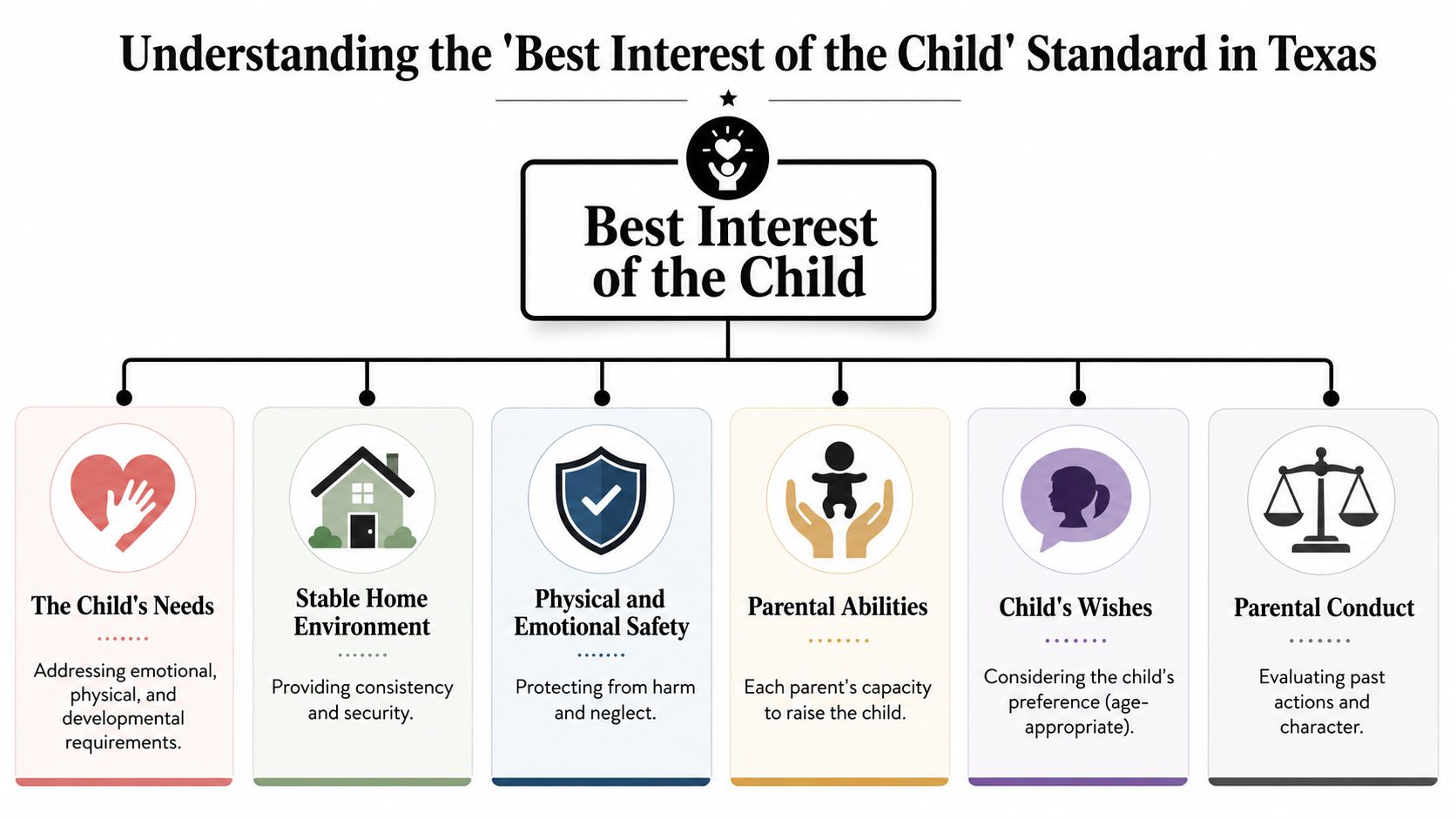
Texas guidance explains that courts use the Holley factors, a framework that looks at the child's emotional and physical needs, each parent's abilities, the stability of the home, and the parent-child relationship when deciding the right conservatorship arrangement (Texas Parent Helpline custody guidance).
What judges are really asking
A judge is usually asking practical questions such as:
- Who provides stability? A parent with dependable housing, reliable routines, and steady involvement often presents a stronger case.
- Who meets the child's needs? That includes school support, emotional care, medical follow-through, and daily supervision.
- Is the child safe? Safety concerns can outweigh almost everything else.
- Can the parents cooperate? If one parent consistently creates conflict that affects the child, that matters.
- What does the parent-child relationship look like? Judges look at history, involvement, and the quality of the bond.
What these factors look like in real life
“Stability” is not an abstract word in court. It can mean one parent makes sure the child gets to school on time, keeps medical appointments, and maintains a calm home.
“Parenting ability” may show up in ordinary details. Who knows the child's teacher? Who responds when the school calls? Who manages prescriptions, therapy, tutoring, or behavioral support?
A strong custody case often turns on everyday facts, not dramatic speeches.
Why this standard matters so much
Parents sometimes believe the court is choosing between a “good parent” and a “bad parent.” That isn't really the test. The court is deciding which legal arrangement best protects the child's development, safety, and stability.
That means a parent can lose decision-making power even if the case doesn't involve the worst possible allegations. If the evidence shows that one structure will work better for the child, the court can tailor the order to fit that reality.
Proving Your Case for Sole Managing Conservatorship
If you're asking for Sole Managing Conservatorship, you need more than a sincere belief that it's necessary. You need proof.
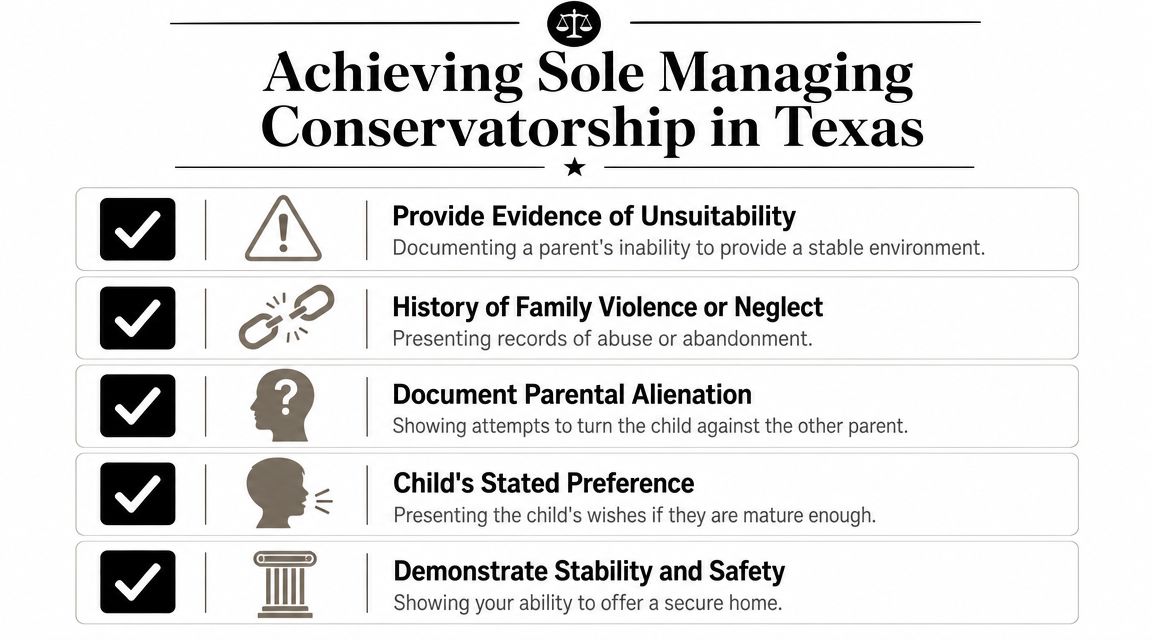
Texas family law sources consistently frame this as an evidence threshold problem. Courts want objective proof, such as police reports, medical records, and third-party witness statements, showing that limiting the other parent's authority is necessary to protect the child from documented neglect, abuse, or severe instability (guidance on proving sole managing conservatorship).
What counts as persuasive evidence
A judge is usually more persuaded by records than by conclusions.
Helpful evidence can include:
- Official reports. Police reports, CPS records, or incident documentation.
- Medical records. Records that reflect injuries, untreated needs, or concerning patterns.
- School records. Attendance issues, repeated tardiness, behavior concerns, or communication from school staff.
- Messages and logs. Texts, emails, and calendars that show missed exchanges, threats, or refusal to cooperate.
- Witness statements. Teachers, counselors, relatives, neighbors, or other adults with firsthand knowledge.
What not to do
Don't build your case around labels. Saying “the other parent is unstable” is much weaker than showing repeated missed pickups, unsafe supervision, or refusal to obtain medical care.
Don't exaggerate. When a parent overstates facts, it can damage credibility fast.
Don't ignore your own conduct. The court will look at both parents, not just the one being accused.
A better way to present your case
Try to organize your concerns by cause and effect.
Instead of saying, “They're irresponsible,” show the pattern:
- missed school days,
- lack of supervision,
- repeated last-minute cancellations,
- increased stress for the child,
- conflict that blocks basic decisions.
That approach helps the judge see why sole authority may be necessary.
Practical rule: Document events close to when they happen. Contemporaneous records usually carry more weight than memories shared months later.
If you're preparing for a custody dispute, options may include working with a private family law attorney, using legal aid if you qualify, or consulting a firm that handles Texas conservatorship cases, such as Law Office of Bryan Fagan, PLLC, for case-specific guidance about evidence, temporary orders, and trial preparation.
Possession Schedules and Child Support Realities
Many parents assume “full custody” means the other parent disappears from the schedule. That usually isn't how Texas orders work.
Even when one parent is the primary conservator, the other parent often still has substantial time. One Texas family-law summary states that fathers receive about 33% of custody time on average, which is roughly 120.5 days per year, and it also notes that child support guidelines are income-based, starting at 20% of net monthly income for one child (Texas family law breakdown and custody statistics). For a closer look at parenting-time expectations, see this discussion of Texas standard visitation rights.
Conservatorship is not the same as possession
Parents often get tripped up here.
A final order may divide the case into separate buckets:
- Conservatorship. Who has legal rights and decision-making power.
- Possession and access. When each parent has time with the child.
- Child support. Who pays support and how much under the guideline framework.
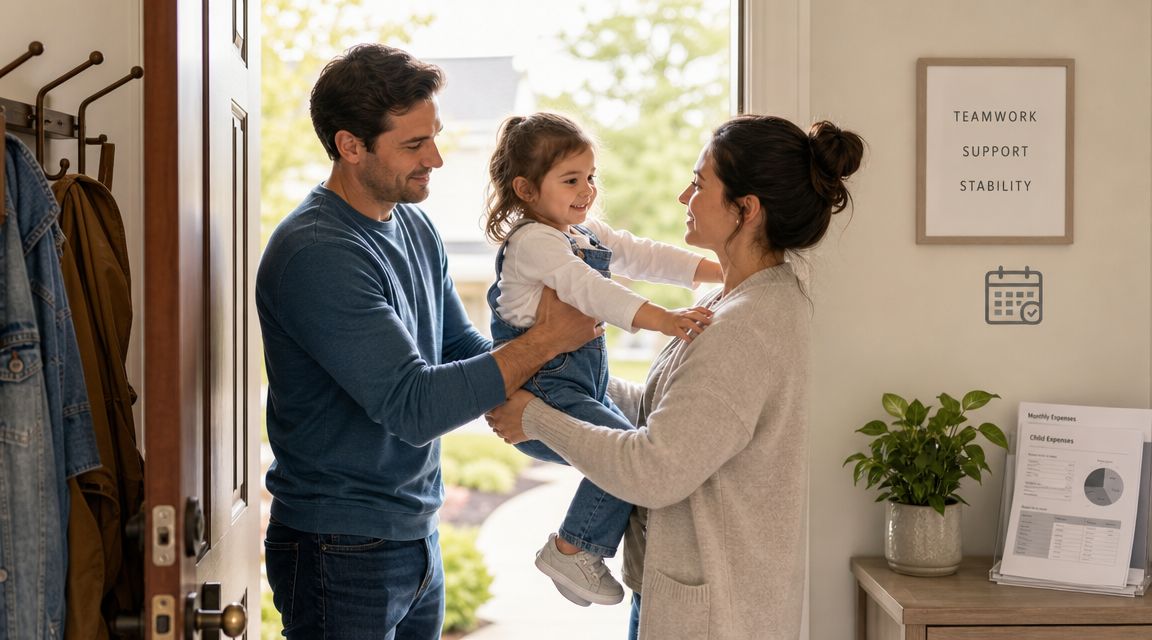
A parent can be the sole managing conservator and still have an order that gives the other parent possession. In other words, one parent may control major decisions while the other parent still has meaningful time with the child.
What that means in daily life
If you receive the authority to make key decisions, your day may become more stable because you no longer need the other parent's agreement for every major issue the order assigns to you.
But that doesn't automatically mean no exchanges, no holiday schedule, or no summer time for the other parent. Unless the danger is serious enough to justify tighter restrictions, Texas courts often preserve some level of parent-child contact.
Child support follows its own rules
Child support and conservatorship are connected, but they are not identical.
The label “full custody” doesn't eliminate support questions. Texas guidelines are income-based, and support can still apply whether the order uses joint or sole conservatorship language. That's one reason it helps to stop thinking in slogans and start reading the actual terms of the proposed order.
The Legal Process for a Texas Custody Case
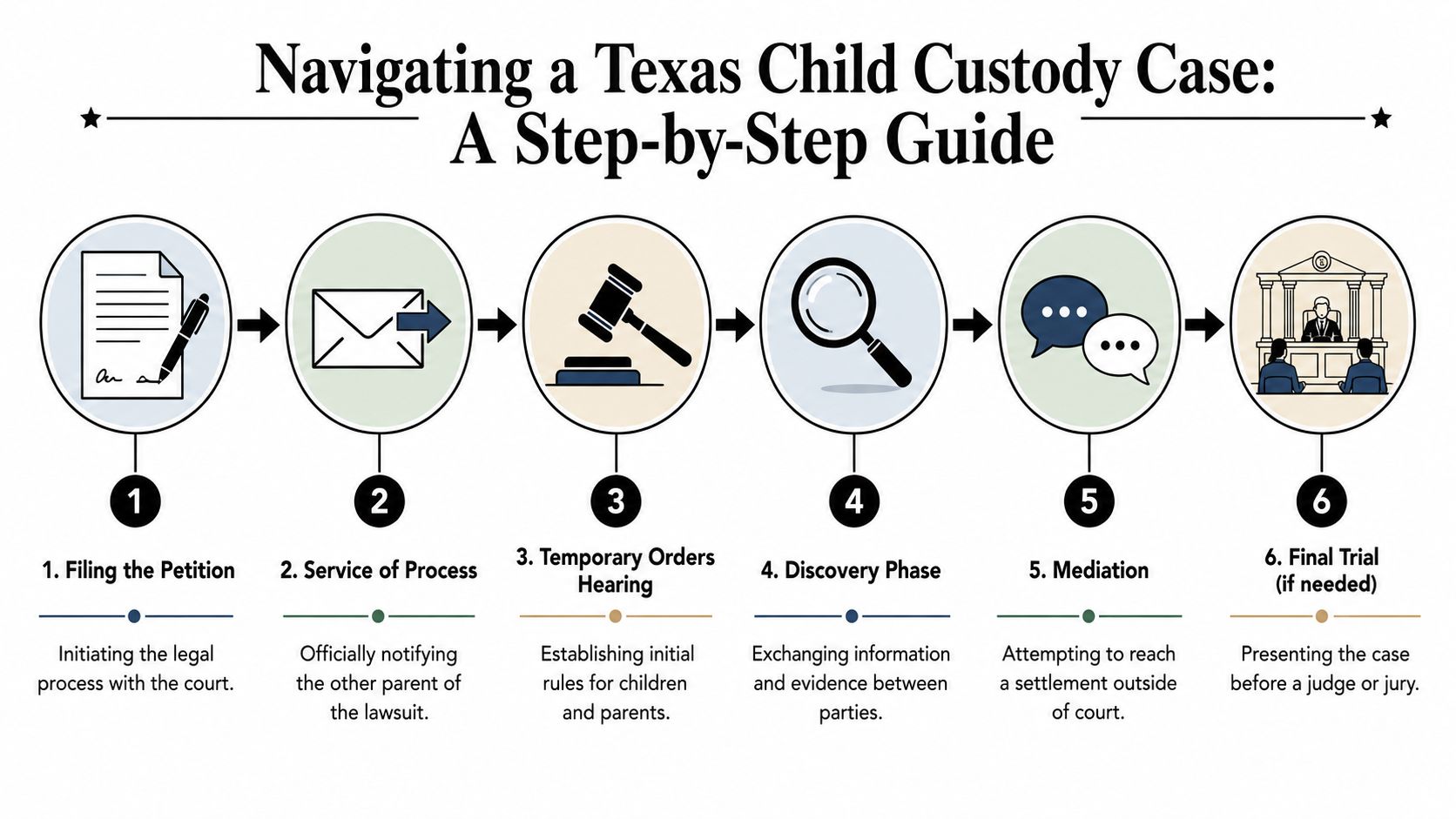
The legal process feels less intimidating when you know what happens next. Most custody cases follow a sequence, even if the details vary.
This graphic gives a quick overview of the path many parents experience in court.
Step 1 through Step 3
Filing the petition
A case starts when one parent files a petition asking the court for orders about conservatorship, possession, support, or related relief.Service on the other parent
The other parent must be formally notified. That gives them a chance to respond.Temporary orders
If things are urgent, the court can enter temporary orders that set ground rules while the case is pending. These orders may address where the child stays, who pays what, and how decisions are handled for now.
Temporary orders matter because they often shape the child's routine while the case is unfolding.
A short video can also help you visualize how these disputes move through court.
Step 4 through Step 6
Discovery
This is the information-gathering phase. Parents exchange records, answer written questions, and collect evidence that supports their position.Mediation
Many Texas custody disputes are negotiated before trial. Mediation gives both parents a chance to reach a structured agreement with the help of a neutral mediator.Final trial if needed
If no agreement is reached, the judge decides. At trial, the court hears testimony, reviews exhibits, and applies the best-interest standard to the evidence presented.
How to prepare yourself
The legal process is easier to manage when you focus on a few practical habits:
- Stay organized. Keep school records, medical records, calendars, and messages in one place.
- Follow existing orders. Judges notice consistency.
- Communicate carefully. Assume written messages may be read in court later.
- Keep your child out of the conflict. Courts pay close attention to whether a parent supports the child's emotional well-being.
Frequently Asked Questions About Texas Custody
Can both parents agree to sole managing conservatorship
Yes, parents can propose agreed terms, but the court still has to approve the arrangement. A judge will look at whether the proposed order serves the child's best interest, not just whether both adults signed it.
If I get sole managing conservatorship, can I move wherever I want
Not always. Many custody orders contain geographic restrictions tied to the child's residence. If you want to relocate later, you may need a modification and court approval depending on the terms of your order.
Is abuse required to get what people call full custody
No. Serious safety concerns can strongly support sole managing conservatorship, but courts can also look at instability, inability to co-parent, neglect, or other facts that show joint authority isn't workable for the child.
Can the other parent still have visitation
Often, yes. A parent may lose shared decision-making authority and still keep possession or access rights. The exact terms depend on the facts, the evidence, and the court's view of the child's welfare.
Can a custody order be changed later
Yes, but you usually need a proper legal basis and evidence supporting the requested change. Parents often seek modification when circumstances shift, the child's needs change, or the existing order stops working in practice.
What should I do first if I'm worried about my child
Start documenting facts. Keep records, save communications, note missed exchanges, and gather school or medical information if relevant. Then speak with a qualified Texas family law attorney about whether your concerns support temporary orders, a modification, or a request for sole managing conservatorship.
If you need help navigating divorce, custody, or estate planning in Texas, contact Law Office of Bryan Fagan, PLLC today for a free consultation.