
A divorce often begins subtly. You're sitting at the kitchen table in Houston Heights, thinking about the house, the kids, the accounts, maybe a rental property, and wondering what happens if this becomes real. That uncertainty is heavy, but the process itself doesn't have to stay confusing.
Texas divorce law gives you a structure. Once you understand how filing works, how property is divided, and what the court expects in Harris County, the next steps become clearer. Good legal guidance won't remove the emotions from divorce, but it can reduce avoidable mistakes and help you make decisions from a position of knowledge instead of fear.
Divorce can be one of life's hardest transitions, especially when you're trying to protect your finances, keep stability for your children, and make sense of legal deadlines all at once. If you live in Houston Heights, your case will move through a Harris County system with specific rules, timelines, and expectations. Knowing those rules early gives you an advantage.

The broader context matters too. According to the most recent statistics from the United States Census Bureau, the Texas divorce rate was 8.4 per 1,000 women in 2018, a benchmark noted in this Houston divorce rate reference. That doesn't tell you how your case will end, but it does show that divorce is a familiar part of the Texas family law field, including Harris County.
What usually feels most urgent
For most clients, the first questions are practical:
- Where do I file: Houston Heights cases are generally handled in Harris County.
- What happens to the home or investments: Texas follows community property rules, but the result isn't always a strict equal split.
- What if we have children: Conservatorship, possession, and support need immediate attention.
- How do I avoid expensive mistakes: Early organization often matters more than early arguments.
Practical rule: The first smart move in a divorce is not “fight harder.” It's getting a clear picture of your assets, your obligations, and your goals.
Why local detail matters
A generic online divorce checklist won't tell you how a Harris County judge may view incomplete records, poorly documented rental income, or a rushed agreement on custody. That's where a Houston Heights divorce lawyer becomes useful. Local procedure affects bargaining power, timing, and settlement value.
You don't need to know everything today. You do need a reliable path forward, and that starts with understanding what your lawyer does.
What a Houston Heights Divorce Lawyer Does for You
A divorce lawyer does much more than show up in court. In practice, the role is part legal strategist, part negotiator, and part steady guide through a process that can turn chaotic quickly if no one is managing it.

If you want a broader overview of the attorney's role in Texas family cases, this complete guide to what Texas family law attorneys do is a useful companion.
Strategist
At the start of a case, your lawyer should identify what matters most and what can wait. That usually means reviewing income, debts, property records, children's schedules, and any immediate risks such as hidden spending or one spouse cutting off access to funds.
For some clients, the strategy is efficient settlement. For others, the case requires tighter control from the beginning because one side owns a business, receives irregular compensation, or refuses to provide documents. A lawyer helps you avoid reacting to every emotional moment and instead build a plan around evidence.
A lawyer may also help you determine whether formal Divorce representation is needed for a contested, uncontested, or high-conflict case.
Advocate
Advocacy starts long before trial. Your attorney drafts the Original Petition for Divorce, responds to counterclaims, requests records, prepares for temporary orders, and pushes for enforceable terms in negotiations. If your spouse makes claims about parenting, spending, or property ownership, your lawyer's job is to answer those claims with facts and admissible proof.
The clients who do best usually aren't the loudest. They're the ones whose positions are documented clearly and presented consistently.
A strong advocate also knows when not to escalate. Some issues should be negotiated because the cost of fighting outweighs the benefit. Others should be litigated because compromise would create long-term harm.
Guide
Divorce is procedural. Deadlines matter. Language in temporary orders matters. The wording of a final decree matters even more because that document controls what happens after the case ends.
A Houston Heights divorce lawyer should help you with the parts clients often underestimate:
- Document collection: tax returns, bank statements, deeds, retirement statements, and business records.
- Decision sequencing: what needs action now versus what can be addressed in mediation.
- Settlement review: making sure a “deal” is workable after the divorce.
- Court preparation: helping you know what to expect before hearings or mediation.
That guidance is what keeps a difficult case from becoming even harder than it needs to be.
The Texas Divorce Process in Harris County
If you live in Houston Heights, your divorce will generally move through the Harris County family courts. That local setting matters. Houston Heights divorce lawyers operate within Harris County's Family Court Building at 1115 Congress Ave, and under Rule 193.5 of the Texas Rules of Civil Procedure, asset discovery must be served within 30 days of the initial request. The source cited here also states that strict enforcement can produce a 40% reduction in contested divorce timelines in those cases, as noted in this Harris County divorce procedure overview.
How the case usually unfolds
Texas divorces follow a recognizable sequence.
Filing the petition
One spouse files an Original Petition for Divorce. This starts the case.Service or waiver
The other spouse is formally served unless they sign a proper waiver.Temporary orders if needed
If there are urgent issues involving children, bill payment, use of the home, or preservation of property, the court can enter temporary orders.Information exchange
Each side gathers and shares records. This is often where the true nature of the case becomes visible.Negotiation or mediation
Many cases resolve through structured negotiation rather than trial.Final decree
If the parties agree, the decree reflects that agreement. If not, the judge decides disputed issues.
For a practical filing walk-through, this step-by-step guide to filing for divorce in Harris County can help you understand the opening stage.
Typical Texas Divorce Timeline in Harris County
| Phase | Typical Duration | Key Actions |
|---|---|---|
| Filing and service | Varies by case | Petition filed, spouse served or waiver signed |
| Waiting period | Texas requires a mandatory waiting period | Initial planning, document gathering, temporary relief if needed |
| Discovery and negotiation | Varies by case complexity | Exchange of records, identify disputed property and parenting issues |
| Mediation or final preparation | Varies | Settlement discussions, draft decree, prepare unresolved issues |
| Finalization | After legal requirements are met | Prove-up or final hearing, decree signed |
What works and what doesn't
Clients often assume the case moves because time passes. It doesn't. It moves because someone gathers records, answers requests, proposes terms, and pushes deadlines forward.
What works in Harris County is disciplined preparation. Keep records organized, answer your lawyer's requests promptly, and treat discovery deadlines seriously.
What doesn't work is informal side deals. If you and your spouse agree that one of you will pay a mortgage, keep a parenting schedule, or preserve a business account, that understanding should be reflected in formal orders when necessary. Otherwise, it's fragile.
Cases slow down when people rely on memory and verbal promises. Courts rely on documents.
Key Issues Your Divorce Will Address
Every divorce has its own history, but most decrees resolve three core areas. Property, children, and financial support. In Houston Heights, property questions often become more technical because families may own investment accounts, closely held business interests, or short-term rental properties that don't fit neatly into a simple checklist.
Property division under Texas law
Texas Family Code § 7.001 says the court must divide the marital estate in a manner that is “just and right.” In practice, that often means a 50/50 split of community property, but judges may depart from that based on the rights of each party and the needs of any children, as explained in this Texas property division resource.
That standard matters because many clients assume “community property” means every asset is split down the middle with no exceptions. That's not how courts operate. A judge may consider fault, earning power, custody arrangements, or waste of marital assets when deciding what is just.
Why short-term rentals create disputes
Houston Heights has many owners with properties used as short-term rentals. In divorce, those assets can create problems quickly. One spouse may view the property as straightforward real estate. The other may argue it functions more like an income-producing business because of booking history, operating costs, occupancy patterns, furnishings, and tax treatment.
That classification fight affects valuation and negotiation. If the property generated cash flow during the marriage, both the ownership interest and the income history may matter. If one spouse managed bookings and maintenance, the recordkeeping may be uneven, which complicates the picture further.
Consider a common scenario. A couple owns a Heights bungalow used part-time as a short-term rental. The title history, mortgage payments, repair costs, online booking revenue, and account deposits don't all point in the same direction. Before anyone can discuss a fair division, someone has to trace what was separate, what became community, and how the property functioned during the marriage.
A property dispute is rarely about the building alone. It's about title, income, debt, tax treatment, and who can prove each piece.
Children and parenting arrangements
When children are involved, the court addresses conservatorship, possession, and support. Parents often call this “custody,” but Texas uses more specific terms. Conservatorship covers decision-making rights and duties. Possession addresses the schedule.
The strongest parenting cases usually focus on stability. School routines, medical care, transportation, communication, and each parent's reliability matter more than broad statements about who loves the child more.
If marital misconduct is part of your situation, it can also affect how you approach negotiations and evidence. For a practical overview, this guide on how infidelity affects divorce proceedings can help you think through the issue carefully.
Support issues may include child support, health insurance responsibility, uncovered medical costs, and in some cases spousal maintenance under the Texas Family Code. The legal question is not just whether support exists. It's how long it may last, what proof is needed, and whether the final terms are realistic.
A settlement that looks acceptable on paper can fail if it ignores irregular income, rental fluctuations, or major debt service. That's especially true when one spouse is self-employed or income comes from several sources rather than a single paycheck.
Choosing the Right Houston Heights Divorce Lawyer
Not every lawyer is the right fit for every divorce. In Houston Heights, that matters even more if your case involves business ownership, military service, contested parenting issues, or property that needs careful tracing and valuation.
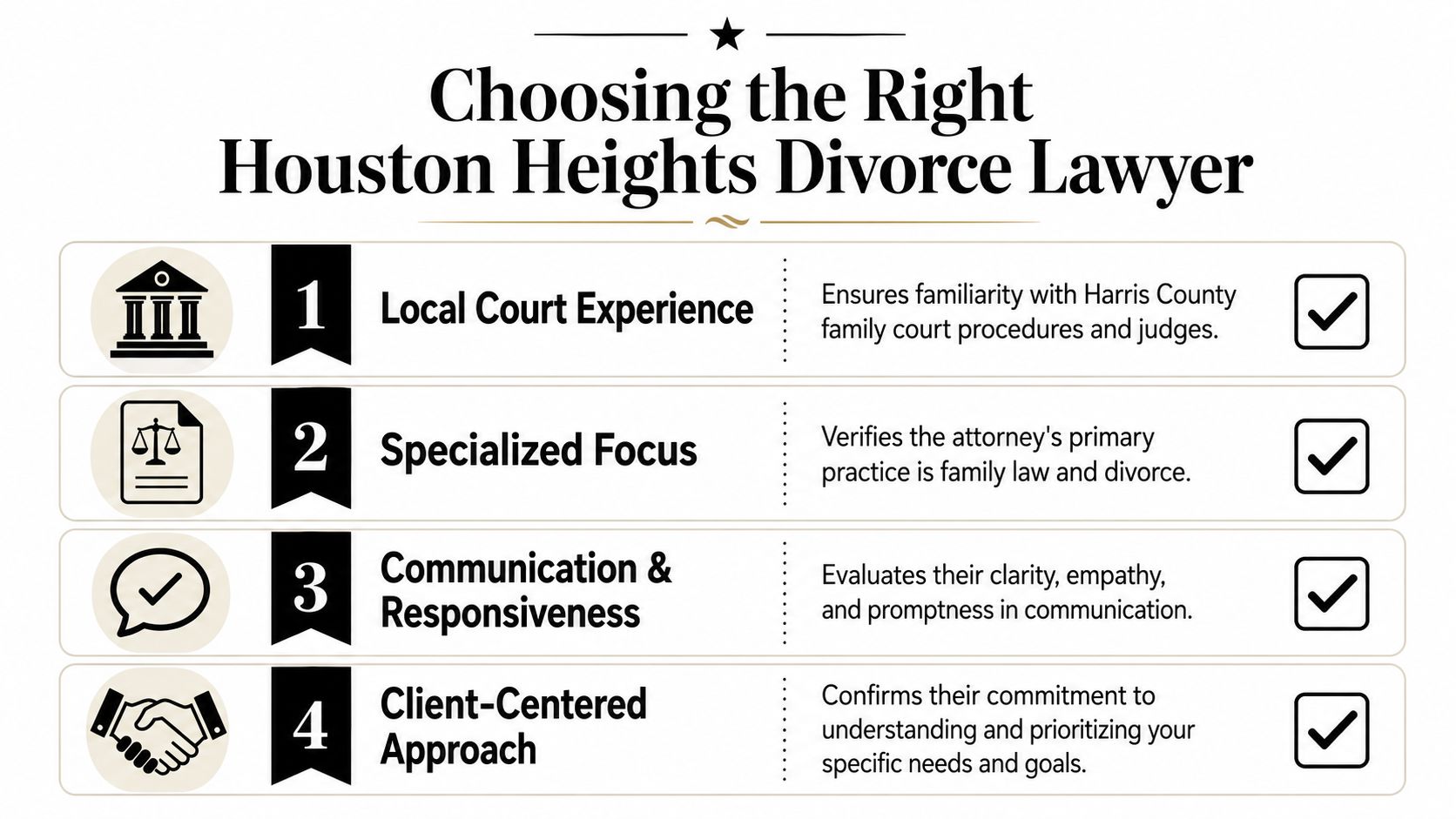
A good starting point is this guide on how to choose a divorce lawyer, which helps frame the decision in practical terms rather than emotional ones.
Credentials and local experience
One useful marker is Board Certification. In Texas, a divorce lawyer specializing in this area may be Board Certified in Family Law by the Texas Board of Legal Specialization, a credential that requires 5+ years of focused practice and peer review, and only approximately 15% of Texas family law attorneys hold it, according to this Texas family law board certification overview.
That doesn't mean a non-certified lawyer can't handle a divorce. It does mean the credential can help you identify attorneys who have made family law a serious concentration.
Questions worth asking in a consultation
Bring written questions. The quality of the answers tells you a lot.
- Case approach: Ask how the lawyer would handle your specific concerns, not divorce in the abstract.
- Communication style: Find out who will answer routine questions and how updates are typically given.
- Financial clarity: Ask how billing works and what kinds of events usually increase cost.
- Courtroom readiness: If settlement fails, ask who will handle hearings and trial preparation.
The Law Office of Bryan Fagan, PLLC is one option for Texas family law representation, including contested matters, and its contested divorce page outlines that service category.
Here is a visual many clients find helpful before a consult.
Watch for fit, not just credentials
A strong lawyer should be able to explain your case plainly. If the attorney avoids direct answers, overpromises outcomes, or treats your concerns as routine when they aren't, that's a warning sign.
This short video may help you think through the decision.
Some clients need a settlement-focused attorney. Others need someone prepared for a hard discovery fight. The right Houston Heights divorce lawyer is the one whose skills match your actual case, not the one who gives the most confident first impression.
Begin Your Next Chapter with Confidence
Divorce changes daily life fast. Even so, many individuals find comfort once they move from uncertainty into a plan. When you understand the legal framework, gather the right records, and get advice specific to your facts, the case becomes more manageable.
That's especially true in Houston Heights, where property issues can be more layered than generic divorce articles suggest. A family home may also be an income asset. A parenting dispute may need immediate structure. A settlement may look fair until taxes, refinance terms, or support obligations are added back into the picture.
Give yourself room to handle both law and healing
Good legal planning matters, but emotional support matters too. If you're trying to process the personal side of divorce while making legal decisions, this St. Petersburg divorce support guide offers thoughtful perspective on grief, adjustment, and hope after separation.
You don't have to solve every issue at once. You need the next sound decision, then the one after that.
A careful lawyer helps you protect your rights. A clear process helps you protect your future. If you need help navigating divorce, custody, or estate planning in Texas, contact The Law Office of Bryan Fagan today for a free consultation.
If you're dealing with divorce questions in Houston Heights, including property division, child-related issues, or complex assets such as short-term rentals, Law Office of Bryan Fagan, PLLC offers free consultations to discuss your situation and explain your options under Texas law.