
A lot of people start looking for a Houston Heights family lawyer at a hard moment. You may have just been served with divorce papers, realized a custody schedule no longer works, or started worrying about what happens to your home, business, or retirement accounts if your marriage ends.
That uncertainty is heavy. The good news is that Texas family law follows clear legal standards, and with steady guidance, you can make informed decisions instead of reacting out of fear. For Houston Heights residents, that often means looking beyond generic divorce advice and focusing on the issues that affect life here, including complex property division, business interests, and custody problems that cross state lines.
The Core Responsibilities of a Houston Heights Family Lawyer
A family lawyer does more than file paperwork. A good Houston Heights family lawyer acts as a strategic guide, helping you understand your legal position, make sound choices under pressure, and move your case toward a workable outcome.
Texas sees substantial demand for family law services. In 2018, Texas had a divorce rate of 8.4 per 1,000 women, according to the United States Census Bureau, a benchmark that reflects the volume of family law matters handled in major markets like Houston, as noted in this discussion of Houston divorce demand.
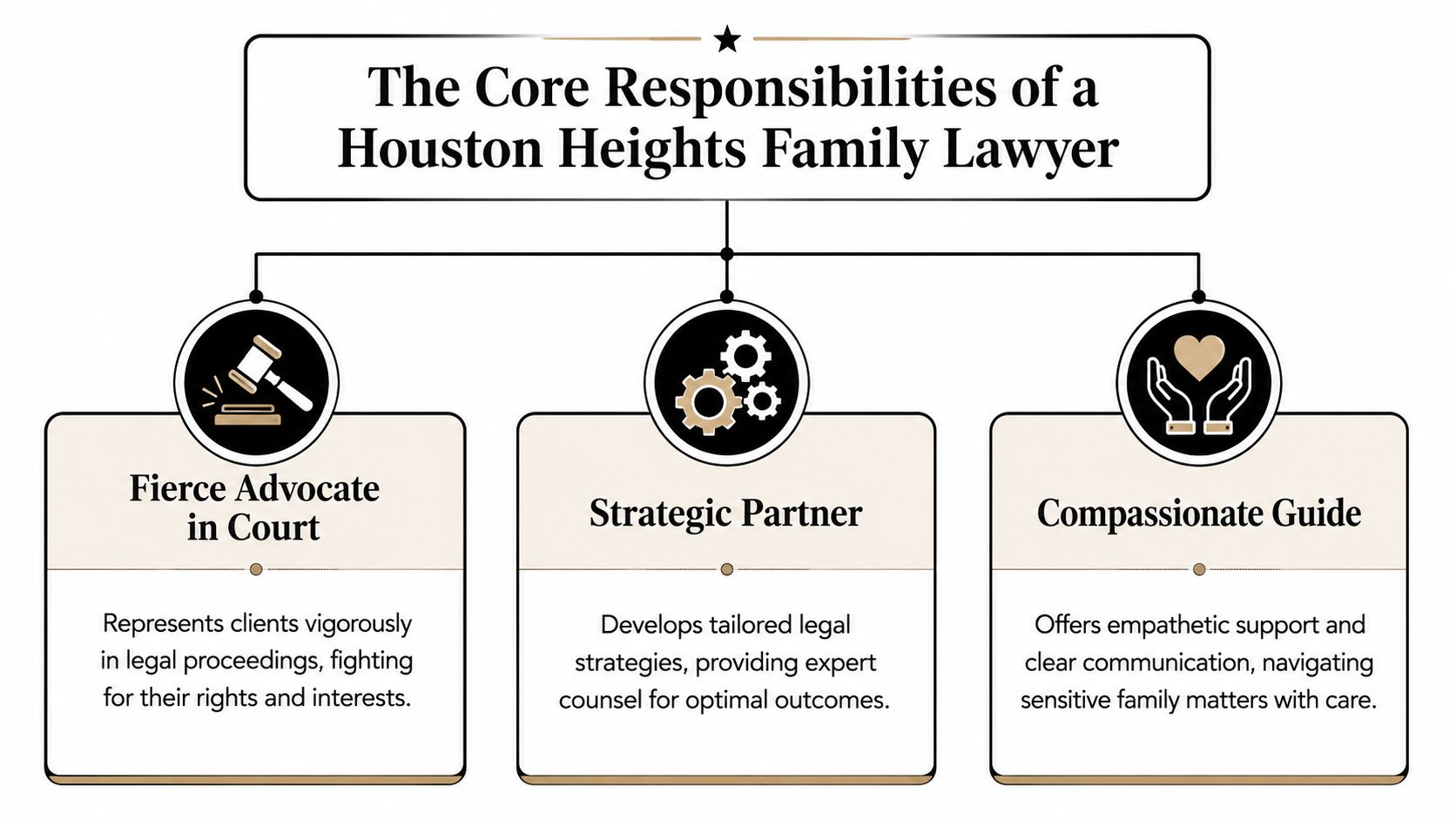
Advocate when conflict reaches the courtroom
Some cases settle. Others don't. When a dispute involves custody, hidden financial issues, temporary orders, or a spouse who won't compromise, your attorney becomes your advocate in court.
That means presenting evidence, challenging weak claims, preparing you for hearings, and making sure the judge hears a clear, legally grounded story. In a Contested Divorce, the job is factual and disciplined. The issue is not who is angriest. The issue is who can prove what matters.
Negotiator when resolution is possible
Many family law matters are resolved through negotiation or mediation rather than a final trial. That matters because settlement can save time, protect privacy, and give families more control over the details.
A strong lawyer doesn't treat negotiation as “giving in.” The lawyer identifies what matters most, where flexibility makes sense, and where a firm line protects your long-term interests.
Practical rule: The best settlement is not the one that sounds nicest in a conference room. It's the one you can actually live with six months later.
Counselor when the legal answer is only part of the problem
Family law decisions affect children, housing, finances, and daily life. You need advice that connects legal rules to real consequences.
That may include deciding whether to stay in the marital home, how to document parenting concerns, whether mediation is worth trying, or how to protect separate property before negotiations begin. A useful overview of that wider role appears in this guide on what Texas family law attorneys do.
A good lawyer is not there only for the fight. The lawyer is there to help you make the next smart decision, then the next one after that.
Guiding You Through Common Family Law Matters
Many who contact a family lawyer are dealing with one of a few core problems. Divorce, custody, support, and post-decree changes all sound technical at first. They become easier to handle when you connect them to everyday situations.
Divorce and the difference between agreement and dispute
Some Houston Heights couples agree that the marriage should end and can work through practical terms with limited conflict. Others agree on the divorce itself but disagree on the house, parenting time, debt, or support. Still others dispute nearly everything.
An uncontested divorce is usually smoother because the parties have already reached agreement on the major issues. A contested divorce requires formal negotiation, mediation, or court intervention. The legal process is still manageable, but preparation matters much more.
One common example is a couple who agrees to divorce but cannot agree on whether one spouse should remain in the home until it sells. That single disagreement can affect temporary orders, budgeting, and final property division.
Conservatorship and parenting decisions
Texas usually uses the term conservatorship instead of “custody.” Conservatorship covers decision-making rights and duties involving the child, while possession and access address the actual schedule.
Under Texas Family Code §153.002, courts decide conservatorship based on the best interest of the child standard, including the child's emotional and physical needs, the stability of the home, and any history of domestic violence or neglect, as summarized in this explanation of Texas conservatorship standards.
If you are a parent, that standard usually raises practical questions:
- School and routine: Who gets the child to school on time, handles homework, and keeps a stable schedule?
- Medical and emotional needs: Which parent has been managing appointments, therapy, prescriptions, or other recurring needs?
- Safety concerns: If there has been family violence, neglect, or substance abuse, the court takes that seriously.
Courts don't award conservatorship based on who makes the louder argument. They look for stability, sound judgment, and evidence tied to the child's well-being.
Child support and later modifications
Child support is meant to meet a child's ongoing needs. In many cases, the original order works at first, then life changes. A parent loses income, relocates, remarries, or takes on a different work schedule. A child may develop new educational or medical needs.
That is when a modification may be necessary. A court order is not something you should casually ignore because it has become inconvenient. It needs to be changed through the proper legal process. For readers dealing with those issues, the firm's page on custody and support modifications is a practical starting point.
Common Family Law Practice Areas
| Legal Matter | What It Involves | Key Goal |
|---|---|---|
| Divorce | Ending the marriage and resolving property, debt, and parenting issues | Reach a legally enforceable final order |
| Conservatorship | Allocating parental rights and duties for a child | Protect the child's best interests |
| Possession and access | Creating a parenting-time schedule | Build a workable routine for the child and parents |
| Child support | Financial support for the child | Provide consistency and meet ongoing needs |
| Modification | Changing an existing order after circumstances shift | Update the order so it matches current reality |
Understanding Property Division in a Texas Divorce
Property division is often where stress spikes. People worry about losing the home, splitting retirement funds, or getting stuck with debts they didn't create. Texas law gives courts a framework, but the outcome depends on careful classification, documentation, and negotiation.

Community property and separate property
Texas is a community property state. In simple terms, property acquired during the marriage is generally presumed to belong to the marital estate, while certain property may remain separate property, such as assets owned before marriage or some gifts and inheritances.
Think of it this way. Community property is the financial house the marriage built together. Separate property is what one spouse brought in individually or received individually under the law. The challenge is that these categories can get blurred when accounts are mixed, a business grows during marriage, or separate funds help pay for marital assets.
What just and right means in practice
Under Texas Family Code Section 7.001, a court must divide community property in a manner that is “just and right” with due regard for the rights of each party and any children. That often leads to a roughly equal split, but it can also support an uneven division based on factors such as disparity in earning capacity or fault, as explained by Texas Law Help on dividing property and debt.
That standard matters because many people assume “community property” always means a strict half-and-half result. It doesn't. The court looks at fairness, not just arithmetic.
A Houston Heights example
Consider a fictional Houston Heights couple. They own a house, each has a retirement account, one spouse has an interest in a small LLC, and they carry joint credit card debt. A lawyer starts by identifying each asset and debt, then asks several questions:
- What is community and what may be separate
- What is each asset worth
- Are there tax consequences if an asset is sold or transferred
- Does one spouse need more liquidity to secure housing after divorce
If the spouse keeping the house must refinance, understanding debt ratios becomes important. That is one reason some clients also benefit from reviewing essential DTI knowledge for mortgage approval while planning post-divorce housing options.
A workable property division is not just about who gets what on paper. It's about whether each person can actually maintain the assets they receive.
For a more detailed discussion of classification, valuation, and division strategies, this guide to Texas divorce asset division rules is helpful.
Handling Complex Family Law Issues in the Heights
Houston Heights families often face issues that don't fit into a simple divorce checklist. A business owner may also be a parent with a relocation dispute. A military family may have interstate custody questions layered on top of a property fight. A high-conflict case may involve both financial control and safety concerns.

High-net-worth divorce and business interests
When a divorce involves a closely held company, professional practice, investment accounts, deferred compensation, or valuable real estate, standard forms and informal estimates usually aren't enough. The legal work becomes more detailed because the attorney has to identify the estate, gather records, evaluate competing claims, and test whether an asset has been undervalued.
This is also where people misunderstand spousal maintenance. Under Texas Family Code §8.055, spousal maintenance is capped at $5,000 per month or 20% of the paying spouse's average monthly gross income, whichever is less, as noted in this discussion of Texas spousal maintenance limits. In higher-asset cases, that cap can shape settlement strategy because parties may focus more heavily on property structure, liquidity, and debt allocation.
Common pressure points in these cases include:
- Business valuation: A company may be one of the largest marital assets, but its value is often disputed.
- Tracing separate property: One spouse may claim part of an account, home, or investment should be excluded from division.
- Cash flow after divorce: Keeping a valuable asset is different from being able to support it after the decree.
Military and interstate custody problems
Some of the most misunderstood cases involve relocation and competing state authority. That is especially true for military families and parents whose work or family ties pull them across state lines.
A critical gap in local guidance is the lack of focused information on the Uniform Child Custody Jurisdiction and Enforcement Act, or UCCJEA. That matters because 28% of interstate custody cases in Texas involve military families, according to this Harris County resource on community legal support and UCCJEA concerns.
If you are dealing with a move, the first legal question often is not whether the relocation feels fair. It is which state has jurisdiction to make or modify custody orders. Filing in the wrong place, or moving before addressing the order, can create serious problems.
High conflict, safety, and parenting breakdowns
Some cases involve behavior that goes beyond poor communication. One parent may interfere with the child's relationship with the other parent, ignore the order, or make exchanges volatile. In those situations, legal strategy has to account for both the immediate problem and the long-term parenting structure.
Readers trying to understand those dynamics may find this article on parental alienation in Texas useful. If there are threats, harassment, or family violence, protective relief may also be necessary. The firm's Protective Orders page explains that process in factual terms.
A Step-by-Step Guide to Choosing Your Family Lawyer
You are sitting at your kitchen table in the Heights after a hard conversation, trying to figure out who should advise you before a spouse moves money, before a parent relocates, or before a temporary orders hearing gets set. The right lawyer does more than file paperwork. The right lawyer spots risk early, explains your options plainly, and helps you make decisions you can live with six months from now.

Start with the kind of case you actually have
Houston Heights clients often come in with issues that generic divorce advice does not address well. A physician practice, equity compensation, rental property, separate property tracing claim, out-of-state parent, or military schedule can change the strategy from the first meeting.
That is why the first screening question should be simple. Has this lawyer handled cases like yours, not just family law cases generally?
A lawyer who regularly handles agreed divorces may not be the right fit for a disputed custody case involving another state. A lawyer who tries cases well may be worth the cost if your spouse owns a business and financial disclosures are likely to be contested. Fit matters more than office location alone.
A practical way to learn more is to watch how an attorney explains the process. This short video gives a useful example of the kinds of concerns clients often raise during an initial search:
Prepare for the consultation like you are preparing a case summary
You do not need a perfect file. You do need organized facts.
Bring any orders, pleadings, prenuptial or postnuptial agreements, recent tax returns, pay stubs, account statements, real estate records, and a short timeline of major events. If children are involved, include school information, medical issues, current possession schedules, and any concerns about travel, relocation, or safety.
Good preparation saves time and often saves money. It also helps the lawyer tell you, early, whether your main problem is custody, cash flow, property division, enforcement, or immediate court protection.
Ask questions that show how the lawyer thinks
The first consultation is not just for the attorney to evaluate you. It is also your chance to evaluate judgment.
Ask questions like these:
- Case strategy: What issues would you address first, and why?
- Risk assessment: What facts could hurt my position if this case becomes contested?
- Staffing: Who will handle day-to-day communication and drafting?
- Settlement vs. hearing: Which issues look realistic for negotiation, and which may need a judge?
- Temporary relief: Do I need temporary orders for support, possession, use of property, or restraints on financial activity?
Listen for direct answers. Family law is full of gray areas, and an honest lawyer should be able to explain both the likely path and the hard parts.
Watch for clarity, realism, and attention to detail
Stress makes it easy to focus on personality alone. Substance matters more.
| Signal | What it usually means |
|---|---|
| The lawyer explains the law in plain language | You are more likely to understand your choices before costs rise |
| The lawyer asks for documents and dates | They are testing facts, deadlines, and proof |
| The lawyer discusses both settlement and trial risk | They are evaluating the full case, not selling one outcome |
| The lawyer guarantees results | That is a serious warning sign |
| The lawyer brushes past business assets, retirement accounts, or out-of-state custody facts | Your case may be getting oversimplified |
Good counsel should leave you better informed and more grounded, even when the facts are difficult.
If you are comparing firms, the Law Office of Bryan Fagan, PLLC is one option that handles Texas family law matters such as divorce, custody, property division, mediation, and related disputes.
Answering Your Pressing Family Law Questions
How much does a divorce in Houston Heights cost
The honest answer is that cost depends on the level of conflict, the number of issues in dispute, and how much formal discovery is necessary. A divorce where both spouses agree on parenting, property, and debt is usually less expensive than one involving contested custody, business valuation, or repeated hearings.
Cost also rises when people fight over avoidable issues or delay producing documents. One of the most effective ways to control legal expense is to organize your records early and focus on outcomes that matter.
How long will my case take
Some cases move steadily because the parties exchange information and negotiate in good faith. Others take much longer because one spouse stalls, important facts are disputed, or the court must decide temporary and final issues.
A useful way to think about timing is this: the legal process moves faster when the facts are clear and the goals are realistic. If your case involves a business, tracing claims, or interstate custody questions, expect more steps.
Do I have to go to court
Not always. Many family law matters settle through attorney negotiation, informal settlement talks, or mediation. Even when a case is filed in court, that doesn't mean a final trial is inevitable.
Still, you should prepare as if judicial review is possible. People who negotiate best are usually the ones who are also ready to prove their case if needed.
What should I do first if I think divorce is coming
Start gathering information carefully. Make copies of financial records you can legally access, note important dates, and avoid inflammatory texts or social media posts.
If children are involved, pay close attention to routines, school details, medical needs, and who handles daily responsibilities. Those details often matter later.
Can I protect my business or separate property
Possibly, but protection usually depends on documentation. If you owned a business before marriage, inherited money, or brought substantial assets into the marriage, your lawyer will want records that show origin, ownership, and whether funds were mixed with marital accounts.
The earlier those records are reviewed, the better. Waiting until the case is already heated usually makes tracing more difficult.
What if my current order no longer works
Don't rely on side agreements. If your custody, support, or visitation order no longer matches reality, the safer path is to pursue a formal modification. Informal arrangements can create confusion and conflict, especially when one parent later changes position.
Do estate planning issues matter during a family law case
Yes. Divorce, separation, remarriage, and custody changes often affect wills, beneficiary designations, powers of attorney, and guardianship planning. If your family structure is changing, your estate plan should be reviewed so it still reflects your intentions.
The legal system can address more than the immediate conflict. It can also help you protect what comes next.
If you need help navigating divorce, custody, or estate planning in Texas, contact The Law Office of Bryan Fagan today for a free consultation.