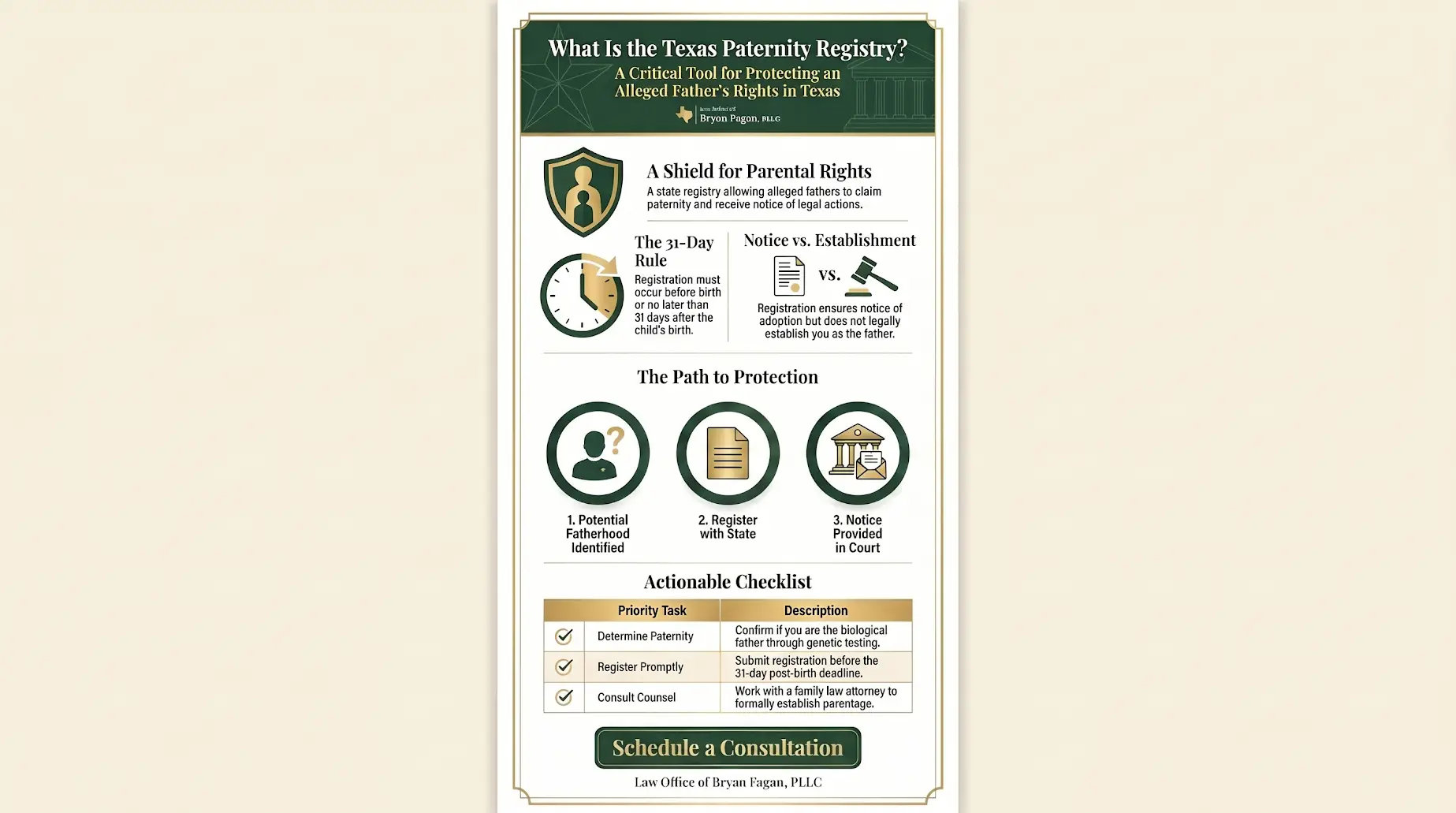

What Is the Texas Paternity Registry? The call usually comes from a man who just learned that the mother of his child is considering adoption, that another man has signed paperwork claiming paternity, or that a court proceeding involving his child may already be underway. By the time he reaches our office, he is asking a question he never thought he would need to ask: can I lose my rights to my child because of a state registry I did not even know existed?
The answer surprises many fathers. The Texas Paternity Registry is real, it is maintained by the Texas Vital Statistics Unit, and in certain circumstances failing to register on time can result in a father losing important legal rights before he ever has the opportunity to tell his side of the story. Most people assume biology alone protects a father’s relationship with a child. Texas law does not always work that way.
The registry exists for one specific purpose. It allows a man who believes he may have fathered a child, but who is not married to the mother and has not yet established legal paternity, to tell the State of Texas: “If someone tries to terminate my rights or place this child for adoption, notify me first.” It is an important safeguard, but it is also one of the most misunderstood areas of Texas family law. Many fathers mistakenly believe that registering makes them the legal father. It does not. Registering protects your right to receive notice. Establishing paternity is a separate legal step that creates parental rights and responsibilities.
What makes this issue so urgent is the deadline. Under Texas Family Code Chapter 160, an unmarried father who fails to register within the required time frame may lose the right to receive notice of adoption or termination proceedings if he has no other legal basis for notice. Over the years, our attorneys have spoken with fathers who assumed they had more time, fathers who thought their name on a text message or informal agreement with the mother was enough, and fathers who learned too late that a legal process had already begun.
At the Law Office of Bryan Fagan, PLLC, we believe families deserve clear answers before a deadline becomes a crisis. Led by Bryan Joseph Fagan, a South Texas College of Law graduate and recognized authority in Texas family law, our firm is committed to helping parents understand their rights, protect their futures, and make informed decisions during life’s most difficult transitions. In this guide, you’ll learn what the Texas Paternity Registry is, who should register, what happens after registration, the deadlines that control your rights, and the steps necessary to establish legal fatherhood in Texas.
The Short Answer
The Texas paternity registry is a confidential database, maintained by the Texas Vital Statistics Unit under Texas Family Code Chapter 160, where an unmarried man can register to receive notice before a child he may have fathered is adopted or has parental rights terminated. Registering preserves your right to be told—it does not by itself make you the legal father.
Key Takeaways
- The registry is about notice, not parenthood. It guarantees you get told about an adoption or termination case—it does not establish your legal rights to the child.
- The deadline is the whole ballgame. To be protected, you must register before the child’s birth or within 31 days after the birth. Miss it and your rights can be terminated without notice to you.
- Married men and adjudicated fathers don’t need it. If you are already the presumed, acknowledged, or court-ordered father, you are entitled to notice regardless of the registry.
- Registering is not establishing paternity. To become the legal father you still need an Acknowledgment of Paternity or a court order—the registry only buys you a seat at the table.
- The 2025 Texas Family Code tightened the language. The 89th Legislature amended Chapter 160 effective September 1, 2025, shifting from “father” to “parent” and reaffirming that failure to timely register can end your rights.

Your Family’s Future Starts Here
Don’t navigate your legal journey alone. Schedule a consultation now and get the clarity and support you deserve.
What the Texas Paternity Registry Actually Is

When fathers ask, “What Is the Texas Paternity Registry?”, they are often surprised to learn that it does not establish legal fatherhood. Instead, the Texas registry of paternity is a confidential database created under Texas Family Code §160.401 that allows a man who believes he may have fathered a child to receive notice before an adoption or parental-rights termination proceeding moves forward.
In simple terms, the registry functions as an early-warning system. It does not give you custody rights, place your name on a birth certificate, or make you the legal father. Its purpose is to ensure that you have the opportunity to be notified and heard before a court makes decisions that could permanently affect your relationship with a child. Similar to how a living will registry helps secure and share important legal directives, the Texas Paternity Registry helps preserve critical legal rights by ensuring important information is available when it matters most.
Under Texas Family Code §160.402, a man may register with the Vital Statistics Unit if he wants notice of proceedings involving a child he may have fathered. Courts and adoption agencies are generally required to search the registry before finalizing an adoption, making registration an important safeguard for protecting a father’s opportunity to participate in the process.
One of the most common mistakes fathers make is confusing registration with establishing paternity in Texas. Registration protects your right to notice. Establishing paternity through an Acknowledgment of Paternity or court order creates legal fatherhood and the rights and responsibilities that come with it. In straightforward situations, that process may be relatively simple. In more complex cases involving disputed paternity, adoption proceedings, or missed deadlines, a strategic legal approach may be necessary to protect your rights and future options.
Why it exists
The registry protects two things at once: a father’s constitutional interest in his child, and the finality of adoptions. By giving fathers a clear way to demand notice, Texas can also tell adoptive families that an adoption won’t be unwound years later by a father who was never found.
Who Needs to Register (and Who Doesn’t)
In Texas, the paternity registry is for the unmarried man who is not yet a legal father—the law calls him an alleged or “putative” father. If you had a relationship that may have produced a child, you are not married to the mother, your name is not on the birth certificate, you have not signed an Acknowledgment of Paternity, and no court has named you the father, then the registry is the tool that protects your right to be heard.
You do not need to register if you already have a legal claim to notice. Under Texas Family Code §160.402(b), a man is entitled to notice regardless of the registry if a father-child relationship has already been established under the law, or if he files a proceeding to adjudicate his own paternity before his rights are terminated. The presumed father, the acknowledged father, and the adjudicated father are all already protected.
The Deadline That Controls Your Rights
If you are asking “What Is the Texas Paternity Registry?”, the most important thing to understand is that the registry comes with a strict deadline. To preserve your right to receive notice of certain legal proceedings, you must register before the child is born or no later than 31 days after birth. Missing that deadline can significantly affect your ability to participate in decisions involving your child.
Texas Family Code §160.404 makes the consequences clear. If a man who may be the father fails to timely register with the Vital Statistics Unit and has not otherwise established a legal basis for notice, his parental rights may be terminated without notice in certain circumstances. Courts, adoption agencies, and family law professionals closely evaluate timeliness, legal standing, and whether a father took reasonable steps to protect his rights once he became aware of the possibility of parentage.
Many fathers make the mistake of waiting for certainty before taking action. Some delay while seeking DNA testing. Others assume an informal agreement with the mother is enough. Unfortunately, deadlines continue to run regardless of those conversations. Much like the systems discussed in our guide to the National Living Will Registry and how legal registries protect important rights, the Texas registry exists to ensure critical information is available when important legal decisions are being made.
In straightforward situations, timely registration may simply preserve your notice rights while you focus on establishing paternity in Texas through an acknowledgment or court order. In more complex cases, where paternity is disputed, adoption proceedings have already begun, or parental rights may be at risk, a more strategic approach is often necessary. Understanding the deadline early can help protect father’s rights in Texas and prevent avoidable mistakes that may be difficult to correct later.
The mistake that ends cases
Assuming “I’m the biological father, so they have to tell me” is how fathers lose children. Biology alone does not entitle you to notice in Texas. If you are unmarried and not yet a legal father, the registry—filed on time—is what protects you. Waiting until you hear about the adoption is usually waiting too long.
Registry vs. Establishing Paternity: Two Different Steps

One of the biggest misconceptions we hear from fathers asking “What Is the Texas Paternity Registry?” is the belief that registering automatically makes them the legal father. It does not. The Texas registry of paternity and the process of establishing legal fatherhood serve two very different purposes. Registration protects your right to receive notice of certain adoption and parental-rights proceedings. Establishing paternity creates the legal parent-child relationship that gives you rights and responsibilities involving custody, visitation, decision-making, and child support.
Under Texas Family Code §160.301, paternity can be established through a voluntary Acknowledgment of Paternity signed by both parents. In other situations, paternity is established through a court order, often after genetic testing under Texas Family Code §160.502. While registration may preserve your opportunity to participate, it does not create legal standing as a parent. That distinction becomes critically important when courts evaluate father’s rights in Texas, adoption proceedings, or disputes involving legal fatherhood.
In straightforward situations where both parents agree about parentage, establishing paternity may be a relatively simple process. In more complex cases, where paternity is disputed, another man claims to be the father, or adoption proceedings have already begun, a more strategic approach may be necessary. Courts frequently examine timeliness, procedural compliance, and whether a father acted diligently to protect his rights after learning he may have a child.
A helpful way to think about the distinction is this: registration preserves your place in the conversation, while establishing paternity in Texas gives you a legal voice in the outcome. Much like obtaining a court-approved document serves a different purpose than simply filing paperwork—as illustrated by resources such as an Order Approving Small Estate Affidavit—registration and legal parentage are related but separate legal steps. Understanding both can help fathers avoid common mistakes and better protect their relationship with their child.
The strategy I use
When an unmarried father comes to me before or right after a birth, we do two things in parallel: register to lock in notice, and immediately move to establish paternity through an acknowledgment or a suit to adjudicate. Notice buys time; legal fatherhood is the goal. Doing only one leaves you exposed.
How to Register and What It Costs
You register by filing a notice of intent to claim paternity with the Texas Vital Statistics Unit, which maintains the registry under §160.402. The form asks for your identifying information, the mother’s information if known, and the approximate date and place of conception or birth. There is a fee set by the Vital Statistics Unit under §160.416, and you must keep your contact information current—the registry will not chase you down if you move.
The filing itself is straightforward; the timing and the follow-through are where fathers get hurt. A registration with stale contact information is nearly as useless as no registration at all. This is the kind of step where an hour with a family law attorney—confirming you filed the right form, on time, with current information, and then moving to actually establish paternity—can be the difference between keeping and losing a relationship with your child.
The Mistakes That Cost Fathers Their Rights

The fathers who lose make predictable, avoidable mistakes. The first is assuming biology is enough—it is not. The second is treating registration as the finish line instead of the starting line, never moving on to actually establish paternity. The third is missing the 31-day window because they were waiting on a DNA test, a conversation with the mother, or a moment that felt right. The deadline does not wait for any of that.
“In Texas, the calendar protects fathers who act and abandons fathers who wait. The registry only works if you file it in time—and then keep going.”
31
days after birth to register and stay protected
§160.404
the section that ends rights for failing to register
2025
current Texas Family Code; Ch. 160 amended 9/1/2025
How This Plays Out in Harris County and Nearby Courts
The registry itself is statewide—it lives with the Vital Statistics Unit, not with any single county—so registration works the same whether you are in Houston, Sugar Land, The Woodlands, Katy, Spring, or Pearland. What changes county to county is the adoption or termination case where your registration matters, and how quickly the local court moves once a child is involved.
In Harris County, contested matters move through the family district courts, and adoption and termination dockets can advance faster than an unrepresented father expects. In the surrounding counties—Fort Bend, Montgomery, Galveston, and Brazoria—the statute is identical, but local procedure, hearing settings, and how aggressively the other side pushes for finality can differ. If a case is already filed, the county it is filed in shapes your timeline to respond, which is why a Houston-area father should not assume he has the same breathing room as someone reading national advice online.
Find Out If You Need to Register
Answer a few quick questions to see where you stand and what to do next.
You appear to be an unmarried alleged father within the window. Registering with the Texas Vital Statistics Unit before the birth or within 31 days after preserves your right to notice. Then move to establish paternity. Don’t wait—the deadline is strict.
Most clients hear back within 5 minutes during business hours (8 AM–10 PM CT, 7 days a week).
← Start overIf more than 31 days have passed since the birth and you haven’t registered or established paternity, your right to notice may already be at risk under Texas Family Code §160.404. There may still be options, but timing is critical. Call before anything is finalized.
Most clients hear back within 5 minutes during business hours (8 AM–10 PM CT, 7 days a week).
← Start overAs a presumed, acknowledged, or adjudicated father, you generally don’t need the registry—you’re entitled to notice under §160.402(b). But if an adoption or custody matter is brewing, you’ll still want a plan to protect your rights. Let’s confirm where you stand.
Most clients hear back within 5 minutes during business hours (8 AM–10 PM CT, 7 days a week).
← Start overNot sure whether the deadline has passed? A short session can tell you fast.
Schedule a Legal Strategy SessionWhat to Do If You’re Dealing With the Texas Paternity Registry
1. Confirm your status—are you presumed, acknowledged, adjudicated, or alleged? Only the alleged father needs the registry.
2. If you’re an unmarried alleged father, register with the Vital Statistics Unit before the birth or within 31 days after.
3. Keep your contact information current with the registry—update it in writing the moment you move.
4. Move to establish paternity—sign an Acknowledgment of Paternity or file suit to adjudicate.
5. If a paternity test is needed, request court-ordered genetic testing under §160.502 rather than relying on an informal test.
6. If you receive any notice of adoption or termination, respond the same day—do not let the deadline run.
7. Gather proof of your relationship and support of the child—it matters if your rights are challenged.
8. Talk to a Texas family law attorney before the window closes—most of these mistakes are only fixable before a court rules.
Want this checklist turned into a plan for your situation?
Schedule a Legal Strategy SessionWhat I Tell Every Client Who Calls About the Texas Paternity Registry

When fathers call our office asking “What Is the Texas Paternity Registry?”, the first thing I explain is that the registry is both more limited and more important than most people realize. It does not make you the legal father. It does not automatically give you custody rights or place your name on a birth certificate. What it does is protect your opportunity to receive notice before an adoption or parental-rights termination proceeding moves forward. For an unmarried father who has not yet established legal fatherhood, that notice can make a tremendous difference.
The second thing I explain is that registration is only the beginning. One of the most common mistakes fathers make is treating registration as the finish line instead of the first step in a larger process. Protecting your notice rights through the Texas registry of paternity is important, but it should be followed by establishing paternity in Texas through an Acknowledgment of Paternity under Texas Family Code §160.301 or a court order under Chapter 160. In straightforward situations where parentage is not disputed, this process may be relatively simple. In more complex cases involving contested paternity, adoption proceedings, or competing parental claims, a more structured legal strategy is often necessary.
The third thing I tell every father is not to wait for perfect certainty. Texas courts, adoption agencies, and family law practitioners frequently evaluate diligence, timeliness, and procedural compliance when determining whether a parent acted to protect his rights. If adoption proceedings have already begun or parental rights may be at risk, delays can significantly reduce your options. Similar to other areas of law where registration requirements carry serious consequences—as discussed in our articles on how to qualify for sex offender deregistration in Texas and the consequences of registering as a sex offender—the Texas paternity registry operates according to strict statutory requirements. Missing a deadline can affect your legal position long before you ever step into a courtroom.
Ultimately, understanding father’s rights in Texas starts with understanding the difference between registration and legal fatherhood. The fathers who are best positioned to protect their relationship with a child are usually the ones who act early, understand the deadlines, and develop a plan before uncertainty becomes a crisis.
Conclusion:
Understanding What Is the Texas Paternity Registry is ultimately about more than paperwork, deadlines, or legal terminology. It is about protecting your opportunity to be involved in a child’s life and ensuring that important decisions are not made without your knowledge. In straightforward situations, registering and establishing paternity may be relatively simple steps. In more complex cases, where adoption proceedings are pending, multiple men claim paternity, parental rights are being challenged, or critical deadlines may have already passed, the legal and practical consequences can become far more significant.
At the Law Office of Bryan Fagan, PLLC, we believe families make better decisions when they have clear information and a strategy tailored to their circumstances. If your case involves questions about paternity, father’s rights, adoption, termination of parental rights, or protecting your relationship with a child, experienced legal guidance can help you understand your options and avoid costly mistakes. Our team is committed to helping Texas families move forward with greater clarity, confidence, and peace of mind while protecting what matters most—the future of the people you love.
Questions My Clients Ask About the Texas Paternity Registry
It is a confidential state database run by the Texas Vital Statistics Unit under Family Code Chapter 160. An unmarried man who believes he may have fathered a child registers so the State must notify him before that child is adopted or before parental rights are terminated. It protects your right to notice; it does not by itself make you the legal father.
“Putative father registry” is the national term for what Texas calls its registry of paternity. A putative father is a man alleged to be the biological father of a child born outside of marriage who has not yet established legal paternity. Most states maintain one; Texas’s version is governed by Family Code §160.401 and following.
You file a notice of intent to claim paternity with the Texas Vital Statistics Unit and pay the required fee. You provide your identifying details and any information about the mother and the child. To stay protected you must register before the birth or within 31 days after, and you must keep your contact information current with the registry.
Under Texas Family Code §160.404, if you failed to timely register and are not otherwise entitled to notice, your parental rights can be terminated without notice to you. In practice that means an adoption can be finalized without anyone telling you. The 31-day window is unforgiving, which is why acting early matters so much.
No. If you were married to the mother at the child’s birth or within 300 days before, you are the presumed father under §160.204 and you are already entitled to notice. The registry exists for the unmarried man who has no other legal claim to be told about an adoption or termination.
No, and this is the most important distinction. Registering protects your right to notice. Establishing paternity—through a signed Acknowledgment of Paternity under §160.301 or a court order—makes you the legal father with rights to custody, visitation, and a voice in the child’s life. You generally want to do both.
No. The registry is confidential and the general public cannot search it. Courts and licensed adoption agencies are required to search it before finalizing an adoption, and the search produces a certificate. Unauthorized release of registry information is itself an offense under Family Code §160.413.
Yes, and often you should. You may register at any time before the birth, and registering early removes the risk of missing the 31-day post-birth window. If you know there may be a child and your relationship with the mother is uncertain, filing before the birth is the safest move.
A voluntary Acknowledgment of Paternity carries no filing fee under §160.306, so when both parents agree the cost can be minimal. A contested case—requiring DNA testing and a court order—costs more and varies with how hard it is fought. We can give you a realistic range for your situation in a strategy session.
Act immediately. Receiving notice means there is an active proceeding and the deadline to respond and assert your rights is short. Do not wait to “see what happens.” Call a family law attorney the same day, because the window to intervene and protect your relationship with the child can close in a matter of weeks.
Still have a question I didn’t answer? Ask it directly.
Schedule a Legal Strategy Session