In Texas, parents can't permanently waive child support by private agreement alone because child support is treated as the child's right, not a parent's personal bargaining chip. But a court can approve a written, signed agreement that results in a zero-dollar child support order when the judge decides that arrangement serves the child's best interests.
If you're asking this question, you're probably in a very human situation. You and your co-parent may be getting along reasonably well, sharing expenses informally, or trying to avoid turning a cooperative arrangement into a courtroom fight. That instinct makes sense.
The problem is that Texas family law doesn't treat child support like an ordinary promise between two adults. Even when both parents agree, the court still has to protect the child's interests. That means the core issue usually isn't, "Can we waive child support?" It's, "Can we structure a legally valid arrangement that a judge will approve?"
Many parents start here: "We don't need child support. We'll just split things ourselves."
Take a common example. Two parents separate on decent terms. One pays for school supplies and clothes. The other covers housing and groceries. Neither wants monthly transfers, and both want to keep the peace. On the surface, that feels practical and fair.
It may even feel more respectful than asking the court to set support.
Why informal peace can create legal risk
The trouble starts later, usually when life changes. A job is lost. A new partner enters the picture. Communication breaks down. One parent starts paying more than expected, or one stops contributing as much as the other thought they would. Suddenly, the "we'll handle it ourselves" plan isn't clear anymore.
That's why strategy matters in family law. A useful outside read on making thoughtful divorce decisions is this discussion of Gonzalez & Waddington divorce guidance, which highlights how early legal choices can shape the rest of a case.
If you're trying to reach an agreement without escalating conflict, mediation may still be part of the solution. This article on negotiating child support during mediation can help you understand how parents turn a private discussion into something the court can enforce.
Parents often confuse "we agree" with "we're legally protected." In Texas, those are not the same thing.
The practical question you should ask
Instead of asking whether support can disappear, ask these questions:
- Will a judge sign off on our plan? If not, the agreement may not protect either of you.
- Is the arrangement written clearly enough? Vague promises create future disputes.
- Does the plan meet the child's needs? The court will focus on that before anything else.
A calm co-parenting relationship is valuable. The law just requires you to formalize it the right way.
The Core Principle Child Support Is the Child's Right
Texas courts start from a basic rule. Child support belongs to the child. That idea explains why parents don't get the final word by themselves.
A parent receiving support isn't treated as the owner of that money in the legal sense. The support is meant for the child's housing, food, medical care, daily needs, and stability. Because of that, one parent can't give it up as if they were waiving their own private contract right.
Why court approval is required
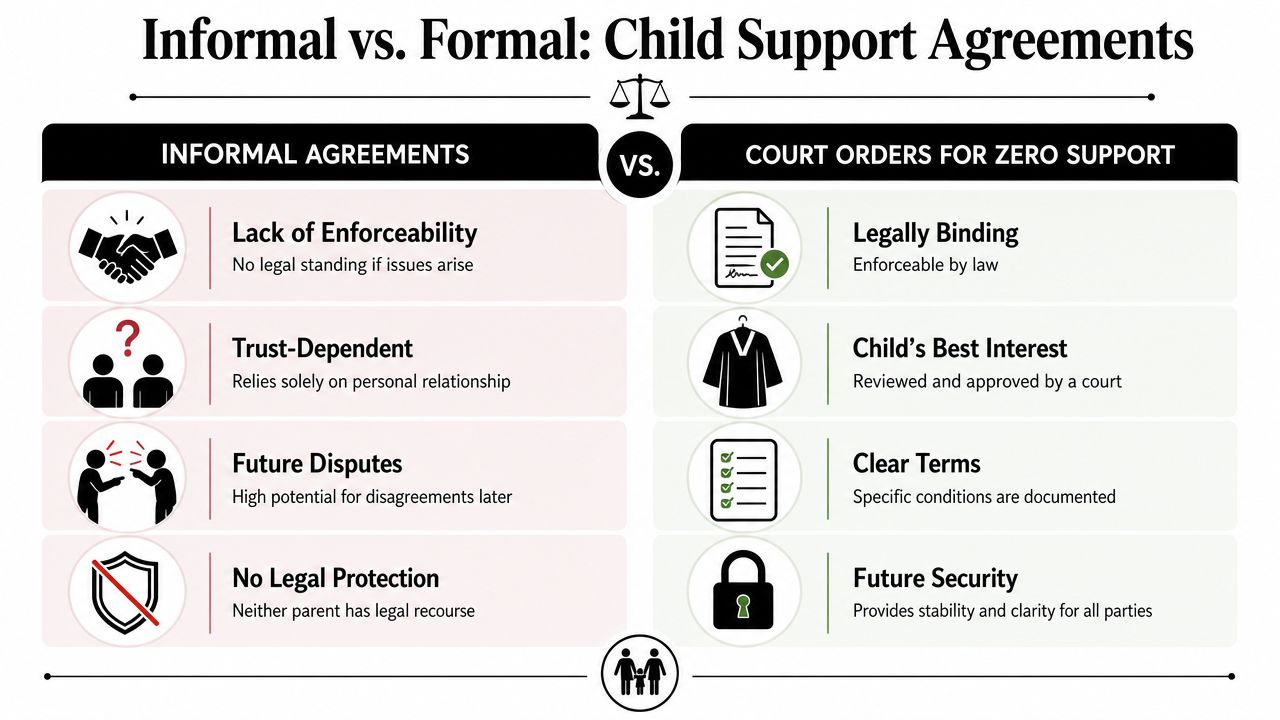
Under Texas Family Code § 154.124, parents can make agreements about child support, but the agreement must be written, signed, and approved by the court. A judge still has to decide whether the arrangement is in the child's best interests. That is the controlling legal principle, as explained in this discussion of Texas child support agreements and court approval.
That means an agreement for no monthly child support isn't automatically invalid. But it also isn't automatically valid just because both parents consent.
A simple way to think about it
Think of child support like funds set aside for a child's care. Parents may propose how those needs will be met, but they don't have unlimited power to erase the obligation without judicial review.
Here is the difference in plain terms:
| Arrangement | Legal effect |
|---|---|
| Verbal promise between parents | Usually not enforceable as a child support order |
| Written private deal never approved by court | Still risky and may not control later |
| Written, signed agreement approved by judge | Becomes part of an enforceable court order |
Where readers often get confused
Parents usually get stuck on one of these points:
- "But we both agree." Agreement helps, but it doesn't replace court review.
- "But we share expenses evenly." That may support a zero-dollar request, but the judge still decides.
- "But no one wants support." The court asks whether the child's needs are still protected.
Practical rule: If it's not in a court order, you should assume it may not fully protect you.
The better legal answer to whether "can child support be waived in Texas" is this: not by parents alone, but sometimes through a properly documented and court-approved process.
The Dangers of Informal Agreements vs The Security of Court Orders
The biggest mistake parents make is treating an informal agreement like a final legal solution. It isn't.
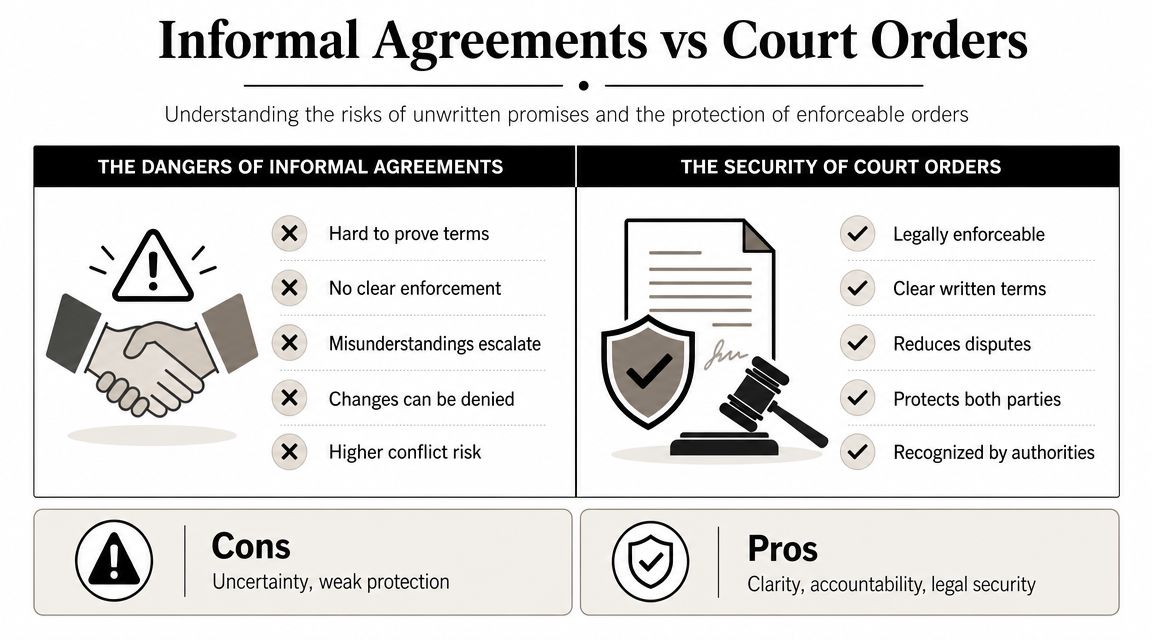
If you and your co-parent make a handshake deal, text each other that no support will be paid, or rely on a side agreement outside your final orders, you may feel settled for now. But the legal system may treat that arrangement very differently from how you intended.
What can go wrong with a private agreement
An informal arrangement can fail in several ways.
- Memories change: One parent may later remember the deal differently.
- Circumstances change: A parent who once felt financially secure may later need formal support.
- Documentation is weak: Text messages and casual conversations rarely provide the clarity of a court order.
- Enforcement becomes difficult: If one parent stops doing what they promised, the other may have limited immediate legal remedies based on the private agreement alone.
A common pattern looks like this. One parent says, "Don't worry about support. Just help when you can." For a while, that works. Later, conflict develops, and the same parent wants formal support set. The parent who relied on the earlier deal is left saying, "But we agreed." That argument is much weaker when the agreement was never turned into a signed order.
Why a zero-dollar court order is different
A zero-dollar order is not the same thing as pretending support doesn't exist. It is a real court order stating that, under the facts presented, the current child support amount is set at zero.
That matters because a court order creates structure.
| Informal arrangement | Court-approved zero-dollar order |
|---|---|
| Based on trust | Based on an enforceable judgment |
| Terms may be vague | Terms are stated in writing |
| Hard to prove later | Easier to show what the judge approved |
| More room for misunderstanding | More clarity for both parents |
A judge may still revisit child support later if circumstances materially change, but starting from a valid order gives both parents a much stronger legal position than starting from a private promise.
Here is a short explanation that helps many clients understand the difference:
What legal security looks like in practice
When your agreement becomes a court order, it usually does three important things:
- It records the facts clearly. The order can reflect why support is set the way it is.
- It reduces future arguments. Specific terms leave less room for different interpretations.
- It protects the child-focused framework. The court has already reviewed the arrangement for fairness.
A peaceful arrangement is worth preserving. But peace is more durable when the paperwork matches the reality.
If you're deciding between "keeping it simple" and formalizing your agreement, the safer path is almost always the court-approved one.
When Texas Courts Might Approve a Zero-Dollar Order
You and the other parent may already have a system that works at home. One parent pays the mortgage and groceries. The other covers school costs, health insurance, and activities. From your point of view, sending a monthly child support payment back and forth may feel unnecessary. In Texas, the legal question is different: will a judge sign an order that reflects this arrangement and still protects the child?

That is the key distinction. Courts are usually not approving a private "waiver" of support. Courts are deciding whether a zero-dollar order makes legal sense under the facts of your case.
A zero-dollar order works like a receipt signed by the court. It shows that the judge reviewed the family's situation and approved support at zero for now, rather than leaving the issue to an off-the-record promise.
Situations that may support a zero-dollar order
One common example is a case where one parent already provides nearly all of the child's day-to-day financial support and can prove it with clear records. If that parent consistently covers housing, food, clothing, school needs, and medical costs, a judge may be more open to an order that reflects the existing situation.
Another example appears in negotiated family cases where support is handled through a broader structure. A parent may agree to carry health insurance, pay specific recurring expenses, or accept a property division that affects how the child's needs are met over time. The court will still want to see how the child is being provided for, but the support plan does not always have to look like a standard monthly payment.
Some parents also share parenting time in a way that leads the court to look more closely at the full picture. If both parents have similar incomes, both spend substantial time caring for the child, and both directly pay regular child-related expenses, a judge may consider whether a zero-dollar order is appropriate.
These cases are highly specific. Small factual differences can change the result.
What the judge is really evaluating
A judge is usually asking a practical question: if I sign this order, do I have enough information to know this child will be supported?
That often means looking at:
- Who is paying for the child's basic needs
- Whether the parents' income and expense information is believable and complete
- How stable the parenting plan is
- Whether the proposed order is clear enough to enforce later if needed
- Why a zero-dollar amount serves this child, not just the parents' convenience
If you are asking for zero support, detail matters. Vague statements such as "we handle things ourselves" usually do not give the court much to work with.
How to present the request in a way the court can evaluate
Start with the facts. Show who pays which expenses, how often, and in what amounts. Attach the kind of proof that turns a family understanding into something a judge can rely on.
Then make the order specific. If one parent will pay health insurance, school tuition, counseling, or extracurricular costs, say so clearly. If the parenting schedule affects how expenses are divided, spell that out too.
It also helps to understand the baseline the judge starts from. Texas courts often begin with guideline support and then decide whether the facts justify a different result. If you want a clearer sense of that framework, review these Texas child support guidelines and how they affect support calculations.
A careful request is better than a casual agreement
Parents often come to court with good intentions. Good intentions alone are rarely enough. A zero-dollar order needs to rest on a record the judge can approve with confidence.
That is why many parents work with private counsel, mediators, or family-law-focused firms such as the Law Office of Bryan Fagan, PLLC to prepare deviation requests and proposed orders. The goal is simple. Give the court a clear, child-focused explanation for why zero support is legally appropriate in this particular family.
How Texas Child Support Guidelines Influence Court Decisions
To understand why zero-dollar orders are closely reviewed, you need to understand the default rule. Texas uses a guideline formula for child support rather than leaving every case entirely open-ended.
According to Texas child support guideline rules, the percentages apply to an obligor's net resources up to $11,700 per month, effective September 1, 2025, and the guideline amounts are 20% for one child, 25% for two, 30% for three, 35% for four, and 40% for five or more children. The same guidance explains that if a parent has no job, the court may impute income based on a full-time minimum-wage job using the federal minimum wage of $7.25 per hour or $290 per week before taxes.
Why the formula matters
Those numbers tell you something important about how Texas views support. The system is structured. Judges begin with a framework that assumes regular financial support is often appropriate.
That means a request for zero support is not being reviewed in a vacuum. It is being measured against a guideline system that already gives the court a baseline.
What this means for your case
If the guideline amount would normally be substantial, a judge may want a strong explanation for why a zero-dollar order still protects the child. If a parent is unemployed, the court may still look at earning capacity rather than accepting a simple claim of no income.
Here is a quick reference table:
| Number of children | Guideline percentage |
|---|---|
| 1 | 20% |
| 2 | 25% |
| 3 | 30% |
| 4 | 35% |
| 5 or more | 40% |
For a deeper walk-through of how these rules work in day-to-day cases, this resource on Texas child support guidelines explained can help you connect the formula to real family situations.
The takeaway from the guidelines
The court isn't being rigid for its own sake. The guideline system reflects a policy choice that child support should be calculated in a predictable way unless there is a good reason to do something different.
So if you're asking can child support be waived in Texas, the guideline framework is part of the answer. It shows why judges usually want detailed support for any request that departs from the standard formula.
Legal Pathways to Permanently End Child Support
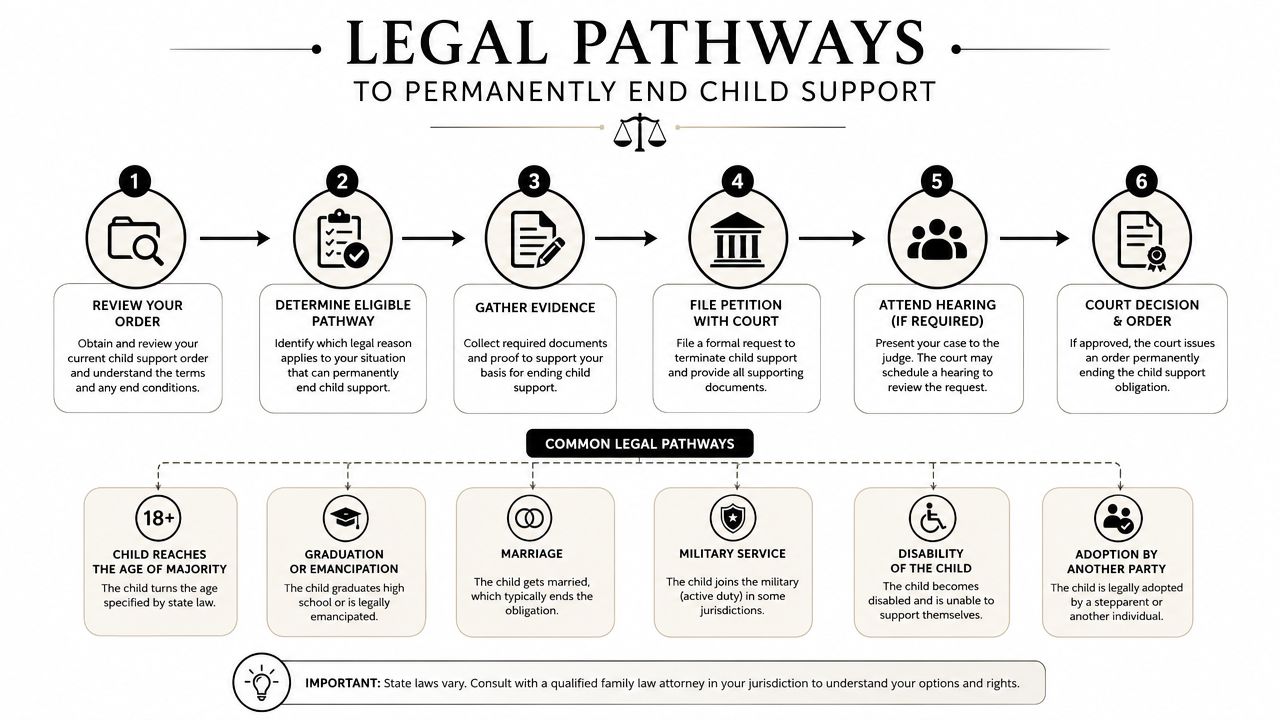
A lot of confusion comes from using the word waiver when the underlying legal issue may be termination.
A waiver usually means one person agrees not to collect. Termination means the legal duty itself ends under recognized legal rules. Those are different ideas, and Texas treats them differently.
True ending points are different from private deals
Some support obligations end because the law says they end. Those situations are not the same as parents trying to opt out by agreement.
Examples can include major legal changes involving the parent-child relationship, such as adoption by another person or the termination of parental rights in a case where the law supports that outcome. Questions about parental rights often overlap with support obligations, and this article on signing over parental rights in Texas gives useful context on that separate process.
Rare exceptions that are not really waivers
Texas also recognizes some limited situations where support may not be pursued or may effectively stop for specific legal reasons. According to Texas Good Cause and SSI guidance, if a parent's only source of income is Supplemental Security Income (SSI), that parent generally does not have to pay child support. The same guidance explains that Texas HHSC's Good Cause process can stop a child support case when cooperation would create a safety risk for the family.
Those are narrow exceptions. They are not general permission for parents to write "no support" into a private agreement and move on.
A practical way to separate the concepts
Use this rule of thumb:
- Waiver question: "Can we agree not to exchange support?"
- Termination question: "Has the legal duty ended under Texas law or a recognized exception?"
If you're dealing with safety concerns, disability income, or a major change in legal parentage, you may be looking at a different legal pathway than a standard child support agreement.
When clients understand that difference, the issue usually becomes much clearer. The answer may not be a waiver at all. It may be a request for a court-approved deviation, a modification, or recognition that a narrow exception applies.
Protecting Your Family and Your Future
If this topic feels frustrating, that's understandable. Many parents believe that if both sides agree, the law should let them handle it privately. Texas doesn't work that way with child support because the court's job is to protect the child, not just record the parents' preferences.
The encouraging part is that you still have options. You may be able to obtain a court-approved zero-dollar order, pursue a modification, or determine whether a rare exception applies to your situation. What matters is using the right legal mechanism instead of relying on a promise that may not hold up later.
A careful approach usually includes three things:
- Get the facts organized: Income, parenting time, and expense responsibility all matter.
- Use precise language: Courts respond better to specific proposed orders than broad understandings.
- Think long term: The goal isn't just today's agreement. It's reducing future conflict and protecting your child.
Whether your current arrangement is legally safe, or whether a judge might approve no monthly support in your case, it's wise to get case-specific advice before signing anything.
If you need help navigating divorce, custody, or estate planning in Texas, contact Law Office of Bryan Fagan, PLLC today for a free consultation. A family law attorney can review your circumstances, explain whether a zero-dollar order, modification, or another legal path makes sense, and help you move forward with more confidence.