
Divorce or a custody dispute can leave you sitting at your kitchen table, staring at paperwork, wondering how a private family problem turned into something that feels so public and so hard to control. In Houston Heights, many people reach that point before they ever step into a courtroom. They want a solution, but they don't want a fight.
Mediation often gives families that middle path. It creates space to work through property, parenting, and support issues in a more private and focused setting, while still keeping the legal framework of Texas family law in view. If you're looking for a Houston Heights mediation attorney, the question usually isn't just whether mediation is available. It's whether mediation is the right fit for your situation, and whether free court-sponsored help or a private attorney-guided process makes better sense for your family.
Facing a Family Dispute in Houston Heights?
A common Houston Heights scenario starts subtly. One spouse has moved into the guest room. The children know something is wrong. Bills still need to be paid, school pickup still has to happen, and both people are trying to act normal while also worrying about the house, retirement accounts, and who will have the children on school nights.

When that tension spills into litigation, every disagreement can start to feel like a contest. Small issues become symbols of larger hurt. A conversation about pickup times turns into an argument about respect. A question about the home equity becomes a fight about fairness.
Mediation changes the setting and, often, the tone. Instead of preparing to persuade a judge, you prepare to make decisions. Instead of building a public record, you work toward a practical plan. That's why many families who still care about stability, privacy, and workable co-parenting arrangements look at mediation before they commit themselves to a drawn-out court battle.
Outside legal help can matter too, especially when communication has broken down. Some couples also benefit from therapeutic support while they sort through conflict, such as expert guidance for couples in Vernon from Interactive Counselling, if emotional communication is getting in the way of practical problem-solving.
Mediation doesn't require you to trust your spouse completely. It requires a process that can hold a difficult conversation together long enough to reach decisions.
A Houston Heights mediation attorney helps you keep both tracks in focus at the same time. One track is legal. What does Texas law allow, require, or expect? The other is personal. What arrangement will work once this case is over and real life resumes?
Understanding the Role of a Neutral Mediator
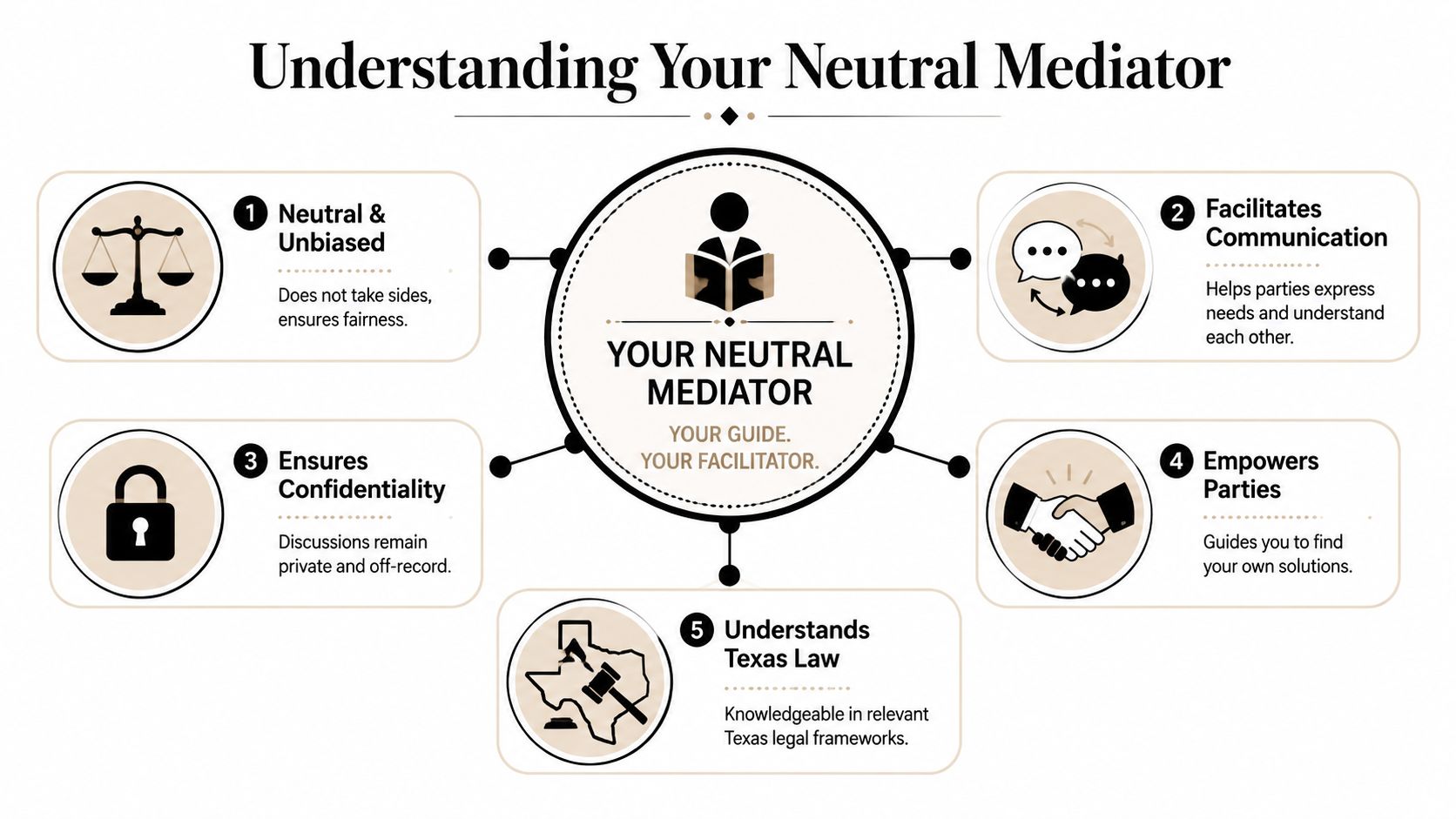
Many people hear the word "mediator" and assume that person will decide who's right. That's not how family mediation works. A mediator is closer to a skilled guide for a hard conversation than a private judge.
What the mediator does
In Harris County, which includes Houston Heights, most family courts require couples to attempt mediation before trial, and the process is confidential, often with spouses in separate rooms while the mediator moves between them to reduce confrontation and help generate options without giving legal advice or making decisions for either side, as described in this Harris County family mediation discussion.
That last point matters. The mediator doesn't represent you. The mediator doesn't represent your spouse. The mediator can't tell you what to sign, and can't force a settlement.
A neutral mediator typically helps with these tasks:
- Keeps the process orderly by setting ground rules and moving the discussion from one issue to the next.
- Tests proposals by asking practical questions about schedules, finances, and logistics.
- Carries information between rooms when direct discussion would likely trigger more conflict than progress.
- Spots stalemates and suggests different ways to frame the same problem.
What the mediator does not do
People often expect a mediator to protect their legal rights the way an attorney would. That's a mistake. The mediator's neutrality is useful, but it's also a limit.
Practical rule: Your mediator manages the negotiation. Your attorney protects your position inside it.
If you want a deeper look at process options, this overview of types of mediation in Texas helps explain how different formats are used in family cases.
For some families, Divorce Mediation is a mediated resolution of divorce issues outside of court. In practice, that can include property division, possession schedules, decision-making rights for children, support terms, and how to handle future communication.
Why confidentiality changes the conversation
Confidentiality often gives people room to be more realistic. In court, a proposal can feel like an admission. In mediation, a proposal can be just that. A proposal. Something to test, revise, or reject.
That privacy can be especially helpful when the dispute involves parenting tension, sensitive finances, or strong emotions that don't belong in a public courtroom. It lets people work toward solutions with less posturing and more candor.
Why Choose Mediation Instead of a Court Battle
Some family cases do need a judge. If there is serious abuse, active concealment of assets, or one party refuses to participate in good faith, litigation may be necessary. But in many Houston Heights cases, mediation offers a more practical route.
Top Houston family mediation lawyers report a settlement rate of 90% or higher in mediation, which shows how often families are able to resolve disputes without asking a judge to make the final call, according to Houston family mediation reporting.
Mediation vs litigation at a glance
| Factor | Mediation | Litigation (Court Trial) |
|---|---|---|
| Privacy | Private and confidential discussions | Court filings and hearings are part of the formal court process |
| Control | Parties shape the terms of agreement | Judge decides unresolved issues |
| Tone | Solution-focused negotiation | Adversarial presentation of evidence and positions |
| Flexibility | Can create customized parenting and property solutions | Court orders follow legal limits and courtroom procedure |
| Emotional impact | Often less combative, especially for co-parents | Conflict can harden over time |
Control usually matters more than people expect
Texas family law gives courts broad authority, but many clients don't want to hand major life decisions to someone who only sees a thin slice of their family history. Mediation lets you decide whether the house will be sold now or later, how holidays should rotate, or how a business interest should be addressed.
In a courtroom, those decisions get compressed into legal arguments and evidence. In mediation, they can be shaped around daily life. That distinction becomes especially important when children are involved. A judge can order a schedule. A mediated agreement can account for soccer practice, grandparents, work travel, and the personality of the child.
Court pressure can make a bad conflict worse
Litigation has its place, but it also changes behavior. Parties often become more defensive because every email, message, and financial record might become part of a case file. People stop talking directly. Attorneys exchange proposals, and positions can harden merely because no one wants to look like they're backing down.
Families often preserve more working goodwill in mediation than they do in a courtroom fight. That matters long after the final decree is signed.
Mediation can protect future co-parenting
A custody order isn't just about the next hearing. It's about school years, doctor visits, holidays, graduations, and the hundreds of transitions that happen after the case ends. A parent who helps build the final arrangement is often better prepared to follow it.
That doesn't mean mediation is soft. Good mediation can be demanding. It forces both sides to confront budgets, schedules, and legal realities. But it does so in a setting designed to reach a functioning agreement, not to score points.
What to Expect During the Mediation Process
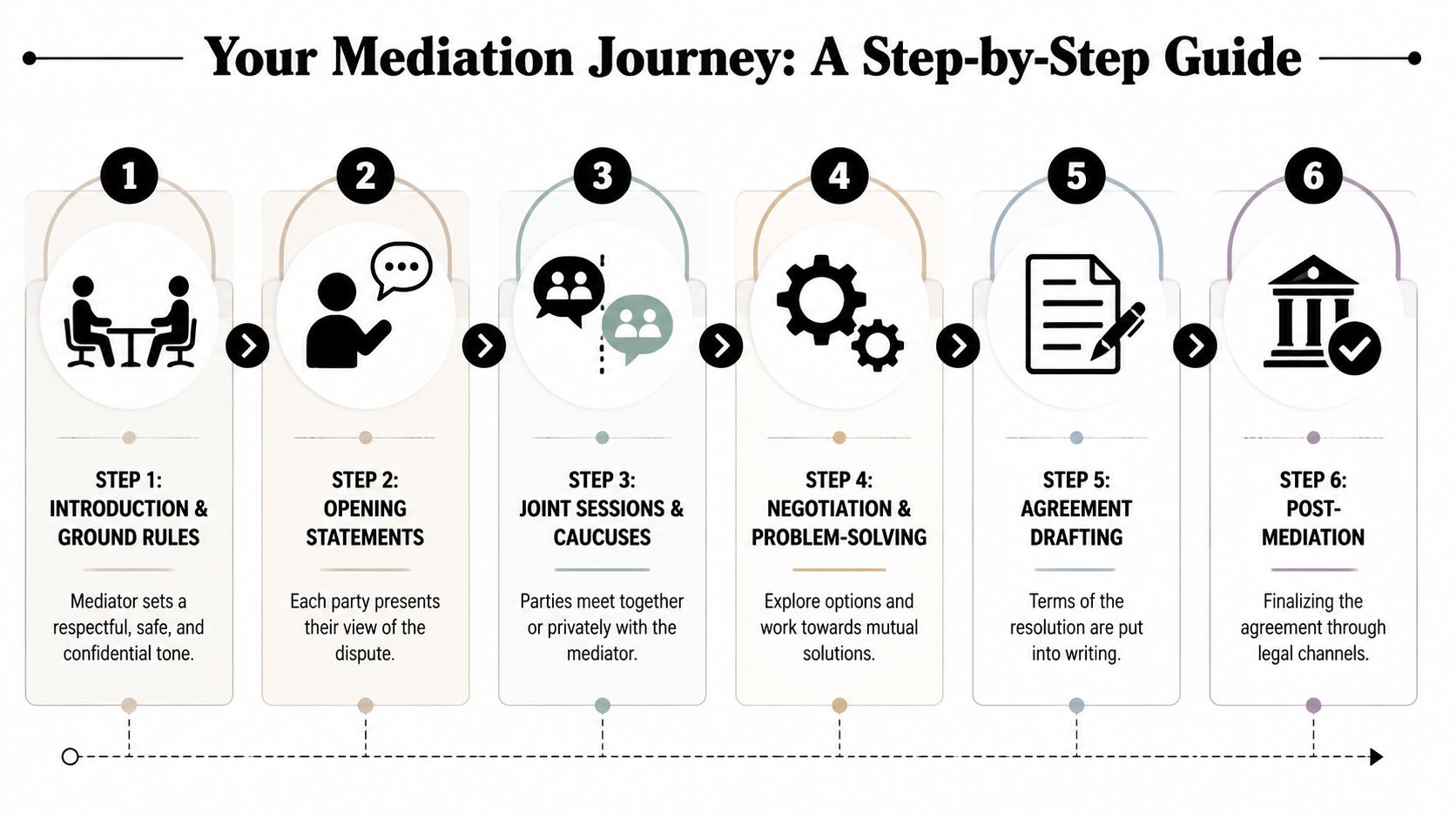
The mediation process becomes much less intimidating once you understand its sequence. Participants perform better when they know what will happen first, what comes next, and where decisions get made.
A helpful visual overview appears below.
Step one through step three
The process typically begins with an initial consultation, then moves into gathering and disclosing financial documents, identifying the main issues, and beginning negotiation sessions where the mediator helps the parties work toward solutions on subjects such as property division and child custody, as outlined in this explanation of the family law mediation process in Texas.
Here is the usual flow:
Initial case assessment
You and your attorney identify the issues that need to be resolved. In some cases, the dispute is mainly about parenting. In others, the sticking point is the marital home, a retirement account, reimbursement claims, or a closely held business.Mediator selection and scheduling
The lawyers and parties agree on a mediator and choose a date. The right mediator often depends on the issues in dispute. A case involving children may need someone with deep family law experience. A case involving complicated assets may call for a mediator who is comfortable with financial detail.Pre-mediation exchange
Documents get organized. Inventories are prepared. Proposed schedules may be drafted. This stage is where much of the core work happens.
For readers dealing with Divorce, meaning Texas divorce representation for contested, uncontested, and high-conflict cases, mediation often becomes the practical checkpoint where the case either resolves or narrows dramatically.
A short video can also help make the flow easier to picture.
What the session day looks like
Most family mediations are not dramatic face-to-face confrontations. In many Harris County cases, the parties remain in separate rooms. The mediator goes back and forth, carrying proposals, questions, and counterproposals. Your attorney stays with you, evaluates offers, and helps you decide whether movement makes sense.
Expect discussion around:
- Property issues such as the house, vehicles, debts, retirement accounts, and reimbursement claims
- Parenting terms including possession schedules, holiday arrangements, and decision-making rights
- Support issues involving child support or, where applicable, spousal maintenance
- Logistics after settlement such as refinance deadlines, move-out dates, and transfer paperwork
How the agreement becomes legally meaningful
If you reach an agreement, the terms are written into a mediated settlement agreement. That written document becomes the foundation for later court paperwork. This is why precision matters. A vague promise causes problems. A clear term gives everyone something they can follow.
A Houston Heights mediation attorney adds value here by catching the practical gaps. If one spouse keeps the house, who pays the mortgage until refinance? If the children switch schools next year, how does that affect exchanges? If a business valuation is disputed, is there a buyout structure both sides can live with?
Preparing for a Successful Mediation Session
Preparation changes outcomes. People who walk into mediation with a rough sense of fairness but no documents, no priorities, and no strategy often spend the day reacting. People who prepare can make deliberate decisions.
Know the legal frame before you negotiate
Under Texas Family Code Section 7.001, a court must divide the marital estate in a manner that is "just and right" with due regard for the rights of each party and any children of the marriage, and while that often results in a 50/50 split, a judge can depart from that depending on the facts, as explained by Texas Law Help on property and debt division.
That rule matters because mediation isn't done in a vacuum. If you don't understand what a court might consider fair, it's hard to judge whether a proposal is reasonable. A spouse may say, "Let's just split everything evenly," but equal on paper isn't always equal in effect. One account may be liquid cash. Another may carry tax consequences or early withdrawal issues.
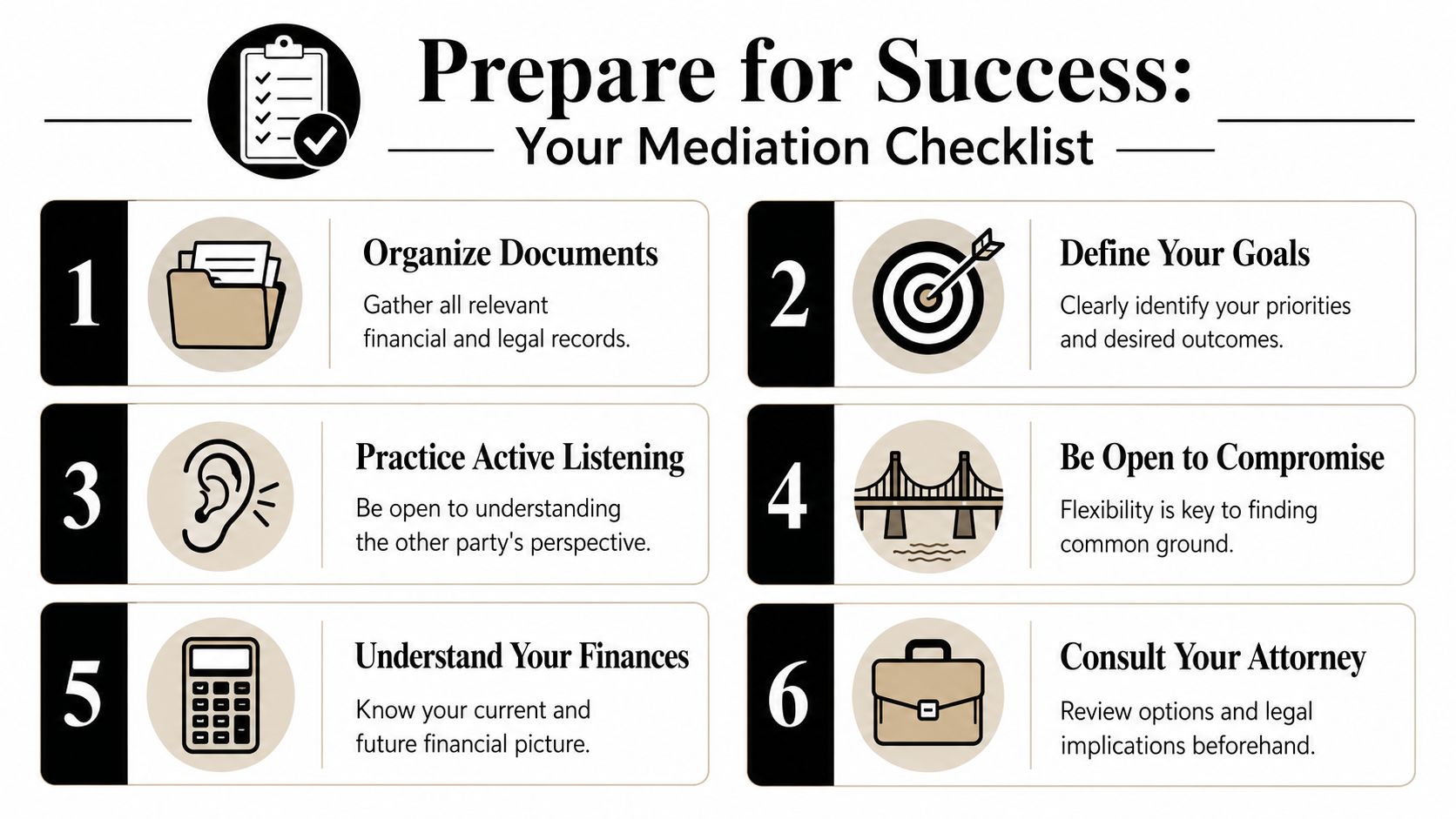
A practical checklist before the session
Use this preparation list as a starting point:
- Gather records. Pull bank statements, mortgage information, retirement account statements, credit card balances, tax returns, and any records tied to business interests or investment accounts.
- List assets and debts clearly. A simple spreadsheet often helps. Identify what exists, whose name it's in, and whether you believe it is separate or community property.
- Set priorities. Decide what you must protect, what you prefer to keep, and what you can trade.
- Think beyond the decree. If you keep the house, can you afford it? If you agree to a schedule, can you manage the transportation?
- Prepare for compromise without surrender. Mediation works best when you're flexible on form but clear on substance.
Key takeaway: The strongest mediation posture is informed and calm. Not rigid, not careless.
Consider costs early
Mediation has direct costs, and they should be part of your planning. If you want a clearer picture of common fee structures, this discussion of what to expect from mediator costs in a Texas divorce is a useful starting point.
One practical example helps. Suppose a spouse wants to keep the family home but hasn't reviewed income, refinance ability, or monthly carrying costs. In mediation, that position can collapse quickly. A prepared spouse arrives with mortgage details, pay information, and several fallback options. That preparation doesn't just look better. It leads to better decisions.
Choosing the Right Mediation Path for Your Family
A common Houston Heights scenario goes like this. A couple starts with free court-sponsored mediation because it seems like the cheaper, safer first step. A few hours in, they realize the underlying dispute is not communication alone. It is a disagreement about a retirement account, a small business, a reimbursement claim, or a parenting term that needs careful wording. The case stalls, another session becomes necessary, and the family ends up paying for private mediation later anyway. In the right case, starting with private mediation can cost more up front and still save time, fees, and stress overall.
The question is not whether mediation is a good idea. The question is which kind of mediation fits your case.
When free mediation may be enough
The Harris County Dispute Resolution Center offers free mediation to county residents through Harris County's Dispute Resolution Center. That option can work well when the issues are narrow, the finances are simple, and both people are already negotiating in good faith.
Free or court-sponsored mediation often makes sense if:
- The dispute is limited to one or two parenting details, such as exchange times or holiday rotations
- The marital estate is modest and easy to identify, with no business ownership or separate property fight
- Both sides are close to an agreement already, but need a neutral setting to finish the conversation
In those cases, a shorter, lower-cost process may be all you need.
When private mediation is often the better choice
Private mediation is usually the better path when the disagreement requires legal judgment, more preparation, or more time than a basic session can offer. I see this often in cases involving closely held businesses, retirement division, tracing separate property, reimbursement claims, contested conservatorship terms, or parenting disputes with relocation concerns.
Those cases can settle in mediation. They just need the right structure.
Private mediation gives families more control over the calendar, more time to work through difficult terms, and the chance to choose a mediator with experience in the issues driving the conflict. That can matter a great deal. A mediator who regularly handles complex property division or high-conflict custody disputes will usually spot problems earlier and help the parties test settlement options more realistically.
Sometimes the cheaper option becomes the expensive one.
A practical comparison helps:
| Situation | Better first option |
|---|---|
| One narrow dispute, basic finances, both parties generally cooperative | Free or court-sponsored mediation |
| Business interests, retirement issues, separate property claims, or disputed valuations | Private mediation with attorney guidance |
| Serious custody disagreement, communication breakdown, or need for detailed custom terms | Private mediation |
| Parties want a quick setting to finalize terms they have mostly agreed on | Free or court-sponsored mediation |
The trade-off is straightforward. Free mediation lowers the initial cost. Private mediation often lowers the risk of delay, repeat sessions, and poorly drafted agreements that create new disputes later.
For parents deciding whether to settle or prepare for court in a custody matter, this guide on child custody mediation vs. litigation in Texas gives a useful side-by-side comparison.
There are situations where attorney-guided mediation support is the sensible choice. The Law Office of Bryan Fagan, PLLC handles Texas family law matters involving divorce, custody, property division, and mediation.
Your Mediation Questions Answered
How much does mediation cost in Texas family cases
Cost depends on the county, the mediator, and the path you choose.
For some Houston Heights families, a free or court-sponsored session is a smart first step. If the dispute is limited, both sides are exchanging information, and there is already a fair amount of agreement, that option can control expenses. If the case involves custody friction, disputed finances, or a spouse who delays decisions, the lower upfront price can disappear fast through second sessions, added attorney time, and postponed court settings.
That is the trade-off clients need to evaluate carefully. The session fee is only part of the cost. Lost work time, repeated preparation, and unclear settlement terms can make a cheaper option more expensive in the end.
Is a mediated agreement enforceable
Usually, yes. In Texas family cases, a signed mediated settlement agreement often becomes the basis for the final orders entered by the court.
The wording matters. If the agreement leaves out details about possession exchanges, decision-making authority, refinance deadlines, or the division of specific accounts, the same dispute often returns later as an enforcement problem. Clear terms give the court something it can sign and give both parties a better chance of following the agreement without another fight.
I often tell clients the goal is not just to reach agreement that day. The goal is to reach terms that still make sense six months from now.
What if we don't settle everything
Mediation can still help even if every issue is not resolved.
A partial agreement may narrow the case enough to reduce legal fees, shorten the hearing, and lower the stress on everyone involved. Parents may settle the weekly schedule and holiday periods but leave support or reimbursement questions for later. In property cases, mediation often identifies the one missing record, appraisal, or account statement that has been blocking a final deal.
That progress matters.
If you need help with divorce, custody, or estate planning in Texas, contact Law Office of Bryan Fagan, PLLC for a free consultation. If you are weighing free court-sponsored mediation against hiring a private Houston Heights mediation attorney, individualized advice can help you choose the option that fits your budget, your timeline, and the level of conflict in your case.