A court order can feel final until real life stops matching the paper. You may be paying support based on an old job, trying to follow a possession schedule that no longer fits your child's school life, or dealing with a co-parenting arrangement that broke down after a move, a health issue, or a major shift at home.
That's where a modification comes in. Texas family law recognizes that families change, and a well-prepared request to modify an order can bring your legal obligations back in line with your current reality. If you're looking for a Houston Heights modification attorney, the key is not just knowing that change happened. It's knowing how to prove that change in a way a Harris County judge will take seriously.
When Life Changes Your Final Court Order
Most parents don't start out wanting to return to court. They do it because something important has changed and the existing order no longer works. A support amount may now be unmanageable. A parenting schedule may create constant conflict. A child's needs may look very different than they did when the order was signed.
Texas law allows a parent to ask the court to modify an existing order when the facts justify it. That applies in post-divorce cases and in suits affecting the parent-child relationship. The legal process is formal, but the reason families use it is simple. Life moves, and the order sometimes has to move with it.
In practice, the hardest part is rarely identifying that something changed. The hard part is separating a real legal change from a frustrating but temporary problem. Harris County courts look closely at whether the issue is ongoing, meaningful, and supported by evidence.
What usually pushes a case toward modification
Some changes are obvious. A parent loses stable income. A child develops new medical or educational needs. One parent relocates and the current schedule becomes unrealistic. Other situations are more subtle, such as a long-term change in caregiving responsibilities or a pattern showing the child is effectively living under a different arrangement than the written order.
Practical rule: If you've been “making it work” informally for months, that often means it's time to ask whether the order itself needs to change.
A modification case is different from an enforcement case. If the problem is that the other person is violating the current order, the proper remedy may be enforcement rather than change. If you're trying to sort out that difference, this discussion of a motion to enforce in Texas family court can help you see which path fits your situation.
Why waiting can make things harder
Delay doesn't always hurt a case, but it can complicate one. If your finances, schedule, or child's living situation have shifted and everyone has been operating outside the written order, the paper record may no longer reflect the family's daily reality. That gap can create avoidable disputes.
A well-timed modification gives the court a chance to put structure around what is already happening. It also gives both parents clarity about what the rules are going forward.
What Is a Modification of a Texas Family Law Order
A modification is a request to change part of an existing final order. It is not a chance to relitigate everything from the original case. The court looks at specific terms of the current order and decides whether those terms should be updated.
That can include conservatorship, possession and access, and support. Many families use the process to address custody schedules or Child Support issues when the old terms no longer reflect present conditions. If you want a broader overview of custody and support modifications in Texas, that service page explains the types of orders commonly addressed.
The core legal standard
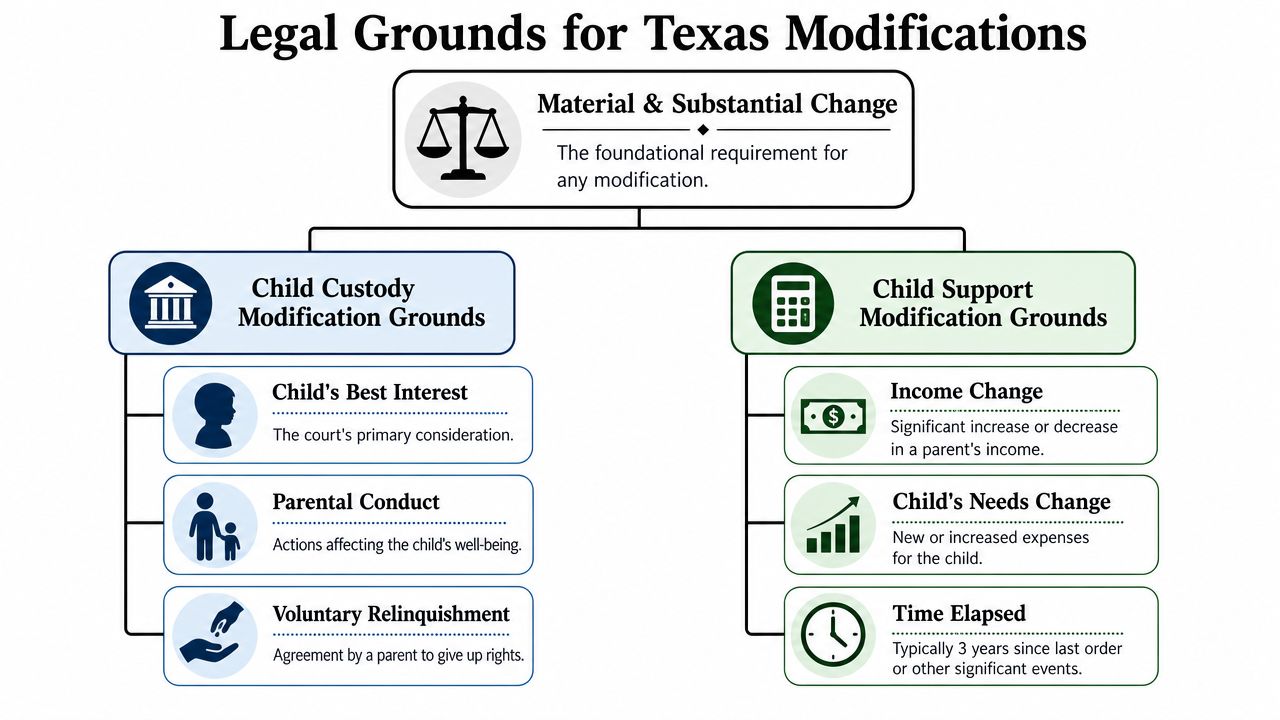
Texas courts don't modify orders just because one parent is unhappy with the result. The legal threshold is higher. In Texas family law, the legal standard for modifying any child custody, support, or divorce order is a “material and substantial change in circumstances” that occurred since the original order was rendered, as discussed by Bastine Law's overview of Texas modifications.
That phrase matters because it filters out minor disagreements and temporary disruptions. A rough month at work isn't always enough. Neither is a short-lived conflict over drop-offs. Courts want to see that the facts have changed in a meaningful way and that the change affects the fairness or workability of the current order.
What can change and what usually cannot
Some parts of a family court order are built for future adjustment. Others are intended to stay final.
| Order topic | Usually modifiable | Main reason |
|---|---|---|
| Child custody and visitation | Yes | Children's needs and family logistics change over time |
| Child support | Yes | Income and the child's needs may change |
| Property division in divorce | Generally no | Division of community property is meant to be final |
Texas treats property division differently from child-related issues. Under Texas law, community property includes assets and debts acquired by either spouse during the marriage unless proven to be separate property, such as property owned before marriage, gifts, inheritances, or certain personal injury compensation, as explained by Texas Law Help's discussion of dividing property and debt in divorce. That finality is one reason modification practice focuses so heavily on support, custody, and visitation rather than re-dividing marital assets.
A modification case succeeds when the proof matches the legal standard. It doesn't succeed because the filing tells a compelling story by itself.
Legal Grounds for Modifying Custody and Support
A strong modification case starts with the right legal ground. Many parents know something feels unfair, but they aren't sure whether the law recognizes that problem. In Harris County, that distinction matters. Judges want specific facts that fit a recognized pathway for relief.
Child support grounds
Texas provides two separate paths for modifying child support. A parent can prove a material and substantial change in circumstances, or proceed under the time-and-guideline-difference rule. Under Texas law, a support order may be modified if it has been three years since the order was rendered and the monthly support amount differs by at least 20% or $100 from what current guidelines would award, as summarized by Gonzalez Law Group's discussion of child support modifications.
That second path is important because it gives some families a more direct route. You may not need to build the entire case around a dramatic life event if the age of the order and the guideline difference already satisfy the statute.
Examples that often support a child support modification include:
- Income changes that are real and lasting. A job loss, promotion, or major shift in compensation can matter if it is documented and not just temporary.
- Changes in the child's needs. New medical costs, education-related needs, or other recurring expenses can support an updated amount when properly tied to the child's welfare.
- Outdated orders. Some orders no longer track the current guideline result after enough time has passed.
Custody and visitation grounds
Custody modifications are more fact-sensitive because the court has to consider not only changed circumstances, but also the child's best interest. Under Texas Family Code § 153.002, the child's best interest is the court's guiding principle in custody decisions.
Texas law also recognizes certain fact patterns that can become especially important. If a child is at least 12 years old and expresses a desire to modify the order to the judge in chambers, that can serve as grounds for a custody modification. Another recognized trigger arises when the primary custodial party has allowed the child to live with a different person for at least six consecutive months, a point discussed in the verified custody modification guidance provided above.
The issue that often surprises parents is that these facts still need context. A child's wishes matter, but they do not automatically decide the case. A six-month living arrangement matters, but the court still examines why it happened and whether a change in the written order would serve the child's welfare.
What Harris County judges usually want to see
Judges in the Houston area tend to focus on durability, not drama. They want to know whether the change is:
- Significant enough to affect the current order
- Non-temporary rather than a short disruption
- Well documented through records and testimony
- Connected to the child's best interest in custody cases
A relocation case is a good example. Moving farther away can justify changing possession terms, but the court will still examine school impact, transportation realities, and whether the proposed new schedule is workable. This review of reasons a judge will change custody in Texas gives additional context on how those decisions are evaluated.
The Modification Process in Harris County Step by Step
For many parents, the court process feels worse than the legal standard. The uncertainty is what creates stress. Once you know the sequence, the case becomes easier to manage.
Step 1 through Step 3
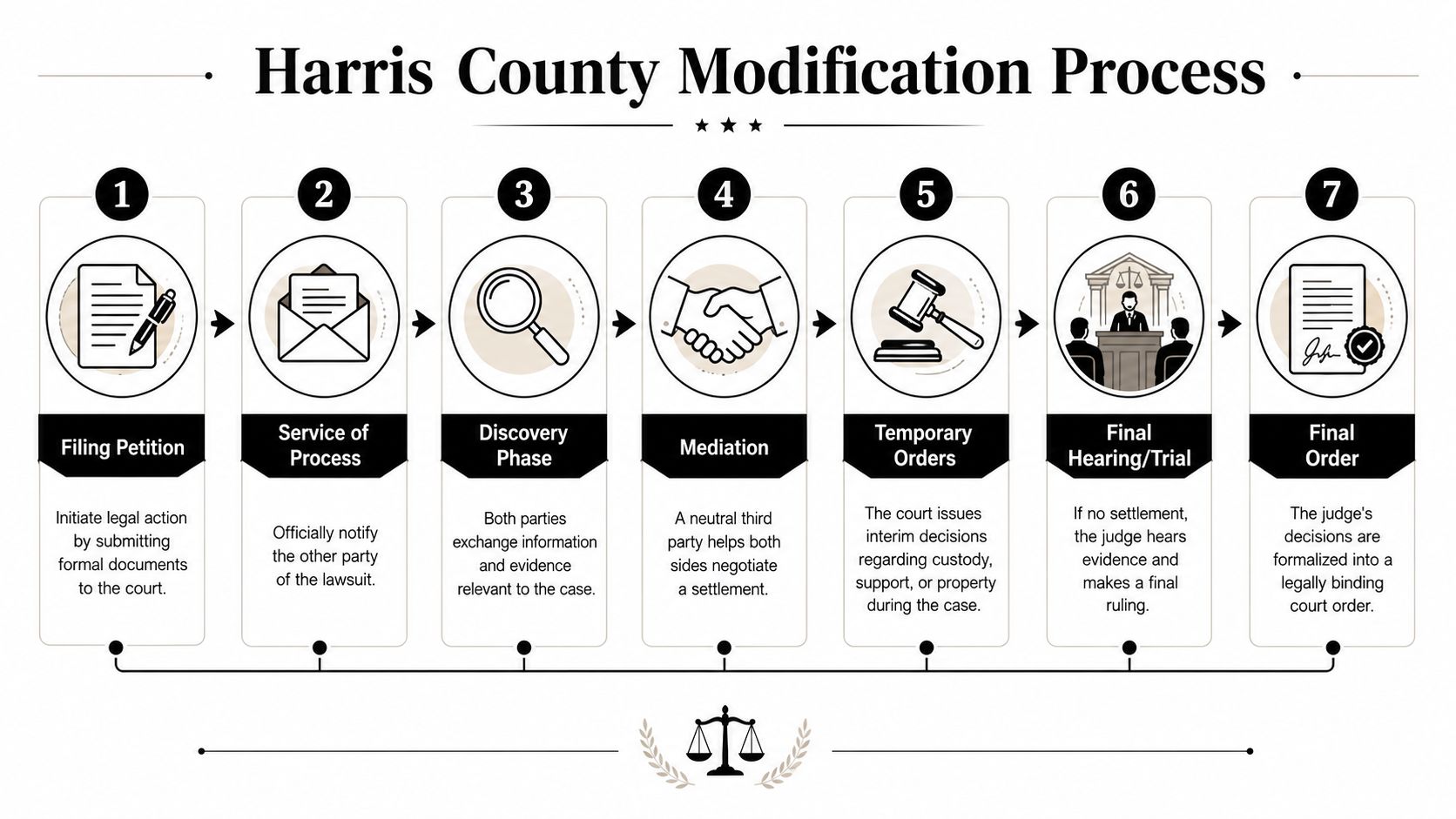
File the petition
The case begins by filing a petition to modify in the proper court. The pleading needs to identify the existing order and state what changes you want the judge to make.Serve the other party
The other parent must receive formal notice unless service is properly waived. Informal notice is not enough.Request temporary orders if needed
Some situations can't wait for a final hearing. If a child's schedule is unstable or support needs immediate adjustment, temporary orders may be appropriate while the case is pending.
Step 4 through Step 5
The middle of the case is where many outcomes are decided.
Discovery and evidence gathering
Discovery and evidence gathering involves collecting the proof that makes the case work. Depending on the issue, that may include pay records, tax documents, school records, medical information, calendars, communications, and evidence showing actual living arrangements.Mediation
Many Harris County family courts expect serious settlement efforts. Mediation gives both sides a structured chance to resolve all or part of the dispute before trial. Even in a difficult case, a partial agreement can narrow the issues and reduce cost.
Cases often turn on preparation before mediation, not performance during mediation.
Step 6 through final order
If settlement doesn't happen, the court holds a final hearing or trial. Each side presents testimony, documents, and arguments. The judge then signs a new order if modification is granted.
A simple sequence looks like this:
| Stage | What happens | Why it matters |
|---|---|---|
| Filing | The request is placed before the court | Sets the legal issues |
| Service | The other side is formally notified | Protects due process |
| Discovery | Evidence is exchanged and developed | Builds or weakens the case |
| Mediation | Settlement is explored | Can resolve disputes without trial |
| Hearing or trial | Judge decides unresolved issues | Produces enforceable relief |
| Final order | New terms become binding | Replaces the prior terms addressed |
If you want a practical walkthrough of how to modify child custody in Texas, that resource can help you compare your situation to the usual court sequence.
Not every family dispute has to be fought in a courtroom from start to finish. Some clients are familiar with Collaborative Divorce, which is an out-of-court collaborative process for resolving divorce. While modification cases follow their own procedural rules, the broader lesson still applies. Structured negotiation can save time and reduce conflict when both parties are willing to engage realistically.
Estimating Timelines and Costs for a Modification Case
Most clients ask two questions early. How long will this take, and what will it cost? The honest answer is that both depend more on conflict level than on the label attached to the case.
An agreed modification can move much faster than a contested one. If both parents want the same result and the paperwork is prepared correctly, the case is usually more straightforward. If one parent denies that any real change occurred, disputes the facts, or raises concerns about the child's best interest, the case naturally takes longer.
What usually drives the timeline
Several factors tend to shape how long a modification lasts:
- Court scheduling. Harris County dockets can affect how quickly hearings are set.
- The need for temporary orders. Urgent disputes often require early court involvement.
- Discovery disputes. Delays happen when one side doesn't promptly provide records.
- Mediation progress. A productive mediation can shorten the path to final orders.
What usually drives the cost
The biggest cost driver is whether the matter is contested. The more disagreement there is, the more attorney time, preparation, and court work the case usually requires.
Common cost components include:
- Attorney's fees for drafting, strategy, negotiation, hearings, and trial work
- Court filing fees
- Service expenses
- Mediation fees
- Costs tied to records or evidence preparation
The least expensive case is usually the one with a narrow issue, organized records, and realistic positions on both sides.
That doesn't mean you should rush to settle an unsafe or unworkable arrangement. It means you should evaluate the dispute carefully. If the case can be framed tightly around a provable issue, you often save time and money. If the case is broad, emotional, and poorly documented, expenses usually rise because more work is required to sort fact from accusation.
A good consultation should include a candid discussion about likely pressure points. No attorney can ethically promise an exact timeline or total cost at the start. What you should expect is a practical explanation of what may increase the burden and what steps can keep the case more efficient.
How to Choose the Right Houston Heights Modification Attorney
A parent gets a new work schedule, the child starts struggling in school, or support has stopped matching real income. The problem usually is not spotting that life changed. The problem is proving that the change is material, substantial, and important enough for a Harris County judge to rewrite an existing order.
That is why attorney selection matters in modification cases. The right Houston Heights modification attorney should know the statute, but that alone is not enough. The lawyer also needs judgment about how local courts evaluate proof, what weakens credibility, and which facts belong in front of the judge versus which facts only create noise.

Why strategy matters so much in these cases
In many modification disputes, the primary fight is not over whether something changed. It is over whether the change can be tied to the legal standard in a focused, believable way. Harris County judges often want a clear before-and-after story supported by records, dates, and practical consequences for the child or the support obligation.
That means a good lawyer will ask pointed questions early. When did the change begin. Has it lasted long enough to show it is not temporary. What documents back it up. Does the requested modification match the facts, or does it ask for more relief than the evidence supports.
These details matter. A parent may have a valid concern and still lose because the case was framed too broadly, the timeline was vague, or the proof suggested frustration rather than a legally significant change.
Questions worth asking in a consultation
Use the consultation to find out how the attorney thinks, not just whether the attorney handles family law.
How much of your work involves modifications of custody, visitation, or support?
Regular modification work usually means better instincts about proof problems and court expectations.What facts do Harris County judges usually want to see for a material and substantial change?
A strong answer should discuss specifics such as income records, school records, medical evidence, housing changes, relocation facts, or long-term schedule changes.How do you separate strong facts from distracting facts?
Modification cases often improve when the issue is narrowed. The answer should reflect discipline, not just aggression.What would concern you about my case right now?
This is one of the best questions to ask. A careful attorney should be able to identify weak spots, missing proof, or facts the other side may use against you.What should I gather before filing or responding?
Look for a practical list tied to your situation rather than a generic request for “everything.”How do you evaluate settlement versus a contested hearing?
The right answer should show judgment. Some cases should be resolved efficiently. Others need a judge because the facts or safety concerns make compromise unrealistic.
One practical sign of good counsel
A reliable modification attorney usually will not make fast promises. The better approach is to assess the last controlling order, compare it to current facts, identify what can be proven, and explain the trade-offs.
Sometimes the strongest legal issue is narrower than the client first expected. That can feel unsatisfying at first, but it often gives the court a cleaner path to grant relief. In other cases, waiting a short period to gather stronger evidence is smarter than filing immediately with a thin record.
The Law Office of Bryan Fagan, PLLC handles Texas family law matters, including modification disputes. A consultation should leave you with a clearer view of your evidence, your risks, and whether your request is framed in a way a Harris County court is likely to take seriously.
Frequently Asked Questions About Texas Modifications
Specific questions often decide whether a parent acts now or waits too long. These are some of the most common.

What if we both agree to change the order without going to court
That can create serious problems. Parents may follow a private agreement for months, then one side changes position and relies on the written order. Until the judge signs a new order, the old one usually remains enforceable. If support or possession terms need to change, put the agreement into a proper court order.
Can an order be modified if it came from mediation
Yes. A prior mediated outcome doesn't permanently block modification. If the legal grounds exist now, the court can consider a request to modify the current order. The focus is on what has changed since the relevant prior order or settlement point, not on whether the earlier resolution came through negotiation.
My original order is from Harris County, but my child now lives in another state. Where do I file
Interstate cases require extra caution. Under the Uniform Child Custody Jurisdiction and Enforcement Act, if a child's primary residence has shifted out of Texas for over six months, a petition to transfer jurisdiction may be required alongside the modification, as discussed by Texas Advocates in its explanation of modification procedure and UCCJEA issues.
That issue is easy to miss. Filing in the wrong place, or filing the right modification without addressing transfer, can delay the case and increase costs. If your child has been living outside Texas, jurisdiction should be analyzed before the petition is drafted.
What proof usually helps most
The best evidence is usually the most concrete. Financial records, school documents, medical records, calendars, and proof of actual living arrangements usually carry more weight than broad accusations. A clear timeline also helps the court see whether the change is real and lasting.
If you need help navigating divorce, custody, or estate planning in Texas, contact The Law Office of Bryan Fagan, PLLC today for a free consultation. If your current order no longer fits your child's needs, your finances, or your family's daily reality, specific legal guidance can help you decide whether modification is the right step and how to pursue it effectively.