Skip to content

Divorce can turn a familiar future into a set of hard questions fast. If you're looking at a pension statement, a 401(k) balance, or a long-earned retirement plan and wondering what happens next, you're already asking the right question. Under Texas community property rules, the part earned during the marriage is generally treated like a shared asset, while the part earned before marriage usually stays separate, so the first task is not emotion, it's classification.
That distinction matters because a retirement plan is often more than a line item. It can be the income you'll rely on later, the buffer that keeps you stable, or the asset you trade against home equity during settlement. Many people assume the divorce judgment itself finishes the job, but retirement division often fails later because the paperwork wasn't handled correctly or the wrong value was used. A clear plan early can prevent that kind of loss.
There's also a real knowledge gap. Many divorced people do not receive the retirement benefits they were awarded. Research shows 27% of married people with a private pension don't know what would happen to it in a divorce, and 73% have never discussed it, which helps explain why retirement rights get overlooked at the exact moment couples need precision most (Pension Rights). If you want a simple starting point, a plain-language overview of pension basics from secure retirement with Fintrack can help you understand the moving parts before you negotiate.
How Texas Law Views Your Pension Community Property Explained
A divorce can turn a retirement account from a private promise into a shared issue very quickly. Texas law starts with a simple rule, property acquired during marriage is presumed community property, so the retirement value built during the marriage usually belongs in the marital estate even if only one spouse's name appears on the account.

Separate property and community property do not work the same way
The key question is timing. Money or growth earned before the marriage is generally separate property, while the value created during the marriage is generally community property, and that distinction matters more than whose name is printed on the statement. Texas law focuses on when the retirement value was earned, not just on which spouse received the paycheck or opened the account.
Practical rule: the account label matters less than the period when the benefit was built.
That is why a retirement plan can have two different characterizations at the same time. A 401(k) or similar account may include premarital contributions, marital contributions, and growth tied to both periods, so the court has to sort those pieces carefully. If the retirement benefit comes from military service, the classification can be even more technical, which is why a focused guide such as military divorce laws in Texas can help when a service pension is part of the case.
A practical way to verify that history is to collect old statements, employment records, and any plan documents that show when the benefit was earned. If something does not line up, a private detective Birmingham may help gather background facts in situations where a spouse suspects hidden employment or incomplete financial disclosure. Those details do not decide the legal issue by themselves, but they often show whether the retirement value really came from the marriage or from an earlier period.
Defined contribution and defined benefit plans need different treatment
A 401(k) usually works like a visible account balance, so you can see the dollars and track contributions over time. A traditional pension works differently because it promises future income, which means the central question is not just what the plan says today, but what monthly retirement income it will eventually produce. That is why pensions often require a separate valuation and not just a quick review of the latest statement.
If you are already dealing with house equity, debt, and savings, a Texas lawyer may address retirement inside a broader Property Division discussion. That matters because pension division can affect the rest of the settlement in practical ways. One spouse may keep more cash now and give up part of the retirement stream later, or the parties may agree to a trade that only makes sense if the pension is understood correctly. A retirement benefit that looks fair on paper can still leave one spouse short on income after the divorce if the future payment rights are not divided with care.
Valuing a Pension It's More Than Just the Account Statement
A pension statement can give a false sense of certainty. It may show a number, but that number does not always reflect what the benefit will do for you in retirement, especially when the plan pays a monthly income instead of handing over a lump sum. The question is the marital share, meaning the portion earned during the marriage, because that is the part a Texas court can divide.
A pension works more like a stream of future pay than a bank account. That is why two spouses can look at the same statement and reach very different conclusions about fairness. One spouse may see a balance and assume the issue is simple, while the other is really looking at a right to future income that may not start for years. If that income is divided the wrong way, the mistake often shows up later, when retirement begins and the monthly checks are smaller than expected.
Why present value matters
Defined contribution plans are usually easier to value because the balance is visible. Defined benefit plans need a closer examination because the future payment stream has to be translated into today's value. That calculation can depend on retirement age, survivor rights, and tax treatment, so a quick comparison of statements can point you in the wrong direction.
A pension that looks equal on paper can still produce very different retirement income later.
That is where many divorcing spouses are caught off guard. One person may keep the house because it feels concrete, while the other keeps the pension because it looks like a number on a page. Those assets do not behave the same way. The house may be easier to sell or refinance, while the pension only has value if the right share is preserved and paid out correctly over time. A settlement that seems balanced at signing can still leave one spouse short in retirement if the income stream was never valued carefully.
A practical valuation sequence
- Identify the plan type. A 401(k), IRA, or similar account usually has a stated balance. A traditional pension may require a present-value analysis, which asks what that future income is worth in today's dollars.
- Separate pre-marriage and marital portions. Texas law generally treats pre-marriage value as separate property and marital growth as community property.
- Check the plan rules. Private plans often will not honor a generic divorce order, and the paperwork has to fit the plan's own requirements.
- Confirm the marital share. That is the portion you negotiate, offset, or divide in the divorce.
If you want a clearer example of how account-based retirement funds are handled in practice, splitting a 401(k) in divorce is a useful comparison. The main point is simple, value the right slice before you decide who keeps what.
The QDRO The Essential Tool for Dividing Retirement Funds
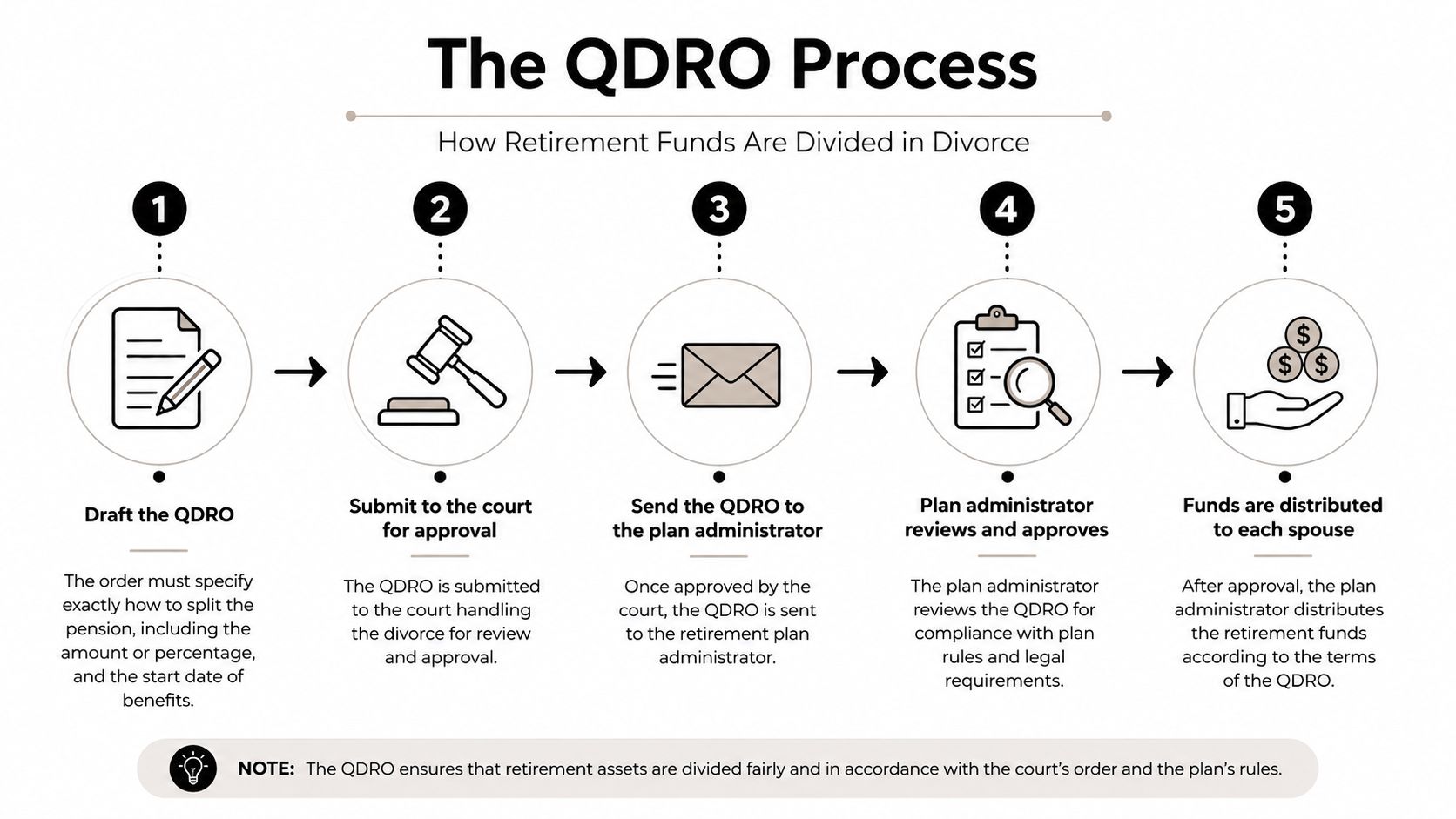
A divorce decree may divide retirement benefits on paper, but that does not make the plan send a payment. For most private retirement plans, the plan administrator needs a separate order that matches the plan's rules before money can be paid to a former spouse, and federal law requires a Qualified Domestic Relations Order, or QDRO, on file before payment can be made to that alternate payee (IRS retirement topics on divorce).
A QDRO works like the instruction sheet for the plan. The decree tells the spouses who is supposed to receive what, while the QDRO tells the retirement plan how to carry out that division. If those two documents do not match, the plan can delay the transfer or reject it altogether.
A real-world example of what goes wrong
A spouse leaves mediation believing the pension issue is finished because the final decree says the account will be divided. Months later, the plan administrator still will not send a payment because no approved QDRO has been entered. The divorce is over, but the retirement money is still sitting where it was.
That kind of delay is more than paperwork frustration. A divorce decree by itself is not enough to force most plans to pay a former spouse, and the missing order can leave someone waiting for income that was supposed to help support retirement later (IRS retirement topics on divorce).
The usual QDRO path
- Get the plan information early. Ask for the summary plan description and the plan's QDRO procedures.
- Draft language that matches the plan. A generic order can fail if it does not fit the administrator's requirements.
- Submit it for review. The plan administrator checks whether the order is valid under the plan rules.
- Obtain court signature. The judge signs after the order is finalized.
- Follow through until acceptance. The process is not complete until the plan accepts the order and the benefit is administered.
Texas families often learn that the legal order and the retirement paperwork are separate steps, and both matter. A firm like the Law Office of Bryan Fagan, PLLC can coordinate retirement division, property settlement, and post-decree follow-through in one place, which lowers the risk that an awarded benefit gets lost in paperwork. If you want to see how the document itself works, qualified domestic relations orders explains the mechanics in more detail.
Bottom line: if the plan does not recognize the order, the order has not protected you yet.
Creative Negotiation Strategies Offsets and Buyouts
Not every pension needs to be split in kind. Sometimes the better move is to trade the pension value for another asset, often home equity, so one spouse keeps the retirement plan intact while the other receives something else of comparable value. In UK terminology, that's called offsetting, and the principle is useful here too because it shows how settlement design can change the long-term result (PPF guidance).
Why a clean split isn't always the smartest split
A defined-benefit pension is really future income, not a pile of cash. If you give that up for a house, you may be trading retirement security for an asset that looks stronger today but doesn't replace monthly income later. That trade can work, but only if you understand what you're giving away.
Offsetting can also simplify settlement. One spouse keeps the pension, the other keeps more of another asset, and the couple avoids ongoing administration of a shared retirement benefit. But simplicity has a cost if the valuation is wrong or if the spouse giving up pension rights doesn't have another reliable source of retirement income.
Details people forget to negotiate
- Tax treatment: Different assets can be taxed differently later, so equal value today doesn't always mean equal value after taxes.
- Survivor benefits: If the pension is meant to provide income after death, the order needs to address that specifically or the benefit can disappear.
- Cash flow needs: A house may feel secure, but it doesn't pay monthly retirement income.
Don't trade a lifetime income stream for a headline number unless you've checked what that number actually buys.
A buyout can also make sense when one spouse wants a clean break and the other wants to preserve a retirement account in full. The key is to compare the settlement against the future, not just the spreadsheet today. If you're handling a broader estate plan too, retirement choices can affect probate and beneficiary planning, which is where a Texas probate resource like probate administration and estate settlement may also become relevant.
Your Pension Division Checklist for a Texas Divorce
A pension division goes smoother when you start with paper, not emotion. Before anyone argues about fairness, gather the account names, recent statements, and plan documents so you can see what exists, what is marital, and what needs to be protected in the final order.
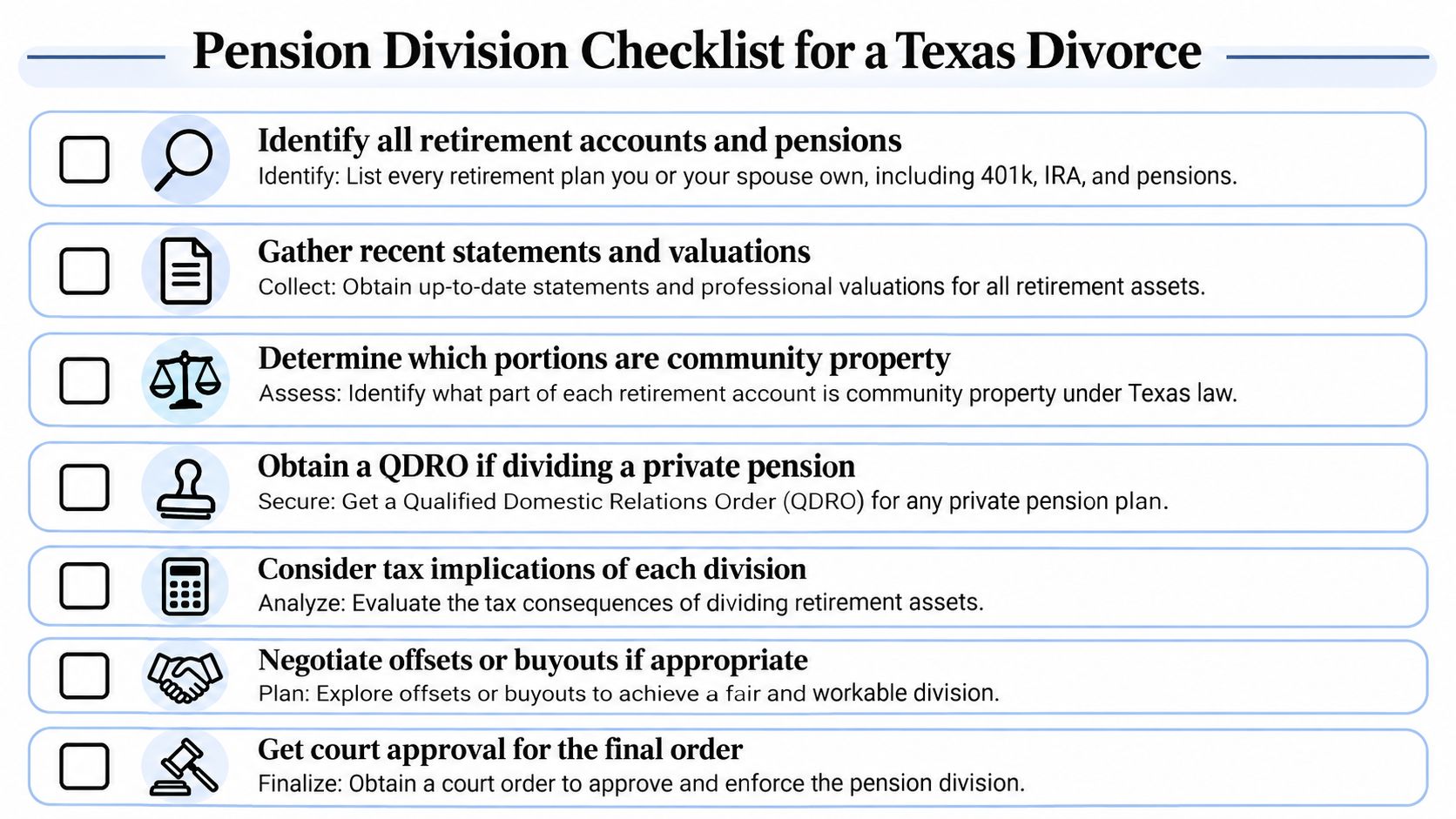
Use this as your working list
- Identify every retirement account. Include 401(k)s, IRAs, pensions, and any other employer plan.
- Gather plan documents early. The summary plan description and distribution rules matter because each plan has its own paperwork and its own timing rules.
- Mark the marriage dates carefully. That is how you separate separate property from community property under Texas law.
- Value the marital share. The full balance is not always what gets divided. The portion earned during the marriage is often the part that matters.
- Decide whether to share or offset. The right choice depends on whether you need income later, cash now, or more stability in retirement.
- Address survivor benefits. If the pension is supposed to keep paying after death, the order needs to say so clearly, or the benefit can disappear like a title issue left off a deed.
- Make sure the QDRO is accepted. A QDRO works like the instruction sheet the plan administrator needs before it can pay the nonemployee spouse. Until the plan accepts it, the award may not be secure.
If you are already in the middle of a divorce, bring this checklist to your next attorney meeting. Bring the statements, ask what part is community property, and do not leave without a clear plan for the QDRO and the retirement income it is supposed to protect. The choices made here affect more than the division on paper, they affect the monthly income you may rely on years later.
If you need help with divorce, custody, or estate planning in Texas, contact The Law Office of Bryan Fagan today for a free consultation. Our team helps clients sort out retirement division, community property questions, and the paperwork that protects the income they will live on. Visit Law Office of Bryan Fagan, PLLC to get guidance for your situation.