 Skip to content
Yes, one spouse can file for bankruptcy alone under U.S. law, but in Texas the non-filing spouse can still be exposed through community property and joint debts. That's why a filing decision in a marriage is rarely just about who signs the petition, it's about how the household is structured.
A couple usually reaches this point after months of pressure. One spouse may be staring at medical bills, a failed business, a job loss, or a stack of joint credit cards that the family can't keep up with. The other spouse may still be working, trying to protect credit, keep the home stable, and figure out whether bankruptcy, divorce, or both need to happen at the same time.
The good news is simple. You are not automatically forced into a joint case, and you are not out of options just because the debt is tangled up with marriage. The hard part is knowing what changes when only one spouse files, especially in Texas, where property rules matter more than many realize. A helpful overview from another Texas practice is the spouse bankruptcy filing guide, but the key issue for most families is how the filing plays out in their own household.
When One Spouse Faces Debt They Cannot Pay Alone
A Houston couple comes in after one spouse's business fails. The debts are in both names, the mortgage is current only because the other spouse has been covering gaps, and both of them are already talking about divorce. That's the moment when people usually ask the wrong question, which is, “Do we have to file together?”
The better question is, “What happens if only one of us files?” Under federal bankruptcy law, marriage does not force a joint filing. A spouse can file alone, and that choice can make sense when the debt problem belongs mostly to one person, or when the household needs to keep one credit profile separate.
What bankruptcy changes, and what it doesn't
Bankruptcy can wipe out qualifying debt for the filing spouse, but it does not erase the marriage, the house, or every shared obligation. If the couple is headed for divorce, that distinction matters even more. Texas property rules, support issues, and the timing of the filing can all change the outcome.
Practical rule: if the debt is mostly yours, file by yourself before assuming your spouse has to get dragged into the case.
For readers comparing family-law and asset-protection options, Prenuptial & Postnuptial Agreements come up for the same reason, they help define who owns what before a crisis forces the issue. That doesn't solve every bankruptcy problem, but it does show how planning and property classification can change the result.
The Federal Rule on Filing Alone Versus Filing Together
Federal bankruptcy law starts with a straightforward rule. A married couple is not required to file a joint case. Under 11 U.S.C. § 302, a joint case exists only when both spouses voluntarily file one petition, and the U.S. Courts explain that a husband and wife may file either a joint petition or individual petitions.
That means the legal system treats the filing decision as personal unless the spouses choose otherwise. One spouse can file alone even if the other spouse stays out of the case. A joint case is an option, not a mandate.
What the paperwork still demands
A single-spouse filing is not a “my finances only” filing. The filer still has to disclose marital status, household expenses, and often the other spouse's income when the means test and petition documents are prepared. That's because the court looks at household cash flow, not just the filer's separate paycheck, especially when the spouses live together or share major obligations.
If the couple is trying to protect separate assets or clarify who owns what before filing, Property Division is the same kind of issue family-law lawyers deal with when community and separate property are both in play. The bankruptcy form doesn't let you ignore those realities.
Bottom line: the question is not whether you're married. The question is how the household finances are built, because the petition has to reflect that truth.
A married filer in Texas usually needs to gather more than just their own statements. Bank records, pay stubs, mortgage statements, car notes, and information about the non-filing spouse's income often become part of the analysis. That's not a defect in the process, it's how the law measures ability to pay.
Chapter 7 Versus Chapter 13 for a One-Spouse Filing
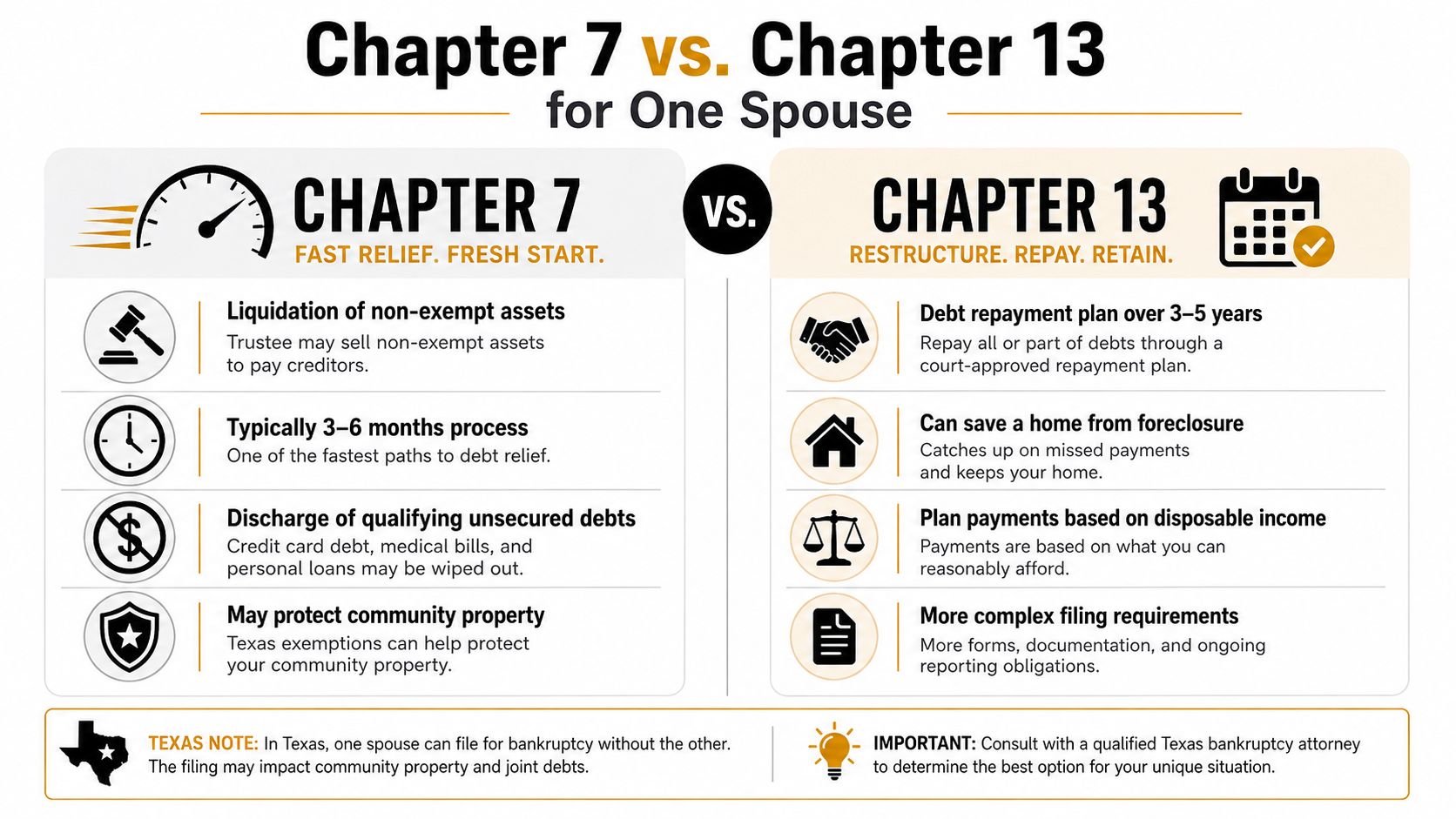
The chapter choice matters more when only one spouse files. Chapter 7 usually fits a household that needs a faster reset and has mostly dischargeable unsecured debt. Chapter 13 usually fits a household that needs time, especially if joint consumer debt, arrears, or a home loan has to be managed through a repayment plan.
How the two chapters treat the household
In Chapter 7, the filing spouse may receive a discharge of qualifying debts after the case moves through the process. The non-filing spouse does not get that discharge automatically, and shared obligations can still remain a problem for the household. Chapter 13 works differently, because it builds a repayment plan and can temporarily stop collection against a co-obligated spouse on consumer debt through the co-debtor stay.
That's the practical split. Chapter 7 is often cleaner for separate debts. Chapter 13 is often more useful when the family needs breathing room on joint consumer obligations.
| Factor | Chapter 7 | Chapter 13 |
|---|---|---|
| General structure | Liquidation-style case | Repayment plan case |
| Effect on joint consumer debt | No co-debtor stay | Co-debtor stay can apply |
| Household income review | Means test still looks at household cash flow | Plan payments depend on disposable income |
| Best fit | Mostly separate unsecured debt | Joint debts, arrears, or need for structured repayment |
The Chapter 7 and Chapter 13 choice can also affect related family-law problems, including a separate CPS matter if the household is already under strain. A resource like Child Protective Services Defense is relevant when family stress has already spilled into other court systems, because debt, stability, and legal risk often overlap.
Texas Community Property and What Enters the Bankruptcy Estate
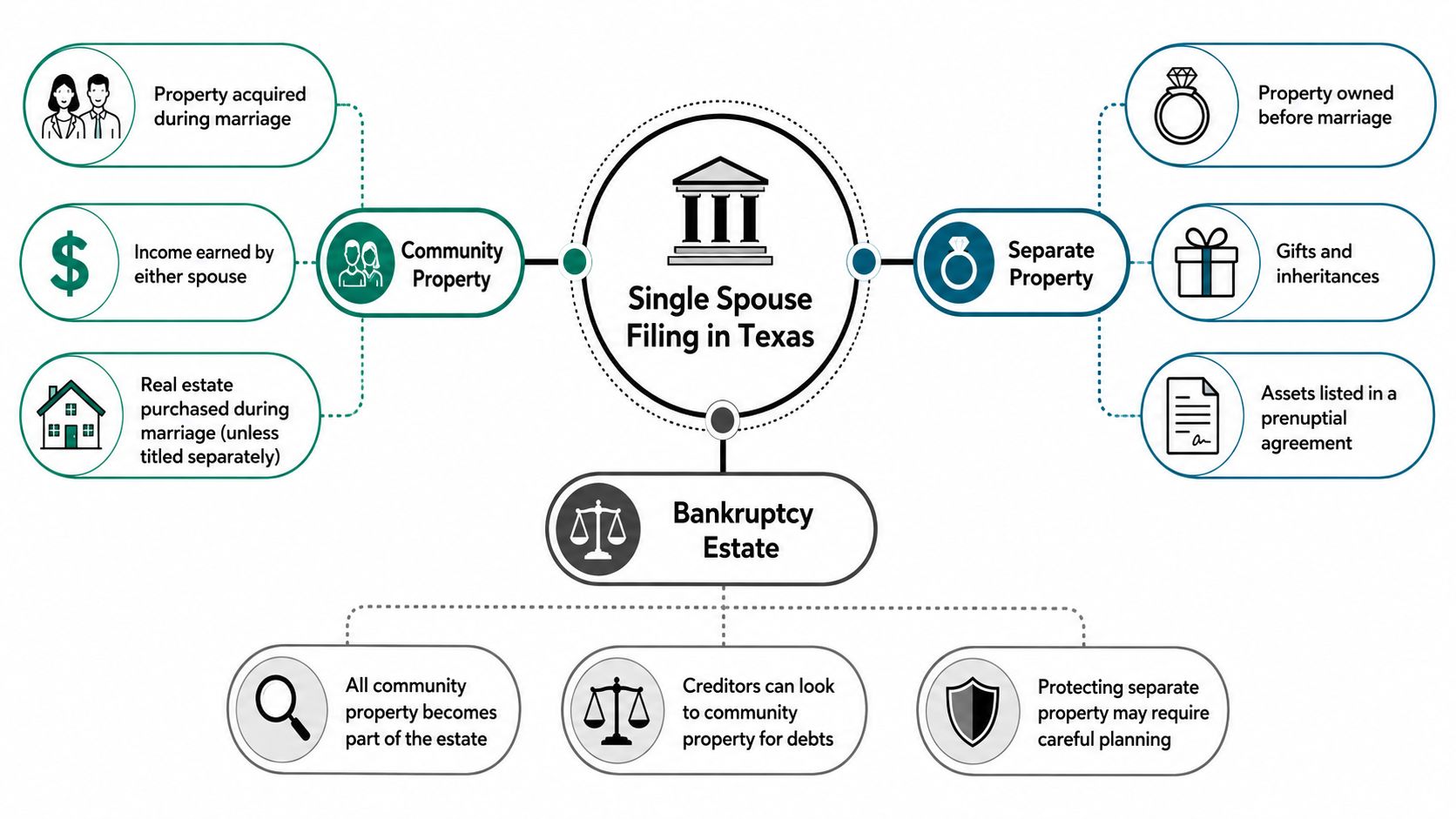
Texas is a community-property state, and that is the biggest Texas-specific issue in a one-spouse filing. Marriage does not magically turn everything into one undivided pot, but it does mean property classification matters. A filing does not sever community property or erase the non-filing spouse's interest.
Why community property changes the result
The bankruptcy estate can reach community property, which often includes wages earned during the marriage, joint accounts, and real estate bought during the marriage. Separate property is different. Property owned before marriage, gifts, inheritances, and assets classified separately stay outside the community bucket, though they still have to be disclosed correctly.
That's why a Texas filing can look very different from a filing in a non-community-property state. If you're protecting the home, the homestead rules also matter, and the discussion often overlaps with Texas homestead exemption basics.
The rule is simple, even if the paperwork isn't. A single-spouse bankruptcy can still draw in community assets, because Texas law doesn't let the filer pretend the marriage doesn't exist for property purposes.
Important: filing alone doesn't convert community property into separate property. It only starts the bankruptcy analysis.
For families working through complicated property issues, the same classification problem appears in divorce court. Bankruptcy and divorce both force the same hard question, what is community, what is separate, and what can still be reached by creditors?
Joint Debts Secured Loans and Child Support Exposure
If only one spouse files, joint debts are still a live problem. Credit cards, mortgages, auto loans, and signature loans don't disappear for the non-filing spouse just because the filing spouse gets relief. Creditors can still pursue the spouse who didn't file, and if collateral is tied to the debt, they may still look to the collateral.
What survives the filing
Child support is not a debt you can wipe away with bankruptcy. The same practical warning applies to most support obligations tied to family court orders. If support is already in the picture, the family should plan around it instead of assuming bankruptcy will solve it.
A good habit is to keep clean records from the beginning. The expense record for custody filings is useful for that reason, because custody and support disputes often depend on documentation that lines up with the family's actual spending.
If you want the clearest reference point on support enforcement, what happens if child support is not paid in Texas is the practical issue that survives bankruptcy planning. Bankruptcy may change the budget, but it does not make support disappear.
Divorce makes the exposure sharper
When a divorce is pending, joint debt can become a bargaining chip, a pressure point, or both. One spouse may hope bankruptcy will reduce the marital debt load before property division. That can help, but it can also create a fight over who keeps the house, who pays the loan, and how the family's remaining obligations are allocated.
If you're dealing with support, debt, and divorce at the same time, the firm's family-law team also handles Texas property division before divorce finalization, because timing can change what the court sees as part of the marital estate.
Rule of thumb: joint debt stays dangerous unless the plan addresses both spouses, not just the filer.
How Bankruptcy Timing Affects Divorce Property Division and Support
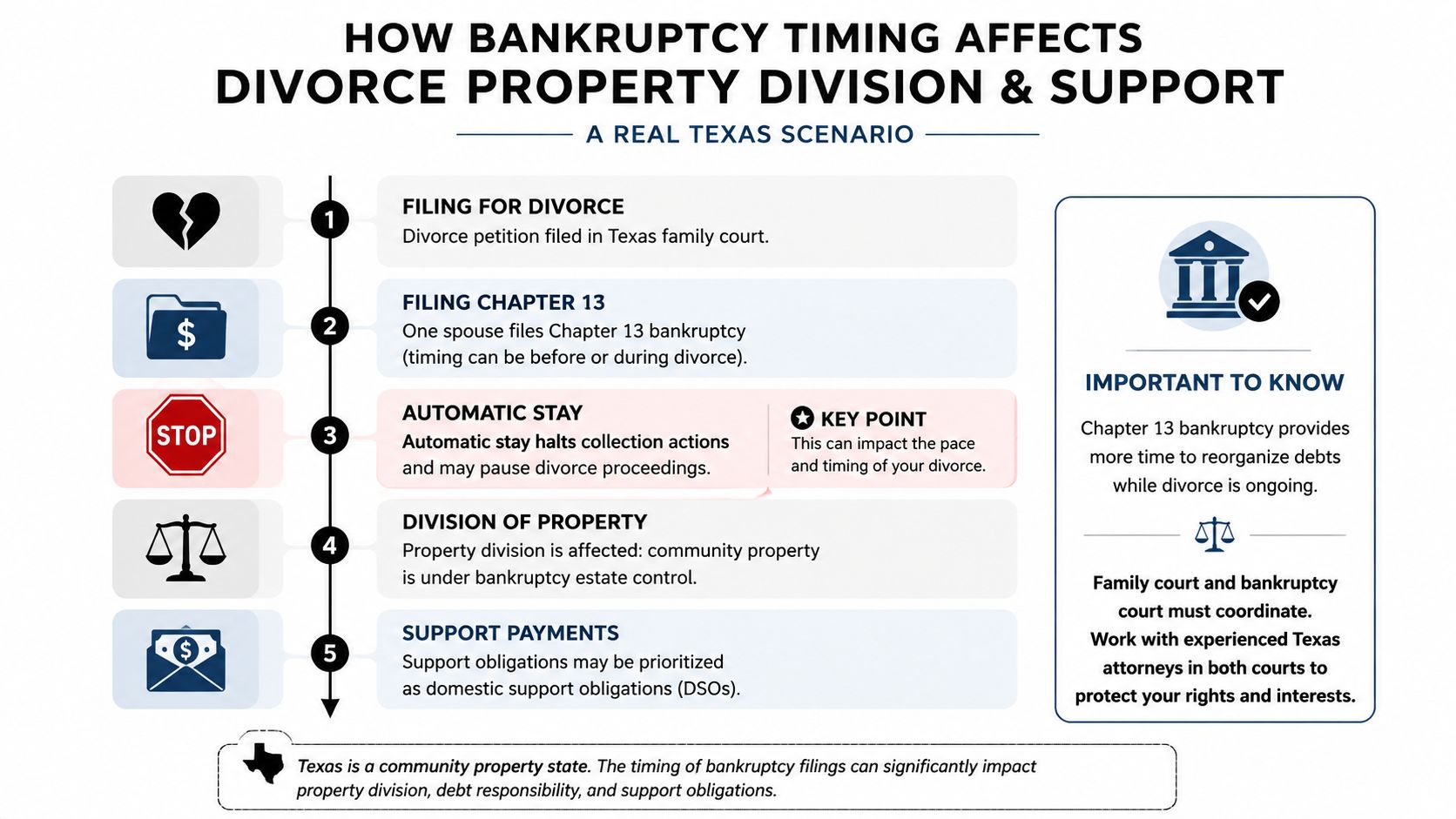
A wife files Chapter 13 two weeks before the divorce hearing. The mortgage is behind, the credit cards are shared, and both spouses want the family home to be handled in the divorce. That timing can change the negotiation overnight.
Why the order of filings matters
The automatic stay generally stops collection activity, but it does not erase the divorce case. Family court can still deal with divorce-related issues, and support and custody issues are treated differently from property debt collection. The fight is usually over the marital estate, because community property can become part of the bankruptcy estate and get pulled into the bankruptcy court's control.
That's why family court and bankruptcy court have to coordinate. If the divorce is already moving, the spouses should not treat bankruptcy as a separate track. It affects what the family court can divide, what creditors can chase, and how much breathing room the household really gets.
The practical effect is this. Filing before divorce can create a strategic position on debt, but it can also freeze or complicate the property picture. Filing during divorce can protect one spouse from collection, but it can also slow down the overall resolution.
The issue gets even more delicate in a household already under review by another court, including a CPS-related case. Legal problems rarely stay in one lane.
Direct advice: if divorce is likely, plan the bankruptcy with the divorce, not after it.
Common Misconceptions and Costly Pitfalls
A lot of Texas couples get blindsided because they assume bankruptcy works like a reset button for the entire household. It doesn't.
The mistakes I see most often
- “My spouse didn't file, so creditors can't touch them.” That's wrong when joint debt exists. The non-filing spouse can still be pursued for the full balance.
- “Community property is automatically safe because we're married.” Also wrong. In Texas, community property can still become part of the bankruptcy analysis.
- “Child support goes away in bankruptcy.” It doesn't. Support obligations keep their own force.
- “My spouse's credit won't be affected.” Not if joint accounts stay open or creditors keep collecting on shared obligations.
- “This won't matter in divorce.” It usually matters a lot, because property division has to account for what bankruptcy already touched.
The biggest pitfall is doing this without a full inventory of the household's finances. A single-spouse filing can look simple at first, then become a fight over a car note, a mortgage, a bank account, or a support order. That is how families end up with surprise lawsuits, missed refinancing opportunities, and avoidable court disputes.
Don't assume the filing solves the household problem. It only solves the part the bankruptcy law actually reaches.
If the family is already under stress from children's issues, debt, or a pending separation, it's smart to get legal help before making the move. One-spouse bankruptcy may be the right strategy, but it has to be built around the rest of the family's legal reality, not just the debt list.
Practical Next Steps and When to Talk to an Attorney
Start with the facts, not the fear. Gather recent pay stubs, tax returns, bank statements, loan statements, mortgage records, and a list of all debts, both joint and separate. If child support, spousal maintenance, or divorce is already in play, include those orders and pending court dates too.
A simple way to prepare
- List every debt in one place, including who signed it.
- Separate community and separate property as carefully as you can.
- Flag support obligations that bankruptcy won't erase.
- Compare Chapter 7 and Chapter 13 based on how much joint debt is involved.
- Bring the divorce timeline to the consultation if a case is pending.

If you're thinking about filing alone, don't wait until a creditor starts moving. Talk through the household structure first, then decide whether a single-spouse case protects the family or just shifts the problem around.
If you need help navigating divorce, custody, or estate planning in Texas, contact The Law Office of Bryan Fagan today for a free consultation.
If you need help with a one-spouse bankruptcy filing, the attorneys at Law Office of Bryan Fagan, PLLC can review your debts, property, and divorce timeline together. We help Texas families sort out community property, joint liabilities, and the practical fallout before the filing becomes a bigger problem.


