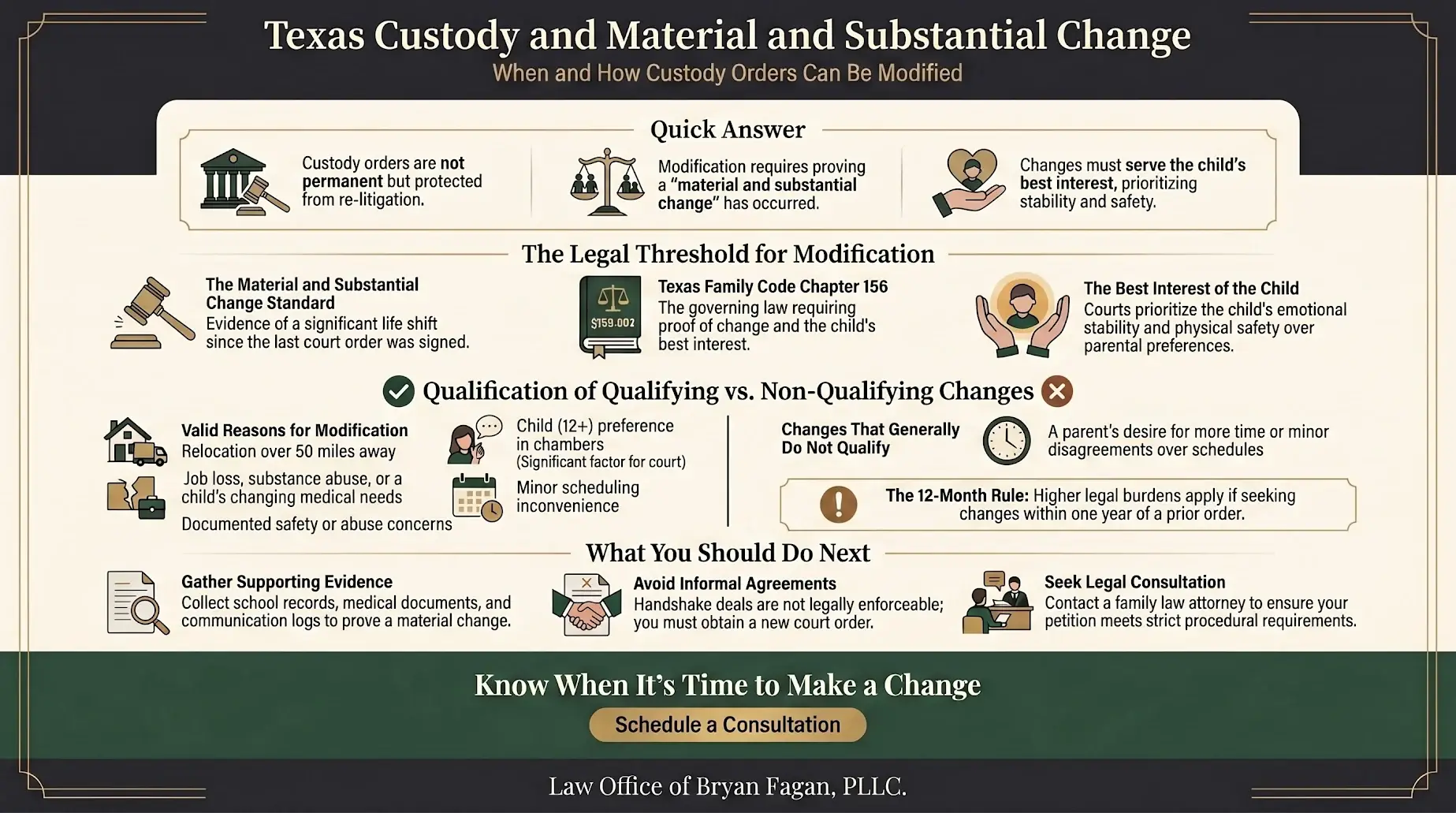

A father called our office recently after something didn’t sit right with him. His ex had moved nearly two hours away with their child without much notice. Weekend visits turned into rushed exchanges, routines disappeared, and communication broke down almost overnight. He didn’t call because he was angry—he called because something felt off. Situations like this often fall under Texas Custody and Material and Substantial Change, the legal standard in Texas Family Code §156.101 that determines whether a custody order can—and should—be modified.
What he was really asking wasn’t just “Can I fix this?” It was “Is this enough to matter legally?” That’s where most parents get stuck. They know something has changed, but they don’t know if it rises to the level the court requires. And in Texas, not every disruption qualifies. The law is designed to protect stability for children, which means courts look for changes that are meaningful, lasting, and directly affecting the child’s daily life.
At The Law Office of Bryan Fagan, PLLC, we’ve guided families across Houston through moments exactly like this. Led by Bryan Joseph Fagan, a South Texas College of Law graduate and a recognized authority in Texas custody law, our firm is built on helping people move from uncertainty to clarity. When your situation changes, you deserve to understand where you stand—not just emotionally, but legally.
In this article, we’ll walk you through what counts as a material and substantial change in Texas, how courts evaluate these situations, and what steps you can take if your current custody order no longer reflects reality.
In Texas, a material and substantial change in circumstances is a meaningful, lasting shift in the conditions of a parent or child that has occurred since the last custody order was signed. Under Texas Family Code §156.101, you must prove both the change and that modifying the order is in the child’s best interest under §153.002. Common qualifying changes include significant relocation, remarriage with a problematic new household, substance abuse or criminal conduct, and changes in the child’s needs or maturity. Routine life changes, schedule frustrations, and disagreements about parenting style typically do not meet the standard.
Key Takeaways
- Filing in the wrong county costs you months. Under §155.201, jurisdiction follows the child’s principal residence — get this wrong and the case transfers, your discovery resets, and your evidence ages.
- The standard is two hurdles, not one. You must prove (1) a material and substantial change and (2) that modification serves the child’s best interest. Many parents prepare for the first and forget the second.
- If your order is less than 12 months old, the standard is much harder. Texas Family Code §156.102 requires an affidavit and limits modification to three narrow grounds — endangerment, voluntary relinquishment, or joint agreement.
- “Material” and “substantial” are not the same word twice. Courts read them as requiring both meaningful magnitude and lasting impact. Temporary disruptions, even severe ones, often fail.
- Schedule frustration alone almost never qualifies. Work hour changes, traffic, or “the order doesn’t work for me anymore” is the #1 reason modifications get denied at the threshold.
- Evidence beats argument every time. Documented relocation distance, police reports, CPS records, medical records, school records, and admissions in text messages win modifications. Testimony alone rarely does.
- The child’s preference matters at age 12 — but only on the residency question. §153.009 lets a child 12 or older confer with the judge, but preference is not the same as a material and substantial change.

Your Family’s Future Starts Here
Don’t navigate your legal journey alone. Schedule a consultation now and get the clarity and support you deserve.
What “Material and Substantial Change” Actually Means Under Texas Law

Under Texas Custody and Material and Substantial Change, the starting point for any custody modification is Texas Family Code §156.101. The law is clear: a court can only revisit an existing order if something meaningful has changed since that order was signed—and that change must be backed by credible evidence, not assumptions or frustration. In practice, judges are looking for real-world impact. They evaluate whether the child’s environment, safety, stability, or relationship with each parent has shifted in a way that affects daily life, not just whether one parent feels the arrangement is no longer working.
“Material” and “substantial” are not interchangeable, and Texas courts treat them as two separate hurdles. A material change is one that matters legally—something tied to the child’s well-being, such as safety concerns, instability in the home, or serious conflict between parents. In higher-risk situations, including those involving patterns of harm or control, courts may look closely at issues similar to those seen in domestic violence cases in Texas. A substantial change, on the other hand, must be ongoing and significant. A short-term disruption or a single disagreement rarely meets this standard. Judges consistently look for patterns, duration, and documented impact before allowing a case to move forward.
Timing is just as important as the facts themselves. The change must have occurred after the last order was entered. This is where many cases fail. If the issue existed at the time of the prior order—even if it has worsened—courts often treat it as something that should have been addressed earlier. Under Texas Custody and Material and Substantial Change, the clock starts the day the order is signed, and anything before that is generally excluded. In straightforward situations, such as a clear relocation or a documented shift in living arrangements, meeting this threshold may be more direct. In more complex cases—where facts are disputed, documentation is limited, or the child’s stability is gradually declining—a more strategic and evidence-driven approach becomes essential.
This is also where legal judgment comes into play. Courts don’t just evaluate whether something changed—they assess credibility, consistency, and whether the proposed modification aligns with the child’s best interest under §153.002. Where disputes are contested or involve safety concerns, delaying action or failing to document issues can weaken a case before it even begins. On the other hand, when changes are clearly documented and tied to the child’s well-being, moving forward at the right time can significantly strengthen your position. Understanding whether your situation is straightforward or requires a more structured legal strategy is often the difference between a case that gets dismissed and one that moves forward with real momentum.
If something has worsened since the last order rather than appeared from nothing, frame it carefully. “He has always been a heavy drinker, but in the last 18 months he has had three DUIs” is a winning frame. “He’s a heavy drinker” is not.
The Two Separate Hurdles: Change AND Best Interest
Most parents are surprised to learn that under Texas Custody and Material and Substantial Change, proving that something has changed is only half the battle. The second—and often more difficult—hurdle is showing that the proposed modification is in the child’s best interest under Texas Family Code §153.002. These are two separate legal questions, and a judge must find both in your favor before making any change to an existing order. If either piece is missing, the case can stall or fail entirely.
Texas courts rely on what are commonly known as the Holley factors, established in Holley v. Adams, to evaluate best interest. Judges look at the child’s emotional and physical needs, the stability of each home, the parenting abilities of each parent, and the plans each parent has moving forward. They also consider whether the current arrangement is working—or if there are signs it is no longer supporting the child’s well-being. This analysis is not theoretical. It is grounded in real evidence, real routines, and real outcomes. In many cases involving Texas Custody and Material and Substantial Change, the parent who presents the most consistent and credible picture of stability often has the stronger position.
This is where many cases break down. In straightforward situations, such as a clear relocation or a documented shift in circumstances, parents may assume the outcome is obvious. But in more complex cases—where disputes are contested, facts are interpreted differently, or the child’s needs are evolving—the strategy behind how you present your case becomes critical. Judges are not just asking whether a change occurred; they are evaluating credibility, documentation, and whether the proposed outcome genuinely improves the child’s life.
Timing and preparation also play a significant role. Waiting too long to build a best-interest case, or focusing only on what the other parent has done wrong, can weaken your position. Courts are forward-looking. They want to see what life will look like for the child if the modification is granted. That means showing structure, consistency, and a clear plan. If you are unsure whether your situation meets both parts of the standard, taking time to evaluate your case carefully can make a meaningful difference. You can start by getting clarity on your options through the firm’s Start Here guide, which helps you understand where your situation fits and what steps may come next.
In the end, understanding how Texas Custody and Material and Substantial Change works in combination with the best-interest standard is what separates cases that move forward from those that are dismissed or denied. Recognizing whether your situation is straightforward or requires a more structured, evidence-driven approach can help you make better decisions—and avoid costly missteps along the way.
| Hurdle | What Texas Law Says | Practical Impact |
|---|---|---|
| Material and Substantial Change §156.101 | A meaningful, lasting change in circumstances since the last order was rendered, affecting the child or a conservator. | If you can’t prove this, the judge dismisses without hearing best interest. This is the threshold gate. |
| Best Interest of the Child §153.002 (Holley factors) | The proposed modification must serve the child’s best interest considering emotional needs, stability, parental abilities, home environment, and the child’s stated preferences. | Even with a clear change, a judge will deny modification if the new arrangement isn’t better for the child than the current one. |
What Counts — and What Doesn’t — as a Material and Substantial Change
In Texas, courts have recognized several recurring categories of qualifying changes. None of these is automatic — every fact pattern depends on evidence and best-interest analysis — but these are the frames that consistently meet the §156.101 threshold when properly supported.
Changes Texas courts routinely accept
- Significant relocation by a parent, especially one that disrupts the existing possession schedule or moves the child outside the geographic restriction in the original order
- Substance abuse by a parent, particularly when documented through DUIs, CPS involvement, or admissions
- Domestic violence or criminal conduct — including charges, convictions, or protective orders involving either parent or a new partner in the home
- Remarriage or cohabitation when the new partner creates risk to the child (criminal history, substance issues, documented conflict with the child)
- Material deterioration in the child’s well-being — declining grades, behavioral changes, mental health concerns documented by professionals
- Voluntary relinquishment of primary care by the current primary conservator for an extended period
- Significant change in a parent’s work schedule that prevents them from exercising their existing possession in a meaningful way
- Age-related changes in the child’s needs, particularly around schooling, medical care, or activities
Changes Texas courts typically reject
- Conflict between parents that doesn’t directly affect the child
- The current order “doesn’t work anymore” without specific facts
- One parent’s general dissatisfaction with the other’s parenting style
- Routine schedule conflicts or transportation frustrations
- A child saying they want to live with the other parent (without independent supporting facts)
- Financial improvement or worsening of one parent (relevant to support, rarely to custody)
- New romantic relationships absent specific harm to the child
Filing modification because “we’re not getting along” is the single most common reason cases get dismissed at threshold. Conflict between parents is presumed by the system — that’s why you needed an order in the first place. The change has to be in circumstances, not in feelings.
The 1-Year Heightened Standard Most Parents Don’t Know About

Under Texas Custody and Material and Substantial Change, timing can be just as important as the facts themselves—especially within the first year after a custody order is signed. Texas Family Code §156.102 creates a much higher barrier for parents seeking to change which parent has the exclusive right to designate the child’s primary residence during that one-year window. Before the court will even consider your case, you must file an affidavit with your petition that clearly establishes one of three very specific legal grounds. If that affidavit doesn’t meet the statutory requirements on its face, the court can dismiss your case immediately—before discovery, before hearings, and before you ever have a chance to present your full evidence.
The law allows only three paths forward under §156.102(b). First, you must show that the child’s current environment may endanger their physical health or significantly impair their emotional development. Second, the parent with the right to determine the child’s primary residence must either be the one requesting the change or must agree to it, and the modification must still serve the child’s best interest under §153.002. Third, you must demonstrate that the primary conservator has voluntarily relinquished care and possession of the child for at least six months, again tied to a best-interest analysis. There is no flexibility beyond these three grounds. Courts apply this standard strictly, and judges routinely dismiss cases that attempt to stretch facts into categories that don’t quite fit.
In straightforward situations—such as clear, documented safety concerns or an undisputed agreement between parents—the affidavit requirement can be met with focused preparation. In more complex cases, where disputes are contested or the facts are less clear, the risk of dismissal increases significantly without a structured legal approach. Judges are not just reading what is alleged; they are evaluating credibility, specificity, and whether the facts, as presented, justify opening the door to a modification at all. Filing too quickly, without fully developed evidence, is one of the most common and costly mistakes parents make.
This is also where strategic timing and planning become critical. Acting too soon can shut the door on your case, while waiting too long without documenting ongoing issues can weaken your position later. Where disputes are contested or involve relocation, emotional concerns, or instability in the child’s environment, building a strong evidentiary foundation before filing is essential. Understanding how these early procedural rules affect your case can also help you anticipate the broader financial and legal impact, including the realities discussed in this guide on the cost of divorce in Texas and what it really means for you.
Ultimately, under Texas Custody and Material and Substantial Change, the one-year rule exists to protect children from frequent and disruptive litigation. It also serves as a filter—ensuring that only cases with clear, immediate, and legally sufficient grounds move forward. Recognizing whether your situation fits within those narrow limits—or whether it requires a more deliberate, evidence-driven strategy outside that window—can make the difference between a case that is dismissed early and one that proceeds with real momentum.
The §156.102 affidavit requirement applies only to changing the person with the exclusive right to designate the child’s primary residence. If you are modifying possession schedules, decision-making rights, or child support — but not the primary residence designation — the heightened standard does not apply. Many parents file under §156.101 thinking they need to clear the §156.102 bar when they don’t.
The Evidence That Wins Modification Cases in Harris County
Family court judges in Harris County and the surrounding metro hear modification arguments every day. They have heard every version of “he’s a bad parent” and “she won’t follow the schedule.” What moves them is documented, contemporaneous evidence tied directly to the §156.101 standard and the §153.002 best-interest factors.
The evidence categories that consistently win Texas custody modifications:
| Evidence Type | Why It Wins | How to Build It |
|---|---|---|
| Text messages and emails between parents | Direct admissions of conduct, schedule, or circumstance from the opposing party | Preserve everything. Don’t edit. Get certified copies through discovery if necessary. |
| School and medical records | Independent third-party documentation of the child’s well-being trajectory | Request directly under FERPA and HIPAA; subpoena if necessary |
| Police reports and CPS records | Government-documented incidents carry weight no testimony can match | Open records requests; subpoenas through your attorney |
| Photographs and video with timestamps | Visual evidence of conditions, injuries, or environment | Original metadata-intact files, never screenshots without source |
| Witness testimony from teachers, coaches, doctors | Independent professionals describing what they’ve observed | Identified early, prepared by counsel, served with proper notice |
| Geographic distance evidence | Documents the practical impossibility of the existing schedule | Lease agreements, utility bills, school enrollment, mileage |
“The single biggest predictor of who wins a Texas modification isn’t who has the better story. It’s who walks in with the better paper.”
— Bryan FaganWhere Procedure Differs in Counties Around Houston
Under Texas Custody and Material and Substantial Change, the legal standard for modifying custody remains consistent statewide under Texas Family Code §156.101. However, where you file your case—and how that court operates—can significantly impact how quickly your case moves, how strictly procedural rules are applied, and how your evidence is evaluated. Under §155.201, custody modification cases must be filed in the county where the child has lived for the past six months, which often places families in Harris County or one of the surrounding counties.
In Harris County, family law dockets are busy, with associate judges handling a large volume of modification cases. Temporary orders hearings are typically scheduled within 30 to 45 days, giving parents an early opportunity to present evidence about stability, living arrangements, and the child’s best interest under §153.002. Mediation is required before trial, and judges expect both sides to come prepared with documentation that supports their claims. In straightforward situations—such as a clearly documented relocation or agreed changes between parents—cases can move efficiently through this system.
In more complex cases, procedure becomes more than just timing—it becomes strategy. Fort Bend County, for example, tends to move cases toward trial more quickly, but judges expect meaningful discovery, including financial and factual disclosures, before mediation. Montgomery County courts are known for applying §156.102 more strictly, particularly when cases are filed within one year of a prior order. Where disputes are contested or involve relocation, safety concerns, or evolving issues affecting the child, filings that might survive in one county can be dismissed in another if the affidavit or evidence lacks specificity.
Other surrounding counties present different pacing challenges. Galveston County typically operates on a longer timeline, meaning delays can affect how fresh or persuasive your evidence appears when presented. Brazoria County often pushes mediation early—sometimes before discovery is fully developed—which can place pressure on parents to evaluate settlement options before all facts are on the table. These procedural differences don’t change the underlying law, but they do influence how judges assess credibility, preparedness, and the strength of your case.
Understanding these distinctions is critical when evaluating your next step. Acting too quickly without the right documentation can lead to early dismissal, especially under §156.102. Waiting too long, on the other hand, can weaken your ability to show that a change is ongoing and meaningful. In many cases, especially where facts are disputed or the child’s environment is in question, building a clear and consistent evidentiary record is essential before filing. This is also where practical considerations—such as cost, timing, and complexity—begin to matter, similar to the factors discussed in this guide on what uncontested divorce really costs in Texas.
Ultimately, under Texas Custody and Material and Substantial Change, success is not just about meeting the legal standard—it’s about presenting your case effectively within the procedural realities of the court you’re in. In straightforward cases, the process may feel manageable with clear documentation and cooperation between parents. In more complex or contested situations, where credibility, timing, and strategy are all under scrutiny, a more structured and experienced approach can make a meaningful difference in how your case progresses.
Case Strength Checker — Built From Real Intake Questions
This isn’t a quiz. The three questions below are taken directly from the first ten minutes of a Legal Strategy Session, in roughly the order I ask them. Your answers route you to a candid read on where your case sits under §156.101 and §156.102 — strong indication, possible claim, or weak claim — and what to do next.
When was your current Texas custody order entered?
The answer determines which legal standard applies to your case.
← Start overBecause your order is under 12 months old, Texas §156.102 limits modification to three narrow grounds. Which best describes your situation?
← Start overWhat’s the primary change in circumstances driving your modification?
← Start overYour facts likely meet the §156.102 endangerment standard.
Endangerment under §156.102(b)(1) covers physical danger and significant emotional impairment. If you have documentation — CPS reports, police reports, medical records, professional concerns — you have a strong basis to file even inside the one-year window. The affidavit is the gating document; it has to be specific.
← Start overVoluntary relinquishment for 6+ months is one of the three §156.102 grounds.
If the parent with the exclusive right to designate the primary residence has actually relinquished care for six months or longer, you have a clear path to modify inside the one-year window. The case will turn on documenting the timeline — when did relinquishment start, what does “primary care” mean factually, and is there evidence the child has been with you.
← Start overInside the one-year window, you’re constrained.
Texas §156.102 gives you only three doors — endangerment, voluntary relinquishment, or joint agreement. “Things got worse” is not enough. The strategic move is usually one of two: wait until the one-year window closes and file under the standard §156.101 standard, or pursue a different remedy like enforcement or temporary orders if conduct supports it.
← Start overRelocation is one of the most frequently litigated material and substantial changes in Texas.
Whether your facts meet §156.101 depends on distance, the impact on the existing schedule, whether there’s a geographic restriction in the original order, and the other parent’s reasons for moving. Relocation cases turn on details — judges weigh the move against the child’s stability, school continuity, and the relationship with the non-moving parent.
← Start overConduct-based modifications win when the evidence is paper, not testimony.
Substance abuse, criminal conduct, neglect, and instability are textbook material and substantial changes under §156.101 — but Texas judges require more than allegations. The cases that succeed bring police reports, CPS records, treatment records, medical records, or admissions in writing. Cases that fail rely on what one parent says about the other.
← Start overA child 12 or older can confer with the judge — but preference alone isn’t a material change.
Under §153.009, a Texas judge will interview a child 12 or older on residency in chambers if requested. But preference is one factor — it doesn’t replace the §156.101 threshold. To win, you need a real change in circumstances alongside the child’s stated preference. The good news: by the time a 12-year-old wants to change residence, there’s usually an underlying material change driving it.
← Start overSchedule frustration, by itself, rarely meets §156.101.
Texas courts hear “the schedule doesn’t work” cases every day and dismiss most of them. The standard possession order is the law’s default precisely because most parents at some point find it inconvenient. To convert schedule problems into a modification, you usually need a tied-in material change — relocation, new work demands tied to a job change, or conduct issues. Without that, the better remedy is often informal renegotiation or enforcement.
← Start overThree questions. Honest read on your case.
Built from the first ten minutes of a Legal Strategy Session. No email required to see your result.
The Five Mistakes That Lose Modifications
After hundreds of Texas custody modification matters, the cases that fail tend to fail for the same reasons. None of them are about whether the parent is right — they’re about whether the case was built right.
- Skipping mediation strategy. Most Texas counties require mediation. Walking in without a settlement framework lets the other side define the negotiation.
- Filing inside the one-year window without §156.102 facts. The affidavit gets bounced, the case gets dismissed, and the other parent’s lawyer now has a roadmap.
- Building a change case without a best-interest case. You prove the change, then lose on Holley factors because you didn’t prepare for the second hurdle.
- Relying on testimony instead of documents. Texas judges hear competing stories every day. The party with paper wins.
- Talking about the other parent’s character instead of the child’s circumstances. §156.101 is about the child’s environment and the conservators’ material circumstances — not who’s a worse human.
The clients who win their modifications are usually the ones who came in early, started documenting, didn’t move the child unilaterally, didn’t post about it on social media, and treated the courtroom as the last stop — not the first. The strongest cases settle at mediation because the other side sees the file and folds.
What I Tell Every Client Who Calls About Modifying Custody

If you’ve made it this far, you’re likely asking the question most parents eventually face: does your situation actually meet the legal threshold under Texas Custody and Material and Substantial Change? Under Texas Family Code §156.101, the answer doesn’t depend on how frustrating or unfair things feel—it depends on whether you can show a meaningful, ongoing change supported by credible evidence. Courts are designed to filter out cases built on general dissatisfaction and move forward only with those grounded in real, documented impact on the child’s life.
In straightforward situations—such as a clearly documented relocation, a significant shift in living arrangements, or an agreed change between parents—the path forward may be more direct with the right preparation. In more complex cases, where disputes are contested, facts are unclear, or concerns involve the child’s emotional stability or safety, the approach needs to be more strategic. Judges evaluate credibility, consistency, and whether the proposed change aligns with the child’s best interest under §153.002. That means it’s not just about what changed, but how well you can demonstrate that the change matters and improves the child’s environment.
Timing also plays a critical role. If you are within the one-year window governed by §156.102, acting too quickly without meeting the affidavit requirements can lead to immediate dismissal. On the other hand, waiting too long without documenting ongoing issues can weaken your ability to show that the change is substantial and continuing. Where disputes are contested or evidence is limited, building a clear record before filing can make a meaningful difference in how your case is received. Understanding both the legal threshold and the practical realities—such as timing, preparation, and even cost considerations like those outlined in this guide on how much a simple divorce costs in Texas—helps you make more informed decisions.
The reality is, you don’t have to have everything figured out before taking the next step. What matters is understanding where your situation falls. Some cases can move forward with focused guidance and clear documentation. Others require a more structured, evidence-driven strategy, especially where the stakes are higher or the facts are disputed. Recognizing that difference early can help you avoid costly missteps and move forward with clarity, confidence, and a plan that truly protects your child’s future.
Still have questions? Book a Legal Strategy Session and get answers specific to your situation.
Book a Legal Strategy Session (281) 810-9760Checklist: What to Do If You’re Considering a Texas Custody Modification
- Pull your existing order — find the date it was rendered and any geographic restriction
- Calculate whether you’re inside or outside the §156.102 one-year window
- Identify the specific change in circumstances since the order was signed
- Start a documentation timeline with dates, witnesses, and supporting records
- Preserve every text message, email, and communication — do not delete anything
- Do not move the child or violate the existing order before getting legal advice
- Pull school, medical, and any government records you’ll need under FERPA and HIPAA
- Identify witnesses — teachers, doctors, coaches, neighbors — who have direct knowledge
- Do not post about the case on social media, ever
- Book a Legal Strategy Session before filing to map the right sequence and standard
Conclusion:
When you step back and look at your situation, the real question isn’t just whether something has changed—it’s whether that change is significant enough to justify action. That’s where Texas Custody and Material and Substantial Change becomes more than a legal phrase—it becomes the framework for deciding what comes next. In straightforward situations, like a clear relocation or a parent no longer following the schedule, the path forward may be relatively direct. In more complex cases—where the changes are gradual, disputed, or tied to deeper issues—the strategy matters just as much as the facts. The key is understanding where your case truly falls before you make a move.
At The Law Office of Bryan Fagan, PLLC, we believe families make better decisions when they have clarity, not guesswork. If your case involves significant changes that are affecting your child’s stability or your ability to parent, it may be time to take a closer look with the right level of legal guidance. Our role is not just to file paperwork—it’s to help you understand your options, protect what matters most, and move forward with confidence.
Book a Legal Strategy Session
Get a candid read on whether your facts meet Texas’s material and substantial change standard. Real attorney, real analysis, in 45 minutes.
Schedule Online Call (281) 810-9760Questions My Clients Ask About Texas Custody Modification
Most contested modifications in Harris County run 6–12 months from filing to final order, longer if there’s significant discovery or expert evidence involved. Temporary orders hearings usually set within 30–60 days of filing. Uncontested modifications — where both parents agree — can wrap in 60–90 days. The biggest driver of timeline is whether the other parent contests, and how quickly the court can set hearings.
It means something important about you, the other parent, or the child has changed in a meaningful and lasting way since the last custody order was signed. Texas courts look for change that’s both substantial enough to matter and lasting enough not to be a temporary problem. Examples include a parent moving far away, a parent’s substance abuse, a child’s age-related needs changing, or one parent voluntarily stepping out of the child’s daily life.
Possibly — relocation is one of the most common bases for modification in Texas. Whether your specific facts qualify depends on the distance of the move, whether there’s a geographic restriction in your existing order, and how it affects the existing possession schedule. A move from Houston to Dallas almost certainly qualifies. A move from Spring to Cypress probably doesn’t. The middle cases turn on details and require a careful look at your order.
A child cannot legally decide on their own in Texas. Under §153.009, once a child reaches age 12, the court must interview them in chambers about their preference for primary residence if either parent requests it. The judge considers the child’s preference as one factor — alongside everything else in the best-interest analysis. The preference matters, but it doesn’t override the §156.101 requirement for a material and substantial change.
Uncontested modifications in our offices typically run $2,500–$5,000 in total fees. Contested modifications run $10,000–$30,000+ depending on complexity, length, expert witnesses, and whether the case goes to final trial. Most cases settle at mediation, which keeps fees in the lower end of the range. We discuss flat-fee and retainer options at the Legal Strategy Session based on your specific case.
Yes — if both parents agree, you can submit an agreed modification order to the court for signature. There’s no trial, no contested hearing. You still need a judge to sign the new order; informal agreements between parents are not legally enforceable. The agreed-modification path is significantly faster and cheaper than contested litigation, and it’s where most amicable modifications end up.
Moving the child or violating the existing order before filing for modification. Self-help loses cases. Texas judges respond poorly to parents who decide to start enforcing what they think the order should be instead of what it actually is. The right sequence is: document, file, get temporary orders, then change behavior — not the other way around.
Don’t try to impress the judge — focus on being the credible parent. Show up on time, dressed professionally, answer questions directly without exaggerating, never speak negatively about the other parent unless answering a specific factual question, and treat your attorney’s instructions like a flight checklist. Judges in family court see hundreds of parents a year and can read posturing in five minutes.
No. The §156.102 affidavit requirement applies only when you’re trying to change the parent with the exclusive right to designate the child’s primary residence. If you’re modifying possession time, decision-making rights, or child support — but not the primary residence designation — you’re under §156.101’s standard rule regardless of how recently the original order was entered.
Modification changes the order going forward — different schedule, different rights, different primary residence. Enforcement makes the other parent comply with the order that already exists, often with contempt remedies. If your ex won’t follow the current order, enforcement is the tool. If the current order no longer fits the facts, modification is the tool. Some cases need both, filed together.