
Dallas Protective Order Attorney: Family Violence Representation in Dallas County

It usually doesn’t start with something dramatic—it starts with a feeling that something isn’t right. Maybe it’s the way conversations turn into arguments faster than they used to, or the way one person begins to feel smaller, quieter, more careful in their own home. For many families, the moment they begin searching for a Domestic Violence Attorney in Dallas Texas is the moment they realize they can’t keep living this way—and more importantly, that their children shouldn’t have to either.
At The Law Office of Bryan Fagan, PLLC, we’ve worked with parents who waited longer than they wish they had, hoping things would calm down, hoping it was just a phase, hoping they could fix it on their own. But Texas law recognizes something critical: safety and stability are not optional in a family—they are foundational. Under Texas Family Code §153.002, every decision the court makes must serve the best interest of the child, and that begins with ensuring a safe environment at home.
Founded by Bryan Joseph Fagan, a South Texas College of Law graduate and a recognized authority in Texas divorce and custody law, our firm exists to help families move from uncertainty to clarity. We do that by combining compassionate guidance with practical legal strategy—so you understand your options, your rights, and the path forward.
In this article, you’ll learn how domestic violence intersects with divorce and custody, how Texas courts evaluate these situations, and what steps you can take to protect your family and rebuild a sense of peace. Because even when things feel overwhelming, there is a way forward—and you don’t have to figure it out alone.
A Dallas protective order is a civil court order under Texas Family Code §85.001 that prohibits an abuser from contacting, approaching, or harming you. To qualify, the court must find that family violence has occurred and is likely to occur again. Orders typically last up to two years, can be obtained on an emergency ex parte basis under §83.001, and apply across all Texas counties once issued. Violations are a criminal offense under Texas Penal Code §25.07.
Key Takeaways
- Three different orders, three different paths. Magistrate’s Emergency (criminal court, at arrest), Temporary Ex Parte (civil, no notice to abuser), and Final Protective Order (civil, after hearing). They are not interchangeable, and Dallas County handles each differently.
- The Dallas County DA’s Family Violence Division will file for you — sometimes. They have limited capacity and prioritize active criminal cases. A private attorney files faster, drafts stronger findings, and represents you in the hearing.
- Family violence findings change custody outcomes. Under Texas Family Code §153.004, a court finding of family violence creates a rebuttable presumption against joint conservatorship — meaning the abuser likely loses decision-making rights.
- The respondent doesn’t have to be a spouse. Dating partners, former roommates, parents of your child, and other household members all qualify under §71.0021 and §71.005.
- Evidence matters more than testimony alone. Photos, texts, voicemails, medical records, 911 transcripts, and witness statements move judges far more than narrative.
- Filing for divorce changes the strategy. If a divorce is on the horizon, the protective order needs to be drafted with custody and exclusive home occupancy in mind from day one.
The Law Office of Bryan Fagan represents victims of family violence in protective order petitions, custody cases involving abuse, divorces with family violence allegations, and CPS matters. We do not handle criminal defense. If you’ve been arrested or charged with family violence assault, we’ll route you to a vetted Dallas criminal defense attorney within one business day — just call (281) 810-9760.

Your Family’s Future Starts Here
Don’t navigate your legal journey alone. Schedule a consultation now and get the clarity and support you deserve.
Speak With a Domestic Violence Attorney in Dallas Texas
Situations involving domestic violence don’t just impact your immediate safety—they can affect your children, your custody rights, and the direction of your entire case. Having a knowledgeable Domestic Violence Attorney in Dallas Texas on your side can help you understand your options, take the right legal steps, and move forward with greater confidence during an incredibly difficult time.
To learn more about how The Law Office of Bryan Fagan, PLLC can help you protect yourself and your family, call 469-972-8473 today to schedule a confidential consultation.
What Counts as Family Violence Under Texas Law

In many Texas family law cases, allegations of family violence don’t just affect safety—they can directly impact whether your case moves forward or risks dismissal. When a court is evaluating delay, compliance, or overall case progression, these issues often intersect with a Texas Motion to Retain, especially if one party argues the case has stalled or should be dismissed for lack of activity.
Under Texas Family Code §71.004, family violence includes not only acts that cause physical harm, bodily injury, assault, or sexual assault, but also credible threats that place a family or household member in fear of imminent harm. This definition is broader than many people expect—and that matters when courts assess credibility, urgency, and whether a case is being actively pursued in good faith.
You do not need visible injuries or medical records to establish family violence. Courts routinely consider evidence such as threatening messages, witness testimony, or patterns of behavior—like blocking exits, taking a phone to prevent communication, physical intimidation, or weapon displays. These details can become highly relevant when a judge evaluates diligence and case activity in the context of a Texas Motion to Retain, particularly if one side claims delay while the other is navigating safety concerns or protective measures.
Dating violence, defined under §71.0021, extends these protections to current or former romantic partners—even if you never lived together or shared children. If the relationship was intimate in nature, the law applies. This becomes especially important in cases where one party may argue the case lacks urgency or should be dismissed, while the other is dealing with ongoing safety risks that impact timing, participation, or procedural steps.
In straightforward situations, where both parties are actively participating and there are no safety concerns, courts tend to focus narrowly on timelines, filings, and procedural compliance. But in more complex cases—particularly those involving family violence, custody disputes, or even CPS involvement under §§262 and 263—the court takes a broader view. Judges look closely at the full context, including whether delays are tied to legitimate safety issues, instability, or the need for protective action.
Where disputes are contested, especially those involving children, the court’s primary concern remains the best interest of the child under §153.002. Allegations of family violence can significantly influence how the court views stability, parental involvement, and whether a case should proceed rather than be dismissed. A well-supported Texas Motion to Retain in these situations often hinges on demonstrating that continued court involvement is necessary to protect the parties involved—particularly children.
This is where many cases begin to diverge. Some matters can be resolved with basic legal guidance and timely filings. Others—especially those involving safety concerns, credibility disputes, or competing narratives about delay—require a more structured legal strategy. Mistakes often happen when parties assume delay won’t matter, or fail to properly document the reasons their case has not progressed.
If your case involves family violence, custody concerns, or contested issues around delay, it’s important to understand how those factors may influence both dismissal risk and the success of a Texas Motion to Retain. Timing, documentation, and how your situation is presented to the court can make a meaningful difference in whether your case moves forward.
For many families, questions about delay also connect to broader concerns about cost, strategy, and next steps. Understanding what to expect financially can help you plan more effectively—especially in cases that may require ongoing litigation or protective action. You can learn more about that here: how much a divorce costs in Texas and what it really means for you.
When handled correctly, a Texas Motion to Retain is more than a procedural tool—it’s an opportunity to show the court why your case still matters, why it deserves to proceed, and how continued involvement supports stability, accountability, and protection moving forward.
Most respondents fight protective orders by claiming the alleged conduct was “an argument” or “mutual.” Texas courts look at intent, fear, and pattern. One isolated push during a verbal fight rarely supports a final order. Choking, weapons, threats to children, or repeated incidents almost always do.
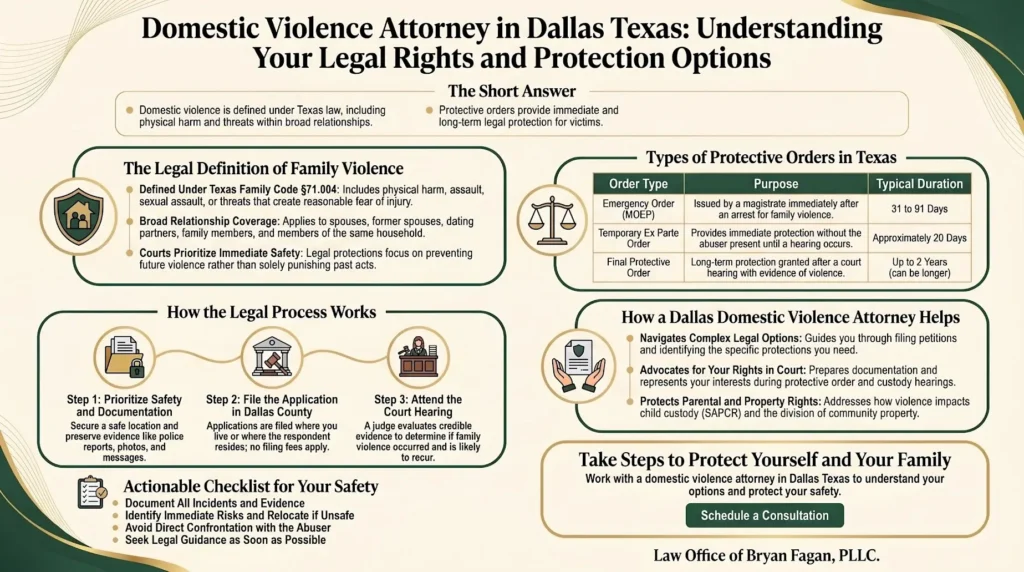
The Three Types of Protective Orders in Texas
Texas law provides three distinct protective order mechanisms, and the right one depends on whether there’s a pending criminal case, whether you need protection tonight, and whether you need long-term relief. Confusing them costs petitioners time and exposes them to gaps in coverage.
| Order Type | How It’s Obtained | How Long It Lasts | Typical Use Case |
|---|---|---|---|
| Magistrate’s Emergency Protection Order (MOEP) Code Crim. Proc. art. 17.292 | Issued at the abuser’s arraignment after arrest — judge orders it, no separate filing | 31 to 91 days (longer with deadly weapon) | Immediate gap protection after arrest while you prepare a civil petition |
| Temporary Ex Parte Protective Order Fam. Code §83.001 | Civil petition filed by you or your attorney; granted same day without notice to respondent | Up to 20 days, extendable | Clear and present danger; need protection before a full hearing |
| Final Protective Order Fam. Code §85.001, §85.025 | Full evidentiary hearing within 14 days of ex parte filing; both sides present evidence | Up to 2 years; lifetime available for serious injury or repeat violations | Long-term protection; almost always paired with divorce or custody filing |
In Dallas County, civil protective order petitions are filed at the George L. Allen Sr. Courts Building and routed to the family district courts. The Dallas County District Attorney’s Family Violence Division can file on behalf of victims at no cost, but their caseload often means a 2–4 week filing delay. A private attorney files within 24–48 hours.
Petitioners who try to file pro se with a court-provided packet often draft findings that are too narrow. A protective order that fails to address exclusive use of the home, custody, child support, possession of pets, and firearm surrender leaves you exposed in every one of those areas for up to two years. Draft it correctly the first time.
Listen to Our Texas Family Law Podcast
Prefer listening? In this episode, we discuss domestic violence in Dallas, Texas, including your legal rights, available protective measures, and the options you have to protect yourself and your family.
Who Can File a Protective Order in Dallas County
In many Texas family law cases, the question of who can seek protection is not just about safety—it can also affect whether your case moves forward or risks delay or dismissal. When courts evaluate case activity, timing, and credibility, these issues often intersect with a Texas Motion to Retain, especially if one party argues the case has not been actively pursued.
Under Texas Family Code §82.002, a protective order may be filed by the victim, any adult member of the victim’s family or household, a prosecuting attorney, or the Department of Family and Protective Services (DFPS) on behalf of a child. Importantly, you do not need a pending criminal case, police involvement, or even to have left the home to seek protection. From a practical standpoint, courts routinely see protective order filings as a sign that a case involves active safety concerns—not inactivity.
To qualify under the Family Code, the respondent must fall within specific legal relationships. Sections §71.003 (family) and §71.005 (household) include current or former spouses, parents of a child, blood relatives, current or former roommates, foster parents, and dating partners as defined under §71.0021. This matters because courts rely heavily on statutory definitions when evaluating credibility and whether a case is being properly brought before the court—factors that can directly impact a Texas Motion to Retain.
In straightforward situations, where eligibility is clear and both parties participate in the process, courts tend to focus on timely filings and procedural compliance. But in more complex cases—such as those involving custody disputes, DFPS involvement under §§262 and 263, or contested allegations of family violence—the court looks beyond timelines. Judges evaluate whether delays are tied to legitimate safety concerns, whether the parties are acting in good faith, and how the situation affects the best interest of the child under §153.002.
Where disputes are contested, eligibility itself can become a point of conflict. For example, coworkers, neighbors, or unrelated individuals do not qualify under the Family Code and must seek protection through other legal avenues, such as a criminal law order under Chapter 7B or a civil injunction. Misunderstanding this distinction is a common mistake—and it can lead to delays, dismissed filings, or weakened credibility if the case is not brought under the correct legal framework.
This is where cases begin to separate. Some situations can be handled with basic legal guidance—particularly when the relationship clearly fits within the statute and the process is uncontested. In more complex cases, especially those involving overlapping custody issues, CPS investigations, or disputes about the validity of the relationship, a more structured legal strategy becomes critical. Courts are not just looking at whether a filing was made—they are evaluating whether the case is progressing appropriately and whether continued court involvement is justified.
Delay is where risk often increases. Waiting too long to act, filing under the wrong statute, or failing to properly connect safety concerns to ongoing legal issues can create arguments for dismissal. In the context of a Texas Motion to Retain, the ability to show that your case involves legitimate, ongoing concerns—rather than inactivity—can make a meaningful difference in whether your case continues.
If you’re unsure whether your situation qualifies or how it may impact your case moving forward, the first step is understanding where you fall on that spectrum. You can begin that process here: Start here to understand your legal options and next steps.
Handled correctly, these early decisions don’t just affect immediate protection—they shape how the court views your case as a whole. And in many situations, they play a key role in whether your case moves forward or faces the risk of being dismissed.
↻ Start over
↻ Start over
↻ Start over
↻ Start over
↻ Start over
Talk through your situation with an attorney who handles Dallas County protective orders every week.
Book a Legal Strategy SessionHow Family Violence Affects Custody, Divorce, and CPS

A protective order is often just the beginning—not the end—of a Texas family law case. In practice, these cases frequently run alongside a divorce, custody dispute, or even a CPS investigation. That overlap matters, especially when courts are evaluating whether a case is progressing appropriately or whether it risks dismissal. In many situations, these dynamics directly influence a Texas Motion to Retain, where one side must show the case still requires the court’s involvement.
Under Texas Family Code §153.004, a finding of family violence within the two years before filing creates a rebuttable presumption against awarding joint managing conservatorship to the offending parent. In real terms, that means a documented history of family violence can significantly limit a parent’s ability to share legal decision-making or exercise unsupervised possession. Courts take these findings seriously—not just for safety, but as part of their broader evaluation of stability and the best interest of the child under §153.002.
In straightforward situations, where there are no allegations of violence and both parties are cooperating, courts tend to focus on timelines, filings, and procedural compliance. But in more complex cases—especially those involving custody disputes, contested allegations, or CPS involvement under §§262 and 263—the court’s analysis becomes much more nuanced. Judges look closely at credibility, patterns of behavior, and whether delays in the case are tied to legitimate safety concerns or a lack of diligence.
Where disputes are contested, a protective order can shape nearly every aspect of the case. In divorce proceedings, it may support requests for exclusive use of the marital residence under §6.501, temporary spousal support, or a disproportionate division of property based on fault. In custody matters, it can determine not only who makes decisions for the child but also whether parenting time is restricted or supervised. And when CPS is involved, a parent who has taken documented steps to protect a child is typically in a far stronger position than one who appears passive or uninvolved.
These factors also play a critical role when delay becomes an issue. Courts evaluating a Texas Motion to Retain are not just looking at how long a case has been pending—they are asking why. A case involving active safety concerns, custody risks, or ongoing investigations is viewed very differently than one where little progress has been made without explanation. Failing to connect these issues to your case progression is one of the most common—and costly—mistakes.
This is where cases begin to separate. Some matters can be resolved with basic legal guidance, particularly when the issues are limited and uncontested. In more complex situations—where family violence, custody rights, or financial consequences are at stake—a more structured legal strategy becomes essential. The higher the conflict and the greater the stakes, the more important it is to present a clear, credible case that demonstrates why continued court involvement is necessary.
Cost and strategy often go hand in hand in these situations. Understanding what different types of cases require—both financially and procedurally—can help you make informed decisions early. For a practical breakdown, see how much an uncontested divorce costs in Texas and what everyone gets wrong, especially if you’re trying to evaluate whether your case is likely to remain straightforward or become more involved.
When handled correctly, a Texas Motion to Retain is not just about keeping a case alive—it’s about showing the court that your situation involves real issues that require resolution. Whether those issues involve safety, custody, or financial stability, how they are presented can make the difference between a case moving forward or being dismissed before those concerns are fully addressed.
If you’re considering divorce and there’s family violence in the relationship, the protective order and the divorce petition should be filed in coordination — not sequentially. Sequencing them wrong can cost you exclusive use of the home for months.
What Happens When a Protective Order Is Violated
A protective order only works if it’s enforced—and in Texas, violations are taken seriously. Under Texas Penal Code §25.07, violating a protective order is a criminal offense. A first violation is typically charged as a Class A misdemeanor, punishable by up to one year in county jail and a $4,000 fine. If there is a prior violation—or if the conduct involves assault or stalking—the charge can be elevated to a third-degree felony, carrying two to ten years in prison.
But the impact doesn’t stop with criminal consequences. In many family law cases, violations become a critical factor in how the court evaluates safety, credibility, and whether the case is actively progressing. That evaluation often connects directly to a Texas Motion to Retain, especially if one party argues the case should be dismissed for lack of activity. Repeated violations can demonstrate the opposite—that the situation remains ongoing, serious, and in need of continued court oversight.
If a respondent violates a protective order by contacting you, showing up at your home or workplace, coming within a prohibited distance, or unlawfully possessing a firearm, immediate action matters. Calling law enforcement is the first step. Just as important is documentation—save every message, log each incident, and preserve any evidence. Courts look closely at this kind of detail when assessing diligence and credibility, particularly in cases where delay or inactivity is being challenged.
In straightforward situations, where both parties comply with court orders, the focus tends to remain on timelines and procedural steps. But in more complex cases—especially those involving custody disputes, ongoing safety concerns, or CPS involvement under §§262 and 263—violations of a protective order can significantly influence how a judge views the case. These issues go directly to stability and the best interest of the child under §153.002, and they often justify why a case must continue rather than be dismissed.
Where disputes are contested, a pattern of violations can strengthen the argument that court involvement is still necessary. Each incident is not only a separate criminal offense—it can also affect custody determinations, restrict parental access, and support enforcement or renewal of the order. Failing to properly document or act on these violations is one of the most common mistakes, and it can weaken both the immediate protection and the broader case.
This is where cases begin to separate. Some matters involve isolated incidents and can be addressed with basic legal guidance. In more complex situations—where violations are repeated, custody is at stake, or financial and parenting issues are intertwined—a more structured legal strategy becomes essential. Courts are not just looking at whether violations occurred—they are evaluating how those violations impact the overall case and whether continued legal intervention is necessary.
Financial considerations can also come into play, particularly when violations lead to extended litigation or modifications involving support. Understanding how child support may be calculated in these situations can provide additional clarity. You can explore that here: Texas child support calculator.
When handled correctly, violations of a protective order can play a key role in demonstrating why a case should move forward. In the context of a Texas Motion to Retain, they help show the court that the issues are ongoing, the risks are real, and dismissal would leave critical matters unresolved.
Still have questions? Get answers specific to your situation in a Legal Strategy Session.
Book a Legal Strategy SessionWhat I Tell Every Client Who Calls About a Dallas Protective Order
If you’re here, it’s usually not by accident. Something has already happened that made you pause, question your safety, or wonder what your options are. And in Texas family law cases, that moment matters—not just for your protection, but for how your case moves forward. Situations involving safety concerns often intersect with broader legal issues like divorce, custody, or even CPS involvement. Those factors can become critical when a court evaluates whether a case should continue through a Texas Motion to Retain or risks being dismissed for lack of activity.
Texas law provides a real, enforceable tool in a protective order. It’s not just paperwork—it’s a court order backed by criminal consequences. When used properly, it can quickly change the structure of your day-to-day life, creating space, boundaries, and a legal record that courts take seriously. From a practical standpoint, judges often view protective actions as evidence of diligence and credibility—two key factors when evaluating case progression and delay.
In straightforward situations, where there is a single incident and both parties comply with court orders, the process may be relatively contained. But in more complex cases—especially those involving custody disputes, ongoing safety concerns, or investigations under Texas Family Code §§262 and 263—the stakes are higher. Courts are not just looking at what happened; they are evaluating stability, risk, and the best interest of the child under §153.002. Waiting too long to act, or failing to document concerns early, is one of the most common mistakes—and it can create unnecessary risk if your case later depends on showing urgency or continued need for court involvement.
Where disputes are contested, timing becomes even more important. The threshold for seeking legal guidance is not when things become unbearable—it’s when you feel uncertain, unsafe, or unsure what to do next. Delaying action in hopes that things improve often leads to more complicated legal situations, particularly if the case evolves into litigation over custody, property, or long-term protection.
This is where cases begin to separate. Some situations can be addressed with basic legal guidance and a clear, proactive plan. Others—especially those involving repeated incidents, children, or overlapping legal issues—require a more structured strategy to ensure the court understands why the case needs to move forward. In the context of a Texas Motion to Retain, demonstrating that your case involves ongoing concerns, rather than inactivity, can be the difference between dismissal and continued protection.
Cost and planning are often part of that decision. Understanding what a case may involve financially can help you move forward with clarity instead of hesitation. For a helpful breakdown, see how much a simple divorce costs in Texas and what to expect—especially if your situation may involve both protective orders and divorce-related issues.
If you’re unsure where your situation falls, the most important step is getting clarity early. Bring whatever information you have—even if it feels incomplete. The goal isn’t to have everything figured out; it’s to understand your options, your timeline, and what actions may be necessary to protect yourself and your family. When handled correctly, early decisions don’t just address immediate concerns—they help ensure your case is positioned to move forward when it matters most.
Checklist: What to Do If You Need a Protective Order in Dallas
- If you are in immediate physical danger, call 911 before you do anything else.
- Get to a safe location — a friend’s home, a hotel, or a Dallas-area shelter (The Family Place, Genesis Women’s Shelter).
- Document every prior incident: dates, locations, witnesses, photos, medical records.
- Preserve all digital evidence — text messages, voicemails, social media, email — before it disappears.
- Do not contact, respond to, or engage the abuser. Silence preserves your legal position.
- If there’s an arrest, ask the prosecutor about a Magistrate’s Order for Emergency Protection at the next court setting.
- Book a Legal Strategy Session with a Dallas family law attorney before you file pro se.
- File the civil protective order petition with proper findings for exclusive home use, custody, support, and firearms.
- Show up to the final hearing prepared — exhibits organized, witnesses confirmed, testimony rehearsed.
- After the order issues, keep a violation log and notify your attorney immediately of any contact.
Conclusion:
The reality is this: when safety, stability, and your child’s future are on the line, waiting rarely makes things better. Working with a Domestic Violence Attorney in Dallas Texas is about more than filing paperwork—it’s about creating a clear path forward where your home feels safe again and your child has the consistency they need to thrive. In straightforward situations, that may mean quickly securing a protective order and putting basic safeguards in place. In more complex cases—especially those involving ongoing custody disputes, conflicting allegations, or significant disruptions to your child’s daily life—the strategy needs to be more deliberate, more detailed, and built to hold up over time.
If your case involves children, school instability, or a pattern of escalating conflict, having the right level of legal guidance matters. The Law Office of Bryan Fagan, PLLC is here to help you understand your options, make informed decisions, and take action with confidence. Our goal is simple: give you clarity, protect what matters most, and help you move forward with a plan that restores peace of mind—not just for today, but for the long term.
Talk to a Dallas Family Violence Attorney Today
Same-week Legal Strategy Sessions available. We file civil protective order petitions within 24–48 hours of engagement.
Frequently Asked Questions
Final protective orders generally last up to two years from the date of entry. Lifetime orders are available under Family Code §85.025 when the abuser caused serious bodily injury, used a deadly weapon, or has prior protective order violations. Temporary ex parte orders typically last 20 days, extendable to 40.
Yes. A protective order is a standalone civil filing under the Texas Family Code. You don’t have to be married, you don’t have to be divorcing, and you don’t have to have children in common. That said, if a divorce is coming, coordinating the two filings strategically protects your custody and property position.
A temporary restraining order is a civil order issued in an existing lawsuit (usually a divorce) — it controls conduct between the parties to a case. A protective order is a standalone Family Code order specifically addressing family violence, with criminal penalties for violation. They’re different instruments with different enforcement mechanisms.
You can request the court modify or terminate an order, but the court doesn’t have to grant it. Judges in Dallas County are skeptical of motions to drop protective orders, particularly when there’s a documented history of family violence. Reconciliation is not a legal basis for dismissal.
Photos of injuries and property damage, screenshots of threatening texts or social media, voicemails, medical records, 911 transcripts, witness statements, and police reports. The respondent will deny, minimize, or claim mutual fault — documentation is what overcomes that. Start preserving evidence the day you decide to file.
A temporary ex parte order under §83.001 takes effect when signed by the judge and does not require advance notice to the respondent. The respondent must then be served before the final hearing. A final order takes effect upon entry after the hearing, regardless of whether the respondent appeared.
Yes. Under Family Code §85.021, the court can grant exclusive use and possession of the residence to the petitioner — including when the home is jointly owned or solely titled to the respondent. This is one of the most powerful provisions of a Texas protective order, and it must be specifically pleaded.
Federal law (18 U.S.C. §922(g)(8)) prohibits the subject of a qualifying protective order from possessing firearms or ammunition. Texas courts can also order surrender of firearms as part of the protective order under §85.022. Compliance is enforced through both state and federal authorities.
Costs vary based on whether you need ex parte filing, full hearing representation, and whether the order is paired with divorce or custody. Most LOBF protective order engagements begin with a paid Legal Strategy Session, where we map the case, the cost, and the timeline before you commit to representation.
Request that the prosecutor seek a Magistrate’s Order for Emergency Protection under Code of Criminal Procedure article 17.292 at the next bond hearing. Don’t wait for the criminal case to play out — file a civil protective order in parallel. The two systems run on different timelines, and you need continuous coverage.