
Child Protective Services Defense Attorney in Texas: How CPS and Divorce Impact Your Child’s Stability

It usually doesn’t start with a courtroom—it starts with a knock at the door, a phone call, or a moment that instantly turns your world upside down. One Dallas parent described it as “the longest five minutes of my life,” standing in the doorway while a CPS caseworker asked questions they weren’t prepared to answer. In that moment, nothing feels clear, and every decision suddenly carries weight. That’s when having a Child Protective Services Defense Attorney in Dallas Texas can make all the difference—because what you say and do in those first interactions can shape everything that follows.
Under Texas Family Code Chapters 261 and 262, Child Protective Services has broad authority to investigate, intervene, and, in urgent situations, remove a child without prior notice. For families already navigating divorce or custody concerns, that pressure multiplies quickly. What feels like a temporary disruption can escalate into a legal process where timelines move fast, evidence builds quietly, and your role as a parent is being evaluated at every step.
At The Law Office of Bryan Fagan, PLLC, we understand that families don’t come into these situations prepared—they come in overwhelmed, trying to protect their children while making sense of a system that feels unfamiliar and intimidating. Our approach is grounded in giving you clarity where there is confusion, structure where there is uncertainty, and a strategy that allows you to move forward with confidence instead of fear.
In the sections that follow, we’ll walk you through how these cases unfold, how they intersect with custody and family law issues, and what you can do to protect your family and restore stability when everything feels uncertain.
Key Takeaways
- A CPS defense attorney in Texas represents parents against DFPS in investigations, removal hearings, and termination proceedings
- The adversary hearing must occur within 14 days of removal — your legal response window is days, not weeks
- DFPS bears the burden of proof at each hearing; an attorney’s job is to make them meet it
- Completing a Family Service Plan ahead of schedule is one of the most effective reunification strategies
- The top-ranking CPS defense pages in Texas have weak authority — Bryan Fagan’s depth of coverage and Texas-specific content is the competitive advantage
- Parents without attorneys are significantly more likely to have parental rights terminated

Your Family’s Future Starts Here
Don’t navigate your legal journey alone. Schedule a consultation now and get the clarity and support you deserve.
Speak With a Child Protective Services Defense Attorney in Dallas Texas
A contested divorce can affect your finances, your family, and your future. Having a skilled Child Protective Services Defense Attorney in Dallas Texas on your side can help protect your interests and give you peace of mind during a challenging time.
To learn more about how the Law Office of Bryan Fagan, PLLC can help with your contested divorce case, call 469-972-8473 today to schedule a confidential consultation.
What Does a CPS Defense Attorney Do in Dallas, Texas?
A Child Protective Services Defense Attorney in Dallas Texas represents parents, caregivers, and family members at every stage of a CPS case—from the first investigation to high-stakes court proceedings that can determine whether a child remains at home or is removed. Under Texas Family Code Chapters 261, 262, and 263, these cases move quickly, and early decisions carry lasting consequences. What you say during an initial CPS visit, whether you agree to a safety plan, and how you respond to DFPS can all influence how your case is viewed by the court.
In straightforward situations—such as an initial investigation with no prior CPS history—legal guidance often focuses on protecting your rights during interviews and managing communication with caseworkers. Understanding how to approach the CPS investigation process in Texas can help you cooperate appropriately without creating unnecessary legal risk. At this stage, credibility and consistency matter, and judges frequently rely on the record established early in the case.
In more complex CPS cases—especially where allegations involve neglect, substance use, or overlapping custody disputes—the role of a CPS defense attorney becomes more strategic. This includes reviewing and challenging the affidavit used for removal under Texas Family Code §262, preparing for the adversary hearing within the required 14-day window, and ensuring that any Family Service Plan is both achievable and aligned with reunification. Where allegations are contested, the focus shifts to challenging DFPS evidence, cross-examining caseworkers, and building a strong, documented record of parental stability.
If your case involves removal or active court hearings, the stakes increase significantly. Texas courts evaluate child safety, parental stability, and compliance with court-ordered services under §263, looking for measurable progress—not just effort. A CPS defense lawyer in Dallas Texas helps organize your documentation, present your progress clearly, and ensure your position is fully understood by the court.
Many CPS cases in Dallas also intersect with broader family law issues like child custody in Texas, which can further complicate the process. What starts as an investigation can quickly evolve into a custody-related legal matter with long-term implications for your parental rights.
Ultimately, the difference between a case that stabilizes and one that escalates often comes down to timing, preparation, and strategy. In some situations, early legal guidance may be enough. In others—particularly where the facts are disputed or the risk of removal is present—having the right level of legal support becomes critical to protecting your family and working toward reunification.

Listen to Our Texas Family Law Podcast
Prefer listening? In this episode, we discuss CPS defense in Dallas, Texas, including how Child Protective Services investigations work, your legal rights as a parent, and steps you can take to protect your family throughout the process.
How CPS Investigations Work in Dallas, Texas
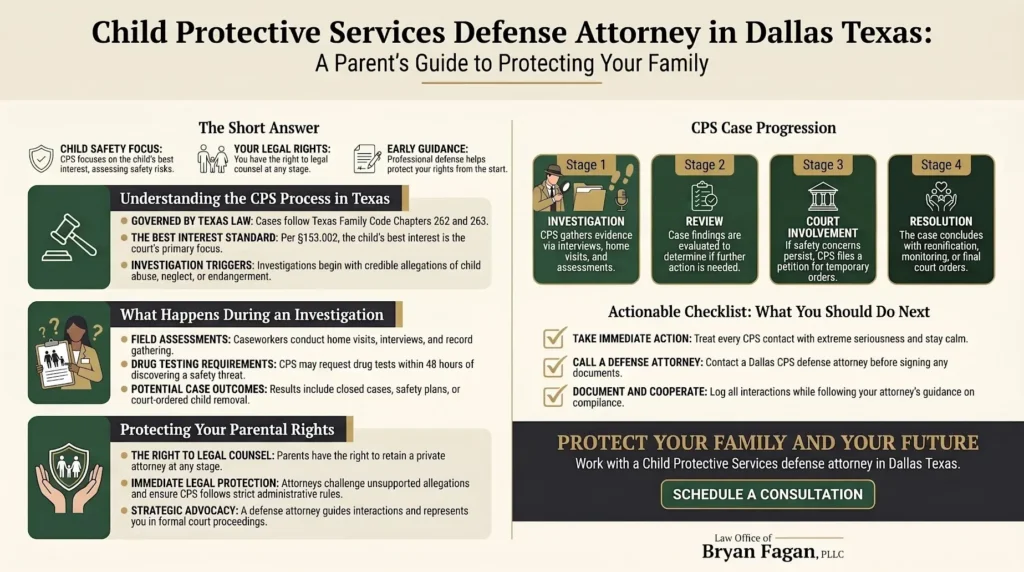
A Child Protective Services Defense Attorney in Dallas Texas helps parents understand that a CPS investigation is not a single event—it is a structured legal process governed by Texas Family Code Chapter 261, with defined stages, deadlines, and decision points that can quickly escalate if not handled carefully. What begins as a report can develop into a case involving court oversight, custody implications, or even removal under Chapter 262 if early steps are not managed strategically.
In straightforward situations—such as a first-time report with no immediate safety concerns—the process often begins with intake and priority assignment. When a report is made by a teacher, neighbor, medical provider, or anonymous caller, DFPS assigns a priority level. Priority 1 cases, involving alleged immediate danger, must be investigated within 24 hours, while Priority 2 cases allow up to 72 hours. DFPS typically has 30 days to complete its investigation, with limited extensions. Even at this early stage, how you respond matters. Your statements, tone, and willingness to engage appropriately all contribute to how your credibility is assessed later by both caseworkers and the court.
In more complex CPS cases, the next phase—initial contact and home visit—often becomes a critical turning point. A caseworker may arrive unannounced, request entry into your home, and attempt to interview your child, sometimes at school and without prior notice. While you are not required to consent to a home visit without a court order, the way you handle that decision can influence the direction of the case. Parents who understand the CPS investigation process in Texas are better positioned to respond in a way that protects both their rights and their credibility.
Where allegations are contested, or where there is prior CPS history, substance use concerns, or overlapping custody disputes, the investigation stage carries even greater weight. At the conclusion of the investigation, DFPS will issue a finding—most commonly “Reason to Believe” (RTB) or “Ruled Out.” An RTB finding means DFPS believes there is credible evidence of abuse or neglect and can place your name in the Texas Child Abuse and Neglect Registry. This can affect future custody decisions, employment opportunities, and how any subsequent CPS involvement is viewed.
If your case involves removal or court hearings, the process moves into a different level of urgency. Under Texas Family Code §262, DFPS may file a petition and seek emergency removal, triggering an adversary hearing within 14 days. From that point forward, the court evaluates child safety, parental stability, and compliance with any service plan under §263. These are not informal reviews—judges are looking for documented progress, consistency, and a clear plan toward reunification or resolution.
In some cases, DFPS may choose a less immediate path, such as implementing a safety plan or opening a Family-Based Safety Services (FBSS) case. While these options may avoid removal initially, they still carry legal and strategic implications. Signing a safety plan without understanding its terms or failing to comply with service requirements can increase the risk of escalation.
The key is recognizing where your case falls on the spectrum. In early-stage investigations, informed decisions and timely guidance can often prevent unnecessary escalation. In higher-risk situations—especially where removal, contested allegations, or court involvement are present—a more structured and strategic legal approach becomes essential. Understanding how CPS builds its case allows you to take control of your response, protect your parental rights, and move toward the most stable outcome possible for your family.
Texas CPS Statistics: What the Data Shows
Understanding the scope of CPS activity in Texas puts your case in context — and makes clear why legal representation matters from the first contact.
| Stage | Trigger | Deadline Under Texas Law |
|---|---|---|
| Emergency Removal (Ex Parte TRO) | DFPS files petition | Immediate — no advance notice required |
| Adversary Hearing | Child removed from home | Within 14 days of removal (Tex. Fam. Code § 262.201) |
| Status Hearing | Court review of service plan | Within 60 days of adversary hearing |
| First Permanency Hearing | Ongoing substitute care | Within 180 days of removal |
| Subsequent Permanency Hearings | Continued state custody | Every 120 days thereafter |
| Termination Trial | DFPS files TPR petition | Within 1 year of removal (12-month statutory deadline) |
Every deadline in this table is a decision point. Missing an adversary hearing without representation can result in DFPS retaining Temporary Managing Conservatorship by default. Missing a permanency hearing compliance review can accelerate the timeline toward termination. These are not administrative formalities — they are the structure of your case.
What Happens When CPS Removes a Child in Dallas, Texas
When a child is removed from a home, the situation shifts from an investigation to a fast-moving legal case with strict deadlines and high stakes. A Child Protective Services Defense Attorney in Dallas Texas becomes critical at this stage because the timeline under Texas Family Code Chapter 262 moves quickly, and early decisions can shape the entire outcome. What happens in the first few days—sometimes even the first few hours—can determine whether a child is returned home or remains in state custody.
In straightforward situations, where removal may have occurred based on limited or unclear information, the focus is often on quickly organizing facts, correcting misunderstandings, and preparing for the first court appearance. Under Texas Family Code §262.102, DFPS can seek an emergency removal through an ex parte Temporary Restraining Order (TRO) without prior notice if it believes a child is in immediate danger. This means parents are often not present when the initial decision is made. DFPS is then required to file a formal petition within one business day, and the legal process begins immediately.
In more complex CPS cases—especially where there are contested allegations, prior CPS history, or concerns involving substance use—the adversary hearing becomes the most important early stage. This hearing must occur within 14 days of removal under §262.201, and it is the court’s first opportunity to evaluate whether DFPS should retain Temporary Managing Conservatorship (TMC). Judges assess credibility, child safety, and parental stability based on the evidence presented at this hearing. Parents who are unprepared or without representation often miss the opportunity to challenge the affidavit or present evidence that supports reunification.
If your case involves removal or court hearings, preparation for the adversary hearing is not optional—it is essential. Understanding what to expect at this stage can significantly affect how your case progresses, especially when navigating situations like what to do if DFPS contacts you during a divorce, where custody and CPS issues may overlap. These early interactions and decisions often influence how the court views the case moving forward.
Where allegations are contested, or where the facts are still developing, the case does not end after the adversary hearing. If DFPS retains TMC, the court will order a Family Service Plan, and the case enters a longer phase governed by Texas Family Code §263. From that point, judges evaluate compliance, consistency, and progress toward reunification at each hearing. The law requires most cases to be resolved within one year under §263.401, meaning there is a limited window to demonstrate stability and meet court expectations.
Many cases turn on how effectively a parent responds after removal. For example, in a Dallas-area case, a parent initially appeared at the adversary hearing without preparation and struggled to challenge the removal. As the case progressed, a structured legal strategy helped document compliance with the service plan, address the underlying concerns, and present a clearer picture of stability to the court. Ultimately, the direction of the case shifted—not because the situation changed overnight, but because the approach became more organized and aligned with what the court needed to see.
The difference between a case that moves toward reunification and one that escalates toward termination often comes down to timing, preparation, and strategy. In some situations, early legal guidance can help stabilize the case quickly. In others—particularly where removal has already occurred or allegations are being contested—a more deliberate and experienced approach is necessary. Recognizing the level of risk early allows you to take the right next step and begin working toward bringing your family back together.
Your Rights as a Parent During a CPS Case in Dallas, Texas
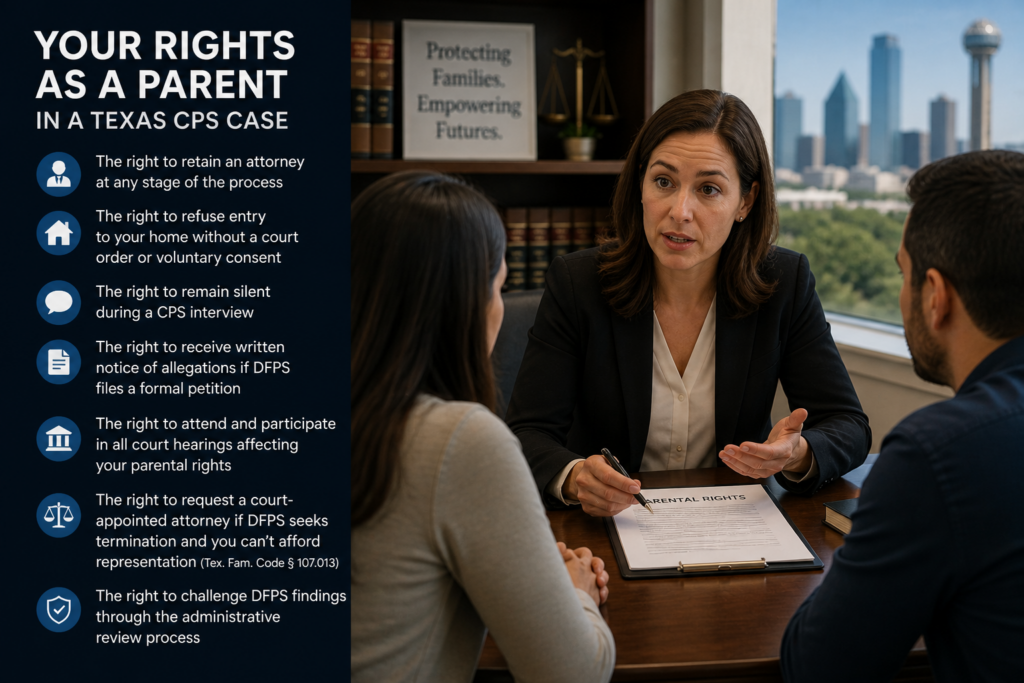
If you are facing a CPS investigation, understanding your rights early can make a meaningful difference in how your case unfolds. A Child Protective Services Defense Attorney in Dallas Texas often begins by helping parents recognize that they are not powerless in this process. Under both the Texas Family Code and the United States Constitution, parents are given specific protections—but those rights only help you if you know when and how to use them.
In straightforward situations—such as an initial investigation with no immediate risk of removal—your rights allow you to slow the process down and make informed decisions. You have the right to retain an attorney at any stage, including before speaking with a caseworker or allowing entry into your home. You also have the right to refuse entry without a court order, and the right to remain silent during questioning. These protections are especially important during the early phase of a CPS investigation, where the record is being created and your credibility is being evaluated. Knowing how to navigate the CPS investigation process in Texas can help you cooperate appropriately without unintentionally creating risk.
In more complex CPS cases—particularly where there are allegations of neglect, substance use, or prior CPS history—these rights become even more critical. If your case involves removal or court hearings under Texas Family Code §262, you have the right to receive formal notice of the allegations, attend all hearings, and participate in decisions affecting your child. You may also have the right to request a court-appointed attorney if termination of parental rights is being pursued under §107.013. Where allegations are contested, your ability to challenge DFPS findings, question the evidence, and present your own documentation becomes central to the case.
Texas courts evaluate factors like parental stability, child safety, and compliance with service plans under §263, but they also look closely at how a parent exercises their rights throughout the process. Judges notice when a parent is thoughtful, consistent, and informed—and they also notice when statements change or when documentation is missing. Everything you say to a caseworker, every document you provide, and every interaction during a home visit becomes part of the case file that DFPS may rely on in court.
If your situation intersects with broader issues like child custody in Texas, the importance of protecting your rights increases even further. What begins as a CPS investigation can quickly influence custody outcomes, especially when questions of stability and decision-making are involved.
Many parents unintentionally waive their rights—not because they are unwilling to cooperate, but because they believe full cooperation will automatically resolve the case. In reality, CPS caseworkers are tasked with documenting and building a record. That does not mean you should refuse to engage, but it does mean your actions should be intentional and informed. Early missteps, such as signing a safety plan without understanding the terms or making inconsistent statements, can become difficult to correct later.
In some situations, a basic understanding of your rights and early legal guidance may be enough to keep the case on track. In others—especially where there is a risk of removal, upcoming hearings, or disputed allegations—a more structured, strategic approach is necessary. Recognizing where your case falls on that spectrum is often the first step toward protecting your parental rights and working toward reunification.
Lawyers Against CPS in Texas: What to Look For
Parents searching for “lawyers against CPS in Texas” are typically past the point of wondering whether they need representation — they already know they need someone who will fight DFPS aggressively. The question is how to identify the right attorney.
Here is what separates a CPS litigation specialist from a general family law attorney in Texas:
CPS-Specific Litigation Experience A general family law attorney handles divorce, custody, and child support. CPS litigation is a distinct practice area governed by Chapters 261–264 of the Texas Family Code, with its own procedural rules, its own evidentiary standards, and an adversarial relationship with a state agency that has its own legal team. Ask directly: what percentage of your caseload is CPS and DFPS litigation specifically?
Adversary Hearing Track Record The adversary hearing is your first and often most important opportunity to challenge DFPS’s grounds for removal. An attorney who has handled dozens of adversary hearings knows how to attack the affidavit, cross-examine the caseworker, and argue for the child’s return. Ask for their approach to adversary hearings specifically.
Termination Defense Experience If DFPS is seeking termination of parental rights, you need an attorney who has defended TPR cases through trial — including jury trials, which are available in Texas termination proceedings. This is not the time for on-the-job training.
Knowledge of Local DFPS Regional Offices DFPS operates regional offices across Texas, including major hubs in Houston (Region 6), Dallas (Region 3), San Antonio (Region 8), Austin (Region 7), and Fort Worth (Region 3). Each region has its own caseworker culture, caseload pressures, and courtroom tendencies. An attorney familiar with your region’s specific practices has a practical advantage.
Responsiveness CPS cases move on statutory deadlines measured in days. An attorney who takes 48 hours to return calls is not equipped to handle a case where the adversary hearing is in 14 days.
How to Build a CPS Defense Strategy in Texas
An effective CPS defense strategy in Texas is built around four priorities: controlling the narrative early, meeting service plan requirements ahead of schedule, building a documented compliance record, and challenging DFPS’s evidence at every hearing.
Priority 1: Retain an Attorney Before the First CPS Interview The single most damaging thing a parent can do in a Texas CPS case is speak with a caseworker at length without an attorney present. Caseworkers are trained to build a file. Statements that seem innocent — “I did spank him, but only once” or “she was alone for just a few minutes” — become documented admissions. An attorney retained at the investigation stage can limit what DFPS has to work with before a case ever reaches court.
Priority 2: Complete Service Plan Requirements Ahead of Schedule If DFPS has established a Family Service Plan — whether voluntary or court-ordered — completion timeline matters. Courts evaluate compliance at every hearing. A parent who completes parenting classes, passes drug screens, obtains stable housing, and completes counseling before the first permanency hearing sends a clear signal that reunification is viable. An attorney tracks these deadlines and flags any gaps before they become court-room ammunition for DFPS.
Priority 3: Document Everything Completion certificates, drug test results, counseling attendance records, employment verification, and housing documentation must all be organized and ready for each hearing. Courts do not take parental word for compliance — they require evidence. Your attorney compiles, organizes, and presents this documentation strategically.
Priority 4: Challenge DFPS’s Evidence at Every Stage DFPS bears the burden of proof. At the adversary hearing, the standard is whether the child was in immediate danger. At a termination trial, DFPS must prove grounds for termination beyond a reasonable doubt. A skilled CPS defense attorney cross-examines caseworkers, challenges the reliability of anonymous tips, contests the admissibility of statements, and argues against RTB findings. Compliance alone does not win CPS cases — aggressive, evidence-based defense does.
A San Antonio mother facing her second CPS involvement retained a CPS defense attorney after her children were placed with a relative following a neglect allegation. Her attorney challenged the caseworker’s affidavit at the adversary hearing, documented that the neglect allegation stemmed from a housing issue she had since resolved, and presented a completed service plan at the first permanency hearing. DFPS did not pursue termination. Her children were returned within seven months. The legal strategy — not just the compliance — drove that outcome.
Texas CPS Hearing Timeline
| Hearing Stage | Trigger | Texas Law Deadline | What’s at Stake |
|---|---|---|---|
| Emergency Removal / Ex Parte TRO | Immediate danger finding | Immediate — no advance notice | Child removed from home |
| DFPS Petition Filed | After emergency removal | Within 1 business day of removal | Formal case opened |
| Adversary Hearing | Child removed from home | Within 14 days (Tex. Fam. Code § 262.201) | DFPS retains or loses TMC |
| Status Hearing | Court review of service plan | Within 60 days of adversary hearing | Service plan compliance reviewed |
| First Permanency Hearing | Ongoing substitute care | Within 180 days of removal | Reunification timeline evaluated |
| Subsequent Permanency Hearings | Continued DFPS custody | Every 120 days | Continued compliance assessed |
| Final Hearing / Termination Trial | DFPS files TPR petition | Within 12 months of removal (§ 263.401) | Parental rights permanently decided |
Every row in this table is a decision point. Missing the adversary hearing without representation means DFPS retains TMC by default. Failing a permanency hearing compliance review accelerates the timeline toward termination. These are not administrative checkboxes — they are the structural architecture of your case.
Next Steps
If CPS has contacted you, visited your home, removed your child, or served you with legal papers, the single most important action you can take right now is to speak with a CPS defense attorney in Dallas Texas before your next interaction with DFPS.
Every day that passes without legal representation is a day the caseworker is building a file, the court clock is running, and deadlines are approaching. Texas CPS cases move on a compressed statutory timeline. The adversary hearing alone must occur within 14 days of removal — which means your window to prepare a legal defense is measured in days, not weeks.
The difference between parents who reunify with their children and parents who lose their parental rights is rarely about who is a better parent. It is almost always about who had the right legal strategy, at the right time, executed by someone who knew how to fight DFPS in a Texas courtroom.
For experienced Texas CPS defense representation, contact The Law Office of Bryan Fagan, PLLC. Learn more about the Texas Family Code and your parental rights, or read our detailed guide on understanding the DFPS investigation process in Texas.
When Do You Need a CPS Defense Attorney in Dallas, Texas?
Not every interaction with CPS requires the same level of response—but the point at which legal guidance becomes critical often comes sooner than most parents expect. A Child Protective Services Defense Attorney in Dallas Texas helps you recognize where your situation falls and how quickly it could escalate under Texas Family Code Chapters 261 and 262. What may begin as a simple inquiry can quickly develop into a formal investigation or even a court case if early decisions are not handled carefully.
In straightforward situations—such as an initial CPS contact with no prior history and no immediate request for a safety plan—some parents can move forward with early legal guidance and a clear understanding of their rights. At this stage, the focus is on protecting your credibility, managing communication with caseworkers, and avoiding common mistakes that can unintentionally complicate the case. Understanding the CPS investigation process in Texas can help you cooperate appropriately while maintaining control over what information is shared.
In more complex CPS cases, the need for structured legal strategy becomes much clearer. If CPS has conducted a home visit, interviewed your child without notice, or asked you to sign a safety plan, your decisions begin to carry more legal weight. Safety plans—while often presented as voluntary—can significantly affect custody, living arrangements, and your ability to remain the primary caregiver. Where allegations are contested, or where there are concerns involving substance use, neglect, or prior CPS history, the case moves beyond basic guidance and into a more strategic defense approach.
If your case involves removal or court hearings, the stakes increase immediately. Under Texas Family Code §262, DFPS can seek emergency removal, and an adversary hearing must follow within 14 days. At that point, the court begins evaluating child safety, parental stability, and the overall direction of the case under §263. Judges are looking for consistency, documented compliance, and a clear plan moving forward—not just explanations after the fact. Missing deadlines, signing agreements without understanding them, or failing to prepare for hearings can have lasting consequences.
Where disputes intersect with broader issues like child custody in Texas, the complexity increases even further. What begins as a CPS investigation can influence long-term custody arrangements, especially when questions of stability and decision-making are raised.
In high-risk situations—such as when DFPS is seeking termination of parental rights, when a jury trial is involved, or when allegations include serious harm—the difference between general legal help and experienced CPS litigation strategy becomes significant. These cases are not just procedural; they are adversarial proceedings against a state agency with its own legal team and defined objectives.
The key is recognizing the level of risk early. In some cases, proactive guidance can prevent escalation. In others, particularly where removal or contested allegations are involved, having the right level of legal support is essential to protecting your rights and working toward reunification.

Conclusion:
The truth is, these cases are not just about legal arguments—they are about protecting stability in a moment when everything feels uncertain. A CPS defense attorney in Dallas Texas helps bring structure to that uncertainty, making sure your decisions are intentional, your rights are protected, and your child’s well-being remains the focus at every stage. When you understand how the process works and what the court is really evaluating, you move from reacting out of fear to acting with purpose.
In straightforward situations, where CPS involvement is limited and there are no prior issues, the right guidance can help you stay ahead of the process and avoid unnecessary escalation. In more complex cases—especially those involving removal, multiple allegations, or overlapping custody disputes—the stakes are higher, and the strategy must be more deliberate. If your case involves tight deadlines, contested facts, or the possibility of long-term consequences, having the right level of legal experience is not just helpful—it is critical.
At The Law Office of Bryan Fagan, PLLC, the focus is always the same: helping families regain control, protect what matters most, and move forward with clarity and confidence. Whether you are at the very beginning of a CPS interaction or already deep into the legal process, the right next step starts with understanding your situation—and making sure you have the guidance to navigate it the right way.
Frequently Asked Questions: CPS Defense in Texas
Yes. Under Texas Family Code § 262.104, a law enforcement officer or CPS caseworker can remove a child without a court order if the child is in immediate danger of physical or sexual abuse and there is no time to obtain a court order. However, DFPS must file a petition with the court within one business day of an emergency removal and an adversary hearing must be held within 14 days.
No. You are not legally required to allow CPS to enter your home without a court order. However, refusing entry without an attorney present — and without a clear, calm explanation — can be used against you. If CPS arrives at your door, your first call should be to a CPS defense attorney before you make any decision about entry.
A Family Service Plan is a written document created by DFPS that outlines the specific services, behaviors, and goals a parent must complete to achieve reunification with their child. Under Texas Family Code § 263.101, the plan must be filed with the court and is reviewed at each subsequent hearing. Failure to comply with the plan is one of the most common grounds DFPS uses to pursue termination of parental rights.
Most CPS cases in Texas are required to be resolved within one year of the date DFPS was named Temporary Managing Conservator of the child. Texas Family Code § 263.401 sets this deadline, after which the court must either return the child to the parent, extend the case for an additional 180 days under limited circumstances, or move forward with a termination trial.
Yes. Parents who navigate CPS court proceedings without an attorney are significantly more likely to have parental rights terminated. DFPS is represented by an attorney at every hearing. The child has a court-appointed attorney ad litem. If you appear pro se — without representation — you are the only party at the table without legal counsel. Texas courts can and do terminate parental rights when parents fail to complete service plans, miss hearings, or fail to challenge DFPS’s evidence. An attorney is not a luxury in a CPS case. It is your primary defense mechanism.
“Reason to believe” is the evidentiary standard DFPS uses to close an investigation with a confirmed finding of abuse or neglect. It means DFPS found credible evidence that abuse or neglect occurred, based on a preponderance of the evidence. A confirmed finding can affect custody proceedings, appear in background checks, and be used as prior history in future CPS cases.
Temporary Managing Conservatorship (TMC) means DFPS has legal custody of your child during the pendency of the case — but your parental rights remain intact. Termination of Parental Rights (TPR) is a permanent, irrevocable court order ending the legal parent-child relationship. TMC is a case status. TPR is a final outcome. An experienced CPS defense attorney works to prevent TMC from becoming the pathway to TPR.