
Grandparents’ Rights in Texas: How to File, What You Must Prove, and Why Most Cases Fail Before They Begin

It usually doesn’t start with a legal question—it starts with a moment. Maybe you’re standing in your grandchild’s kitchen, realizing you’ve been the one making dinner, getting them ready for bed, and keeping life steady while everything else feels uncertain. If you’re in that position, speaking with a Grandparent’s Rights attorney in Dallas Texas can help you understand whether you have a legal path to protect that relationship and the stability you’ve been providing.
For many families, these situations unfold quietly. A parent may be struggling, absent, or overwhelmed. A grandparent steps in—not to take over, but to help. Weeks turn into months, routines form, and a bond deepens. Then suddenly, circumstances change. A parent reappears, a new relationship enters the picture, or access is cut off without warning. What felt like a natural role becomes a legal gray area overnight.
Texas law does not automatically recognize that role, even when it has become essential in a child’s life. Courts are guided by the best interest of the child under Texas Family Code §153.002, but grandparents must first meet strict legal standards just to be heard. That’s where clarity matters. Understanding your rights—and your limitations—early can make the difference between preserving that relationship and losing it entirely.
At the Law Office of Bryan Fagan, PLLC, we’ve helped families across Texas navigate these exact turning points. Led by Bryan Joseph Fagan, a South Texas College of Law graduate and a recognized authority in Texas family law, our team is committed to helping people move from uncertainty to clarity. We believe that when you understand the law and your options, you can make decisions that restore stability and protect what matters most.
In the sections that follow, we’ll break down how Texas law treats grandparent rights, when intervention may be possible, and what steps you can take to protect your relationship with your grandchild before it’s too late.
Key Takeaways
- Texas grandparents’ rights exist — but only under narrow conditions. §153.432 provides the procedural vehicle and §153.433 sets the substantive standard. Most cases live or die on §153.433’s “significant impairment” requirement.
- Adoption by anyone other than a stepparent ends your case permanently. Under §153.434, once a non-stepparent adoption is final, the grandparent loses standing forever — even when the adoptive parent is another relative.
- You probably want conservatorship, not just visitation. If your grandchild has lived in your home for six months or more, §102.003(a)(13) gives you a much stronger door than §153.432.
- The fit-parent presumption is the wall every case hits. Troxel v. Granville (2000) put a constitutional thumb on the scale for fit parents. You beat that presumption with evidence of harm — not sympathy.
- Where you file matters. Dallas, Collin, Tarrant, and Denton Counties have different bench tendencies. Identical facts don’t always produce identical results across the courthouse line.
- HB 575 didn’t pass. People search for it because someone told them the law changed. It didn’t. The standard is still §153.433 plus Troxel.
- Speed matters more than people realize. If a stepparent or non-stepparent adoption is being filed, you have a closing window. Once the adoption order is signed, you’re out — period.

Your Family’s Future Starts Here
Don’t navigate your legal journey alone. Schedule a consultation now and get the clarity and support you deserve.
Speak With a Grandparent’s Rights attorney in Dallas Texas
A contested grandparents rights can affect your finances, your family, and your future. Having a skilled Grandparent’s Rights attorney in Dallas Texas on your side can help protect your interests and give you peace of mind during a challenging time.
To learn more about how the Law Office of Bryan Fagan, PLLC can help with your contested custody
case, call 469-972-8473 today to schedule a confidential consultation.
What Grandparents’ Rights Actually Mean Under Texas Law

Listen to Our Texas Family Law Podcast
Prefer listening? In this episode, we discuss grandparents’ rights in Dallas, Texas, including what the law actually allows regarding visitation, custody, and protecting relationships with grandchildren.
In Texas, grandparents’ rights are not automatic—they are a narrow, highly structured legal pathway that allows a grandparent to ask the court for possession of, access to, or conservatorship of a grandchild under specific conditions defined by the Texas Family Code. If you are considering taking legal action, speaking with a Grandparent’s Rights attorney in Dallas Texas early can help you determine whether you meet the threshold requirements before investing time and resources into a case that may not move forward.
What many families don’t realize is that “grandparents’ rights” is not a single claim—it is actually three distinct legal avenues, each with its own rules and risks. A grandparent may seek visitation under §§153.432–153.433, pursue conservatorship under §102.003(a)(13) or §102.004, or intervene in an existing custody case. Each option has different standing requirements and evidentiary burdens, and choosing the wrong path is one of the most common reasons cases fail early. In straightforward situations, where a grandparent is seeking limited access and clearly meets statutory triggers, the process may be more predictable. In more complex cases—especially those involving prior caregiving, CPS involvement, or contested custody—the strategy behind how the case is filed becomes critical.
Texas courts begin with a strong presumption that a fit parent is acting in the child’s best interest. This principle, reinforced by both constitutional law and Texas Family Code §153.002, means that even if a grandparent disagrees with a parent’s decision, that disagreement alone is not enough. Under §153.433, the grandparent must prove that denying access would significantly impair the child’s physical health or emotional well-being. Judges look closely at evidence—not assumptions. They evaluate credibility, the consistency of the child’s environment, and whether there is documented harm supported by third parties such as teachers, counselors, or medical professionals. Where disputes are contested, the strength of this evidence often determines whether the case moves forward or is dismissed.
This is where many cases turn. In straightforward situations, families may only need guidance on whether they have standing or how to properly file under the correct statute. In more complex cases—such as when a grandparent has acted as a primary caregiver or when a parent is absent or unstable—the case requires a structured, evidence-driven approach. And where disputes are highly contested or involve competing custody claims, the stakes are significantly higher, making early legal strategy essential to avoid missteps that cannot be undone.
Timing also matters. Under §153.434, certain events—such as a non-stepparent adoption—can permanently eliminate a grandparent’s right to seek access. Waiting too long or filing under the wrong legal theory can close the door before the court ever considers the relationship itself. That’s why understanding both standing and strategy from the beginning is so important.
For families trying to make sense of their options, it helps to start with a clear understanding of how Texas courts approach these cases. You can explore more about child custody in Texas and grandparents’ rights in Texas to better understand the legal framework, but applying those principles to your specific situation is where legal guidance becomes most valuable.
Every case is different. Some involve limited access disputes that can be resolved with focused legal direction. Others involve deeper issues—custody, safety concerns, or long-term caregiving—that require a more strategic and litigation-aware approach. If you’re unsure where your situation falls, that’s often the clearest sign it’s time to speak with a Grandparents Rights attorney in Dallas Texas who can help you understand your options and take the right next step with confidence.
Who Has Standing — The §153.432 Gateway
A grandparent has standing to file a suit for access under §153.432 only if at least one biological or adoptive parent of the child has not had their parental rights terminated, and one of these triggering conditions is present: the parent through whom you claim a relationship is incarcerated, found by a court to be incompetent, deceased, or does not have actual or court-ordered possession of the child.
Standing is the first wall. If you can’t get through standing, the merits of your case never matter. The §153.433(a)(2) triggers, in plain English: the parent has been incarcerated during the three months preceding filing, has been judicially declared incompetent, has died, or has no actual or court-ordered possession of the child.
The fourth condition is the one most people miss. If your son or daughter has no court order and isn’t actually exercising visitation, you may have standing through them even when they’re not deceased, incarcerated, or incompetent. It’s a hidden door — and one of the first things we test in a Legal Strategy Session.
§153.432(c) also requires an affidavit alleging facts that, if true, would satisfy §153.433. A weak affidavit gets you dismissed at the gate. A strong, fact-specific one — names, dates, conduct, third-party witnesses — gets you to a hearing where the actual evidence can do its work.
The “Significant Impairment” Standard
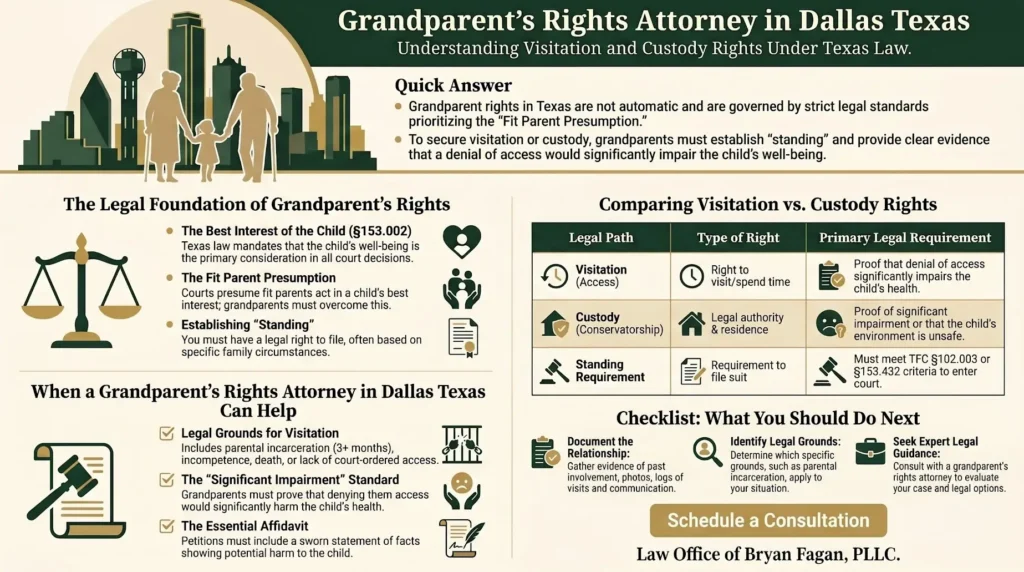
In any case involving a Grandparent’s Rights attorney in Dallas Texas, the legal battle often comes down to one central issue: whether the grandparent can meet the “significant impairment” standard under Texas Family Code §153.433. This is not a minor hurdle—it is the core requirement that determines whether a case moves forward or ends before it truly begins.
Under §153.433, a grandparent must prove by a preponderance of the evidence that denying access would significantly impair the child’s physical health or emotional well-being. In plain terms, the court is not asking whether contact with a grandparent would be beneficial—it is asking whether the lack of that relationship is actively harmful. That distinction is where many cases are won or lost.
Texas courts evaluate this standard with a high level of scrutiny. Judges are looking for clear, objective evidence that a child is suffering or will suffer real harm without the grandparent’s involvement. This often includes documentation from therapists, pediatricians, or school counselors, as well as detailed proof of the grandparent’s prior caregiving role. Evidence of instability in the parent’s home—such as substance abuse, untreated mental health issues, or patterns of alienation—can also become relevant when tied directly to the child’s well-being. In more complex cases, particularly those involving CPS, understanding how to build this type of evidence becomes even more critical, as outlined in this resource on representation for grandparents in a Texas CPS case.
What courts do not accept is equally important. Statements like “I love my grandchildren” or “I’ve always been involved” may be emotionally compelling, but they do not meet the legal threshold. The court begins with the presumption—reinforced by both constitutional law and Texas Family Code §153.002—that a fit parent is acting in the child’s best interest. That presumption must be overcome with specific, credible evidence. In In re Derzapf, 219 S.W.3d 327 (Tex. 2007), the Texas Supreme Court made it clear that generalized concerns or emotional appeals are not enough. Without concrete proof of harm, the parent’s decision stands.
In straightforward situations, where there is clear documentation of a child’s decline and a well-established caregiving relationship, meeting this standard may be more achievable with focused legal guidance. In more complex cases—such as those involving contested custody, inconsistent parenting, or gaps in documentation—the challenge becomes building a structured, evidence-driven case that aligns with how courts actually evaluate impairment. Where disputes are contested, credibility becomes a deciding factor, and the court will closely examine not only the facts but how those facts are presented and supported.
Timing and preparation also play a critical role. Waiting too long to gather evidence or filing without a clear strategy can weaken a case before it even reaches a hearing. In some situations, especially where adoption under §153.434 may be pending, delay can eliminate the opportunity to bring a claim altogether. This is why understanding the standard—and what it truly requires—early in the process is essential.
For families navigating these decisions, the question is not just whether you care about the child—it’s whether you can prove, in a courtroom setting, that the child is being harmed without your involvement. That’s a very different conversation, and one that often determines whether basic guidance is enough or whether a more strategic legal approach is needed to protect the relationship moving forward.
“Significant impairment” is a much higher bar than “would benefit the child” or “is in the child’s best interest.” A grandparent can be loving, important, and missed without meeting this standard.
The §153.434 Trap — When Adoption Kills Your Case

Under §153.434, a biological grandparent has no standing to request access if both biological parents’ rights have been terminated and the grandchild has been adopted (or is being adopted) by anyone other than the child’s stepparent. Once that adoption is final, the grandparent’s right is gone — completely and permanently.
This is the procedural trap that ruins more cases than any other. A grandchild gets placed with a relative, family friend, or foster family for adoption while the parents’ rights are being terminated. The grandparent assumes the relationship will continue. The adoption finalizes. Now there is no statute, no case law, and no equity argument that puts the grandparent back in court.
Stepparent adoption is the carve-out: §153.434 specifies that adoption by the child’s stepparent does not cut off the grandparent’s right to seek access. So when a surviving parent remarries and the new spouse adopts, your access claim survives. The threshold trap is brutal otherwise — grandparents call our office every month two or three months after an adoption was finalized looking for a remedy that doesn’t exist under Texas law.
If you suspect a stepparent or non-stepparent adoption is being filed for your grandchild, you do not have time to think it over. File for intervention, conservatorship, or access before the adoption order is signed.
Conservatorship vs. Visitation — Different Doors
One of the most important decisions in any case involving a Grandparent’s Rights attorney in Dallas Texas is understanding whether you are pursuing visitation or conservatorship. These are not interchangeable options—they are entirely different legal paths under Texas law, and choosing the wrong one can significantly impact the outcome of your case.
Under Texas Family Code §§153.432–153.433, grandparents may seek visitation or access. This type of case operates within an existing parental framework, meaning the parent retains primary control while the grandparent requests defined periods of time with the child. In straightforward situations, where a grandparent is seeking limited, structured access and can meet the statutory requirements, this path may be appropriate with the right legal guidance.
However, when a grandparent has taken on a much larger role—providing daily care, making decisions, and acting as a consistent presence in the child’s life—the law offers a different door. Under §102.003(a)(13), a grandparent may have standing to file for conservatorship if the child has lived with them for at least six months, with that period ending within 90 days before filing. This is not just about visitation—it allows the grandparent to seek broader rights, including decision-making authority over the child’s health, education, and overall well-being.
This distinction is critical because Texas courts evaluate these cases very differently. Judges look closely at the nature of the relationship, the level of responsibility the grandparent has assumed, and the stability of the child’s current environment. Documentation becomes key—records showing school involvement, medical care, and financial support can demonstrate that the grandparent has been acting in a true parental role, not simply providing occasional help.
In more complex cases, §102.004 provides an additional pathway for conservatorship when the child’s present circumstances would significantly impair their physical or emotional development. This often arises when a grandparent has been informally raising a child for an extended period and a parent suddenly seeks to reassert control. Where disputes are contested, courts will weigh credibility, consistency, and the risk of disruption to the child’s stability before making any decision.
Timing also plays a crucial role. If a grandparent delays filing or misunderstands which legal avenue applies, they may lose leverage—or in some cases, the ability to act altogether, particularly if adoption under §153.434 becomes an issue. These are the moments where early clarity matters most, because once a case is framed incorrectly, correcting course can be difficult.
In straightforward situations, determining whether visitation or conservatorship applies may only require focused legal direction. In more complex scenarios—especially those involving long-term caregiving, contested custody, or potential adoption—the strategy behind how the case is filed becomes essential. If you’re unsure which path fits your situation, exploring resources like grandparents’ rights in Texas can provide helpful context, but applying that framework to your specific facts is where informed legal guidance becomes critical.
Ultimately, the question is not just whether you want to be involved in the child’s life—it’s how the law recognizes your role. And that answer determines whether your case is positioned for success or at risk from the very beginning.
If your grandchild has been living with you, §102.003(a)(13) is almost always the right door — not §153.432 access. Bring the documentation: school records listing you as contact, medical records, the financial timeline. The paper trail is the case.
| Statute / Concept | What Texas Law Says | Practical Impact |
|---|---|---|
| Standing under §153.432 | Grandparent files affidavit alleging facts that, if true, satisfy §153.433. | Weak affidavits cause early dismissal. The affidavit is the case at the gate. |
| Substantive standard under §153.433 | Denial must significantly impair the child’s physical health or emotional well-being. | Sympathy doesn’t cross the bar. Evidence of demonstrable harm does. |
| Preclusion under §153.434 | No standing if non-stepparent adoption is final. | The trap. Cannot be reopened once the adoption order is signed. |
| Standing under §102.003(a)(13) | 6 months of actual care/control/possession ending within 90 days of filing. | The stronger door. Conservatorship relief, not just visitation. |
| Standing under §102.004(a) | Significant impairment of child’s development OR consent of parents/managing conservator. | The path for grandparents who’ve raised a grandchild informally. |
| Constitutional overlay (Troxel) | Fit parents are presumed to act in the child’s best interest. | The wall every case hits. Beat it with specific evidence, not narrative. |
The Fit-Parent Presumption After Troxel

In any case involving a Grandparent’s Rights attorney in Dallas Texas, one legal principle shapes nearly every outcome: the fit-parent presumption established in Troxel v. Granville, 530 U.S. 57 (2000). This U.S. Supreme Court decision confirms that parents have a fundamental constitutional right to make decisions about their children—including who is allowed access. Texas courts apply this principle strictly, which means grandparents must do more than show involvement or love—they must prove that something has gone wrong in a way that affects the child’s well-being.
In practical terms, the court begins with the assumption that a parent’s decision is correct and in the child’s best interest, consistent with Texas Family Code §153.002. That presumption does not shift simply because a grandparent disagrees. Under §§153.432–153.433, the burden falls on the grandparent to present specific, credible evidence that denying access would significantly impair the child’s physical health or emotional well-being. This is where many cases lose momentum—because the legal standard is not about fairness, but about measurable harm.
Judges in Dallas County and throughout Texas evaluate these cases through a structured lens. They look at the credibility of each party, the consistency of the child’s environment, and whether there is objective evidence supporting claims of harm. In straightforward situations, where there is documented instability—such as medical records, counseling reports, or clear evidence of a parent’s inability to provide a stable environment—the court may be more receptive. In more complex cases, especially those involving contested custody or conflicting narratives, the strength and organization of the evidence become critical to overcoming the presumption.
Where disputes are contested, courts are not persuaded by family testimony alone. Instead, they look for third-party documentation and patterns of behavior that demonstrate real risk to the child. This can include evidence of substance abuse, untreated mental health issues, criminal conduct, or intentional alienation that disrupts the child’s emotional stability. Even then, the connection between the parent’s conduct and the child’s harm must be clearly established.
Timing and preparation play a significant role here. Waiting too long to gather evidence or approaching the case without a clear legal strategy can make it difficult to meet the required standard. In some situations—particularly where adoption under §153.434 may be pending—delay can eliminate the opportunity to bring a claim entirely. That’s why understanding how courts apply the fit-parent presumption early in the process is essential.
For families trying to navigate this challenge, it can help to review broader guidance on grandparents’ rights in Texas child custody cases to understand how these principles are applied in real situations. But applying that framework to your specific circumstances is where informed legal judgment becomes most important.
In straightforward situations, you may simply need clarity on whether your facts meet the legal threshold. In more complex cases—particularly where evidence is limited, disputes are contested, or the child’s stability is already in question—a more strategic, litigation-aware approach becomes necessary. Understanding where your case falls on that spectrum is often the first step toward protecting your relationship with your grandchild and making informed decisions about what comes next.
“In every grandparent rights case I’ve handled, the question that decides the outcome isn’t whether the grandparent loves the child. It’s what specific evidence shows the child is being harmed.
How Cases Play Out in Dallas County and Surrounding Courts
When working with a Grandparent’s Rights attorney in Dallas Texas, it’s important to understand not just the law—but how these cases actually play out in real courtrooms. While Texas Family Code §§153.432–153.433 and §§102.003–102.004 define the legal framework, the outcome of a case often depends on how it is presented, the strength of the evidence, and the court where it is filed.
In Dallas County, grandparent rights cases are typically handled as part of a Suit Affecting the Parent-Child Relationship (SAPCR). These cases move through a structured process: filing an original petition with a detailed affidavit (for visitation claims) or pleadings establishing standing (for conservatorship), followed by service, a potential temporary orders hearing within 30 to 45 days, mediation, discovery, and—if necessary—trial. Most contested cases take six to twelve months to resolve, though timing can accelerate if urgent issues arise, such as potential adoption under §153.434.
In straightforward situations, where standing is clear and the evidence of significant impairment is well-documented, the process may move more efficiently with focused legal guidance. In more complex cases—especially those involving contested access, CPS involvement, or competing claims for conservatorship—the strategy behind the initial filing becomes critical. Judges often form early impressions based on how clearly the case is framed and whether the evidence aligns with the statutory requirements.
Dallas County courts vary in how they approach these cases. Temporary matters are often heard by associate judges, while final trials are decided by district judges. Some courts apply the Troxel presumption with particular rigor, requiring strong, third-party evidence of harm before allowing a case to proceed. Others may be more receptive when a grandparent demonstrates a consistent, long-term caregiving role that directly impacts the child’s stability. This makes the initial pleading—and the credibility it conveys—one of the most important parts of the case.
Nearby counties each bring their own procedural tendencies. In Collin County, courts are often more exacting when it comes to affidavit requirements and standing under §153.432, meaning weak filings may be dismissed early. In Tarrant County, mediation plays a central role, and outcomes often depend on how effectively the grandparent can demonstrate their involvement in the child’s daily life. In Denton, Rockwall, and Ellis counties, cases may move faster, but there can be less predictability, making preparation and adaptability even more important.
Where disputes are contested, judges consistently evaluate the same core factors: whether the grandparent has standing, whether there is credible evidence of significant impairment under §153.433, and whether the requested relief supports the child’s long-term stability. The court is not simply deciding who cares more—it is deciding whether the legal threshold has been met and whether intervention is justified under Texas law.
This is why understanding how cases are handled across different courts matters just as much as understanding the statutes themselves. Reviewing broader guidance on grandparents’ rights in Texas child custody cases can help provide context, but applying that knowledge to your specific county and circumstances is where strategic legal insight becomes essential.
In straightforward situations, a well-prepared filing and clear documentation may be enough to move a case forward effectively. In more complex cases—particularly where multiple legal paths exist, evidence is contested, or timing is critical—a more structured, litigation-aware approach is often necessary. Knowing which situation you’re in is often the first step toward making the right decisions and avoiding costly missteps that can affect the outcome of your case.
Where you file isn’t always negotiable, but how you frame the pleading is. The same facts can read like a §153.432 access case or a §102.003(a)(13) conservatorship case depending on how it’s pleaded. That choice is the single highest-leverage call your attorney makes.
| Your Situation | Eligibility Test | What It Means |
|---|---|---|
| Bio parent deceased | §153.433(a)(2)(iii) trigger met | Standing through deceased parent likely available. |
| Bio parent incarcerated 3+ months | §153.433(a)(2)(i) trigger met | Standing likely available during incarceration window. |
| Bio parent’s rights terminated, child not yet adopted | Standing remains; window is closing | File before any adoption is finalized. |
| Child adopted by stepparent | §153.434 carve-out | You retain standing for access. |
| Child adopted by non-stepparent | §153.434 preclusion | Standing extinguished — permanently. |
| Grandchild lived with you 6+ months | §102.003(a)(13) qualifying | Stronger conservatorship door — file there, not §153.432. |
| Both bio parents intact, no triggering condition | No §153.432 standing | Likely no claim under current Texas law. |
| Stepparent or non-stepparent adoption pending | Time-sensitive | Intervention required before order signed. |
Five Mistakes That Sink Grandparent Cases
Most grandparent rights cases lose for procedural and evidentiary reasons that have nothing to do with the underlying family situation. These are the five that come up most often.
1. Weak affidavit under §153.432(c).
If the affidavit doesn’t recite specific facts that, if true, would meet §153.433, the case dies at the standing motion. Don’t repeat conclusions. Plead facts — names, dates, conduct, third-party observations.
2. Filing a §153.432 access claim when §102.003(a)(13) was available.
Six months of actual care and possession unlocks a much stronger door. Plead it if you have it. Filing the wrong claim is the most expensive mistake in this practice area.
3. Filing after an adoption is on the calendar — without intervening.
Once the adoption is final, your case is over. Three weeks of “thinking it over” can wait you out of a remedy entirely.
4. No third-party evidence of impairment.
Family-only witness lists fail. Therapists, teachers, pediatricians, and school counselors are the witnesses Troxel effectively requires.
5. Treating the case like a relationship case instead of a litigation file.
Grandparent cases require a litigation mindset — exhibits, expert input, focused testimony, clean cross-exam prep. The judge isn’t there to fix the relationship. The judge rules on evidence.
HB 575 and the “New Law” Myth
HB 575 was a 2019 Texas House bill that proposed loosening the grandparent rights standard. It died in committee. It is not law. The statute remains §153.432–434 and the Troxel presumption is intact.
Search traffic for “HB 575 Texas grandparents rights” persists because well-meaning sources mention the bill without clarifying it never passed. If a friend, advocacy group, or article tells you the standard has changed — verify on statutes.capitol.texas.gov before acting on it.
If you’ve been waiting on a “new law” to make your case easier, you’re waiting on something that hasn’t happened. The case you can build is the case under current law — and that case requires the evidence file we’ve been talking about.
See Where Your Grandparents’ Rights Case Stands
A short series of questions built around Texas Family Code §153.432–434 and §102.003(a)(13). Your answers stay on your device — nothing is sent until you choose to schedule.
Has the grandchild been adopted by anyone other than the child’s stepparent?
Under Texas Family Code §153.434, a non-stepparent adoption — even by another relative — permanently ends a grandparent’s standing to seek access. This is the threshold question.
Is your son or daughter (the grandchild’s biological or adoptive parent) in any of these situations?
- Deceased
- Incarcerated for 3 months or more
- Found by a court to be legally incompetent
- Has no actual or court-ordered possession of the grandchild
Do you have a third-party witness who could document the grandchild is being harmed by losing the relationship with you?
Examples: therapist, pediatrician, teacher, school counselor, daycare provider. Family members and friends don’t count for this question — courts require independent third parties under Troxel v. Granville.
Has the grandchild lived in your home, under your day-to-day care, for at least six months ending within the last 90 days?
This is the §102.003(a)(13) caregiver standing threshold. “Day-to-day care” means making the daily decisions — not just hosting for weekends or holidays.
Are both of these true?
- You currently provide regular caregiving — daily, weekly, or monthly contact with the grandchild
- The parent restricting access is making decisions you believe are harming the child (substance abuse, untreated mental illness, criminal conduct, or active alienation)
Your case profile suggests real grounds to pursue.
Based on your answers, you appear to have standing under either Texas Family Code §153.432 or §102.003(a)(13), and at least the foundation of a §153.433 evidence file. This is the profile of a case worth pursuing in Dallas County or the surrounding counties.
The next step is a Legal Strategy Session. We’ll review the affidavit, the evidence, and confirm the right statutory door before any filing.
This tool provides general information only. It is not legal advice and does not create an attorney-client relationship. Outcomes depend on facts, evidence, and applicable law in your specific case. Start over
You may have standing — the evidence file is what we need to look at next.
This is the most common profile of a grandparent rights case. There may be a path forward, but the §153.433 evidence has to be built carefully before filing.
A Legal Strategy Session gives you a clear answer on whether to file now, build the evidence file first, or pursue an adjacent option like mediation. We’ll tell you what your facts can support — and what they can’t.
This tool provides general information only. It is not legal advice and does not create an attorney-client relationship. Outcomes depend on facts, evidence, and applicable law in your specific case. Start over
A non-stepparent adoption ends standing under §153.434.
Once an adoption by anyone other than the child’s stepparent is final, Texas Family Code §153.434 permanently extinguishes a grandparent’s right to seek access — even when the adoptive parent is another relative.
That said, two things are still worth a 30-minute conversation: (1) confirming the adoption is actually final and properly executed, and (2) walking through whether mediation, family counseling, or informal contact strategies can reopen the relationship without a court order.
This tool provides general information only. It is not legal advice and does not create an attorney-client relationship. Start over
Current Texas law likely doesn’t give you a direct route.
Based on your answers, the §153.433(a)(2) trigger conditions don’t appear to be met, the §102.003(a)(13) caregiver threshold isn’t met, and the fit-parent presumption from Troxel v. Granville would be hard to overcome with the evidence available.
That doesn’t always mean nothing can be done. A Legal Strategy Session can confirm the legal read and walk through alternatives — mediation, family counseling, or contact strategies — so you don’t spend a retainer on a case that won’t move.
This tool provides general information only. It is not legal advice and does not create an attorney-client relationship. Start over
§ Checklist: What to Do If You’re Dealing With Grandparents’ Rights in Texas
What I Tell Every Client Who Calls About This
Texas grandparents’ rights cases are winnable, but they aren’t casual. The clients who succeed treat the case like litigation from day one — evidence file, statutory door, affidavit, witness list. The clients who lose treat it like a family conversation that happens to be in front of a judge.
If a stepparent or non-stepparent adoption is on the horizon, today is when this gets handled. If your grandchild has been living with you and a parent now wants to take them back, §102.003(a)(13) is your statute and waiting costs you leverage. If your son or daughter has cut you off and you want to know whether you have a case at all — that’s exactly what a Legal Strategy Session is for.
Our firm gives every caller a straight read before we take a retainer. If you don’t have a case, we’ll tell you and tell you why. If you do, we’ll lay out the evidence file, the cost, the timeline, and your odds in the specific county where the case will be filed. Schedule a Legal Strategy Session — call (281) 810-9760 or book online.
Conclusion:
At the end of the day, these cases are not just about legal rights—they’re about stability, relationships, and the role you’ve played in a child’s life. Texas law sets a high bar for grandparents, and understanding where you fit within that framework is the first step toward protecting what matters most. Speaking with a Grandparent’s Rights attorney in Dallas Texas can help you move from uncertainty to clarity, especially when the situation feels like it’s shifting faster than you can keep up.
In straightforward situations, a grandparent may simply need guidance on whether they have standing or how to approach a limited access issue. In more complex cases—especially those involving long-term caregiving, CPS involvement, or a pending adoption—the strategy becomes far more critical, and the margin for error is small. If your case involves conflicting parental rights, questions about conservatorship, or a child whose stability is already at risk, having the right level of legal support can make all the difference in how the court views your role.
At the Law Office of Bryan Fagan, PLLC, our focus is not just on filing cases—it’s on helping families understand their options, make informed decisions, and move forward with confidence. When you have clear guidance and a strategy built around your specific situation, you’re in a much stronger position to protect your relationship with your grandchild and help create the stability they need to thrive.
Frequently Asked Questions
Yes, but they’re limited. Under Texas Family Code §153.432–434, a grandparent can ask a court for visitation, access, or conservatorship — but only if specific standing conditions are met and the grandparent can prove that denial of access would significantly impair the grandchild’s physical or emotional well-being.
Significant impairment under §153.433 means real, demonstrable harm to the child’s physical health or emotional well-being. Courts look for third-party evidence — therapists, teachers, pediatricians, school counselors — not family testimony alone. A loving relationship being interrupted is not enough.
Probably not. Under §153.433(a)(2), one of these triggers must be met: incarceration for three or more months, court-finding of incompetency, death, or no actual or court-ordered possession of the child. If both parents are intact and the parent simply doesn’t want you involved, current Texas law gives you very limited options.
If your grandchild is adopted by anyone other than the child’s stepparent — including by another relative — §153.434 cuts off your standing permanently. Stepparent adoption is the only carve-out.
Visitation under §153.432 gives you periods of access. Conservatorship under §102.003(a)(13) or §102.004 is broader: it can include managing decisions about the child’s healthcare, education, and residence. If your grandchild has lived with you for six months or more, the conservatorship door is almost always the right one.
Most contested cases run six to twelve months from filing to final order. Temporary orders hearings typically occur within 30–45 days. Cases involving urgent intervention — like a pending adoption — move faster.
Cost varies widely depending on complexity, contested mediation, and trial. We give every client a clear picture of expected costs in their Legal Strategy Session — and we’ll tell you up front if your facts don’t justify the spend.
No fixed statutory deadline — but the practical window closes when the adoption order is signed. Once that happens, §153.434 ends the case. If an adoption is pending, file for intervention immediately.
No. HB 575, a 2019 bill that would have loosened the standard, died in committee. The law is still §153.432–434 with the constitutional overlay from Troxel v. Granville. Verify any “new law” claim on statutes.capitol.texas.gov before acting on it.
Jurisdiction follows the child under the UCCJEA — usually the county where the child has lived for the prior six months. If your grandchild is in Plano, the case may file in Collin County even if you live in Dallas.
This is the strongest fact pattern for overcoming the fit-parent presumption from Troxel. Document everything: prior CPS involvement, criminal history, missed appointments, third-party concerns. Bring the evidence file to your Legal Strategy Session.