
Uncontested Divorce Lawyer in Dallas Texas: Your Guide to a Simple, Peaceful Divorce

It started as a calm conversation at the kitchen table—two people agreeing that it was time to move forward separately, without fighting, without court battles, without tearing everything apart. But even in that moment of agreement, questions crept in: Are we doing this right? What are we missing? What happens next? For many families, that’s exactly where an Uncontested Divorce Lawyer in Dallas in Texas becomes essential—not because there’s conflict, but because there’s too much at stake to leave anything unclear.
At The Law Office of Bryan Fagan, PLLC, we understand that divorce is rarely about legal forms alone. It is about transitions, uncertainty, and the desire to move forward with dignity. Texas law may allow couples to resolve their divorce without litigation, but under Texas Family Code §153.002, the court still requires that every decision—especially those involving children—serves their best interests. That means even the most amicable divorce must be handled with care, precision, and a clear understanding of long-term impact.
Led by Bryan Joseph Fagan, a South Texas College of Law graduate and a trusted authority in Texas family law, our firm is built on a simple mission: to help families reclaim peace of mind through clarity, education, and thoughtful legal strategy. If you are considering an uncontested divorce in Dallas, this article will guide you through not only the legal process, but the deeper considerations that can shape your family’s future long after the paperwork is signed.
Key Takeaways
- An uncontested divorce lawyer in Dallas Texas helps couples finalize their divorce efficiently when both parties agree on all major issues, including property division, debt allocation, and child arrangements.
- Even in an uncontested divorce, Texas law requires proper filing, documentation, and court approval before the marriage can be legally dissolved.
- The 60-day waiting period under Texas Family Code §6.702 applies to all divorces in Texas, regardless of how quickly spouses reach agreement.
- Uncontested divorces typically cost significantly less and resolve faster than contested cases, often completing in 70–90 days.
- If any major issue becomes disputed—property, custody, or support—the case may no longer qualify as uncontested and will require more extensive litigation.

Your Family’s Future Starts Here
Don’t navigate your legal journey alone. Schedule a consultation now and get the clarity and support you deserve.
We understand the personal nature of family law cases. Our firm not only operates with professionalism, diligence, and efficiency, but also places a strong emphasis on communication with our clients. You’ll have the opportunity to speak directly with your attorney and access a dedicated client support team for updates on your case, billing inquiries, and other concerns.
You can reach our office 24/7. Please don’t hesitate to schedule your free case evaluation by calling 469-972-8473 or contact us online today.
Uncontested Divorce Lawyer in Dallas Texas: The Short Answer
Working with an Uncontested Divorce Lawyer in Dallas in Texas provides a clear, structured path through the divorce process when both spouses are in agreement—but still need to ensure everything is handled correctly. Even in cooperative situations, Texas law requires proper filing, precise documentation, and court approval before a divorce is finalized. Under Texas Family Code §6.301 and §6.702, residency requirements and the mandatory waiting period must be satisfied, and a judge will only approve a Final Decree if the agreement is complete, enforceable, and legally sound.
In straightforward uncontested divorces, where both parties fully agree on property division, debts, and any child-related arrangements, the process can move efficiently with the right legal guidance. A well-drafted agreement should clearly define each term, leaving no room for confusion about ownership, responsibilities, or future obligations. Courts often evaluate whether the agreement is thorough and practical to enforce—especially in matters involving child custody in Texas, where stability and consistency are critical under Texas Family Code §153.002.
In more complex situations, however, what begins as “uncontested” can shift if details are unclear or disagreements start to emerge. Issues involving property division in Texas divorce, retirement accounts, or parenting schedules can create gaps that lead to delays—or even contested proceedings. Judges do not simply look at whether both parties agreed; they evaluate whether the agreement reflects a fair, complete, and workable resolution. If key provisions are missing or vague, those mistakes can create long-term consequences that are difficult to correct.
This is where experienced legal guidance becomes essential. A Dallas uncontested divorce lawyer helps ensure your agreement is not only accurate but built to hold up over time, protecting you from costly mistakes and unnecessary setbacks. Whether your situation is truly simple or involves more complexity beneath the surface, having the right level of support helps you move forward with confidence—and protects your future long after the divorce is finalized.

Listen to Our Texas Family Law Podcast
Prefer listening? In this episode, we discuss uncontested divorce in Dallas, Texas, including how the process works, why it may be a faster and simpler option, and what couples need to know before moving forward.
What Is an Uncontested Divorce in Texas?
An Uncontested Divorce Lawyer in Dallas in Texas typically works with couples who have reached full agreement on how to end their marriage—but still need to ensure those agreements meet Texas legal standards. Under Texas law, an uncontested divorce means both spouses agree on all material issues, including property division, debt allocation, and, when applicable, arrangements involving children. Because there are no disputed issues, the court is not asked to resolve conflicts through hearings or trial, allowing the process to move more efficiently when handled correctly.
Texas is a no-fault divorce state, meaning neither spouse must prove wrongdoing. Most divorces are filed on the ground of insupportability, which simply means the marriage can no longer continue due to conflict or discord. While this simplifies the legal basis for divorce, it does not eliminate the court’s responsibility to review the agreement. Judges still evaluate whether the Final Decree is complete, enforceable, and aligned with Texas law—particularly under Texas Family Code §6.702, which requires a mandatory waiting period, and §153.002, which prioritizes the best interest of the child in any custody-related provisions.
In straightforward uncontested divorces, where both parties have clearly outlined terms and fully understand the implications of their agreement, the process can remain efficient and predictable. For example, if spouses agree on how to divide assets and have developed a workable parenting plan that supports stability, courts are generally more likely to approve the agreement without issue. However, that approval depends heavily on clarity. Judges look closely at whether the agreement can be enforced without confusion—especially in areas like property division in Texas divorce, where vague or incomplete terms can lead to future disputes.
In more complex situations, the line between uncontested and contested can become less clear. If disagreements begin to emerge over financial details, custody arrangements, or long-term obligations, the case may shift into contested territory. This often happens when initial agreements were not fully thought through or when circumstances change during the process. Courts expect not just agreement, but meaningful, informed agreement that reflects a workable resolution for both parties and, when applicable, supports the child’s stability under Texas Family Code §153.134.
For many families, the key is recognizing early whether the situation is truly straightforward or requires more structured legal guidance. Reviewing important factors ahead of time—such as those outlined in key considerations before filing for an uncontested divorce in Texas—can help prevent avoidable delays and costly mistakes. When agreements are clear, complete, and carefully prepared, uncontested divorce remains one of the most efficient paths forward. When uncertainty exists, taking a more strategic approach helps protect your long-term interests and ensures the outcome holds up over time.
What Must Be Agreed Upon for an Uncontested Divorce?
For a divorce to qualify as uncontested in Dallas County, both spouses must reach mutual agreement on every significant issue before finalizing the case. Under Texas Family Code §7.001, courts must divide the marital estate in a manner that is “just and right,” taking into account the rights of each party and any children. When spouses agree, the court generally approves their arrangement without modification.
Table 1: Requirements for an Uncontested Divorce
| Issue | Must Be Agreed? | Examples |
|---|---|---|
| Property Division | Yes | Who receives the house, vehicles, bank accounts, furniture, retirement accounts |
| Debt Allocation | Yes | Which spouse pays credit card balances, mortgages, car loans, medical bills |
| Child Custody/Conservatorship | Yes (if children exist) | Primary residence, decision-making authority, visitation schedules |
| Child Support | Yes (if children exist) | Amount of support, payment frequency, medical insurance responsibility |
| Spousal Support | Yes (if requested) | Whether maintenance is paid, amount, duration, triggering events |
Under Texas Family Code §153.002, the best interest of the child must always be the primary consideration in any custody decisions. Courts examine factors including the emotional and physical needs of children, parental abilities, stability of each home environment, and the desires of children if they are old enough to express preferences. Your divorce agreement must address these considerations to receive court approval.
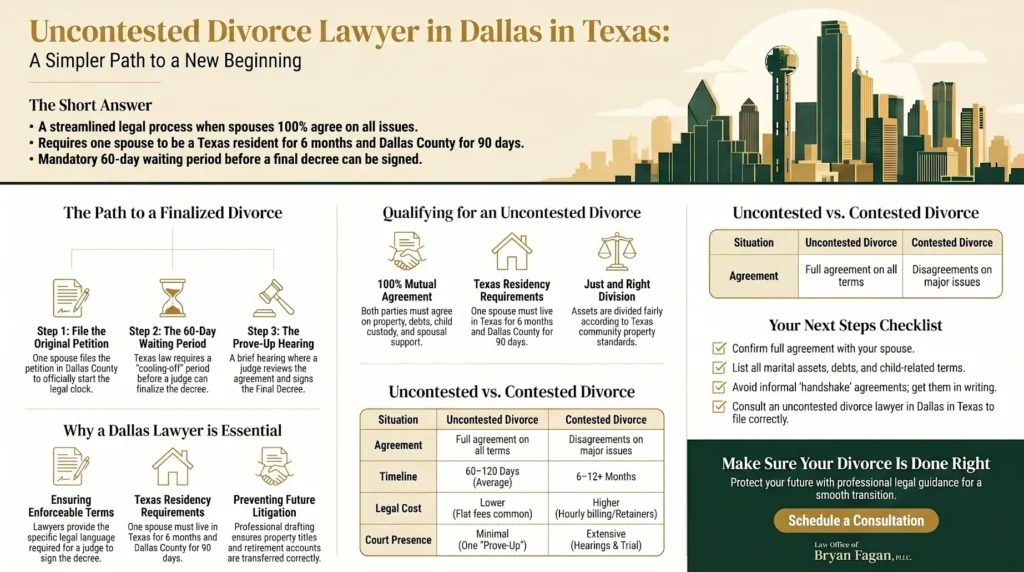
Step-by-Step Uncontested Divorce Process in Dallas
Working with an Uncontested Divorce Lawyer in Dallas in Texas allows couples to move through the divorce process with clarity and efficiency—but only when each step is handled correctly. While the process may seem straightforward on the surface, Texas courts still expect precision, complete agreements, and compliance with procedural requirements before approving a final divorce decree.
In straightforward uncontested divorces, where both spouses are fully aligned, the process follows a predictable path. The first step is confirming eligibility under Texas Family Code §6.301, which requires at least one spouse to have lived in Texas for six months and in Dallas County for ninety days. Just as important is confirming that all issues—property division, debts, and, if applicable, child-related matters—are fully resolved. Courts will not move forward if any key issue remains unclear or incomplete.
Once eligibility is established, the Original Petition for Divorce is filed with the Dallas County District Clerk, typically at the George L. Allen Sr. Courts Building or through the state’s e-filing system. From there, the other spouse must be formally notified, either through service of process or by signing a Waiver of Service. In cooperative cases, a waiver can help streamline the process and avoid unnecessary delays. However, if communication breaks down or one spouse hesitates, this step can quickly become a point of friction.
The next phase—often where mistakes happen—involves drafting the Final Decree of Divorce. This document must clearly outline every agreed term, including property division, debt allocation, and, when applicable, arrangements related to child custody in Texas. Under Texas Family Code §153.002, courts prioritize the best interest of the child, which means stability, consistency, and clear expectations must be reflected in the agreement. Judges often evaluate whether the decree is specific enough to be enforced without confusion, especially in areas involving parenting schedules and decision-making authority.
In more complex situations, even small gaps in the agreement can create larger problems. Questions about property division in Texas divorce, financial accounts, or parenting logistics—such as transportation between households—can lead to delays if not properly addressed. For families in Dallas, practical considerations like scheduling and coordination across the city, including factors discussed in transportation in Dallas, can directly impact how workable a parenting plan is in real life. If agreements are vague or incomplete, judges may hesitate to approve them, or worse, issues may arise later that require additional legal action.
After the mandatory 60-day waiting period under Texas Family Code §6.702, the court reviews the submitted documents. In many uncontested cases, the divorce can be finalized without a formal hearing, though some situations require a brief prove-up to confirm the agreement. At this stage, the court is not simply checking for signatures—it is evaluating whether the agreement is fair, complete, and enforceable.
In straightforward uncontested divorces, proper preparation keeps the process efficient and predictable. In more complex situations, where financial details, children, or logistical challenges are involved, having structured legal guidance becomes essential to avoid costly mistakes. If disagreements begin to emerge at any point, the case can shift from uncontested to contested, increasing both time and expense.
Taking the time to get each step right protects more than just the outcome of your case—it protects your ability to move forward without unnecessary complications. With the right approach, an uncontested divorce can remain efficient, clear, and focused on long-term stability rather than short-term convenience.

Timeline for Uncontested Divorce in Dallas
Table 2: Uncontested Divorce Timeline
| Step | What Happens | Typical Timeframe |
|---|---|---|
| Filing Petition | Submit paperwork to Dallas County District Clerk | Day 1 |
| Service/Waiver | Spouse receives notice or signs waiver | Days 1–14 |
| Waiting Period | Mandatory 60-day period under Texas law | Days 1–60 |
| Document Preparation | Draft final decree and supporting documents | During waiting period |
| Court Review | Judge reviews and approves final decree | Days 61–90 |
| Divorce Finalized | Certified copy of decree available | Day 70–90 typically |
Several factors can extend this timeline: incomplete paperwork, missing signatures, court backlogs, or required hearings. When documents are prepared correctly and both parties cooperate, most Dallas uncontested divorce cases finalize within 70–90 days.
Filing Requirements and the 60-Day Waiting Period
Working with an Uncontested Divorce Lawyer in Dallas in Texas begins with understanding the legal requirements that must be satisfied before your case can move forward. Even when both spouses are fully aligned, Texas law sets clear thresholds that determine whether a court has authority to grant your divorce. Under Texas Family Code §6.301, at least one spouse must have lived in Texas for six continuous months and in Dallas County for at least ninety days before filing. Without meeting these residency requirements, the court cannot proceed, regardless of how simple the agreement may be.
In straightforward uncontested divorces, once eligibility is confirmed, the process typically moves forward efficiently—but it is still governed by mandatory timelines. Texas Family Code §6.702 requires a minimum 60-day waiting period between the filing of the Original Petition for Divorce and the court’s ability to finalize the case. This “cooling-off” period applies in nearly every situation, even when both parties have already agreed on all terms. Courts use this time to ensure that decisions are not made hastily and that the final agreement reflects careful consideration and long-term stability.
In more complex situations, this waiting period becomes even more important. It provides time to review agreements for completeness and enforceability—two factors judges carefully evaluate before approving a Final Decree. If provisions related to property division in Texas divorce are unclear or incomplete, or if arrangements involving child custody in Texas do not reflect stability and consistency under Texas Family Code §153.002, the court may delay approval until those issues are addressed. What may seem like a minor oversight can quickly turn into a costly delay if not corrected early.
There are limited exceptions to the 60-day waiting period, primarily involving documented family violence, such as protective orders or certain criminal findings. Outside of these circumstances, courts are strict about enforcing the timeline. This means that even in the most cooperative cases, finalization cannot occur before day sixty-one.
Filing costs are another practical consideration. In Dallas County, filing fees are typically $350 for cases without children and $401 when children are involved. Additional costs may arise if formal service is required, rather than using a waiver. While these expenses are generally predictable, delays caused by incomplete paperwork or unclear agreements can increase overall costs and extend the timeline.
In straightforward uncontested divorces, meeting these requirements early helps keep the process smooth and predictable. In more complex situations—especially where children, financial details, or evolving concerns are involved—careful attention to these rules becomes essential. For those navigating similar processes in other Texas communities, such as uncontested divorce in Houston Heights, the same legal standards apply, reinforcing the importance of accuracy and preparation.
Taking the time to understand and follow these requirements protects your case from unnecessary delays and ensures that your agreement is ready for court approval when the waiting period ends. With the right approach, you can move forward confidently—knowing that each step has been handled with clarity and care.
Cost and Timeline Expectations
One significant advantage of an uncontested divorce is reduced cost effective resolution compared to contested cases. When spouses agree on all issues, they avoid expensive discovery processes, multiple hearings, and potentially a trial.
Typical costs for uncontested divorce in Dallas include:
- Filing fees: $350 (no children) or $401 (with children)
- Service costs: $0 with waiver, or $75–$150 for formal service
- Attorney fees: $1,500–$5,000 for straightforward cases; more complex situations involving children or significant marital assets may reach $5,000–$7,000
- DIY or online services: $250–$1,500 for document preparation
Compare these figures to contested divorce proceedings, which can cost $15,000–$50,000 or more depending on complexity and duration of litigation. The financial savings of reaching mutual agreement are substantial.
Regarding timeline, expect approximately 70–90 days from filing to final decree in most uncontested cases. This assumes no unnecessary delays from paperwork issues or court scheduling conflicts.
What Can Turn an Uncontested Divorce into a Contested One
Working with an Uncontested Divorce Lawyer in Dallas in Texas often begins with a shared goal—keeping the process simple, efficient, and free from unnecessary conflict. However, even when both spouses start in agreement, it is not uncommon for an uncontested divorce to shift into a contested case if disagreements arise along the way. Understanding where these breakdowns happen can help you avoid delays, added costs, and long-term complications.
In straightforward uncontested divorces, both parties have already reached clear, detailed agreements on property, finances, and, if applicable, children. When those agreements are complete and properly documented, courts are more likely to approve them without issue. Judges typically evaluate whether the terms are specific, enforceable, and aligned with Texas law. But if those agreements lack clarity—especially in areas like property division in Texas divorce—even minor disagreements can quickly escalate into larger disputes.
In more complex situations, disagreements often begin with how assets are valued or divided. A family home, retirement accounts, or business interests can become points of tension if both parties view them differently. What once felt like a simple agreement can become contested when financial details are not fully addressed or when one party begins to question fairness. This is particularly true when life changes—such as relocation considerations discussed in moving to Dallas—impact decisions about property or long-term planning.
Child-related issues are another common turning point. Under Texas Family Code §153.002, courts prioritize the best interest of the child, which places a strong emphasis on stability and consistency. If disagreements arise about parenting schedules, decision-making authority, or support obligations, the case may no longer qualify as uncontested. Even when parents initially agree, concerns about routines, school, or long-term stability can lead to second thoughts. Judges will carefully evaluate whether custody arrangements—often guided by principles found in child custody in Texas—are workable and clearly defined.
Spousal support can also introduce unexpected conflict. If one spouse requests support after initial discussions or disputes the amount or duration, the agreement may need to be renegotiated. Similarly, last-minute changes—when one party reconsiders previously agreed terms—can delay the process and create uncertainty. Courts expect consistency and clarity, and sudden shifts often signal deeper issues that require closer review.
If disagreements begin to emerge at any point, the case may require additional steps such as mediation, formal discovery, or even litigation. This is where the difference between a truly uncontested case and a more complex situation becomes clear. In straightforward uncontested divorces, proper preparation keeps everything on track. In more complex situations, where financial details, children, or changing circumstances are involved, structured legal guidance becomes essential to protect your interests and avoid costly mistakes.
Recognizing these potential turning points early allows you to make informed decisions and maintain control over the outcome. With the right approach, many of these issues can be addressed before they escalate—helping you preserve the efficiency and clarity that make uncontested divorce such a valuable option in the first place.

Why You Still Need a Lawyer for an Uncontested Divorce
Even when both spouses agree completely, legal representation provides significant value. The legal documents required for divorce are technical and must be precisely worded to be enforceable. Mistakes in your divorce petition or final decree can create future conflicts that require additional legal action to resolve.
An experienced attorney ensures:
- Accurate documentation: All required forms are completed correctly and filed according to Dallas County procedures
- Proper property characterization: Separate property and community property are correctly identified under Texas law
- Enforceable agreements: The final decree contains language that courts can enforce if disputes arise later
- Child-related compliance: Custody and support provisions meet Texas Family Code §153.002 standards for protecting children’s best interests
- Protection of your rights: Your interests are fully represented in all agreements
Without legal guidance, you risk creating legal documents that are ambiguous, incomplete, or unenforceable—problems that may not become apparent until years later when enforcement becomes necessary.
How a Dallas Uncontested Divorce Lawyer Helps
Working with an Uncontested Divorce Lawyer in Dallas in Texas provides more than just assistance with paperwork—it offers a structured, strategic approach to ensuring your divorce is handled correctly from start to finish. Even when both spouses agree, Texas courts still require that every detail be properly documented, enforceable, and aligned with legal standards before approving a Final Decree. This is where experienced legal guidance makes a meaningful difference.
In straightforward uncontested divorces, the focus is on efficiency and accuracy. Proper filing procedures must be followed, whether submitting documents through Dallas County courts or the state’s e-filing system. Missing a form, overlooking a requirement, or failing to meet deadlines can delay the process unnecessarily. A well-prepared case ensures compliance with Texas Family Code §6.301 and §6.702, allowing the divorce to move forward without avoidable setbacks.
Equally important is the drafting of a comprehensive and enforceable agreement. Courts do not simply accept agreements at face value—they evaluate whether the terms are clear, complete, and capable of being enforced without confusion. This is especially critical in matters involving property division in Texas divorce, where vague language or incomplete provisions can create disputes long after the divorce is finalized. In more complex situations, even small oversights can lead to costly corrections or future litigation.
When children are involved, the level of scrutiny increases. Under Texas Family Code §153.002, judges prioritize the best interest of the child, focusing on stability, consistency, and clearly defined parenting arrangements. Agreements related to child custody in Texas must reflect practical, workable solutions that support the child’s daily life. Courts often look at whether the plan minimizes disruption and provides a stable environment across both households.
In more complex situations, the process requires careful coordination and attention to detail. Managing deadlines, preparing for potential prove-up hearings, and ensuring all required documents are properly submitted can become challenging if disagreements begin to emerge or if financial or parenting issues are not fully resolved. What initially appears uncontested can shift if terms are unclear or incomplete, making early precision essential.
Familiarity with local court procedures also plays a key role. Understanding how Dallas County courts operate—including expectations around filings, timelines, and approvals—can help prevent unnecessary delays. This local knowledge allows cases to move forward more efficiently, reducing uncertainty and helping families reach resolution sooner. For those exploring similar uncontested processes in other Texas communities, such as uncontested divorce in Humble, Texas, the same principles of clarity and enforceability apply.
In straightforward uncontested divorces, proper guidance helps keep the process simple and predictable. In more complex situations, where children, assets, or evolving concerns are involved, a more structured legal approach becomes essential to protect your long-term interests. Having the right level of support ensures that your agreement is not only finalized efficiently, but built to withstand future challenges—allowing you to move forward with confidence and peace of mind.

Checklist: Preparing for Your Uncontested Divorce
- Confirm complete agreement with your spouse on all property, debt, and child-related issues
- Verify residency requirements (six months in Texas, ninety days in Dallas County)
- Gather financial documents including bank statements, retirement account statements, tax returns, and debt records
- Prepare a comprehensive list of all marital assets and separate property
- Finalize child custody arrangements including living schedules and decision-making responsibilities
- Agree on child support amounts based on Texas guidelines
- Determine spousal support terms if applicable
- File proper paperwork with Dallas County District Clerk and pay required fees
- Arrange service of process or obtain signed waiver from your spouse
- Review the final decree carefully before signing to ensure all terms are correct
- Consult with qualified legal counsel to verify everything is legally sound
Conclusion
Moving forward with an uncontested divorce is not just about ending a marriage—it is about doing it in a way that preserves stability, clarity, and your ability to confidently step into the next chapter of your life. An experienced Uncontested Divorce Lawyer in Dallas in Texas helps ensure that what feels simple on the surface is handled correctly beneath it, so you are not left dealing with preventable issues months or years down the road.
In straightforward situations, where both spouses are aligned and the path is clear, the right legal guidance can keep things efficient and stress-free. In more complex cases—especially if your situation involves children, property questions, or long-term financial considerations—having a deeper level of strategy becomes critical. The key is understanding where your case falls and making sure your decisions today truly protect your future.
At The Law Office of Bryan Fagan, PLLC, the focus is always on helping families move forward with clarity and peace of mind. Through education, thoughtful strategy, and a commitment to doing things the right way, you can approach this transition with confidence—knowing you have taken the steps necessary to protect what matters most.
FAQ – Uncontested Divorce in Texas
An uncontested divorce in Dallas Texas occurs when both spouses agree on all major issues—property division, debt allocation, child custody, and support—without needing the court to decide disputed matters. The Dallas County district courts still must approve the final divorce decree, but the process is significantly simpler and faster than contested cases.
Texas law requires a minimum 60-day waiting period under Texas Family Code §6.702 before any divorce can be finalized. Most uncontested divorces in Dallas County complete within 70–90 days from filing, assuming all paperwork is correct and no complications arise.
While not legally required, a lawyer helps ensure your legal documents are properly prepared, all Dallas County procedures are followed, and your divorce agreement is legally enforceable. This protection can prevent costly mistakes and future conflicts.
Dallas County filing fees are $350 without children or $401 with children. Attorney fees for simple uncontested cases typically range from $1,500–$5,000. Total costs remain significantly lower than contested divorce proceedings, which can exceed $15,000–$50,000.
In many Dallas County uncontested divorce cases, no in-person hearing is required if all paperwork is properly prepared. The judge reviews the documents and signs the final decree without requiring the parties to appear. Some cases may require a brief prove-up hearing.
If disagreements emerge during the process, your case may become contested, requiring additional legal proceedings to resolve disputed issues. If disputes arise after the divorce is finalized, you may need to seek modification through the family courts.
Yes. Under Texas Family Code §6.301, at least one spouse must have lived in Texas for six continuous months and in Dallas County for ninety days immediately before filing the divorce petition.
Required legal documents include the Original Petition for Divorce, Civil Case Information Sheet, Waiver of Service (if spouse agrees), and Final Decree of Divorce. Cases involving children require additional forms addressing custody, possession orders, and child support. Dallas County provides Texas Supreme Court–approved forms for uncontested divorces.