
Moving to Dallas Texas: Your Complete 2026 Relocation Guide

It started with a late-night conversation at the kitchen counter—boxes not yet packed, coffee growing cold, and two parents quietly asking the same question: “Is this the right move for our family?” Moving to Dallas Texas often begins like this, not with excitement, but with uncertainty. A new job offer, a fresh start after a divorce, or simply the need for change can all point in the same direction—but when children are involved, the decision carries more weight than just a new address.
In Texas, relocation is not just a personal choice—it’s a legal one. Courts look closely at how a move will affect a child’s stability, emotional well-being, and daily life. Under Texas Family Code §153.002, every decision must serve the best interest of the child, which means judges often focus on consistency, structure, and the ability of both parents to remain actively involved. Even when a move makes sense for one parent, the court’s priority remains the child’s long-term stability.
At The Law Office of Bryan Fagan, PLLC, we’ve guided countless families through these exact moments—when life is shifting, and the path forward isn’t clear. Bryan Joseph Fagan, a South Texas College of Law graduate and a recognized authority in Texas divorce and custody law, built this firm on a simple belief: families deserve both strong legal guidance and compassionate support during life’s hardest transitions. We don’t just handle cases—we help parents make informed decisions that protect what matters most.
If you’re facing a potential move while navigating divorce or custody issues, this article will help you understand how Texas courts evaluate relocation, what factors truly matter, and how to move forward with confidence while keeping your family’s future intact.
Key Takeaways
- Dallas offers strong job opportunities with major employers like American Airlines, AT&T, and Texas Instruments, plus a job market that gained nearly 276,000 new jobs between February 2021 and February 2022—a growth rate of 7.4% compared to the national average of 4.9%.
- Dallas is ‘worth it’ for many new residents due to its vibrant lifestyle, rich culture, and a wide range of housing options that appeal to families and professionals alike.
- Tech growth in Dallas is fueling economic opportunity, as the expanding technology sector attracts new companies and creates high-quality jobs, making the city a major tech hub in Texas.
- No state income tax in Texas often results in a lower overall tax burden, though property taxes are higher than many states.
- Cost of living runs approximately 2-3% above the national average, with median home prices around $326,000—significantly more affordable than coastal cities like San Francisco or Seattle.
- Dallas is ranked as one of the most diverse cities in the U.S., with a young demographic (median age around 32.9 years) and a welcoming community atmosphere.
- Transportation requires planning: while Dallas Area Rapid Transit provides extensive bus and light rail services, the metropolitan area remains car dependent for most residents.

Your Family’s Future Starts Here
Don’t navigate your legal journey alone. Schedule a consultation now and get the clarity and support you deserve.
Moving to Dallas Texas: The Short Answer
Moving to Dallas Texas offers more than just a change of scenery—it can represent a new chapter for your family, especially during or after a divorce. Dallas combines big-city opportunity with suburban flexibility, making it attractive for parents seeking career growth, affordable housing, and a fresh start. But when children are involved, this decision is not just personal—it carries legal implications that Texas courts take seriously.
Under Texas Family Code §153.002, every custody-related decision must prioritize the best interest of the child. That means judges often look beyond job opportunities or housing costs and focus on stability, continuity, and the child’s day-to-day life. A move that improves one parent’s circumstances may still face scrutiny if it disrupts school routines, limits the other parent’s involvement, or creates instability. In many cases, practical factors—like commute times, access to school districts, and even transportation options in Dallas—can influence how realistic and sustainable a relocation plan truly is.
In straightforward situations, where both parents agree and a clear plan supports the child’s routine, relocating can be a manageable process with the right legal structure in place. Courts tend to view cooperative co-parenting and thoughtful planning favorably, especially when both parents remain actively involved. However, in more complex cases—such as contested moves, geographic restrictions, or concerns about educational stability—the stakes increase significantly. If your case involves disagreements about where a child should live or how parenting time will be affected, courts will closely evaluate each parent’s credibility, long-term planning, and willingness to support the child’s overall well-being.
From a practical standpoint, finding a home in Dallas still offers many advantages. The housing market remains relatively accessible compared to coastal cities, and the Dallas-Fort Worth metroplex provides diverse living options—from urban convenience to family-focused suburbs. But relocation during divorce is not just about affordability or lifestyle—it’s about ensuring that the move aligns with your child’s needs and meets legal expectations. For parents navigating child custody in Texas, this often means building a strategy that balances opportunity with stability.
Whether you’re pursuing a better job, more space, or a new beginning, Dallas can offer meaningful opportunity. The key is approaching that move with clarity and a plan that protects your child’s future. In situations where timing, coordination, or legal approval becomes critical, having the right guidance early can make all the difference—not just in the outcome of your case, but in how smoothly your family transitions into the next chapter.

Listen to Our Texas Family Law Podcast
Prefer listening? In this episode, we discuss moving to Dallas, Texas, including what families need to know before relocating, how a move can impact custody arrangements, and key legal considerations to keep in mind.
Where Is Dallas in the Dallas Fort Worth Metroplex and Why People Are Moving There
Moving to Dallas Texas often starts with opportunity—but for families navigating divorce or custody, it also requires careful legal planning. Dallas sits in Dallas County in North Texas and serves as a central hub within the Dallas–Fort Worth metroplex, one of the fastest-growing regions in the country. With Fort Worth just 30 miles west and surrounding communities like Plano, Frisco, Irving, and Arlington offering diverse living options, families have flexibility in choosing a place that fits both their lifestyle and their child’s needs.
That flexibility, however, comes with responsibility. Under Texas Family Code §153.002, courts focus on the best interest of the child, which means relocation decisions are evaluated through the lens of stability, continuity, and long-term well-being. Judges often look closely at whether a move will improve or disrupt a child’s daily life—especially when it comes to school consistency, access to educational resources in Dallas, and the ability of both parents to remain actively involved. Even in a city with strong economic growth and opportunity, those factors can outweigh financial benefits if the move creates instability.
The Dallas–Fort Worth area continues to attract new residents due to its expanding job market, including major industries like technology, healthcare, finance, and telecommunications. With 23 Fortune 500 companies and continued infrastructure growth, Dallas offers meaningful career advancement. For many parents, this creates a strong motivation to relocate. In straightforward situations—where both parents agree and the move supports the child’s routine—courts are more likely to approve relocation when it aligns with a well-structured parenting plan. Cooperation, communication, and a clear plan for maintaining the child’s relationships are key factors that courts view favorably.
In more complex cases, however, the situation can shift quickly. If your case involves contested relocation, geographic restrictions, or concerns about how the move will affect your child’s education or stability, courts will take a deeper look. Judges evaluate each parent’s credibility, their willingness to support co-parenting, and whether the move enhances or disrupts the child’s overall environment. For parents dealing with these challenges, understanding how child custody in Texas works in relocation cases becomes essential, especially when decisions must be made quickly to avoid delays or unintended legal consequences.
Ultimately, people are drawn to Dallas because it offers something many cities cannot—strong job growth combined with a relatively accessible cost of living. But when relocation intersects with custody, the decision becomes more than financial or geographic. It becomes a legal and strategic choice that must balance opportunity with your child’s stability. In situations where timing, agreement, or court approval becomes critical, taking a thoughtful and informed approach early can help protect both your rights and your child’s future.
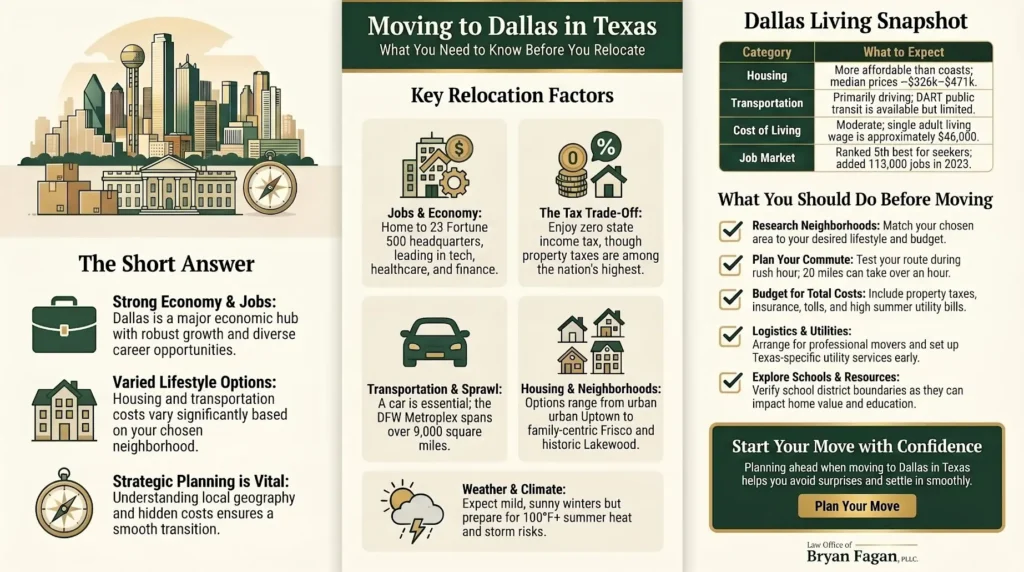
What It’s Like Living in Dallas
Living in Dallas means embracing a lifestyle shaped by diversity, warmth, and yes—heat. Dallas is ranked as one of the most diverse cities in the U.S., with a population exceeding 1.3 million and a median age of around 32.9 years. This young demographic creates a vibrant community with energy that pulses through neighborhoods from central Dallas to the suburbs.
The culture scene thrives here. The Dallas Arts District is one of the largest in the United States, hosting multiple museums and cultural venues. From the Dallas Museum of Art to live music in Deep Ellum, cultural centers abound for those who appreciate the arts.
Weather shapes daily life significantly. The average high temperature during a Dallas summer exceeds 90 degrees Fahrenheit, with peaks regularly topping 100 degrees. Summers are hot and humid—there’s no sugarcoating it. However, winters in Dallas are mild, with temperatures often hovering in the high 50s and low 60s, and snow is rare. Dallas receives an average of 39 inches of rainfall per year, contributing to its generally sunny climate with spring thunderstorms adding occasional drama.
Texas hospitality is genuine. Neighbors wave, strangers strike up conversations, and that welcoming environment helps newcomers feel at home quickly. Many residents find Dallas worth it for its blend of Texas living, welcoming atmosphere, and high quality of life, making the city a rewarding place to call home.
Cost of Living in Dallas
The cost of living in Dallas is generally more affordable than in many other major U.S. cities, making it an attractive destination for newcomers seeking value without sacrificing opportunity. Dallas runs approximately 2-3% above the national average on composite cost indices, which is remarkably reasonable for a metropolitan area of this size.
Owning a Dallas home offers significant benefits, including relative affordability compared to other large cities and strong investment potential due to the area’s steady growth and robust real estate market. Essential expenses such as groceries, transportation, and utilities in Dallas remain manageable, easing the financial burden often felt in larger metropolitan areas like San Francisco or New York.
Table 2: Cost of Living in Dallas
| Category | Typical Cost Range | Notes |
|---|---|---|
| 1-Bedroom Apartment (Urban) | $1,300 – $2,400/month | Uptown and downtown Dallas toward upper end |
| 2-Bedroom Apartment | $1,600 – $2,800/month | Suburban apartments often less expensive |
| Median Home Price | ~$326,000 | More affordable than Seattle, Washington D.C., San Francisco |
| Utilities | Near national average | Summer cooling costs increase electricity bills |
| Transportation | Gas ~$2.80-$3.00/gal | Commuting and parking add costs |
| Groceries | Slightly below national average | Basic items affordable; specialty goods cost more |
Housing costs in Dallas are comparatively lower, with the median home price around $326,000, making it more affordable for young home buyers compared to cities like Seattle and Washington D.C. However, to live comfortably as a single person, you might need approximately $95,000-$100,000 annually. For dual-income households with children, figure $130,000-$150,000 or more, depending heavily on neighborhood choices.
Texas has no state income tax, which often results in a lower overall tax burden for residents. However, property taxes run higher than many states—a trade-off worth calculating when comparing total costs.

Pros and Cons of Moving to Dallas Texas
Every relocation involves trade-offs. Here’s an honest assessment of what Dallas offers—and what challenges you’ll face.
Table 1: Pros and Cons of Moving to Dallas Texas
| Pros | Cons |
|---|---|
| Strong, diverse job market with 23 Fortune 500 companies | Hot, humid summers with temperatures exceeding 100°F |
| No state income tax reducing overall tax burden | Traffic congestion significant on major highways during rush hour |
| Affordable housing compared to coastal cities | Car dependent city with limited public transportation coverage |
| Over 410 parks and 180 miles of trails for outdoor activities | Higher property taxes offset income tax savings |
| Rich cultural arts, dining, and sports scene | Public schools vary greatly in quality by neighborhood |
| Diverse, welcoming community with young demographics | Urban sprawl means longer commutes for many residents |
| Mild winters with rare snow | Severe weather risks including storms and occasional tornadoes |
The job market strength and affordable housing attract many newcomers, but summer heat and traffic congestion require adjustment. Schools present perhaps the biggest variable—Dallas ISD received a “C” rating in recent Texas Education Agency accountability scores, with 47 campuses earning A’s but 8 receiving failing grades. Choosing your neighborhood carefully matters enormously for families.
Best Neighborhoods in Dallas
Dallas offers remarkably diverse residential options, from walkable urban cores to spacious suburban communities.
Urban Living: Uptown is a vibrant neighborhood in Dallas known for its tree-lined streets, upscale restaurants, and nightlife, making it popular among young professionals and families seeking walking distance to amenities. Oak Lawn is recognized as a cultural hub in Dallas, featuring a variety of shops, restaurants, and community events, making it attractive for renters and first-time home buyers. Deep Ellum draws artists and nightlife seekers with its historic district character and live music venues.
Family-Friendly Suburbs: Frisco, a suburb of Dallas, is known for its family-friendly atmosphere and amenities, including the Dallas Cowboys corporate headquarters and Toyota Stadium, appealing to sports enthusiasts. Plano offers excellent schools, extensive shopping centers, parks, and more spacious single-family homes. Irving provides diversity and some more affordable housing options while maintaining good access to employment centers. The Mid Cities, a group of suburban communities located between Dallas and Fort Worth, are especially appealing to growing families and professionals seeking convenient access to both cities.
Character Neighborhoods: The Bishop Arts District is an eclectic neighborhood in Dallas filled with local boutiques, art galleries, and restaurants, offering a vibrant urban lifestyle just south of downtown. Highland Park is an upscale residential area in Dallas known for its beautiful parks and luxurious homes, making it one of the most desirable neighborhoods in the city.
North Dallas features a collection of established neighborhoods, premier shopping destinations, and convenient regional access points, making it attractive for both residents and visitors seeking short-term or long-term accommodations near Dallas.
Northwest Dallas offers convenient access to business districts, leisure activities, and family-friendly neighborhoods, with proximity to attractions like the Mandalay Canal, making it a tranquil yet well-connected part of the city.
For green space seekers, White Rock Lake Park provides outdoor adventure right in east Dallas, while the Great Trinity Forest offers nature escapes within city limits.
Jobs and Economy
Dallas is ranked as the 5th best city for job seekers, with a healthy job economy driven by major employers such as Walmart, American Airlines, and AT&T. The local job market demonstrates remarkable resilience and growth, adding approximately 11,600 jobs in January 2026 alone.
The Dallas job market gained nearly 276,000 new jobs between February 2021 and February 2022, with a job growth rate of 7.4%, significantly higher than the national average of 4.9%. While growth has moderated slightly, employment opportunities remain strong across multiple sectors.
Major industries driving career opportunities include:
- Technology and data centers (rapidly expanding, with significant tech growth fueling job creation and economic vitality)
- Healthcare (Baylor, UT-Southwestern)
- Finance industry (banking, insurance)
- Telecommunications (AT&T headquarters)
- Aviation (American Airlines, Southwest Airlines nearby)
- Defense and aerospace
Dallas is home to 23 Fortune 500 companies, creating diverse economy conditions that protect against single-industry downturns. The business-friendly policies attracting companies to Texas continue drawing headquarters relocations and expansions, sustaining employment opportunities across skill levels.
Schools and Education
Moving to Dallas Texas often comes with access to a wide range of educational opportunities, but for parents navigating divorce or custody, those options must be evaluated through a legal lens—not just a lifestyle one. Dallas is home to hundreds of public and private schools, with the Dallas Independent School District serving over 150,000 students. While the area includes highly regarded campuses like the School for the Talented and Gifted, overall performance can vary significantly from one neighborhood to another. For families considering relocation, this variability becomes a key factor in how courts evaluate whether a move supports a child’s best interests.
Under Texas Family Code §153.002, judges focus on stability and continuity when making custody decisions. That includes where a child goes to school, how they are performing academically, and whether a move would disrupt their progress or support systems. Courts also consider how each parent will remain involved in the child’s education, especially in joint managing conservatorship arrangements under §153.134. Access to strong academic programs and local support systems—such as those highlighted in West Dallas community and legal resources—can play a role, but they must be part of a larger, well-thought-out plan that prioritizes the child’s day-to-day stability.
In straightforward situations, where both parents agree on the move and the child can transition into a comparable or stronger school environment, relocation may be a manageable process. Courts often view cooperative co-parenting and proactive planning as positive indicators. Parents who take the time to research districts like Plano ISD or Frisco ISD—known for consistently high performance—can demonstrate that the move is designed to enhance their child’s educational experience rather than disrupt it.
In more complex cases, however, the analysis becomes much more detailed. If your case involves disagreements about school quality, concerns about academic performance, or geographic restrictions that limit relocation, courts will closely examine each parent’s reasoning and long-term planning. Judges may ask whether the move will create instability, whether one parent’s access to the child will be reduced, and whether the proposed school environment truly benefits the child. For families dealing with these challenges, understanding how child custody in Texas intersects with education is critical, especially when timing and court approval can directly impact your ability to move forward.
Higher education opportunities in Dallas—such as the University of Texas at Dallas, Texas Woman’s University, and Southern Methodist University—add long-term value to the region. But in custody cases, the focus remains on the child’s immediate needs. Relocation is not just about future potential; it’s about present stability. When decisions are made thoughtfully and supported by a clear plan, parents can position themselves to protect both their child’s education and their legal rights.

Transportation and Commuting
Getting around Dallas requires planning. The Dallas Area Rapid Transit (DART) system provides extensive bus and light rail services, connecting key neighborhoods, business districts, and popular attractions. Four light rail lines serve the region, including access to DFW International Airport via the Orange Line.
However, while it is possible to get by without a car in Dallas, owning one is highly recommended due to the city’s size and limited coverage of public transportation options. Dallas remains car dependent for most residents, particularly those living in suburbs.
Dallas has a robust highway system, but rush hour can be busy, making commuting by car a common experience. Traffic congestion is significant, particularly on major highways during peak times. Key routes like I-35, U.S. 75, LBJ Freeway (I-635), and the Dallas North Tollway see heavy usage. Commute times range from 30-60 minutes depending on distance and traffic conditions.
Two major airports serve the region: Dallas-Fort Worth International (DFW) and Dallas Love Field. Easy access to both makes business and personal travel convenient.
Things to Do in Dallas
Dallas boasts entertainment options rivaling any major city in America. Sports fans celebrate the Dallas Cowboys, Mavericks (NBA), Stars (NHL), and FC Dallas (MLS). Football season transforms the region into a celebration of Texas football culture.
The dining scene ranges from legendary Tex-Mex and barbecue to innovative fine dining. The Bishop Arts District offers eclectic boutique shopping and local restaurants, while Uptown delivers upscale options. Deep Ellum remains the heart of live music and nightlife.
For families, the Dallas Zoo provides year-round activities including a butterfly garden that delights children. Klyde Warren Park in downtown Dallas offers green space and community events in the urban core. White Rock Lake and Lake Ray Hubbard provide outdoor adventure opportunities including hiking, biking, and water activities.
Dallas features over 410 parks and 180 miles of trails, providing numerous outdoor activity options despite its urban character. The modern art scene, anchored by institutions like the Dallas Museum of Art, ensures cultural enrichment alongside entertainment.
Tips for Moving to Dallas
Moving to Dallas Texas can be an exciting step forward, but when children and custody orders are involved, every practical decision carries legal importance. What may seem like simple relocation planning—choosing a neighborhood, testing a commute, or budgeting for utilities—can directly impact how a court evaluates the move under Texas Family Code §153.002. Judges are not just looking at where you want to live; they are looking at how that move supports your child’s stability, routine, and long-term well-being.
One of the most important steps is visiting Dallas before making a final decision. Spending time in both urban and suburban areas helps you understand commute times, daily logistics, and how your child’s routine might change. In straightforward situations, where both parents agree and the move clearly supports the child’s lifestyle, this type of preparation can help demonstrate thoughtful planning. Courts often view proactive efforts—like researching neighborhoods and verifying school zones—as indicators that the move is in the child’s best interest.
In more complex cases, these details become even more critical. If your case involves contested relocation, geographic restrictions, or concerns about how the move will affect your child’s daily life, courts will closely evaluate your planning and credibility. Testing commute times during rush hour, for example, is not just a convenience—it helps show whether you can realistically maintain school schedules and parenting time. Similarly, researching local conditions, including community dynamics and resources like those found in South Dallas community considerations, can help demonstrate that you’ve considered the full environment your child will be entering.
Financial planning also plays a role. Budgeting for higher summer electricity costs, transportation needs, and overall living expenses shows the court that you are prepared to provide a stable home. Texas courts often look at whether a parent can maintain consistency—not just emotionally, but financially—when evaluating relocation requests. In cooperative co-parenting situations, this preparation can support a smooth transition. However, if disagreements arise, these same factors may be scrutinized more closely.
Planning for a car-dependent lifestyle is another practical consideration that can influence custody arrangements. Reliable transportation affects your ability to manage school drop-offs, extracurricular activities, and visitation schedules. For parents navigating child custody in Texas, these logistical realities can directly impact how parenting time is structured and whether a relocation plan is feasible.
Finally, building connections early—whether through professional networks or community groups—can help establish stability after the move. Courts often look at long-term planning, including how a parent intends to integrate into a new community while maintaining a consistent environment for the child. In situations where timing is critical or approval is required, delays or lack of preparation can create unnecessary legal challenges.
Relocating is never just about the move itself—it’s about how that move fits into a larger plan for your child’s future. With the right preparation and a clear understanding of both the practical and legal factors involved, you can approach relocation with confidence and protect what matters most.

Checklist: Moving to Dallas Texas
- Research neighborhoods matching your priorities (schools, commute, budget)
- Compare cost of living against your current location and salary
- Verify school ratings and enrollment options for your children
- Plan commute routes from potential neighborhoods to your workplace
- Calculate total housing costs including property taxes
- Visit Dallas and tour neighborhoods during both weekdays and weekends
- Secure housing with adequate time before your move date
- Explore job opportunities if relocating without employment
- Budget for moving expenses plus first-month costs
- Connect with local community groups or professional networks
Conclusion
Moving to Dallas in Texas can represent a new beginning—but when children and custody are involved, it also requires careful, informed decisions that protect stability and long-term well-being. The choices you make now—where your child lives, how routines are maintained, and how both parents stay involved—can shape not just your child’s emotional health, but their ability to succeed and feel secure during a time of change.
In straightforward situations, parents may be able to work together to create a relocation plan that supports consistency and keeps both households aligned. In more complex cases—especially if your case involves contested custody, geographic restrictions, or concerns about your child’s adjustment—it becomes critical to have experienced legal guidance that understands how Texas courts evaluate these decisions. The right strategy isn’t just about winning a case—it’s about building a plan that works for your child.
At The Law Office of Bryan Fagan, PLLC, we help families move forward with clarity and confidence by combining legal experience with practical, real-world solutions. Whether you’re just starting to explore your options or facing a difficult dispute, the right guidance can help you protect what matters most—and take the next step with peace of mind.
Frequently Asked Questions
Dallas is an excellent place to live for those seeking job opportunities, affordable housing compared to coastal cities, and a diverse community atmosphere. The city offers strong employment across multiple industries, no state income tax, and over 410 parks for outdoor activities. However, summer heat, traffic congestion, and variable school quality require consideration.
The cost of living in Dallas runs approximately 2-3% above the national average. Median home prices around $326,000 are significantly lower than cities like San Francisco or Seattle. Essential expenses including groceries, transportation, and utilities remain manageable, though summer cooling costs increase electricity bills substantially.
Frisco and Plano offer excellent schools, family amenities, and safe suburban environments. Within Dallas proper, Lake Highlands and Lakewood in east Dallas provide tree-lined streets and community feel. Highland Park offers prestigious schools and beautiful parks, though at premium prices.
Dallas is ranked as the 5th best city for job seekers, home to 23 Fortune 500 companies including American Airlines and AT&T. The job market gained nearly 276,000 jobs between February 2021 and February 2022, with growth rates significantly exceeding national averages. Major industries include technology, healthcare, finance, and telecommunications.
The Dallas Area Rapid Transit system provides extensive bus and light rail services connecting key areas. However, coverage remains limited in many suburban areas. While possible to get by without a car, owning one is highly recommended due to the city’s size and the metropolitan area’s sprawling nature.
Yes. Housing costs in Dallas are comparatively lower than coastal cities, with median home prices around $326,000 versus significantly higher amounts in San Francisco, Seattle, or Washington D.C. Combined with no state income tax, Dallas offers meaningful cost advantages for many relocating families and professionals.
Dallas and San Antonio each offer unique lifestyles and neighborhoods. Dallas is known for its robust job market, diverse urban amenities, and fast-paced environment, while San Antonio features a more relaxed pace, rich cultural heritage, and historic neighborhoods like Alamo Heights and Stone Oak. Both cities provide strong family options, but Dallas tends to have higher housing costs and a larger metropolitan feel, whereas San Antonio is often praised for its affordability and community atmosphere.
Texas living is characterized by a blend of southern hospitality, diverse cultures, and a generally high quality of life. Dallas stands out within Texas for its economic opportunities, vibrant arts scene, and cosmopolitan lifestyle, while still offering the friendliness and community spirit found throughout the state. Compared to cities like Austin, Houston, or San Antonio, Dallas provides a balance of urban excitement and suburban comfort.
Many people find moving to Dallas worth it due to its strong job market, affordable housing relative to other major cities, and wide range of lifestyle options. Dallas offers excellent schools, diverse neighborhoods, and no state income tax, making it attractive for families and professionals alike. The value of living in Dallas is often highlighted by its combination of career opportunities, cultural amenities, and overall quality of life.