
Mediation Lawyer in Dallas Texas: Your Guide to Resolving Family Disputes Without Court

The argument had started like so many others—quiet at first, then sharper, until both voices filled the room and neither felt heard. Later that evening, sitting alone at the kitchen table, one thought kept surfacing: there has to be a better way to get through this. For many families facing divorce, that moment becomes the turning point—the realization that resolution doesn’t have to mean a drawn-out courtroom battle. Working with a Mediation Lawyer in Dallas Texas offers a path where decisions are made with intention, not imposed under pressure, allowing families to move forward with greater control and less conflict.
At The Law Office of Bryan Fagan, PLLC, we understand that divorce is not just a legal process—it’s a deeply personal transition that affects every part of your life. Founded by Bryan Joseph Fagan, a South Texas College of Law graduate and trusted authority in Texas family law, our firm is committed to helping families navigate these moments with clarity and confidence. Texas law, including the guiding principle under Family Code §153.002, centers decisions around what serves the best interests of those involved, and that often means finding solutions that reduce conflict and create lasting stability.
In this article, you’ll discover how mediation works in Dallas, when it may be the right choice for your situation, and how thoughtful legal guidance can help you protect what matters most while building a path toward peace of mind.
Key Takeaways
- A mediation lawyer in Dallas Texas advocates for your legal rights during negotiation sessions, helping you reach agreements that protect your interests without going to trial.
- Texas Family Code § 153.0071 authorizes courts to refer family law cases to mediation and makes properly executed Mediated Settlement Agreements legally binding.
- Many Dallas County district courts expect or require mediation before trial in contested custody and divorce cases, making early preparation essential.
- Mediation typically costs less, resolves faster, and gives parties greater control over outcomes compared to courtroom litigation.
- Not all cases are suitable for mediation—domestic violence, power imbalances, or refusal to cooperate may require court intervention instead.

Your Family’s Future Starts Here
Don’t navigate your legal journey alone. Schedule a consultation now and get the clarity and support you deserve.
Speak With a Contested Divorce Attorney in Dallas, TX
A contested divorce can affect your finances, your family, and your future. Having a skilled contested divorce attorney in Dallas, TX on your side can help protect your interests and give you peace of mind during a challenging time.
To learn more about how the Law Office of Bryan Fagan, PLLC can help with your contested divorce case, call 469-972-8473 today to schedule a confidential consultation.
Mediation Lawyer in Dallas Texas: The Short Answer
A Mediation Lawyer in Dallas Texas helps families resolve divorce, custody, and financial disputes without stepping into a courtroom, offering a more controlled and less adversarial path forward. Instead of leaving decisions in the hands of a judge, mediation allows both parties to work toward practical solutions—with guidance from an attorney who protects your rights, evaluates proposals, and ensures any agreement is fair, enforceable, and aligned with your long-term goals. For many families navigating daily life across Dallas—including practical considerations like getting around Dallas—having a structured, predictable resolution process can make a meaningful difference in maintaining stability.
Mediation itself is a structured process guided by a neutral third party, but your attorney plays a very different role. While the mediator facilitates discussion, your lawyer focuses on strategy—helping you understand how Texas law applies to your situation, including standards under Texas Family Code §153.002 and §153.134 when children are involved. Courts in Dallas County expect parties to participate in mediation in good faith, and judges often evaluate cooperation, reasonableness, and whether proposed agreements support stability for children. In many cases, especially those involving parenting arrangements, mediation becomes a key step before trial under §153.0071.
In straightforward situations, mediation can move quickly, helping both parties reach agreement on issues like property division or basic parenting schedules with minimal conflict. In more complex cases—such as those involving contested custody, detailed parenting plans, or significant financial considerations—mediation requires a more strategic approach. Where disputes are contested or communication has broken down, having experienced legal guidance becomes critical to avoid agreements that may create problems later. Understanding the divorce mediation process and how it connects to child custody in Texas can help you make informed decisions that protect your future.
Ultimately, mediation is not just about resolving a case—it’s about creating workable solutions that last. The right approach depends on your situation, and knowing when to seek guidance can help you avoid costly delays, reduce conflict, and move forward with greater clarity and confidence.

Listen to Our Texas Family Law Podcast
Prefer listening? In this episode, we discuss family law mediation in Dallas, Texas, including how mediation works, the benefits of resolving your case without court, and what to expect during the process.
What Does a Mediation Lawyer Do?
A Mediation Lawyer in Dallas Texas serves as your advocate throughout the mediation process, helping you navigate complex legal decisions while keeping the focus on practical, workable outcomes. Unlike the mediator—who must remain neutral—your attorney is there to protect your interests, guide your strategy, and ensure that any agreement reflects both your rights and your long-term goals under Texas law.
Before mediation begins, preparation is key. Your attorney works with you to gather financial documents, review assets and debts, and outline priorities related to parenting, support, and property division. This early stage is where much of the strategy is developed. Dallas County courts expect parties to approach mediation with organization and good faith, and judges often consider how prepared and cooperative each side has been when evaluating the overall reasonableness of an agreement—especially in cases involving children under Texas Family Code §153.002 and §153.134.
During mediation, your lawyer plays an active role behind the scenes and in real time. They help you understand how proposals align with Texas Family Code requirements, including child support guidelines and enforceability standards under §153.0071. In straightforward situations, this guidance may simply confirm that an agreement is fair and complete. In more complex cases—such as contested custody arrangements, detailed parenting plans, or financial disputes—your attorney helps identify risks, suggest counter-proposals, and prevent decisions that could create future conflict. Where disputes are contested or communication has broken down, this level of support becomes critical to reaching an outcome that is both practical and sustainable. For families managing broader concerns—such as coordinating care or accessing medical resources in Dallas—these decisions can also impact daily life well beyond the legal process.
After mediation, careful review of the Mediated Settlement Agreement (MSA) is essential. Once signed, these agreements are typically binding, and courts will enforce them if they meet statutory requirements. Your attorney ensures that the document includes the required language, accurately reflects the negotiated terms, and protects your rights moving forward. Understanding how the divorce mediation process works—and how it connects to issues like child custody in Texas—can help you approach this final stage with confidence.
The distinction between roles is important. A mediator facilitates communication, but cannot provide legal advice or advocate for either side. A mediation lawyer ensures that your voice is heard, your interests are protected, and your decisions are informed. The level of support you need depends on your situation, but knowing when to rely on basic guidance versus experienced legal strategy can make a meaningful difference in both the outcome and your ability to move forward with clarity and peace of mind.
How Mediation Works in Texas
Working with a Mediation Lawyer in Dallas Texas often begins with understanding how the mediation process actually unfolds—and why courts across Dallas County rely on it so heavily in family law cases. Under Texas Family Code §153.0071, judges have the authority to refer cases involving children, custody, and support to mediation, and in many situations, this step becomes a required part of moving a case forward. Whether you are newly navigating life changes—like moving to Dallas—or dealing with an ongoing dispute, mediation offers a structured way to resolve issues without the unpredictability of trial.
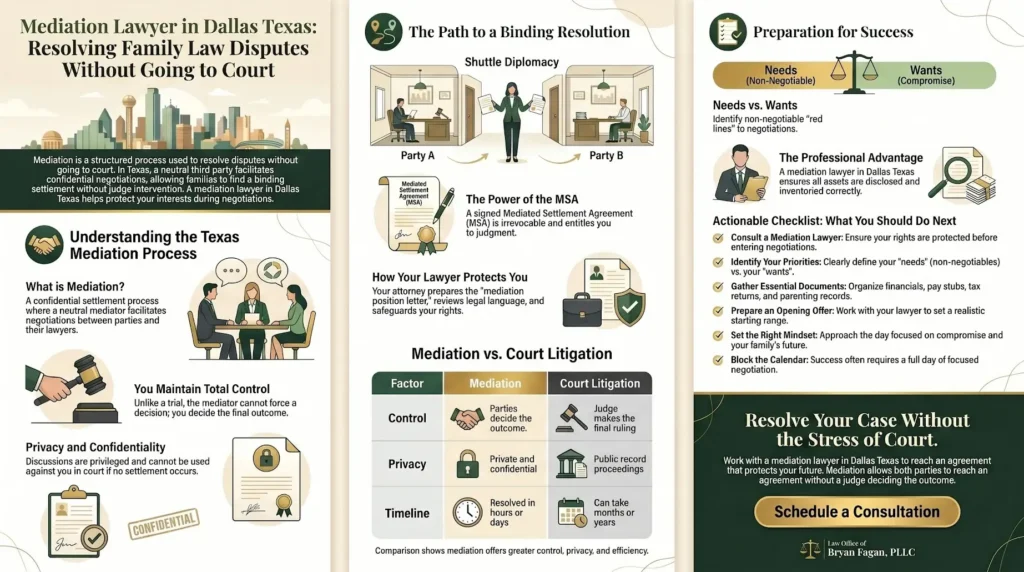
The process typically starts with an opening session where the mediator outlines expectations and each party identifies their goals. From there, most mediations shift into private caucuses, where each side meets separately with the mediator to discuss concerns, priorities, and possible solutions. Negotiation follows, with the mediator working between both sides to narrow differences and find common ground. If an agreement is reached, the terms are formalized in a Mediated Settlement Agreement (MSA), which becomes legally binding when it meets statutory requirements.
Confidentiality is a key part of the process. Under Texas Civil Practice & Remedies Code §154.073, what is said in mediation generally cannot be used in court, allowing both parties to speak openly and explore solutions without fear that their words will be used against them later. Dallas County courts expect good faith participation, and judges often evaluate whether both parties approached mediation with a willingness to cooperate, whether proposed agreements are reasonable, and whether they promote stability—especially in matters involving children under §153.002 and §153.134.
In straightforward situations, mediation can be completed in a single half-day or full-day session, often through services like the Dallas County Dispute Resolution Center. In more complex cases—such as contested custody disputes, detailed parenting plans, or significant financial negotiations—multiple sessions may be necessary, and strategy becomes more important. Where disputes are contested or communication has broken down, working through the divorce mediation process with experienced legal guidance can help avoid delays, reduce conflict, and ensure that agreements are both practical and enforceable. Understanding how mediation connects to broader issues like child custody in Texas can also help you make decisions that support long-term stability for your family.
Ultimately, mediation is designed to give you more control over the outcome—but the level of guidance you need depends on your situation. Knowing when to approach mediation with basic preparation and when to rely on structured legal strategy can make a significant difference in both the process and the result.

Mediation vs Litigation
Understanding the differences between mediation and litigation helps you make informed decisions about how to resolve your family dispute.
Table 1: Mediation vs Litigation
| Feature | Mediation | Litigation |
|---|---|---|
| Cost | Generally lower; shared mediator fees | Higher; attorney fees, court costs, expert witnesses |
| Timeline | Often resolves in days or weeks | May take months or over a year |
| Control | Parties make their own decisions | Judge or jury decides outcome |
| Privacy | Confidential discussions | Public court record |
| Emotional Impact | Less adversarial | Adversarial cross-examination |
| Flexibility | Customized solutions | Standardized legal outcomes |
| Relationship | Can preserve co-parenting relationship | Often increases conflict |
| Enforceability | Binding when properly executed | Court order enforceable |
In Dallas County, many family district courts cycle cases back to mediation if more than eight months pass since the last session. County Court at Law No. 4 requires mediation at least 45 days before trial. These local practices reflect judicial recognition that conflict resolution through negotiation often serves families better than courtroom battles.
What Issues Can Be Resolved in Mediation
Texas mediation addresses a wide range of family law matters. The best interest of the child standard under Texas Family Code § 153.002 guides all custody-related agreements.
Table 2: Issues Resolved in Mediation
| Issue | What Mediation Addresses | Typical Outcome |
|---|---|---|
| Child Custody | Conservatorship appointments, decision-making rights | Joint managing conservatorship with defined responsibilities |
| Visitation | Possession schedules, holidays, summers | Customized parenting plans fitting work and school schedules |
| Child Support | Amount, payment schedule, healthcare | Agreement within or justifiably deviating from guidelines |
| Property Division | Assets, debts, retirement accounts, real estate | Equitable distribution avoiding valuation disputes |
| Spousal Maintenance | Duration, amount, conditions | Negotiated terms or mutual waiver |
| Modifications | Changed circumstances, relocation | Updated orders acceptable to both parties |
Under Texas Family Code § 153.131, courts presume parents should serve as conservators unless evidence shows significant impairment to the child. Under § 153.134, joint managing conservatorship standards apply. A skilled mediation lawyer helps frame proposals consistent with these statutory presumptions.
When Is Mediation Required in Dallas County
Dallas County courts routinely refer contested family law cases to mediation before trial. While Texas law gives judges discretion under § 153.0071(c), local practice makes mediation nearly universal in custody disputes.
Court expectations include:
- Dallas County standard mediation orders require parties to agree on a mediator within 7-20 days after the order is filed
- Dallas County Court at Law No. 1 requires mediator designation at the scheduling order stage
- Cases return to mediation if no session has occurred in the past eight months
- County Court at Law No. 4 mandates mediation at least 45 days before trial
The Dallas County Dispute Resolution Center accepts referrals from family district courts at no fee for qualifying cases. Private mediation remains an option for those who prefer specific mediators or scheduling flexibility.
Judges may waive mediation requirements when domestic violence history compromises safety or when family violence has impaired a party’s ability to negotiate freely. Under § 153.0071(e-1), courts can decline to enter judgment on an MSA if violence affected decision-making.
What to Expect During a Mediation Session
Working with a Mediation Lawyer in Dallas Texas starts well before you walk into the mediation room. Preparation often determines how successful the process will be. Your attorney will help you organize key financial and parenting information so you can negotiate from a position of clarity and confidence. This typically includes gathering recent tax returns, income records, account statements, and any documents related to property or debt, along with proposed parenting schedules that reflect your child’s routine. Taking time to prepare not only strengthens your position—it also signals to the court that you are approaching the process in good faith, which Dallas County judges often consider when evaluating cooperation and credibility.
During mediation, the structure is designed to encourage productive conversation while reducing direct conflict. You may participate in joint discussions where both parties outline their goals, followed by private caucuses where the mediator meets with each side separately. This allows for more open dialogue and strategic negotiation, with your attorney advising you on each proposal and helping you avoid agreements that could create long-term issues. For many families, understanding how the divorce mediation process works can ease uncertainty and make it easier to stay focused on practical outcomes rather than emotional reactions.
If an agreement is reached, it is formalized in a Mediated Settlement Agreement (MSA). Under Texas Family Code §153.0071(d), the MSA must include specific language stating it is not subject to revocation and must be properly signed to become binding. Courts generally enforce these agreements, especially when they reflect reasonable terms and promote stability for children under §153.002 and §153.134. In straightforward situations, this process can resolve disputes efficiently and allow both parties to move forward without prolonged litigation. In more complex cases—such as contested custody arrangements or detailed financial negotiations—careful review and strategic guidance become critical to ensure the final agreement truly protects your interests and supports long-term stability, particularly in matters involving child custody in Texas.
If mediation does not result in a full agreement, the case proceeds toward trial, and the mediator will report that an impasse has been reached. However, even partial agreements can narrow the issues and reduce the scope of litigation. Where disputes are contested or communication has broken down, having the right level of legal support can help you navigate the process more effectively and avoid costly delays. Ultimately, mediation is an opportunity to take control of the outcome—but knowing when to rely on basic preparation versus experienced legal strategy can make all the difference.

Benefits of Mediation
Mediation offers significant advantages over litigation for many Dallas families facing divorce or custody disputes.
Lower costs: Avoiding motions, depositions, trial preparation, and expert witness fees saves thousands of dollars. The Dallas County Dispute Resolution Center provides free or subsidized mediation services for eligible cases.
Faster resolution: While litigation in Dallas County district courts often takes many months or longer, mediation can conclude in a single session or over a few weeks. Getting resolution quickly reduces ongoing stress for everyone, especially children.
Greater control: In mediation, you and the other party craft your own solutions. Parenting plans can reflect your family’s actual schedules rather than standard court-ordered templates. Financial arrangements can address your specific circumstances.
Reduced conflict: The collaborative nature of mediation preserves relationships better than adversarial litigation. For parents who will co-parent for years, maintaining a working relationship matters.
Privacy: Unlike public court proceedings, mediation discussions remain confidential. Financial details and family matters stay private.
Enforceability: When MSAs meet statutory requirements, they become binding and courts must enter consistent orders. Texas courts have consistently upheld properly executed mediated agreements.
Limitations of Mediation
Mediation is not appropriate for every situation. Understanding its limitations helps you make realistic decisions.
Domestic violence: If a history of abuse has created power imbalances or safety concerns, mediation may not provide a safe environment for negotiation. Courts recognize this—under § 153.0071(e-1), judges can refuse to enforce MSAs where family violence impaired decision-making.
Refusal to cooperate: Mediation requires both parties to participate in good faith. If one person refuses to negotiate reasonably or disclose financial information, the process stalls.
Hidden assets: Successful mediation depends on accurate financial disclosure. If you suspect the other party is concealing assets, discovery through litigation may be necessary before meaningful negotiation can occur.
Power imbalances: When one party has significantly more resources, information, or emotional control, that person may dominate negotiations. A skilled mediation lawyer helps level the playing field, but severe imbalances may require court intervention.
Emergency matters: Temporary restraining orders, protective orders, and urgent custody issues may require immediate court action rather than the time mediation takes.
Preparing for Mediation
Success in mediation starts with thorough preparation. Your mediation lawyer helps you get ready.
Gather documentation: Compile financial statements, tax returns, property records, debt information, and any evidence relevant to custody matters. Complete financial disclosure builds credibility and enables fair negotiation.
Identify priorities: Know what matters most to you. Is preserving the family home essential? Is maximizing time with children your primary goal? Understanding your priorities helps your attorney develop effective strategy.
Set realistic expectations: Mediation involves compromise. Identify what you absolutely need versus what you would like but could accept living without.
Understand the law: Your attorney will explain relevant Texas Family Code provisions, child support guidelines, and property division rules. Knowing the legal framework helps you evaluate proposals realistically.
Prepare emotionally: Mediation can be stressful. Staying calm, focused, and cooperative serves your interests better than hostility or emotional outbursts.
How a Dallas Mediation Lawyer Can Help
Working with a Mediation Lawyer in Dallas Texas can bring structure, clarity, and direction to what often feels like an overwhelming process. Mediation is not just about sitting down to talk—it’s about making informed decisions that will shape your financial future, your parenting arrangements, and your day-to-day life moving forward. Having the right legal guidance ensures those decisions are made with a full understanding of your rights under Texas law, including standards outlined in Texas Family Code §153.002 and §153.134 when children are involved.
One of the most important advantages is strategic preparation. Your attorney evaluates the strengths and weaknesses of your case, helping you prioritize what matters most and anticipate how proposals may be received. Dallas County courts expect parties to participate in mediation in good faith, and judges often consider whether agreements are reasonable and promote long-term stability—especially for children. In straightforward situations, this kind of preparation may be enough to reach efficient, balanced agreements. In more complex cases—such as contested custody disputes, detailed parenting plans, or significant financial considerations—strategy becomes essential to avoid outcomes that could create ongoing conflict or instability.
Legal knowledge also plays a critical role during negotiation. Mediation moves quickly, and decisions made in the moment can carry long-term consequences. Your attorney helps you evaluate proposals in real time, ensuring they align with child support guidelines, property division standards, and enforceability requirements under §153.0071. Where disputes are contested or communication has broken down, this guidance helps prevent rushed decisions that may not reflect your best interests. For families navigating broader life transitions—such as changes in routine or access to educational resources in Dallas—thoughtful agreements can also help maintain stability outside the legal process.
Before anything is finalized, careful review of the Mediated Settlement Agreement (MSA) is critical. Once signed, these agreements are typically binding, and courts will enforce them if they meet statutory requirements. In straightforward cases, this may simply involve confirming that the terms reflect what both parties intended. In more complex situations, detailed review ensures that nothing is overlooked and that the agreement truly protects your rights moving forward. Understanding how the divorce mediation process works—and how it connects to issues like child custody in Texas—can help you approach mediation with confidence and clarity.
Ultimately, a mediation lawyer serves as your advocate throughout the process—helping you avoid unnecessary conflict, make informed decisions, and reach agreements that are both practical and enforceable. The level of guidance you need depends on your situation, but knowing when to rely on basic support versus experienced legal strategy can make a meaningful difference in both the outcome and your ability to move forward with peace of mind.

Checklist: Working with a Mediation Lawyer in Dallas Texas
- Identify all issues to resolve: List custody, support, property, and other matters requiring agreement
- Gather financial documents: Collect tax returns, pay stubs, account statements, and property records
- Document parenting arrangements: Prepare school schedules, activity calendars, and proposed custody plans
- Define your priorities: Determine what matters most and where you have flexibility
- Consult with a mediation lawyer: Get legal advice before mediation begins
- Prepare negotiation strategy: Work with your attorney to develop realistic goals and fallback positions
- Stay calm and cooperative: Approach sessions with willingness to work toward solutions
- Review all proposals carefully: Consider each offer’s long-term implications
- Ensure agreement meets legal requirements: Verify MSA contains required language and signatures
- Plan for implementation: Understand next steps after agreement is reached
Conclusion
Divorce doesn’t have to leave lasting damage in its wake—especially when the right approach is taken from the start. Working with a Mediation Lawyer in Dallas Texas gives you the opportunity to resolve conflict with intention, protect your family’s stability, and move forward with decisions you helped shape. In straightforward situations, mediation can provide a faster, more cost-effective path to resolution. In more complex cases—especially where emotions run high, finances are layered, or parenting arrangements require careful planning—the right legal guidance becomes even more important. If your case involves those added pressures, having an experienced attorney by your side can make the difference between a short-term agreement and a long-term solution.
At The Law Office of Bryan Fagan, PLLC, the goal is not just to resolve your case—it’s to help you regain clarity, confidence, and peace of mind. Through thoughtful strategy and a commitment to education, our team works to ensure every decision supports what matters most: your future and your family. Whether you’re exploring mediation for the first time or trying to determine the best path forward, the next step is simply understanding your options—and choosing the level of support that fits your situation.
Frequently Asked Questions
A mediation lawyer represents and advises you during the mediation process, helping you negotiate favorable terms while protecting your legal rights. Unlike the mediator who remains neutral, your attorney advocates specifically for your interests.
Texas Family Code § 153.0071 gives courts authority to order mediation in family law matters. While not mandatory in all cases, Dallas County courts routinely require mediation in contested custody and divorce cases before trial.
Most Dallas County mediation sessions last a half-day (up to four hours) or full day (up to eight hours). Simple matters may resolve in one session, while complex cases involving significant assets or custody disputes may require multiple sessions.
Yes, when properly executed. Under Texas Family Code § 153.0071(d), an MSA that contains required language about irrevocability and is signed by both parties and their attorneys becomes binding and enforceable.
If parties cannot reach agreement, the mediator certifies impasse and unresolved issues proceed to trial. The court then decides contested matters, which typically takes longer and costs more than mediated resolution.
While not legally required, having a mediation lawyer provides significant advantages. Your attorney ensures you understand your rights, evaluates proposals accurately, and reviews agreements before you sign anything binding.
Courts take domestic violence seriously. Under § 153.0071(e-1), judges can decline to enforce MSAs if family violence impaired a party’s ability to make decisions. Safety measures or waiver of mediation may be appropriate in these situations.
The Dallas County Dispute Resolution Center provides free mediation for qualifying cases referred by family courts. Private mediation fees vary but are typically shared between parties and cost less than litigation expenses.
