
Gestational Agreements in Dallas, Texas: What Intended Parents and Surrogates Need from a Family Law Attorney

It usually starts with a moment that feels small—but isn’t. A couple sits across from each other at the kitchen table, reviewing documents they barely understand, trying to make decisions that will shape a child’s future before that child is even born. In that moment, having a Gestational Agreements attorney in Dallas Texas isn’t just about paperwork—it’s about certainty, protection, and knowing that no matter what happens next, the child’s future is secure.
Family transitions—whether through assisted reproduction or divorce—have a way of exposing how fragile things can feel without the right legal structure in place. Texas law recognizes this, which is why courts focus heavily on stability, clarity, and the child’s best interest under Texas Family Code §153.002. When those elements are missing, uncertainty can ripple through every part of a child’s life, even in ways parents don’t immediately see.
At The Law Office of Bryan Fagan, PLLC, we’ve guided Texas families through these defining moments—helping them move from confusion to clarity with thoughtful planning and compassionate counsel. The goal is simple: protect what matters most while giving families the confidence to move forward. In the sections that follow, we’ll break down how these legal decisions shape real outcomes—and how the right strategy can bring peace of mind when it matters most.
Key Takeaways
- Court validation before pregnancy is mandatory. Texas Family Code §160.754 requires a court to validate your gestational agreement before the embryo transfer. Skip this step and you lose the statutory presumption of parentage at birth.
- Intended parents must be married to each other. Single intended parents and unmarried couples cannot use the Chapter 160 validation pathway and need a different legal strategy — usually a private agreement followed by adoption after birth.
- The gestational carrier must have had at least one prior pregnancy and delivery. This is statutory, not negotiable. A first-time surrogate cannot enter a Chapter 160 gestational agreement.
- A home study is required for the intended parents. Section 160.756 mandates it before the court will validate. Plan four to eight weeks for this step alone.
- Compensation is permitted in Texas. Unlike Michigan or Louisiana, Texas allows reasonable payment to the gestational carrier. Independent escrow accounts and milestone-based disbursement schedules are standard practice.
- You file in the gestational mother’s county of residence — not yours. If your carrier lives in Frisco and you live in Highland Park, the petition goes to Collin County.
- Without validation, you’re litigating parentage after birth. Possible to fix, but expensive, slow, and emotionally brutal. Validation is the cheap insurance policy that protects everything else you’ve spent.

Your Family’s Future Starts Here
Don’t navigate your legal journey alone. Schedule a consultation now and get the clarity and support you deserve.
Our Family Law Services in Dallas
We offer comprehensive family law and estate planning services including but not limited to the following:
Speak With a Gestational Agreements attorney in Dallas Texas
A contested divorce can affect your finances, your family, and your future. Having a skilled Gestational Agreements attorney in Dallas Texas on your side can help protect your interests and give you peace of mind during a challenging time.
To learn more about how the Law Office of Bryan Fagan, PLLC can help with your contested divorce case, call 469-972-8473 today to schedule a confidential consultation.
What a Gestational Agreement Is Under Texas Law

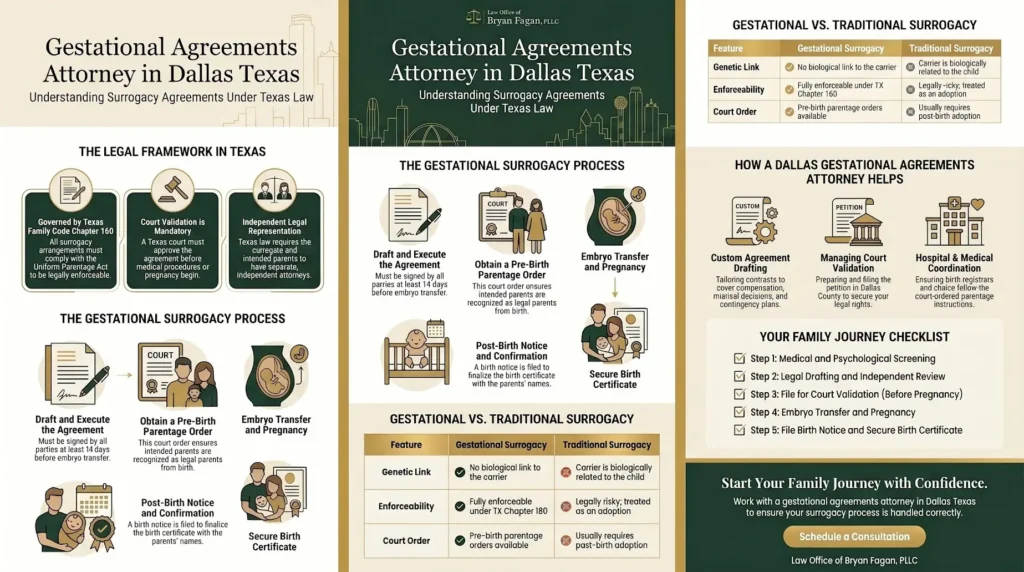
A gestational agreement is a Texas family law contract that defines the rights, responsibilities, and parentage expectations between intended parents and a gestational carrier before a child is conceived through assisted reproduction. In plain English, the carrier agrees to carry a pregnancy using an embryo created from the intended parents’ or donors’ genetic material, while the intended parents agree to accept full legal and financial responsibility for the child from birth. This is where working with a Gestational Agreements attorney in Dallas Texas becomes critical, because the agreement is not just a private understanding between adults—it is part of a statutory process designed to protect the child, the intended parents, and the carrier.
Texas addresses these arrangements in Chapter 160, Subchapter I of the Texas Family Code, which covers gestational agreements under §§160.751–160.763. Section 160.754 explains what a gestational agreement may provide, including that the gestational mother agrees to pregnancy by assisted reproduction, that the carrier and applicable donors relinquish parental rights, and that the intended parents will be the child’s legal parents. The same section also requires the agreement to be entered into before the transfer of embryos, eggs, or sperm for implantation.
One of the most important things to understand is that Texas law protects gestational surrogacy differently from traditional surrogacy. A gestational carrier is not genetically related to the child. Traditional surrogacy, where the carrier uses her own egg, falls outside the same statutory protection and can create much more serious parentage risks. If someone offers a quick template or an informal “surrogacy contract,” that is a warning sign—not a shortcut. You can learn more about how these matters are approached through the firm’s guidance on gestational agreements in Texas.
The second major point is timing. In Texas, the legal work cannot wait until the baby is born. A Texas gestational agreement validation process gives the court an opportunity to review the agreement, confirm statutory compliance, and evaluate whether the parties are prepared, informed, and properly documented before the pregnancy moves forward. Judges look for more than signatures. They want to see that the agreement fits Chapter 160, that timing requirements have been followed, that required evaluations and documentation are in place, and that the parties understand the legal effect of what they are asking the court to approve.
In straightforward surrogacy arrangements, the main task may be drafting, reviewing, and validating the agreement before embryo transfer. In more complex situations involving unmarried intended parents, out-of-state families, donor issues, embryo ownership, divorce concerns, or a carrier dispute, the legal strategy needs to be more careful and litigation-aware. If your case involves multiple legal risks, delay can create problems that are harder and more expensive to fix later. The goal is not to make the process feel intimidating; it is to make sure your family has the clarity and protection it needs before the most important steps occur.
At The Law Office of Bryan Fagan, PLLC, our approach is rooted in education, preparation, and protecting futures. Families considering assisted reproduction deserve to understand the law before they are standing at a clinic, facing a transfer date, and hoping the paperwork is enough. It should be more than enough. It should be right.
Listen to Our Texas Family Law Podcast
Prefer listening? In this episode, we discuss gestational agreements in Dallas, Texas, including how they work, legal requirements, and how they help protect parental rights.
§II. The Court Validation Step Most People Don’t Know About
One of the most critical—and most overlooked—parts of the process is court validation. Under Texas Family Code §160.754, a gestational agreement is only enforceable if it is approved by a court before the gestational carrier becomes pregnant through assisted reproduction. That timing requirement is not flexible. If you move forward without validation in place, you are stepping outside the protections of Chapter 160, Subchapter I, and exposing yourself to avoidable legal risk. This is exactly where guidance from a Gestational Agreements attorney in Dallas Texas becomes essential—because getting the timing wrong can undo everything else you’ve planned.
The process itself is straightforward on paper but requires careful execution. A petition for validation is filed in the district court of the county where the gestational carrier resides—not where the intended parents live or where the clinic is located. At the hearing, the court reviews whether the agreement complies with Texas law, including documentation of medical necessity, completion of the home study, and confirmation that all parties understand the legal consequences of the agreement. Judges are not simply checking boxes; they are evaluating credibility, preparedness, and whether the agreement meets the statutory framework. For a deeper look at how these requirements apply in real-world cases, you can explore more about gestational agreements in Texas.
When the court is satisfied, it issues a validation order. That order is what allows intended parents to be recognized as the legal parents at birth without the need for adoption. It also creates legal certainty in situations where things don’t go as planned—such as a dispute, a change in circumstances, or a medical emergency. Without that order, the law defaults to presumptions that may not reflect the parties’ intentions.
In straightforward surrogacy arrangements, this step is about proper timing and complete documentation before embryo transfer. In more complex situations involving unmarried intended parents, out-of-state arrangements, or disagreements between the parties, the validation process requires a more strategic approach. If your case involves multiple legal risks, delay or incomplete preparation can lead to complications that are far more difficult to resolve later. The key is not just filing paperwork—it is making sure everything is aligned before the process moves forward, so your family is protected from the start.
§III. Who Qualifies as Intended Parents and as a Gestational Carrier

Texas law is very specific about who can use the protections of Chapter 160, Subchapter I—and understanding these requirements early can make the difference between a smooth process and a complicated legal situation. This is one of the first areas where guidance from a Gestational Agreements attorney in Dallas Texas becomes important, because eligibility is not flexible once the process begins. If the statutory requirements are not met, the court cannot validate the agreement, and that changes the entire legal strategy moving forward.
Under Texas Family Code §160.754(b), intended parents must be married to each other to qualify for the validation pathway. This requirement often catches people by surprise. If you are single or in an unmarried relationship, surrogacy is still possible—but it will not follow the same streamlined validation process. Instead, it typically involves a private agreement followed by a stepparent or second-parent adoption after birth. In straightforward surrogacy arrangements where the intended parents meet the marital requirement, the process is more predictable. In more complex situations involving unmarried parents or blended families, planning becomes more strategic, and timing becomes even more critical.
The law also requires documentation of medical necessity. Section 160.754(b)(3) provides that the intended mother must be unable to carry a pregnancy to term or would face an unreasonable risk to her health or the child’s health. Courts expect this to be supported by medical documentation, usually from a reproductive specialist. For male same-sex couples, courts recognize the biological impossibility of pregnancy, but they still expect clear documentation and compliance with the statutory framework. Judges are looking for credibility and completeness—not assumptions.
The gestational carrier must meet several specific criteria as well. She must be at least 21 years old, have previously given birth, and complete both medical and psychological evaluations. These are not just formalities. The court reviews this documentation during the validation process to ensure that the carrier is physically and mentally prepared, and that all parties are entering the agreement knowingly and voluntarily. If documentation is incomplete or inconsistent, it can delay or even prevent validation. You can explore how these requirements apply across different situations by reviewing more about gestational agreements in Texas.
Another critical detail involves the gestational carrier’s spouse. Texas law presumes that the husband of a married woman is the legal father of any child she gives birth to. That presumption must be addressed directly in the agreement and formally rebutted during the validation process. This means the spouse must be a party to the agreement, must consent, and will typically need to appear before the court. Overlooking this step is one of the more common mistakes that can create avoidable legal complications.
In straightforward cases where all statutory requirements are clearly met, the path to validation is typically efficient and predictable. In more complex situations—such as out-of-state intended parents, questions about eligibility, or overlapping legal concerns—additional planning and legal strategy may be required. If your case involves multiple legal risks, waiting too long to address these requirements can limit your options. The goal is to identify your situation early, understand where you fit within Texas law, and move forward with a plan that protects your family from the start.
Eligibility — Intended Parents vs. Gestational Carrier
| Requirement | Intended Parents | Gestational Carrier |
|---|---|---|
| Marriage | Must be married to each other | Marital status flexible (husband must consent if married) |
| Age | No statutory minimum | At least 21 |
| Prior pregnancy | N/A | At least one prior delivery required |
| Medical evaluation | Documentation of medical need | Required before validation |
| Mental health evaluation | Recommended | Required before validation |
| Home study | Required for the intended parents | Not required |
| Residency | Anywhere — including out of state | Determines the county of filing |
Interactive Tool · 60 seconds
Do You Qualify for Texas’s Chapter 160 Validation Pathway?
Answer 4 quick questions and we’ll tell you whether you’re on the standard validation track, need an adjustment, or need a different legal strategy.
What Belongs in Every Texas Gestational Agreement
A well-drafted gestational agreement in Texas is not a short or simple document—and that is intentional. These agreements often run 40 to 60 pages because they are designed to anticipate real-life scenarios before they happen. This is where working with a Gestational Agreements attorney in Dallas Texas becomes especially important. A rushed or overly simplified contract may seem efficient in the moment, but it can create serious legal gaps when timing becomes critical—especially before embryo transfer, when Texas law under §160.754 requires everything to be in place for validation.
At its core, the agreement must clearly establish parentage. Under Chapter 160, Subchapter I of the Texas Family Code, the document must state that the gestational carrier and, if applicable, her spouse are not the legal parents, and that the intended parents will assume full legal responsibility at birth. Courts reviewing a validation under Texas Family Code Chapter 160 look closely at this language to ensure there is no ambiguity. If the agreement is unclear or incomplete, it can delay validation or create complications later. For a broader understanding of how these agreements function, you can explore more about gestational agreements in Texas.
Medical decision-making is another critical component that often gets underestimated. The agreement should address who has authority over major decisions during pregnancy, including issues like selective reduction, responses to fetal abnormalities, and general health-related decisions affecting the carrier. These conversations can feel uncomfortable early on, but avoiding them creates far greater risk later. Judges expect to see that these issues have been thoughtfully addressed, not left open-ended.
The financial structure must also be clearly defined. This includes base compensation, reimbursements, and a structured escrow arrangement tied to milestones. Transparency here protects both sides and demonstrates to the court that the parties have planned responsibly. Insurance provisions are equally important, covering prenatal care, delivery, and potential complications. Underinsuring or overlooking coverage details is one of the more common mistakes that can create significant financial and legal exposure.
Risk allocation is where the agreement becomes truly protective. The document should address how unforeseen circumstances are handled, including medical complications, pregnancy loss, or long-term health impacts. In straightforward surrogacy arrangements, these provisions may feel like safeguards you hope never to use. In more complex situations involving higher medical risk, multiple parties, or out-of-state considerations, they become essential to protecting everyone involved.
The agreement should also include provisions for confidentiality, expectations for post-birth contact, and a clear dispute resolution process. Typically, this means establishing mediation as a first step, followed by arbitration or litigation if necessary, along with identifying Texas as the governing law and the appropriate venue for disputes. These clauses are not just formalities—they are part of how courts evaluate whether the parties are prepared and whether the agreement is enforceable.
In straightforward cases, a properly structured agreement with complete documentation can move efficiently through the validation process. In more complex situations—such as disputes between parties, embryo ownership questions, or overlapping legal issues—these provisions require more strategic planning and precision. If your case involves multiple legal risks, cutting corners in the contract phase can create problems that are far more difficult to resolve later. The goal is not just to have an agreement—it is to have one that holds up when it matters most.
§V. Where You File: Dallas, Collin, Denton, and Tarrant County Courts

One of the most important—and often misunderstood—parts of the process is where the case is filed. Under Texas Family Code §160.754, the venue for a gestational agreement validation is determined by the gestational carrier’s county of residence. Not the intended parents’ location, not the fertility clinic, and not the agency. This detail matters more than people expect, and it is one of the reasons working with a Gestational Agreements attorney in Dallas Texas can help prevent avoidable delays when timing becomes critical before embryo transfer.
Across the Dallas–Fort Worth area, this requirement plays out differently depending on where the carrier lives. In Dallas County, petitions are filed in one of several family district courts at the George Allen Courts Building, with cases typically assigned at random. These courts are familiar with validation under Texas Family Code Chapter 160 and tend to move efficiently when the paperwork is complete and compliant. In Collin County, filings go through the district courts in McKinney, where judges expect well-prepared documentation and strict adherence to statutory requirements. Denton County and Tarrant County follow similar structures, with designated district courts handling family law matters and reviewing gestational agreements for compliance with Chapter 160, Subchapter I.
What judges consistently look for—regardless of county—is statutory compliance, proper timing, and complete documentation. That includes confirmation that the agreement was executed before any assisted reproduction occurred, that required evaluations and home study materials are included, and that all parties appear credible and prepared. A missing detail or filing in the wrong venue can result in delays that push back medical timelines or require additional court appearances. For a broader look at how these requirements apply across Texas, you can review more about gestational agreements in Texas.
In straightforward surrogacy arrangements, filing in the correct county with complete documentation allows the validation process to move predictably. In more complex situations—such as when the carrier relocates, when intended parents are out of state, or when there are questions about eligibility—the venue decision can become more strategic. If your case involves multiple legal risks, filing in the wrong place or waiting too long to establish residency can complicate the process in ways that are difficult to unwind.
The key takeaway is simple: venue is not just a technical detail—it is part of the legal foundation of the entire process. Getting it right from the beginning helps ensure that your agreement can be validated, your timeline stays intact, and your family is protected before the next step forward.
§VI. Compensation, Escrow, and Insurance — The Money Side
Texas permits compensation to the gestational carrier and does not cap the amount. Market rates in DFW currently fall in the following ranges, all subject to negotiation and the carrier’s experience.
- Base Comp · First-Time Carrier $40K – $55K
- Base Comp · Experienced Carrier $55K – $75K
- Monthly Allowance $250 – $350
- Embryo Transfer Fee $750 – $1,500
- Multiples Fee $7.5K – $10K
- C-Section Fee $3K – $5K
- Total Journey Cost $130K – $200K+
Compensation is paid through an independent escrow agent — never directly from the intended parents to the carrier. The escrow agent holds the funds, releases them on a schedule tied to medical milestones (positive heartbeat, second trimester, delivery, post-delivery), and provides accounting to both sides. This protects everyone: the carrier knows the money is there, the intended parents have a record of every disbursement, and disputes are easier to resolve.
Insurance is the area where most journeys hit unexpected costs. Many employer-sponsored health plans exclude surrogacy maternity. Read the carrier’s policy — actually read it, not just the broker summary — before you finalize the match. If the policy excludes, you’ll need to purchase a surrogacy-specific maternity policy, which can run $25,000 to $40,000 depending on the carrier’s location and policy structure. That’s a budget line that has nothing to do with legal fees and everything to do with whether your journey closes on the timeline you expect.
§VII. What Happens If You Skip Validation
Some people try to do this without a validation order. Sometimes the agency tells them validation is optional. Sometimes they’re trying to save legal fees. Sometimes they just didn’t know. The result is the same.
Without validation, the gestational carrier is the legal mother of the child at birth. Her name goes on the original birth certificate. If she’s married, her husband is presumed to be the father. The intended parents have no legal standing until they obtain a court order — typically through a Suit Affecting the Parent-Child Relationship (SAPCR) under Chapter 102, an adoption under Chapter 162, or a parentage action under the rest of Chapter 160.
The fix takes between three and twelve months depending on the county and the cooperation of the parties. Costs typically run $8,000 to $25,000 in legal fees on top of what you would have paid for validation. During the gap, the intended parents may not have legal authority to make medical decisions for the child, may not be able to add the child to their health insurance, may face problems with international travel, and may face complications with employer parental leave benefits. If anything goes wrong with the carrier — change of mind, divorce, death — the intended parents are starting from scratch.
Validation is the cheapest part of this process and the part that protects everything else you’ve spent.
§VIII. Common Mistakes That Cost People Their Parental Rights

Even well-intentioned families can run into problems when the legal side of surrogacy is rushed or misunderstood. Many of the most serious issues arise not from conflict, but from timing mistakes or incomplete preparation. This is where working with a Gestational Agreements attorney in Dallas Texas helps bring clarity early—before decisions create consequences that are difficult to reverse under Texas law.
One of the most common mistakes is moving forward with medical treatment before the agreement is validated. Under Texas Family Code §160.754, validation must occur before pregnancy through assisted reproduction. Clinics may be ready, schedules may feel urgent, and it can be tempting to “handle the legal side later.” But courts do not always allow retroactive correction. When timing becomes critical before embryo transfer, skipping this step can remove the statutory protections that Chapter 160 was designed to provide.
Another frequent issue involves using out-of-state or generic contract templates. What works in California or Illinois does not necessarily meet Texas requirements. Validation under Texas Family Code Chapter 160 requires compliance with specific eligibility rules, documentation standards, and procedural steps. Judges reviewing these agreements expect Texas-specific language and complete alignment with §§160.751–160.763. If the contract does not meet those expectations, it can delay validation or create uncertainty around parentage. For a clearer understanding of how these agreements should be structured, you can review more about gestational agreements in Texas.
Documentation issues can also create avoidable problems. The home study process requires full disclosure of household members and family structure. Omissions—whether intentional or accidental—are often identified during court review and can delay or prevent validation. Judges look closely at credibility and preparedness, and incomplete information raises concerns that can slow the process at a critical stage.
Another area that is often overlooked is planning for unexpected life changes. A gestational agreement should address what happens if the intended parents separate or divorce during the process. Without clear provisions, disputes over embryo ownership, parentage, or responsibilities can arise at the worst possible time. In straightforward surrogacy arrangements, these provisions may feel unlikely to matter. In more complex situations involving relationship uncertainty or financial considerations, they become essential.
Insurance is another place where families sometimes underestimate risk. Medical complications during pregnancy, while rare, can create significant financial exposure if coverage is inadequate. Courts expect to see thoughtful planning around insurance as part of evaluating whether the parties are prepared for the responsibilities they are taking on.
In straightforward cases, these issues can be avoided with proper planning and attention to detail. In more complex situations—especially those involving multiple legal risks, out-of-state parties, or overlapping concerns—these mistakes can escalate quickly. If your case involves higher stakes or uncertainty, early legal guidance can help prevent problems rather than trying to fix them after the fact. The goal is not perfection—it is preparation that protects your family when it matters most.
IX. Timeline: From First Consult to Birth Certificate
Here’s a realistic timeline for a Texas gestational agreement journey, assuming a matched carrier and ready embryos.
Month 1 — Intake with attorneys (separate counsel for both sides). Initial draft of the agreement. Home study scheduled.
Months 2–3 — Contract negotiation. Medical and psychological evaluations completed. Home study completed and report issued. Insurance verification.
Month 4 — Petition for validation filed in carrier’s county of residence. Hearing scheduled.
Month 5 — Validation hearing. Order signed. Order delivered to the fertility clinic. Embryo transfer scheduled.
Months 6–14 — Pregnancy. Periodic check-ins with counsel. Pre-birth order prepared in the final trimester.
Birth + 1–7 days — Birth certificate issued naming the intended parents pursuant to the validated agreement and pre-birth order. Hospital protocols followed. Post-birth release of escrow funds.
That’s the clean version. Any number of variables can extend the timeline — failed transfers, contract negotiation snags, court calendar issues, carrier medical complications. Build slack into your expectations.
What I Tell Every Client Who Calls About This
When someone calls my office about a gestational agreement, the first question is whether the embryo transfer has happened yet. If the answer is no, we have time and the full statutory pathway is available. If the answer is yes, we have a problem to solve and a different conversation to have — still solvable, but more expensive and less certain.
The second thing I tell them is that this is a contract that matters more than almost any other contract they will sign. It governs the legal status of a child. The savings you might find by going with the cheapest attorney, the fastest agency, or the most aggressive timeline will not look like savings if something goes wrong. The right way costs more and takes longer than people want it to. It is also the way that ends with you walking out of the hospital with your child.
If you’re considering gestational surrogacy in Texas, or you’re already matched and you need Texas counsel, the next step is a Legal Strategy Session. We’ll review where you are, what’s missing, and what the realistic path looks like. Bring whatever paperwork you have — match documents, agency contract, insurance information, prior drafts — and we’ll go through it together.
Conclusion:
Every family’s path looks a little different, but the goal is always the same—create certainty where there was once uncertainty and protect the future of a child before conflict can disrupt it. Working with a Gestational Agreements attorney in Dallas Texas is about more than meeting a legal requirement; it’s about building a structure that holds up when life doesn’t go exactly as planned. In straightforward situations, that may mean putting the right agreement in place and moving forward with confidence. In more complex cases—if your situation involves divorce, embryo ownership questions, or disagreements between intended parents—it means having a strategy that anticipates challenges before they become problems.
The right next step isn’t always obvious, and that’s where experienced guidance matters. Some families need a clear, efficient path to validation and parentage. Others need a deeper level of planning to navigate overlapping legal issues and protect long-term stability. At The Law Office of Bryan Fagan, PLLC, the focus is on helping you understand where you stand, what risks exist, and how to move forward with clarity. When you’re ready, a thoughtful conversation can turn uncertainty into a plan—and a plan into peace of mind.
Frequently Asked Questions
Not under Chapter 160. The validation pathway requires married intended parents. A single intended parent can pursue surrogacy through a private contractual arrangement followed by an adoption after birth. The legal structure is different and the protections during pregnancy are weaker, but it’s done regularly.
Yes. A married same-sex couple meets the Chapter 160 marital requirement, and Texas courts have validated gestational agreements for same-sex couples. The medical-need element is satisfied differently for male same-sex couples (the impossibility is self-evident) and for female same-sex couples (typically through documented medical inability of the intended carrying parent).
The hearing itself is usually 15 to 30 minutes when the paperwork is in order. The judge confirms identity, voluntariness, and understanding, then signs the order. The bulk of the work happens before the hearing.
Before the embryo transfer, yes — the agreement can be terminated. After a validated agreement and successful transfer, no. The carrier has no parental rights to assert at birth, and the agreement is enforceable.
The validation order remains in effect. Both intended parents are still recognized as the legal parents of the child at birth. Custody and support between the two intended parents are then handled like any other Texas SAPCR.
Yes. Chapter 160 does not require a genetic connection between the intended parents and the child. The agreement should disclose the use of donor gametes and address any related parentage issues.
For intended parents, plan on $7,500 to $15,000 in legal fees for a Texas validation, depending on complexity, negotiation rounds, and court appearances. The gestational carrier’s separate counsel is typically paid by the intended parents and runs $1,500 to $3,500.
Yes, and this is common. The intended parents’ state of residence doesn’t control. The carrier’s Texas residence is what makes Chapter 160 available.
The case files where she lives. We handle filings statewide and appear in Texas courts wherever the carrier resides.
With a validated Chapter 160 gestational agreement, no. The validation order is what allows the original birth certificate to issue in the intended parents’ names. An adoption is only needed when validation wasn’t obtained or when the marital structure didn’t fit Chapter 160.