
Termination of Parental Rights Attorney in Texas: What Wins These Cases, What Loses Them

It usually starts with a quiet realization—like the moment a parent looks around the house and recognizes they’ve been the only one showing up for years. The routines, the doctor visits, the bedtime talks, the hard conversations—handled alone. And then the question finally surfaces: is it time to make this permanent? For many families, that’s when they begin searching for a Termination of Parental Rights attorney in Dallas Texas, trying to understand whether the law can finally reflect the reality they’ve been living. The truth is, these cases are not about cutting someone out—they’re about creating stability where uncertainty has lingered too long.
At The Law Office of Bryan Fagan, PLLC, we’ve guided parents through these deeply personal decisions across Texas, helping them move from confusion to clarity. Texas law requires courts to focus on what truly serves a child’s long-term well-being, and that means looking closely at consistency, safety, and the ability of a parent to meet a child’s needs over time. When one parent has stepped away—physically or emotionally—the legal system provides pathways to address that absence, but those pathways must be handled carefully and strategically.
Led by Bryan Joseph Fagan, a South Texas College of Law graduate and a recognized authority in Texas family law, our firm is built on a mission to educate families and protect their futures. We believe that when parents understand their rights and options, they can make confident decisions that restore peace of mind. In the sections ahead, we’ll walk you through how termination of parental rights works in Texas, when it may be appropriate, and how to approach these decisions with both legal precision and compassion.
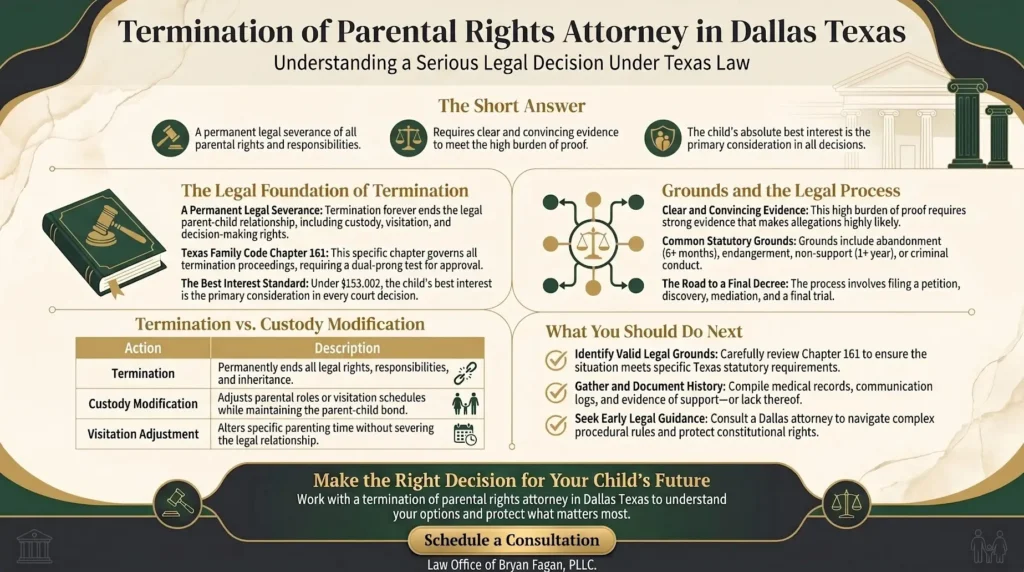
Termination of parental rights in Texas is a court order under Texas Family Code §161.001 that permanently ends the legal parent-child relationship. It can be voluntary — through a sworn affidavit of relinquishment under §161.103 — or involuntary, based on one of more than 20 statutory grounds plus a separate finding that termination is in the child’s best interest. Texas courts require clear and convincing evidence, the highest civil burden of proof, before granting termination.
Key Takeaways
- Dallas County procedure differs from Tarrant, Collin, and Harris. Ad litem panels, mediation requirements, and trial settings move differently across counties. Local counsel matters more here than in almost any other family matter.
- Termination is permanent, and Texas treats it that way. Unlike custody, a termination order generally cannot be undone after six months under §161.211. Texas applies the clear-and-convincing standard precisely because the order is final.
- Voluntary and involuntary terminations are different cases. A voluntary affidavit under §161.103 is paperwork and process. Involuntary termination is contested litigation with grounds, discovery, and trial. Treating one like the other is one of the most expensive mistakes a client can make.
- CPS cases run on a one-year clock. Under §263.401, a CPS termination case must be tried or dismissed within one year of the temporary managing conservatorship order. Most contested CPS terminations are won or lost on how that clock is managed, not at trial.
- The 60-day rule on voluntary relinquishments is real. Under §161.103(g), a signed affidavit becomes irrevocable after 60 days. The “I changed my mind” call at day 90 has almost no remedy.
- Statutory grounds don’t guarantee termination. Texas requires both grounds and a separate finding that termination is in the child’s best interest under the Holley v. Adams factors. Petitions with strong grounds still fail at the best-interest stage.
- This is one of the few civil cases where a jury is available. Under §161.109, either side may demand a jury. That changes strategy and cost from day one.

Your Family’s Future Starts Here
Don’t navigate your legal journey alone. Schedule a consultation now and get the clarity and support you deserve.
Our Family Law Services in Dallas
We offer comprehensive family law and estate planning services including but not limited to the following:
Speak With a Termination of Parental Rights attorney in Dallas Texas
A Termination of Parental Rights can affect your finances, your family, and your future. Having a skilled Termination of Parental Rights attorney in Dallas Texas on your side can help protect your interests and give you peace of mind during a challenging time.
To learn more about how the Law Office of Bryan Fagan, PLLC can help with your contested Termination of Parental Rights case, call 469-972-8473 today to schedule a confidential consultation.
What Termination of Parental Rights Actually Means in Texas

Termination of parental rights in Texas is not just another family law order—it is the most permanent decision a court can make about a parent and child. When families begin searching for a Termination of Parental Rights attorney in Dallas Texas, they are often facing a situation where the legal relationship no longer reflects reality. Under Texas Family Code §161.206, once a termination order is signed, the parent-child relationship is completely and permanently severed. Both the parent and the child lose all legal rights and duties toward each other, with very limited exceptions such as certain inheritance rights.
In practical terms, this means no conservatorship, no visitation, no access to medical or school records, and no role in decision-making moving forward. Future child support obligations end, but any unpaid support that already exists remains enforceable. For many families, this is not just a legal shift—it is a complete restructuring of the child’s support system, daily stability, and long-term future. That is why courts focus heavily on whether termination truly serves the child’s best interest, often alongside related issues like child custody in Texas.
Texas courts apply a “clear and convincing evidence” standard in these cases, which is significantly higher than what is required in most civil matters. This reflects how seriously judges treat termination. They are not looking for assumptions or frustration between parents—they are evaluating documented patterns of behavior, consistency, and the overall stability each parent provides. Under Texas Family Code §161.001, the court must find at least one statutory ground, such as abandonment, endangerment, or failure to comply with court-ordered services. Just as importantly, the court must separately determine that termination is in the child’s best interest, often considering factors like safety, emotional needs, and long-term stability.
In straightforward situations—such as a voluntary relinquishment connected to a stepparent adoption—the process can be more procedural, provided the affidavit complies with §161.103 and the case is properly filed. In more complex cases, especially those involving CPS under Chapter 263, the timeline becomes critical. Deadlines under §263.401 create real pressure, and missed services or inconsistent engagement can significantly impact the outcome. Where termination is contested, the case becomes a detailed evaluation of credibility, parental involvement, and whether the child’s environment will improve or destabilize if rights are severed. For families navigating CPS-related issues, understanding your options for CPS defense in Texas can also play an important role in shaping the outcome.
This is where many cases succeed or fail—not at trial, but in how the case is built from the beginning. Missed service deadlines, improperly executed affidavits, or failure to present clear evidence can undermine even strong claims. If your situation involves CPS, ongoing disputes, or questions about long-term stability, the need for structured legal strategy becomes more important. In those moments, working with a Termination of Parental Rights attorney in Dallas Texas is not just about filing a case—it is about making sure the legal outcome actually protects your child’s future and aligns with what Texas courts require.
Termination of parental rights is the only family-law order I treat with criminal-defense-level seriousness. Once a court signs it, the door doesn’t reopen. Under §161.211, a direct or collateral attack on the order is barred after six months in most cases. Get this wrong and there is no second bite.
Voluntary vs. Involuntary Termination — Two Completely Different Cases
A voluntary termination in Texas is an administrative process built around a sworn affidavit; an involuntary termination is contested trial litigation. The legal frameworks live in the same chapter of the Family Code, but the strategy, timeline, cost, and emotional weight bear no resemblance to each other.
In voluntary terminations, the parent agrees to give up rights, usually as a precursor to stepparent or relative adoption. The vehicle is an affidavit of voluntary relinquishment under §161.103, which must comply with strict formal requirements: notarized, witnessed by two credible adults, executed at least 48 hours after the child’s birth if the affiant is the biological mother, and containing specific waivers spelled out in the statute. A defectively executed affidavit gives the court grounds to reject the termination entirely.
Involuntary terminations are litigation in the classical sense. The petitioner files, the respondent answers, discovery happens, ad litems get appointed, and the case proceeds to mediation or trial. Either side may demand a jury under §161.109. Witnesses are called. Drug tests, criminal history, CPS records, school records, and therapist testimony all get introduced. The judge or jury renders findings on each ground alleged and on best interest.
| Category | Voluntary Termination | Involuntary Termination |
|---|---|---|
| Triggering document | Affidavit of Relinquishment (§161.103) | Petition alleging grounds (§161.001) |
| Typical timeline | 30–90 days | 6–18 months (CPS capped at 1 year + 180 days) |
| Standard of proof | Strict statutory compliance | Clear and convincing evidence |
| Reversibility | Generally irrevocable after 60 days | Direct appeal only; 6-month limit on attacks |
| Jury available? | Not typically applicable | Yes — either side may demand |
| Most common use | Stepparent or relative adoption | CPS removals, fathers’ rights disputes, adoptions where one parent is absent |
The single most expensive misstep in this space: a client who actually needs an involuntary termination tries to handle it as paperwork because the absent parent won’t respond, assuming non-response equals consent. It does not. Texas requires proof of grounds even when the respondent never appears.
The 20+ Grounds for Involuntary Termination Under §161.001
When families begin exploring options with a Termination of Parental Rights attorney in Dallas Texas, one of the first realities they face is how specific and demanding Texas law is about when termination is allowed. Under Texas Family Code §161.001, there are more than twenty statutory grounds for involuntary termination. But proving one ground is only half the case. The court must also find—by clear and convincing evidence—that termination is in the child’s best interest. That second requirement is where many cases are won or lost.
In straightforward situations, such as uncontested cases tied to a stepparent adoption, the focus is often on proper documentation and compliance with statutory requirements. In more complex cases—especially those involving CPS or disputed facts—the court looks far beyond the petition. Judges evaluate consistency, parental involvement, and whether the child’s long-term stability improves if the legal relationship ends. This is why many families dealing with layered custody issues benefit from understanding how termination interacts with broader topics like child custody in Texas.
Texas organizes termination grounds under §161.001(b)(1)(A) through (U), but certain categories appear repeatedly in real cases. Abandonment-related grounds are among the most common. For example, §161.001(b)(1)(C) addresses situations where a parent leaves a child with another person and fails to provide support for at least six months. In CPS cases, subsection (N) focuses on constructive abandonment, where the parent has not maintained meaningful contact while the child is in state care. These cases often depend on clear documentation—missed visits, lack of communication, and failure to stay involved.
Endangerment grounds under subsections (D) and (E) are also heavily litigated. These provisions focus on whether a parent exposed a child to dangerous conditions or engaged in behavior that threatened the child’s physical or emotional well-being. Courts often examine evidence such as substance abuse, domestic violence, unstable housing, or repeated criminal conduct. The analysis is forward-looking—judges are asking whether the child would be safe and supported moving forward.
Other statutory grounds include criminal-conviction provisions under subsections (L), (Q), and (T), which may apply when a parent is incarcerated for a significant period or convicted of certain offenses involving a child. Drug-related grounds under subsection (P) focus on substance use that endangers the child, especially when treatment is not completed or relapse occurs. In CPS cases, subsection (O)—failure to comply with a court-ordered service plan—is one of the most frequently used grounds. Missing services, delaying participation, or failing to complete required programs can quickly impact how the court views a parent’s reliability and commitment.
Even when a statutory ground is proven, the court must still evaluate best interest through the Holley factors. These include the child’s emotional needs, future stability, potential risks, parenting abilities, and the strength of the proposed placement. Judges also consider long-term plans for the child and whether a more stable environment is available. For families navigating these decisions, reviewing broader guidance from a termination of parental rights attorney can help clarify how these factors apply in real cases.
Where termination is contested, the case becomes more strategic. Evidence, timelines, and credibility all play a role. In more complex cases—especially those involving CPS deadlines under §263.401—timing becomes critical. Missed deadlines, incomplete services, or inconsistent engagement can shape the outcome long before trial. If your situation involves multiple grounds, disputed facts, or CPS involvement, the need for structured legal guidance increases. In those moments, working with a Termination of Parental Rights attorney in Dallas Texas is not just about meeting legal requirements—it is about building a case that aligns with how Texas courts actually make these decisions.
The most expensive misunderstanding in this space: clients reading the §161.001 list and assuming that proving one of these grounds automatically wins. It does not. Best interest under the Texas Supreme Court’s Holley v. Adams framework is a separate finding requiring its own evidentiary showing. I have watched judges find clear grounds and decline to terminate because the petitioner could not satisfy the best-interest factors.
CPS Terminations and the One-Year Deadline That Decides Most Cases

CPS termination cases are governed by Texas Family Code Chapter 263, and the single most important rule is the one-year dismissal deadline under §263.401. From the date the court signs an order appointing the Department as temporary managing conservator, the court has one year to render a final order or dismiss the case. A 180-day extension is available in narrow circumstances, but the clock is real, and it shapes every strategic decision.
If CPS has removed your children, you do not have unlimited time. Every status hearing, every permanency hearing, every service-plan deadline is calibrated against that one-year clock. Miss the parenting-class window and you don’t just lose access to that class — you compress the timeline for the rest of your services, and the Department uses that compression at trial.
| Stage | Texas Family Code | Timing |
|---|---|---|
| Adversary hearing | §262.201 | Within 14 days of removal |
| Initial permanency hearing | §263.304 | Within 180 days of TMC appointment |
| Subsequent permanency hearings | §263.305 | Every 120 days |
| Statutory dismissal deadline | §263.401 | 1 year (180-day extension possible) |
| Trial on the merits | §263.401 | Must occur before dismissal date |
Constructive abandonment under §161.001(b)(1)(N) is the ground I see invoked most often by the Department. It requires (1) the child has been in the Department’s permanent or temporary managing conservatorship for at least six months, (2) the Department made reasonable efforts to return the child, (3) the parent did not regularly visit or maintain significant contact, and (4) the parent demonstrated an inability to provide the child with a safe environment.
Failure to comply with court-ordered services under §161.001(b)(1)(O) is the parallel workhorse. When the court orders specific services to address the conditions that led to removal — substance-abuse treatment, parenting classes, supervised visitation, psychological evaluation — and the parent does not complete them, the Department invokes (O).
“In CPS terminations, the trial isn’t where you win or lose. The status hearings are. By the time the case reaches trial, the record on services, visits, and engagement is mostly already written.”
— Bryan Fagan
Voluntary Relinquishment, the 60-Day Rule, and What Clients Get Wrong
A voluntary relinquishment of parental rights in Texas becomes irrevocable 60 days after it is executed, under Texas Family Code §161.103(g). This is the most misunderstood rule in the voluntary termination process. The calls I get on day 70 or day 90 from parents wanting to “take it back” are almost always answered the same way: that window closed.
The affidavit itself must be executed precisely. §161.103 requires that it be signed after the child’s birth, witnessed by two credible persons, verified before someone authorized to take oaths, and contain specific waivers and acknowledgments. If the affidavit becomes the basis for a contested termination — say, in a stepparent adoption where the biological parent later changes their mind — defects in execution are the first line of attack.
For stepparent and grandparent adoption clients, voluntary relinquishment is usually the cleanest path. A biological parent who has not been involved, who agrees to sign, and whose signing follows the statutory requirements creates an uncontested termination that pairs with the adoption petition. The whole package — termination plus adoption — typically moves through Dallas County District Courts in 30 to 90 days when all parties cooperate.
For parents considering signing one, the analysis is different. A relinquishment is the most serious legal document I will ever ask a client to sign. Before it is executed, the questions to answer are: is there a real, named, ready adoptive placement? Has the parent had independent counsel review the document? Has the parent had at least 48 hours to consider it (mandatory for biological mothers post-birth)? Have alternatives been considered — a possession-only arrangement, a SAPCR modification, a managing conservatorship transfer — that don’t require permanent severance?
If you’re a stepparent or grandparent considering voluntary termination plus adoption, the cleanest cases are the ones where (1) the biological parent has been absent for years, (2) child-support arrears have been minimal or are being addressed separately, (3) the child is old enough to express a preference (the child’s consent is required after age 12 under §162.010), and (4) the home study and background check pieces are already underway. Filing without those elements lined up creates delay, not denial.
What Actually Wins a Contested Termination Case
When families consult a Termination of Parental Rights attorney in Dallas Texas, they often expect these cases to turn on emotion—who cares more, who tried harder, or who tells the better story. In reality, contested termination cases are decided on something far more concrete: documentation, credibility, and timing. Texas courts, applying the standards under §161.001 and the “best interest of the child” analysis, focus on what can be proven—not what is promised.
In straightforward situations, where termination is uncontested or tied to an adoption, the process may center on compliance with statutory requirements and proper filings. But where termination is contested—especially in CPS cases governed by §263.401—the case becomes a structured evaluation of evidence, consistency, and long-term stability. Judges are looking for patterns. Who showed up? Who followed court orders? Who created a stable environment for the child? These are the factors that carry weight.
If you are the petitioner, a strong case is built on three pillars. First, objective evidence of statutory grounds that does not rely on the other parent admitting fault—because in many cases, they will not. This includes court records, CPS reports, criminal history, and documented patterns of absence or non-support. Second, credible witnesses who can speak to the child’s needs and well-being. Professionals like therapists or pediatricians often carry significant influence because they provide neutral, experience-based insight into the child’s emotional and physical needs. Third, a clear and realistic permanency plan. Courts want to know what happens next—how the child’s life improves in terms of stability, safety, and long-term care.
If you are defending against termination, the strategy shifts. Engagement becomes your strongest argument. Courts pay close attention to whether a parent has consistently visited, completed court-ordered services, maintained stable housing and employment, and demonstrated a commitment to change. Even in cases where the Department believes grounds are established, a parent who builds a record of consistent effort can significantly change how the court evaluates best interest. This is especially true in CPS-related cases, where compliance with service plans is closely tied to outcomes.
The role of the ad litem is another critical factor that many families underestimate. Under §107.001, courts often appoint an attorney ad litem to represent the child’s interests, particularly in CPS cases. That recommendation carries significant weight. Judges rely on the ad litem’s assessment of the child’s situation, stability, and future needs. Being responsive, transparent, and cooperative with the ad litem from the beginning can influence how your case is viewed long before trial.
Where termination is contested, timing and strategy matter just as much as evidence. Missed deadlines, incomplete service plans, or poorly prepared filings can weaken a case quickly. In more complex situations—especially those involving CPS timelines or disputed facts—early decisions shape the final outcome. If your case involves multiple moving parts or uncertainty about how the court will evaluate your situation, it may be time to take a structured next step through the firm’s Start Here process.
Ultimately, these cases are not won at trial—they are built over time. The side that presents consistent, credible, and well-documented evidence aligned with the child’s best interest is the side most likely to succeed. And when the stakes involve permanently ending a parent-child relationship, making sure that case is built correctly from the start can make all the difference.
In every TPR case I take, the first two weeks focus on three things: documentary record review, ad litem contact, and witness-list development. The cases that fall apart at trial are the ones where the lawyer waited until trial to build the file. By then, the record has been written by someone else.
Termination of Parental Rights in Dallas County: Local Procedure

Termination of parental rights cases in Dallas County are heard in the Family District Courts — the 254th, 255th, 256th, 301st, 302nd, 303rd, and 330th — and each court has its own pace and standing orders. Local procedure varies enough that the same case filed in Dallas, Tarrant (Fort Worth), Collin (Plano/Frisco/McKinney), and Denton counties will look meaningfully different from filing to final.
Dallas County uses a centralized assignment system for new family-law petitions, but once assigned, the individual court’s rules govern. Mediation is essentially mandatory before a contested final trial in private TPRs. The Dallas County Domestic Relations Office plays a role in evaluations and supervised visitation. Ad litem appointments come from a vetted panel and rotate predictably.
For clients in Plano, Frisco, or McKinney (Collin County), the procedure looks different — Collin County District Courts handle their own family docket with different mediation expectations and different ad litem panels. Arlington and Fort Worth clients are in Tarrant County. Garland and Irving can fall into Dallas County depending on residency specifics. Filing in the wrong county is a curable error but a costly one — venue motions delay the substantive case by months.
CPS cases are handled in specific child-protection courts under §201.301 et seq., not the general family district courts. The Child Protection Court of Dallas County hears the majority of CPS terminations involving Dallas County children. Different judge, different docket, different rhythm.
Listen to Our Texas Family Law Podcast
Prefer listening? In this episode, we discuss termination of parental rights in Dallas, Texas, including the legal grounds for termination, how the process works, and what parents need to know before taking action.
Timeline, Cost, and What to Expect From Filing to Final Order
A clean voluntary termination in Texas typically resolves in 30 to 90 days; a contested involuntary termination runs 6 to 18 months, with CPS cases statutorily capped at 12 months plus a possible 6-month extension. Cost varies more than any other family-law matter I handle, because the gap between paperwork and a 5-day jury trial is enormous.
| Case Type | Typical Timeline | Typical Attorney Fee Range |
|---|---|---|
| Voluntary TPR + stepparent adoption (uncontested) | 30–90 days | $3,500–$7,500 |
| Voluntary TPR (uncontested, no adoption) | 30–60 days | $2,500–$5,000 |
| Contested private TPR (bench trial) | 6–12 months | $15,000–$40,000 |
| Contested private TPR (jury trial) | 9–18 months | $35,000–$100,000+ |
| CPS-driven TPR (respondent representation) | Up to 12 months (statutory) | Court-appointed available; private $10K–$30K |
The cost drivers are predictable: number of contested issues, ad litem involvement, expert witnesses (psychologists, addiction specialists, child psychiatrists), mediation, and whether a jury is demanded. Jury trials in TPR cases are expensive because Texas allows them, the parties have a constitutional interest at stake, and trial preparation reflects that.
What every client should budget for, regardless of case type, is a thorough initial document review and case assessment in the first two weeks. The strategic decisions that determine outcome — what to file, when to file, who to call as witnesses, whether to demand a jury, whether to seek a temporary order — are made early. Money spent on early strategy pays for itself many times over by the end.
The tool covers 8 weighted questions reflecting the legal elements of TPR cases: petitioner or respondent posture; CPS-driven vs. private; six-month abandonment threshold under §161.001(b)(1)(C); documentary evidence of absence; service of process status; compliance with court-ordered services; availability of a named adoptive placement; and time since the triggering event. Three outcome tiers route to the right next step:
Weak or no claim. Based on your responses, a termination case may not be the right vehicle for your goal. There are often better legal tools — custody modification, possession-schedule changes, child-support enforcement, or a managing conservatorship transfer. A Legal Strategy Session will identify the right path.
Strong indication. Your responses suggest the legal elements for prosecuting or defending a termination case are present. These cases turn on documentation, ad litem engagement, and timing — every one of which can be addressed immediately. Book a Legal Strategy Session and bring everything you have.
Possible claim. Your situation involves elements of a viable termination case, but key facts — documentation, timing, jurisdiction — need to be evaluated before a strategy is set. A Legal Strategy Session will identify what’s missing and what to do about it.
Are you trying to terminate someone’s parental rights, or defending against a petition to terminate yours?
This determines which legal elements apply to your case.
Has the other parent been absent for six months or more without supporting the child?
This is the threshold for the abandonment ground under Texas Family Code §161.001(b)(1)(C).
← BackDo you have documentation of the absence?
Records that prove non-involvement — phone logs, support payment history, school or medical records, prior court orders.
← BackIs there a named, ready adoptive placement?
A stepparent, grandparent, or relative who is prepared to adopt. Texas courts will rarely terminate without a permanency plan.
← BackHave you been served with a termination petition or court order?
Service of process triggers statutory deadlines that move quickly.
← BackHave you complied with all court-ordered services to date?
CPS service plans, visitation orders, drug testing, parenting classes — non-compliance is the most-used ground under §161.001(b)(1)(O).
← BackHow long has the situation been developing?
When did CPS first get involved, or when did the concerning behavior or absence start?
← BackThe legal elements for a termination case appear to be present.
Based on your answers, the threshold facts for a §161.001 termination case look strong — particularly on abandonment, documentation, and timing. What happens next is decided in the first two weeks: documentary record review, ad litem positioning, and witness identification. These are the levers that win at trial. Waiting compresses the timeline and weakens the file.
- Gather all documentation of the other parent’s absence — phone, support, school, medical records
- Identify witnesses who can speak to the child’s best interest under the Holley factors
- Confirm whether a named adoptive placement is ready (stepparent, grandparent, relative)
- Schedule a Legal Strategy Session immediately — this case is time-sensitive
Your next step is a Legal Strategy Session.
Bring everything you have. Get a written assessment of where you stand.
You have material defenses available — but the case needs immediate attention.
Based on your answers, you have meaningful ground to defend on — your compliance record and the timing of the case both work in your favor. But CPS terminations run on a one-year statutory clock under §263.401, and private terminations move on tight discovery schedules. Every status hearing, every visit, every service deadline shapes the trial record. Engagement is your strongest argument, and it has to start now.
- Bring every document you have — petition, service plan, prior orders, communications
- Document every visit, service completed, and contact with the child to date
- Calendar every deadline — the CPS dismissal date or private discovery schedule
- Schedule a Legal Strategy Session today — the trial record is written long before trial
Your next step is a Legal Strategy Session.
Bring everything you have. Get a written assessment of where you stand.
Your situation has elements of a viable case — but key facts need to be evaluated.
Based on your answers, you may have a termination case, but the strength depends on facts we haven’t fully evaluated yet — documentation quality, the specific grounds available under §161.001, and whether the timing supports the petition. A Legal Strategy Session is the right next step. We’ll review what you have, identify what’s missing, and tell you whether to file, wait, or pursue a different remedy.
- All paperwork related to the case or situation
- A written timeline of events
- Names of anyone who knows the relevant facts
- Questions specific to your situation
Your next step is a Legal Strategy Session.
A real assessment, in writing, of whether and how to proceed.
Your defense has elements to work with — but case posture needs evaluation.
Based on your answers, your defense has elements to work with — but the case posture depends on facts we need to evaluate together. Whether you’ve been served, your level of service compliance, and the timing all matter. A Legal Strategy Session will identify your strongest defenses and the deadlines you need to hit.
- All paperwork related to the case or situation
- A written timeline of events including every CPS contact
- Records of services completed or visits attended
- Questions specific to your situation
Your next step is a Legal Strategy Session.
A real assessment, in writing, of whether and how to proceed.
A termination case may not be the right legal vehicle — but that doesn’t mean nothing can be done.
Based on your answers, the threshold elements for a termination of parental rights case don’t appear to be in place yet. Texas family law has multiple tools that may better fit your situation: modification of conservatorship (custody), changes to the possession schedule, child support enforcement, or a managing conservatorship transfer. These remedies don’t require permanent severance and often achieve what clients actually need.
- Modification of conservatorship — change custody arrangements without termination
- Possession schedule modification — restructure visitation
- Child support enforcement — pursue unpaid support without ending rights
- Managing conservatorship transfer — move primary custody to you or another relative
Your next step is a Legal Strategy Session.
We’ll identify the right legal tool — at the right cost — for your actual situation.
Termination of Parental Rights Case Strength Checker
Answer 3 questions about your situation. We’ll assess whether the legal elements for prosecuting or defending a termination case are present, and tell you exactly what your next move should be — based on Texas Family Code, not generic advice.
Takes about 60 seconds. No email required.
Start Assessment →Checklist: What to Do If You’re Dealing With Termination of Parental Rights
When families begin searching for a Termination of Parental Rights attorney in Dallas Texas, it’s often because something time-sensitive is already in motion. Whether you are considering filing, responding to a petition, or dealing with CPS, the early steps you take can shape the entire outcome. Texas courts—especially under §161.001 and §263.401—place heavy weight on timing, documentation, and consistency. The checklist below is designed to help you stay focused on what actually matters.
Start by getting clarity on your position in the case. Are you the petitioner seeking termination, or the respondent defending against it? Is this a private matter or a CPS case? In straightforward situations, such as a voluntary relinquishment tied to adoption, the process may be more procedural. In more complex cases—especially where termination is contested or CPS is involved—your strategy needs to be more structured from the beginning.
Gather every document connected to your case without filtering. This includes petitions, citations, prior custody orders, CPS service plans, communication records, and child-support history. Courts rely heavily on documented patterns, not assumptions. If your case involves related custody issues, reviewing guidance on child custody in Texas can help you understand how stability and involvement are evaluated alongside termination.
Track every deadline immediately. In CPS cases, the one-year dismissal deadline under §263.401 is critical, and every hearing, service requirement, and status update is tied to that timeline. In private cases, response deadlines after service and hearing dates can move just as quickly. Missing a deadline is not a minor issue—it can directly impact how the court views your diligence and credibility.
If you are a respondent in a CPS case, focus on full compliance with every court order. Attend all visits, complete required services, and maintain stability in housing and employment. Courts evaluate consistency over time, and failure to complete services can be used as evidence under §161.001(b)(1)(O). In more complex cases, where multiple services or evaluations are required, early and consistent engagement can significantly strengthen your position.
Document involvement—or lack of involvement—clearly. Communication logs, medical records, school involvement, and financial support history all help establish patterns the court will consider when determining best interest. Where termination is contested, this documentation becomes central to how the judge evaluates stability, parental involvement, and the child’s future environment.
Identify potential witnesses early. Individuals such as therapists, family members, or others familiar with the child’s daily life can provide valuable insight into the child’s needs and stability. Courts often rely on neutral or professional voices when evaluating best interest, especially in close cases.
Be proactive with the ad litem. In many cases, especially CPS matters, an attorney ad litem is appointed under §107.001 to represent the child’s interests. Their recommendation carries significant weight. Being responsive, cooperative, and transparent helps build credibility throughout the case.
Avoid irreversible mistakes. Do not sign an affidavit of relinquishment without understanding the consequences under §161.103. Do not assume hearings or deadlines are flexible. Delays, incomplete filings, or procedural missteps can quickly limit your options and affect the outcome.
In straightforward situations, following this checklist carefully may help you stay on track. In more complex cases—particularly those involving CPS timelines, contested facts, or multiple legal issues—the need for structured legal strategy becomes more important. If your situation involves uncertainty or high stakes, reviewing broader guidance from a termination of parental rights attorney can help you better understand how Texas courts approach these cases.
Ultimately, termination of parental rights cases are built step by step. The earlier you focus on documentation, deadlines, and consistency, the stronger your position becomes—and the better aligned your case will be with what Texas courts expect when making these permanent decisions.
What I Tell Every Client Who Calls About Termination of Parental Rights

When someone reaches out about a termination case, whether they are a stepparent trying to make a long-standing role official or a parent facing a CPS petition, the first reality they need to understand is urgency. Families searching for a Termination of Parental Rights attorney in Dallas Texas are often dealing with timelines that move faster than expected. Texas law treats parental rights as a fundamental interest, and the process reflects that. Under statutes like §161.001 and §263.401, deadlines are firm, the burden of proof is high, and once a termination order is signed under §161.206, the decision is permanent. Waiting too long, missing a filing deadline, or misunderstanding the process can change the direction of a case before it ever reaches a courtroom.
The second reality is that outcomes are rarely decided at trial—they are built in the early stages. In straightforward situations, such as a voluntary termination tied to adoption, success often comes from getting the details right from the beginning—proper affidavits under §161.103, correct filings, and a clear plan for the child’s future. In more complex cases, especially those involving CPS or contested termination, the first sixty days are critical. Documentation, compliance with service plans, communication with the ad litem, and identifying credible witnesses all shape how the court evaluates best interest. Judges are looking for consistency, stability, and a clear record of involvement or absence, not last-minute arguments.
Where termination is contested, early missteps can be difficult to correct. Missed services, incomplete records, or delays in responding to court orders can be used as evidence against you. On the other hand, a parent who engages early, documents everything, and follows through consistently builds credibility over time. These are the patterns courts rely on when making decisions that affect a child’s long-term stability. For families trying to understand how these cases are handled across Texas, resources like this overview of parental rights in Texas can provide helpful context.
The final—and most important—step is moving from general information to a clear plan. Reading articles can help you understand the process, but every case turns on specific facts, timelines, and evidence. If your situation involves tight deadlines, CPS involvement, or uncertainty about how the court will evaluate your case, it may be time to take a more structured approach. The goal is not just to file something—it is to make sure every step you take aligns with what Texas courts expect when deciding whether termination is appropriate.
Conclusion:
When you’re making decisions that could permanently shape your child’s future, clarity matters more than ever. Working with a Termination of Parental Rights attorney in Dallas Texas is not just about completing a legal process—it’s about ensuring that the outcome truly supports your child’s stability, safety, and long-term well-being. Texas courts, applying standards under §161.001 and §161.206, are not simply evaluating legal arguments; they are looking at real-life patterns—consistency, involvement, and whether termination improves the child’s future. In straightforward situations, such as a voluntary termination tied to adoption, the process may be more predictable when handled correctly from the start. In more complex cases—especially those involving CPS timelines under §263.401 or contested facts—the strategy, timing, and level of preparation can significantly affect the outcome.
If your case involves uncertainty, missed deadlines, or questions about how the court will evaluate your situation, taking the next step early can make a meaningful difference. Where termination is contested or involves multiple legal issues, a structured approach becomes critical to avoid common mistakes in filings, service, or compliance with court orders. For families looking to better understand how these cases are approached across Texas, resources like this overview of termination of parental rights in Texas can provide additional insight into what courts expect.
At its core, this process is about more than resolving a legal issue—it’s about protecting what matters most. The right guidance helps you understand your options, avoid costly missteps, and move forward with confidence. Whether your situation is relatively simple or involves high stakes and complex factors, taking informed, timely action can help you regain control and create a more stable future for your child.
Frequently Asked Questions
Voluntary terminations typically resolve in 30 to 90 days, especially when paired with a stepparent adoption. Contested involuntary terminations usually run 6 to 18 months. CPS cases are statutorily capped at one year from the date of the temporary managing conservatorship order under §263.401, with a possible 180-day extension. Actual length depends on whether the case is contested, whether a jury is demanded, and how aggressively the docket moves in the assigned court.
Under §161.206, a termination order ends the legal parent-child relationship completely. The terminated parent loses all custody and visitation rights, all rights to information about the child, and the obligation to pay future child support. The child generally retains inheritance rights from the terminated parent unless the order specifies otherwise. The terminated parent becomes, in legal terms, a stranger to the child.
Texas Family Code §161.001(b)(1) lists more than 20 grounds, including abandonment, endangerment, conviction of certain offenses, drug-related conduct endangering the child, and failure to comply with a CPS service plan. The petitioner needs to prove only one ground, but must also prove — separately, by clear and convincing evidence — that termination is in the child’s best interest.
Under §161.001(b)(1)(C), six months of voluntarily leaving the child with another person, without expressing intent to return, without providing adequate support, and without remaining away due to no fault, can establish an abandonment ground. Constructive abandonment in CPS cases under (N) also requires six months of state custody plus failure to maintain contact. Six months is the floor — most contested abandonment cases involve far longer periods.
Texans use “deadbeat father law” to describe abandonment-based termination grounds, primarily §161.001(b)(1)(C) and (F). Subsection (C) covers a parent who voluntarily left the child and failed to support the child for six months. Subsection (F) covers failure to support a child in accordance with the parent’s ability for a period of one year. Neither is automatic — the petitioner still has to prove the elements and best interest.
Yes, through an affidavit of voluntary relinquishment under §161.103. The affidavit has strict formal requirements — notarization, two credible witnesses, specific waivers, and (for biological mothers) execution at least 48 hours after the child’s birth. Voluntary relinquishments are usually paired with a stepparent or relative adoption. Texas courts will not accept a “blank” relinquishment without a permanency plan for the child.
After 60 days, generally no. Texas Family Code §161.103(g) makes an executed affidavit of relinquishment irrevocable after 60 days, with very narrow exceptions for fraud, duress, or coercion. Even within the 60-day window, revocation requires written notice to the court. Clients who call months later asking to reverse a relinquishment are almost always told the door has closed.
In an uncontested voluntary termination, the hearing is brief — the petitioner presents the affidavit and the court verifies its validity. In a contested termination, the hearing is a full trial: opening statements, witness testimony, document admission, expert testimony where applicable, closing arguments, and findings on each statutory ground and on best interest. Either side may demand a jury under §161.109.
Custody loss and termination are different. A mother can lose conservatorship (the formal name for custody in Texas) through a SAPCR modification, while termination ends all parental rights permanently. The grounds that lead to termination — endangerment, drug use, criminal conviction, abandonment — also support custody changes, but termination requires a higher showing and a separate best-interest finding.
Uncontested voluntary terminations paired with adoptions typically run $3,500 to $7,500 in attorney fees. Contested involuntary terminations heard by a judge run $15,000 to $40,000. Jury trials run $35,000 to $100,000 or more. CPS respondents may qualify for court-appointed counsel; private retention for CPS cases ranges from $10,000 to $30,000. The driver is contested issues, not hourly rates.
Yes, in any contested case. Texas treats parental rights as a fundamental constitutional interest, and the clear-and-convincing burden, the right to a jury, the rules of evidence at trial, and the strict statutory deadlines make these cases unsuitable for self-representation. In uncontested voluntary terminations, the affidavit must still comply with statutory requirements, and a defective affidavit invalidates the whole case.
Then the case shifts from voluntary to involuntary. You will need to plead and prove a §161.001 ground, serve the absent parent, and proceed to trial on the merits. This is the most common reason private terminations end up contested — the petitioner assumed the other parent’s absence was equivalent to consent.
