
Business Owner Divorce Attorney in Dallas Texas: What Your Company Is Really Exposed To (and How to Defend It)

It usually starts with something small—a late-night glance at your business bank account, a tense conversation that doesn’t get resolved, or the quiet realization that the life you built is about to change. If you’re searching for a Business Owner Divorce Attorney in Dallas Texas, you’re not just thinking about divorce—you’re thinking about how to protect your company, your future, and the life you’ve worked years to create.
We’ve seen it before. A business owner sits in their office after everyone else has gone home, staring at contracts, payroll obligations, and years of hard-earned growth, wondering what happens next. Will the business be divided? Will someone interfere with operations? What can a judge actually do if things escalate? Under Texas law, those questions aren’t hypothetical. The Texas Family Code presumes that assets acquired during marriage are part of the community estate, and courts are required to divide that estate in a way that is “just and right.” That means the decisions made early in a case can shape not only the outcome of the divorce—but the future of the business itself.
At The Law Office of Bryan Fagan, PLLC, we understand that for business owners, this isn’t just a legal issue—it’s personal. Bryan Joseph Fagan, a South Texas College of Law graduate and recognized authority in Texas family law, built this firm on a simple idea: when people are facing some of the hardest moments of their lives, they deserve clear guidance, honest answers, and a strategy that actually protects what matters most.
In the sections ahead, we’ll break down what really happens to a business during a Texas divorce, where business owners are most exposed, and what steps you can take now to protect both your company and your peace of mind.
Key Takeaways
- The entity is separate, but the value can still be community.Even a pre-marriage LLC can owe the community estate a reimbursement claim if marital effort or community funds built its value. The legal question is not who owns the entity — it is who built the value.
- Texas Family Code §3.003 puts the burden on you.Every business interest is presumed community property until the owner-spouse proves otherwise by clear and convincing evidence. Tracing your separate-property funds requires documentation most founders never keep.
- Three valuation methods produce three different numbers — and your spouse’s expert will pick the highest one.Asset, market, and income approaches each have a legitimate use case. The fight is rarely about which method exists; it is about which one the court adopts.
- Dallas County procedure matters.Standing orders, mandatory ADR, and individual judge preferences shift how aggressively each side can move before trial. Collin and Tarrant Counties do not run the same way.
- A buy-out is usually cheaper than a fight.Most contested business-owner divorces resolve with the owner-spouse keeping the business and offsetting value with other assets. The strategic question is what those other assets are worth — and which ones you can afford to give up.
- Postnups work. Operating-agreement clauses work better.If you are reading this before filing, you still have moves available. If you are reading this after being served, you have fewer.
- Goodwill is the silent number.Personal goodwill (tied to you) is generally separate property in Texas; enterprise goodwill (tied to the business) is community. Where the line falls determines whether the value is divisible at all.

Your Family’s Future Starts Here
Don’t navigate your legal journey alone. Schedule a consultation now and get the clarity and support you deserve.
Speak With a Business Owner Divorce Attorney in Dallas Texas
A business owner divorce can impact more than just your company—it can affect your income, your parenting schedule, and your child’s stability at home. Having a skilled Business Owner Divorce Attorney in Dallas Texas on your side can help protect what you’ve built while creating a path forward that supports your family and your future.
To learn more about how the Law Office of Bryan Fagan, PLLC can guide you through a business owner divorce, call 469-972-8473 today to schedule a confidential consultation.
What Counts as a “Business Owner Divorce” Under Texas Law

In Texas, a business owner divorce is not just about ending a marriage—it is about untangling ownership, value, and years of financial decisions tied to a closely held company. If you are working with a Business Owner Divorce Attorney in Dallas Texas, the focus quickly shifts from “who owns the business” to “how that business is characterized, valued, and ultimately divided under Texas law.” What makes these cases complex is not the divorce itself, but the nature of the asset. A business is often illiquid, deeply tied to the owner’s effort, and frequently commingled with community funds, creating disputes over what portion—if any—belongs to the marital estate under Texas Family Code §3.003 and potential reimbursement claims under §3.402.
In straightforward situations, where the business was clearly formed before marriage and financial records are clean, the path forward may involve confirming separate property status and addressing limited exposure. In more complex cases, especially where income has flowed between personal and business accounts or where one spouse contributed time and effort without full compensation, the analysis becomes more detailed. Courts look closely at documentation, not intent. Judges evaluate whether the evidence supports a clear trace of separate property or whether the community estate has a valid claim tied to growth, labor, or financial contribution. This is where disputes over valuation and characterization often emerge, and why understanding issues like dividing business assets in divorce becomes critical to protecting long-term financial outcomes.
Unlike a typical divorce involving W-2 income and easily appraised assets, a business owner divorce requires reconstructing the financial history of the company. That includes identifying when the business was formed, how it was funded, how income was distributed, and how its value evolved over time. Where disputes are contested, courts weigh the credibility of financial records, expert testimony, and the consistency of reported income. They also consider broader equitable factors under Texas Family Code §7.001, which allows the court to divide the community estate in a manner that is “just and right”—not necessarily equal. That means outcomes can vary significantly depending on factors like earning capacity, contributions to the business, and the overall financial picture.
If your business involves multiple revenue streams, partners, or years of commingled finances, the level of strategy required increases. Early decisions—such as how financial records are organized, how valuation is approached, and how claims are framed—can directly impact both settlement leverage and courtroom outcomes. Even in cases that begin as cooperative, delays or assumptions about a “50/50 split” can lead to unnecessary exposure. Taking a structured, informed approach early helps protect not only the business, but also your broader financial stability as the case moves forward.
The strategic question is not “will my business be divided?” The strategic question is “what will I have to give up to keep operating it?” Reframe it that way and every decision — from how aggressively to defend characterization to which assets to put on the table in mediation — becomes clearer.
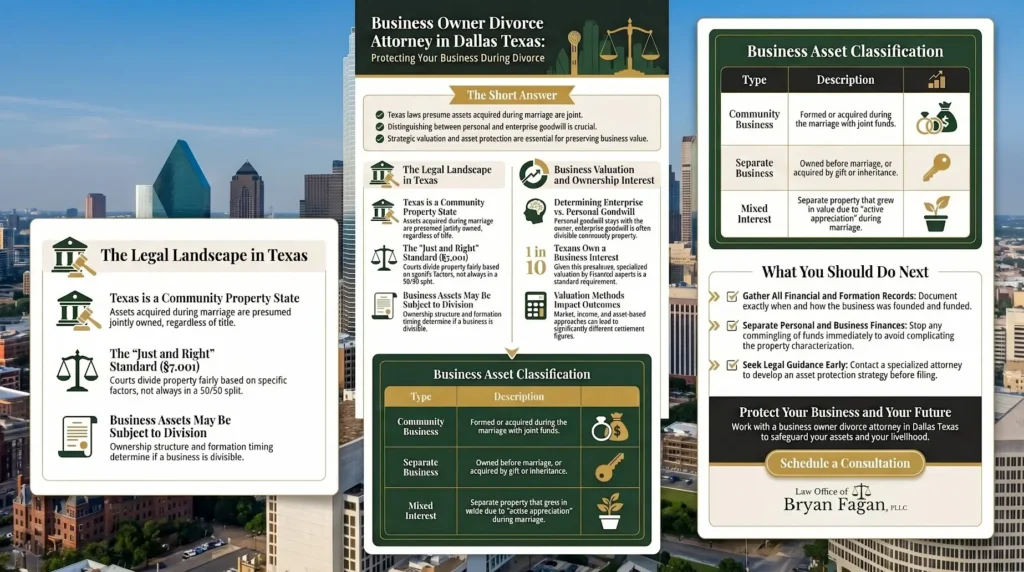
Is My Business Community Property or Separate Property?
One of the first—and most misunderstood—questions in a business owner divorce is whether the company is actually yours alone or subject to division. If you’re working with a Business Owner Divorce Attorney in Dallas Texas, this is where the legal analysis begins. Under Texas Family Code §3.003, all property possessed by either spouse during or on dissolution of marriage is presumed to be community property. That means the burden is on you to prove, with clear and convincing evidence, that your business interest is separate.
In straightforward situations, where a business was formed before marriage, funded exclusively with separate property, and maintained with clean financial records, the path to establishing separate ownership may be relatively direct. But even then, the analysis doesn’t stop at ownership. Texas courts distinguish between the entity itself and the value created during the marriage. If the company grew because of marital effort, reinvested earnings, or shared financial decisions, the community estate may have a claim—even if the original ownership predates the marriage.
In more complex cases, this is where many business owners encounter unexpected exposure. It is common to assume that forming an LLC before marriage fully protects the business. In reality, courts focus on how the business operated over time. If community funds were used, if income was commingled, or if one spouse contributed labor without adequate compensation, reimbursement claims under Texas Family Code §3.402 may arise. Judges evaluate financial transparency, documentation, and consistency in how the business was treated throughout the marriage—not what either party intended.
Where disputes are contested, characterization becomes a technical, evidence-driven process. Courts look at bank records, tax filings, ownership documents, and expert testimony to determine what portion of the business, if any, belongs to the community estate. This is often closely tied to valuation disputes, especially in cases involving growth over time or reinvested earnings. Understanding how courts approach these issues—and how different valuation methods can impact the outcome—is critical, particularly in dividing business assets in divorce.
If your business involves multiple revenue streams, inconsistent compensation, or years of financial overlap between personal and business accounts, the level of analysis increases significantly. Early decisions—such as how records are organized and how claims are framed—can influence both settlement leverage and trial outcomes. Waiting too long to address characterization issues is one of the most common mistakes business owners make, and it often leads to avoidable financial exposure.
At its core, this question is not just legal—it’s strategic. The more clearly you can define what is separate, what may be community, and how the value was built, the better positioned you are to protect both your business and your long-term financial future.
Table 1 — Characterization Framework
| Category | What Texas Law Says | Practical Impact |
|---|---|---|
| Pre-marriage formation, separate funds, no community contribution | Separate property — entity and value | Strongest defense; tracing required |
| Pre-marriage formation, community funds invested or community effort applied | Entity separate; community holds reimbursement claim (§3.402) | Most common Dallas founder scenario |
| Formed during marriage with community earnings | Community property — divisible | Default unless prenup/postnup |
| Formed during marriage with separate startup capital, properly traced | Mixed character; community share of growth | Tracing is the entire case |
| Inherited or gifted during marriage to one spouse | Separate property | Documentation must be airtight |
Tracing is the technical work that makes or breaks the separate-property claim. If you used a separate-property bank account to fund the business and that account never received a deposit of community earnings, the trace is clean. If community paychecks deposited into that same account at any point during the marriage, you have commingling — and under the “community out first” presumption Texas courts apply, the community is presumed to have funded the business unless you can rebut it with specific records. Most founders cannot, because most founders did not keep eight years of bank statements segregated by source.
Listen to Our Texas Family Law Podcast
Prefer listening? In this episode, we discuss business owner divorce in Dallas, Texas, including how business interests may be handled, key financial considerations, and steps to help protect your company and future.
The Reimbursement Claim Most Dallas Business Owners Don’t See Coming
A reimbursement claim under Texas Family Code §3.402 is the community estate’s right to be paid back when marital funds or marital effort enhanced one spouse’s separate-property business. It is the single most common — and most under-prepared-for — exposure in Dallas business owner divorces. The entity stays yours. The check the community is owed for building it does not.
In Texas, §3.402 recognizes reimbursement claims for, among other things, the use of one marital estate’s property to benefit another, and for inadequate compensation paid to a spouse whose time, toil, talent, and effort were applied to the enhancement of separate property. That second category is the one that catches founders. If you ran your pre-marriage company for ten years during the marriage and paid yourself $80,000 a year when comparable executive comp in your market would have been $250,000, the community has a claim for the difference — every year, with interest, against the appreciated value of the business.
The defenses to a reimbursement claim exist but they are technical. Under §3.402(b), the court can consider offsetting benefits the community received from the separate-property business — like distributions, perks, or the use of the business to pay community expenses. A §3.406 offset can reduce or eliminate the claim. None of these defenses are automatic; each one has to be pleaded, documented, and argued. A Dallas business owner divorce attorney who treats §3.402 as an afterthought is one I would not hire.
The “low salary” defense backfires. Founders who keep personal draws artificially low to leave cash in the business are creating community property in two places at once. The undrawn compensation is a §3.402 claim. The retained earnings that fueled growth are evidence of community contribution. What looked like financial discipline becomes the spouse’s exhibit list.
How a Texas Court Values a Business in Divorce

A Texas court will value a closely held business in divorce using one of three methodologies — asset, market, or income — and the choice of method, the choice of valuation date, and the treatment of goodwill will swing the final number by hundreds of thousands of dollars. The valuation fight is not about whether the business is worth something; it is about which method the court adopts and whose expert the judge believes.
The three approaches do not produce comparable numbers. An asset-based approach values the company by subtracting liabilities from the fair market value of tangible assets — useful for asset-heavy businesses (a Dallas HVAC company with trucks, equipment, and warehouse inventory) but punitively low for service businesses. A market approach values the company by comparison to recent sales of similar businesses, which works well for franchise resales and stable industries but produces noisy results for niche professional practices. An income approach — usually a discounted cash flow or capitalization of earnings — values the company by projecting future earnings and discounting them to present value, which is the most defensible method for established profitable businesses and the one I see adopted most often in Dallas County family courts.
Table 2 — Valuation Dispute Framework
| Scenario | Likely Outcome | What to Do |
|---|---|---|
| Both spouses agree on a single neutral expert | Court typically adopts the agreed valuation | Front-load expert selection; cheaper than two competing experts |
| Each side hires own expert with significantly different numbers | Court adopts one, splits the difference, or appoints a third | Build the record for your expert’s methodology, not just the number |
| Owner-spouse uses an in-house CPA, non-owner uses a credentialed business valuation expert | Owner-spouse loses credibility battle | Always hire a credentialed ABV, CVA, or ASA — never your tax CPA |
| Personal goodwill argued as separate property | Texas courts generally exclude personal goodwill from community estate | Have your expert separate personal from enterprise goodwill in the report |
| Valuation date disputed | Court selects based on equitable considerations | This single decision can move value 20%+; argue it early |
The goodwill question deserves its own paragraph because it is where the most defensible value gets carved out. Texas law distinguishes personal goodwill — the value attributable to the individual professional or owner that does not transfer in a sale — from enterprise goodwill, which is tied to the business itself and would transfer to a buyer. Personal goodwill is generally treated as separate property and excluded from the community estate. For a Dallas plaintiff’s firm, a McKinney dental practice, or any business where the owner is the brand, this distinction can move six or seven figures off the table. Your expert has to be qualified to draw the line.
The number the court adopts is almost never the number anyone walked in with. It is the number the court can defend in a written order. Your job, and mine, is to make the defensible number the one closest to where you need it to land.
— Bryan Fagan
Dallas County Procedure — and What Changes in Collin and Tarrant
In a business owner divorce, procedure can be just as important as strategy. When working with a Business Owner Divorce Attorney in Dallas Texas, one of the first realities to understand is that Dallas County courts operate under standing orders that immediately restrict what either spouse can do with marital assets—including a business—the moment a divorce is filed. These orders are not suggestions. Moving funds, adjusting distributions, or transferring ownership interests without court approval can trigger sanctions and significantly damage credibility in front of the judge. In many cases, early missteps like these create problems that are difficult—and sometimes impossible—to fully correct later.
In straightforward situations, where both parties respect the standing orders and maintain financial transparency, the process tends to move more predictably. But in more complex cases, especially where disputes are contested or financial activity is unclear, courts look closely at how each party handled business operations during the pendency of the case. Judges evaluate whether actions were reasonable, whether income reporting remained consistent, and whether either party attempted to gain an unfair advantage. These factors often influence not only temporary orders but also final outcomes under Texas Family Code §7.001, which requires a “just and right” division of the estate.
Temporary orders hearings and mediation are central to how these cases resolve in Dallas County. Where disputes are contested, temporary orders can establish who controls business operations, how income is handled, and what financial responsibilities each party carries moving forward. Mediation is where most business owner divorces ultimately settle, largely because the cost of ongoing litigation—valuation experts, depositions, and financial analysis—begins to impact the business itself. Courts generally favor solutions that preserve business continuity, especially when a workable buy-out structure is on the table. Understanding how valuation and negotiation strategy intersect is critical, particularly when navigating issues related to dividing business assets in divorce.
If your business involves multiple locations, partners, or overlapping jurisdictions, venue selection becomes another strategic factor. Collin County courts often move faster and take a more aggressive approach to temporary orders, while Tarrant County courts may implement more detailed operational controls for ongoing businesses. Filing in the right county—and doing so early—can shape how the case unfolds over the next year or more. In cases involving complex financial structures or operational concerns, these procedural differences can directly impact both litigation strategy and settlement leverage.
Ultimately, business owner divorces are not just decided on the facts—they are shaped by timing, procedure, and how well each side navigates the legal framework from the start. Taking a proactive, informed approach helps protect your position, maintain business stability, and avoid costly mistakes that often arise in the early stages of the case.
For a Dallas-area business owner, the first three procedural decisions — venue, standing-order compliance, and the choice of valuation expert — set the trajectory of the case more than anything you will do at trial. These are the decisions to make with counsel in the room, not after the fact.
Business Exposure Assessment
Three questions. One screen. Built to give you a defensible read on where your business sits before you call. There is no email capture and no scoring — the tool routes you to one of six outcomes based on the legal elements that determine characterization and reimbursement risk under Texas law.
Did community funds (salary, joint accounts, marital earnings) ever flow into the business during the marriage?
Do you have a signed prenup or postnup that defines the business as separate property?
Did your spouse contribute labor, expertise, or uncompensated work to the business?
Was the agreement signed with both spouses represented by independent counsel and full financial disclosure?
Was the business funded primarily with community earnings and operated as a marital asset?
Your business is presumptively community property.
A business started during the marriage, funded with community earnings, and operated as a marital asset is presumed community property under Texas Family Code §3.003. Without a prenup or postnup, your spouse holds a direct ownership claim — not a reimbursement claim — to the community share of the business. A Dallas County judge will divide the community estate in a manner that is “just and right,” which can range from 50/50 to a meaningful skew against the higher earner. The strategic work is structuring a buy-out that lets you keep operating the business while offsetting your spouse’s share with other assets.
- Pull eight years of business and personal bank statements before any conversation
- Engage a credentialed business valuation expert (ABV, CVA, or ASA) through counsel
- Identify offset assets — real estate, retirement, brokerage — that can fund a buy-out
- Do not move money or change operating distributions before counsel is engaged
Reimbursement and appreciation claims are live against your business.
A pre-marriage business that received community funds during the marriage and grew substantially in value creates two distinct exposures under Texas Family Code §3.402: a reimbursement claim for community funds used to enhance separate property, and a claim against the community share of appreciation attributable to marital effort. The entity itself remains your separate property — but the community estate is owed a meaningful payment. The size of that payment is the entire fight. Tracing, expert valuation, and the §3.406 offset analysis will determine the final number.
- Document the original separate-property funding source with bank records
- Reconstruct community contributions year by year — capital, salary draws, joint signatures
- Engage a forensic accountant and valuation expert who can quantify §3.402 exposure
- Identify §3.406 offsets — distributions, perks, community benefits — that reduce the claim
An active claim against your business needs to be defended.
Your situation involves either a reimbursement claim, a sweat-equity contribution claim, or a tracing-required defense — each of which is winnable, but none of which defends itself. Texas Family Code §3.402 and §3.408 give your spouse procedural footing to assert claims against the value of the business even when the entity is separate property. The defense work is technical: documentation, expert valuation, and a written narrative the court can adopt. The cost of mounting the defense is meaningful but smaller than the cost of conceding the claim.
- Locate and preserve formation documents and historical funding records
- Identify the specific claim type your spouse is most likely to assert
- Engage counsel before any settlement conversation or written communication
- Consider a postnup if no divorce petition is on file yet
Your marital agreement may be vulnerable to challenge.
A prenup or postnup is enforceable in Texas under §4.001 and §4.101, but only if it was executed with independent counsel on both sides, full financial disclosure, and an absence of duress. Agreements signed without independent counsel for the non-owner spouse, or without complete asset disclosure, are routinely challenged — and sometimes set aside — in contested divorces. The first move is a hard review of the agreement’s execution: who signed, when, with what counsel, and what was disclosed. If the agreement holds, your exposure drops to near zero. If it does not, you are operating under default community property rules.
- Locate the original signed agreement and all execution records
- Identify who served as independent counsel for each spouse
- Review the financial disclosures attached to the agreement
- Have counsel assess enforceability before any divorce filing
Your separate-property defense is strong — if the trace holds.
A pre-marriage business funded with separate-property capital, with no community contribution and no spousal involvement, is the cleanest fact pattern for a separate-property defense under Texas Family Code §3.001. The entity is yours and the community estate’s claims against it are minimal. The defense still has to be documented — bank records, formation papers, and a tracing analysis — but the legal posture is favorable. The risk is that the trace breaks somewhere in eight or ten years of records, opening the door to a presumption of community character on the funding account.
- Pull bank statements for the separate-property funding account back to before the marriage
- Confirm no community earnings ever deposited into that account
- Preserve formation documents and any pre-marriage business records
- Confirm spouse had no operational involvement or uncompensated contribution
Your marital agreement is likely enforceable.
A prenup or postnup executed with independent counsel on both sides, full financial disclosure, and no duress is enforceable in Texas in the overwhelming majority of cases. If the agreement properly characterizes the business as separate property, your spouse’s claim against the business itself is largely foreclosed. Residual exposure typically runs through reimbursement provisions, ambiguity in the agreement’s language, or claims regarding assets the agreement did not specifically address. The work now is confirming the agreement’s scope and identifying any gaps before a petition is filed.
- Locate the original signed agreement and all execution records
- Have counsel review the agreement’s scope and identify uncovered assets
- Confirm the business has not changed in ways that affect the agreement’s coverage
- Address any gaps before a divorce filing forecloses postnup options
How exposed is your business in a Texas divorce?
Three questions. No email required. Get a defensible read on your exposure under Texas community property law before you book a Legal Strategy Session.
Question 1 of 3 — When was the business started?
The Defenses That Actually Hold Up in Texas Courtrooms

In Texas, protecting your business during divorce is not about what you intended—it is about what you can prove. When working with a Business Owner Divorce Attorney in Dallas Texas, the focus shifts to defenses that consistently hold up in court: tracing, written agreements, statutory offsets, and the personal goodwill carve-out. Courts do not rely on a founder’s belief that the business was “always separate.” Instead, they apply Texas Family Code §§3.003 and 7.001 and evaluate documentation, financial transparency, and credibility when determining how assets should be characterized and divided.
In straightforward situations, where financial records are clean and clearly segregated, tracing can provide a strong foundation for a separate property claim. If you can show that startup capital originated from a pre-marriage account and remained free from community deposits, the argument becomes more defensible. But in more complex cases—especially where business and personal finances have overlapped over time—tracing becomes more difficult and often requires forensic reconstruction. Courts tend to give more weight to original records than reconstructed reports, which is why delays in organizing financial documentation can create unnecessary exposure early in the process.
Where disputes are contested, written agreements often become one of the most reliable tools for asset protection. Premarital and postmarital agreements under Texas Family Code §§4.001 and 4.101 can define ownership and reduce ambiguity, but only if they were properly executed with full disclosure and without coercion. Similarly, operating agreements can play a critical role in shaping outcomes. Provisions that address buy-sell triggers, valuation methods, and transfer restrictions may not prevent a dispute, but they can significantly influence how a business is treated when it comes time for dividing business assets in divorce.
If your business involves multiple owners, informal compensation structures, or years of reinvested earnings, the level of strategy required increases. Courts will closely evaluate whether the business fairly compensated the marital estate for time, labor, and resources, which can give rise to reimbursement claims under §3.402. Judges also assess the credibility of valuation experts and whether financial disclosures are consistent across tax returns, bank records, and internal reporting. These details often determine not just the outcome, but the leverage each side brings into settlement discussions.
One of the most underutilized defenses in these cases is the personal goodwill carve-out. When properly supported by a qualified expert, separating personal goodwill from enterprise value can significantly reduce the portion of the business subject to division. This is particularly relevant for service-based businesses and owner-driven companies, where much of the value is tied directly to the individual rather than the entity itself.
Ultimately, the effectiveness of any defense comes down to preparation and timing. Business owners often make costly mistakes by waiting too long to address documentation gaps or assuming that informal practices will hold up in court. In reality, early, strategic decisions—how records are organized, how claims are framed, and how valuation is approached—can shape the entire trajectory of the case. Taking action early not only strengthens your legal position but also helps protect the long-term continuity of the business you’ve worked to build.
Defense Comparison
| Defense | When It Works | When It Fails |
|---|---|---|
| Tracing separate funds | Bank records exist, no commingling | Community deposits hit the funding account |
| Prenup / postnup | Both sides represented, disclosure, executed correctly | Executed in haste; no counsel for non-owner |
| Operating agreement buy-sell | Drafted before marriage; covers divorce trigger | Generic OA without divorce language |
| Personal goodwill carve-out | Owner-dependent business, credentialed expert | Enterprise-driven business, in-house CPA |
| §3.406 offset | Community benefit documented | Distributions never tracked |
Buy-Outs, Offsets, and Asset Trades: How These Cases Resolve
In most Dallas cases, the goal is not to split the business—it is to protect it while still meeting the legal requirement under Texas Family Code §7.001 to divide the community estate in a manner that is “just and right.” When working with a Business Owner Divorce Attorney in Dallas Texas, the strategy typically centers on keeping the operating company intact while structuring a fair offset for the non-owner spouse. Courts generally avoid forcing the sale of a functioning business because it often reduces value, disrupts income, and creates unnecessary financial harm for both parties.
In straightforward situations, where the business has a clear valuation and there are sufficient marital assets available, a clean buy-out is often the most efficient solution. This allows the owner-spouse to retain full control of the company while the other spouse receives equivalent value through assets like real estate, retirement accounts, or investment portfolios. These types of exchanges can also be tax-efficient under federal law, making them a practical option when structured properly. For a deeper understanding of how these arrangements work, it can be helpful to review issues related to dividing business assets in divorce.
In more complex cases, where the business represents a large portion of the marital estate and liquid assets are limited, the structure becomes more strategic. Where disputes are contested, courts and attorneys often look to solutions such as promissory notes, where payments are made over time, or structured settlements tied to business performance. Judges will evaluate financial transparency, the credibility of valuation methods, and whether proposed payment structures are realistic and sustainable. If your business involves fluctuating income, multiple revenue streams, or ongoing operational demands, these factors become even more important in shaping a workable resolution.
If your situation includes commingled assets, disputed valuations, or reimbursement claims under Texas Family Code §3.402, the complexity increases further. In these cases, early planning can make a significant difference. Waiting too long to address valuation strategy or assuming the outcome will be a simple 50/50 division can lead to unnecessary financial exposure. Courts are not required to divide assets equally, and outcomes often reflect the broader financial and factual picture presented.
Ultimately, most cases move toward a negotiated resolution because maintaining business continuity is in everyone’s interest. While partial co-ownership arrangements may be considered in limited circumstances, they rarely last due to operational conflict and financial strain. Taking a proactive, informed approach—one that balances legal requirements with real-world business needs—can help preserve the value you’ve built while creating a path forward that protects your long-term financial stability.
Mistakes Dallas Business Owners Make Before Hiring Counsel
The mistakes that hurt Dallas business owners most are made before the divorce is filed — usually in the weeks after the relationship becomes terminal but before counsel is involved. These are the patterns I see repeatedly in intake, and almost all of them are unforced errors.
Moving money is the largest one. Transferring cash from a business operating account to a parent’s account, a friend’s account, or a separate LLC after the marriage breaks down does not protect the asset. It creates a fraudulent transfer claim under Texas Business & Commerce Code Chapter 24, a credibility problem with the judge, and frequently a sanctions motion. Whatever the founder thought they were protecting becomes the centerpiece of the opposing counsel’s narrative. Don’t move money. Document everything that has already moved.
Underreporting income or accelerating expenses to depress the business’s apparent earnings is the second. The non-owner spouse’s expert will reconstruct historical earnings using bank deposits, tax returns, and industry comparables. Underreporting in the year of divorce produces a normalization adjustment that not only restores the income but flags the entire valuation as adversarial. Forensic accountants are good at this; juries and judges believe them.
Telling the spouse “I built this business, you have no claim to it” before filing is the third. That sentence ends up in a verified petition or a sworn affidavit. Anything you say about ownership, contribution, or value in the months before filing is admissible and quotable. Say nothing about the business until you have counsel. Refer questions to your attorney once representation is engaged.
Hiring the wrong attorney is the fourth. A general family lawyer who has never tried a business valuation case, never cross-examined a business valuation expert, and never written a §3.402 reimbursement argument is not the right counsel for a high-asset business owner divorce. The work is technical and the stakes are large. Ask your prospective attorney directly: how many business owner divorces have you handled in Dallas County in the last three years, and how did valuation play in those cases.
What to Do If You Own a Business and Divorce Is Coming
- Pull eight years of bank statements for every account that has touched the business — operating, payroll, personal, and any separate-property funding accounts.
- Locate and copy your formation documents — articles of organization, operating agreement, bylaws, shareholder agreement, buy-sell provisions, and any amendments.
- Gather tax returns — five years of business returns (federal and Texas franchise) and five years of personal returns.
- Identify your separate-property funding source if the business was formed pre-marriage, and pull the records that prove it.
- Do not move money out of the business or out of any joint account after the relationship becomes terminal. Document every transfer that has already happened.
- Stop discussing the business with your spouse beyond what is required for joint operations. Anything you say is admissible.
- Engage a credentialed business valuation expert through counsel — not your tax CPA. ABV, CVA, or ASA credentials are the floor.
- Talk to your business attorney about updating operating agreements, buy-sell provisions, or any other entity-level protections that are still available.
- Consider a postnuptial agreement if no divorce petition is on file yet and the relationship is salvageable in the short term.
- Book a Legal Strategy Session before you file, before you respond to a filing, and before you have any conversation with your spouse’s attorney.
What I Tell Every Client Who Calls About a Business Owner Divorce in Dallas

In Texas, the business owners who face the greatest losses are rarely the ones with the most complex companies—they are the ones who underestimate how quickly risk builds once a divorce is on the table. If you are working with a Business Owner Divorce Attorney in Dallas Texas, the difference often comes down to timing, preparation, and strategy. Texas courts apply a presumption under §3.003 that property is community, and under §7.001 they divide that estate in a manner that is “just and right.” That means assumptions—especially about ownership, valuation, or a guaranteed 50/50 outcome—can create exposure before the case even fully develops.
In straightforward situations, where both parties are cooperative and financial records are clear, early organization and informed decision-making can help preserve both the business and overall financial stability. But in more complex cases—particularly where disputes are contested, valuations differ, or financial records are inconsistent—the stakes increase quickly. Judges evaluate credibility, consistency in financial disclosures, and whether a business owner acted transparently once divorce became likely. Waiting too long to seek guidance, continuing informal financial practices, or speaking too freely about business value or ownership can unintentionally shape the narrative presented in court.
If your business involves multiple revenue streams, fluctuating income, or potential reimbursement claims under §3.402, early strategic planning becomes even more important. Courts look closely at how the business was operated during the marriage and whether the community estate was fairly compensated. Delays at this stage often lead to higher costs, reduced leverage, and outcomes that could have been avoided with earlier action. Understanding how valuation, income, and asset characterization interact is critical, especially when reviewing issues related to dividing business assets in divorce.
Ultimately, the first steps you take set the direction of the entire case. Treating the process as a structured legal strategy—rather than a reaction to events—can help protect both your business and your long-term financial future.
Conclusion:
Divorce for a business owner is rarely just about dividing assets—it’s about protecting everything that depends on that business, from your financial future to the stability of your family. If you’ve made it this far, you already understand that the decisions you make early can shape the outcome in ways that are difficult to undo later. Working with a Business Owner Divorce Attorney in Dallas Texas is not just about legal representation; it’s about having a strategy that aligns with your goals, your responsibilities, and the reality of how Texas courts approach these cases.
In straightforward situations, where the business is small, income is clear, and both sides are cooperative, the path forward may be more efficient and resolution-focused. In more complex cases—especially where valuation disputes, commingled assets, reimbursement claims, or operational control are at stake—the strategy needs to be more deliberate and experienced-driven. If your case involves multiple revenue streams, partners, or concerns about how the divorce could impact day-to-day operations, the level of legal guidance you choose can make a meaningful difference in both the process and the result.
At The Law Office of Bryan Fagan, PLLC, the goal is simple: to help you move forward with clarity, confidence, and a plan that protects what matters most. Whether you are just beginning to ask questions or preparing to take the next step, having the right legal perspective early can give you the control and peace of mind you need during a time that often feels uncertain.
FAQ – Business Owners and Divorce in Texas
Not automatically. In Texas, your spouse is entitled to a share of the community estate, and your business is part of that estate only to the extent it is characterized as community property. If the entity is your separate property, your spouse’s claim runs through reimbursement under §3.402, not direct ownership. The “half” answer applies only if the business itself is community property and the court divides 50/50 — which it does not always do.
A Dallas County judge has the authority to order a sale but rarely does when a buy-out is feasible. Forced sales destroy value, harm employees, and produce worse outcomes for both spouses than a structured offset. In practice, the owner-spouse keeps the business in the overwhelming majority of cases, and the non-owner spouse receives offsetting assets or a note.
A qualified business valuation expert applies one of three methods — asset, market, or income approach — and produces a written valuation report. The court considers the methodology, the credibility of the expert, and the date of valuation. In contested cases, each side usually retains its own expert and the court adopts one valuation, splits the difference, or appoints a neutral.
For characterization, the entity type matters less than how the entity was funded and operated. Under Texas Family Code §7.001 the court divides the community estate regardless of entity type. For practical execution, LLCs and corporations are easier to value and divide than partnerships, because they have clearer accounting and transfer mechanics.
The entity itself is your separate property. Whether you keep the full value depends on whether community funds, community effort, or marital contributions enhanced the business during the marriage. If they did, the community holds a reimbursement claim against the appreciated value even though the entity remains yours. This is the most misunderstood area of business owner divorce in Texas.
Yes. Discovery in a Texas divorce gives the non-owner spouse the right to subpoena bank records, tax returns, financial statements, operating agreements, and any other document relevant to characterization and valuation. Refusing to produce records produces sanctions and creates an adverse inference. The right strategy is controlled production through counsel, not resistance.
Twelve to eighteen months for a fully contested case from filing to final decree, depending on court docket, complexity of valuation, and willingness to mediate. Uncontested cases with a written settlement can close in 60–90 days after the statutory waiting period.
A postmarital agreement under Texas Family Code §4.101 can be executed during the marriage to characterize property — including a business interest — as separate. It requires the same elements as a prenup: both parties represented by independent counsel, full financial disclosure, and execution free of duress. A postnup signed before a divorce is filed is enforceable. A postnup signed after a petition is on file is generally not.
Texas law distinguishes personal goodwill from enterprise goodwill. Personal goodwill — the value tied to the individual professional or owner that would not transfer in a sale — is generally treated as separate property and excluded from division. Enterprise goodwill — value tied to the business itself, transferable in a sale — is part of the community estate if the business is community property. A credentialed valuation expert separates the two in the report.
Your case will be venued in the county where you and your spouse reside, which for most Dallas-area business owners is Dallas, Collin, or Tarrant County. Local procedure, standing orders, and individual judge preferences vary. The Law Office of Bryan Fagan, PLLC handles Dallas, Collin, Tarrant, and surrounding counties, with Dallas trial attorney Robert A. Thornton anchoring our North Texas litigation work.
A Legal Strategy Session is a paid consultation with a Texas family law attorney designed for exactly the kind of decisions a business owner faces pre-filing: characterization risk, valuation strategy, venue, timing, and what protective steps make sense before a petition is on file. It is not a free intake call. It is the strategic conversation that determines whether the next twelve months go well or badly.