
Annulment Lawyers in Dallas Texas: Your Complete Guide to Marriage Annulment Under Texas Law
The argument didn’t start out big—it rarely does. It was something small, like who was picking up dinner or why a text went unanswered. But now you’re sitting in a quiet room, replaying everything, wondering how something that felt certain just weeks ago could unravel so quickly. If you’re searching for Annulment Lawyers in Dallas Texas, you’re likely facing a moment like this—where confusion, regret, and urgency all collide, and you need real answers about what comes next.
In Texas, the law draws a clear line between a marriage that was valid and one that never should have existed in the first place. That distinction matters more than most people realize, especially when legal decisions begin shaping the future of your family. Under Texas Family Code Chapter 6, annulment is only available in very specific situations, and the path forward depends on facts that existed at the very beginning—not just how things feel now.
At the Law Office of Bryan Fagan, PLLC, we’ve guided individuals and families through these exact moments—when everything feels uncertain, and the stakes are deeply personal. Led by Bryan Joseph Fagan, a South Texas College of Law graduate and recognized authority in Texas family law, our firm is committed to helping you move forward with clarity and confidence. We believe in simplifying complex legal problems, providing honest guidance, and protecting what matters most as you take your next step.
In this article, you’ll learn how annulment works under Texas law, how it differs from divorce, and how these decisions can impact your family in ways you may not expect. Because even when things feel overwhelming, there is a path forward—and it starts with understanding your options.
Key Takeaways
- Annulment is not simply a faster divorce—it requires specific legal grounds established under Texas Family Code Chapter 6, and not every marriage qualifies regardless of how short it was.
- Texas recognizes several grounds for annulment, including underage marriage without parental consent, fraud or duress, mental incapacity, intoxication during the marriage ceremony, impotence, and concealed divorce.
- Strict deadlines apply for certain annulment grounds, so consulting with a Dallas annulment lawyer early in the process is essential to protect your rights.
- Property division and child custody are handled differently in annulment than in formal divorce, though children’s rights remain fully protected under Texas law.
- An experienced annulment attorney can help you determine eligibility, gather proper evidence, navigate Dallas County courts, and ensure all legal requirements are met.

Your Family’s Future Starts Here
Don’t navigate your legal journey alone. Schedule a consultation now and get the clarity and support you deserve.
We offer comprehensive family law and estate planning services, including but not limited to:
Annulment Lawyers in Dallas Texas: The Short Answer
Annulment Lawyers in Dallas Texas help individuals determine whether their marriage meets the strict legal requirements for annulment under Texas law and guide them through each step of the Texas annulment process in Dallas County courts. Unlike divorce—which ends a legally valid marriage—annulment focuses on whether a legal defect existed at the time of the marriage, meaning the relationship may be treated as though it never legally existed under Texas Family Code Chapter 6.
In straightforward situations, where the legal ground is clear—such as intoxication at the time of the ceremony or a recent undisclosed divorce—the process may move more efficiently with the right documentation and timely filing. However, in more complex cases, proving annulment requires meeting the burden of proof by a preponderance of the evidence. Texas courts carefully evaluate whether the alleged ground truly existed at the time of marriage, whether credible evidence supports the claim, and whether any actions—such as continued cohabitation after discovering the issue—may have waived the right to seek annulment.
Where annulment grounds are disputed, the process becomes more evidence-driven and strategic. Cases involving fraud, duress, or mental incapacity often require detailed documentation, witness testimony, and a clear legal narrative that aligns with how judges in Dallas County evaluate credibility and intent. Timing also plays a critical role. Certain grounds have strict deadlines, and waiting too long—or taking inconsistent actions—can eliminate the ability to pursue annulment altogether.
For many, the decision is not just whether annulment is possible, but whether it is the best legal path forward. In some situations, pursuing annulment under Texas law in Far North Dallas may be appropriate. In others—particularly where evidence is limited or disputes are likely—exploring options like divorce in Texas may provide a more predictable outcome.
Understanding the difference early can prevent costly delays and missteps. The right approach depends on your specific facts, the strength of your evidence, and how the court is likely to evaluate your case.

Listen to Our Texas Family Law Podcast
Prefer listening? In this episode, we discuss annulment in Dallas, Texas, including when a marriage may be legally voided, the grounds required under Texas law, and what you need to know before pursuing this option.
What Is an Annulment Under Texas Law?
Annulment Lawyers in Dallas Texas often begin by helping clients understand a fundamental concept: an annulment is not simply a faster version of divorce—it is a legal determination that a marriage was never valid from the beginning. Under Texas Family Code Chapter 6, annulment applies when a specific legal defect existed at the time of the marriage, meaning the relationship can be treated as though it never legally existed.
Texas law distinguishes between voidable marriages and void marriages. Voidable marriages require a court to formally grant an annulment based on statutory grounds such as fraud, duress, mental incapacity, or intoxication. Void marriages, such as those involving bigamy or prohibited relationships, are considered invalid from the outset, though a court order is often still needed to formally clarify legal status. In either situation, the burden of proof rests on the person seeking annulment, and the standard applied is a preponderance of the evidence—meaning the court must be convinced that the claim is more likely true than not.
In straightforward situations, where the legal ground is clear and supported by credible documentation, the annulment process may be more direct. However, in more complex cases—especially where annulment grounds are disputed—courts in Dallas County take a closer look at the facts. Judges evaluate whether the alleged issue truly existed at the time of the marriage, whether testimony is consistent and credible, and whether actions taken after the marriage—such as continuing to live together after discovering the issue—may have waived the right to seek annulment. These details often determine whether a case succeeds or fails.
One of the most common misconceptions is that a short marriage automatically qualifies for annulment. In reality, Texas courts do not consider the length of the marriage as a determining factor. Instead, the focus is entirely on whether a valid legal ground existed from the beginning. This is why many individuals ultimately pursue alternatives like divorce in Texas when the required elements for annulment cannot be proven.
Understanding these distinctions early is critical, especially because certain annulment grounds are subject to strict deadlines. Waiting too long or proceeding without sufficient evidence can eliminate the option entirely. If you want a clearer sense of how challenging these cases can be in practice, you can review how difficult it is to get an annulment in Texas.
Ultimately, deciding whether to pursue annulment requires more than just a desire to undo a marriage—it requires a careful evaluation of the facts, the available evidence, and how a court is likely to view your case. Recognizing whether your situation is straightforward or requires a more structured legal strategy can help you make informed decisions and move forward with clarity.
Annulment vs Divorce: Understanding the Difference
Understanding the differences between annulment and divorce helps you make an informed decision about which legal path makes sense for your situation.
Table 1: Annulment vs Divorce
| Feature | Annulment | Divorce |
|---|---|---|
| Legal Effect | Marriage declared legally invalid; treated as if it never existed | Ends a valid marriage going forward |
| Grounds Required | Must prove specific statutory grounds under Texas Family Code Chapter 6 | No-fault divorce available; grounds not required |
| Time Limitations | Strict deadlines for certain grounds (30 days to one year depending on ground) | Standard waiting period after filing; less rigid on timing |
| Property Division | Attempts to restore parties to pre-marriage status; putative spouse doctrine may apply | Community property division required under Texas law |
| Children | Children remain legitimate; custody determined by best interest standard | Same protections for children apply |
| Commonality | Rare; most marriages don’t qualify | Very common; standard path for ending marriages |
The practical implication is significant: if you cannot prove valid annulment grounds, divorce may be your only legal option for ending the marriage.
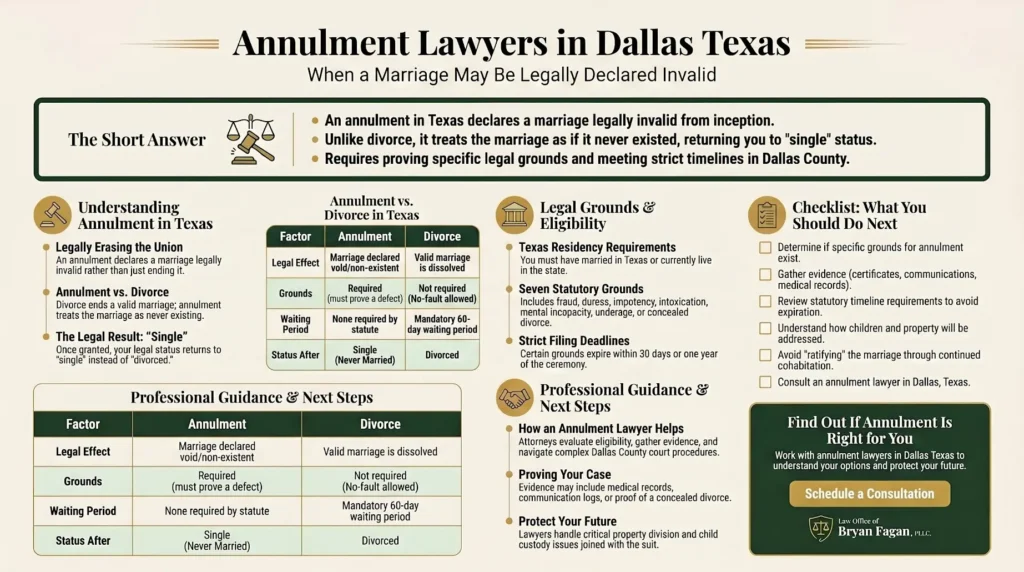
Legal Grounds for Annulment in Texas
Annulment Lawyers in Dallas Texas often begin by evaluating one critical question: did a legally recognized ground for annulment exist at the time of the marriage? Under Texas Family Code Chapter 6, Subchapter B, courts will only grant an annulment when specific statutory requirements are met—and the burden is on the person seeking annulment to prove those grounds by a preponderance of the evidence. This is where many cases become more complex than expected, especially when documentation, timing, or credibility are in question.
In straightforward situations, where the facts clearly align with statutory grounds and evidence is available, the process may be more efficient. But in more complex cases—particularly where annulment grounds are disputed or require proof of intent—Texas courts closely examine whether the legal defect truly existed at the time of the marriage and whether the actions of the parties afterward affect eligibility. Understanding these distinctions is essential before moving forward with the Texas annulment process.
Underage Marriage Without Proper Consent
Texas law allows annulment when a person between the ages of 16 and 17 marries without proper parental consent or a court order. However, strict deadlines apply. A parent or guardian must file within 90 days of the marriage, and the case must be brought before the minor turns 18. If no action is taken within that timeframe, the right to seek annulment is lost—making timing a critical factor in these cases.
Fraud, Duress, or Force
Fraud-based annulments often involve some of the most evidence-intensive cases. Texas courts require proof that a material misrepresentation directly induced the marriage—not simply a disagreement or minor dishonesty. In addition, judges carefully evaluate credibility and behavior after discovery. If the innocent party continues to live with the other spouse after learning of the fraud or after the duress ends, the court may determine that the right to annul has been waived. In more complex cases involving disputed facts, building a clear evidentiary record becomes essential.
Mental Incapacity at Time of Marriage
Annulment may be granted when one party lacked the mental capacity to understand the nature of the marriage at the time of the ceremony. Courts are not focused on later diagnoses but on whether informed consent existed at that specific moment. These cases often require medical records, expert testimony, and strong supporting evidence, making them more strategic and documentation-driven.
Intoxication During the Marriage Ceremony
If a party was so impaired by alcohol or drugs that they could not consent to the marriage, annulment may be possible. However, the court will look closely at what happened afterward. Continued cohabitation after regaining sobriety can eliminate the ability to seek annulment. This is a common area where delay or misunderstanding can negatively affect a case.
Impotence
A permanent physical inability to engage in sexual relations, if undisclosed before the marriage, may qualify as grounds for annulment. These cases typically require medical documentation and credible testimony. As with other grounds, continued cohabitation after discovery may prevent relief.
Concealed Divorce
If one spouse finalized a prior divorce less than 30 days before the new marriage and failed to disclose that fact, the other party may seek annulment. Texas law imposes a one-year deadline to file in these cases, and missing that window can eliminate the option entirely. In some situations, this overlaps with broader questions about whether the marriage was valid at all, which can affect strategic decisions moving forward.
For a deeper understanding of eligibility and how courts evaluate these cases, you can explore annulment under Texas law. In some situations—especially where evidence is limited or disputes are likely—reviewing options like divorce in Texas may provide a more practical path forward.
The key is recognizing early whether your situation is straightforward or requires a more structured legal strategy. Acting quickly, gathering the right evidence, and understanding how Texas courts evaluate these claims can make the difference between a viable annulment case and one that may not succeed.
Table 2: Grounds for Annulment in Texas
| Ground | Description | Example |
|---|---|---|
| Underage Marriage | Person 16-17 married without parental consent or court order | 17-year-old elopes without parents’ knowledge |
| Fraud, Duress, or Force | Consent obtained through lies, concealment, threats, or coercion | Spouse lied about identity or concealed existing marriage |
| Mental Incapacity | Unable to understand nature of marriage at time of ceremony | Person with severe cognitive impairment married |
| Intoxication | Under influence of alcohol/drugs during ceremony, lacked capacity | Extremely intoxicated Las Vegas wedding |
| Impotence | Permanent physical inability to have intercourse, not disclosed | Spouse concealed medical condition before wedding |
| Concealed Divorce | Prior divorce finalized less than 30 days before marriage, hidden | Party concealed that divorce was not yet final |
Who Qualifies for an Annulment?
Not every marriage qualifies for annulment, even if it was short or you deeply regret it. To qualify, you must prove that one of the specific grounds under Texas law applied at the time of the marriage ceremony.
Evidence is essential. Texas courts require proper evidence demonstrating the ground existed—medical records for impotence or mental incapacity, witness testimony for intoxication, documentation for concealed divorce, or proof of misrepresentation for fraud.
Timing matters significantly. Some grounds have strict deadlines, and for others, continued cohabitation after discovering the defect can eliminate your right to seek annulment. This is why consulting with an experienced Dallas annulment attorney early in the process is so important.
For filing in Dallas County, at least one spouse must live in Texas at the time of filing, or the marriage must have occurred in Texas. Unlike divorce, annulment does not require the same six-month residency period.
How the Annulment Process Works in Dallas County
The annulment process begins when you file a petition with the Dallas County district court. Understanding each step helps you prepare properly.
Filing the Petition
You file an Original Petition for Annulment (or Suit to Declare Marriage Void for automatically void marriages) with the Dallas County District Clerk. Under Texas law, a valid marriage license is required for a marriage to be legally recognized, and issues with the marriage license—such as failure to obtain one or not meeting the waiting period—can affect the validity of the marriage. Filing fees in Dallas County are currently $350 for cases without children, or approximately $401 when children are involved and SAPCR (Suit Affecting Parent-Child Relationship) is required. If children were born or adopted during the marriage, you must join a child custody suit to address conservatorship, possession, and support.
Service of Process
Texas law requires that your spouse receive formal notice of the annulment suit. This is accomplished through service of process—delivery by a process server, sheriff, or formal citation. If your spouse agrees, they may sign a waiver of service. The other spouse then has a deadline to respond to the petition.
Court Hearings
Depending on whether your case is contested, you may need one or more court hearings. You’ll present evidence supporting your annulment grounds—documents, witness testimony, and potentially expert witnesses for medical or mental health issues. The judge will evaluate whether you’ve proven the legal grounds.
Final Decision
If the court determines you’ve met the requirements, it will issue a final decree declaring the marriage annulled. This decree establishes your legal status and addresses any property or child custody matters.
What Happens to Property and Children
Annulment Lawyers in Dallas Texas are often asked how property and children are handled when a marriage is declared invalid. While annulment treats the marriage as if it never legally existed under Texas Family Code Chapter 6, the practical reality is that courts still must resolve financial and parenting issues in a fair and structured way. Understanding how this works is critical before deciding whether annulment is the right path.
In straightforward situations—where there are minimal shared assets and no disputes—Texas courts generally aim to return each party to their pre-marriage financial position. However, in more complex cases, especially where one spouse genuinely believed the marriage was valid, the court may apply the putative spouse doctrine. This allows for an equitable division of property, similar to what might occur in divorce in Texas, even though the marriage itself is later declared invalid. Judges in Dallas County carefully evaluate financial records, credibility, and whether either party acted in good faith when determining how to divide assets.
Where property issues are contested or involve significant financial complexity, the process becomes more strategic. Documentation, tracing of assets, and clear evidence of ownership can heavily influence outcomes. Delays or incomplete financial disclosures can create risk, making early legal guidance particularly important in these situations. For a deeper understanding of how these issues are handled locally, you can explore annulment under Texas law in West Dallas.
When children are involved, the court’s focus shifts immediately to stability and long-term well-being. Even in an annulment, children remain legally protected, and custody decisions are made under Texas Family Code §153.002, which requires courts to act in the best interest of the child. This means conservatorship, possession schedules, and child support are handled in much the same way as in child custody in Texas cases.
In straightforward parenting situations, where both parties agree and prioritize consistency, custody arrangements can be established relatively smoothly. In more complex cases—particularly where disputes arise over decision-making, schedules, or the child’s environment—courts will closely evaluate each parent’s ability to provide stability, meet the child’s needs, and support their overall development. Judges look for credible evidence, consistent involvement, and a willingness to act in the child’s best interest, not just short-term preferences.
Ultimately, while annulment changes the legal status of the marriage, it does not eliminate the need for thoughtful planning around property and children. Recognizing early whether your situation is simple or requires a more structured legal approach can help you avoid costly mistakes and protect what matters most moving forward.

How Long Does an Annulment Take?
Annulment Lawyers in Dallas Texas are often asked how long the process will take, and the honest answer is that timing depends heavily on the strength of your case, the evidence available, and whether the matter is contested. Unlike divorce, which typically includes a mandatory 60-day waiting period, annulment under Texas Family Code Chapter 6 does not follow a fixed timeline. Instead, the process moves at the pace required to prove that a valid legal ground existed at the time of the marriage.
In straightforward situations—where both parties agree, the legal grounds are clear, and supporting documentation is readily available—an annulment may be resolved within a few weeks to a few months. These cases tend to move more efficiently because there are fewer disputes and less need for extensive evidence review. However, even in these scenarios, accuracy matters. Filing errors, incomplete documentation, or delays in service can slow the process unexpectedly.
In more complex cases, the timeline can extend significantly. Where annulment grounds are disputed, courts require a full presentation of evidence, often including witness testimony, medical records, or other documentation. Judges in Dallas County carefully evaluate credibility, whether the alleged defect truly existed at the time of the marriage, and whether any actions—such as continued cohabitation after discovering the issue—may have waived the right to seek annulment. Meeting the burden of proof by a preponderance of the evidence takes time, especially when facts are contested.
Court scheduling also plays a role. Contested hearings, discovery, and the need for expert testimony can extend the process over several months or longer. In some cases, delays occur simply because one party challenges the annulment or because additional documentation is needed to support the claim. Acting early and preparing thoroughly can help avoid unnecessary setbacks.
Timing is especially important because certain annulment grounds come with strict deadlines. Waiting too long to act can eliminate the option entirely, leaving alternatives like divorce in Texas as the only path forward. Understanding how your specific situation fits within these timelines is critical to making informed decisions.
For a closer look at how these timelines play out locally, you can review annulment under Texas law in Knox-Henderson. Ultimately, the length of your case depends on whether your situation is straightforward or requires a more structured legal approach—and recognizing that early can help you move forward with clarity and confidence.
Common Myths About Annulment
Myth: Short marriages automatically qualify for annulment. Reality: Marriage length has no legal bearing on annulment eligibility. A marriage of one week doesn’t qualify without valid grounds, while a marriage of years might qualify if proper grounds exist.
Myth: Annulment is faster and easier than divorce. Reality: While annulment can sometimes move faster, proving fraud, mental incapacity, or other grounds often requires substantial evidence gathering. Many people find formal divorce simpler procedurally.
Myth: You can annul a marriage for any reason you regret it. Reality: Regretting a marriage, discovering incompatibility, or simply wanting out are not legal grounds for annulment under Texas law.
Myth: Annulment erases everything about the marriage. Reality: Property issues, children’s legitimacy, and other legal effects still require resolution. Children remain protected regardless of the marriage’s legal status.
Myth: Religious annulments equal legal annulments. Reality: A religious annulment from a religious institution has no legal effect in Texas courts. You need a legal annulment through the court process for legal recognition. Some religions do not recognize divorce and instead use religious annulments to address marital status within their faith, but this does not change your legal marital status under Texas law.
When Divorce May Be the Better Option
If no valid annulment grounds apply to your situation, or if deadlines have passed, or if you continued living together after discovering a defect, divorce is likely your path forward.
Divorce offers practical advantages in many cases: no-fault grounds are available, community property division follows established rules, and the process is more predictable. When evidence of annulment grounds is difficult to obtain or when the legal strategy favors a straightforward approach, many people find divorce serves their interests better.
An experienced family law attorney can help you evaluate both options objectively.
How Annulment Lawyers in Dallas Texas Can Help
Annulment Lawyers in Dallas Texas play a critical role in helping individuals understand whether their situation meets the strict legal requirements for annulment and how to move forward with confidence. The Texas annulment process is not simply about filing paperwork—it requires proving that a valid legal ground existed at the time of the marriage under Texas Family Code Chapter 6, often with detailed evidence and careful timing.
In straightforward situations, where the facts clearly support a qualifying ground and documentation is readily available, the process may be more direct. A Dallas annulment attorney can evaluate eligibility early, ensure deadlines are met, and guide the case through filing and court review efficiently. However, even in these cases, small missteps—such as incomplete filings or missed deadlines—can create unnecessary delays or risk dismissal.
In more complex cases, the process becomes far more strategic. Where annulment grounds are disputed or require proof of fraud, duress, or mental incapacity, courts expect credible testimony and well-documented evidence. Judges in Dallas County carefully assess whether the alleged issue truly existed at the time of the marriage, whether the burden of proof has been met, and whether any actions—such as continued cohabitation after discovering the issue—may have waived the right to seek annulment. These cases often require a structured approach, including gathering medical records, witness statements, and supporting documentation that aligns with courtroom expectations.
Timing is another critical factor. Certain annulment grounds have strict statutory deadlines, and waiting too long can eliminate the option entirely. Understanding these timelines early can prevent costly mistakes and help preserve your legal rights. For a more detailed look at how these cases are handled locally, you can review annulment under Texas law in Old East Dallas.
Beyond eligibility and evidence, annulment cases often involve broader considerations such as property division or parenting issues. Where financial matters or children are involved, courts may apply principles similar to those used in divorce in Texas or child custody in Texas cases, making it even more important to approach the case with a clear legal strategy.
Ultimately, the right approach depends on your situation. In some cases, annulment is a viable and efficient path. In others—particularly where evidence is limited or disputes are likely—a different legal strategy may be more appropriate. Recognizing that distinction early helps you make informed decisions and move forward with clarity, confidence, and a plan that protects your future.

Checklist: Working with Annulment Lawyers in Dallas Texas
- ☐ Determine if valid annulment grounds apply to your specific situation
- ☐ Gather supporting evidence and documentation (medical records, correspondence, witnesses)
- ☐ Review filing deadlines and timing requirements for your particular ground
- ☐ Identify potential witnesses who can support your case
- ☐ Understand residency and jurisdiction requirements for Dallas County
- ☐ File petition correctly with the proper Dallas County district court
- ☐ Ensure proper service of process on your spouse
- ☐ Prepare for potential court hearings and evidence presentation
- ☐ Consider divorce as an alternative option if grounds are uncertain
- ☐ Consult an experienced annulment lawyer early in the process
Conclusion
At the end of the day, deciding whether to pursue an annulment or move forward with divorce isn’t just a legal question—it’s a decision about how you want to move forward with your life. For those exploring options with Annulment Lawyers in Dallas Texas, the right path often comes down to understanding your unique circumstances and acting within the legal framework Texas provides. In straightforward situations, where the facts clearly meet statutory grounds, the process may be more direct. In more complex cases—especially those involving disputes, children, or questions about evidence—having the right legal strategy and guidance becomes essential.
That’s where experience and clarity matter. If your case involves nuanced legal issues like fraud, timing deadlines, or questions about whether annulment is even the right option, working with a team that understands both the law and the real-life impact of these decisions can make all the difference. The goal isn’t just to file paperwork—it’s to protect your future, minimize unnecessary stress, and create a path forward that makes sense for you.
At the Law Office of Bryan Fagan, PLLC, we focus on helping you understand your options and make informed decisions with confidence. Whether your situation is simple or more involved, taking the next step starts with clarity—and having the right legal support to guide you there.
Frequently Asked Questions
A marriage qualifies for annulment when specific grounds existed at the time of the ceremony, including underage marriage without parental consent, fraud or duress, mental incapacity, intoxication, impotence, or concealed divorce. Simply regretting the marriage or having a short marriage is not sufficient.
Not necessarily. While annulment doesn’t have the mandatory 60-day waiting period that divorce requires, proving annulment grounds often requires gathering substantial evidence. Uncontested annulments with clear evidence may resolve quickly, but contested cases can take many months.
While you can technically file pro se, annulment cases involve complex legal requirements, evidence standards, and strict deadlines. An experienced annulment attorney helps ensure you meet all requirements and protects your interests throughout the process.
Courts typically attempt to restore parties to their pre-marriage status. However, the putative spouse doctrine may protect innocent parties who believed the marriage was valid, potentially allowing equitable property division similar to divorce.
Yes. Children born or adopted during the marriage remain legitimate even after annulment. Child custody, possession schedules, and support are determined according to the best interest of the child standard under Texas Family Code §153.002.
File an Original Petition for Annulment with the Dallas County District Clerk. Filing fees are currently $350 without children involved, or approximately $401 when children require a SAPCR. Proper service of process on your spouse is required.
Annulment declares the marriage legally invalid as if it never existed, requiring proof of specific grounds. Divorce ends a valid marriage going forward and doesn’t require proving fault in Texas. Property and children are handled differently in each process.
Filing fees in Dallas County are $350-$401 depending on whether children are involved. Additional costs include service fees, document copies, and attorney fees, which vary based on case complexity and whether the matter is contested.
