
Debt Division in Dallas Texas: A Complete Guide to Dividing Marital Debt Under Texas Law

It started with a stack of unopened envelopes on the kitchen counter—credit card bills, a car note, and a notice about a past-due balance that neither spouse wanted to claim. As the tension grew, so did the silence between them. If that scene feels familiar, you’re not alone. Debt Division in Dallas Texas often becomes one of the most overwhelming parts of divorce, not because the law is unclear, but because the real-life impact of those decisions reaches far beyond numbers on a page.
Here’s the reality many families don’t see coming: how debt is divided doesn’t just affect your finances—it shapes your ability to create stability during a time when everything feels uncertain. Under Texas Family Code §7.001, courts must divide marital property in a way that is “just and right,” while §153.002 requires that decisions ultimately support the best interest of the child. That means financial outcomes and family stability are more connected than most people realize.
At The Law Office of Bryan Fagan, PLLC, led by Bryan Joseph Fagan—a South Texas College of Law graduate and trusted authority in Texas family law—we’ve guided thousands of families through these exact moments. Our approach is grounded in one purpose: helping you move forward with clarity, confidence, and peace of mind. By combining legal expertise with a deep understanding of what families actually go through, we help you make decisions that protect not just your financial future, but your ability to rebuild and move forward.
In the sections ahead, we’ll break down how debt division really works in Dallas, what risks to watch for, and how to position yourself for a more stable next chapter.
Key Takeaways
- Debt division in Dallas, Texas is part of the overall asset division process, which includes both community assets and debts acquired during marriage. Asset division ensures a fair distribution of property and liabilities under the Texas Family Code.
- Community assets include real estate, personal property, and financial accounts acquired during marriage, while separate property—such as assets owned before marriage or received by gift or inheritance—is not subject to division in a divorce.
- Child support is determined separately from property and debt division, but Texas courts consider child support, custody, and asset division together to ensure the child’s best interests are met.
- Courts divide marital debt using the “just and right” standard, not a strict 50/50 split—factors like earning capacity, custody of children, and each spouse’s ability to pay influence the outcome.
- A divorce decree does not override contracts with lenders; even if a court assigns debt to one spouse, creditors can still pursue the other spouse if their name remains on the account.
- Documentation is critical—financial records, loan agreements, and payment history can determine whether debt is classified as community debt or separate debt.
- Working with a Dallas family law attorney early helps protect your financial interests and ensures you understand both your rights and your exposure to marital debt.

Your Family’s Future Starts Here
Don’t navigate your legal journey alone. Schedule a consultation now and get the clarity and support you deserve.
Speak With a Debt Division Attorney in Dallas, TX
A contested divorce can affect your finances, your family, and your future. Having a skilled Debt Division attorney in Dallas, TX on your side can help protect your interests and give you peace of mind during a challenging time.
To learn more about how the Law Office of Bryan Fagan, PLLC can help with your contested divorce case, call 469-972-8473 today to schedule a confidential consultation.
Debt Division in Dallas Texas: The Short Answer
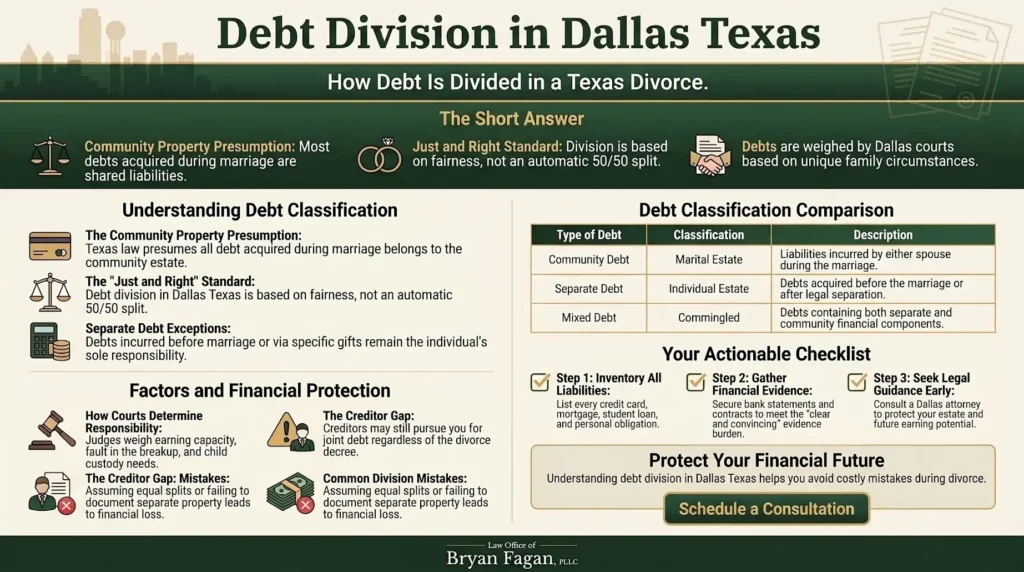
Debt Division in Dallas Texas follows community property principles under the Texas Family Code, but the outcome is rarely as simple as splitting balances evenly. Under §3.002 and §3.003, most debts incurred during the marriage are presumed to be community obligations, meaning they are part of the marital estate. However, Texas courts apply a “just and right” standard under §7.001, giving judges broad discretion to divide both assets and debts in a way that reflects fairness—not equality.
In straightforward situations, where debts are clearly documented and both spouses generally agree on responsibility, dividing debt in a Texas divorce can be relatively predictable. Courts will still consider each spouse’s financial capacity, earning ability, and overall stability—especially when children are involved—but agreements that align with these factors are often approved. For a deeper understanding of how courts approach these decisions, reviewing how debt is divided in a Texas divorce can provide helpful context on how these principles are applied in real cases.
In more complex cases, the analysis becomes more detailed and strategic. Where disputes are contested—such as disagreements over whether a debt is community or separate, the existence of hidden liabilities, or high-value financial obligations—judges closely evaluate documentation, credibility, and the purpose behind each debt. Courts may assign a greater share of debt to one spouse based on earning potential, responsibility for incurring the obligation, or the need to preserve financial stability moving forward. This is particularly important when debt allocation must be balanced alongside broader issues like property division in Texas divorce, where both assets and liabilities must work together to create a fair outcome.
The key takeaway is that no two cases are exactly alike. Some debt division matters can be handled with basic legal guidance and clear financial records. In more complex or high-stakes situations, however, a structured, strategic approach becomes critical to avoid long-term financial consequences. Acting early, understanding your exposure, and recognizing the level of complexity in your case can make a meaningful difference in protecting your financial future and moving forward with confidence.

Listen to Our Texas Family Law Podcast
Prefer listening? In this episode, we discuss debt division in Dallas, Texas, including how debts are allocated in divorce, what factors courts consider, and who may be responsible for paying what after the case is finalized.
What Is Community Debt in Texas?
When it comes to Debt Division in Dallas Texas, understanding what qualifies as community debt is one of the most important first steps. Under Texas Family Code §3.002, community property includes not only assets acquired during the marriage but also the liabilities tied to that marital estate. In practical terms, this means that most debts incurred by either spouse during the marriage—if they benefited the household or were taken on for family purposes—are presumed to be shared obligations subject to division in a divorce.
In straightforward situations, this classification is relatively clear. Common examples of community debt include credit card balances used for household expenses, mortgages on homes purchased during the marriage, car loans, medical bills, and even certain business-related obligations. Courts generally view these debts as part of the overall financial picture that must be divided fairly under the “just and right” standard in Texas Family Code §7.001. If you want a clearer breakdown of how these principles are applied in real cases, reviewing how debt is handled in a Texas divorce can provide helpful context.
In more complex cases, however, determining whether a debt is truly “community” can become a contested issue. Where disputes arise—such as claims that a debt was incurred for personal use, hidden liabilities, or financial activity that did not benefit the marriage—Texas courts will closely evaluate documentation, timing, and credibility. Under §3.003, debts incurred during the marriage are presumed to be community, but that presumption can be challenged. The spouse claiming a debt is separate must meet a high burden of proof with clear and convincing evidence, often requiring detailed financial records and tracing.
This is where many people underestimate the importance of early action. Assuming all debt will simply be split—or ignoring how creditors may still pursue both parties—can create long-term financial risk. In cases involving higher debt amounts, business interests, or disputed financial activity, a more structured and strategic approach is often necessary to protect your position. Recognizing whether your situation is straightforward or more complex can make a meaningful difference in how your case is resolved—and in your financial stability moving forward.

What Is Separate Debt?
Separate debt, under Texas Family Code §3.001, includes obligations that are not part of the community estate. Generally, separate debt falls into these categories:
- Debt incurred before marriage: Student loans taken out before you said “I do,” credit cards opened and charged before the wedding, and car loans from your single days remain your separate obligation.
- Debt tied to separate property: If you inherited property and took out a loan secured by that inheritance, that debt may be considered your separate debt. Debts tied to a spouse’s separate property are not subject to division in divorce; however, if community funds were used to pay down such debts, the other spouse may have a reimbursement claim under Texas law.
- Debt from gifts or inheritance obligations: Obligations connected to assets received by gift or inheritance during marriage may remain separate.
Here’s where it gets complicated: commingling can blur the lines. If you used community funds to pay down separate debt, or if separate property funds were mixed with community funds in joint bank accounts, tracing becomes necessary to establish what remains separate.
For Dallas residents, this means keeping meticulous records. Texas courts, including Dallas County district courts, require clear evidence when one spouse claims debt was separate rather than community debt.
Table 1 – Community vs Separate Debt
Community assets and community income—including property acquired during marriage such as salaries, bonuses, and other earnings—are generally considered community property under Texas law and are subject to division during divorce proceedings. The table below compares how Texas courts distinguish between community and separate debt:
| Debt Type | Community Debt Under Texas Law | Separate Debt Under Texas Law |
|---|---|---|
| Credit cards used for household expenses | Yes – subject to division under §7.001 | No – unless incurred entirely before marriage |
| Mortgage on home purchased during marriage | Yes – community debt | Separate only if home acquired before marriage with no community funds used |
| Car loan during marriage | Yes – community debt | Potentially separate if vehicle and loan predate marriage |
| Student loans before marriage | No | Yes – remains separate obligation |
| Medical bills during marriage | Yes – community debt | No |
| Business debts from marital enterprise | Yes – typically community debt | Separate only if business was separate property and no community funds were used |
How Courts Divide Debt in Dallas Divorce Cases
Texas Family Code §7.001 establishes that courts must divide the marital estate in a manner that is “just and right,” considering the rights of each spouse and any children. In Texas, the term “just and right division” refers to the legal standard for dividing property—including both assets and debts—during a divorce, allowing judges discretion to determine what is fair based on the unique circumstances of each case.
This means Dallas County district courts have significant flexibility when dividing property. A court is not required to make an equal division of community property; instead, it must divide it in a manner that considers various factors such as earning capacity and financial resources of each spouse. If the court finds that one spouse is primarily responsible for certain debts, it may assign those debts accordingly.
Factors Texas courts consider include:
- Each spouse’s earning capacity, education, and employment background
- Age and health of both parties
- Which spouse will have primary custody of children
- Each spouse’s separate property holdings
- Fault in the breakup of the marriage (if raised)
- The nature and extent of the community estate
- Each spouse’s ability to pay certain debts going forward
- Whether an equal division is appropriate, or if a just and right division should result in one spouse receiving more property or more debt based on the circumstances
In Dallas divorce cases, judges often examine who incurred the debt, what the debt was used for, and whether assigning it to one spouse over the other would create an unfair burden. For example, if one spouse has significantly greater earning potential, they may be assigned more debt to balance the overall division of the marital estate. If the court finds that one spouse is primarily responsible for incurring a particular debt, that spouse may be ordered to pay it.
The case of Finn v. Finn from the Dallas Court of Appeals established that liabilities are legitimate factors in making a just and right division, and courts may order one spouse to assume debts as part of the divorce judgment. In complex estates, if community funds were used to pay debts tied to a spouse’s separate property, the court may also consider reimbursement claims. Additionally, while primary custody does not guarantee more property, courts may award more property to the custodial parent to promote stability for children.
Common Types of Debt in Divorce
Understanding how different types of debt are handled is a critical part of Debt Division in Dallas Texas, especially when you’re trying to anticipate how financial responsibilities may be assigned during your divorce. Under Texas Family Code §3.002 and §3.003, most debts incurred during the marriage are presumed to be community obligations, but how those debts are ultimately divided depends on what the court considers “just and right” under §7.001. That means the type of debt—and how it was used—can significantly influence the outcome.
In straightforward situations, where debts are clearly tied to shared household expenses, courts typically treat them as community obligations. Credit card balances, for example, are often divided between spouses if they were used for family-related purchases, even if only one name appears on the account. Mortgage debt follows a similar pattern. If a home was purchased during the marriage, the loan is generally considered community debt, and the spouse awarded the home is often assigned responsibility for the mortgage. However, a common mistake is assuming that this assignment removes the other spouse from liability. In reality, lenders are not bound by the divorce decree, and refinancing is usually necessary to fully protect both parties. For a broader overview of how these issues are handled, reviewing debt and divorce in Texas can provide additional clarity.
In more complex cases, the analysis becomes more detailed and often more contested. Car loans, for instance, are typically assigned to the spouse who keeps the vehicle, but disputes can arise if there is negative equity or disagreement over value. Student loans present another layer of complexity. While debt incurred before marriage is generally separate, loans taken out during the marriage may be considered community debt—particularly if the education contributed to the financial well-being of the household. Where disputes are contested, courts look closely at the purpose of the debt, the timing, and whether the marital estate benefited.
Higher-stakes financial issues require even more strategic consideration. Retirement accounts such as 401(k)s and pensions are treated as community property to the extent they were accumulated during the marriage, and dividing them often requires a Qualified Domestic Relations Order (QDRO) to avoid tax consequences. Tax debt can be especially risky, as obligations incurred during the marriage are typically considered community debt, and agencies like the IRS may pursue either spouse regardless of how the court allocates responsibility. In cases involving large balances, business-related liabilities, or mixed financial interests, a more structured approach becomes essential to protect long-term financial stability.
The key takeaway is that not all debt is treated the same, and assumptions can be costly. In simpler cases, clear documentation and basic legal guidance may be enough to reach a fair resolution. In more complex or high-conflict situations, however, careful analysis and strategic planning are often necessary to avoid unintended financial consequences. Recognizing the type and complexity of the debt involved is one of the most important steps in protecting your financial future during divorce.

Table 2 – Common Debt Types in Divorce
| Debt Type | How It’s Typically Handled | Key Considerations |
|---|---|---|
| Credit card balances | Assigned in decree; treated as community debt | Joint accounts may require both spouses to remain liable to creditors |
| Mortgage | Spouse keeping home often assumes debt | Refinancing necessary to remove other spouse’s liability |
| Auto loans | Assigned to spouse keeping vehicle | Title transfer and refinancing recommended |
| Student loans | Pre-marital: separate; during marriage: potentially community | Whether education benefited community matters |
| Medical bills | Treated as community debt | Timing of incurrence determines classification |
| Tax debt | Community obligation | Government can pursue either spouse regardless of decree |
| Retirement plans | Division typically requires a Qualified Domestic Relations Order (QDRO) | Proper QDRO avoids tax penalties when dividing retirement accounts |
What Happens If One Spouse Doesn’t Pay Assigned Debt
Here’s a critical point that catches many Dallas residents off guard: a divorce decree does not override contracts with lenders. Even if ordered by a judge, creditors can pursue the original debtor if payments are missed.
If an ex-spouse is ordered to pay a joint debt and defaults, the creditor can legally pursue the other spouse for payment if their name is on the contract. This is why debt division in Dallas Texas requires careful attention to creditor liability, not just court orders. If one party is dissatisfied with how debts were divided, it’s important to know that appeals focus on legal errors—such as abuse of discretion or misapplication of law—rather than simply one party’s unhappiness with the outcome.
What can you do?
- Include indemnification clauses in your divorce decree, requiring the responsible spouse to reimburse you if creditors pursue you for their assigned debt
- Seek contempt of court remedies if your ex-spouse violates the decree by not paying assigned debts
- Refinance joint debts into the responsible spouse’s name only
- Monitor your credit report to catch missed payments early
Your credit score is at stake. Even if the court assigned debt to your ex-spouse, late payments and defaults will appear on your credit report if your name remains on the account.
Contested vs Uncontested Debt Division
The approach to dividing debt depends significantly on whether your divorce is contested or uncontested.
Uncontested divorce means you and your spouse agree on how to divide assets and debts. You can negotiate debt division through mediation or collaborative divorce, often reaching agreements faster and at lower cost. Asset division and debt division are typically negotiated together, as both are crucial to ensuring a fair distribution of the marital estate. Experienced law firms can help guide you through this process to protect your interests and achieve a just outcome. Dallas courts still review these agreements to ensure they meet the just and right standard, but approval is typically straightforward when both parties agree.
Contested divorce means disagreements require court intervention. In Dallas County, contested divorces involving substantial debts often require:
- Extensive financial discovery
- Expert testimony from forensic accountants
- Multiple court hearings
- Significantly higher legal costs (often tens of thousands of dollars)
The Law Office of Bryan Fagan, PLLC serves clients in Dallas County, Denton County, and surrounding areas, providing experienced legal counsel for complex contested divorces. If your marital estate includes complex debts—business obligations, mixed separate and community property, or disputed reimbursement claims—litigation may be necessary. However, most Dallas family law attorneys recommend attempting negotiation first whenever possible.
Why Documentation Matters
When it comes to Debt Division in Dallas Texas, documentation is one of the most powerful tools you have to protect your financial future. Texas law begins with a presumption under §3.003 that debts incurred during the marriage are community obligations, but that presumption can be challenged. Without clear, organized records, proving that a debt is separate—or that it should be allocated differently under the “just and right” standard in §7.001—becomes extremely difficult.
In straightforward situations, where debts are clearly tied to specific accounts and there is little disagreement, gathering basic documentation may be enough to support a fair division. This typically includes loan agreements showing when obligations were created, credit card statements reflecting how funds were used, bank records tracking payments, and tax returns documenting income and expenses. When these records are complete and consistent, courts can more easily determine whether a debt belongs to the community estate under §3.002 or whether it should be treated differently. For a broader understanding of how these financial details influence outcomes, reviewing debt division in Texas divorce: what you need to know can provide helpful context.
In more complex cases, documentation becomes even more critical. Where disputes are contested—such as claims of hidden debt, disagreements over whether an obligation benefited the marriage, or situations involving business finances or mixed accounts—courts rely heavily on detailed records and credible tracing. Business financial statements, prenuptial or postnuptial agreements, and payment histories can all play a role in determining how debt is classified and divided. Judges often evaluate not only the existence of the debt, but also its purpose, timing, and impact on the overall financial stability of each spouse, especially when children are involved.
This is where many people encounter avoidable risk. Failing to fully disclose debts or assets can lead to serious consequences, including sanctions and damage to your credibility in court. More importantly, incomplete documentation can weaken your ability to argue for a fair allocation—particularly in reimbursement claims under §§3.402 and 3.409, where one spouse may seek compensation for community funds used to pay separate obligations. In simpler cases, staying organized and proactive may be enough. In higher-stakes or disputed situations, however, a more structured and strategic approach to documentation is often necessary to protect your position and avoid long-term financial consequences.

How to Protect Yourself During Debt Division
When navigating Debt Division in Dallas Texas, taking proactive steps early in the process can make a significant difference in protecting your financial future. Texas courts apply the “just and right” standard under §7.001, which means outcomes are influenced not only by the type of debt involved but also by each spouse’s financial capacity, responsibility, and overall stability. What you do before and during your divorce can directly impact how those factors are evaluated—and whether you face unnecessary financial risk later.
In straightforward situations, where debts are clearly identified and there is little dispute, basic financial awareness can go a long way. Monitoring your credit reports across all three bureaus helps you identify joint accounts and catch any unusual activity early. Closing joint accounts or removing yourself as an authorized user where possible can prevent additional debt from accumulating during the divorce. Refinancing obligations like mortgages or car loans into one spouse’s name is another critical step, especially since creditors are not bound by a divorce decree and may still pursue both parties. For additional insight into how financial obligations can continue to affect you beyond major life events, reviewing what happens to your debt when you pass away can help illustrate the importance of understanding liability.
In more complex cases, where disputes are contested or financial situations involve higher debt levels, business obligations, or unclear responsibility, a more structured approach becomes essential. Documentation plays a central role—keeping detailed records of financial communications, payment histories, and account statements can strengthen your position when courts evaluate classification under §§3.002 and 3.003. Judges often look closely at who incurred the debt, how it was used, and whether assigning it to one spouse supports long-term stability, particularly when children are involved.
This is also where common mistakes can create long-term consequences. Assuming debt will be divided equally, ignoring creditor liability, or delaying action on refinancing can all increase financial exposure. Creating a realistic post-divorce budget that reflects your assigned obligations helps ensure you can meet those responsibilities moving forward. In simpler cases, these proactive steps may be enough to maintain control and clarity. In higher-stakes or contested situations, however, careful planning and timely decisions are often necessary to avoid financial strain and ensure a more stable transition after divorce.
Checklist: Debt Division in Dallas Texas
Use this checklist to stay organized throughout your divorce—whether you are handling debt division, asset division, or dividing property:
- [ ] List all debts, including creditor names, balances, and whose name is on each account
- [ ] Identify which debts are joint and which are individual
- [ ] Gather all loan agreements, credit card statements, and payment histories
- [ ] Obtain credit reports from all three bureaus
- [ ] Close or freeze joint credit accounts to prevent new charges
- [ ] Create a plan for refinancing joint debts
- [ ] Track all payments made during the divorce process
- [ ] Document any debts your spouse incurs after separation
- [ ] Consult with a Dallas family law attorney early in the process
- [ ] Follow all court orders regarding debt payment

How a Dallas Family Law Attorney Can Help
Navigating debt division in Dallas Texas without legal guidance is risky. A knowledgeable family law attorney helps you—and a law firm with experience in asset division and retirement plans can help protect your interests throughout the process.
Identify all marital and separate debts through comprehensive financial discovery, ensuring nothing is hidden or overlooked.
Classify debts correctly under Texas community property law, protecting you from assuming obligations that should remain separate.
Negotiate favorable terms during mediation or settlement discussions, advocating for a fair and equitable division based on your specific circumstances.
Handle reimbursement claims and divide retirement plans as part of the overall asset division process, ensuring that community funds used for separate property or retirement accounts are properly addressed and divided according to Texas law.
Represent you in court if contested issues require judicial resolution, presenting evidence that supports your position on debt classification and division.
Draft protective language in your divorce decree, including indemnification provisions that shift liability if creditors pursue you for your ex-spouse’s assigned debts.
The Law Office of Bryan Fagan, PLLC understands the unique challenges Dallas County residents face in divorce. Debt division isn’t just about splitting numbers—it’s about protecting your financial stability for years to come.
Conclusion
Debt Division in Dallas Texas isn’t just about assigning balances—it’s about shaping what your life looks like after the divorce is final. The choices made during this process can either create clarity and stability or leave lingering financial stress that follows you for years. When you understand how Texas courts approach debt, and how those decisions connect to your broader family situation, you’re in a much stronger position to move forward with confidence instead of uncertainty.
In straightforward situations, where debts are clearly defined and both spouses are cooperative, resolving these issues can be relatively smooth with the right guidance. In more complex cases—especially those involving high balances, business obligations, hidden accounts, or disputes about who created the debt—strategy becomes critical. If your case involves financial pressure that could affect housing, credit, or your ability to maintain stability, it’s important to have the right level of legal support guiding each decision.
At The Law Office of Bryan Fagan, PLLC, the focus is on helping families regain control through clear, practical direction—not just legal answers. Whether you’re navigating a simple division or a more complicated financial landscape, the goal remains the same: protect what matters most and give you a path forward with clarity, confidence, and peace of mind.
Frequently Asked Questions
Debt division in Dallas Texas is part of the broader asset division process in a community property state. Under Texas Family Code §7.001, courts divide marital property—which includes both assets and debts acquired during marriage—in a manner that is “just and right,” not necessarily equal. Judges consider factors such as earning capacity, custody arrangements, and each spouse’s ability to pay when dividing property and debt between spouses.
Community debt includes most debts incurred during marriage by either spouse, regardless of whose name appears on the account. Under Texas Family Code §3.002, any debt acquired during marriage is presumed to be community property unless proven otherwise by clear and convincing evidence. Community property includes assets acquired during marriage, such as real estate, personal property, and financial accounts, while separate property is not subject to division in a divorce.
Possibly. While a divorce decree may assign debt to one spouse, creditors can still pursue both spouses if both names remain on the account. A divorce decree does not override contracts with lenders, so refinancing or removing your name from joint accounts is essential protection.
If your ex-spouse fails to pay debt assigned in the divorce decree, you may file a motion for contempt of court. However, creditors may still pursue you if your name is on the account. Including indemnification language in your decree provides additional protection and recourse.
Yes. Spouses can negotiate debt division as part of the overall asset division process through mediation, collaborative divorce, or direct settlement discussions. Courts in Dallas County generally approve agreements that meet the just and right standard. Negotiated settlements often cost less and resolve faster than contested litigation.
While not legally required, working with a Dallas family law attorney is strongly recommended. An attorney helps identify all debts, classify them correctly under Texas law, negotiate favorable terms, and draft protective language in your divorce decree to safeguard your financial interests.
Under Texas law, the community estate continues until the divorce decree is final. Debt incurred after separation but before the decree may still be considered community debt, though courts have discretion to consider the circumstances of when and why the debt was acquired.
Mortgages incurred during marriage are community debt. Typically, the spouse keeping the home assumes the mortgage. However, the other spouse remains liable to the lender until the mortgage is refinanced. Courts often include provisions requiring refinancing within a specified timeframe.
Retirement plans are considered marital property if acquired or contributed to during the marriage and are subject to division in a divorce. Dividing retirement plans often requires a Qualified Domestic Relations Order (QDRO) to allocate assets without incurring tax penalties. Proper legal procedures are essential to ensure compliance and avoid unnecessary financial consequences.
A reimbursement claim arises when community funds are used to pay down a spouse’s separate debt or improve separate property. Under Texas Family Code §3.402, a spouse may be entitled to reimbursement from the other spouse during asset and debt division if the court finds it equitable. This helps ensure financial fairness in dividing property and debts.