
Child Custody Lawyers in Dallas Texas: What Parents Need to Know About Custody Laws (2026 Guide)

It usually doesn’t begin in a courtroom. It begins in a quiet moment—standing in the kitchen after the kids are asleep, realizing the routine you once relied on is starting to unravel. Maybe communication with your spouse has broken down. Maybe you’re already living separately. And now the question that keeps coming back is: what happens next for your children? For many parents, that’s when they start searching for Child Custody Lawyers in Dallas Texas—not just for legal answers, but for clarity, stability, and a way forward.
The truth is, custody decisions in Texas shape far more than schedules. They determine where your child lives, how decisions are made, and how stable their daily life will feel during a time that can otherwise feel uncertain. Under Texas Family Code §153.002, courts are required to make decisions based on the “best interest of the child,” which means judges are carefully evaluating which parent can provide consistency, structure, and support when it matters most.
At The Law Office of Bryan Fagan, PLLC, that reality is at the heart of everything we do. Led by Bryan Joseph Fagan, a South Texas College of Law graduate and recognized authority on Texas divorce and custody law, the firm was built to help families navigate these moments with confidence. The goal is simple but powerful: to empower people to reclaim peace of mind during life’s most difficult transitions by providing clear guidance, compassionate support, and legal strategies that protect what matters most.
In this article, you’ll gain a clearer understanding of how custody works in Texas—from what “primary custody” really means to whether 50/50 schedules are realistic, how temporary orders can shape your case, and what judges actually look for when making decisions. More importantly, you’ll begin to see how the right approach can restore stability for your child—and for you—so you can move forward with clarity and confidence.
Key Takeaways
- Texas uses conservatorship, not “custody,” to define parental rights and responsibilities under the Texas Family Code.
- Courts decide all custody matters based on the best interest of the child, not parental preference or gender.
- Most cases result in Joint Managing Conservatorship, but this does not automatically mean equal physical time with children.
- Documentation and behavior matter—your communication, involvement, and conduct can directly impact your case.
- Working with experienced Child Custody Lawyers in Dallas Texas helps you avoid costly mistakes and protects your parental rights throughout the legal process.

Your Family’s Future Starts Here
Don’t navigate your legal journey alone. Schedule a consultation now and get the clarity and support you deserve.
Speak With a Child Custody Lawyer in Dallas Texas
A contested divorce can affect your finances, your family, and your future. Having a skilled Child Custody Lawyer in Dallas Texas on your side can help protect your interests and give you peace of mind during a challenging time.
To learn more about how the Law Office of Bryan Fagan, PLLC can help with your contested divorce case, call 469-972-8473 today to schedule a confidential consultation.
Start Here: What Should You Do Right Now?
If you’re just beginning to face custody questions, it’s easy to feel overwhelmed—but the first step is clarity. Many parents start by searching for Child Custody Lawyers in Dallas Texas because they want to understand their rights, their options, and what decisions will truly protect their child. In straightforward situations, taking time to learn the basics of Texas custody law—known as conservatorship—can help you avoid early mistakes. Under Texas Family Code §153.002, every decision centers on the best interest of the child, which means your actions now—how you communicate, how involved you are, and how you handle conflict—can directly impact the outcome of your case.
As situations become more complex, especially where conflict is developing, documentation becomes critical. Courts in Dallas look closely at consistency, credibility, and each parent’s ability to provide stability. If your case involves disagreements over schedules, school routines, or daily transitions between households, begin keeping clear records of communication and parenting involvement. Practical realities—like distance, commute times, and how easily a child can move between homes—also play a role in how courts evaluate stability. Understanding local factors such as transportation in Dallas alongside guidance on child custody in Texas can help you better prepare for what judges expect to see in real-world custody arrangements.
Where disputes are contested, or if your case involves relocation, enforcement issues, or high-conflict co-parenting, relying on informal agreements can quickly create risk. These are often the moments where small missteps—like verbal arrangements or inconsistent follow-through—can affect long-term parental rights. In more complex cases, courts will evaluate not just what each parent says, but what they consistently do—and whether their approach supports long-term stability for the child.
If you’re unsure where you stand, that uncertainty is often a signal to take the next step. Some custody matters can be handled with basic legal guidance, but others—especially those involving conflict or multiple variables—require a more structured legal strategy. Recognizing where your situation falls is the first step toward protecting your rights, your child’s stability, and your future.

Listen to Our Texas Family Law Podcast
Prefer listening? In this episode, we discuss child custody in Dallas, Texas, including how courts make custody decisions, key factors that influence parenting arrangements, and what parents need to know.
Child Custody Lawyers in Dallas Texas: The Short Answer
Child custody lawyers in Dallas Texas, also known as child custody attorneys, help parents protect their rights and create parenting plans that serve the child’s best interest. A child custody attorney is dedicated to guiding clients through negotiation, mediation, and court proceedings, ensuring that legal strategy aligns with both the family’s needs and Texas law requirements.
The legal team at The Law Office of Bryan Fagan, PLLC provides comprehensive legal services and is experienced in guiding clients through all family law practice areas, including complex custody, divorce, and other family law issues. With recognized legal specialization in Texas family law, our collaborative legal team is committed to helping clients achieve the best possible outcomes in their cases. Whether you’re establishing custody for the first time, seeking to modify an existing order, or enforcing your rights, a seasoned attorney can provide objective advice and help you navigate family law matters with confidence.
What Does “Child Custody” Mean in Texas?
When parents begin searching for Child Custody Lawyers in Dallas Texas, one of the first points of confusion is terminology. In Texas, what most people call “child custody” is legally referred to as conservatorship—and understanding that distinction is critical. Texas Family Code Chapter 153 governs conservatorship, possession, and access, forming the legal framework courts use to decide who makes decisions for a child and how parenting time is shared. At the center of every case is the standard set by §153.002: the best interest of the child. Judges are not focused on labels or assumptions—they are evaluating stability, involvement, and which parent can provide a consistent, supportive environment.
Conservatorship addresses decision-making authority, including choices about education, healthcare, and overall welfare. Possession and access determine when each parent spends time with the child. In straightforward situations, where parents are aligned and cooperative, these roles can often be structured with relative ease. However, in more complex cases—especially where disputes are contested, communication breaks down, or major decisions are in conflict—the court takes a much closer look at each parent’s credibility, consistency, and ability to co-parent effectively. These are not abstract concepts; they are evaluated through real actions, documented behavior, and the overall stability each parent brings to the child’s life.
Where your case involves relocation, lifestyle changes, or questions about long-term stability, those factors can carry significant weight. For example, if one parent is considering a move, understanding practical implications—like community transition and adjustment factors outlined in resources such as moving to Dallas—can help frame how courts evaluate disruption versus opportunity. Judges are not just deciding where a child lives; they are deciding how that child’s day-to-day life will function moving forward.
In everyday terms, many parents think of custody as simply “who the child lives with.” In reality, Texas law separates rights, responsibilities, and possession into distinct components, and how those pieces are structured can have long-term consequences. In agreed cases, a clear understanding of these terms may be enough to move forward. But where disputes are contested, or where your case involves high-conflict dynamics, enforcement issues, or competing claims for primary residence, a more structured legal strategy becomes essential. Recognizing the complexity of your situation is the first step toward protecting your rights—and your child’s future.

Types of Custody Arrangements in Texas
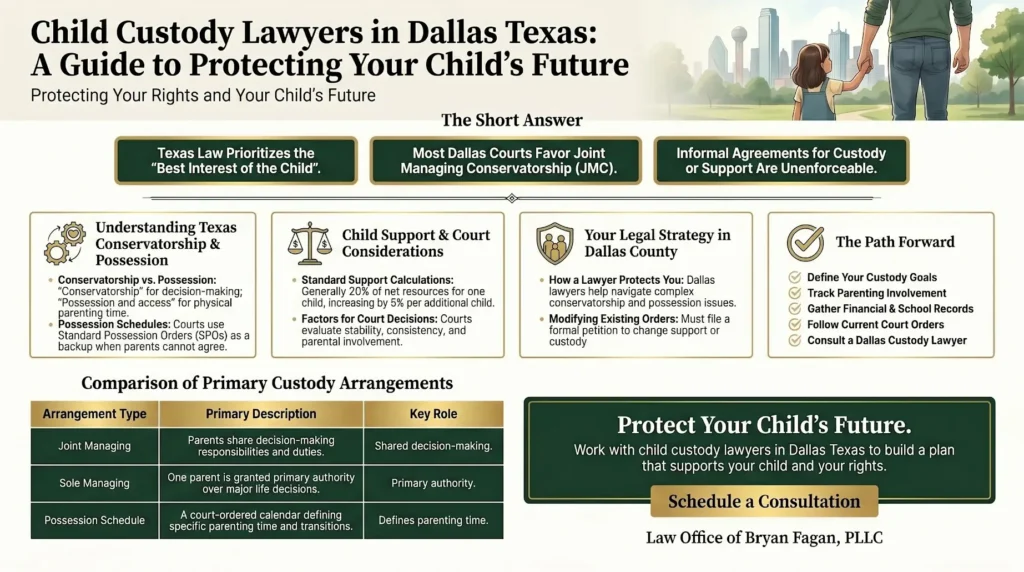
Texas courts generally favor arrangements that allow children to maintain close relationships with both parents. The standard custody arrangement is Joint Managing Conservatorship (JMC), where both parents share physical and legal custody of the child.
Joint Managing Conservatorship means both parents have equal rights and responsibilities regarding their child. However, joint conservatorship does not automatically mean equal time. One parent is typically designated with the exclusive right to determine the child’s primary residence.
Sole Managing Conservatorship (SMC) is granted when the court determines that one parent is unfit or that joint conservatorship would significantly impair the child’s health or emotional development. In these circumstances, one parent receives almost total legal and physical custody.
| Type | What It Means | When It’s Used |
|---|---|---|
| Joint Managing Conservatorship (JMC) | Both parents share decision-making rights and responsibilities; one parent typically has primary residence designation | Default presumption under Texas law; used when both parents are fit |
| Sole Managing Conservatorship (SMC) | One parent has exclusive legal authority over major decisions and primary physical custody | Used when one parent is unfit, or there is domestic violence, neglect, or abuse |
| Possessory Conservatorship | Parent has visitation rights but limited decision-making authority | Typically applies to the parent without primary custody designation |
Some families benefit from creative solutions, such as customized possession schedules or unique parenting plans. Approaches like collaborative law—including collaborative divorce—allow parents to work together outside of court to reach agreements tailored to their unique circumstances, often resulting in less conflict and more flexible arrangements that serve the best interests of their children.
Real-world example: Two Dallas parents divorce amicably. The court appoints them as joint managing conservators. Mom has the right to designate primary residence, while Dad has possession on specific weekends, Thursdays, and shared holidays under the Standard Possession Order. Both parents participate in major decisions about the children’s education and healthcare.
How Courts Decide Custody in Dallas Texas
Family courts in Dallas County are responsible for making child custody determinations based on the child’s best interests. Under Texas Family Code §153.002, every conservatorship decision must be made in the best interest of the child—this is the foundational standard in all Texas custody cases.
Family courts do not favor either parent based on gender when determining custody. They evaluate multiple factors, including:
- The child’s emotional and physical needs
- Each parent’s ability to provide stability
- The existing relationship between each parent and the child
- Any history of family violence or domestic violence
- The child’s desires (if the child is of suitable age and maturity)
- Plans each parent has for the child’s future
In Dallas County, judges in family courts expect parents to come prepared with evidence supporting their position. Documentation of your parenting involvement, communication records, school and medical records, and witness testimony can all influence the court’s determination.
Standard Possession Order (SPO) Explained
When parents begin working with Child Custody Lawyers in Dallas Texas, one of the most important concepts to understand is the Standard Possession Order (SPO). This is Texas’s default visitation framework for the parent who does not have the exclusive right to determine the child’s primary residence. Established under Texas Family Code §153.134, the SPO is designed to create consistency, reduce conflict, and support meaningful parent-child relationships—factors that directly align with the “best interest of the child” standard under §153.002.
In straightforward situations, where parents live within 100 miles of each other and communication remains relatively stable, the SPO provides a predictable structure. This typically includes the 1st, 3rd, and 5th weekends of each month, Thursday evening visits during the school year, and extended time during the summer. Holidays are divided between parents on a rotating basis, allowing children to maintain traditions while spending time with both sides of the family. This consistency is exactly what courts look for when evaluating stability and routine.
In more complex cases, however, the standard schedule may not fully address the realities of the family. Where disputes are contested, or where your case involves relocation, high-conflict co-parenting, or scheduling challenges, courts will look beyond the default structure. Judges evaluate each parent’s ability to follow the schedule, communicate effectively, and meet the child’s day-to-day needs—including access to essential services like healthcare. For example, proximity to providers and continuity of care—factors outlined in resources like medical resources in Dallas—can influence how a possession schedule is structured, particularly when a child has ongoing medical needs.
If your case involves parents living more than 100 miles apart, the schedule typically shifts to longer but less frequent visitation periods to reduce travel strain. For younger children, especially those under three, courts often tailor schedules to support developmental needs, recognizing that frequent, shorter visits may be more appropriate. These adjustments reflect how Texas courts balance parental rights with the child’s need for stability, consistency, and care.
Where parents are aligned, the SPO can serve as a reliable starting point. But if your case involves enforcement issues, changing circumstances, or disagreements about parenting time, relying solely on a default schedule can create long-term challenges. In those situations, a more structured legal strategy may be necessary to ensure the arrangement truly supports your child’s well-being. Understanding whether your situation is straightforward or more complex is a critical step in protecting both your parental rights and your child’s future.

Common Child Custody Disputes in Dallas
Custody disputes arise from many circumstances. The most common issues Dallas family lawyers encounter include:
Relocation disputes: When one parent wants to move—whether across Dallas or out of state—the other parent may object. If a parent wants to relocate, they may need court approval, and courts evaluate how the move affects the child’s relationships, schooling, and stability.
School decisions: In Joint Managing Conservatorship, both parents typically share educational decision-making. Disagreements about which school a child attends can require court intervention.
Safety concerns: Allegations of family violence, domestic violence, or neglect significantly impact custody decisions. Under Texas Family Code §153.004, credible evidence of abuse can eliminate the presumption of joint managing conservatorship.
Communication breakdown: When parents cannot communicate effectively, it affects the child. Courts consider each parent’s willingness to facilitate the other’s relationship with the child.
Parental alienation: Parental alienation—when one parent attempts to undermine or damage the child’s relationship with the other parent—can be a significant factor in custody arrangements. Texas courts may intervene to protect the child’s best interests if parental alienation is present.
| Issue | Legal Approach | What Helps |
|---|---|---|
| Relocation | Court approval required if it affects existing order | Demonstrate how move serves child’s best interest |
| School decisions | May require modification or court order | Mediation; documented communication |
| Safety concerns | Emergency orders; modification of conservatorship | Evidence and documentation of incidents |
| Communication breakdown | Court-ordered communication protocols | Use of co-parenting apps; written records |
| Parental alienation | Court intervention to protect parent-child relationship | Evidence of alienating behaviors; counseling recommendations |
Dallas family lawyers also handle other family law issues that may arise alongside custody disputes, such as child support, visitation, modifications, and related concerns.
Child Support and Custody: How They Work Together
While conservatorship and child support are distinct legal concepts under Texas law, they often intertwine in custody cases. Texas Family Code Chapter 154 governs child support calculations.
Child support is calculated based on the paying parent’s income and the number of children, not on the amount of possession time. The parent who does not have primary custody typically pays support to help cover the child’s expenses.
It’s important to understand that support obligations exist independently of possession rights. A parent cannot withhold visitation because support payments are late, and support cannot be withheld because visitation was denied.
In divorce cases, issues of child support and custody frequently intersect with property division, especially in high-asset or complex family law matters. Careful legal strategy is required to ensure that both the financial and custodial interests of all parties are fairly addressed during the division of marital property.
How Much Does a Child Custody Lawyer Cost in Dallas Texas?
Legal fees for custody cases vary significantly based on complexity, conflict level, and whether the case goes to trial. In Dallas, family law attorneys may charge hourly rates ranging from $200 to $500 or more, depending on the attorney’s years of experience and recognition, such as being named to the Texas Super Lawyers list. Attorneys with decades of dedicated service and extensive years of experience often command higher fees due to their expertise in complex family law matters.
Texas Super Lawyers uses a rigorous, multiphase selection process involving peer nominations and independent research to identify top-rated custody attorneys. Verified legal directories can also help clients find highly rated child custody specialists in Dallas, allowing you to filter for attorneys with the right credentials and focus.
Simple agreed cases—where parents reach consensus—cost considerably less than high-conflict litigation requiring expert witnesses, custody evaluations, or multiple court hearings.
Many firms offer consultations to help you understand your case and potential costs. Early legal strategy can reduce long-term expenses by avoiding mistakes that prolong litigation.
The Dallas Bar Association offers a Lawyer Referral Service to connect clients with qualified private attorneys.
Modifying Custody Orders in Texas
Life doesn’t stay the same—and Texas law recognizes that custody orders sometimes need to change to reflect new realities. Parents often turn to Child Custody Lawyers in Dallas Texas when they realize their current order no longer fits their child’s needs or their family’s circumstances. Under Texas Family Code Chapter 156, modifying a custody order requires clear proof of a material and substantial change in circumstances, along with evidence that the proposed change is in the best interest of the child as required by §153.002.
In straightforward situations, modifications may arise from practical changes—such as a new work schedule, relocation within the Dallas area, or evolving needs as a child grows older. Courts look for stability and consistency, so even when both parents agree, the court still evaluates whether the change supports the child’s overall well-being. In more complex cases, where disputes are contested or communication has broken down, judges take a closer look at each parent’s credibility, level of involvement, and ability to provide a stable environment moving forward.
Examples of material and substantial changes can include a parent relocating, shifts in the child’s medical or emotional needs, repeated violations of an existing order, or significant changes in a parent’s household. In some cases, access to better support systems—such as schools, counseling, or community programs—can also become relevant. For families navigating these transitions, understanding local opportunities like educational resources in Dallas can help demonstrate how a proposed change benefits the child’s long-term development and stability.
Where disputes are contested, or if your case involves high-conflict co-parenting, CPS concerns, or disagreements over primary residence, the stakes are much higher. Courts will closely evaluate whether the requested modification promotes continuity or creates unnecessary disruption. Judges are generally cautious about changing primary residence designations—especially within the first year of an order—because stability is a central factor in custody decisions under §153.134.
If your situation feels uncertain, that’s often a sign that timing matters. In some cases, waiting too long or failing to properly document changes can weaken your position. In others, acting without a clear legal strategy can lead to unintended consequences that affect long-term parental rights. Some modifications can be handled with basic legal guidance, but where complexity or conflict exists, a more structured and strategic approach becomes critical.
Understanding where your situation falls is the first step toward making the right decision. Whether your case is relatively straightforward or involves multiple layers of conflict and change, the goal remains the same: protecting your child’s stability while preserving your role in their life.

Enforcing Custody Orders
When one parent violates a custody order—whether by denying possession, failing to follow the schedule, or ignoring specific terms—the other parent has legal remedies. Texas Family Code Chapter 157 provides enforcement mechanisms.
A Motion for Enforcement must specify which parts of the order were violated, when the violations occurred, and supporting evidence. Remedies include contempt (which can carry fines or jail time), make-up possession time, and attorney’s fees.
Documentation is essential. Keep records of missed visitation, late pickups, denied access, and any communication related to violations.
What to Expect in Dallas County Courts
Dallas County Family District Courts handle conservatorship and custody issues according to local rules and standing orders. Understanding the process helps you prepare.
Temporary orders are typically issued within three to six weeks after filing a divorce petition or custody suit. These orders establish interim conservatorship, possession, and child support while the case proceeds.
Mediation is required in most Dallas custody cases. Local rules often require mediation no later than 45 days before trial. Many families reach agreement in mediation, avoiding the expense and stress of a courtroom trial.
Final hearings occur if mediation fails. Judges evaluate evidence, hear testimony, and issue orders based on the best interest standard.
Dallas judges expect preparation. Working with a family law attorney who knows the local courts and procedures gives you a significant advantage. An experienced attorney can help you determine the best path for your case—whether that means pursuing mediation, negotiation, or trial—to achieve the most favorable outcome for your family.
Common Mistakes Parents Make in Dallas Custody Cases
Many parents unknowingly harm their position by:
- Waiting too long to act: Informal arrangements can establish patterns courts later formalize
- Relying on verbal agreements: Without court orders, agreements are unenforceable
- Poor communication: Text messages and emails become evidence—choose your words carefully
- Failing to document involvement: Keep records of your participation in your child’s life
- Moving or making major decisions without court approval: Relocating with a child without proper authority can damage your case
An empathetic approach—by both parents and their child custody lawyers in Dallas, Texas—can help avoid these common pitfalls and keep the focus on the child’s well-being, rather than escalating conflict or overlooking emotional needs.
When to Hire a Child Custody Lawyer
Consider hiring a family law attorney when:
- The other parent has retained legal representation
- You’re facing a high-conflict custody situation
- There are safety concerns involving family violence or abuse
- CPS involvement has occurred
- One parent plans to relocate
- You need to modify or enforce an existing order
An experienced family law attorney can act as a buffer between you and the other party, allowing you to focus on your emotional well-being while they handle legal strategy.
Hiring an experienced family law attorney is crucial as they can provide objective advice and help navigate the emotional complexities of family law cases. Family law cases can quickly become legally complex, making it advisable to hire an attorney to avoid potential mistakes that could delay or jeopardize your case.

How a Dallas Child Custody Lawyer Can Help
Child Custody Lawyers in Dallas Texas provide comprehensive support throughout your case:
Strategic planning: They assess your situation, identify strengths and weaknesses, and develop a legal strategy aligned with your goals.
Evidence preparation: They help gather documentation, coordinate with experts if needed, and prepare compelling presentations for mediation or court.
Negotiation: Skilled attorneys can often reach favorable agreements without trial, saving time, money, and emotional stress.
Court representation: When courtroom advocacy is necessary, they present your case effectively, handle objections, and ensure your rights are protected.
Working with a law firm that has deep understanding of Texas family law and combined experience in Dallas County courts makes a meaningful difference in outcomes.
Checklist: Preparing for a Child Custody Case in Dallas
- ☐ Understand your custody rights under Texas law
- ☐ Gather relevant documents (school records, medical records, financial information)
- ☐ Track your parenting involvement (activities, appointments, daily care)
- ☐ Maintain communication records (save texts, emails, messages)
- ☐ Follow existing court orders precisely
- ☐ Avoid conflict with the other parent, especially in front of children
- ☐ Prepare for mediation with clear goals and flexibility
- ☐ Consult a family law attorney early in the process
- ☐ Document any concerns about the child’s safety or well-being
- ☐ Focus on your child’s best interests in every decision
Conclusion
Divorce and custody decisions don’t just shape legal outcomes—they shape your child’s daily life, their sense of stability, and their ability to move forward with confidence. The choices you make now matter, but you don’t have to make them blindly. Working with experienced Child Custody Lawyers in Dallas Texas gives you the clarity to understand what the court is really looking for and how to position your case in a way that protects both your rights and your child’s well-being.
In straightforward situations, a clear parenting plan and cooperative approach may be enough to create stability and avoid unnecessary conflict. In more complex cases—especially if your case involves relocation, high conflict, CPS concerns, or disputes over primary custody—you need a more strategic approach built on evidence, preparation, and a deep understanding of how Texas courts make decisions. The key is recognizing where your situation falls and making sure you have the right level of guidance to match it.
At The Law Office of Bryan Fagan, PLLC, the focus is on helping families move from uncertainty to clarity. Through education, thoughtful strategy, and compassionate support, the goal is to help you make informed decisions that protect what matters most—your relationship with your child and their future.
FAQs
Texas courts determine custody based on the best interest of the child, as outlined in Texas Family Code Chapter 153. Judges evaluate factors including each parent’s relationship with the child, parenting abilities, stability, and any history of family violence. Courts do not favor either parent based on gender.
Joint Managing Conservatorship (JMC) allows both parents to share rights and responsibilities regarding their child. Both parents participate in major decisions about education, healthcare, and welfare. However, one parent typically has the exclusive right to designate the child’s primary residence.
Yes, custody orders can be modified under Texas Family Code Chapter 156. You must demonstrate a material and substantial change in circumstances since the prior order and that the modification is in the child’s best interest. Common reasons include relocation, changes in the child’s needs, or safety concerns.
The other parent can file a Motion for Enforcement under Texas Family Code Chapter 157. Remedies include contempt findings, make-up possession time, fines, and attorney’s fees. Documentation of violations is essential for successful enforcement.
While not legally required, hiring a family law attorney provides significant advantages, especially in contested cases. An attorney helps you understand your rights, avoid mistakes, negotiate effectively, and represent you in court if necessary.
Under Texas Family Code §153.009, children 12 years or older may express a preference to the court, but this preference does not control the outcome. The court still determines custody based on the child’s best interest.
Texas courts evaluate the best interest of the child without favoring either parent based on gender. The parent who demonstrates greater stability, involvement, and ability to meet the child’s needs may be designated with primary residence rights.
If a custody order restricts geographic residence, the parent must obtain court approval before relocating. Moving without proper authority can negatively impact your custody case and may constitute a violation of court orders.
