
Parental Visitation in Dallas Texas: A Complete Guide for Parents

It usually starts with something small. A missed weekend. A last-minute schedule change. A tense exchange in a parking lot that your child quietly watches from the back seat. In that moment, Parental Visitation in Dallas Texas stops feeling like a legal concept and starts feeling very real—because it’s shaping your child’s sense of stability, security, and connection with both parents.
Texas law recognizes how important that stability is. Under Texas Family Code §153.002, every decision about possession and access must serve the best interest of the child. That means courts are not just dividing time—they are trying to create a structure where children can maintain strong relationships, feel emotionally grounded, and avoid being caught in the middle of conflict. In Dallas County, judges look closely at how parents communicate, how transitions are handled, and whether a visitation schedule supports consistency in a child’s daily life.
At the Law Office of Bryan Fagan, PLLC, we’ve seen firsthand how the right structure can change everything. Led by Bryan Joseph Fagan, a South Texas College of Law graduate and a trusted authority in Texas family law, our firm is built on a simple mission: to help families move through difficult transitions with clarity, confidence, and peace of mind. Because when parents understand their options and have a plan that works, children feel it—and they begin to settle, adjust, and move forward.
In this article, we’ll walk you through how visitation really works in Dallas, what courts look for when creating or modifying orders, and how you can protect your child’s sense of stability during uncertain times.
Key Takeaways
- Texas law uses “possession and access” instead of “visitation” to describe a parent’s time with their child
- The child’s best interest is the primary consideration in all custody and visitation decisions under Texas Family Code §153.002
- The Standard Possession Order is presumed appropriate for children aged three and older, providing a reliable baseline schedule
- Visitation orders can be modified when there’s a material and substantial change in circumstances
- Documentation is essential when seeking to enforce or modify any visitation order in Dallas County courts

Your Family’s Future Starts Here
Don’t navigate your legal journey alone. Schedule a consultation now and get the clarity and support you deserve.
Parental Visitation in Dallas Texas: The Short Answer
Parental visitation in Dallas Texas refers to the time a parent spends with their child under a court-ordered schedule. In Texas, this is legally called “possession and access” rather than visitation, though many parents use these terms interchangeably. The terms “child visitation” and “child visitation rights” are commonly used to describe a parent’s legal right to spend time with their child as set out in a court order.
Courts base visitation decisions on the best interest of the child, considering factors like the child’s age, health, emotional needs, and relationship with each parent. Dallas County district courts handle these matters locally, applying Texas Family Code provisions while considering each family’s unique circumstances.

Listen to Our Texas Family Law Podcast
Prefer listening? In this episode, we discuss parental visitation in Dallas, Texas, including how parenting time is determined, your legal rights, and how to protect your relationship with your child.
What Does “Visitation” Mean in Texas?
When parents begin navigating Parental Visitation in Dallas Texas, one of the first points of confusion is terminology. In Texas, what most people call “visitation” is legally referred to as “possession and access.” This distinction isn’t just technical—it directly impacts how court orders are written, enforced, and interpreted. Understanding this language early helps you communicate more effectively and avoid costly misunderstandings as your case moves forward.
Under Texas Family Code Chapter 153, “conservatorship” addresses parental rights and decision-making authority, while “possession and access” defines when each parent has physical time with the child. Courts operate under the guiding principle in §153.002—the best interest of the child—which means every possession schedule must promote stability, consistency, and meaningful relationships with both parents. In practice, this often results in one parent being designated to determine the child’s primary residence, while the other parent—known as a possessory conservator—receives a structured visitation schedule that includes weekends, holidays, and extended time during the summer.
For families living in or relocating to the Dallas area, understanding how these schedules are applied locally can make a significant difference in how smoothly things function day-to-day. If you are planning a move or adjusting to life in the area, reviewing considerations around moving to Dallas can help you anticipate how location, distance, and routines may affect your visitation schedule. Courts in Dallas County pay close attention to how well parents can maintain consistency for the child, including school routines, transportation logistics, and communication between households.
In straightforward situations, a standard possession schedule may work effectively with minimal conflict. However, in more complex cases—such as when visitation is denied, schedules are repeatedly disrupted, or parents disagree on key decisions—courts will look more closely at each parent’s credibility, cooperation, and willingness to follow court orders under enforcement provisions like Texas Family Code §157. Where disputes are contested or circumstances change significantly, such as relocation or evolving needs of the child, modifications under §156 may become necessary to restore stability.
Ultimately, visitation in Texas is not just about dividing time—it’s about creating a structure that supports your child’s well-being. When that structure is clear and followed consistently, it provides the foundation children need to feel secure. When it breaks down, the legal system becomes essential in restoring balance and protecting the child’s best interests.

How Visitation Schedules Are Determined
Texas courts consider the following factors when determining visitation arrangements: the child’s best interests, as outlined in Texas Family Code §153.002, are always the primary concern. These factors include the child’s age, health, and emotional needs, as well as other circumstances that may affect the child’s well-being.
When determining a visitation schedule, Texas courts examine:
- The child’s age and developmental needs (the child’s age is a significant factor; for example, Texas courts may adjust visitation schedules for very young children, such as those under three, to ensure the arrangement supports the child’s developmental stage)
- Each parent’s involvement in the child’s life before separation
- Work schedules and availability of both parents
- The distance between where parents live
- Any history of family violence or substance abuse
- The child’s relationship with siblings, extended family, and community
- The child’s school activities and established routines
Judges in Dallas may also consider the financial circumstances of both parents, including income, childcare costs, and medical expenses, when determining custody and visitation arrangements. Texas law allows children aged twelve and older to express their preferences regarding custody arrangements, but the court ultimately decides based on the child’s best interest.
Standard Possession Order (SPO) in Dallas Texas
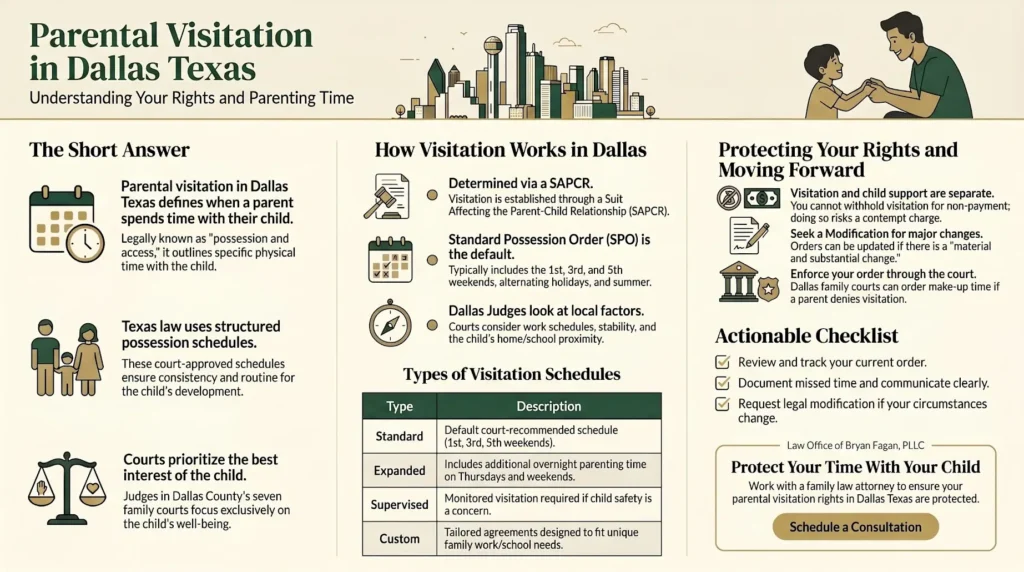
The Texas Standard Possession Order provides the baseline visitation schedule that courts presume is in the best interest of a child aged three or older. This order is often referred to as the ‘standard possession schedule’ or ‘standard visitation schedule’ in Texas family law, and it serves as the default or ‘standard schedule’ for parenting time unless parents agree to a different arrangement. The Standard Possession Order in Texas is presumed to be in the best interest of a child aged three or older, allowing the noncustodial parent to have specific visitation rights unless otherwise agreed upon by both parents.
When the court issues its decision, it is formalized in a ‘custody order,’ which includes the standard schedule or any custom arrangements for visitation and custody. The parent who determines the child’s primary residence is said to have ‘primary possession,’ a key factor in custody and support decisions that can influence child support calculations and holiday visitation arrangements.
Table 1: Standard Possession Order Overview
| Schedule Type | Typical Time | Notes |
|---|---|---|
| Weekends (within 100 miles) | 1st, 3rd, and 5th Friday 6 PM – Sunday 6 PM | Applies when parents live within 100 miles |
| Thursday Visits | Thursday 6 PM – 8 PM during school year | Only for parents within required distance |
| Spring Break | Annually in even or odd years | Typically alternates between parents |
| Summer Possession | 42 days total | Can be two blocks of 7+ days or extended period June 15–July 27 |
| Holiday Rotation | Thanksgiving, Christmas, birthdays | Specific times vary; alternating holidays between parents |
| Over 100 Miles Apart | One weekend per month | No Thursday visits; modified holiday schedule |
If parents live within 100 miles of each other, the non-custodial parent generally has visitation on the 1st, 3rd, and 5th weekends of each month and Thursday evenings during the school year. If parents live more than 100 miles apart, the non-custodial parent may have one weekend per month, every spring break, and 42 days during the summer.
For children under the age of three, Texas law does not apply the presumption of the Standard Possession Order, allowing parents to agree on a different visitation schedule or have the court decide based on relevant factors. Courts recognize that very young children may need different arrangements that account for feeding schedules, attachment, and developmental stages.
When Parents Disagree About Visitation
Disagreements are a common part of Parental Visitation in Dallas Texas, especially when parents are adjusting to new routines and expectations. While many families are able to reach agreements on their own, others find that even small issues—like scheduling conflicts or communication breakdowns—can quickly escalate. Texas courts recognize this reality and have structured processes in place to help parents resolve disputes while keeping the child’s best interest at the center, as required under Texas Family Code §153.002.
In straightforward situations, parents may be able to work through differences by creating a clear, detailed parenting plan that addresses day-to-day concerns. These often include how to handle transportation between homes, how holidays are divided, and how to manage schedule conflicts. For families navigating the logistics of living in a large metro area, factors like distance and commute times can play a significant role, making it helpful to understand how transportation in Dallas can impact consistency and punctuality in visitation exchanges. When expectations are clearly defined, it becomes easier to avoid misunderstandings and maintain stability for the child.
In more complex cases, where disagreements persist or communication breaks down, Dallas County courts typically require mediation before moving forward to trial. Mediation allows both parents to work with a neutral third party to find common ground and develop a workable solution. However, where disputes are contested—particularly when there are repeated missed visits, denial of access, or concerns about a parent’s reliability—judges will closely evaluate each parent’s credibility, level of involvement, and willingness to follow court orders under enforcement provisions like Texas Family Code §157. These factors can significantly influence the outcome of a case.
There are also situations where safety becomes a primary concern. Texas law requires courts to carefully consider any evidence of family violence, substance abuse, or neglect when determining visitation arrangements. In these circumstances, a judge may order supervised visitation to protect the child while still preserving the parent-child relationship. If conditions change over time, modifications under §156 may be necessary to reflect the child’s evolving needs and restore a more stable arrangement.
Ultimately, disagreements about visitation are not just legal disputes—they directly affect a child’s sense of security and routine. Addressing issues early, documenting concerns, and seeking guidance when problems persist can prevent small conflicts from becoming larger, more disruptive challenges.

Modifying a Visitation Order
Life changes, and sometimes visitation orders need to change too. A parent can request a modification of an existing visitation order by filing a modification case with the court under Texas Family Code Chapter 156. If you have a custody agreement from another state or country that needs to be modified or enforced in Texas, you may need to register the agreement with the Texas court before seeking modification or enforcement.
To modify a possession order, you generally must show:
- A material and substantial change in circumstances since the last order
- The modification serves the child’s best interest
Examples of circumstances that might warrant modification include:
- A significant change in one parent’s work schedule
- A parent relocating for employment
- The child’s changing needs as they grow older
- Safety concerns that weren’t present before
- The child reaching age 12 and expressing residential preferences
Courts won’t modify orders for minor inconveniences. The change must be significant enough to affect the child’s well-being or the current order’s workability.
Enforcing a Visitation Order
If one parent is not complying with the visitation order, the other parent can seek enforcement through the court, which may include remedies such as make-up time or clarification of the order. Texas Family Code Chapter 157 provides the framework for enforcement actions. The Office of the Attorney General of Texas and its Child Support Division can assist parents with enforcing child support and visitation orders, though they do not provide legal representation.
If a parent violates a court order regarding visitation, the other parent can file an enforcement action, which may result in penalties such as fines or jail time for contempt of court. Texas law provides for a “Three Strikes” regulation, making it a criminal offense for a custodial parent to interfere with visitation, with penalties that escalate on subsequent offenses. Parents who cannot afford private counsel may seek legal aid for assistance with enforcement actions.
Documentation of missed visits, communication between parents, and any relevant records are essential when seeking modification or enforcement of visitation orders in court. Keep records of:
- Dates and times of missed visits
- Text messages and emails about scheduling
- Attempts to resolve issues informally
- Any witnesses to violations
Visitation rights are independent of child support, meaning a parent cannot be denied visitation for failing to pay child support. These are separate legal obligations, and withholding visitation as punishment for missed support payments violates Texas law.
Common Visitation Challenges
Many parents find themselves facing similar obstacles when navigating their visitation schedule. If the court has concerns about a child’s safety or well-being, the visiting parent may be required to have supervised visitation, meaning another adult or professional must be present during visits. Understanding these common challenges—and their solutions—can help you approach difficulties with clarity.
Table 2: Common Visitation Issues and Solutions
| Issue | Legal Approach | What Helps |
|---|---|---|
| Missed visits or late returns | Motion for enforcement under Chapter 157 | Document incidents with dates, times, and communications |
| Work schedule conflicts | Request modified possession schedule | Present employer documentation; propose alternative times |
| Child resists visiting | Court may consider child’s preference if 12+ | Family counseling; consistent routines; patience |
| Communication breakdown | Mediation; co-parenting coordinator | Use co-parenting apps; written agreements |
| Transportation difficulties | Negotiate exchange locations; court clarification | Neutral meeting points; shared driving responsibilities |
| Concerns about child’s safety | Request supervised visitation | Document specific concerns; report to authorities if needed |
When a child refuses to visit the other parent, the situation requires careful handling. While Texas law allows children aged twelve and older to express their preferences, a child’s refusal alone doesn’t give the custodial parent permission to deny visitation. Courts expect parents to encourage the child’s relationship with both parents.
What to Expect in Dallas County Visitation Cases
Understanding how the legal process works is a key part of navigating Parental Visitation in Dallas Texas. While every family’s situation is unique, Dallas County courts follow a structured process designed to create stability for children and clarity for parents. Knowing what to expect can reduce uncertainty and help you make informed decisions at each stage.
Most cases begin with the filing of a Suit Affecting the Parent-Child Relationship (SAPCR), which formally asks the court to establish or modify custody and visitation. Once filed, the other parent must be properly served. This initial step may seem procedural, but it sets the tone for how efficiently your case moves forward—delays here can slow everything that follows.
Early in the process, courts often issue temporary orders to establish a working visitation schedule while the case is pending. These temporary arrangements are more important than many parents realize. Judges frequently look at how well each parent follows these orders when making final decisions under Texas Family Code §153.002 and §153.134. Consistency, communication, and reliability during this phase can significantly influence the outcome.
In straightforward situations, parents may reach an agreement through mediation, which Dallas County courts strongly encourage before trial. Mediation gives both sides the opportunity to create a customized plan that fits their child’s needs without the stress of litigation. However, in more complex cases—especially where disagreements persist, schedules are not followed, or communication breaks down—mediation may not resolve all issues.
Where disputes are contested, the case moves to a final hearing. At this stage, the judge evaluates evidence, testimony, and each parent’s ability to provide a stable environment. Courts will closely consider factors such as adherence to prior orders, involvement in the child’s daily life, and overall credibility. If enforcement becomes an issue, provisions under Texas Family Code §157 may come into play, while significant life changes may require modification under §156 to better support the child’s long-term stability.
The timeline for these cases can vary. Some resolve within a few months, while others take longer depending on complexity, court availability, and the level of conflict involved. For parents navigating local systems and processes, understanding available governmental resources in Dallas can also provide helpful context and support along the way.
Ultimately, the process is designed to protect the child—not just legally, but in a practical, day-to-day sense. When handled proactively, it creates structure and predictability. When issues are ignored or delayed, small problems can become larger challenges that are harder to resolve later.

How a Dallas Family Law Attorney Can Help
Navigating Parental Visitation in Dallas Texas often becomes more manageable when you have clear legal guidance and a strategy tailored to your family’s needs. While the law provides a framework under Texas Family Code §153.002 and §153.134, how those rules apply in real life depends on your specific circumstances—your schedule, your child’s needs, and your ability to work with the other parent.
In straightforward situations, legal support may focus on helping you create a well-structured parenting plan that reduces confusion and promotes consistency. This can include defining clear visitation schedules, outlining communication expectations, and ensuring both parents understand their rights and responsibilities. When both parties are cooperative, this type of guidance can help avoid future disputes and provide the stability courts look for when evaluating the best interest of the child.
In more complex cases, where communication breaks down or disagreements persist, a more strategic approach becomes important. This may involve preparing for mediation, negotiating terms that protect your time with your child, and addressing issues like missed visitation or conflicting schedules. Courts often evaluate how each parent handles these challenges, including their willingness to follow court orders and maintain consistency. When patterns of noncompliance emerge, enforcement under Texas Family Code §157 may be necessary to restore balance and accountability.
Where disputes are contested or circumstances change significantly—such as relocation, evolving needs of the child, or concerns about stability—modifications under §156 may be required. These situations often demand a deeper level of preparation, including documentation, evidence of changed circumstances, and a clear plan that aligns with the child’s best interests. In some families, additional considerations may arise, such as extended family involvement. Understanding how issues like grandparents’ rights in Texas can intersect with visitation may also become relevant depending on the dynamics of your case.
Ultimately, legal guidance is not just about navigating the court system—it’s about creating a structure that protects your child’s well-being and your relationship with them. When handled proactively, it helps prevent small issues from becoming larger disputes. When challenges arise, having the right level of support can make the difference between ongoing conflict and a workable, stable solution.
Actionable Checklist: Parental Visitation in Dallas Texas
- [ ] Review your court order thoroughly and understand every provision
- [ ] Track your visitation schedule and document any missed visits or problems
- [ ] Maintain clear, respectful communication with the other parent
- [ ] Keep detailed records of all interactions and scheduling issues
- [ ] Stay organized with school calendars, activities, and important dates
- [ ] Avoid conflict in front of your children—always
- [ ] Prepare for mediation if disputes arise by knowing your priorities
- [ ] Consult an attorney early if serious issues develop
- [ ] Focus on your child’s best interests in every decision
- [ ] Know your legal rights and responsibilities under your possession order
Conclusion
Parental Visitation in Dallas Texas isn’t just about following a schedule—it’s about creating a structure your child can rely on when everything else feels uncertain. The right plan brings consistency, reduces conflict, and gives your child the stability they need to feel secure in both homes. When parents approach visitation with clarity and intention, it shows up in their child’s confidence, behavior, and overall well-being.
In straightforward situations, a clear and well-structured possession order may be enough to keep things running smoothly. But in more complex cases—especially when communication breaks down, schedules conflict, or your child is struggling to adjust—having the right legal guidance can make all the difference. If your case involves disputes, modifications, or concerns about how visitation is affecting your child, it’s important to work with a team that understands both the legal framework and the real-life impact on your family.
At the Law Office of Bryan Fagan, PLLC, our goal is to help you move forward with clarity, confidence, and a plan that truly works. Whether you’re navigating a simple agreement or facing a more complicated situation, we’re here to provide the guidance and structure you need to protect what matters most—your relationship with your child and their future.
Frequently Asked Questions
In Texas, parental visitation is legally called “possession and access.” It refers to the scheduled time a parent spends with their child under a court order. Texas Family Code Chapter 153 governs these arrangements, with all decisions based on the child’s best interest.
Dallas County courts determine visitation by evaluating the child’s best interest under Texas Family Code §153.002. Judges consider factors including the child’s age, health, emotional needs, each parent’s involvement, and any safety concerns. The Standard Possession Order serves as the presumed schedule for children three and older.
Yes. Under Texas Family Code Chapter 156, visitation orders can be modified when there’s a material and substantial change in circumstances and the modification serves the child’s best interest. A parent must file a modification case with the court to request changes.
If a parent repeatedly misses court-ordered visitation, the other parent may file an enforcement motion under Chapter 157. Courts can order make-up time and may hold the violating parent in contempt, which can result in fines or jail time in serious cases.
Texas law allows children aged twelve and older to express preferences about living arrangements, but courts make final decisions based on best interest—not the child’s wishes alone. A child’s refusal doesn’t give the custodial parent permission to withhold visitation.
While not legally required, an experienced family law attorney provides significant advantages. Legal representation helps ensure your rights are protected, documentation is proper, and your case is presented effectively—whether in mediation or court.
Temporary orders can often be obtained within weeks of filing. Final orders typically take several months, depending on court schedules, whether parties reach agreement, and case complexity. Contested cases requiring trial take longer than mediated settlements.
If the other parent violates the possession order, you can file an enforcement action in Dallas County court. Document all violations carefully. Remedies include make-up visitation time, contempt findings, fines, and in extreme cases, modification of custody arrangements.