
Governmental Resources in Dallas Texas: Your Complete Guide to Local Services and Offices
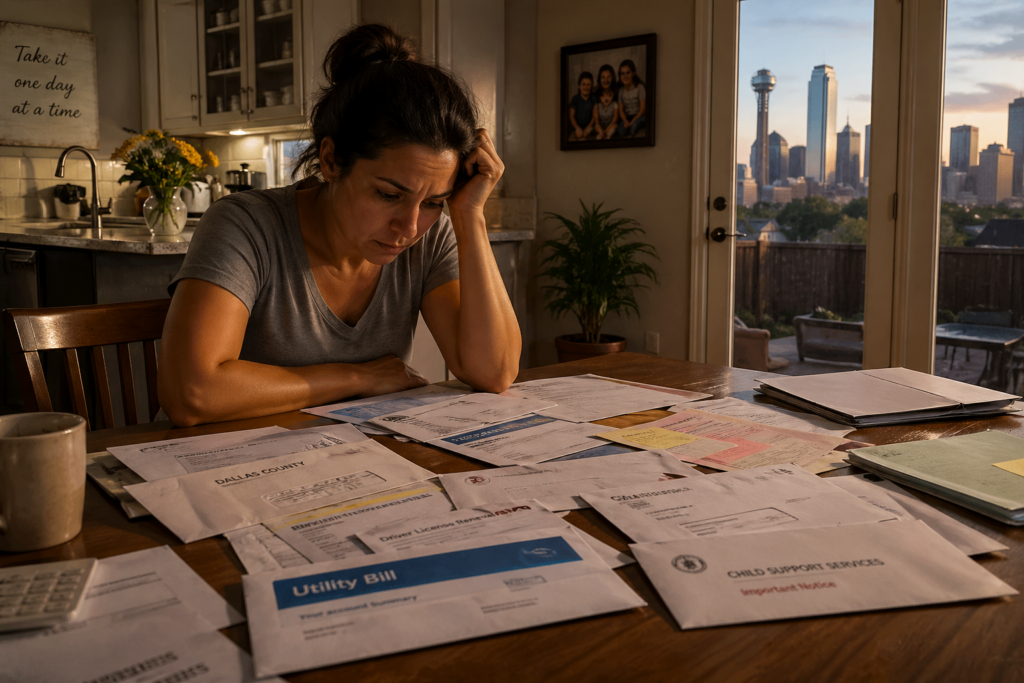
One evening, a parent in Dallas sits at the kitchen table surrounded by unopened mail—utility bills, a notice from the county, paperwork about a driver’s license renewal, and a letter about child support. Just days earlier, life felt predictable. Now, after the decision to divorce, even simple tasks feel overwhelming. In moments like this, understanding Governmental Resources in Dallas Texas becomes more than helpful—it becomes essential to regaining control and moving forward with clarity.
Divorce has a way of turning everyday responsibilities into complicated decisions. Who updates the child’s address with the school? Who maintains health insurance? How do you ensure financial support continues without interruption? Under Texas Family Code §153.002, courts are required to focus on the best interest of the child, which includes maintaining stability across all areas of life—not just where a child lives, but how their daily needs are met and supported.
At the Law Office of Bryan Fagan, PLLC, families are guided through these transitions with a clear purpose: helping people reclaim peace of mind during life’s hardest moments. Led by Bryan Joseph Fagan, a South Texas College of Law graduate and a recognized authority in Texas divorce and custody law, the firm combines experience, education, and practical strategy to simplify what can otherwise feel overwhelming. Because when parents understand both the legal process and the systems supporting them, they can make decisions that protect their family’s future with confidence.
If you are facing divorce and trying to navigate everything that comes with it—from legal filings to daily logistics—you are not alone. The path forward may feel uncertain right now, but with the right guidance and resources, it becomes manageable—and even empowering.
Key Takeaways
- Dallas County handles most legal and administrative services, including court filings, vital records, property taxes, and social services, while the City of Dallas manages permits, zoning, and municipal court matters.
- Many services are available online, allowing residents to pay taxes, search records, and apply for assistance without visiting an office in person.
- Preparation is essential: bringing proper documentation, checking office hours, and understanding which office handles your specific need will save significant time.
- Assistance programs exist for low income families, including utility assistance, rental assistance, food programs, and health services through Dallas County Health and Human Services.
- The 2-1-1 Texas service connects residents to local resources such as food pantries, shelters, and childcare, providing a single point of contact for community support.

Your Family’s Future Starts Here
Don’t navigate your legal journey alone. Schedule a consultation now and get the clarity and support you deserve.
Governmental Resources in Dallas Texas: The Short Answer
Governmental Resources in Dallas Texas include a network of courts, public offices, and community-based services that touch nearly every part of daily life—especially during major transitions like divorce or custody disputes. For families trying to regain stability, knowing where to turn is not just helpful—it can directly impact your child’s well-being, your financial footing, and the outcome of your case.
In Dallas, responsibilities are divided primarily between Dallas County and the City of Dallas, and understanding that distinction can save time, reduce stress, and prevent costly mistakes. Dallas County government services handle many of the legal and administrative functions tied to family law, including district courts where divorce and custody cases are decided, as well as offices responsible for vital records, property documentation, and public assistance programs. These services often intersect with issues like child support, healthcare access, and financial stability—factors that courts consider under Texas Family Code §153.002 when determining the best interest of the child.
The City of Dallas, on the other hand, focuses on municipal services such as permitting, zoning, and code enforcement. While these may seem unrelated at first, they can become relevant in cases involving housing stability, relocation, or disputes over living conditions. Judges often evaluate not just where a child will live, but whether that environment supports consistency, safety, and access to necessary resources. This aligns with considerations found in Texas Family Code §153.134, where courts structure custody arrangements to promote stability and continuity in a child’s life.
In straightforward situations, families may be able to navigate Governmental Resources in Dallas Texas with careful planning and organization—accessing court services, obtaining records, and coordinating support without significant conflict. But in more complex cases, where multiple agencies are involved or disputes arise over custody, financial support, or access to services, the process can quickly become overwhelming. Delays in paperwork, misunderstandings about jurisdiction, or missed deadlines can affect everything from court outcomes to a child’s daily routine.
Where multiple agencies or disputes are involved—such as CPS investigations under §§262 and 263, disagreements over school placement, or challenges with public assistance—having a structured legal approach becomes critical. Courts look closely at how each parent manages responsibilities, communicates with institutions, and maintains consistency for the child. Even small missteps can be interpreted as a lack of diligence or stability.
For families seeking a broader understanding of how local systems operate, reviewing Governmental Resources in Kingwood can provide helpful context on how Texas communities structure access to services. And if your situation involves parenting arrangements or custody concerns, exploring child custody in Texas can help you better understand how these systems connect to your case.
Ultimately, understanding how government systems intersect with family law is about more than logistics—it’s about protecting your future and your child’s stability. Some situations can be handled with the right information and preparation, but others require careful legal strategy to avoid complications and ensure the best possible outcome. When the stakes involve your family, knowing when to seek guidance can make all the difference in moving forward with clarity and confidence.

Listen to Our Texas Family Law Podcast
Prefer listening? In this episode, we discuss government resources in Dallas, Texas, including where families can find legal assistance, court services, and local programs that provide support when navigating family law matters.
Overview of Dallas Government Structure
Understanding Governmental Resources in Dallas Texas starts with recognizing how the system is structured. Dallas operates under a dual framework where Dallas County and the City of Dallas each serve distinct roles, but often intersect in ways that directly affect families navigating divorce, custody, and financial responsibilities.
Dallas County government oversees many of the functions most closely tied to family law. It is led by a Commissioners’ Court, which includes a county judge and four commissioners responsible for setting tax rates, managing budgets, and supervising county departments. Offices such as the County Clerk, District Clerk, Tax Assessor-Collector, and Sheriff play a central role in handling court filings, maintaining records, enforcing orders, and managing processes that often arise in divorce or custody cases. These systems are not just administrative—they are part of the broader framework courts rely on when applying standards like Texas Family Code §153.002, which focuses on the best interest of the child, and §153.134, which emphasizes stability and consistency in custody arrangements.
The City of Dallas operates separately, focusing on services within city limits such as zoning, building permits, municipal courts, and licensing. While these may appear unrelated to family law at first glance, they often become relevant in cases involving housing stability, relocation, or disputes over living conditions. Courts frequently evaluate whether a parent can provide a stable environment, maintain compliance with local regulations, and ensure access to essential services—factors that influence both credibility and long-term outcomes.
In straightforward situations, families may be able to navigate Governmental Resources in Dallas Texas by identifying whether their needs fall under county or city jurisdiction and following the appropriate process. However, in more complex cases—especially where custody disputes, financial hardship, or coordination between multiple agencies is involved—the overlap between these systems can create confusion. Delays, filing errors, or misunderstanding where to go for specific services can impact everything from court timelines to a child’s day-to-day stability.
Where multiple agencies or disputes are involved, such as CPS matters under §§262 and 263 or conflicts related to housing and financial support, having a clear and structured approach becomes critical. Courts often look at how effectively each parent navigates these systems, communicates with institutions, and maintains consistency for the child. These factors can influence how a judge evaluates parental involvement, responsibility, and overall stability.
For families seeking a broader understanding of how government systems operate across Texas communities, reviewing governmental resources in West University can provide helpful context. And if your situation involves parenting arrangements or decision-making authority, exploring child custody in Texas can help clarify how these systems connect to your case.
Ultimately, some situations can be managed with organization and clear information, but others require a more strategic approach—especially when multiple systems, disputes, or legal considerations are involved. Knowing how these government structures work together allows you to make informed decisions, avoid unnecessary delays, and move forward with greater confidence during an already challenging time.
Courts and Legal Resources in Dallas
Dallas County offers a comprehensive court system that handles everything from small claims to complex family law matters.
District Courts serve as trial courts of general jurisdiction. They handle felony criminal cases, civil lawsuits involving larger amounts, family law matters including divorce, child custody, and adoption, and probate cases. Access to filings, judgments, and case status is available through the District Clerk’s Office.
Justice of the Peace Courts handle smaller civil matters with claims up to $10,000, criminal cases where fines do not exceed $500, and preliminary hearings. Dallas County has 10 Justice of the Peace Courts, each serving a specific precinct. These courts also perform marriages and issue search and arrest warrants.
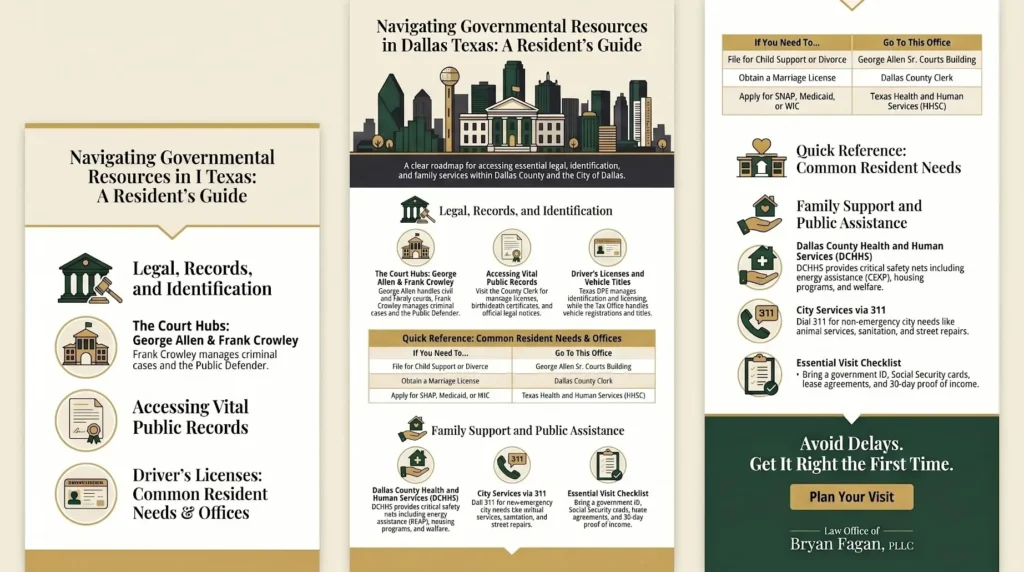
The County Clerk records real property documents like deeds and mortgages, handles vital records including birth, death, and marriage certificates, and maintains assumed business name filings.
The District Clerk manages court filings at the district court level, including civil, family law, and criminal felony cases. This office also handles jury service and maintains appeal records.
The City of Dallas operates the South Dallas Community Court, which serves as a National Mentor Court for community courts worldwide. This court is recognized for its focus on community-based solutions, offering innovative approaches to address underlying issues and improve outcomes for individuals and families in the Dallas area.
For families navigating divorce, custody disputes, or estate planning, understanding how to access district court records and file documents correctly is essential. Dallas courts and community organizations also provide support and intervention for families affected by domestic violence, ensuring access to resources and protection. Walk ins may be possible for some services, but checking hours and requirements in advance is recommended.
Key Government Offices in Dallas Texas
| Office | Purpose | Typical Services |
|---|---|---|
| County Clerk | Records and vital statistics | Birth certificates, death certificates, marriage licenses, property records, assumed business names |
| District Clerk | Court records and filings | Civil case filings, family law documents, criminal felony records, jury service, appeals |
| Justice of the Peace Courts | Small claims and minor offenses | Civil cases up to $10,000, traffic tickets, evictions, marriage ceremonies, preliminary hearings |
| Sheriff’s Office | County law enforcement and jail | Warrant service, court security, county jail operations, unincorporated area patrol |
| Tax Assessor-Collector | Property tax collection | Tax payments, exemptions, vehicle registration, delinquency management |
| Health and Human Services | Public health and social services | Energy assistance, housing aid, immunizations, health screenings, older adult services, dental services |
Each office maintains specific hours of operation, which can be found on their official web pages for the most current information and available resources.
Public Safety and Law Enforcement Resources
Governmental Resources in Dallas Texas include essential public safety systems that directly impact families navigating divorce, custody, and other legal matters. Understanding how law enforcement is structured in Dallas is not just about knowing who to call—it can play a meaningful role in protecting your rights, your children, and your overall stability during a family law case.
Public safety in Dallas is divided between the Dallas Police Department and the Dallas County Sheriff’s Office, each serving different jurisdictions. The Dallas Police Department handles law enforcement within city limits, including patrol, investigations, traffic enforcement, and emergency response. For non-emergency concerns such as property issues, disturbances, or code-related complaints, residents can use Dallas 311, which often serves as a first step in documenting issues that may later become relevant in legal proceedings.
The Dallas County Sheriff’s Office operates at the county level, serving unincorporated areas and managing broader responsibilities such as jail operations, warrant service, and court security. Located at the Frank Crowley Courts Building, the Sheriff’s Office plays a critical role in the judicial system, particularly in cases involving enforcement of court orders, custody disputes, or protective orders. In family law matters, interactions with law enforcement—whether through welfare checks, incident reports, or emergency responses—can become part of the evidence courts review.
Under Texas Family Code §153.002, courts prioritize the best interest of the child, and that often includes evaluating the safety and stability of each parent’s environment. In more complex cases, especially those involving allegations of domestic conflict, CPS involvement under §§262 and 263, or repeated law enforcement interactions, judges will closely examine patterns of behavior, credibility, and each parent’s ability to maintain a safe and consistent home. Even non-emergency reports can influence how a court views diligence and parental responsibility.
In straightforward situations, families may only interact with these systems occasionally, using them for routine matters or documentation. But in more complex cases—where disputes are contested or safety concerns arise—coordination between law enforcement, courts, and other agencies becomes critical. Delays in reporting, failure to document incidents, or misunderstanding jurisdiction can create complications that impact both custody outcomes and enforcement of court orders.
Where multiple agencies or disputes are involved, having a clear understanding of how these systems connect can make a significant difference. For families looking to better understand how local systems operate in similar communities, reviewing Atascocita governmental resources can provide helpful context. And if your situation involves parenting arrangements or concerns about safety, learning more about child custody in Texas can help you understand how courts evaluate these issues.
Ultimately, public safety resources are not separate from family law—they are often part of the larger picture courts consider when making decisions about custody, possession, and a child’s well-being. Some situations can be managed with awareness and organization, but when safety concerns, repeated incidents, or disputes arise, legal guidance becomes increasingly important to ensure your actions support—not undermine—your case.
Vital Records and Licensing Services
Accessing vital records requires knowing which office handles your specific request.
Birth and Death Certificates: The Dallas County Clerk Vital Records Division handles birth, death, and marriage records for events occurring in Dallas County. The office is located at 500 Elm Street, Suite 2100, Dallas, TX 75202. Phone: (214) 653-7131. Bring a government-issued photo ID and proof of relationship if you are not the subject of the record. Fees are approximately $22 per certificate.
The City of Dallas Vital Statistics office, located at J. Erik Jonsson Central Library, 1515 Young Street, handles birth and death certificates for events within city limits for certain dates. This office has earned a Five-Star Service Award from the State of Texas for multiple years for excellence in vital statistics services.
Marriage Licenses: Available through the County Clerk’s office with valid photo identification. Requirements include completing an application and paying the required fee.
Property Records: The County Clerk maintains records of deeds, mortgages, and liens. Online search options are available through the county website.
Vehicle Registration: Handled through the Tax Assessor-Collector’s office. Bring proof of insurance, vehicle title, and payment for fees.
Social Services and Assistance Programs
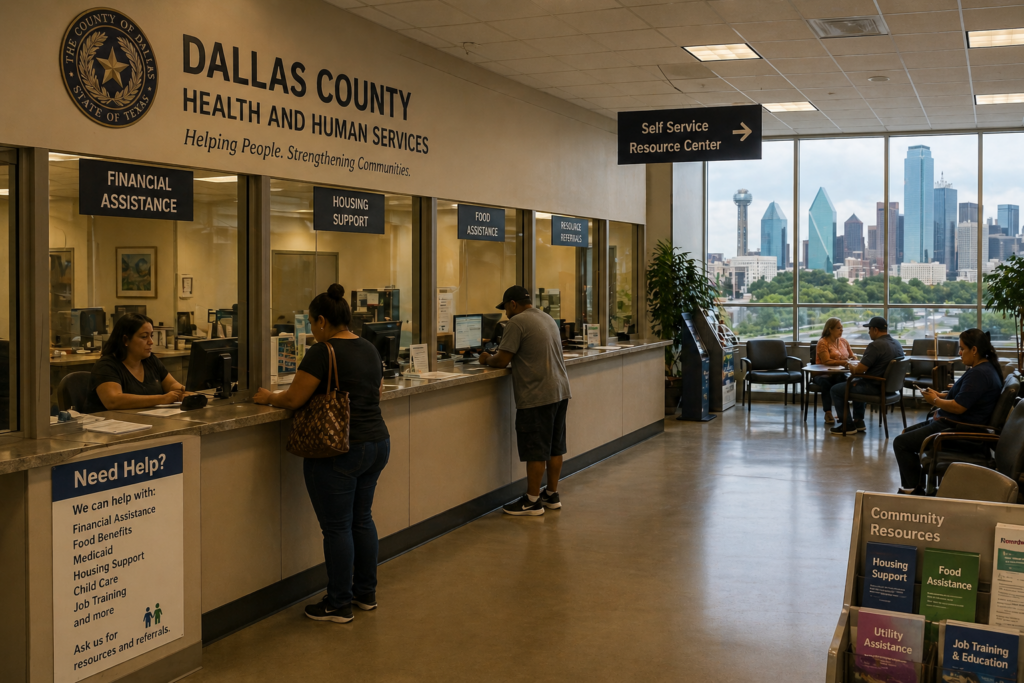
Dallas County Health and Human Services provides essential support services for families and individuals facing financial hardships.
Comprehensive Energy Assistance Program (CEAP) offers utility assistance for low income families, prioritizing elderly residents, persons with disabilities, and families with young children. The City of Dallas Social Services Program provides utility assistance for electricity, water, and rent, depending on the availability of funds. Clients may need to speak with a caseworker to determine eligibility and begin the application process for these services.
Rental Assistance programs help families facing housing instability. The Dallas County Housing Agency operates several programs, including Section 8 rental vouchers and homebuyer education. Emergency assistance is available through the Social Services & Support Program for individuals and families who have experienced a temporary financial crisis, with services based on the availability of funds. A caseworker serves as the point of contact for intake and ongoing support, helping applicants understand eligibility requirements and guiding them through the process.
Food Assistance: SNAP, formerly known as food stamps, supports low income families in purchasing groceries. The MLK Fresh Produce Distribution Center provides fresh fruits, vegetables, and dry goods to citizens at no cost, with no zip code requirements or income restrictions. There are also programs specifically supporting homeless individuals and families, offering food and shelter resources to address housing insecurity.
Weatherization Assistance Program (WAP) helps low-income residents reduce energy costs through home improvements, improving quality of life while lowering utility bills.
Temporary Assistance for Needy Families (TANF) provides financial aid for essential needs like clothing and housing for families with children.
Health Services: Dallas County offers immunizations, health screenings, and medical treatment through various community health centers. These centers provide comprehensive medical and dental services to patients of all ages. Appointments may be required for some services.
The 2-1-1 Texas service connects residents to local resources such as food pantries, shelters, and childcare, serving as a central referral point for community programs.
Programs dedicated to the aging population are also available, offering specialized support and resources for older adults in Dallas County.
Taxes and Financial Government Services
Governmental Resources in Dallas Texas include essential financial systems that directly impact families navigating divorce, custody, and long-term stability. From property taxes to business licensing and financial obligations, these services are more than administrative—they often influence how courts evaluate responsibility, consistency, and a parent’s ability to provide a stable environment.
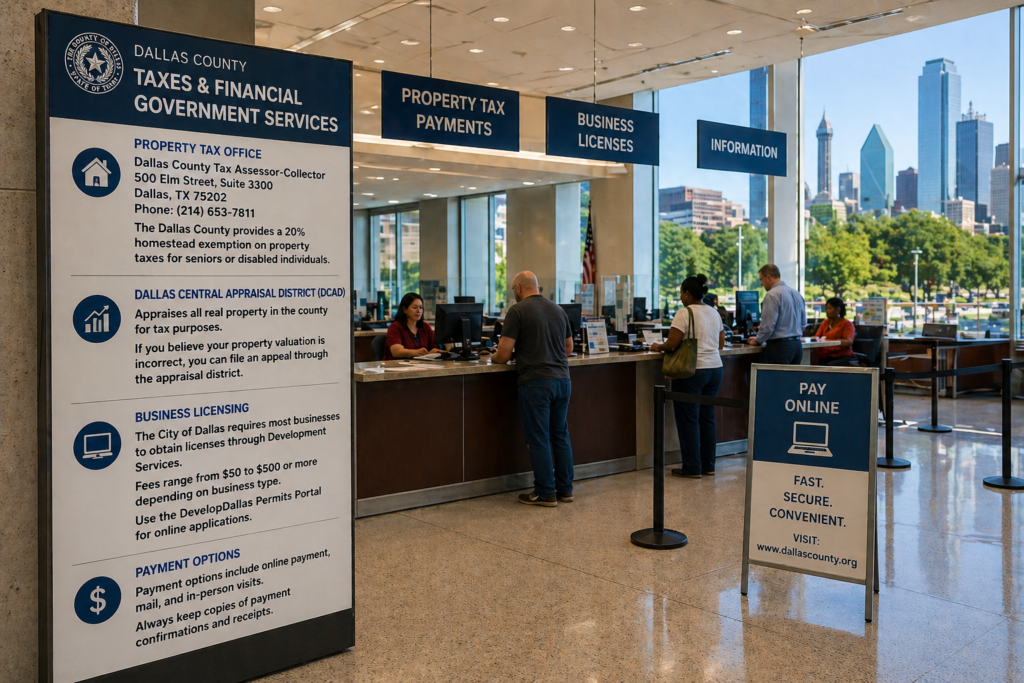
The Dallas County Tax Assessor-Collector, located at 500 Elm Street, handles property tax payments, exemptions, and delinquency management. For many families, especially those adjusting to a single-income household after divorce, understanding available exemptions—such as homestead protections for seniors or individuals with disabilities—can make a meaningful difference. At the same time, the Dallas Central Appraisal District (DCAD) determines property values, and disputes over those valuations can affect not only tax obligations but also how assets are viewed in a divorce or support context.
Under Texas Family Code §153.002, courts focus on the best interest of the child, which includes financial stability and consistency. Judges often look at whether each parent is meeting financial obligations, maintaining housing, and responsibly managing expenses. In more complex cases, particularly those involving child support enforcement, public assistance, or financial hardship, these factors become even more significant. Courts may also consider how well a parent navigates available systems to maintain stability for the child.
Business licensing through the City of Dallas is another area where financial government services intersect with family law. Whether a parent owns a small business or relies on self-employment income, proper licensing and compliance can affect income verification, support calculations, and overall credibility in court. In straightforward situations, managing these responsibilities may be a matter of staying organized and keeping accurate records. But in more complex cases—especially where income is disputed or financial documentation is incomplete—delays or mistakes can create complications that impact legal outcomes.
Where multiple agencies or disputes are involved, such as disagreements over support obligations or coordination with public assistance programs, having a structured approach becomes increasingly important. Payment options, including online systems, mail, and in-person services, provide flexibility—but they also require diligence. Failing to keep records, missing deadlines, or misunderstanding requirements can affect both compliance and how a court views financial responsibility.
For families looking to better understand how financial systems operate in other Texas communities, reviewing Governmental Resources in New Caney can provide helpful context. And if your situation involves financial obligations tied to parenting, exploring Texas child support laws can help clarify how courts approach these issues.
Ultimately, financial government services are closely tied to family law outcomes. Some situations can be handled with careful organization and attention to detail, but in more complex cases—where financial disputes, enforcement issues, or multiple systems are involved—legal guidance becomes essential. Taking the right steps early can help protect your financial position, support your child’s stability, and keep your case moving in the right direction.
Common Services and Where to Go
| Service Needed | Office | What to Bring |
|---|---|---|
| File a divorce or custody case | District Clerk | Petition documents, filing fee, identification |
| Obtain a birth certificate | County Clerk Vital Records or City Vital Statistics | Government-issued photo ID, proof of relationship, fee |
| Pay property taxes | Tax Assessor-Collector | Tax bill stub or property account number, payment |
| Apply for utility assistance | Dallas County Health and Human Services | Proof of income, utility bills, identification, proof of residency |
| Get a marriage license | County Clerk | Valid photo ID for both parties, fee |
| Register a vehicle | Tax Assessor-Collector | Title, proof of insurance, payment |
| Search property records | County Clerk | Property address or legal description |
| Apply for food assistance | Texas Health and Human Services (state office) or call 2-1-1 | Income verification, identification, household information |
Online Government Resources in Dallas
Many services are available through official websites, saving residents time and eliminating the need for in-person visits. Official web pages provide up-to-date information on available services, hours of operation, and application procedures, ensuring residents have accurate details before accessing resources.
Dallas County Online Portal offers property tax lookup and payment, public record searches for property and court cases, and vital records information.
City of Dallas Website provides access to the DevelopDallas Permits Portal for business permits and licensing, vendor registration, and municipal service requests through Dallas 311.
Court Records: The District Clerk offers online case information access, allowing residents to search case status and filings.
2-1-1 Texas: Available by phone or online, this service connects residents to thousands of community resources across Texas.
Many online resources operate 24 hours a day, 7 days a week, offering convenience for residents with busy schedules. Each service’s web page lists its specific hours of operation if applicable, so users can confirm when services are available. Security measures protect personal information during online transactions.
Tips for Navigating Government Offices
- Identify the correct office before visiting. Confirm whether your need is handled by the city or county to avoid wasted trips.
- Gather required documents in advance. Most offices require government-issued photo ID. Specific services require additional documentation like utility bills, income proof, or case numbers.
- Check office hours online. Most offices operate Monday through Friday from 8:00 AM to 4:30 PM, but hours vary. Some vital records offices close at 4:00 PM.
- Consider appointments when available. Some offices accept walk ins, but appointments can reduce wait times significantly.
- Use online services when possible. Many tax payments, record searches, and applications can be completed online.
- Bring copies of documents. Keep originals secure and provide copies when acceptable.
- Arrive early. Popular offices experience high volume, especially on Monday and Wednesday mornings and at the end of the month.
- Plan for parking. Downtown Dallas offices may have limited parking. Check for nearby public lots or use public transportation.
How Legal Professionals Can Help
Understanding Governmental Resources in Dallas Texas is an important first step, but knowing how to use those systems effectively during a divorce or custody matter is where many families begin to feel overwhelmed. Court procedures, government offices, and documentation requirements are often interconnected, and even small mistakes can lead to delays, added stress, or unintended consequences that affect your case.
Legal guidance becomes especially valuable when navigating district court procedures tied to divorce, custody, or support. Texas courts operate under standards such as Texas Family Code §153.002, which prioritizes the best interest of the child, and §153.134, which focuses on creating stable custody arrangements. Judges often evaluate how well each parent manages responsibilities, maintains consistency, and interacts with systems like schools, financial institutions, and public agencies. Missing filings, incomplete records, or missteps with government processes can raise concerns about diligence and reliability—factors that may influence court decisions.
In straightforward situations, families may be able to handle basic filings, gather records, and coordinate with local offices with careful attention to detail. But in more complex cases—especially those involving custody disputes, CPS involvement under §§262 and 263, or financial hardship tied to public assistance—having a structured legal strategy becomes critical. Coordinating between courts, child support enforcement, and other government agencies requires not just organization, but an understanding of how each step affects the overall outcome.
Where multiple agencies or disputes are involved, legal professionals help ensure documents are filed correctly, deadlines are met, and records are obtained efficiently. They also help families understand what information matters most—whether it’s proof of income, school records, or documentation showing consistent involvement in a child’s life. This level of preparation can make a meaningful difference in how a case progresses and how a judge views each parent’s ability to provide stability.
For families seeking additional insight into how government systems function across Texas communities, reviewing governmental resources in Humble can offer helpful perspective. And if your situation involves parenting arrangements or legal decision-making, exploring child custody in Texas can clarify how courts approach these issues.
Ultimately, some situations can be managed with clear information and careful planning, but others require experienced legal guidance to avoid complications and protect what matters most. When your case involves multiple systems, competing priorities, or uncertainty about the next step, having the right level of support can help you move forward with confidence and clarity.

Actionable Checklist: Governmental Resources in Dallas Texas
- Identify the specific service you need and determine whether it is handled by Dallas County or the City of Dallas.
- Find the correct office location using official county or city websites.
- Gather all required documents including identification, proof of residency, income verification, or case numbers as needed.
- Check current office hours since schedules can vary and some offices have limited availability.
- Explore online options for payments, applications, or record searches to save time.
- Schedule an appointment when the option is available to reduce wait times.
- Plan your visit including parking, transportation, and arrival time.
- Keep copies of all submitted documents for your records.
- Follow up on pending applications using reference numbers or case tracking systems.
- Contact 2-1-1 Texas if you need help finding community resources or assistance programs.
Conclusion
Navigating Governmental Resources in Dallas Texas is about more than finding the right office or filling out the correct form—it’s about creating stability during a time when everything can feel uncertain. The decisions you make now, from custody arrangements to how you use available support systems, can shape your child’s daily life in ways that last well beyond the divorce itself. When you understand how these systems connect, you move from reacting to problems to proactively building a more stable future.
In straightforward situations, parents may be able to coordinate routines, communicate effectively, and use local resources to maintain consistency without significant conflict. But in more complex cases—especially where there are disagreements about custody, relocation, school stability, or financial support—the stakes are higher. If your case involves disruptions to your child’s routine, declining academic performance, or disputes over decision-making, having the right level of legal guidance becomes essential to protecting your child’s well-being and your parental rights.
At the Law Office of Bryan Fagan, PLLC, the focus is on helping families move forward with clarity, structure, and confidence. Through thoughtful strategy and a deep understanding of Texas family law, the goal is to simplify the process while protecting what matters most. If you’re unsure about your next step, that’s often the clearest sign it’s time to get answers—so you can make informed decisions and move forward with peace of mind.
Frequently Asked Questions
Most Dallas County government offices are located in downtown Dallas, including the Records Building at 500 Elm Street, which houses the County Clerk, District Clerk, and Tax Assessor-Collector offices. The City of Dallas operates offices throughout the city, with many services available at City Hall and the J. Erik Jonsson Central Library.
Dallas County handles courts, vital records, property taxes, and social services for the entire county. The City of Dallas manages permits, zoning, business licensing, and municipal court matters for areas within city limits. Residents often need services from both levels of government depending on their needs.
Court records are available through the District Clerk’s Office for district court cases and through Justice of the Peace Courts for smaller matters. Online search options are available through the Dallas County website, or you can visit the office in person at the Frank Crowley Courts Building.
Marriage licenses are issued through the Dallas County Clerk’s office at 500 Elm Street, Suite 2100. Both parties must appear with valid photo identification and pay the required fee. The license is typically issued the same day.
Dallas County offers multiple assistance programs including utility assistance, rental assistance, food programs through SNAP, and health services. The City of Dallas Social Services Program provides emergency assistance based on availability of funds. Call 2-1-1 Texas to connect with local resources.
Yes, many services are available online including property tax payments, record searches, permit applications, and some assistance program applications. The Dallas County website and City of Dallas DevelopDallas portal offer convenient digital access to numerous services.
Residents in Dallas can use Dallas 311 to report non-emergency issues like graffiti, litter, potholes, or code violations. Dallas 311 is available by phone, online, or through the city’s mobile app.
To obtain a birth certificate from Dallas County Vital Records, bring a government-issued photo ID and proof of your relationship to the person named on the certificate if you are not the subject. The fee is approximately $22 per certificate. Processing time varies depending on the request method.