
Dallas Texas Family Law FAQs: Complete Guide to Your Legal Questions

It usually doesn’t happen all at once. One conversation turns tense, then distant, and before long you’re sitting at the kitchen table wondering how your life got here—and what you’re supposed to do next. If you’ve found yourself searching for Dallas Texas family law FAQs, it’s likely because you need real answers, not just legal definitions. You want to know what happens to your home, your children, your finances—and how to make the right decisions when everything feels uncertain.
At The Law Office of Bryan Fagan, PLLC, we understand that moment. We’ve guided families across Texas through divorce, custody disputes, and life transitions where emotions run high and clarity feels out of reach. Led by Bryan Joseph Fagan, a South Texas College of Law graduate and recognized authority in Texas divorce and custody law, our firm focuses on more than just outcomes—we focus on helping you regain control, direction, and peace of mind. Texas law itself reflects this approach. Under Texas Family Code §153.002, every decision involving children must serve their best interest, reinforcing the importance of stability, thoughtful planning, and informed decision-making from the very beginning.
In this article, you’ll gain clear, practical insight into how Texas family law works, what courts consider when making decisions, and how those decisions can impact your child’s day-to-day life—including areas you may not have considered yet. Because when you understand the process and your options, you’re no longer reacting—you’re making intentional choices that protect your future.
Let’s walk through what you need to know so you can move forward with clarity and confidence.
Key Takeaways
- Texas is a community property state, but courts use the principle of equitable distribution—meaning assets acquired during marriage are divided in a manner that is just and right, not always split equally, based on factors such as each spouse’s earning capacity and contributions.
- Child support in Texas generally follows percentage guidelines (20% of net income for one child, 25% for two, 30% for three, up to the first $7,500 of monthly net income), but Texas courts may also consider additional factors such as health insurance premiums for the children and any special needs the children may have.
- Dallas courts prioritize the best interest of the child in all custody decisions, often designating parents as joint managing conservators rather than awarding one parent sole custody.
- Texas has a mandatory 60-day waiting period from the date a divorce petition is filed before the divorce can be finalized, regardless of whether both parties agree.
- Dallas County has specific local rules requiring mediation before a final trial in most family law cases, which can help resolve disputes more quickly and affordably.

Your Family’s Future Starts Here
Don’t navigate your legal journey alone. Schedule a consultation now and get the clarity and support you deserve.
Dallas Texas Family Law FAQs: Quick Overview
When people search for Dallas Texas family law FAQs, they are usually looking for more than definitions—they are trying to understand how the legal process will actually unfold and what it means for their family. Texas family law covers a wide range of issues, including divorce, child custody (known as conservatorship), child support, property division, spousal maintenance, protective orders, and modifications of existing court orders. Many of these matters fall under suits affecting the parent-child relationship (SAPCR), which address custody, visitation, and support, and are handled in Dallas County district courts under the Texas Family Code.
Texas courts approach these cases with a clear priority: the best interest of the child. Under Texas Family Code §153.002, judges focus heavily on stability, consistency, and long-term outcomes—especially when children are involved. In custody matters, §153.134 further requires courts to define rights and duties clearly, which directly impacts daily routines, school stability, and parental decision-making. From a practical standpoint, judges are not just reviewing paperwork—they are evaluating credibility, how diligently each party has handled the case, and whether the proposed outcome creates a stable environment moving forward.
In straightforward situations, such as agreed divorces or uncontested modifications, the process can often move efficiently with a clear understanding of filing requirements, deadlines, and procedural steps. Many families are able to resolve issues through mediation, which Dallas courts commonly require before trial, helping reduce conflict and preserve both time and financial resources. However, in more complex cases—where disputes are contested, custody is at issue, finances are layered, or concerns about a child’s safety arise—the process becomes more strategic. Case progression, preparation, and how each party presents their position can significantly influence the outcome.
For families relocating or navigating legal issues in the area, understanding the local court system and expectations is equally important. Resources like moving to Dallas and understanding the local legal landscape can provide helpful context as you prepare for what lies ahead. Similarly, gaining a deeper understanding of child custody in Texas can clarify how conservatorship decisions are made and what factors courts prioritize.
The key is recognizing where your situation falls. In some cases, a basic understanding of the process may be enough to move forward confidently. In others—particularly where emotions run high, disagreements persist, or the stakes involve your children’s future—structured legal guidance becomes essential. Delays, missed steps, or incomplete preparation can create setbacks that are difficult to undo. Taking the time to understand your options now can make a meaningful difference in how your case progresses and how your family moves forward.

Table 1: Common Family Law Questions and Quick Answers
| Question | Short Answer |
|---|---|
| How long does divorce take in Dallas? | Minimum 60 days; uncontested cases typically 2-4 months; contested cases 8-18 months |
| How is child support calculated? | 20% of net income for one child, 25% for two, 30% for three |
| Can a child choose which parent to live with? | At age 12, a judge may interview the child, but best interest of the child determines the outcome |
| What is community property? | Assets acquired during marriage that both spouses own jointly |
| Do I need a lawyer? | Not required, but strongly recommended for complex cases involving children or significant assets |
How Do I Start a Divorce in Dallas Texas?
In Texas, a divorce is initiated by filing an Original Petition for Divorce in the district court. This document serves as a lawsuit requesting the court to dissolve the marriage and make appropriate orders regarding property division and children.
To file for divorce in Dallas County, you must meet the residency requirements under Texas Family Code §6.301. Either you or your spouse must have been a resident of Texas for at least six months before filing and a resident of Dallas County for at least 90 days immediately before filing. Once you file the original petition, your spouse must be served with notice of the lawsuit.
The divorce petition outlines the basic information about your marriage, identifies any children, and states the grounds for divorce. Texas allows for no-fault divorces based on insupportability, meaning the marriage has become unworkable due to discord or conflict. Under the Texas Family Code, “insupportability” means that the legitimate ends of the marital relationship have been destroyed and there is no reasonable expectation of reconciliation. In plain English, this means the fundamental purposes or goals of marriage can no longer be met, and it is not reasonable to expect the spouses to repair the relationship.
Additionally, a fault-based divorce in Texas can be filed on grounds such as adultery, cruelty, or abandonment. These fault grounds may influence the division of property and spousal support, as Texas courts can consider fault when making these determinations.
How Long Does a Divorce Take in Dallas?
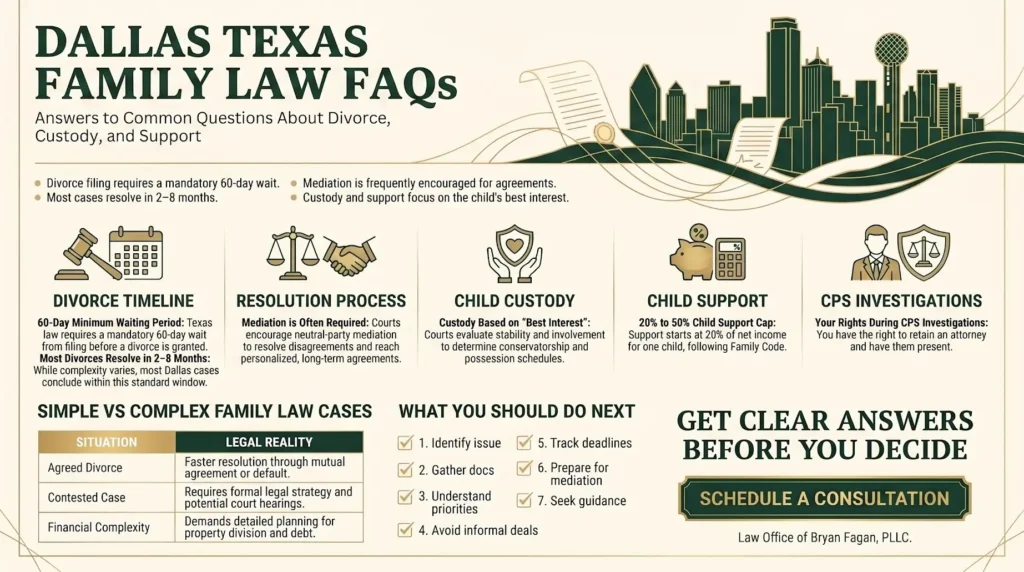
There is a mandatory 60-day waiting period in Texas from the date the divorce petition is filed before the divorce can be finalized, regardless of whether the divorce is contested or agreed upon. This sixty day waiting period gives both parties time to consider reconciliation.
An agreed divorce in Texas is a type of divorce where both parties have reached mutual consent on all terms—including property division, child custody, and support—allowing for a faster resolution once the mandatory waiting period has passed. For an uncontested or agreed divorce where both spouses agree on all terms, the process typically takes 2-4 months in Dallas County. When significant disagreements exist—about custody, property division, or spousal support—contested divorces often last 8-18 months or longer depending on complexity and court schedules.
Dallas County courts maintain busy dockets, so timing can vary based on hearing availability. Working with an experienced family law attorney can help move your case forward efficiently.
What Makes a Divorce Contested vs. Uncontested?
One of the most common topics in Dallas Texas family law FAQs is understanding the difference between a contested and uncontested divorce—and more importantly, what that means for how your case will move forward. In Texas, an uncontested divorce occurs when both spouses reach agreement on all major issues, including property division, debt allocation, child custody, child support, and any spousal maintenance. In these situations, the legal process is typically more streamlined, allowing the case to progress efficiently through filing, required waiting periods, and finalization without significant court intervention.
In straightforward situations, where both parties are cooperative and communication remains productive, uncontested cases can often be resolved through negotiation or mediation. Courts generally favor these resolutions because they promote stability and reduce conflict—especially when children are involved. Under Texas Family Code §153.002, the court’s primary focus is always the best interest of the child, and agreements that support consistency, routine, and parental cooperation are often viewed favorably. For many families, this approach reduces both emotional strain and financial burden while keeping decision-making in the hands of the parents rather than the court.
In more complex cases, however, a divorce becomes contested when disagreements arise on one or more key issues. This may include disputes over where a child will primarily live, how parenting time will be structured, how assets such as homes or retirement accounts will be divided, or how financial support will be calculated. Where disputes are contested, the court becomes responsible for making decisions, and judges begin evaluating factors such as each party’s credibility, level of preparation, and overall diligence in moving the case forward. Case progression becomes critical—missed deadlines, incomplete documentation, or inconsistent positions can negatively impact how a judge views your case.
Contested cases often require a more structured legal strategy, particularly when custody is involved. Under Texas Family Code §153.134, courts must clearly define parental rights and duties, which means the details of your proposed parenting plan matter. In high-conflict situations, or where concerns involve a child’s safety, relocation, or complex financial issues, the stakes increase significantly. These are the types of cases where preparation, organization, and a clear legal approach can directly influence outcomes.
It’s also important to understand that many divorces evolve over time. Cases that begin with disagreement may eventually move toward resolution through mediation, which is typically required in Dallas County before a case proceeds to trial. Mediation provides an opportunity to regain control of the outcome, but success often depends on how well each side is prepared and whether realistic expectations have been established early in the process.
For families navigating divorce in Dallas, practical considerations—like work schedules, school routines, and even logistics such as commuting and exchanges—can influence how custody arrangements are structured. Understanding local factors, including transportation in Dallas and how it impacts daily routines, can help shape more realistic and sustainable agreements. You can also explore more about how courts approach child custody in Texas to better understand what judges prioritize.
The key is recognizing where your situation falls. Some divorces can be resolved with clear communication and a basic understanding of the process. Others—particularly those involving ongoing conflict, custody disputes, or financial complexity—require a more deliberate and strategic approach. Acting early, staying organized, and understanding the legal landscape can make a significant difference in both the efficiency of your case and the long-term outcome for your family.

Listen to Our Texas Family Law Podcast
Prefer listening? In this episode, we answer common questions about family law in Dallas, Texas, including what you need to know before filing and how to navigate key legal issues with confidence.
How Is Child Custody Decided in Texas?
Dallas courts prioritize the best interest of the child in all custody decisions, applying the standard set forth in Texas Family Code §153.002. Rather than automatically favoring one parent over another, judges examine multiple factors to determine what arrangement will best serve the child’s physical, emotional, and developmental needs.
In Texas, the term conservatorship is used instead of custody to describe the rights and duties of parents regarding their children. Conservatorship designates who has the authority to make significant decisions for the child, including where the child will live, go to school, and receive health care.
Courts consider factors such as each parent’s relationship with the child, the stability of each home environment, the child’s current school and community ties, each parent’s earning capacity and ability to provide for the child’s needs, any history of family violence or neglect, and the child’s preferences when age-appropriate.
What Is Joint Managing Conservatorship?
There are two types of conservatorship in Texas: Joint Managing Conservatorship and Sole Managing Conservatorship, with a presumption that Joint Managing Conservatorship is in the best interest of the child. Under joint managing conservatorship, both parents share rights and responsibilities for their children, though one parent is typically designated to determine the child’s primary residence.
Joint managing conservators share decision-making authority on major issues like education, medical care, and religious upbringing. However, the possession and access schedule—when each parent has physical time with the children—is a separate matter. Texas provides a Standard Possession Order that establishes guidelines for visitation schedules.
A sole managing conservator arrangement may be ordered when circumstances make joint conservatorship inappropriate. Dallas courts can deny joint conservatorship when there’s credible evidence of domestic violence, abuse, neglect, or other factors that make shared decision-making contrary to the child’s best interest. The other parent becomes a possessory conservator with visitation rights but limited decision-making authority.
Can a Child Choose Where to Live in Texas?
At age 12, a judge may interview a child about their living preference, but the final decision is based on the child’s best interest rather than the child’s wishes alone. Texas law does not give children a legal right to choose their custodial parent at any specific age.
Courts consider a child’s preferences as one factor among many, giving more weight to the opinions of older, more mature children. A judge might interview a child privately in chambers to understand their feelings without exposing them to courtroom pressure or parental conflict.
Even when a child expresses a strong preference for one parent, the court will still examine whether that preference aligns with the child’s actual best interest. Factors like which parent provides more stability, supports the child’s relationship with the non custodial parent, and meets the child’s educational and emotional needs often carry significant weight.
How Is Child Support Calculated in Dallas Texas?
One of the most important topics in Dallas Texas family law FAQs is understanding how child support is calculated—and why the final number is not always as simple as a percentage. In Texas, child support generally begins with guideline calculations under Texas Family Code §154.125, which apply a percentage to the non-custodial parent’s net resources. For example, the standard guideline is 20% for one child, 25% for two children, and 30% for three children, calculated on the first $7,500 of monthly net income. Net resources include income after taxes, Social Security contributions, and certain deductions like health insurance premiums for the child.
In straightforward situations, where income is consistent and both parents agree on financial details, this formula provides a clear starting point. However, even in these cases, accuracy matters. Courts expect financial disclosures to be complete and credible, and judges often evaluate diligence in gathering and presenting income information. Small mistakes or missing documentation can delay case progression or lead to outcomes that do not fully reflect a child’s needs.
In more complex cases, child support becomes less predictable. If the paying parent has additional children to support, the guideline percentages may be adjusted downward. If income exceeds the statutory cap, the court shifts its focus from percentages to the proven needs of the child. Where disputes are contested—especially in cases involving fluctuating income, self-employment, or hidden financial resources—judges closely examine credibility, documentation, and whether each party has been transparent throughout the process. These factors can significantly influence the final support order.
Courts may also consider additional expenses that impact a child’s well-being, including childcare costs, uninsured medical expenses, and specialized needs such as therapy or educational support. The goal, consistent with Texas Family Code §153.002, is to ensure that the child’s best interest remains the central focus. Financial stability plays a key role in that analysis, particularly when it supports consistent housing, school routines, and access to care.
For parents navigating support issues in Dallas, it can also be helpful to understand the broader system of support available. Local resources, including governmental resources in Dallas that support families, can provide additional assistance when financial circumstances are strained. You may also benefit from learning more about how courts approach child custody in Texas, since custody arrangements often directly impact how support is structured.
The key is recognizing when your situation is straightforward and when it requires a more strategic approach. Some families can rely on guideline calculations and cooperative disclosure. Others—particularly where income is complex, disagreements exist, or the child’s needs extend beyond basic support—require careful planning and a well-prepared presentation. Acting early, staying organized, and understanding how courts evaluate financial stability can make a meaningful difference in both the outcome of your case and your child’s long-term security.

Can Child Support Be Modified?
A common concern in Dallas Texas family law FAQs is whether child support can be changed after a court order is already in place. The short answer is yes—but only under specific legal standards. Under Texas Family Code Chapters 156 and 157, a court may modify a child support order if there has been a “material and substantial change in circumstances.” This means the change must be meaningful, not minor, and must affect the fairness or practicality of the existing order.
In straightforward situations, modification may be relatively clear. For example, a significant job loss, a major increase in income, or a documented change in the child’s needs—such as medical care, educational support, or therapy—can justify revisiting support. Courts also allow modification if at least three years have passed since the last order and the new calculation differs by 20% or $100 from the current amount. Even in these cases, judges expect diligence and accuracy. Updated financial records, consistent documentation, and a clear explanation of the change all play a role in how smoothly the case progresses.
In more complex cases, modification becomes more nuanced. Where disputes are contested—especially when one parent challenges the validity of the claimed change or questions financial disclosures—judges begin evaluating credibility and transparency more closely. If income is inconsistent, involves self-employment, or appears underreported, the court may scrutinize financial evidence in greater detail. Similarly, if custody arrangements have shifted or concerns about a child’s safety arise, the court may consider how those factors impact both financial support and overall stability, consistent with the best interest standard under Texas Family Code §153.002.
Timing is also critical. Child support modifications are generally effective from the date the petition is filed, not retroactively. That means delays can result in lost financial relief or increased obligations that could have been adjusted sooner. In some situations—particularly those involving heightened conflict, safety concerns, or allegations that intersect with issues like family violence—it becomes even more important to act quickly and with a clear legal strategy. Understanding related legal considerations, such as how courts view serious allegations in family contexts, can be helpful. For example, resources addressing family violence and assault issues in West Dallas may provide additional context where safety concerns overlap with family law matters.
The key is recognizing where your situation falls. Some parents can navigate modification with clear documentation and a straightforward filing. Others—particularly where finances are complex, disputes are ongoing, or the child’s needs have significantly evolved—benefit from a more structured, litigation-aware approach. Taking action early, preparing thoroughly, and understanding how courts evaluate stability and case progression can make a meaningful difference in both the outcome and your child’s long-term well-being.

What Happens if Child Support Isn’t Paid?
Texas takes child support enforcement seriously, providing multiple tools to ensure children receive the financial support they deserve. When a parent fails to pay court-ordered child support, the other party can seek enforcement through the court or the Office of the Attorney General of Texas.
Enforcement remedies include wage garnishment (automatically deducting support from the paying parent’s paycheck), interception of tax refunds, liens on property owned by the delinquent parent, suspension of driver’s licenses and professional licenses, and contempt of court proceedings that can result in fines or jail time.
The Texas Attorney General’s Child Support Division plays a major role in establishing and enforcing child support orders, especially for families receiving public assistance. Their involvement can provide significant resources for tracking down non-paying parents and collecting arrears.
How Is Property Divided in Texas Divorce?
In Texas, the process of having assets divided during a divorce is governed by community property principles. Texas is a community property state, meaning that most assets acquired during the marriage—referred to as marital property—are considered jointly owned by both spouses. Marital property includes income earned by either spouse during the marriage, property acquired with that income, and retirement benefits accrued during the marriage. This is contrasted with separate property, which consists of assets owned by one spouse before marriage or received as a gift or inheritance during the marriage, and is not subject to division in a divorce. Personal injuries sustained by one spouse and recovered through lawsuit are also generally considered separate property (except for lost wages).
While some assets, such as home equity or retirement accounts, may be split equally between the parties, Texas courts focus on a just and right division rather than a strict 50/50 split. Under Texas Family Code §7.001, courts divide community property in a manner that is just and right considering the rights of each spouse and any children. This approach is sometimes referred to as equitable distribution.
Bank accounts opened during marriage, vehicles purchased during marriage, and real estate bought with marital funds are all considered community property. If the parties cannot agree on the division of community assets, the court will divide them in a manner that is just and right, considering factors such as the earning capacity of the spouses, fault in the breakup of the marriage, the size of the community estate, and each spouse’s separate property.
The division of property is finalized in the final decree of divorce, which is the official court order that formally ends the divorce process and resolves all legal matters related to property division.
What Happens to the House in Divorce?
The family home often represents the largest marital asset and creates significant emotional attachment. When couples divorce, several options exist for handling property owned jointly.
Common solutions include selling the home and dividing the proceeds, one spouse buying out the other spouse’s equity share, or one spouse keeping the home while the other receives offsetting assets (like retirement accounts or other property). The spouse who keeps the home typically must refinance the mortgage to remove the other party’s name and liability.
Courts can order the sale of the house if the spouses cannot agree on disposition and neither can afford to buy out the other. In cases with children, courts sometimes allow the custodial parent to remain in the home temporarily to provide stability, with sale occurring later when circumstances change.
When Can I Modify a Court Order?
Texas courts will modify existing family law orders when there has been a material and substantial change in circumstances since the prior order was entered. This standard applies to custody arrangements, possession schedules, child support amounts, and other matters addressed in the divorce decree.
Examples of material changes include significant income increases or decreases, remarriage of either parent, relocation that affects the current custody arrangement, changes in the child’s needs or preferences, and concerns about the child’s safety in one home.
To request modification in Dallas County, you file a petition in the court that issued the original order, explaining the changes and requesting specific relief. The process requires showing both that circumstances have changed and that modification serves the child’s best interest for custody matters, or reflects updated financial circumstances for support matters.

What Is a Protective Order?
A Protective Order is a civil order issued to prevent continuing acts of family violence, aimed at protecting individuals from abuse by a household member or someone in a dating relationship. Dallas courts can issue these orders when credible evidence of domestic violence exists.
In Texas, if a person feels threatened, they can obtain an emergency order—often called an emergency protective order—which can be issued quickly to protect individuals from immediate harm, sometimes without the respondent (alleged abuser) present. This emergency order can last up to 20 days until a hearing is held, where the court determines whether to issue a longer-term protective order.
Violating a Protective Order is a criminal offense in Texas, allowing law enforcement to arrest the alleged abuser immediately upon violation. These orders can prohibit contact, require the abuser to stay away from the victim’s home and workplace, and establish temporary custody arrangements.
How Does Family Violence Affect Custody?
Family violence has profound implications for custody decisions in Dallas County. When credible evidence of domestic violence exists, courts may refuse to award joint managing conservatorship and may restrict the abusive parent’s access to the children.
Texas Family Code §153.004 creates a rebuttable presumption that appointing a parent who has engaged in family violence as a joint managing conservator is not in the child’s best interest. The non-abusive parent may receive sole managing conservatorship, and the abusive parent’s visitation may be limited or supervised.
Safety planning for children becomes paramount in these cases. Courts can order supervised visitation, prohibit overnight stays, require the abusive parent to complete counseling or intervention programs, and establish other conditions designed to protect the children from exposure to violence or ongoing conflict.
Table 2: Legal Issue and Next Step
| Situation | Recommended Action |
|---|---|
| Considering divorce | Gather financial documents; consult with family law attorney |
| Served with divorce papers | Respond within 20 days; seek legal advice immediately |
| Custody dispute | Document parenting involvement; prepare for mediation |
| Behind on child support | File for modification if circumstances changed; communicate with other parent |
| Experiencing domestic violence | Seek protective order; contact local resources; prioritize safety |
| Need to modify existing order | Document changed circumstances; file petition in original court |
| Property division concerns | Inventory all assets and debts; identify separate vs. community property |
How a Dallas Family Law Attorney Can Help
Navigating family law without guidance is possible but often overwhelming. A Dallas family law attorney brings experience with local court procedures, knowledge of Texas law, and objectivity during an emotional time. Choosing a board certified attorney in family law demonstrates legal specialization and recognized expertise, providing additional assurance that your case is handled by someone with proven skill and authority in this sensitive area.
An attorney can clarify your options so you make informed decisions rather than guesses. They ensure paperwork is filed correctly and deadlines are met—critical in Dallas County district courts where procedural errors can delay your case significantly. When negotiations stall, your attorney advocates for your interests in mediation and, if necessary, at trial.
The Law Office of Bryan Fagan, PLLC has extensive experience helping families throughout Dallas and the surrounding areas navigate divorce, custody, support, and property division matters. Understanding what you’re facing is the first step toward resolution.

Checklist: Dallas Texas Family Law FAQs Action Steps
- Identify your specific legal issue – Clarify whether you’re dealing with divorce, custody, support, modification, or protective order matters.
- Gather essential documents – Collect financial records, tax returns, property deeds, bank account statements, and any existing court orders.
- Understand critical deadlines – Note response requirements (usually 20 days to answer a petition) and the 60-day waiting period for divorce.
- Keep all communication in writing – Document conversations with your spouse or the other parent via text or email when possible.
- Stay organized throughout the process – Create a folder system for legal documents, correspondence, and financial records.
- Avoid major financial decisions – Don’t make large purchases, empty bank accounts, or transfer assets without legal guidance.
- Focus on children’s wellbeing – Keep children out of adult conflicts and maintain their routines as much as possible.
- Prepare for mediation – Dallas County requires mediation in most cases; approach it with openness to compromise.
- Seek legal advice early – Consulting with a family law attorney before making major decisions protects your interests.
- Document everything – Keep records of parenting time, expenses, and any incidents relevant to your case.
Conclusion
Navigating Dallas Texas family law FAQs isn’t really about finding perfect answers—it’s about gaining enough clarity to make the next right decision for your family. Whether you’re dealing with custody, support, or the early stages of a divorce, the law provides a framework—but how that framework applies to your life depends on the details. In straightforward situations, a clear understanding of timelines, filings, and expectations may be enough to move forward with confidence. But in more complex cases—especially those involving children, contested custody, financial disputes, or changing circumstances—the strategy behind your decisions becomes just as important as the decisions themselves.
If your case involves uncertainty, conflict, or long-term consequences for your children or financial future, having the right level of legal guidance can make a meaningful difference. At The Law Office of Bryan Fagan, PLLC, the focus is on helping families move from confusion to clarity through education, structure, and thoughtful legal strategy. The goal isn’t just to resolve a case—it’s to help you protect what matters most and move forward with confidence, knowing your decisions were informed, intentional, and built around your future.
Frequently Asked Questions
While Texas law allows you to represent yourself, having a family law attorney is strongly recommended, especially when children or significant assets are involved. An attorney ensures your rights are protected and helps navigate complex court procedures in Dallas County district courts.
Costs vary significantly based on complexity. Filing fees in Dallas County run approximately $250-350. Uncontested divorces with attorney assistance typically cost $2,000-5,000, while contested divorces can range from $10,000 to $50,000 or more depending on issues involved.
The general rule is that Texas law requires a minimum 60-day waiting period from the date the divorce petition is filed until a final decree of divorce can be granted (Texas Family Code § 6.702). However, contested cases or those involving complex issues may take several months or longer, especially if the case proceeds to trial.
You must have a final hearing before a judge to finalize your divorce decree, but this can be brief for agreed divorces. Many issues can be resolved through mediation, avoiding lengthy contested hearings. Dallas County requires mediation before trial in most family law cases.
Texas does not recognize formal legal separation; individuals are considered married until the divorce is final. However, couples can obtain temporary orders establishing support obligations and custody arrangements while the divorce is pending.
Bring financial documents (tax returns, pay stubs, bank statements), any existing court orders, your marriage certificate, information about assets and debts, and documentation related to your specific concerns (custody schedules, communication records, evidence of violence if applicable).
Spousal maintenance in Texas is restricted to specific cases, such as marriages lasting 10 or more years where one spouse cannot meet their basic needs. Courts consider factors including each spouse’s income, earning capacity, education, employment history, and the duration of the marriage.
In Texas, the primary grounds for divorce include insupportability (no-fault), cruelty, adultery, conviction of a felony, abandonment, living apart for three years, and confinement in a mental hospital. Most divorces proceed on no-fault grounds based on insupportability.
Relocation with children may require court approval or modification of existing orders, especially if it affects the other parent’s possession and access rights. The court will evaluate whether the move serves the child’s best interest and may modify custody arrangements accordingly.
The general rule is that Texas courts calculate child support based on a percentage of the noncustodial parent’s net resources, as outlined in the Texas Family Code § 154.125. For one child, the guideline is 20%, increasing with each additional child, but the court may adjust this amount in suits affecting the parent-child relationship if circumstances warrant.