
Collaborative Divorce in Dallas Texas: A Complete Guide to Peaceful Divorce Resolution

It usually doesn’t start with a fight. More often, it’s a quiet moment—two people sitting across from each other, realizing that what they built together isn’t working anymore. No yelling, no slammed doors. Just the weight of a decision that will change everything. In that moment, most couples ask the same question: is there a way to do this without tearing everything apart? Collaborative Divorce in Dallas Texas offers an answer—one that focuses on resolution instead of conflict, and clarity instead of chaos.
At The Law Office of Bryan Fagan, PLLC, we’ve guided families through these moments for years. Led by Bryan Joseph Fagan, a South Texas College of Law graduate and a recognized authority on Texas divorce and custody law, our firm understands that divorce is not just a legal process—it’s a deeply personal transition. Under Texas law, every decision must ultimately serve the best interest of the child, as outlined in Texas Family Code §153.002. But behind that legal standard is something more human: the need for stability, dignity, and a path forward that doesn’t create unnecessary harm.
This article will walk you through how collaborative divorce works in Dallas, why it can lead to better outcomes for families, and how the choices you make during divorce can shape your child’s future in ways you may not expect. Because even when a marriage ends, your role as a parent—and your ability to protect what matters most—does not.
Key Takeaways
- Collaborative Divorce in Dallas Texas offers a structured, private alternative to litigation that prioritizes cooperation over conflict.
- Texas courts focus on the best interest of the child (Texas Family Code §153.002), which includes stability in routines, environment, and overall well-being.
- The way parents handle divorce can directly impact a child’s emotional health and academic performance, even if school is not the initial concern.
- Collaborative divorce allows parents to create customized parenting plans that support consistency across both households.
- Reduced conflict between parents often leads to better long-term outcomes for children, including improved focus and adjustment.
- Dallas County courts generally favor arrangements that minimize disruption in a child’s daily life and relationships.
- A team-based approach—including attorneys, financial professionals, and child specialists—can help families make more informed, balanced decisions.
- Compared to litigation, collaborative divorce is often more cost-effective and faster, reducing stress on the entire family.
- Early, proactive steps—like maintaining routines and open communication—can significantly protect a child’s stability during divorce.
- Working with an experienced firm like The Law Office of Bryan Fagan, PLLC helps ensure your decisions align with both Texas law and your family’s long-term well-being.

Your Family’s Future Starts Here
Don’t navigate your legal journey alone. Schedule a consultation now and get the clarity and support you deserve.
Speak With a Collaborative Divorce in Dallas Texas
A contested divorce can affect your finances, your family, and your future. Having a skilled Collaborative Divorce in Dallas Texas on your side can help protect your interests and give you peace of mind during a challenging time.
To learn more about how the Law Office of Bryan Fagan, PLLC can help with your contested divorce case, call 469-972-8473 today to schedule a confidential consultation.
Collaborative Divorce in Dallas Texas: The Short Answer
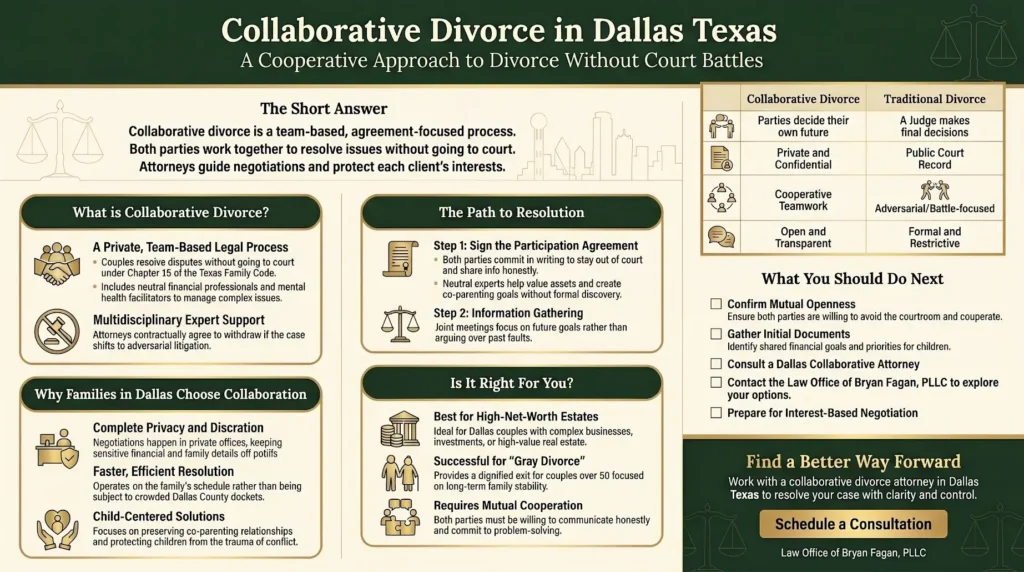
Collaborative Divorce in Dallas Texas is a private, structured process designed for spouses who want to resolve their divorce without stepping into a courtroom. Instead of preparing for litigation, both parties commit to working together—each with their own collaboratively trained attorney—to reach a fair and workable agreement through guided negotiation. This approach centers on transparency, cooperation, and long-term solutions rather than conflict.
The process is governed by the Texas Collaborative Family Law Act (Chapter 15 of the Texas Family Code), which requires full financial disclosure, good faith participation, and a shared commitment to resolving all issues outside of court. In many cases, neutral professionals—such as financial specialists or communication coaches—are brought in to help both parties make informed decisions. The goal is not just to finalize a divorce, but to create durable agreements around property division, parenting, and support that reflect the real needs of the family.
In straightforward situations, where both spouses are willing to communicate openly and prioritize resolution, the Dallas collaborative divorce process can move efficiently with less emotional and financial strain. In more complex cases—such as those involving parenting plan disagreements, high-value assets, or inconsistent communication—the process may require more structured guidance to stay on track. Where cooperation becomes difficult or trust begins to break down, having experienced legal support becomes essential to protect your interests while still working toward resolution.
Texas courts ultimately evaluate outcomes based on the best interest of the child under §153.002, and in custody-related matters, stability and consistency are key considerations under §153.134. Collaborative divorce allows parents to proactively design parenting plans that align with these standards, rather than leaving those decisions to a judge.
For many families, this approach offers a more thoughtful and cost-effective alternative to litigation. If you want to better understand whether this path fits your situation, exploring collaborative divorce services in Texas can help you evaluate your options and determine the level of guidance your case may require.

Listen to Our Texas Family Law Podcast
Prefer listening? In this episode, we discuss family law mediation in Dallas, Texas, including how mediation works, the benefits of resolving your case without court, and what to expect during the process.
What Is Collaborative Divorce?
Collaborative divorce is a form of alternative dispute resolution in family law where both parties agree to focus on settlement rather than litigation. Each spouse retains their own collaborative attorney, and together, the parties commit to resolving all issues through structured negotiation rather than adversarial court proceedings. The foundational concepts of collaborative law were developed in the 1980s by the international academy, which established the standards, training, and interdisciplinary approaches that underpin collaborative family law methods used today.
The core principles of the collaborative approach include:
- Transparency: Both parties agree to full, voluntary disclosure of all relevant information
- Cooperation: The focus is on problem solving and finding solutions that work for everyone
- Respect: Communication remains civil, even when discussing difficult topics
- Commitment: All participants pledge to reach agreement without court intervention
Unlike traditional litigation where attorneys advocate aggressively for their clients in court, collaborative lawyers work together to find creative solutions. Many collaborative attorneys have legal specialization in family law, distinguishing their practice and expertise in handling complex family disputes. This doesn’t mean your interests aren’t protected—your attorney still provides legal guidance and advocates for your goals. But the process prioritizes resolution over conflict.
The Texas Collaborative Family Law Act establishes the legal framework for this approach, requiring a written participation agreement and setting clear expectations for how the process unfolds. The practice of collaborative law emphasizes consistent, good-faith procedures and a problem-solving mindset throughout the process. When both parties genuinely commit to collaboration, families often find this process less stressful, more private, and better suited to creating sustainable agreements.
How Collaborative Divorce Works
Understanding the collaborative divorce process step-by-step can help you know what to expect if you choose this path.
Step 1: Both Spouses Agree to Collaborate
The process begins when both parties decide they want to avoid litigation. This requires honest conversations about whether collaborative divorce is right for your situation. Both spouses must genuinely commit to good faith negotiation.
Step 2: Each Spouse Hires a Collaborative Attorney
Each party retains their own collaboratively trained attorney in Dallas. These attorneys have specialized training in collaborative law and understand how to negotiate constructively rather than adversarially.
Step 3: Sign the Participation Agreement
Both parties and their attorneys sign a written participation agreement under Texas Family Code Chapter 15. This document commits everyone to the collaborative process and outlines expectations for disclosure, negotiation, and what happens if the process fails.
Step 4: Assemble the Team (If Needed)
Depending on your situation, you may involve neutral professionals such as a neutral financial professional—a neutral person who assists both spouses in making informed financial decisions for complex asset division—or a mental health professional to help with communication and emotional challenges. A child specialist may be included when children’s needs require special attention. Qualified professionals, such as divorce coaches and financial advisors, are often included in the collaborative divorce process to assist couples in negotiations.
Step 5: Joint Meetings and Negotiation
The heart of collaborative divorce involves joint meetings where both parties, their attorneys, and any neutral experts work through issues together. These meetings are typically scheduled based on the parties’ availability rather than the court’s schedule, allowing for faster resolutions. Couples participate in a series of ‘four-way’ meetings to negotiate terms related to asset division and child custody. These sessions address property division, child custody arrangements, child support, and spousal support in a structured, respectful environment.
Step 6: Reach Agreement and Draft Documents
Once all issues are resolved, attorneys prepare the final settlement documents, parenting plans, and any other required paperwork. These documents must comply with Texas law requirements.
Step 7: Court Approval
Although the collaborative process avoids litigation, the final agreement must still be submitted to a Dallas County court for approval. This typically involves an uncontested “prove-up” hearing where the court confirms the agreement meets legal requirements. Texas law requires a 60-day waiting period after filing the divorce petition before the court can grant a final decree.
What Is a Participation Agreement?
In Collaborative Divorce in Dallas Texas, the participation agreement is the foundation that sets the tone for the entire process. It’s more than just a document—it’s a commitment by both spouses to resolve their divorce outside of court through cooperation, transparency, and good faith negotiation. For many families, this agreement creates the structure needed to move forward with clarity instead of conflict.
Under the Texas Collaborative Family Law Act (Chapter 15 of the Texas Family Code), particularly §15.101, the participation agreement outlines how the process will work and what each party is agreeing to from the start. It confirms that both spouses intend to resolve all issues—such as property division, parenting arrangements, and support—without court intervention. It also establishes expectations for full financial disclosure, defines the role of any neutral professionals, and explains how decisions will be made throughout the Collaborative Divorce in Dallas Texas process.
In straightforward situations, where both spouses are aligned on the goal of reaching a resolution, this agreement provides a clear roadmap that keeps the process efficient and focused. In more complex cases—such as those involving parenting plan disagreements, high-value assets, or communication challenges—the participation agreement becomes even more important. It creates accountability and structure, helping prevent misunderstandings and keeping negotiations on track. Where cooperation becomes difficult, the clarity of this agreement often determines whether the process succeeds or begins to break down.
One of the most important features of the participation agreement is confidentiality. Unlike traditional litigation, where filings and hearings become part of the public record, collaborative divorce keeps sensitive family and financial matters private. This is especially valuable for families who want to protect their children and maintain a sense of dignity throughout the process.
The agreement also includes what is known as a “disqualification provision” under §15.106. If either party chooses to leave the collaborative process and pursue litigation, both attorneys must withdraw, and new counsel must be hired. While this may seem like a risk, it actually serves as a powerful incentive for both sides to remain committed to resolution. In many cases, this structure encourages more thoughtful decision-making and reduces the likelihood of unnecessary escalation.
For families considering their options, understanding how this agreement works is key to deciding whether collaboration is the right path. Exploring collaborative divorce services in Texas can provide additional insight into how this process is structured and when it may be most effective. In situations where both parties are willing to engage in good faith, the participation agreement becomes the framework that helps protect not just legal interests—but the future stability of the entire family.
Collaborative Divorce vs Mediation vs Litigation
Understanding how collaborative divorce differs from other divorce options helps you choose the right process for your situation.
Table 1 – Collaborative Divorce vs Mediation vs Litigation
| Feature | Collaborative Divorce | Mediation | Litigation |
|---|---|---|---|
| Court Involvement | Minimal until final approval | Minimal; mediator facilitates but doesn’t decide | High; judge controls entire process |
| Control Over Outcome | High – parties decide together | High – parties decide with mediator’s help | Low – judge makes final decisions |
| Privacy | High – discussions remain confidential | Generally high | Low – proceedings become public record |
| Time to Resolution | Moderate to fast with cooperation | Often faster for specific issues | Longest – months to years for contested cases |
| Cost | Lower than litigation; varies with team size | Generally lowest | Highest – extensive fees and court costs |
| Attorney Role | Advisor and negotiator; withdraws if litigation begins | Optional; reviews mediated agreements | Full advocacy in adversarial proceedings |
| Suitability for High Conflict | Less suitable when safety concerns exist | Depends on specific circumstances | Available for all cases with court protections |
In Dallas County, litigation costs often reach $10,000 to $50,000 or more for contested divorces. Collaborative divorce and mediation both offer more cost effective alternatives, though the collaborative approach provides more comprehensive legal support throughout the process.
The key distinction is that collaborative divorce involves attorneys throughout, while mediation typically uses a neutral mediator with optional attorney involvement. For complex family law cases involving significant assets or custody disputes, the collaborative team approach often provides better support.

Who Is Involved in a Collaborative Divorce
The collaborative divorce process uses a team approach, bringing together professionals with different expertise to support your family through this transition.
Table 2 – Collaborative Divorce Team Roles
| Role | Responsibility |
|---|---|
| Collaborative Attorneys | Provide legal advice, protect rights, draft agreements, negotiate on client’s behalf, and manage the process |
| Neutral Financial Professional | Values assets and businesses, prepares financial disclosures, analyzes tax implications, helps with equitable division |
| Mental Health Professional | Facilitates communication, manages emotional conflict, helps parties cope during the process |
| Child Specialist | Advocates for children’s needs, helps develop parenting plans, ensures children’s voices are considered |
Not every collaborative divorce requires the full team. Simple cases with minimal assets and no children may only need the two collaborative attorneys. More complex situations benefit from neutral experts who bring specialized knowledge and help reduce conflict.
As a leading firm in collaborative divorce in Dallas, Texas, The Law Office of Bryan Fagan, PLLC has a specialized team of Collaborative Divorce experts. Our firm’s extensive experience and credentialed professionals ensure that each client receives knowledgeable, tailored guidance throughout the collaborative process. We are recognized for our depth of expertise in facilitating collaborative divorce for Texas families.
Dallas is home to the Collaborative Law Institute of Texas, which provides training and connects families with experienced collaborative professionals. This established network means Dallas families have access to attorneys, financial advisors, and mental health professionals with genuine collaborative law expertise. Many collaborative attorneys in Dallas are recognized by the Texas Board of Legal Specialization, highlighting their expertise and credibility in family law and collaborative divorce practices.
What Issues Can Be Resolved Collaboratively
Nearly every issue addressed in traditional divorce proceedings can be resolved through the collaborative process when both parties commit to good faith negotiation.
Property Division
Texas is a community property state, meaning marital assets and debts are typically divided. Collaborative teams help value homes, retirement accounts, business interests, and personal property. Neutral financial experts can analyze complex assets and help create equitable division plans.
Child Custody and Conservatorship
Under Texas law, custody is called “conservatorship,” with terms like “managing conservator” and “possessory conservator.” Texas Family Code Section 153.002 requires that all custody decisions serve the best interest of the child. In collaborative divorce, parents work together to create parenting plans that courts then review for compliance with this standard.
Child Support
Child support in Texas follows guidelines under Chapter 154 of the Family Code. Collaborative agreements can follow these guidelines or, with proper justification, deviate when circumstances warrant.
Spousal Support
Texas provides for spousal maintenance under specific conditions, including marriages lasting ten years or longer when one spouse lacks earning capacity. Collaborative negotiation allows parties to craft support arrangements that reflect their unique circumstances.
For Dallas families, resolving these matters collaboratively means creating agreements tailored to your specific situation rather than accepting whatever outcome a judge might impose.
Benefits of Collaborative Divorce
Privacy and Confidentiality
Unlike litigation, where court proceedings become public record, collaborative divorce keeps family, financial, and personal details private. Your settlement terms remain confidential except for the final decree.
Reduced Conflict
The process emphasizes cooperation over competition. This reduced hostility benefits everyone, especially children who suffer when parents fight. Research consistently shows that children fare better when parents can maintain respectful relationships after divorce.
Control Over Outcomes
You and your spouse craft your own agreements rather than having a judge impose solutions. This allows for creative, customized arrangements—flexible parenting schedules, unique property divisions, or special provisions that courts simply cannot order.
Potential Cost Savings
While collaborative divorce involves professional fees, it typically costs significantly less than contested litigation in Dallas County. Avoiding discovery, depositions, hearings, and trial preparation saves substantial money.
Preservation of Relationships
For families with children, the relationship between parents continues long after divorce. Collaborative divorce helps preserve the ability to co-parent effectively, which benefits children for years to come.
Limitations of Collaborative Divorce
While Collaborative Divorce in Dallas Texas offers a powerful path toward resolution, understanding its limitations is just as important as understanding its benefits. This process is built on cooperation, transparency, and mutual commitment—without those elements, even the best-designed framework can struggle to succeed.
In straightforward situations, where both spouses are willing to communicate openly and prioritize resolution, collaborative divorce can be highly effective. But where cooperation becomes difficult—such as when one party is unwilling to fully disclose financial information or engage in good faith negotiation—the process may stall. Experienced family law attorneys often evaluate early signs of resistance, as a lack of transparency can quickly create risk and undermine progress.
There are also situations where collaborative divorce may not be appropriate from the outset. Under Texas Family Code §15.053, collaborative law cannot be used in cases involving certain safety concerns. In more complex cases—particularly those involving domestic violence, significant power imbalances, or fear between spouses—court intervention may be necessary to ensure protection and fairness. When one party cannot safely or confidently participate, a more structured legal approach becomes critical.
Another important consideration is what happens if the process breaks down. In Collaborative Divorce in Dallas Texas, both parties agree that if negotiations fail, they will need to hire new attorneys to proceed with litigation. This can increase overall costs and delay resolution, especially if significant time has already been invested in the collaborative process. While this structure encourages commitment, it also means that early decision-making about whether collaboration is the right fit matters more than many people realize.
It’s also important to recognize that collaborative divorce does not guarantee agreement. Even when both parties start with the best intentions, disagreements over parenting plans, property division, or financial support can arise. Texas courts ultimately apply the “best interest of the child” standard under §153.002 and evaluate stability factors under §153.134, particularly in custody matters. If parents cannot reach alignment on these issues, the collaborative process may not be able to produce a final resolution.
For families considering this path, the key is understanding where your situation falls. In more cooperative circumstances, collaboration can provide a clear, efficient path forward. In more complex or high-conflict cases, additional structure and legal strategy may be necessary to protect your interests and your future. Exploring collaborative divorce services in Texas can help you better evaluate whether this approach fits your specific situation and what level of guidance may be needed to move forward with confidence.

When Collaborative Divorce Is a Good Fit
Collaborative divorce works best when:
- Both spouses genuinely want to avoid courtroom conflict
- Both parties can negotiate honestly and respectfully
- Both are committed to full financial disclosure
- Both prioritize their children’s emotional wellbeing
- The relationship, while ending, isn’t characterized by abuse or severe power imbalances
If you and your spouse can have difficult conversations without them escalating into hostility, collaborative divorce may serve your family well. If you want control over outcomes rather than leaving decisions to a judge, this process provides that opportunity.
Collaborative divorce is not a good fit when there’s a history of abuse, manipulation, or dishonesty. It also may not work when one party refuses to participate genuinely or when urgent safety issues require immediate court intervention.
What to Expect in Dallas County
When pursuing Collaborative Divorce in Dallas Texas, it’s important to understand that while the process minimizes courtroom involvement, it does not eliminate the legal requirements of filing and finalizing a divorce through the court system. Dallas County still requires a formal divorce petition to be filed, but unlike traditional litigation, most of the work happens outside the courtroom—through structured, private negotiations focused on resolution rather than conflict.
In straightforward situations, where both spouses are aligned and committed to cooperation, the collaborative process can move efficiently. Agreements related to property, support, and parenting are developed in a series of guided meetings rather than contested hearings. However, in more complex cases—such as those involving parenting plan disagreements, high-value assets, or inconsistent communication—the process may require additional time and structure to reach meaningful resolution. Where cooperation becomes difficult, delays can occur, making early organization and clear communication especially important.
Once agreements are finalized, they must be submitted to the appropriate Dallas County court for approval. For families with children, parenting plans must meet the “best interest of the child” standard under Texas Family Code §153.002. Courts also consider stability factors outlined in §153.134, including consistency in the child’s living arrangements and each parent’s ability to support their educational and emotional needs. Even though the agreement is reached collaboratively, the court still ensures that it meets these legal standards before approving it.
Most cases will include a brief “prove-up” hearing, where the court confirms that both parties understand and voluntarily accept the terms of the agreement. Texas law also requires a minimum 60-day waiting period from the date the divorce petition is filed before a final decree can be granted. While this timeline applies to all divorces, collaborative cases often feel significantly faster because the negotiation phase is not tied to crowded court schedules.
For many families, this balance—private resolution with final court approval—provides both flexibility and legal certainty. In situations where both parties are motivated to resolve issues respectfully, collaborative divorce can conclude within a few months. In cases with more complexity or evolving disagreements, having structured legal guidance becomes essential to keep the process moving forward and protect long-term outcomes. Exploring collaborative divorce services in Texas can help you better understand how the process works and what level of support your situation may require.

How a Dallas Collaborative Divorce Attorney Can Help
Navigating Collaborative Divorce in Dallas Texas requires more than just a willingness to cooperate—it requires structure, legal clarity, and the ability to make informed decisions at every stage of the process. A collaboratively trained attorney plays a critical role in guiding that process, helping you move forward with confidence while protecting what matters most.
One of the most important ways an attorney helps is by providing clear, practical legal guidance. Texas family law—particularly under the Texas Collaborative Family Law Act (Chapter 15)—sets expectations around transparency, participation, and enforceability. In cases involving children, courts ultimately evaluate outcomes based on the best interest standard under §153.002 and stability considerations under §153.134. Understanding how these laws apply to your situation allows you to make decisions that are not only fair, but also likely to hold up if reviewed by a court.
In straightforward situations, where both spouses are aligned and communication is consistent, an attorney helps keep the process efficient by clarifying rights and avoiding unnecessary complications. In more complex cases—such as those involving parenting plan disagreements, high-value assets, or uneven financial knowledge—the need for structured legal guidance becomes more apparent. Where cooperation becomes difficult, an experienced attorney helps maintain focus, prevent missteps, and ensure that negotiations remain productive rather than breaking down.
Beyond legal advice, collaborative attorneys also bring strategy to the negotiation process. They help you identify priorities, understand reasonable outcomes, and navigate discussions in a way that balances cooperation with protection. This is especially important when evaluating financial transparency, parenting alignment, and each party’s ability to follow through on agreements—factors that experienced attorneys consistently assess when determining whether a collaborative process is likely to succeed.
Equally important is the role attorneys play in drafting and finalizing agreements. Every term—whether related to property division, support, or custody—must be clearly written, legally enforceable, and aligned with Texas law. Poorly structured agreements can create long-term issues, particularly in custody matters where stability and consistency are key considerations. This is why careful drafting is not just a formality—it’s a critical step in protecting your future.
Collaborative divorce also requires ongoing coordination, and attorneys help manage that process from start to finish. They schedule and prepare for meetings, facilitate communication, and help resolve impasses when they arise. In cases where delays or miscommunication begin to create risk, having structured guidance can be the difference between moving forward and starting over.
For families considering this approach, understanding how legal support fits into the process is essential. In more cooperative cases, guidance may be focused on efficiency and clarity. In more complex or evolving situations, a stronger legal strategy may be necessary to maintain progress and protect your interests. Learning more about collaborative divorce services in Texas can help you determine what level of support aligns with your specific circumstances and goals.
Checklist: Collaborative Divorce in Dallas Texas
Follow these steps to prepare for a successful collaborative divorce:
- [ ] Confirm both parties want collaboration – Have honest conversations about whether this process fits your situation
- [ ] Choose experienced collaborative attorneys – Select lawyers with specific training in collaborative law in Dallas
- [ ] Gather financial information – Collect tax returns, account statements, property records, and debt information
- [ ] Define your priorities – Identify what matters most regarding parenting, property, and your future
- [ ] Discuss neutral professionals – Decide whether financial or mental health experts would help your team
- [ ] Prepare for joint meetings – Come ready to listen, communicate respectfully, and problem solve
- [ ] Stay open to compromise – Remember that successful negotiation requires flexibility from both parties
- [ ] Keep communication respectful – Even difficult conversations should remain civil
- [ ] Review agreements carefully – Ensure you fully understand and accept all terms before signing
- [ ] Plan for your future – Think beyond the divorce to what your life will look like going forward
Conclusion
Divorce may change the structure of your family, but it doesn’t have to disrupt your child’s ability to feel secure, supported, and capable of thriving. When handled thoughtfully, Collaborative Divorce in Dallas Texas gives parents the opportunity to make intentional decisions—ones that reduce conflict, preserve stability, and keep the focus where it belongs: on your child’s future. The choices you make now don’t just resolve legal issues—they shape routines, relationships, and the environment your child depends on every day.
In straightforward situations, collaborative divorce can be a practical, efficient way to reach agreements without unnecessary stress or expense. In more complex cases—especially if your situation involves disagreements about parenting time, communication challenges, or concerns about stability—the structure and guidance of a collaborative team become even more important. The key is recognizing that not every case requires the same level of strategy, and having the right legal support ensures your decisions are both thoughtful and legally sound.
At The Law Office of Bryan Fagan, PLLC, we focus on helping families move forward with clarity and confidence. Whether you’re just beginning to explore your options or ready to take the next step, the right guidance can make all the difference—not just in how your divorce is resolved, but in how your family rebuilds afterward.
Frequently Asked Questions
Collaborative divorce in Dallas Texas is a voluntary, out-of-court process where both spouses hire specially trained attorneys and commit to reaching settlement through negotiation rather than litigation. The process is governed by the Texas Collaborative Family Law Act and involves signing a participation agreement that commits both parties to transparency and good faith negotiation.
In mediation, a neutral mediator facilitates discussions, but attorneys are optional and typically only review final agreements. In collaborative divorce, each spouse has their own attorney throughout the process, and a team of neutral professionals may assist with financial and emotional issues. Collaborative divorce provides more comprehensive legal support during negotiations.
Yes. Once both parties reach agreement and the terms are submitted to a Dallas County court for approval, the final decree is legally binding and enforceable. The collaborative process produces the same legal result as traditional divorce—a court-approved dissolution of marriage with binding orders regarding property, custody, and support.
If the collaborative process breaks down and either party decides to pursue litigation, both collaborative attorneys must withdraw from the case. This means both spouses would need to hire new attorneys and begin the litigation process, potentially increasing costs and extending the timeline.
Yes. Unlike mediation, collaborative divorce requires each spouse to have their own collaboratively trained attorney. These attorneys provide legal advice, negotiate on your behalf, and draft settlement documents. The participation agreement must be signed by both parties and their attorneys.
Timeline varies based on case complexity and how quickly parties reach agreements. Texas law requires a 60-day waiting period after filing the divorce petition. Many collaborative divorces conclude within three to six months when both parties cooperate, though complex cases involving significant assets or custody disputes may take longer.
Collaborative divorce typically costs less than contested litigation, which can reach $10,000 to $50,000 or more in Dallas County. However, costs depend on complexity, the professionals involved, and how efficiently parties reach agreements. When both spouses cooperate, collaborative divorce offers significant cost savings compared to courtroom battles.
Yes. Child custody, called “conservatorship” under Texas law, is commonly resolved through collaborative divorce. Parents work together to create parenting plans that serve their children’s best interests, as required by Texas Family Code Section 153.002. Child specialists may join the team when children’s needs require special attention.