
Divorce can be one of life’s most difficult transitions—but understanding your rights under Texas law can make it less overwhelming. Many people believe a divorce automatically means a bitter courtroom battle, but that's rarely the case in Texas. There is a smarter, more constructive path that avoids the animosity and expense of litigation: mediation. This guide will walk you through exactly how mediation for divorce in Texas works, step-by-step, so you can face this transition with clarity and confidence.
Finding a Calmer Path Through Divorce in Texas
At The Law Office of Bryan Fagan, PLLC, we’ve seen firsthand how overwhelming divorce can feel. Our philosophy is simple: empower families to find peaceful resolutions. Gaining a solid understanding of your options under Texas law is the first step toward regaining control over your family's future. Mediation gives you and your spouse a structured, private setting to make your own decisions, guided by a neutral third party.

Why Mediation Is Gaining Ground
Think about it: do you really want a judge who doesn’t know you or your family making critical decisions about your children, your home, and your finances? Mediation puts the power right back where it belongs—with you.
The process is built to encourage communication and collaborative problem-solving. This is absolutely vital for parents who will need to co-parent effectively for years to come. When you choose mediation, you're choosing a path that values dignity, privacy, and mutual respect.
In Texas, divorce mediation isn't just an alternative; it's become a cornerstone for resolving family disputes efficiently. This is especially true as our state’s overall divorce rate remains one of the lowest in the country. To give you an idea, in a recent year, Tarrant County family courts achieved an impressive 119.4% clearance rate, with 50.2% of all cases being resolved within six months. Mediation is a huge reason why those outcomes are possible. You can explore more about Texas divorce statistics to see these trends for yourself.
The Benefits of a Mediated Approach
Opting for mediation can dramatically reduce the emotional and financial toll that divorce takes. The core advantages are clear:
- Greater Control: You and your spouse, not a court, decide the terms of your agreement.
- Cost-Effectiveness: Mediation is almost always less expensive than a contested trial, freeing up resources for your new future.
- Confidentiality: Your family's private matters stay private, discussed behind closed doors instead of in a public courtroom.
- Faster Resolution: The process is typically much quicker, allowing you to move forward with your life sooner.
By understanding this path, you can make informed decisions that protect what matters most to you.
What Is Mediation and Why Do Texas Courts Prefer It?
When you hear the word “divorce,” it’s easy to picture a tense courtroom drama played out before a judge. But in Texas, the reality is often much different—and far more constructive.
Think of mediation not as a legal battle, but as a structured, private conversation guided by a neutral professional. It's a confidential negotiation where you and your spouse, along with your attorneys, can work together to find common ground on your own terms.
The core of mediation for divorce in Texas is about empowerment. A trained mediator doesn't take sides or make decisions for you; their sole job is to facilitate discussion. They help you both communicate clearly, identify the issues that matter most, and craft your own solutions for your family’s future. This process puts you in control of the outcome, rather than handing that power over to a stranger in a black robe.
The Texas Approach to Resolving Disputes
Texas law is designed to help families resolve disputes outside of the courtroom whenever possible. The Texas Family Code actively supports alternative dispute resolution (ADR) methods like mediation because they are typically faster, less expensive, and less emotionally draining than a drawn-out court fight.
In fact, courts across the state, from Harris County to Dallas County, will almost always order a couple to attend mediation before they’ll even consider scheduling a final trial. Why? Because it works. Judges recognize that you and your spouse know your family’s needs better than anyone else. Mediation gives you a formal, supportive space to create an agreement that is custom-fit to your unique circumstances, from dividing property to creating a co-parenting plan that actually works for your kids.
The goal of mediation is not to crown a “winner” and a “loser.” It's about finding a mutually acceptable path forward that allows both of you to move on with your lives with dignity and certainty.
Comparing Your Options: Mediation vs. Litigation vs. Collaborative Divorce
Understanding the different paths available can help you make the best choice for your family. While all three methods aim to finalize your divorce, they are worlds apart in terms of process, cost, privacy, and the level of control you retain.
For a more detailed breakdown, you can learn more about what to expect from mediation in a Texas family law case in our comprehensive guide.
To make these differences crystal clear, let’s compare the key features of each approach.
Comparing Divorce Resolution Methods in Texas
This table compares the key aspects of Mediation, Litigation, and Collaborative Divorce to help you decide which path is right for your family.
| Feature | Mediation | Litigation | Collaborative Divorce |
|---|---|---|---|
| Control | High: You and your spouse make the final decisions on all issues. | Low: A judge makes the final, binding decisions for you. | High: You and your spouse commit to resolving issues out of court. |
| Privacy | Confidential: Discussions are private and cannot be used in court. | Public: Court proceedings and records are generally public. | Confidential: The entire process is private and agreement-focused. |
| Cost | Moderate: Less expensive than litigation, with shared mediator fees. | High: Can be extremely expensive due to court fees and attorney hours. | Moderate to High: Can be costly but is often less than litigation. |
| Pace | Fast: Can be completed in a matter of weeks or a few months. | Slow: Often takes many months, or even years, to complete. | Moderate: The pace is set by the couple and their professional team. |
Ultimately, mediation offers a balanced, practical, and respectful way to navigate one of life's most challenging transitions. It's a process championed by Texas courts for a simple reason: it puts the decision-making power back into the hands of the people who are most affected—you.
A Walk Through the Texas Divorce Mediation Process
It helps to pull back the curtain and see what actually happens during mediation. For many, the idea feels intimidating, but it is far from a formal legal proceeding. Think of it as a structured conversation, a logical journey designed to help you and your spouse find common ground and write your own resolution.
Let's walk through the typical steps, from the moment mediation is decided upon to the final, signed agreement that closes this chapter of your life.
The journey begins in one of two ways: either you and your spouse voluntarily agree to try mediation, or a judge orders you to. The second path is incredibly common in Texas. Most family law judges require couples to make a good-faith effort in mediation before they will consider scheduling a final, contested trial. This underscores just how effective the process can be at helping families create their own solutions.
Step 1: Choosing a Qualified Mediator
With mediation scheduled, the first step is selecting a neutral third party to guide the process. Your attorney is your best resource here, providing a shortlist of experienced, respected mediators who know Texas family law inside and out.
You and your spouse, through your lawyers, must agree on this person. Here’s what to look for:
- Experience: A mediator with a deep background in family law understands the complexities of property division, possession schedules, and support calculations.
- Temperament: The right mediator is patient, an exceptional listener, and skilled at de-escalating tension.
- Approach: Some mediators are more direct and push for resolution, while others are more facilitative, helping you explore options. Your lawyer will help find a mediator whose style fits your dynamic.
Remember, the mediator's job isn't to give legal advice or take sides. Their role is to facilitate the conversation and help you both explore compromises you might not see on your own.
Step 2: Preparing for the Session
Success in mediation is often determined long before you enter the conference room. Thorough preparation with your attorney is essential. This is where you gather information and clarify your goals.
You’ll assemble all financial documents—bank statements, property deeds, 401(k) information, and more. If you have children, you’ll work with your lawyer to draft a proposed parenting plan detailing the custody schedule and decision-making rights you believe are in their best interest.
Most importantly, you'll have a frank discussion with your attorney about your priorities. What are your non-negotiables? Where can you be flexible? This clarity transforms a potentially chaotic negotiation into a productive one.
Step 3: The Mediation Session Itself
When the day arrives, you and your attorney will be in one room, and your spouse and their attorney will be in another. This setup, known as a caucus, is standard practice for a reason. It allows you to speak freely and confidentially with your lawyer without the pressure of direct confrontation, which can easily derail progress.
The mediator acts as the go-between, shuttling from room to room. They carry offers and counter-offers, but their role is much larger. They help each side understand the other's perspective, ask probing questions, challenge assumptions, and help you brainstorm creative solutions. The entire process is 100% confidential. Nothing you say in mediation can be used against you in court if a settlement is not reached.
This chart helps visualize how mediation stacks up against other methods for handling divorce.
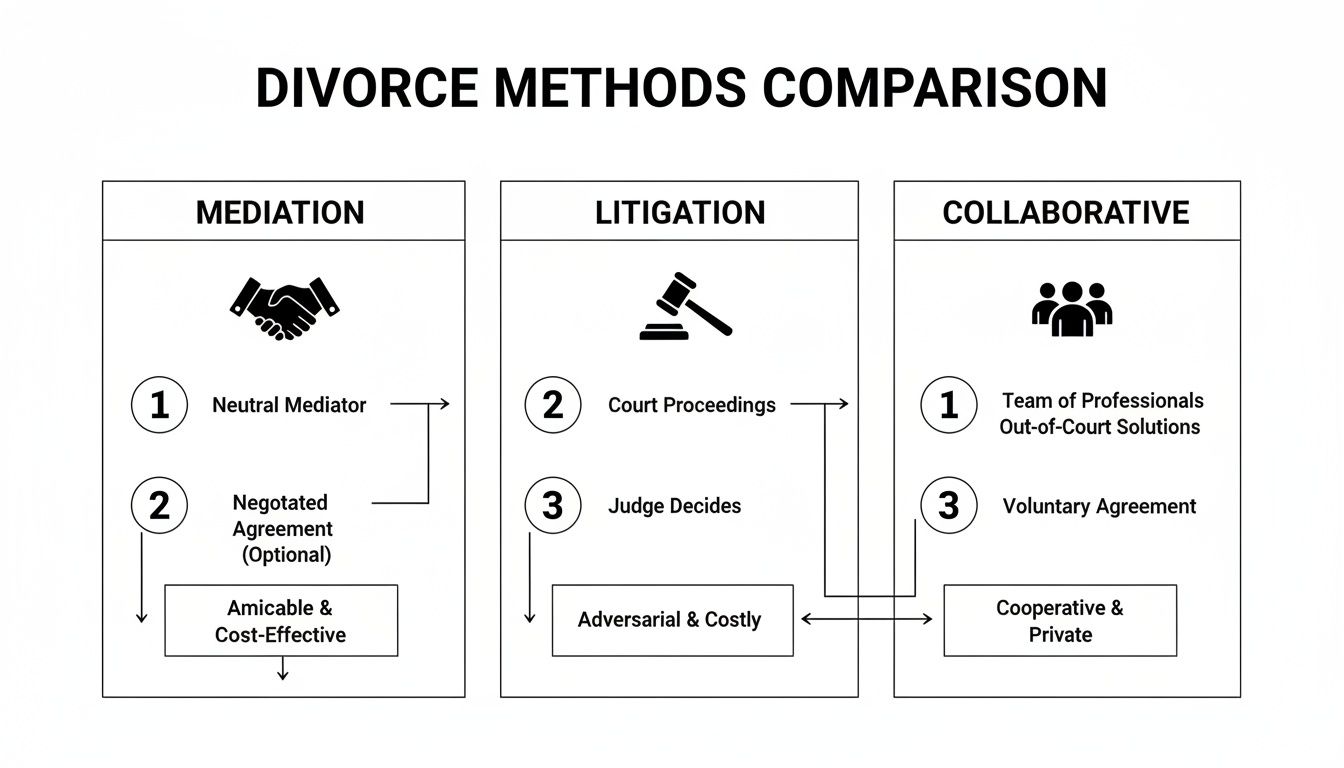
As you can see, mediation offers a unique balance of client control and efficiency. It stands in stark contrast to the high-conflict, high-cost world of litigation and the more structured team approach of collaborative divorce.
Step 4: Reaching a Final Agreement
If you and your spouse successfully reach a deal on all issues, the mediator will draft a Mediated Settlement Agreement (MSA). This is, without a doubt, the most important document you will sign during the entire divorce process.
Under Texas Family Code § 6.602, a properly drafted and signed MSA is binding and irrevocable. What does that mean in plain English? Once you sign it, there are almost no do-overs. You can't just change your mind the next day.
You and your attorney will review every word of the MSA to ensure it perfectly reflects the agreements made and fully protects your interests. Once both spouses and their lawyers have signed, the hard part is over. The MSA is then submitted to the court, and a judge will incorporate its terms into your Final Decree of Divorce. This final step transforms your private agreement into a legally enforceable court order, officially closing your case.
How to Get Ready for a Successful Mediation
Success in mediation isn’t something that just happens; it's almost always the direct result of careful, thoughtful preparation. When you walk into that room feeling organized, clear-headed, and confident, it can completely change the dynamic and the final outcome. But getting ready isn't just about gathering papers—it’s about getting into the right mindset for a productive negotiation.

This is a team effort between you and your attorney. We work hand-in-hand with our clients to pull together all the necessary information and really nail down their goals. This lets them step into the mediation process from a position of strength, knowing their rights are protected every step of the way.
Gathering Your Essential Documents
The bedrock of any solid negotiation is accurate information. Before you ever sit down at the mediation table, you and your attorney will be busy compiling a complete financial picture. This kind of transparency is non-negotiable for fairly dividing your community estate and figuring out any support obligations.
Your preparation checklist will almost certainly include:
- A Detailed Inventory and Appraisement: This is a comprehensive list of everything you and your spouse own—and owe—both together and separately.
- Financial Statements: Round up recent bank statements, credit card bills, mortgage documents, and details on any outstanding loans.
- Income Verification: This means gathering recent pay stubs, W-2s, and tax returns for both of you.
- Retirement and Investment Information: We'll need statements from 401(k)s, IRAs, pension plans, and any brokerage accounts.
- Business Records: If a business is part of the marital estate, you'll need profit and loss statements, balance sheets, and other key financial data.
Having all these documents organized and ready to go allows you to make decisions based on cold, hard facts, not just guesswork. It also prevents frustrating delays and shows the mediator and the other side that you're serious about reaching a fair deal.
Preparing for Child-Related Issues
If you have kids, your main focus is going to be on creating a stable and loving future for them. A huge part of preparing for mediation will be developing a proposed parenting plan. Think of this not as a final, set-in-stone document, but as a thoughtful starting point for discussion.
Your proposed plan should carefully address:
- Conservatorship: Who gets to make the big decisions about the kids' education, medical care, and religious upbringing?
- Possession Schedule: This is a detailed calendar mapping out when the children will be with each parent. It should cover regular time, plus holidays, birthdays, and summer vacations.
- Child Support: What's the appropriate amount of financial support based on Texas guidelines? For a deeper dive, you might want to read our guide on whether you can negotiate child support during mediation.
Thinking through these details beforehand lets you negotiate from a clear, child-focused perspective. It keeps their best interests right where they should be: at the very center of the conversation.
The Mental and Emotional Prep Work
Just as crucial as all the paperwork is your emotional readiness. Mediation is a process of give-and-take. It demands a mindset of good-faith compromise, a principle that Texas law itself encourages.
Before your session, take some time to reflect with your attorney. Define what you absolutely need, identify what's most important to you, and understand your non-negotiables. It’s just as important to figure out where you have some wiggle room.
Knowing what truly matters most—whether that’s keeping the family home, securing a specific co-parenting schedule, or protecting a retirement account—gives you a roadmap for the negotiation. This clarity helps you and your attorney advocate effectively for a settlement that lines up with your long-term goals. It’s about building a resolution that allows you to move forward with confidence and peace of mind, with your attorney acting as your strategic partner every step of the way.
The Financial and Emotional Benefits of Mediation
Deciding how you'll handle your divorce is one of the biggest choices you'll make, period. The path you take will ripple through your financial future and emotional health for years. While a courtroom battle often guarantees high stress and even higher costs, mediation offers a way forward that puts your wallet and your peace of mind first.
The practical upsides of mediation for divorce in Texas are huge, starting with the most obvious one: your bank account. A contested divorce trial can spiral into a five-figure legal bill before you know it. Mediation is a far more grounded and economical choice.
The cost difference is a game-changer for most Texas families. Divorce mediation typically runs between $500 to $2,500 total—a figure that depends on the mediator's experience, how many sessions you need, and where you are. Even with the rising cost of living in cities like Houston and Dallas, it’s a smart move. While a seasoned mediator with a high success rate will charge more, it’s still just a fraction of what litigation costs. The savings are almost always substantial.
Preserving Your Privacy and Control
Beyond the financial relief, mediation offers emotional benefits that you just can't put a price tag on. When you go to court, your family's private life becomes public record. Every disagreement over finances, every argument about parenting—it's all out there for anyone to see. Mediation, on the other hand, is completely confidential. Your private business stays private.
This confidential space creates a sense of safety, which naturally encourages more honest and open conversations. It also puts you and your spouse back in the driver's seat. Instead of a judge who doesn't know you making final, binding decisions about your kids and your property, you work together to build an agreement you can both live with. This sense of empowerment is one of the biggest reasons why to choose mediation for your Texas divorce.
Protecting Your Co-Parenting Relationship
For parents, this might be the most important benefit of all: mediation helps protect your ability to co-parent effectively down the road. The adversarial, you-vs-me nature of a courtroom fight can leave deep, lasting scars. It can make simple communication feel impossible for years to come.
Mediation is designed to be less confrontational. It helps parents shift their focus to a shared goal: finding the best solution for their children. By modeling cooperation and respect during the divorce, you're laying the foundation for a much healthier co-parenting relationship for the long haul.
Part of creating a less stressful divorce involves making big financial decisions calmly. For example, figuring out whether to sell the marital home before or after divorce can have massive financial and logistical consequences. Mediation gives you a structured, cooperative space to work through these tough choices, reducing conflict and setting your family up for a more stable future. By choosing a less contentious path, you're not just saving money—you're investing in your kids' emotional well-being and your own peace of mind.
The Power of a Mediated Settlement Agreement
All the hard work in mediation—the document gathering, the financial disclosures, the tough conversations—all funnels into one crucial document: the Mediated Settlement Agreement (MSA). This isn't just another piece of paper. Think of it as the legally binding contract that becomes the blueprint for your life after divorce. Understanding just how powerful it is under Texas law can bring a huge sense of relief.
The whole point of a successful mediation is to hammer out an MSA that resolves every single issue in your divorce. Once you, your spouse, and your attorneys sign on the dotted line, that document becomes a fortress. It provides a level of certainty and finality that a long, unpredictable court battle simply can't match.
Why an MSA is So Strong
The Texas Family Code gives a properly executed MSA a special, almost sacred, status. Under Texas Family Code § 6.602, a signed MSA is binding on everyone involved and gives you the right to a final judgment based on its exact terms.
What does this mean for you in plain English? Once that MSA is signed, it is irrevocable. You can't wake up the next day with a case of buyer's remorse and decide to change your mind. This rule exists to make sure the agreements people reach in good faith during mediation are respected, preventing endless second-guessing and drawn-out conflict.
This finality is a massive emotional and legal win. It allows you and your family to stop living in limbo and start moving forward with a clear, predictable roadmap for the future.
From Agreement to Final Decree
For an MSA to have this ironclad power in Texas, it has to meet a few specific legal requirements:
- It must be in writing.
- It must be signed by you, your spouse, and both of your attorneys (if you have them).
- It must state somewhere prominently—usually in bold text or ALL CAPS—that the agreement is not subject to revocation.
Once it’s signed, your attorney will draft the Final Decree of Divorce, which will mirror the terms of your MSA word-for-word. This is the official document the judge signs to make your divorce final. At this stage, the judge isn't there to second-guess your decisions or re-hash old arguments; their job is simply to confirm the agreement follows the law and sign off on the terms you both created.
The rules in Texas are built to protect the mediation process, keeping it confidential and ensuring the final agreement is solid. This structure is especially helpful for the 43.5% of divorcing couples with children who desperately need stability. With most mediated cases finalizing within 30-60 days after the MSA is signed, it’s a process that truly fast-tracks peace of mind for everyone. You can learn more about the typical timelines for how Texas family law cases are resolved.
Common Questions About Divorce Mediation in Texas
Heading into mediation for the first time can feel like walking into the unknown. It's completely normal to have questions and feel a little uncertain. Getting clear, straightforward answers can make all the difference. We’ve put together some of the most common questions we hear from our clients to help you get a better handle on what to expect.
What Happens If We Can't Agree on Every Issue?
It's actually pretty common not to solve every single puzzle piece during mediation, and that's okay. Any progress is good progress. A partial agreement is still a huge step in the right direction.
For instance, if you manage to work out a solid parenting plan and visitation schedule but hit a wall when it comes to dividing a business, that's a win. The issues you did agree on can be written into a partial Mediated Settlement Agreement. This dramatically narrows the list of items a judge has to decide later, saving everyone time, money, and significant courtroom stress.
Can I Be Forced to Accept an Offer I Don’t Like?
Absolutely not. At its heart, mediation is a voluntary process. You and your spouse are the only ones with the power to make the final call. The mediator is a guide, not a judge; their job is to open up lines of communication and help you explore options, not to force a decision.
You will never be pressured or required to sign an agreement that you do not believe is fair or in your family's best interest. Your attorney is there to advise you and ensure you understand the full implications of any offer before you even consider accepting it.
Is Mediation a Good Option If We Have a High-Conflict Relationship?
Surprisingly, yes. For many high-conflict couples, mediation is often the best path forward. The typical structure of mediation—where each person and their attorney are in separate rooms (a "caucus")—is designed to prevent direct confrontations and keep emotions from boiling over.
The mediator acts as a calm, neutral go-between, relaying offers and information without the emotional charge. This setup helps de-escalate tension and allows both of you to focus on the facts and make logical decisions, free from the weight of face-to-face arguments.
Why Do I Still Need My Own Lawyer in Mediation?
This is probably one of the most critical things to understand about the process. The mediator must remain neutral—it's their ethical and legal duty. They cannot give legal advice to you or your spouse. Their role is to facilitate the negotiation, not to protect your individual legal rights.
Your attorney is your advocate and yours alone. They are the only person in the room whose entire job is to look out for your best interests, explain how Texas law applies to your specific situation, and help you determine if a settlement offer is genuinely fair for your future. Going into mediation without your own lawyer is like negotiating a major deal without knowing all the terms—you're at a serious disadvantage and could agree to something with long-term consequences you don't fully understand.
If you need help navigating divorce, custody, or estate planning in Texas, contact The Law Office of Bryan Fagan, PLLC today for a free consultation.



