
Uncontested Divorce Attorneys in Humble, Texas

The moment usually starts small. One spouse reaches for the coffee mug the other bought on a trip to Galveston years ago, and suddenly both people are standing silently in the kitchen realizing the marriage is truly ending. For many Texas families, that quiet moment feels heavier than any courtroom hearing. Families searching for Uncontested Divorce Attorneys in Humble Texas are often not looking for a fight. They are looking for clarity, stability, and a way to move forward without tearing apart everything they built together.
At The Law Office of Bryan Fagan, PLLC, we understand that divorce is rarely just a legal process. It is a deeply personal transition that affects routines, finances, parenting, emotional health, and the future of an entire family. Bryan Joseph Fagan, a South Texas College of Law graduate and recognized authority on Texas divorce and custody law, founded the firm on a simple but powerful mission: to help people reclaim peace of mind during life’s most difficult moments through education, compassionate guidance, and strong legal advocacy.
Texas law recognizes that family stability matters, especially when children are involved. Under Texas Family Code §153.002, courts are required to make custody decisions based on the best interest of the child. In practice, that often means judges look closely at consistency between households, communication between parents, emotional stability, and the child’s day-to-day well-being. Even in uncontested divorces, the details of a parenting plan can significantly affect how children adapt emotionally and academically after separation.
Many parents are surprised to learn that a peaceful divorce does not happen automatically just because both spouses agree to separate. Questions about parenting schedules, child support, conservatorship, property division, and future decision-making still need careful attention. When these issues are handled thoughtfully and clearly from the beginning, families often avoid unnecessary conflict later and create a healthier foundation for the next chapter of their lives.
This article will explain how uncontested divorce works in Texas, how custody arrangements can impact children’s emotional and academic stability, and what parents in Humble, Kingwood, Atascocita, and surrounding Harris County communities should know before filing. You will also learn how experienced family law attorneys help families create practical parenting plans, protect long-term stability, and move through divorce with greater confidence and less uncertainty.
At The Law Office of Bryan Fagan, PLLC, we believe family law should do more than finalize legal paperwork. It should help families protect what matters most while building a path forward rooted in dignity, structure, and peace of mind. As you continue reading, you will see how the right legal guidance can help transform a stressful transition into an opportunity for stability, healing, and a stronger future for your family.
The Short Answer
Uncontested divorce in Texas requires both spouses to agree on every issue — property division, debts, custody, support — and to sign filings without contest. Texas Family Code §6.702 (2025) imposes a mandatory 60-day waiting period from filing. Harris County residents in Humble qualify if they’ve lived in Texas 6 months and the county 90 days. Disputed assets, family violence allegations, or active separate counsel disqualify the case from uncontested status.
Key Takeaways
- Self-filing fails roughly half the time in Harris County. Most failures are technical — wrong form, missing waiver, defective service — not substantive. An attorney-prepared uncontested filing closes faster and rarely gets kicked back.
- Agreement on everything is the threshold. Texas does not allow partially-uncontested divorce. If one issue is disputed — even one item of property — the case is contested and must be filed that way.
- The 60-day waiting period is non-negotiable. §6.702 (Tex. Fam. Code 2025) requires a 60-day clock from petition filing to final decree, even when both spouses agree completely. Family violence cases are the only exception.
- Residency rules are jurisdictional. §6.301 requires 6 months in Texas and 90 days in the county of filing. Humble residents file in Harris County. Kingwood residents whose neighborhoods cross into Montgomery County need to verify which county their address falls in.
- Children change the analysis. If there are minor children, uncontested status requires written agreement on conservatorship, possession, and child support — calculated per §154 guidelines. Disagreement on any of these makes the case contested.
- Real property and retirement accounts are common disqualifiers. Spouses who think they’re uncontested often have not actually resolved how to divide a house, a 401(k), or a business interest. That conversation usually surfaces the real disagreement.

Your Family’s Future Starts Here
Don’t navigate your legal journey alone. Schedule a consultation now and get the clarity and support you deserve.
Our Humble Texas family lawyers and attorneys for wills advise our clients of the immediate aftermath as well as the long-term effects of divorce-related issues, such as the following:
Trust us to help you with our Uncontested Divorce Attorneys in Humble, Texas. Call 281-817-1827 or contact us online today to schedule a free consultation with our Uncontested Divorce Attorneys in Humble, Texas.
What Uncontested Divorce Actually Means in Texas

For many families searching for Uncontested Divorce Attorneys in Humble Texas, the word “uncontested” sounds simpler than it actually is. Under Texas law, there is no middle ground between uncontested and contested divorce. Either both spouses agree on every issue in writing, or the case is contested and must move through negotiation, mediation, or litigation before it can be finalized.
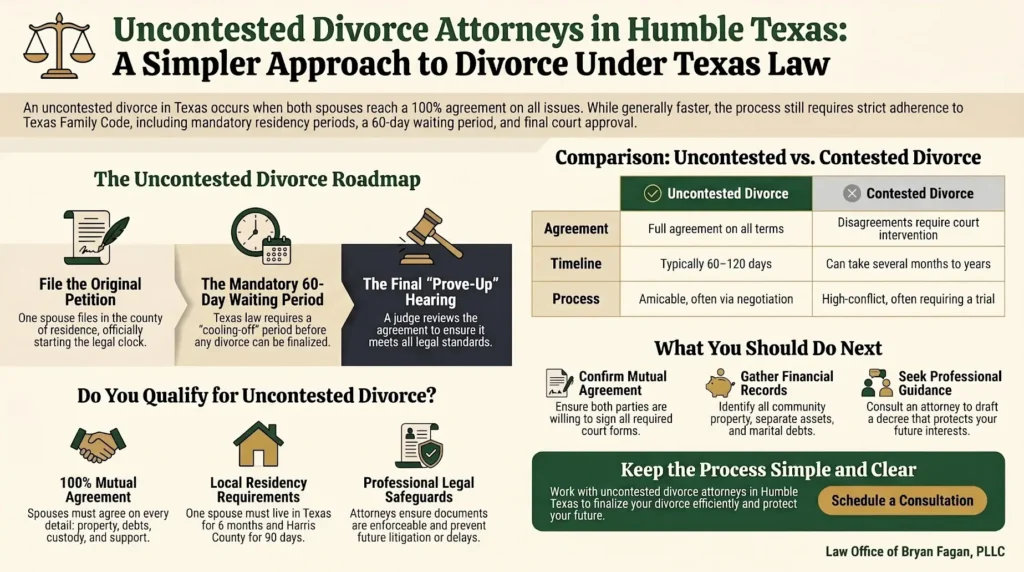
In straightforward situations, an uncontested divorce in Texas works because both spouses already agree on property division, debt allocation, conservatorship, parenting schedules, child support, and any spousal maintenance issues before filing. One spouse files the Original Petition for Divorce, the other spouse signs a Waiver of Service or files an Answer, and both parties sign an Agreed Final Decree of Divorce. After the mandatory waiting period under Texas Family Code §6.702 expires, the court can finalize the case at a prove-up hearing.
Most agreed divorces are filed under Texas Family Code §6.001 using insupportability, Texas’s no-fault divorce standard. However, one of the most common misunderstandings our attorneys hear in Humble, Kingwood, Atascocita, and Spring is this: “We’re getting along, so the divorce must be uncontested.” In reality, civility is not the same thing as legal agreement. A couple may communicate respectfully but still disagree about retirement accounts, parenting schedules, child support, or who keeps the family home.
If the case involves children, Texas courts must evaluate whether the agreement serves the child’s best interest under §153.002. Parenting plans, conservatorship rights, and child support provisions under Chapter 154 must be detailed enough for the court to enforce. In more complex cases involving custody disputes, relocation concerns, retirement accounts, or business ownership, experienced legal guidance often becomes critical because a partially agreed divorce can quickly become contested.
Texas courts also expect divorce decrees to fully address community property division under §7.001. In Harris County and Montgomery County, judges frequently see uncontested filings delayed because of incomplete paperwork, incorrect waiver language, unclear parenting provisions, or unresolved retirement issues requiring a QDRO.
Families trying to understand the difference between a true agreed divorce and a partially resolved case can learn more about uncontested divorce in Texas and how Texas courts approach child custody matters during divorce proceedings. At The Law Office of Bryan Fagan, PLLC, the focus is not simply on finishing paperwork quickly, but on helping families create clear, enforceable agreements that protect long-term stability and peace of mind.
What Makes Uncontested Work
The cases that close cleanly in Harris County share a pattern: both spouses have already separated emotionally, both want to move on, neither is using the divorce as leverage, and they’ve talked through every financial and parenting decision before they call. If those four conditions are met, the filing is paperwork. If any one is missing, the case will probably escalate.
Who Qualifies for Uncontested Divorce in Harris County
For families searching for Uncontested Divorce Attorneys in Humble Texas, one of the biggest surprises is learning that agreeing “in principle” is not enough for a case to qualify as uncontested. Texas courts require spouses to fully resolve every issue before the divorce can move through the agreed process. That includes property division, debt allocation, conservatorship, parenting schedules, child support, and any request for spousal maintenance.
Under Texas Family Code §6.301, residency requirements must also be satisfied before filing. At least one spouse must have lived in Texas for the six months preceding the divorce and in the county of filing for at least 90 days. For Humble residents, that usually means filing in Harris County District Court. However, families in Kingwood, Atascocita, Spring, Porter, and nearby communities sometimes run into problems because portions of those areas cross county lines into Montgomery County. Filing in the wrong county can delay the case, force refiling, and restart the mandatory waiting period under §6.702.
The agreement itself must be far more detailed than many couples expect. In straightforward situations, spouses may already agree on who keeps the house, how vehicles and bank accounts will be divided, and how parenting time will work. In more complex cases involving retirement accounts, business interests, or children, the legal drafting becomes significantly more important. Texas courts expect agreed final decrees to clearly address community property division under §7.001, conservatorship rights under §153.134, and child support obligations under Chapter 154.
If the case involves children, parenting plans must go beyond broad verbal understandings. Judges in Harris County want to see clear agreements regarding possession schedules, school-year routines, holiday schedules, medical decision-making, and financial responsibilities. Parents are often surprised to learn that unresolved details about extracurricular activities, transportation, or educational decisions can quickly turn an uncontested divorce into a contested matter. Families seeking guidance about parenting arrangements may benefit from reviewing information about parenting plans in Texas and how courts evaluate the child’s best interest under §153.002.
Another issue that frequently changes the direction of a divorce case is family violence. Under Texas law, agreed divorces involving active protective orders or recent family violence allegations often require additional court scrutiny and may no longer qualify for a straightforward uncontested process. Where disputes remain unresolved or safety concerns exist, strategic legal guidance becomes especially important to protect both the client and the children involved.
At The Law Office of Bryan Fagan, PLLC, the goal is not simply to determine whether spouses are “getting along.” The real question is whether the agreement is complete, enforceable, and structured clearly enough to protect long-term stability. Families wanting to better understand the legal process can also explore additional educational resources about uncontested divorce in Texas and the filing requirements that apply in Harris County and surrounding Texas communities.
Strategic Insight
The eligibility test is not a hurdle. It’s the framework that determines whether your filing will succeed or get kicked back. Most uncontested filings that fail in Harris County fail because the spouses agreed verbally but had not actually run the math on retirement division or finalized the child support calculation. The agreement was real; the documentation was not.
Listen to Our Texas Family Law Podcast
Prefer listening? In this episode, we discuss uncontested divorce in Humble, Texas, including how the process works, why it may be a simpler way to move forward, and what couples should know before filing.
The 60-Day Waiting Period and Harris County Filing Timeline
Families searching for Uncontested Divorce Attorneys in Humble Texas are often surprised to learn that Texas law requires a waiting period even when both spouses fully agree on the divorce terms. Under Texas Family Code §6.702, courts cannot finalize most divorces until at least 60 days have passed from the date the Original Petition for Divorce is filed. The waiting period applies whether the divorce involves children, property, or a simple agreed separation.
The purpose of the 60-day rule is twofold. First, it gives spouses time to reconsider before the marriage is legally dissolved. Second, it allows the court to confirm that all required Texas divorce paperwork has been properly completed. In Harris County and Montgomery County, judges regularly reject or delay uncontested filings because of incomplete decrees, incorrect waiver language, missing child support provisions, or unresolved property issues.
In straightforward situations, the timeline usually moves quickly once the paperwork is prepared correctly. The petition is filed first, then the responding spouse signs a Waiver of Service or files an Answer. After that, both parties sign the Agreed Final Decree of Divorce and any supporting documents related to conservatorship, child support, retirement division, or property transfers. Most uncontested divorces in Harris County finalize shortly after the 60-day waiting period ends through a short prove-up hearing that often lasts less than fifteen minutes.
In more complex cases, delays usually come from unresolved details rather than the waiting period itself. If the case involves children, parenting plans must address conservatorship, possession schedules, and support obligations under Texas Family Code §§153.002, 153.134, and Chapter 154. When spouses disagree about holiday schedules, educational decisions, extracurricular activities, or relocation restrictions, the divorce may no longer qualify as uncontested.
Financial issues create similar problems. Retirement accounts, business interests, real estate, and debt allocation often require more detailed drafting than couples initially expect. Courts also expect community property division to comply with Texas Family Code §7.001, which requires a “just and right” division of marital assets. A missing QDRO, unclear property language, or incomplete retirement division can delay the prove-up process and create problems long after the divorce is finalized.
One of the most common misconceptions is that hiring an attorney somehow shortens the statutory waiting period. It does not. The 60-day clock runs regardless of how quickly spouses reach agreement. What experienced legal guidance often changes is the quality and efficiency of the work completed during those 60 days. Proper drafting, accurate filing procedures, and carefully prepared agreed decrees help families avoid avoidable delays, rejected filings, and costly corrections later.
Families trying to better understand the timeline for uncontested divorce in Texas or how Texas courts approach child support in Texas can benefit from reviewing additional educational resources before filing. At The Law Office of Bryan Fagan, PLLC, the focus is on helping families move through the divorce process with clarity, stability, and legally enforceable agreements that protect their future.
When “Uncontested” Becomes “Contested” — The Warning Signs

For many families searching for Uncontested Divorce Attorneys in Humble Texas, the biggest surprise is how quickly an agreed divorce can turn into a contested case. In Texas, an uncontested divorce remains uncontested only as long as both spouses continue agreeing on every issue. The moment one spouse changes positions on property division, conservatorship, child support, or parenting schedules, the case can shift into litigation territory before the judge ever signs the final decree.
In straightforward situations, couples often enter the process believing they have already worked everything out. However, experienced Texas family law attorneys frequently see warning signs before the petition is even filed. One of the most common is unilateral financial activity. If one spouse suddenly transfers money, opens new credit accounts, moves retirement funds, or sells property without the other spouse’s knowledge, the agreement may not be as stable as it first appeared. Under Texas Family Code §7.009, courts can address fraud on the community when one spouse improperly hides or transfers marital assets.
Another major warning sign involves unresolved financial complexity. In more complex cases involving business ownership, retirement accounts, investment portfolios, or significant debt, couples often discover they never fully agreed on division terms in the first place. Retirement accounts requiring QDROs, disputes over home equity, or confusion about separate versus community property under §7.001 can quickly create delays and additional conflict. A divorce that looked simple during kitchen-table conversations may become contested once the legal drafting begins.
If the case involves children, disagreements often surface even later in the process. Texas courts prioritize the child’s best interest under §153.002, which means parenting plans must address much more than basic visitation schedules. Conservatorship rights, transportation responsibilities, extracurricular activities, holiday possession, school decisions, and child support obligations under Chapter 154 all need to be clearly defined. Parents frequently believe they agree until they begin discussing the practical realities of week-to-week parenting between two households in Humble, Kingwood, Atascocita, or Spring.
When spouses disagree about parenting schedules, relocation issues, or communication responsibilities, the divorce may no longer qualify as uncontested. In Harris County courts, judges expect agreed parenting plans to be specific, enforceable, and realistic. Vague agreements often create future conflict, especially when transportation logistics, school-year schedules, or medical decision-making are left unresolved. Families trying to better understand how courts evaluate these issues may benefit from reviewing information about parenting plans in Texas and how Texas judges approach custody-related decisions.
Another issue families misunderstand is the role of legal representation. In truly uncontested divorces, the process is usually collaborative and document-focused. Where disputes remain unresolved, separate legal representation often signals that negotiation and litigation strategy are becoming necessary. That does not automatically mean the divorce will end in trial, but it usually means the case requires more careful planning and more detailed legal guidance than originally expected.
At The Law Office of Bryan Fagan, PLLC, the focus is on helping families recognize potential problems before they create delays, additional costs, or long-term instability. Families seeking additional educational guidance about uncontested divorce in Texas and Texas divorce filing procedures can better understand when a straightforward agreed divorce remains realistic and when a more strategic legal approach becomes important.
Warning — The Most Expensive Mistake
Filing as uncontested when the case is actually contested wastes filing fees, restarts the 60-day clock when the case has to be refiled or amended, and gives the disagreeing spouse legal grounds to demand a new petition and process service. The cost of getting this wrong is typically 4-6x the cost of filing contested from the start. Run the eligibility test below before you file anything.
“I tell every Humble client the same thing on the first call: I don’t care if you’ve been calm with each other for six months. Show me the signed property agreement and the signed parenting plan. If those don’t exist, this isn’t uncontested yet.”
Interactive Eligibility Test
Does Your Situation Qualify for Uncontested Divorce in Texas?
Have you and your spouse agreed in writing on how to divide all property, debts, and assets?
Do you have minor children together (under age 18)?
Do you have minor children together (under age 18)?
Have you and your spouse agreed on conservatorship, possession schedule, and child support?
Have you and your spouse agreed on conservatorship, possession schedule, and child support?
Does either spouse own a business, retirement account, real estate, or assets worth more than $100,000?
Does either spouse own a business, retirement account, real estate, or assets worth more than $100,000?
Have those high-value assets been formally valued and divided in writing?
Has either spouse filed a protective order or alleged family violence in the past two years?
Have you or your spouse lived in Texas for at least 6 months and in Harris County for at least 90 days?
Your Results
You qualify for uncontested divorce in Texas
Your answers indicate full written agreement, no disqualifying factors, and Harris County residency. Your case is positioned to file uncontested. The remaining work is execution — preparing the petition, decree, and waivers correctly so the case closes cleanly at the end of the 60-day waiting period under §6.702. Talk to a Texas family law attorney to verify the documents before filing.
Most clients hear back within 5 minutes during business hours (8 AM–10 PM CT, 7 days a week)
Your Results
You likely qualify — but need to formalize agreement before filing
Your answers indicate substantive agreement with your spouse but gaps in written documentation. This is the most common situation I see in Humble intake calls. Verbal agreement turns into contested filings when one spouse changes a position after the petition is filed. The fix is straightforward: get the agreement on paper — property division, parenting plan, and support calculation — before anything goes to the courthouse.
Most clients hear back within 5 minutes during business hours (8 AM–10 PM CT, 7 days a week)
Your Results
Eligible, but complex assets need formal division first
Your answers indicate you have the foundation for an uncontested filing, but the case involves business interests, retirement accounts, or real estate that has not been formally valued and divided. Courts will accept the agreed decree once those assets are properly documented — but filing before that documentation exists creates legal exposure for both spouses under §7.009. The path forward is valuation and division, then filing. This is solvable, not blocking.
Most clients hear back within 5 minutes during business hours (8 AM–10 PM CT, 7 days a week)
Your Results
Your case is contested — filing as uncontested will fail
Your answers indicate at least one disqualifying factor: unresolved disagreement on a material issue, family violence allegations, or a residency gap. Filing this case as uncontested will cost time and money. The better path is to file contested from the start with proper representation, work through the disputed issues efficiently, and either settle or proceed to trial. A contested filing handled well closes faster than a failed uncontested filing that has to be refiled.
Most clients hear back within 5 minutes during business hours (8 AM–10 PM CT, 7 days a week)
Your Results Sent You Here For a Reason
Whatever tier the qualifier landed on, the next step is the same: a 45-minute Legal Strategy Session to map your specific case to Harris County procedure.
Schedule a Legal Strategy SessioWhat an Uncontested Divorce Costs in Texas
The honest answer on cost: uncontested divorce in Texas runs in a range, not a flat fee, because the variables that drive the work — children, assets, retirement accounts, business interests — change the document preparation substantially. A childless couple with no real property and aligned agreement is a different filing than a couple with two kids, a Humble-area home, and a 401(k) that needs a QDRO. Both can be uncontested. Neither costs the same.
What I tell Humble-area clients on intake: the cost questions are the wrong place to start. The right starting question is whether the case actually qualifies as uncontested. If it does, the legal work is constrained and predictable. If it does not — if there’s unresolved property or parenting disagreement — the cost of a failed uncontested filing exceeds the cost of doing it right from the beginning by a meaningful multiple.
The cost drivers worth flagging upfront: number of minor children, whether spousal maintenance is requested under §8.051, presence of retirement accounts requiring qualified domestic relations orders, real estate that needs deed transfer, business interests requiring valuation, and any debt allocation that needs creditor coordination. The more of those present, the more document preparation the case requires.
| Cost Driver | Why It Matters | What Affects It |
|---|---|---|
| Children under 18 | Parenting plan, child support calculation under §154, possession schedule | Number of children, agreement complexity |
| Real property | Deed transfer, refinance coordination, lien releases | Number of properties, mortgage status |
| Retirement accounts | QDRO preparation, plan administrator coordination | Type of plan (401k, pension, IRA) |
| Business interests | Valuation, transfer of ownership, operating agreement updates | Business structure, ownership % |
| Spousal maintenance | Eligibility analysis under §8.051, term and amount drafting | Marriage length, income disparity |
| Court filing fees | Required by Harris County District Clerk | Fixed statutory amount |
Filing in Harris County vs. Montgomery County — for Kingwood, Porter, and New Caney Residents

If your address is in Humble proper, you file in Harris County District Court. If your address is in Kingwood, the answer depends on which side of the county line your neighborhood sits on — most of Kingwood is Harris County, but portions near the eastern edge fall into Montgomery County. Atascocita is Harris County. Porter and New Caney are Montgomery County. Crosby is Harris County.
Filing in the wrong county is a common mistake. The 90-day county residency requirement under §6.301 means you cannot simply file in the county that’s more convenient — you must file in the county you’ve actually resided in for the preceding 90 days. Filing in the wrong county forces dismissal and refiling, which restarts the 60-day waiting period.
Procedurally, Harris and Montgomery counties operate similarly, but with differences worth knowing. Harris County has a higher case volume, which means slightly longer prove-up scheduling but more predictable judicial assignment. Montgomery County moves cases faster on average but has tighter local practice rules on document formatting. The District Clerk’s e-filing systems differ between counties; a filing prepared for Harris will need adjustment before
| Status | Eligibility Test | What It Means for Your Filing |
|---|---|---|
| Strong | Full written agreement, no disqualifiers, 6+ months Texas / 90+ days Harris County | File uncontested. Case closes ~60-75 days from petition. |
| Possible | Verbal agreement, no written documentation | Document agreement first. Then file. Failure to document is the #1 reason uncontested cases convert to contested. |
| Gated | Eligible but complex assets unvalued | Valuation and division required before filing. Filing without this creates §7.009 exposure for both spouses. |
| Weak | Active disagreement, family violence, separate counsel, residency gap | File contested with proper representation. Faster than failed uncontested + refile. |
Checklist: What to Do If You’re Considering Uncontested Divorce in Humble
Verify residency before doing anything else
Confirm you or your spouse has lived in Texas 6 months and in Harris County 90 days. If you’re in a Kingwood neighborhood near the Montgomery line, verify your address falls inside Harris County. Wrong-county filings get dismissed.
Run the eligibility qualifier above
The interactive test surfaces disqualifiers most people miss — unresolved retirement division, verbal-only agreements, residency gaps. If the result is anything but Strong, that’s diagnostic information about what to fix before filing.
Inventory community property in writing
Every account, vehicle, retirement plan, real estate holding, debt, and business interest acquired during the marriage. This is the property division conversation that surfaces hidden disagreements.
Draft the property division agreement before filing
Specific allocation of every item from the inventory. Who keeps the house. How retirement splits. Who takes the car loan. Verbal agreements turn into contested filings during the 60-day waiting period.
If children are involved, draft the parenting plan
Conservatorship, possession schedule, child support calculation under §154 guidelines, decision-making authority on education and medical care. Use the state template — it forces explicit answers on every issue.
Get retirement and business interests formally valued
If either spouse has a 401(k), pension, IRA, or business ownership interest, valuation needs to happen before division. Filing without valuation creates §7.009 exposure for both spouses.
Book a Legal Strategy Session before drafting petitions
The Strategy Session is where you verify the case actually qualifies as uncontested and identify the issues that would cause a kickback from the District Clerk. This is cheaper than filing and refiling.
File once, file correctly
Petition, Waiver of Service or Answer, Final Decree, and any required supporting documents (QDRO, deed transfers, child support order). Properly prepared documents close the 60-day clock cleanly. Defective documents restart it.
Run the Checklist With Counsel, Not Alone
Every item above gets resolved faster with an attorney at the table. The Legal Strategy Session is where we work through it.
Schedule a Legal Strategy SessionWhat I Tell Every Client Who Calls About Uncontested Divorce in Humble

Uncontested divorce is the right answer when it’s the right answer. When both spouses have actually resolved every issue — property, debts, children, support — and have it in writing, the legal work is straightforward and the case closes in 60 to 75 days. When the situation is anything other than that, calling the case uncontested does not make it uncontested. It just delays the contested filing.
The threshold I use with Humble-area clients: if you can produce a written property division agreement, a written parenting plan (if children are involved), and a clear answer to whether either spouse is asking for spousal maintenance — and both spouses sign those documents — you have an uncontested case. If you cannot produce those documents, you have a contested case that is being labeled as uncontested. That mislabeling is what fails in Harris County District Court.
If you’re in Humble, Kingwood, Atascocita, Spring, or anywhere in Harris County and you’re considering uncontested divorce, the next step is a Legal Strategy Session. Bring the documents you do have. We’ll identify what’s missing, what needs to be drafted, and whether the case files as uncontested or needs to be handled differently. The session is direct, the answer is specific, and you’ll leave knowing exactly how your case moves.
The Next Step Is the Strategy Session
45 minutes. Specific answers. No assumption that your case is uncontested until we verify it.
Schedule a Legal Strategy SessionConclusion:
Divorce changes the structure of a family, but it does not have to destroy stability, communication, or your child’s future. The right legal strategy can reduce conflict, preserve routines, and give both parents a clearer path forward. Families searching for Uncontested Divorce Attorneys in Humble Texas are often looking for more than paperwork—they are looking for guidance they can trust during a time that feels uncertain and emotionally exhausting. At The Law Office of Bryan Fagan, PLLC, we believe families deserve honest answers, practical solutions, and legal support that protects what matters most.
In straightforward situations where both spouses genuinely agree on parenting, property division, and support, an uncontested divorce can provide an efficient and less stressful resolution. In more complex cases, especially if your case involves custody disputes, retirement accounts, business interests, hidden assets, or concerns about your child’s emotional and academic well-being, the legal strategy often requires a more detailed and customized approach. Understanding that difference early can help families avoid costly mistakes and unnecessary conflict later.
Whether you are ready to move forward with an agreed divorce or still trying to understand your options, the goal should always be the same: creating stability, clarity, and peace of mind for the next chapter of your life. The Law Office of Bryan Fagan, PLLC continues to help Texas families navigate difficult transitions with compassionate counsel, strategic guidance, and a commitment to protecting both parents and children through every stage of the process.
Questions My Clients Ask About Uncontested Divorce in Humble
The cost depends on the case’s complexity, not the agreement level. A simple uncontested filing with no children and no real property requires substantially less work than an uncontested filing involving retirement accounts, a Humble-area home, and a parenting plan. We quote uncontested cases after a Legal Strategy Session — that’s the only point at which the actual scope of work is known. What I will say: the cost of a properly-handled uncontested case is meaningfully lower than a contested case, and dramatically lower than a failed uncontested case that has to be refiled as contested.
Texas Family Code §6.702 (2025) imposes a mandatory 60-day waiting period from petition filing. Most Harris County uncontested cases close between day 60 and day 75. The waiting period is statutory — it cannot be shortened by paying more, hiring different counsel, or both spouses agreeing to waive it. The only waiver path is under §6.7022 for family violence cases, which is a protection mechanism, not a speed mechanism.
Filing requires four core documents: the Original Petition for Divorce, a Waiver of Service or Answer signed by the respondent, a Final Decree of Divorce signed by both spouses, and supporting documents for any specific issues (child support order, QDRO, deed transfers). The petitioner files the petition with the Harris County District Clerk, the respondent signs the waiver, both sign the decree, and after the 60-day waiting period the court enters the decree at a brief prove-up hearing. Self-filing is legal but the form errors that cause refiling are common.
Uncontested divorce in Texas refers to a divorce where both spouses agree on every issue — property, debts, custody, support — and one spouse files paperwork the other signs without contest. Texas does not recognize partially-uncontested divorce. If any single issue remains disputed at the time of filing, the case is contested and must be filed and handled that way. The “uncontested” label describes the resolution status, not the filing process.
Yes, it is legal to file pro se. Whether it is wise depends on the complexity of the case. Self-filed uncontested cases in Harris County fail at a meaningful rate — most failures are technical form errors that an attorney would catch at draft stage. If your case has no children, no real property, no retirement accounts, and complete written agreement, pro se filing is feasible. Once any of those complicating factors are present, the cost of an attorney is lower than the cost of a refiled case.
No. Uncontested divorce by definition requires both spouses to sign — at minimum the Waiver of Service or Answer and the Final Decree of Divorce. If your spouse will not sign, you have a contested case and must proceed by serving them with process. Refusal to sign is a contest. The case can still resolve quickly through negotiation, but the filing path is contested.
Uncontested and no-fault are different concepts that often appear together. No-fault refers to the grounds for divorce — under §6.001, insupportability allows divorce without proving wrongdoing. Uncontested refers to whether the spouses agree on the case’s resolution. A case can be no-fault contested (insupportability grounds, but disputed property), or fault-based uncontested (rare but possible). Most uncontested Texas divorces are filed as no-fault on insupportability grounds.
Not when the case is genuinely uncontested. Mediation is required by most Harris County courts in contested cases before trial. In an uncontested case where both spouses already agree, mediation is not required because there is nothing to mediate. If you’re considering mediation, that may itself be a signal that the case is not actually uncontested — you have unresolved issues that need a mediator’s help to resolve.
The case becomes contested. The spouse who changed their position has the right to do so any time before the judge signs the final decree, and the case must be refiled or amended to reflect the disputed status. This is the most common reason Humble-area uncontested filings escalate — the agreement that existed at filing erodes during the 60-day waiting period. The remedy is to have the agreement properly documented before filing, which makes withdrawal more difficult and more costly for the changing spouse.
Yes, if you meet the Texas residency requirements under §6.301. The Texas resident files in their county of residence (Harris County for Humble), and the out-of-state spouse signs the Waiver of Service or Answer remotely. Mail or e-signature is acceptable for these documents. The 60-day waiting period applies. The complication that arises is child custody jurisdiction if there are minor children — the Uniform Child Custody Jurisdiction and Enforcement Act controls which state has authority, and it is not always Texas.
Have a Specific Question I Didn’t Cover?
Every Humble-area divorce I handle starts with a Legal Strategy Session. Bring your questions. Get specific answers about your case.
Schedule a Legal Strategy Session