
Collaborative Divorce in Texas: The Complete Process Guide (Including Collaborative Divorce Attorneys in Humble Texas)

A father from Kingwood once sat across from us turning his wedding ring over in his hand while talking about something surprisingly small: taco night. Every Tuesday for nearly a decade, his family gathered around the kitchen island making tacos together while music played in the background and the dog waited for scraps to hit the floor. After separation discussions started, taco night disappeared almost overnight. His biggest fear was not the legal paperwork or even dividing property. It was watching his children quietly realize their world no longer felt predictable. For many families searching for Collaborative Divorce Attorneys in Humble Texas, that fear is painfully familiar. Parents are not just worried about ending a marriage — they are worried about protecting the routines, relationships, and emotional stability their children depend on every day.
That concern becomes even more important when custody decisions begin affecting a child’s emotional well-being, daily structure, and long-term development. Children often experience anxiety, behavioral changes, withdrawal, or declining academic performance during divorce, especially when conflict becomes constant or communication between parents breaks down. Texas courts recognize the importance of stability when making custody decisions under Texas Family Code §153.002, which requires judges to prioritize the best interest of the child. In many Harris County family law cases, courts closely examine which parenting arrangements create the most consistent and supportive environment for the child moving forward.
At The Law Office of Bryan Fagan, PLLC, we believe families deserve more than courtroom conflict during one of the hardest transitions of their lives. Founded by Bryan Joseph Fagan, a South Texas College of Law graduate and recognized authority on Texas divorce and custody law, our firm was built on the mission of helping people reclaim peace of mind, clarity, and confidence during uncertain times. Through compassionate counsel, practical education, and innovative legal solutions like collaborative divorce, we help Texas parents create child-centered solutions designed to protect what matters most.
In this article, you will learn how collaborative divorce works in Texas, how divorce can affect a child emotionally and academically, and how carefully structured parenting plans can help preserve stability during major family transitions. Most importantly, you will discover how the right legal guidance can help families move forward without losing sight of the people who matter most — their children.
The Quick Version
Collaborative divorce in Texas is governed by the Collaborative Family Law Act (Tex. Fam. Code §15.001–15.116, 2025). Both spouses and both attorneys sign a participation agreement promising to settle outside court — if either side litigates, both attorneys must withdraw. The process takes 4–8 months on average, costs $15,000–$50,000 per side, and works best for couples who want privacy, control, and a co-parenting relationship intact afterward.
Key Takeaways
- It’s a contract, not a vibe. The Texas Collaborative Family Law Participation Agreement is statutorily required under §15.101 and binds both parties to the no-court rule. Sign it, and you’ve changed the legal architecture of your divorce.
- The disqualification clause is the entire point. Under §15.051, if collaborative breaks down and either spouse files contested litigation, both collaborative attorneys must withdraw. That risk is what forces good-faith negotiation.
- Cost depends on cooperation, not complexity. A high-asset collaborative divorce between cooperative spouses often costs less than a low-asset litigated one. Conflict, not assets, drives the bill.
- Not every couple qualifies. Active domestic violence, hidden assets, severe power imbalances, or a spouse who refuses transparency are dealbreakers. We’ll tell you that in the first 30 minutes.
- The team model matters. Most Texas collaborative cases use a financial neutral and often a child specialist or communication coach. These professionals shorten the timeline and reduce the lawyer hours.
- Humble, Kingwood, and Atascocita cases run through Harris County district courts. The procedural overlay is the same as any Houston-area collaborative, but local mediator availability and financial neutral pools differ from downtown.
- Privacy is the underrated benefit. Collaborative settlements are filed as an agreed decree. Litigated divorces leave a discovery and motion record that anyone can pull.

Your Family’s Future Starts Here
Don’t navigate your legal journey alone. Schedule a consultation now and get the clarity and support you deserve.
Our Humble Texas family lawyers and attorneys for wills advise our clients of the immediate aftermath as well as the long-term effects of divorce-related issues, such as the following:
Trust us to help you with your Family Law Attorneys in Humble, Texas. Call 281-817-1827 or contact us online today to schedule a free consultation with your Family Law Attorney in Humble, Texas.
What Collaborative Divorce in Texas Actually Is

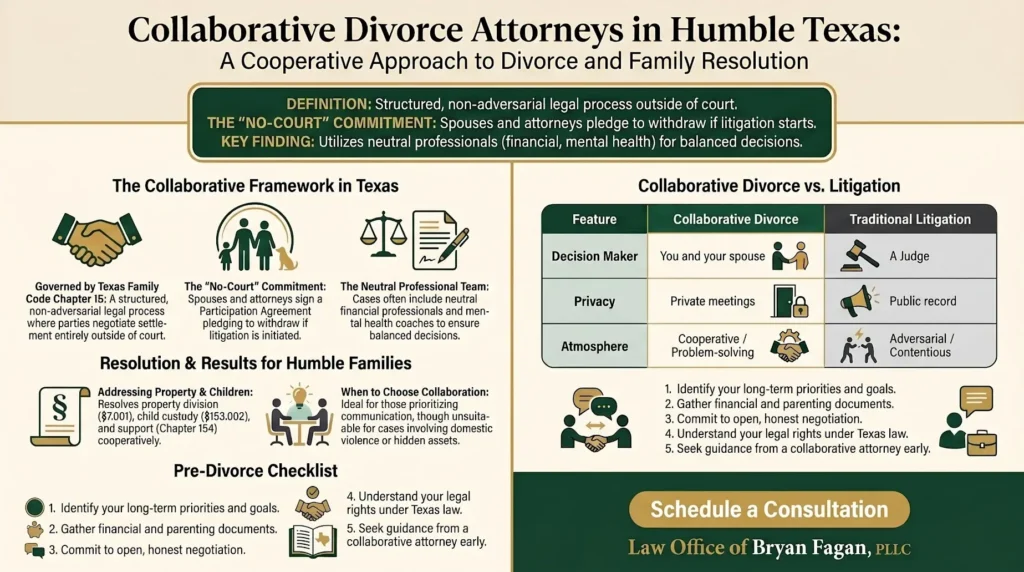
For many families searching for Collaborative Divorce Attorneys in Humble Texas, collaborative divorce offers something traditional litigation often cannot: a structured legal process focused on protecting family stability instead of escalating conflict. Under Chapter 15 of the Texas Family Code, collaborative divorce allows spouses to resolve issues like property division, parenting schedules, and financial support outside the courtroom through cooperative negotiation and transparent communication. The process is designed to help families move forward with greater clarity, privacy, and emotional stability, especially when children are involved.
Texas law treats collaborative divorce differently from a standard negotiated settlement. Under Texas Family Code §15.101, both spouses and both attorneys must sign a written collaborative law participation agreement committing to resolve the divorce without contested court hearings. That agreement creates a shared legal framework focused on settlement rather than courtroom strategy. Unlike traditional litigation, where attorneys often prepare for motions and trial from the beginning, collaborative divorce in Texas centers on problem-solving, financial transparency, and long-term co-parenting solutions.
One of the most important protections in collaborative divorce appears in Texas Family Code §15.051. If the collaborative process fails and the case becomes contested, both collaborative attorneys must withdraw from representation. That requirement changes the dynamics of the case significantly because everyone involved has a direct incentive to work toward meaningful resolution. In straightforward situations where communication remains respectful and both spouses are committed to transparency, collaborative divorce can reduce emotional strain, preserve healthier family relationships, and lower overall legal costs.
In more complex collaborative divorce cases involving business ownership, high-net-worth assets, separate property disputes, or contested parenting concerns, experienced legal guidance becomes even more important. Texas judges evaluating custody issues under Texas Family Code §153.002 focus heavily on the best interest of the child, including emotional stability, communication between parents, and consistency in the child’s daily life. Collaborative divorce often allows parents to create customized Texas parenting plans and structured collaborative child custody arrangements that support long-term co-parenting stability rather than leaving critical decisions entirely in the hands of the court.
Families throughout Humble, Kingwood, Atascocita, The Woodlands, and greater Houston often choose collaborative divorce because it creates space for more thoughtful solutions while avoiding the emotional escalation that courtroom litigation can bring. Parents who want to preserve routines, protect children from conflict, and maintain greater privacy frequently find that collaborative divorce aligns better with their long-term goals. Where disputes become highly contested or financial disclosure breaks down, however, stronger litigation-aware legal strategy may still become necessary to protect parental rights and financial stability.
Families wanting to better understand their legal options can learn more about collaborative divorce and how Texas courts approach child custody in Texas. For many families working with Collaborative Divorce Attorneys in Humble Texas, the goal is not simply ending a marriage — it is creating a healthier and more stable foundation for the next chapter of life.
Strategy Note
The disqualification provision under §15.051 is also what makes collaborative cheaper in practice. Lawyers don’t run up hours preparing for trial contingencies. There is no trial contingency. Every billable hour points toward settlement.
Who Qualifies — and Who Doesn’t
For many families searching for Collaborative Divorce Attorneys in Humble Texas, the first question is not whether collaborative divorce sounds appealing — it is whether the process realistically fits their situation. Collaborative divorce in Texas works best when both spouses are willing to participate honestly, communicate in good faith, and prioritize long-term family stability over courtroom conflict. Under Texas Family Code §15.101, both parties must sign a formal collaborative law participation agreement committing to resolve issues outside contested litigation. That commitment creates the foundation for a more cooperative and child-centered divorce process.
In straightforward situations, collaborative divorce can work extremely well for spouses who still communicate respectfully, want greater privacy, and hope to preserve healthier co-parenting relationships after divorce. Parents throughout Humble, Kingwood, Atascocita, and The Woodlands often choose collaborative divorce because they want more control over Texas parenting plans, school schedules, and long-term family routines instead of leaving those decisions entirely to a judge. Families focused on maintaining emotional consistency for their children frequently find that collaborative child custody arrangements create stronger long-term co-parenting stability while reducing the emotional strain children often experience during litigation.
Collaborative divorce may also benefit business owners, physicians, executives, and high-net-worth couples who want to avoid public courtroom disputes involving financial records, business valuation, or sensitive personal matters. In more complex collaborative divorce cases involving closely held companies, executive compensation, trusts, or separate property tracing, financial transparency becomes especially important. Experienced Texas family law attorneys often work alongside neutral financial professionals to help spouses evaluate assets fairly while reducing unnecessary litigation costs and protecting long-term financial stability.
At the same time, collaborative divorce is not the right fit for every case. Where co-parenting disputes become contested, communication completely breaks down, or one spouse refuses to disclose financial information honestly, collaborative negotiations can quickly become unworkable. Texas courts evaluating custody matters under Texas Family Code §153.002 and §153.134 focus heavily on the best interest of the child, including stability, safety, and each parent’s ability to support healthy communication. If your case involves active domestic violence, coercive behavior, hidden assets, or serious power imbalances, stronger court intervention and litigation-aware legal strategy may become necessary to protect both parental rights and child safety.
Families should also understand that collaborative divorce differs significantly from mediation. Mediation is often a short-term settlement effort, while collaborative divorce in Texas is a structured legal process involving ongoing meetings, voluntary disclosure, and strategic negotiation designed to prevent courtroom escalation altogether. Under Texas Family Code §15.051, if the collaborative process fails and contested litigation begins, both collaborative attorneys must withdraw from representation. That legal requirement creates strong incentives for cooperation, but it also means families should enter the process with realistic expectations about communication, transparency, and shared problem-solving.
Families wanting to better understand whether collaborative divorce fits their circumstances can learn more about family law attorneys in Humble Texas and how structured parenting plans in Texas help support long-term child stability. For many families working with Collaborative Divorce Attorneys in Humble Texas, the goal is not simply avoiding court — it is protecting children, reducing emotional harm, and building a healthier foundation for life after divorce.
Disqualifying Condition
If your spouse has hidden assets, transferred property to family members without disclosure, or refused to provide tax returns in the past 12 months, collaborative is not your process. You need formal discovery tools — interrogatories, subpoenas, depositions — that only litigation provides. We’ll tell you this directly in your strategy session.
Listen to Our Texas Family Law Podcast
Prefer listening? In this episode, we discuss collaborative divorce in Humble, Texas, including how the process works, how it differs from traditional divorce, and why it may be a smarter way to end your marriage.
The Eight-Step Collaborative Divorce Process
The Texas collaborative divorce process moves through eight defined stages, each with specific deliverables and decision points. Unlike litigation, where the schedule is set by the court, the collaborative timeline is driven by the parties’ availability and the complexity of the financial picture.
The information-gathering stage is where most cases either accelerate or stall. A financial neutral working directly with both spouses can pull together a complete marital inventory in 4–6 weeks. Litigated divorce discovery on the same case typically takes 4–6 months and costs both sides four to five times more in legal fees.
| Step | What Texas Law Says | Practical Impact |
|---|---|---|
| 1. Initial consultations | No statutory requirement, but standard practice | Each spouse meets separately with a collaboratively trained attorney to confirm fit |
| 2. Participation agreement signing | §15.101 requires written agreement signed by all four parties | Disqualification clause locks lawyers in; case formally begins |
| 3. Team assembly | Not statutorily required; standard in Texas practice | Financial neutral retained; child specialist or coach added if needed |
| 4. Goals and interests session | No statute | Both spouses articulate priorities — kids’ stability, retirement security, business continuity |
| 5. Information gathering | Voluntary disclosure under §15.103 | Financial neutral compiles inventory, valuations, projections |
| 6. Option generation | No statute | Multi-party meetings to brainstorm settlement structures before negotiation |
| 7. Negotiation and agreement | Standard contract law applies to final agreement | Joint drafting of marital settlement agreement and parenting plan |
| 8. Decree and finalization | Tex. Fam. Code §6.701 governs final decree | Filed as agreed final decree; one short uncontested prove-up hearing |
Trust Builder
The “goals and interests” session in step 4 is the one most clients underestimate going in. It’s not therapy. It’s a structured framework for telling your spouse, in front of professionals trained to neutralize defensiveness, what actually matters to you. Couples who do this well settle in months. Couples who skip it negotiate for a year.
What It Costs in Texas

For many families researching Collaborative Divorce Attorneys in Humble Texas, cost is one of the first concerns — and understandably so. Divorce affects not only emotions and parenting relationships, but also long-term financial stability. In Texas, collaborative divorce typically costs less than fully contested litigation because the process focuses on structured negotiation, financial transparency, and problem-solving rather than courtroom escalation. In many Harris County and Montgomery County cases, collaborative divorce allows families to resolve issues more efficiently while protecting children from prolonged conflict and uncertainty.
In straightforward situations where both spouses are organized, cooperative, and committed to settlement, collaborative divorce in Texas can remain significantly more cost-effective than traditional litigation. When financial documents are gathered early, communication remains functional, and parents already agree on key child-related priorities, the process often moves faster and with fewer legal disputes. Families who proactively discuss routines, possession schedules, and long-term Texas parenting plans before formal meetings begin are often better positioned to preserve emotional stability for children while reducing unnecessary legal expenses.
In more complex collaborative divorce cases, however, costs may increase depending on the level of financial and emotional complexity involved. If your case involves business valuation, oil and gas interests, executive compensation, trusts, separate property tracing, or high-net-worth asset division, additional financial analysis may become necessary. Experienced Texas family law attorneys frequently work alongside neutral financial professionals to ensure accurate disclosure and fair settlement planning. Where co-parenting disputes become contested or communication has significantly deteriorated, collaborative coaches or child specialists may also become important tools for supporting healthier negotiation and long-term co-parenting stability.
One of the biggest cost drivers in collaborative divorce is delayed or incomplete financial disclosure. Under the collaborative process established by Texas Family Code §15.101, both spouses agree to exchange information voluntarily through a legally binding collaborative law participation agreement. When one party withholds records, delays producing documents, or refuses transparency, the process can slow dramatically. In some situations, those breakdowns may eventually increase litigation risk under Texas Family Code §15.051 if collaborative negotiations fail entirely. Financial transparency is not simply about efficiency — it is often what determines whether the collaborative process remains productive and child-focused.
Texas courts evaluating custody matters under Texas Family Code §153.002 and §153.134 consistently prioritize the best interest of the child, including stability, consistency, and healthy communication between parents. That reality often shapes collaborative settlement strategy as much as finances do. Parents focused on preserving routines, reducing emotional harm, and maintaining stronger collaborative child custody arrangements frequently find value in investing early in cooperative solutions rather than paying later for prolonged litigation. For many families, the true financial cost of divorce includes not only attorney fees, but also emotional stress, disruption to children, and long-term conflict between parents.
Families wanting to compare their legal options can learn more about the cheapest way to get a divorce in Texas and how collaborative divorce differs from traditional courtroom litigation. For many people working with Collaborative Divorce Attorneys in Humble Texas, the goal is not simply lowering legal bills — it is protecting family stability, preserving healthier parenting relationships, and creating practical long-term solutions that support life after divorce.
Get a Specific Cost Range for Your Situation
Generic ranges aren’t a budget. A Legal Strategy Session gives you a candid estimate based on your actual asset structure, your spouse’s willingness, and the team composition we’d recommend.
Book Your Strategy SessionHow Long It Takes
Most Texas collaborative divorces in Harris County and surrounding counties complete in 4–8 months from participation agreement signing to final decree. The Texas 60-day waiting period under §6.702 applies — no Texas divorce, collaborative or otherwise, can finalize sooner than 60 days after filing — but the collaborative timeline is otherwise driven by team scheduling and financial complexity, not court dockets.
Compare that to a litigated Harris County divorce, which averages 12–18 months from filing to final decree when contested, and often pushes past two years when there’s a custody dispute. The court doesn’t move faster because you want it to.
“I’ve had clients sign their final decree in collaborative the same week their neighbor — same county, similar assets — was getting a third trial reset in litigation. That’s not luck. That’s the difference between two systems.”
The Collaborative Team: Attorneys, Financials, Coaches

A standard Texas collaborative team in 2025 includes both spouses, both collaboratively trained attorneys, and one neutral financial professional. More complex cases add a child specialist, a communication coach, or both. The team model is what makes collaborative work — and what most clients don’t fully understand until they’re inside the process.
The financial neutral
One professional — usually a CPA or CFP with collaborative training — works for both spouses. They compile the inventory, value the business, project post-divorce cash flow, and model settlement scenarios. Both spouses see the same numbers at the same time. There are no dueling experts.
The child specialist
A licensed mental health professional who consults with the children and brings their perspective into the parenting plan negotiation. Used in roughly 30–40% of Texas collaborative cases involving minor children.
The communication coach
Sometimes one per spouse, sometimes one neutral. They manage emotional triggers in the room, help spouses stay in productive negotiation, and shorten meetings that would otherwise spiral. Optional but high-ROI when one spouse is grief-driven and the other is logistics-driven.
Collaborative vs. Mediation vs. Litigation: How They Differ in Texas
Mediation and collaborative are often confused, but they’re structurally different. Mediation is a single-session settlement push — typically one day, sometimes two — with a neutral mediator and both spouses (often in separate rooms) attempting to resolve open issues. Collaborative is a months-long, multi-meeting team process designed to address every issue in the divorce.
| Factor | Collaborative | Mediation | Litigation |
|---|---|---|---|
| Court involvement | Only for final decree | Filed case, mediation between hearings | Continuous |
| Timeline | 4–8 months | 1 day (often after months of litigation) | 12–24 months |
| Average cost (per spouse, HCT) | $15K–$50K | $5K–$15K (plus underlying case) | $30K–$100K+ |
| Privacy of records | High — only agreed decree filed | Medium — discovery may be on file | Low — full litigation record |
| Best for | Cooperative spouses, complex assets, privacy | Stuck on 1–3 specific issues | Hidden assets, abuse, total breakdown |
| Lawyer disqualification on failure | Yes — §15.051 | No | No |
Collaborative Divorce Attorneys in Humble Texas (and Across NE Houston)
Families searching for Collaborative Divorce Attorneys in Humble Texas are often looking for more than legal representation. Many are searching for a process that protects children from conflict, preserves privacy, and creates a healthier path forward after divorce. Collaborative divorce in Texas follows the same statewide legal framework under Chapter 15 of the Texas Family Code, but local court procedures, scheduling practices, and available professionals can vary significantly between Harris County and Montgomery County. Understanding those local differences can make the collaborative process smoother, more efficient, and less emotionally disruptive for families.
For residents in Humble, Kingwood, Atascocita, and much of Northeast Houston, collaborative divorce cases are generally filed in Harris County family courts, including courts such as the 257th, 281st, and 308th District Courts depending on assignment. Since 2020, many Harris County courts have continued offering virtual prove-up hearings and flexible scheduling procedures that can help reduce unnecessary stress on families and children. Parents focused on maintaining co-parenting stability often appreciate that collaborative divorce allows them to build customized solutions outside the courtroom rather than relying on contested hearings to resolve parenting disputes.
Families in New Caney, Porter, Conroe, and parts of The Woodlands may instead file in Montgomery County, where collaborative divorce follows the same statutory rules under Texas Family Code §15.101 and §15.051 but often involves different local professionals, scheduling expectations, and financial neutral availability. In straightforward situations where communication remains respectful and both spouses remain committed to transparency, collaborative divorce can help families avoid the emotional and financial strain that often accompanies litigation. In more complex collaborative divorce cases involving high-conflict parenting dynamics, business ownership, or concerns about long-term child stability, experienced legal guidance and structured negotiation become even more important.
Texas courts evaluating parenting matters under Texas Family Code §153.002 and §153.134 consistently focus on the best interest of the child, including emotional consistency, communication between parents, and the child’s long-term stability. That is one reason collaborative divorce can be especially valuable for parents working to preserve routines, minimize school disruption, and create healthier Texas parenting plans after separation. Through structured communication and voluntary financial disclosure, collaborative divorce often creates more practical and sustainable outcomes than traditional courtroom litigation, especially for families seeking a more private and child-centered divorce process.
Where co-parenting disputes become contested or financial transparency begins to break down, collaborative divorce may require deeper legal strategy and more detailed planning. If your case involves high-net-worth asset division, business valuation concerns, executive compensation, or emotionally difficult parenting disagreements, collaborative settlement discussions often become more nuanced. Experienced Texas family law attorneys understand how to balance financial negotiation with long-term parenting goals while still protecting the legal rights and emotional well-being of everyone involved.
Families exploring their options can learn more about spousal maintenance in Texas and how collaborative divorce differs from traditional litigation. For many families working with Collaborative Divorce Attorneys in Humble Texas, the ultimate goal is not simply finalizing a divorce — it is creating a stable, healthier foundation for children, finances, and life moving forward.
Local Note
If your Humble-area collaborative case involves a small business or professional practice, we usually retain a financial neutral based in the Greater Houston metro rather than central Houston. The valuation methodology is identical — but a neutral familiar with the local commercial real estate market and the regional service-business multiples produces a more defensible final number, faster.
Eligibility Qualifier — Is Collaborative Divorce Right for Your Case?
Six questions. Two minutes. Answer based on your real situation, not what you wish were true. You’ll get a candid read on whether collaborative is the right process for your divorce — or whether mediation or litigation will protect you better.
Collaborative Divorce Eligibility Qualifier
6 questions · No email required · Results in 2 minutes
Question 1 of 6
Are you and your spouse both willing to commit, in writing, to resolving every issue without going to court?
This is the statutory threshold under Tex. Fam. Code §15.101. Both spouses must sign the participation agreement.
Question 2 of 6
Has either spouse hidden assets, transferred property without disclosure, or refused to provide tax returns or financial records in the last 12 months?
Collaborative requires voluntary financial disclosure under §15.103. Hidden assets require litigation discovery tools.
← BackQuestion 2 of 6
Has either spouse hidden assets, transferred property without disclosure, or refused to provide tax returns or financial records in the last 12 months?
← BackQuestion 2 of 6
Has either spouse hidden assets, transferred property without disclosure, or refused to provide tax returns or financial records in the last 12 months?
← BackQuestion 3 of 6
Has there been domestic violence, threats of violence, or a protective order in your marriage?
Active or recent abuse is a hard stop for collaborative. Court protective tools are required.
← BackQuestion 3 of 6
Has there been domestic violence, threats of violence, or a protective order in your marriage?
← BackQuestion 4 of 6
Can you and your spouse be in the same room for a 90-minute meeting without it escalating?
Tension is normal. Active escalation that requires intervention is the red flag.
← BackQuestion 4 of 6
Can you and your spouse be in the same room for a 90-minute meeting without it escalating?
← BackQuestion 5 of 6
Do you have minor children, a closely held business, or assets above $500K (excluding primary residence)?
These factors don’t disqualify — they’re where collaborative typically delivers the most value vs. litigation.
← BackQuestion 5 of 6
Do you have minor children, a closely held business, or assets above $500K (excluding primary residence)?
← BackQuestion 5 of 6
Do you have minor children, a closely held business, or assets above $500K (excluding primary residence)?
← BackQuestion 6 of 6
Will you and your spouse continue to interact after the divorce — co-parenting, shared business, or other ongoing relationship?
← BackQuestion 6 of 6
Will you and your spouse continue to interact after the divorce — co-parenting, shared business, or other ongoing relationship?
← BackResult · Strong Fit
Collaborative divorce looks like the right process for your case.
Your answers show the three threshold conditions are met: mutual commitment to settlement, financial transparency, and a working ability to be in the same room. With ongoing co-parenting or shared business interests in the picture, collaborative will likely save you 40–60% versus litigation and protect the relationships you’ll still need after the divorce closes.
The next step is a Legal Strategy Session where we’ll map your specific team composition, cost range, and timeline.
Most clients hear back within 5 minutes during business hours (8 AM–10 PM CT, 7 days a week)
Start overResult · Possible Fit
Collaborative could work — but the case needs a closer read.
Your answers clear the major disqualifying conditions, but the absence of strong ongoing-relationship drivers means collaborative may not deliver the maximum benefit versus a well-mediated traditional divorce. In some cases like yours, a hybrid approach — limited collaborative on key issues, mediated resolution on the rest — moves faster.
A 60-minute Legal Strategy Session will tell you specifically which process protects your interests best given your asset structure and your spouse’s posture.
Most clients hear back within 5 minutes during business hours (8 AM–10 PM CT, 7 days a week)
Start overResult · Eligible but Gated
Collaborative may be possible — but a transparency issue needs to be addressed first.
Your answers indicate potential concerns around financial disclosure that have to be resolved before the participation agreement can be signed in good faith. Under §15.103, collaborative depends on voluntary, complete financial disclosure. If the suspicion of hidden assets is real, you need formal discovery tools that only litigation provides.
This is a case-strategy call. Don’t lock yourself into the wrong process before you’ve had a candid read on whether disclosure is actually achievable. Talk to us first.
Most clients hear back within 5 minutes during business hours (8 AM–10 PM CT, 7 days a week)
Start overResult · Not a Fit
Collaborative isn’t the right process for your case — but you have options.
Your answers indicate at least one hard-stop condition: active domestic violence concerns, severe communication breakdown, or both. Collaborative depends on equal-footing negotiation in shared rooms. When safety or coercion is in play, court-supervised processes protect you better. That’s not bad news. It just means a different path.
We handle the full range of Texas family law cases — protective orders, contested custody, complex litigation. The strategy session will map the right one for your situation.
Most clients hear back within 5 minutes during business hours (8 AM–10 PM CT, 7 days a week)
Start overTalk Through Your Result With Our Team
The qualifier gives you a directional read. A 60-minute Legal Strategy Session gives you a strategic plan — process choice, team composition, cost range, timeline — tailored to your actual case.
Schedule a Strategy SessionFive Mistakes That Sink Collaborative Cases
Texas collaborative cases fail at a meaningfully lower rate than national mediation cases, but the failures cluster around the same five mistakes. Avoiding them at the start protects the $30,000+ you and your spouse will save by staying out of court.
1. Signing the participation agreement before the financial picture is real
If you don’t yet know what assets exist, what they’re worth, or what’s been moved in the past 18 months, you’re not ready. Do the pre-work first.
2. Trying to do collaborative without a financial neutral
It can technically be done. It rarely succeeds with any complexity above a simple W-2 household. The neutral pays for themselves three times over in saved lawyer hours.
3. Hiring an attorney who “does some collaborative”
Collaborative is a specific practice. The lawyers who treat it as a sideline default to litigation posture in the room, and that ends the process. Hire someone with formal Collaborative Law Institute of Texas training.
4. Hiding a number from the financial neutral
One concealed account discovered in week 12 ends the case, disqualifies both lawyers, and forces you to restart with new counsel in litigation. The neutral will find it. They always find it.
5. Refusing to do the goals-and-interests session
Couples who skip step 4 negotiate for months over positions instead of interests. The session is two hours. It saves six months.
Checklist: What to Do If You’re Considering Collaborative Divorce in Texas
Pull three years of joint tax returns and current statements for every account in either spouse’s name.
If you can’t access them, that’s information too. A clear financial picture is the prerequisite for collaborative.
Have the conversation with your spouse before you call an attorney.
Collaborative requires mutual commitment. If you’re not sure your spouse will agree, the strategy session is where we figure out whether it’s worth proposing.
Take the eligibility qualifier above honestly.
The qualifier flags the threshold conditions in two minutes. Don’t game it. Bad inputs produce bad strategy.
Write down your three non-negotiables and three negotiables.
This becomes the input to your goals-and-interests session. Doing it before you hire counsel saves you billable hours.
Schedule a Legal Strategy Session with collaboratively trained counsel — not a general family lawyer.
Ask the firm directly: “Who on your team has formal collaborative law training?” If the answer is unclear, it’s the wrong firm.
Confirm a financial neutral will be part of the team.
If the firm wants to run collaborative without a neutral, push back. The neutral is the structural feature that makes it work.
Don’t file anything in court — even an amicable original petition — until you’ve decided on process.
Once a litigation case is open, collaborative becomes harder to start. Decide first, file second.
Set realistic expectations with your spouse on timeline.
Four to eight months feels long until you compare it to the 18-month average for a contested Harris County divorce.
Plan your communication strategy with children, family, and employer in advance.
Collaborative gives you the privacy to control the narrative. Use it.
Don’t sign anything before reading Tex. Fam. Code Chapter 15 for yourself.
The statute is short and readable. You’re agreeing to a contract backed by it. Know what’s in it.
Work the Checklist With Counsel That Actually Practices Collaborative
The strategy session walks you through the items above with someone who’ll tell you when collaborative isn’t right for you — not just sell you the process.
Schedule Your Strategy SessionWhat I Tell Every Client Who Calls About Collaborative Divorce in Texas
Collaborative isn’t gentler litigation. It’s a different legal architecture. The disqualification clause changes the lawyers’ incentives. The financial neutral changes the information asymmetry. The team model changes the emotional dynamic. Together, those shifts produce divorces that finish in months instead of years, cost half as much, and leave the family functional on the other side. That’s what the system is built to do, and when the conditions are right, it does it reliably.
It’s also not for everyone. If your spouse has hidden assets, if there’s a safety concern, if one of you has already lawyered up and filed — collaborative isn’t your tool. Trying to force it produces worse outcomes than honest litigation would. The first conversation we have in the strategy session is whether the process fits the case. We won’t sell you a path that doesn’t work for you.
If you’re in Humble, Kingwood, Atascocita, or anywhere in NE Houston and you’re considering collaborative divorce, the next step is a Legal Strategy Session. Sixty minutes. Candid read on whether collaborative protects you, what your case will likely cost, and what to do this week. Book it directly here, or call 281-810-9760 and we’ll get you on the calendar this week.
The Last Step on This Page Is the First Step in Your Case
Sixty minutes. Real strategic read. No sales pitch. Same-week availability across all our Houston-area offices.
Schedule My Legal Strategy SessionConclusion:
Divorce affects far more than legal paperwork. It changes routines, communication, finances, parenting dynamics, and the emotional foundation children rely on every day. The right process can make an enormous difference in how a family experiences that transition. For many families working with Collaborative Divorce Attorneys in Humble Texas, the goal is not to “beat” the other parent in court — it is to protect stability, reduce unnecessary conflict, and create a healthier path forward for everyone involved. In straightforward situations where both parents remain cooperative and transparent, collaborative divorce can often preserve communication and minimize disruption for children. In more complex cases involving business ownership, high-conflict parenting disagreements, hidden financial concerns, or significant emotional strain, having the right legal strategy and the right level of attorney guidance becomes even more important.
At The Law Office of Bryan Fagan, PLLC, we believe families deserve clarity, honest guidance, and solutions designed around their real lives — not one-size-fits-all legal approaches. Whether your case involves protecting a child’s educational stability, creating a detailed parenting plan, addressing high-net-worth property division, or navigating difficult co-parenting dynamics, our team works to help you move forward with confidence and peace of mind. Founded by Bryan Joseph Fagan, a South Texas College of Law graduate and recognized Texas family law authority, our firm remains committed to educating families, protecting futures, and helping parents make thoughtful decisions that support what matters most long after the divorce is finalized.
Questions My Clients Ask About Collaborative Divorce in Texas
Both spouses retain separately collaboratively trained attorneys and sign a participation agreement under Tex. Fam. Code §15.101 committing to resolve all issues without court. The team — usually including a financial neutral — meets across 4–8 months to negotiate property division, custody, and support. The final agreement is filed as an agreed decree. No contested hearings.
Collaborative divorce is a process defined by statute in Texas where both spouses and both attorneys contractually commit to resolve the entire divorce outside of court. If either party files contested litigation, both attorneys are disqualified from continuing — which structurally aligns everyone’s incentives toward settlement.
Typically $15,000–$50,000 per spouse depending on asset complexity and team composition. Most Houston-area cases land in the $20K–$35K range per side. That’s usually 40–60% less than a contested litigated divorce involving the same assets, because the lawyers aren’t preparing for trial.
Four to eight months on average, from the participation agreement signing to the final decree. The Texas 60-day waiting period under §6.702 applies. The remaining timeline is driven by team scheduling and how quickly financial information flows — not by court dockets.
Both collaborative attorneys are disqualified under §15.051 and must withdraw. Each spouse retains new litigation counsel and the case proceeds in court. The work product from collaborative — the financial inventory, the parenting framework — usually doesn’t transfer cleanly. The risk of starting over is the structural incentive that makes the process work.
Mediation is a single-session settlement attempt, often after litigation has already started, with one neutral mediator. Collaborative is a months-long, multi-meeting team process designed to handle the entire divorce without ever filing contested motions. Different tools for different situations.
No. Each spouse has their own attorney. Sharing an attorney would be a conflict of interest. The team’s neutral professional — usually a financial expert — is shared, but the legal representation stays separate.
Only the final agreed decree is filed with the court — and even that has limited substantive detail compared to a litigated record. There are no public motions, depositions, discovery responses, or hearing transcripts because none of those occur. Collaborative is the most privacy-protective divorce path Texas law offers.
Yes. Humble, Kingwood, and Atascocita addresses file in Harris County district courts, and the collaborative statute applies identically. Our team handles collaborative cases across all NE Houston cities including Spring, New Caney, Porter, and Conroe (Montgomery County). Local team professionals — financial neutrals and child specialists — practice in the same area.
The participation agreement is binding the moment it’s signed. The final marital settlement agreement and parenting plan are binding once executed and entered as an agreed final decree by the court — same legal force as any other Texas divorce decree.
National data from the International Academy of Collaborative Professionals reports completion rates of 86–92%. Texas case rates track at the high end of that range. The cases that fail almost always trace back to undisclosed assets, undiagnosed power imbalances, or one spouse who entered the process in bad faith.
Get the Strategic Read You Can’t Get From a FAQ
Every question above has a generic answer and a specific answer for your case. We’ll give you the specific one in 60 minutes.
Schedule a Legal Strategy Session