
Postnuptial Agreement Attorneys in Humble, Texas
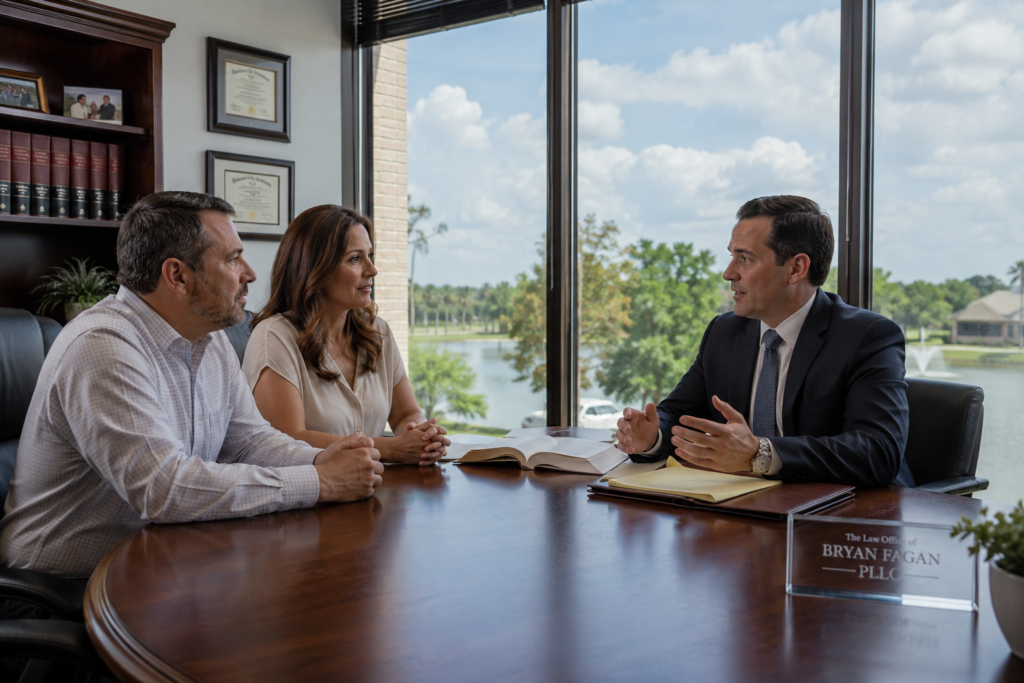
A husband and wife sat across from me one afternoon after spending nearly twenty years building a life together. They were not discussing divorce. In fact, they wanted to stay married. The challenge was that one spouse had recently inherited family land that had been in the family for generations, while the other had helped grow a successful local business. They both agreed on one thing: they never wanted uncertainty about money or property to create conflict in their marriage or hardship for their children. Like many families seeking guidance from Postnuptial Agreement Attorneys in Humble Texas, they were looking for clarity, protection, and peace of mind—not an exit strategy.
Their story is more common than many people realize. Life changes. Businesses grow. Inheritances are received. New opportunities emerge. Families blend together. As circumstances evolve, many married couples discover that proactive planning can strengthen a marriage by reducing uncertainty and creating clear expectations about the future.
At The Law Office of Bryan Fagan, PLLC, we believe legal planning is about empowering families, not preparing them for failure. Founded by Bryan Joseph Fagan, a South Texas College of Law graduate and recognized authority on Texas divorce and custody law, our firm has spent years helping Texans navigate important decisions involving family law, estate planning, and asset protection. We understand that behind every legal question is a family trying to protect what matters most.
Texas law gives married couples powerful tools to define their financial future. Through postnuptial agreements authorized under Texas Family Code §§ 4.102 through 4.105, spouses can clarify property ownership, protect businesses and inheritances, allocate financial responsibilities, and reduce the likelihood of costly disputes later. When structured properly, these agreements can provide certainty during uncertain times and help families focus on building their future instead of worrying about what could happen if circumstances change.
For parents, this type of planning often extends beyond finances. Stability at home can have a profound impact on a child’s emotional well-being and overall success. When families reduce conflict and establish clear expectations, children often benefit from greater consistency, stronger routines, and a healthier environment in which to grow and thrive.
In this guide, you’ll learn how postnuptial agreements work under Texas law, how they can protect assets and family relationships, why they are becoming increasingly popular among Humble-area families, and how thoughtful legal planning can help create greater confidence, security, and peace of mind for the people you love most.
A postnuptial agreement in Texas is enforceable when it is in writing, signed voluntarily by both spouses, and entered without fraud or unfair concealment of assets. Under Texas Family Code §4.105 (2025), the spouse fighting it must prove it was signed involuntarily or was unconscionable with hidden finances. Full disclosure and independent review make it stick.
Key Takeaways
- Writing and signatures are mandatory. Texas Family Code §4.104 requires a postnuptial agreement to be written and signed by both spouses. An oral promise between spouses is worth nothing in a Harris County courtroom.
- The burden flips to the challenger. Unlike most contracts, §4.105 puts the burden on the spouse attacking the agreement—a structural advantage if you build it right.
- Hidden assets sink the agreement. If one spouse concealed property or debt, a court can void the deal. Full financial disclosure is not optional.
- Templates are the most common failure point. Generic postnuptial forms ignore Texas community-property rules and routinely fail enforcement.
- It is not a divorce filing. A postnuptial agreement settles property terms while you stay married; it does not end the marriage or set custody.
- Timing matters less than process. There is no waiting period after marriage—what protects the agreement is disclosure and voluntariness, not the calendar.

Your Family’s Future Starts Here
Don’t navigate your legal journey alone. Schedule a consultation now and get the clarity and support you deserve.
Trust us to help you with your Family Law Attorneys in Humble, Texas. Call 281-817-1827 or contact us online today to schedule a free consultation with your Family Law Attorney in Humble, Texas.
What a Postnuptial Agreement Is in Texas

Major life changes often happen after the wedding day. A family business grows, an inheritance is received, retirement planning becomes more important, or spouses simply want greater clarity about their financial future. Working with experienced Postnuptial Agreement Attorneys in Humble Texas can help couples create a clear legal framework that protects assets while preserving the marriage.
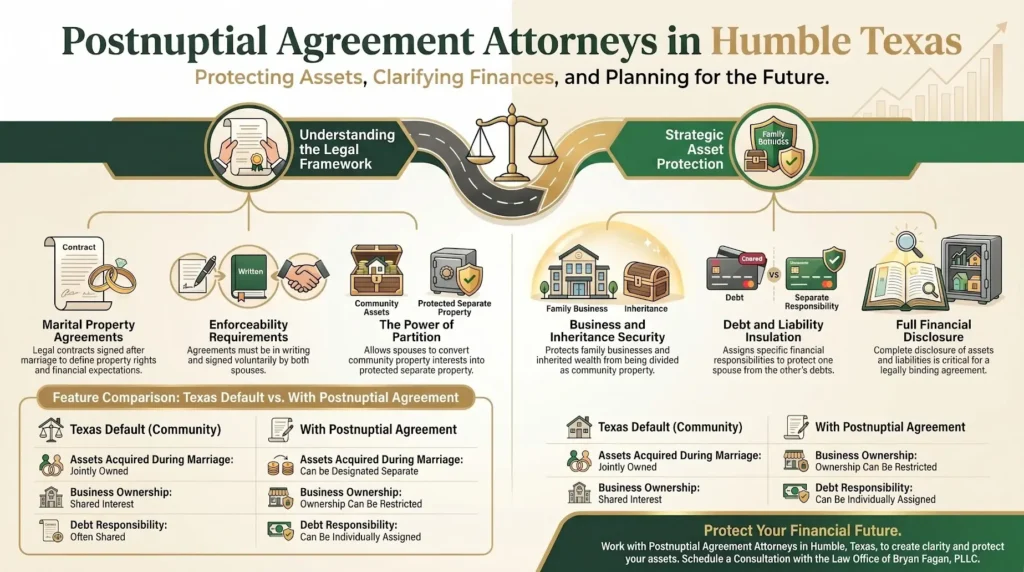
A postnuptial agreement is a written contract signed after marriage that allows spouses to define how property and income will be treated under Texas law. Under Texas Family Code §§4.102 and 4.103, spouses may convert community property into separate property and determine whether income generated from separate property remains separate. This flexibility makes a Texas Postnuptial Agreement an effective tool for protecting businesses, preserving inheritances, and reducing future uncertainty.
Texas is a community-property state, meaning most assets acquired during marriage are presumed to belong to both spouses. A properly drafted postnuptial agreement can clarify ownership before disputes arise. In straightforward situations, this may involve protecting an inheritance or specific financial account. In more complex cases involving family-owned businesses, significant investments, blended-family estate planning, or high-value assets, strategic legal planning becomes increasingly important.
Texas courts generally enforce properly prepared agreements, but challenges often arise when there are questions about voluntariness, financial disclosure, or property characterization under Texas Family Code §4.105. This is one reason many couples choose to seek legal guidance before signing documents that could affect their long-term financial future.
For families in Humble, Kingwood, Atascocita, and throughout Harris County, postnuptial agreements often work alongside broader asset protection and retirement planning strategies. When drafted correctly, these agreements help create certainty, reduce future conflict, and protect what matters most.
Strategy insight
The most valuable postnuptial agreements I draft are not the ones that divide everything. They are the ones that protect a single asset—a business, an inheritance, a professional practice—while leaving the rest as community property. Narrow agreements survive enforcement challenges far more reliably than sweeping ones.
Who Qualifies and When It Makes Sense
One of the most common misconceptions about postnuptial agreements is that they are only for wealthy couples or marriages in crisis. In reality, almost any married couple can benefit from the clarity a postnuptial agreement provides. There is no income requirement, waiting period, or court approval needed. For many families working with Postnuptial Agreement Attorneys in Humble Texas, the decision is less about preparing for divorce and more about protecting assets, reducing uncertainty, and planning for the future.
Common Situations Where a Postnuptial Agreement Makes Sense
A postnuptial agreement often becomes valuable when a major life event changes a family’s financial landscape. Common examples include starting or acquiring a business, receiving a significant inheritance, planning for children from a prior relationship, or rebuilding trust after financial challenges within the marriage. Texas Family Code §4.102 allows spouses to convert community property into separate property, making a Texas Family Code postnuptial agreement an effective tool for business protection, inheritance preservation, and long-term estate planning.
The Real Question Is Whether the Agreement Will Hold Up
The more important question is not whether you qualify, but whether the agreement is likely to withstand future scrutiny. Texas courts evaluating postnuptial agreement enforcement often focus on voluntariness, financial disclosure, and whether both spouses had a meaningful opportunity to understand the agreement before signing. A document signed under pressure, without proper disclosure, may face challenges later. By contrast, an agreement supported by transparency and careful planning is generally in a much stronger position.
Simple Situations Versus Complex Financial Planning
In straightforward situations, a postnuptial agreement may simply clarify ownership of a specific asset or protect inherited property. In more complex cases involving family-owned businesses, blended-family estate planning, high-net-worth assets, significant debt concerns, or complicated community-versus-separate-property disputes, strategic legal guidance becomes increasingly important. When significant assets are involved, taking action before problems arise can help avoid costly mistakes and future litigation.
Protecting Your Family’s Future
For families in Humble, Kingwood, Atascocita, and throughout Northeast Harris County, a postnuptial agreement can provide peace of mind while preserving important family relationships. Whether your goal is protecting a business, safeguarding an inheritance, or creating certainty for future generations, understanding your options before signing any agreement is essential. Readers interested in broader family law planning may also find value in learning more about Texas family law issues and divorce planning.
When properly structured, a postnuptial agreement is not simply a legal document—it is a proactive step toward protecting your future and the people who matter most.
The strongest postnuptial agreement is the one neither spouse felt rushed into signing. Pressure is the single fact that opposing counsel hunts for first.
Postnuptial Agreement Eligibility Qualifier
Is there a specific asset you want to protect—a business, inheritance, or property?
← BackAre both you and your spouse willing to fully disclose your finances to each other?
← BackIs your spouse aware you want a postnuptial agreement and generally open to it?
← BackWill both spouses have time to review the agreement without pressure or a hard deadline?
← BackAre you and your spouse open to each having independent review of the document?
← BackYour situation supports an enforceable agreement
You are married, you have a clear asset to protect, both spouses will disclose finances, and no one is being rushed. That is exactly the profile Texas Family Code §4.105 protects. The next step is drafting it to the Code so it survives any future challenge.
Most clients hear back within 5 minutes during business hours (8 AM–10 PM CT, 7 days a week).
Restart the toolA postnuptial agreement may work—with groundwork first
Your answers show real potential, but one or more pieces need attention before drafting—usually getting your spouse aligned or clarifying the goal. These are solvable in a single strategy session, where we map what your specific situation needs to become enforceable.
Most clients hear back within 5 minutes during business hours (8 AM–10 PM CT, 7 days a week).
Restart the toolOne condition has to be fixed before this can hold up
You may be fully eligible, but you flagged either incomplete financial disclosure or pressure on the signing timeline. Both are the exact grounds §4.105 lets a spouse use to void an agreement. Resolve that one condition and your agreement moves to strong footing—that is the first thing we address in a session.
Most clients hear back within 5 minutes during business hours (8 AM–10 PM CT, 7 days a week).
Restart the toolA postnuptial agreement may not be the right document
A postnuptial agreement requires an existing marriage. If you are not married, a prenuptial agreement or cohabitation agreement is likely the right fit instead. A short strategy session points you to the correct document for your situation.
Most clients hear back within 5 minutes during business hours (8 AM–10 PM CT, 7 days a week).
Restart the toolGot your result? Let’s make it real.
Whether you landed on strong, possible, or gated, a Legal Strategy Session turns the answer into an enforceable plan built to the Texas Family Code.
Schedule a Strategy SessionWhat Texas Law Requires for Enforcement

Agreement Attorneys in Humble Texas understand that enforceability often comes down to the process used when the agreement was created, not just the language on the page.
Under Texas Family Code §4.104, a postnuptial agreement must be in writing and signed by both spouses. Texas Family Code §4.105 adds another layer of protection by allowing a spouse to challenge the agreement only under limited circumstances. Generally, the spouse attacking the agreement must prove they signed involuntarily or that the agreement was unconscionable and they were denied fair and reasonable financial disclosure.
This burden-shifting framework is one reason a properly drafted Texas Family Code postnuptial agreement can be such a powerful planning tool. Unlike many contract disputes where the party seeking enforcement bears the burden of proof, Texas law often places that burden on the spouse attempting to invalidate the agreement. However, that advantage can quickly disappear if there are gaps in disclosure, unclear asset characterization, or evidence that one spouse did not fully understand what they were signing.
In straightforward situations involving simple asset clarification, compliance may be relatively easy to document. In more complex cases involving business ownership protection, inheritance preservation, family-owned companies, significant debt, or high-value estates, careful planning becomes increasingly important. Where property ownership is disputed or substantial assets are involved, experienced legal guidance can help ensure proper financial disclosure and reduce future litigation risk.
Texas courts frequently examine whether both spouses had sufficient information to make informed decisions. Questions surrounding voluntariness, hidden assets, incomplete disclosures, or improperly drafted provisions are among the most common reasons postnuptial agreements fail. Taking the time to properly document finances and structure the agreement correctly today can help prevent expensive disputes tomorrow.
For families in Humble, Kingwood, Atascocita, and throughout Harris County, postnuptial agreements often play an important role in broader asset protection and high-net-worth divorce planning. Whether your goal is protecting a business, preserving an inheritance, or creating certainty around property ownership, the strength of the agreement often depends on the care taken before it is ever signed.
| Status | Eligibility Test (Tex. Fam. Code) | What It Means |
|---|---|---|
| In writing & signed | §4.104 — must be written, signed by both spouses | Oral or unsigned agreements are unenforceable, full stop. |
| Voluntary signing | §4.105(a)(1) — no duress or coercion | Pressure or a hard deadline is the top ground for voiding. |
| Fair disclosure | §4.105(a)(2) — assets/debts disclosed | Hidden finances let a spouse undo the agreement. |
| Not unconscionable | §4.105(a)(2) — terms not grossly one-sided | Extreme imbalance plus no disclosure is fatal. |
What makes an agreement bulletproof
Documented financial disclosure attached as an exhibit, independent review for each spouse, a signing free of any deadline, and narrow tailored terms. When all four are present, a Harris County court has almost no path to set the agreement aside.
Listen to Our Texas Family Law Podcast
Prefer listening? In this episode, we discuss postnuptial agreements in Humble, Texas, including how they work, what they can cover, and how they can help protect your finances after marriage.
Postnuptial vs. Prenuptial vs. Divorce
A postnuptial agreement and a prenuptial agreement do the same job—defining property rights—but a prenup is signed before marriage and a postnup is signed after. Neither one ends a marriage; a divorce does. Confusing these three is the most common misunderstanding I correct in intake calls.
The practical difference between a prenup and a postnup is timing and leverage. A prenup is negotiated when both people are still deciding to marry, which courts view as inherently less coercive. A postnup is signed inside an existing marriage, so Texas scrutinizes voluntariness more closely—which is exactly why process discipline matters more for postnuptial agreements.
| Document | When Signed | What It Does |
|---|---|---|
| Prenuptial agreement | Before marriage | Sets property rules in advance; lowest enforcement scrutiny. |
| Postnuptial agreement | During marriage | Re-characterizes property while married; higher scrutiny on process. |
| Divorce | Ends the marriage | Divides property and resolves custody/support by decree. |
What a Postnuptial Agreement Costs in Texas
A properly drafted postnuptial agreement in Texas typically runs in the low-to-mid four figures, depending on the complexity of the assets and whether both spouses use separate counsel. The honest driver of cost is not page count—it is how complicated your estate is and how much negotiation the terms require.
A clean agreement protecting a single inheritance costs far less than one carving up a multi-entity business with real estate in three counties. Beware the cheapest option: a downloaded template that costs nothing up front and fails in court costs you the entire asset it was supposed to protect.
| Cost Driver | Range Impact | What Affects It |
|---|---|---|
| Asset complexity | Largest | A single account vs. a business, real estate, and investments. |
| Separate counsel | Moderate | Independent review for each spouse adds cost but strengthens enforcement. |
| Negotiation | Variable | Aligned spouses draft faster; contested terms add time. |
| Disclosure prep | Modest | Organized financials reduce drafting hours. |
Harris County and Nearby-County Procedure

Many people are surprised to learn that a postnuptial agreement is not filed with a court when it is created. A postnuptial agreement is a private contract between spouses, meaning its validity depends on how well it is drafted and executed—not on approval from a judge. Experienced Postnuptial Agreement Attorneys in Humble Texas often emphasize that the most important work happens before the agreement is ever needed in court.
If a dispute later arises during a divorce, postnuptial agreement enforcement typically occurs in the court handling the family law case. For couples in Humble, Kingwood, Atascocita, and other parts of Harris County, that usually means a Harris County family district court applying the standards found in Texas Family Code §4.105. The same Texas law applies in nearby counties such as Montgomery County, including Porter, New Caney, and Conroe, as well as Fort Bend and Galveston Counties. While local court procedures may vary, the legal requirements governing a Texas Family Code postnuptial agreement remain consistent statewide.
In straightforward situations involving simple asset clarification, enforcement questions may be relatively limited. In more complex cases involving business ownership protection, inheritance preservation, blended-family estate planning, significant debt, or high-net-worth assets, courts often examine the agreement much more closely. Where property ownership is disputed, issues involving financial disclosure, voluntariness, and asset characterization frequently become central to the case.
Because postnuptial agreements are often reviewed years after they are signed, proper drafting matters. Taking steps to address potential challenges before they arise can help reduce future uncertainty, avoid costly litigation, and protect important family and financial interests. Families seeking broader guidance on protecting their rights may also find value in learning more about Texas family law attorneys and situations involving Child Protective Services defense in Humble, where careful preparation and strategic legal planning can make a significant difference.
The cross-county trap
If your assets sit in multiple counties—a home in Atascocita, a rental in Montgomery County, a business registered in Harris—a template that ignores how each is characterized creates gaps. Those gaps are where enforcement challenges start. Multi-county estates need agreements drafted with each property’s characterization spelled out.
The Mistakes That Void Agreements
Most postnuptial agreements that fail in Texas fail for one of three reasons: no real financial disclosure, a signing rushed under pressure, or terms so one-sided a court calls them unconscionable. Every one of these is preventable, and every one is what opposing counsel looks for first.
The fourth quiet killer is the template. A generic form pulled off the internet does not account for Texas community-property characterization under §4.102, does not attach disclosure exhibits, and does not document independent review. It looks like a contract and behaves like a trap. I have watched spouses lose the exact asset they thought they had protected because the document was never built to Texas standards.
A postnuptial agreement is only as strong as its weakest signing condition. One rushed signature can undo a perfectly drafted document.
Checklist: What to Do If You’re Considering a Postnuptial Agreement
Name the asset you’re protecting. Be specific—a business, an inheritance, a home. Narrow agreements survive challenges; vague ones invite them.
Talk to your spouse first. A postnuptial agreement signed by a surprised or resistant spouse is the easiest kind to void. Alignment comes before drafting.
Gather full financial disclosure. List every asset and debt for both spouses. Incomplete disclosure under §4.105 is the top reason agreements fail.
Do not use a downloaded template. Generic forms ignore Texas community-property rules and routinely collapse under enforcement.
Build in time to review. Never sign against a deadline. An unpressured signing is your strongest defense.
Arrange independent review. Each spouse having their own counsel makes the agreement hardest to attack later.
Map assets by county. Property in Harris, Montgomery, or Fort Bend each needs its characterization spelled out.
Notarize the signed agreement. It documents voluntariness and removes an argument a challenging spouse could raise.
Store the executed original safely. A lost original creates proof problems if the agreement is ever tested.
Book a strategy session before you sign anything. One session confirms the agreement is built to the Code and worth the paper.
Work the checklist with someone who’s drafted hundreds.
A Legal Strategy Session walks your specific situation through every step above—and flags the gaps a template would miss.
Schedule a Strategy SessionWhat I Tell Every Client Who Calls About a Postnuptial Agreement

One of the most valuable aspects of a postnuptial agreement is that it allows couples to create certainty without changing their relationship status. A properly drafted agreement can protect a family business, preserve an inheritance, clarify property ownership, and support long-term estate planning while the marriage continues. This is why many families turn to Postnuptial Agreement Attorneys in Humble Texas when they want to proactively protect what they have worked hard to build.
The difference between an agreement that provides lasting protection and one that fails during a future dispute often comes down to preparation. Texas courts evaluating postnuptial agreement enforcement focus on issues such as voluntariness, financial disclosure, and compliance with Texas Family Code §§4.102 through 4.105. In straightforward situations involving simple asset clarification, a marital property agreement may be relatively uncomplicated. In more complex cases involving business ownership protection, inheritance preservation, blended-family estate planning, high-net-worth assets, or significant debt concerns, careful drafting and full disclosure become increasingly important.
When significant assets are involved, relying on a generic template can create unnecessary risk. Questions about community property versus separate property, business valuation, future income, and asset characterization often become major issues during divorce litigation. Taking the time to properly structure an agreement today can help prevent costly disputes tomorrow and provide greater confidence that the agreement will achieve its intended purpose.
For families in Humble, Kingwood, Atascocita, and throughout Northeast Harris County, a postnuptial agreement is often part of a larger strategy focused on protecting assets, reducing uncertainty, and preserving family relationships. If you are considering a postnuptial agreement, it is wise to understand your options before signing anything. Additional resources on Texas family law matters and enforcing Texas child support orders can help provide broader insight into how Texas courts approach family law disputes and long-term financial obligations.
The goal is not simply to create a document. The goal is to create a legally sound agreement that protects your future, minimizes uncertainty, and gives your family greater peace of mind moving forward.
Protect what matters—before you sign.
Book your Legal Strategy Session today and get a clear answer on whether your postnuptial agreement will stand up in a Texas court.
Schedule a Strategy SessionConclusion:
Ultimately, a postnuptial agreement is not just about property, finances, or planning for worst-case scenarios. It is about creating certainty in an uncertain world and giving your family a clearer path forward. Whether you are protecting a family business, preserving an inheritance, planning for a blended family, or simply seeking greater financial transparency within your marriage, working with experienced Postnuptial Agreement Attorneys in Humble Texas can help you make informed decisions that support both your immediate goals and your long-term peace of mind.
In straightforward situations, a carefully drafted agreement may be all that is needed to clarify ownership and avoid future misunderstandings. In more complex cases, issues involving business interests, high-value assets, inherited property, significant debt, estate planning concerns, or children from prior relationships often require a more strategic approach. If your case involves unique financial circumstances or questions about how a postnuptial agreement could affect your family’s future, obtaining guidance tailored to your specific situation can make a meaningful difference.
At The Law Office of Bryan Fagan, PLLC, our mission is to help Texas families regain control, reduce uncertainty, and move forward with confidence. Through education, compassionate guidance, and practical legal solutions, we help families protect what matters most. When you are ready to better understand your options, a Legal Strategy Session can provide the clarity and direction needed to determine the best path forward for you and your family.
Questions My Clients Ask About Postnuptial Agreements in Texas
Yes. A postnuptial agreement is enforceable in Texas when it meets Texas Family Code §4.105 (2025): it is in writing, signed voluntarily, and entered with fair financial disclosure. The spouse challenging it carries the burden to prove it was involuntary or unconscionable. Build it with documented disclosure and independent review and it holds.
A drafted postnuptial agreement in Texas generally falls in the low-to-mid four figures, driven by asset complexity and whether both spouses use separate counsel. A single-asset agreement costs far less than one dividing a business across counties. The true risk is a free template that fails and forfeits the asset it was meant to protect.
You can legally sign one without a lawyer, but it is the fastest way to a document that fails. Texas scrutinizes postnuptial agreements closely for voluntariness and disclosure, and templates miss community-property characterization entirely. Independent review for each spouse is one of the strongest defenses against a later challenge.
The difference is timing. A prenuptial agreement is signed before marriage; a postnuptial agreement is signed during the marriage. Both define property rights under Texas law, but postnuptial agreements face higher scrutiny on voluntariness because they are signed inside an existing marriage. Neither ends the marriage.
There is no waiting period in Texas—you can sign a postnuptial agreement at any point during the marriage, whether one year in or twenty. What protects the agreement is not how long you have been married but the process: full disclosure, voluntary signing, and time to review without pressure.
Texas Family Code §4.104 requires the agreement to be in writing and signed by both spouses; it does not strictly mandate notarization. That said, I notarize every postnuptial agreement I draft, because it documents the voluntariness of the signing and removes one more argument a challenging spouse could raise.
Yes, if it fails the §4.105 test. A court can void a postnuptial agreement when a spouse proves they signed involuntarily, or that the terms were unconscionable and finances were concealed. This is exactly why disclosure, independent review, and an unpressured signing matter—they close the doors a court could use to set it aside.
Yes—protecting a business is one of the most common reasons couples in Humble and Harris County sign one. Under §4.102, spouses can partition a business interest into one spouse’s separate property, shielding it from division. The agreement has to spell out the characterization precisely, which is where templates fall short.
No. A postnuptial agreement governs property and income only. Texas courts decide child custody and support based on the best interest of the child at the time of any divorce, and parents cannot contract that away in advance. Anyone selling you a postnup that “settles custody” is selling an unenforceable promise.
If you stay married, the agreement simply governs how your property is characterized during the marriage and at death, which can simplify estate planning. It only becomes a dividing instrument if a divorce happens. Many couples sign one purely for the financial clarity it brings while the marriage continues.
Still have a question I didn’t answer?
Bring it to a Legal Strategy Session. You’ll get a direct answer about your situation—not a generic one.
Schedule a Strategy Session