
A mother once called our Houston office after spending forty-five minutes in a grocery store parking lot trying to figure out which bills could wait another week. Her ex had stopped paying support months earlier. The rent was due, her car needed repairs, and her debit card had just declined while her young daughter sat quietly in the back seat asking if they were still getting tacos for dinner. In that moment, the legal issue stopped feeling like paperwork and started feeling deeply personal. Enforcing a Delinquent Texas Child Support Order is often about restoring stability to everyday life when a parent has been left carrying the full financial burden alone.
For many Texas families, unpaid child support creates a chain reaction that touches nearly every part of daily life. Parents suddenly find themselves juggling extra work shifts, canceled activities, mounting stress, and constant uncertainty about how they are going to keep everything together. Children notice more than adults sometimes realize. They feel the tension, the schedule changes, the missed routines, and the emotional exhaustion that can settle into a household when financial support disappears.
At The Law Office of Bryan Fagan, PLLC, we understand that these cases are about more than numbers on a payment ledger. Bryan Joseph Fagan, a South Texas College of Law graduate and respected authority on Texas divorce and custody law, built the firm around a mission of helping families reclaim peace of mind during life’s hardest transitions. Through compassionate counsel, education, and practical legal solutions, our team works to help parents move from uncertainty to clarity with a strategy designed to protect what matters most.
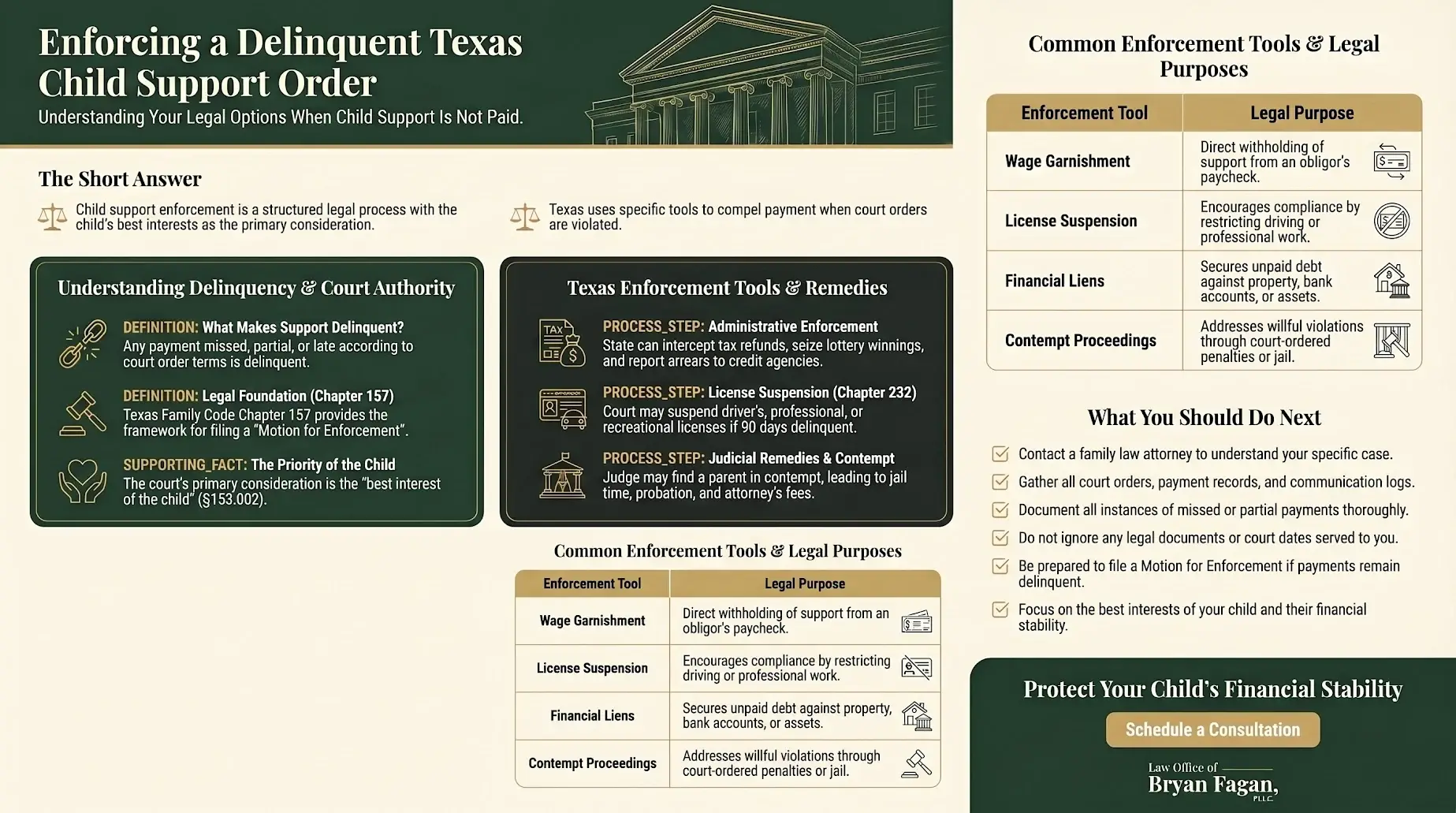
Texas law gives parents meaningful enforcement tools when a court-ordered obligation goes unpaid. Under Texas Family Code §153.002, courts must prioritize the best interest of the child, and financial stability is often part of that conversation. Whether the issue involves wage withholding, contempt proceedings, child support liens, license suspension, or enforcement against a self-employed parent, understanding your rights can make the difference between continued frustration and real progress.
In this article, you will learn how Texas courts handle child support enforcement, what legal remedies may be available, how enforcement actions connect to family stability, and what practical steps parents can take when support payments stop. Most importantly, you will see that you do not have to navigate this process alone. With the right legal guidance and a clear plan forward, families can take meaningful steps toward stability, accountability, and peace of mind.
Enforcing a delinquent Texas child support order means filing a Motion for Enforcement under Texas Family Code §157.001 (2025), which can compel wage withholding, license suspension, a cumulative money judgment for arrears, and contempt of court — including up to 180 days in county jail per violation under §157.066. Most contested enforcement actions in Harris County resolve in 60–120 days. Criminal nonsupport under Texas Penal Code §25.05 becomes a state jail felony once arrears exceed roughly $10,000 or six months unpaid.
Key Takeaways
- You don’t have to use the OAG. The Attorney General handles enforcement administratively, but a private Motion for Enforcement under §157.001 typically moves faster — 60–120 days to a contested hearing in Harris County vs. 6–18 months at the OAG.
- Arrears become a judgment automatically. Under Texas Family Code §157.261, unpaid child support becomes a judgment by operation of law the day it’s missed — you don’t have to prove it again later. Interest accrues at 6% per year.
- Contempt is the leverage. §157.066 allows up to 180 days in county jail per separate violation, plus $500 per violation in fines. Used correctly, the threat of jail is what produces payment.
- License suspension works. Under §232.003, the court can suspend driver’s licenses, professional licenses, and recreational licenses for nonpayment. This is the single most underused tool in private enforcement.
- The felony threshold matters. Texas Penal Code §25.05 makes criminal nonsupport a state jail felony when the obligor has failed to pay for two years OR is more than $10,000 behind. Below those thresholds, you are working civil tools only.
- Time kills enforcement. Statute of limitations on filing a motion for enforcement is 10 years after the child turns 18 (§157.005) — but every month that passes makes location and collection harder. Move fast.
- Cost is recoverable. §157.167 requires the court to order the obligor to pay your attorney’s fees if enforcement is granted. In practical terms, the obligor pays for the fight.

Your Family’s Future Starts Here
Don’t navigate your legal journey alone. Schedule a consultation now and get the clarity and support you deserve.
What Enforcement Actually Means in Texas

Enforcing a Delinquent Texas Child Support Order means asking a Texas family court to require the obligor — the parent ordered to pay support — to comply with an existing court order using the enforcement remedies available under Texas Family Code Chapter 157. This is not the same as requesting a new support order or filing a modification. The order already exists. The issue is that one parent has stopped following it, and the court now has the authority to enforce compliance through tools such as wage withholding, contempt proceedings, money judgments, liens, and license suspension.
Under Texas Family Code §157.261, unpaid child support becomes a judgment by operation of law the moment a payment is missed. In practical terms, that means the arrears balance starts accumulating automatically without the receiving parent first needing to “prove” the debt exists in court. Interest also begins accruing immediately on the unpaid amount. Many parents mistakenly believe the Office of the Attorney General must officially declare support delinquent before enforcement rights exist. That is not how Texas law works. The original court order defines the obligation, and once the payment due date passes without full payment, the enforcement process can begin.
In straightforward situations involving a parent with stable W-2 employment and recent arrears, administrative wage withholding may resolve the issue without extensive litigation. In more complex cases, however, private enforcement under Texas Family Code §157.001 may become necessary to create meaningful leverage. If the other parent is self-employed, hiding income, repeatedly violating court orders, working for cash, or moving between jobs, stronger enforcement strategies are often required. Where enforcement becomes contested, Texas judges frequently evaluate credibility, payment history, financial transparency, diligence, and whether the parent’s conduct is negatively affecting the child’s stability and best interests under §§153.002 and 153.134.
Texas gives parents a unique advantage compared to many other states because private enforcement actions can proceed alongside OAG enforcement efforts. That parallel track is one of the most underutilized strategic tools in Texas family law. In many cases, delays become risky because the longer arrears continue growing, the harder collection can become — especially when assets disappear, procedural mistakes occur, or the obligor restructures income. Families dealing with ongoing nonpayment often benefit from understanding the difference between administrative collection efforts and litigation-focused enforcement strategy. Parents looking to better understand their options regarding child support enforcement in Texas or related Texas child custody concerns should recognize that the right legal approach often depends on the complexity of the case, the level of conflict, and the financial realities involved.
For many families, enforcement is about more than recovering unpaid support. It is about restoring accountability, reducing uncertainty, and protecting long-term stability for the child. Texas law cannot eliminate every family conflict, but it does provide meaningful remedies that can help parents move forward with greater clarity, structure, and peace of mind.
OAG Enforcement vs. Private Counsel — Which Path Belongs to Which Case
When parents begin Enforcing a Delinquent Texas Child Support Order, one of the first strategic questions is whether the case is better handled through the Texas Office of the Attorney General or through private enforcement litigation in family court. Both paths can be effective, but they operate very differently, move at different speeds, and offer different enforcement tools depending on the facts of the case.
The Texas OAG Child Support Division provides enforcement services at no upfront cost and can be extremely helpful in straightforward situations. If the obligor has a stable W-2 job, recent arrears, and a consistent payment history before the delinquency began, administrative enforcement may resolve the problem without extensive court involvement. The OAG can issue administrative wage withholding orders, intercept federal tax refunds, deny passports for arrears exceeding federal thresholds, report delinquent balances to credit agencies, and initiate license suspension proceedings. These remedies are often effective when the other parent wants to maintain employment, preserve professional licensing, or avoid additional financial consequences.
In more complex cases, however, delays can become costly. The OAG handles an enormous statewide caseload, which means enforcement efforts frequently move according to agency priorities rather than the urgency of the individual family’s situation. In Harris County and surrounding areas, it is not uncommon for parents to wait many months before meaningful collection activity begins through the administrative process alone. During that time, arrears continue growing under Texas Family Code §157.261, interest accumulates, and enforcement leverage may weaken as employment changes, assets disappear, or financial records become harder to trace.
Private enforcement under Texas Family Code §157.001 often becomes important when the case involves repeated nonpayment, hidden income, contested allegations, or more aggressive enforcement remedies such as contempt under §157.066. If the other parent is self-employed or hiding income, works primarily in cash, owns business entities, transfers assets between accounts, or repeatedly ignores prior enforcement efforts, litigation-focused strategy may be necessary to create accountability. In these situations, experienced Texas family law attorneys may use subpoenas, financial discovery, bank record analysis, payment app history, business documentation, and sworn testimony to establish the obligor’s true earning capacity and financial conduct before the court.
Where enforcement becomes contested, Texas judges frequently evaluate credibility, diligence, payment history, and financial transparency very closely. Courts also consider the broader impact unpaid support is having on the child’s day-to-day stability and best interests under Texas Family Code §§153.002 and 153.134. In straightforward enforcement situations, limited legal guidance may be enough to resolve the matter efficiently. In higher-conflict cases involving contempt proceedings, interstate enforcement, hidden assets, or significant child support arrears, strategic legal representation often becomes far more important because procedural mistakes can delay relief or weaken enforcement remedies altogether.
One of the most misunderstood realities in Texas family law is that OAG enforcement and private enforcement are not mutually exclusive. A parent can pursue both tracks simultaneously. In practice, that parallel strategy often creates stronger leverage and faster results than relying on administrative enforcement alone. Families researching child support enforcement in Texas or broader issues involving Texas family law attorneys should understand that the right enforcement path usually depends on the complexity of the financial issues, the level of conflict between the parties, and how urgently stability needs to be restored for the child.
At its core, enforcement is not simply about collecting money. It is about restoring consistency, accountability, and peace of mind for families trying to move forward after a court order has been ignored. Texas law provides meaningful enforcement tools, but knowing when to escalate, when to litigate, and when to apply pressure strategically can make a significant difference in the outcome of the case.
When a client tells me the OAG has had their case for nine months and they’ve received nothing, my first question is what the obligor does for a living. The OAG works well for W-2 cases. It fails predictably for self-employed obligors, and those are the cases where private contempt is the only thing that produces payment. — Bryan Fagan
| Category | What Texas Law Says | Practical Impact |
|---|---|---|
| Arrears become judgment | Tex. Fam. Code §157.261 — unpaid support is a judgment by operation of law | You don’t have to re-prove the debt; you only need to prove non-payment at hearing |
| Statute of limitations | Tex. Fam. Code §157.005 — 10 years after the child turns 18 to file motion for enforcement | Long window legally, but evidence and assets disappear fast — move within months, not years |
| Contempt | Tex. Fam. Code §157.066 — up to 180 days county jail per violation + $500 fine per violation | The threat of jail is the lever that produces payment in 70%+ of contested cases |
| Income withholding | Tex. Fam. Code §§158.001–.501 — judicial writ of withholding from earnings | Reaches up to 50% of disposable earnings under federal limits; effective for W-2 obligors |
| License suspension | Tex. Fam. Code §232.003 — driver, professional, and recreational licenses | Underused but devastating leverage for self-employed obligors who need licenses to work |
| Criminal nonsupport | Tex. Penal Code §25.05 — state jail felony at $10,000 arrears OR 2 years nonpayment | Referral for prosecution is the escalation lever above contempt |
| Attorney’s fees | Tex. Fam. Code §157.167 — court SHALL order obligor to pay fees if enforcement granted | Mandatory fee shifting; effectively makes the obligor finance the enforcement |
The Motion for Enforcement: Mechanics and Pleading Requirements
When parents begin Enforcing a Delinquent Texas Child Support Order, one of the most important steps is properly preparing and filing a Motion for Enforcement under Texas Family Code §157.001. While the process may sound simple, Texas enforcement litigation is highly procedural, and even small filing mistakes can create delays, weaken enforcement leverage, or limit the remedies available in court. A Motion for Enforcement is not simply a request for payment. It is a formal legal action asking the court to compel compliance with an existing child support order through remedies such as wage withholding, contempt, liens, judgments, attorney’s fees, and license suspension.
Texas Family Code §157.002 requires the motion to identify the exact provisions violated, the specific dates of missed payments, and the amount of arrears owed as of the filing date. Courts generally expect detailed allegations backed by reliable documentation. In most cases, that includes a verified State Disbursement Unit payment history along with a month-by-month breakdown of unpaid support. Generic claims that the other parent “failed to pay child support” are rarely enough when contempt remedies under §157.066 are requested. Texas judges often evaluate accuracy, credibility, diligence, and financial transparency very closely during enforcement hearings, especially where the obligor disputes the arrears balance or claims inability to pay.
In straightforward situations involving recent missed payments and cooperative parties, the process may move relatively efficiently. In more complex cases, however, strategic legal preparation becomes far more important. If the other parent is self-employed or hiding income, works through cash payments, owns business entities, or repeatedly ignores prior court orders, the enforcement process can quickly become contested litigation. In these situations, experienced attorneys often use subpoenas, financial discovery, payment records, business documentation, and sworn testimony to establish income patterns and demonstrate noncompliance. Delays can become risky because arrears continue accruing under §157.261 while enforcement leverage may weaken as financial records disappear or employment situations change.
Service of process is another critical part of Enforcing a Delinquent Texas Child Support Order. Texas law generally requires personal service on the obligor, and procedural shortcuts often create problems later in the case. Under §157.061, hearing timelines are directly connected to proper service. If contempt remedies involving possible jail time are requested, the obligor may also have the right to court-appointed counsel under §157.163 if they cannot afford representation. These constitutional protections matter because improperly handled contempt proceedings can later be challenged or overturned on appeal. In practice, many enforcement cases succeed or fail based not only on the unpaid support itself, but also on whether the procedural requirements were followed carefully from the beginning.
A properly prepared enforcement filing in Harris County or surrounding Texas courts typically includes the verified Motion for Enforcement, certified copies of the underlying support order, payment histories, a proposed enforcement order, and notice of hearing. If the case seeks a cumulative money judgment under §157.211, a sworn arrears affidavit is often filed as well. Cases involving license suspension under §232.003 or significant property interests may require additional pleadings and strategic planning, particularly where the obligor owns businesses, investment assets, or substantial marital property. Families facing financially complex disputes may also benefit from understanding how broader asset and property issues can intersect with support enforcement in high-conflict family litigation involving Texas family law attorneys.
Parents researching child support enforcement in Texas should understand that enforcement hearings are not simply administrative paperwork exercises. Texas courts routinely evaluate payment history, compliance efforts, financial conduct, and the overall impact unpaid support is having on the child’s stability and best interests under §§153.002 and 153.134. The stronger the documentation and procedural preparation, the stronger the enforcement position typically becomes.
For many families, filing a Motion for Enforcement is about more than recovering unpaid support. It is about restoring accountability, reducing uncertainty, and protecting a child’s long-term stability during an already stressful chapter of life.
Costly Mistake
The most common drafting error I see in DIY enforcement motions is listing arrears as a single lump-sum number without itemizing per-month violations. Texas courts will not hold an obligor in contempt for a generalized debt — contempt requires proof of each specific willful violation. Without per-month itemization, the motion may collect a money judgment but cannot deliver jail time, which is the only leverage that actually moves a stubborn obligor.
The Six Enforcement Tools Texas Courts Use

Texas courts have multiple enforcement remedies available when parents begin Enforcing a Delinquent Texas Child Support Order, and the right strategy often depends on the obligor’s financial situation, payment history, and willingness to comply with prior court orders. In many enforcement cases, courts use several remedies together rather than relying on a single tool. The combination selected can significantly affect how quickly arrears are collected and how much leverage exists during the enforcement process.
One of the most common remedies is judicial income withholding under Texas Family Code Chapter 158. In straightforward situations involving a parent with stable W-2 employment, wage withholding is often the fastest and most effective solution. The court can order an employer to deduct current support along with additional amounts toward arrears directly from the obligor’s paycheck. This process works well when employment is steady and income is transparent. In more complex cases, however, wage withholding becomes less effective if the other parent is self-employed, paid primarily in cash, frequently changes jobs, or attempts to conceal income sources.
Texas courts may also enter a cumulative money judgment for arrears under §157.211. This allows unpaid child support to be converted into a formal judgment that may be used to pursue bank account garnishment, property liens, and other collection remedies. Where enforcement becomes contested, judges often evaluate financial transparency, credibility, asset ownership, and the obligor’s overall compliance history very carefully. If the other parent owns businesses, investment assets, or retirement-related financial holdings, strategic enforcement planning may become especially important. Families facing financially complex disputes sometimes discover that support enforcement overlaps with broader financial planning and asset protection concerns involving Texas family law attorneys.
License suspension under Texas Family Code §232.003 is another powerful enforcement tool that many parents overlook. Texas courts can suspend driver’s licenses, professional licenses, and recreational licenses when significant child support arrears exist. In practice, this remedy often creates immediate pressure in cases involving self-employed professionals, contractors, or individuals whose income depends heavily on maintaining a valid license. If the other parent is self-employed or hiding income, license suspension can sometimes produce faster compliance than wage withholding alone because it directly impacts the obligor’s ability to continue working under the same conditions.
Civil contempt under §157.066 remains one of the strongest enforcement remedies available in Texas family court. If a judge determines that the obligor had the ability to comply with the order but intentionally failed to pay, the court may impose fines, attorney’s fees under §157.167, probation conditions, or even county jail confinement. In many enforcement hearings, however, the threat of contempt itself creates the leverage needed to negotiate payment plans, purge conditions, or settlement agreements before incarceration occurs. Texas judges generally expect detailed records, accurate payment histories, and strong procedural compliance before granting contempt relief, which is why mistakes in pleadings or service often hurt enforcement cases significantly.
In more severe situations involving repeated violations or substantial arrears, criminal referral may also become possible. Unlike civil contempt, criminal nonsupport proceedings focus on punishment for past conduct and may involve prosecution through the District Attorney’s office under Texas law. These cases are less common but can arise where long-term nonpayment, hidden assets, or repeated disregard for court orders exist. Interstate enforcement cases may also involve federal tools such as passport denial, tax refund intercepts, and multistate location services coordinated through the Office of the Attorney General.
Parents researching child support enforcement in Texas should understand that no single enforcement remedy fits every situation. In straightforward cases, administrative wage withholding may resolve the issue efficiently. In high-conflict enforcement litigation involving hidden income, contempt proceedings, repeated nonpayment, or interstate collection issues, strategic legal guidance often becomes much more important because delays, procedural errors, or weak documentation can reduce leverage and slow collection efforts considerably.
At its core, enforcement is about more than recovering unpaid support. Texas courts view these remedies as tools to restore accountability, preserve stability for children, and reinforce the importance of complying with family court orders. The stronger the enforcement strategy and supporting documentation, the more effectively families can move toward financial consistency and long-term peace of mind.
Strategic Note
The most effective enforcement strategy I use in cases where the obligor is self-employed and has dodged the OAG for 12+ months: file the motion for enforcement, request license suspension AND contempt simultaneously, and request the §157.211 money judgment in the same filing. Three pressure points, one hearing. Obligors who shrug at one will fold at three.
When Delinquency Becomes a Felony Under Texas Law
For many parents, Enforcing a Delinquent Texas Child Support Order starts as a civil enforcement issue involving missed payments, wage withholding, or arrears collection. In some situations, however, repeated nonpayment can escalate into a criminal matter under Texas law. Texas Penal Code §25.05 addresses criminal nonsupport and establishes when unpaid child support may rise from a civil enforcement problem to a potential state jail felony.
Under current Texas law, criminal nonsupport may become a felony when the obligor intentionally or knowingly fails to support a child for a qualifying period while the unpaid balance exceeds statutory thresholds. This distinction matters because many online explanations oversimplify the law by suggesting that any arrears balance above $10,000 automatically creates a felony case. In reality, prosecutors and courts also evaluate conduct, intent, payment history, and the surrounding circumstances before criminal prosecution is seriously considered.
In straightforward situations involving temporary financial hardship, job loss, or isolated missed payments, courts are often more focused on restoring compliance than pursuing criminal penalties. Texas judges frequently look at whether the parent made genuine efforts to pay, communicated appropriately, sought relief through modifying child support orders, or demonstrated financial transparency throughout the process. Where enforcement becomes contested, however, credibility and diligence become extremely important. If the other parent is self-employed or hiding income, repeatedly ignores court orders, moves assets, works for cash, or intentionally avoids payment despite having the ability to comply, the case can begin to look very different in the eyes of the court.
A state jail felony classification carries serious consequences, including potential incarceration, significant fines, and a permanent criminal record. In practice, though, criminal nonsupport prosecutions remain relatively uncommon across Texas counties, including Harris County, because prosecutors often prioritize violent criminal cases and reserve nonsupport prosecutions for more severe patterns of intentional noncompliance. That does not mean the criminal aspect lacks importance. In many enforcement cases, the possibility of criminal referral creates substantial leverage during negotiations, particularly where civil contempt under §157.066, license suspension, judgments, and prior enforcement efforts have already failed to secure compliance.
In more complex enforcement litigation involving substantial arrears, repeated violations, interstate enforcement issues, or hidden assets, strategic legal guidance often becomes critical because procedural mistakes can weaken enforcement remedies or delay relief. Texas courts regularly evaluate payment records, financial conduct, asset ownership, employment history, and whether the obligor’s actions are negatively affecting the child’s long-term stability and best interests under §§153.002 and 153.134. Families involved in high-conflict support disputes may also find that broader financial issues connected to divorce, property division, or long-term planning overlap with support enforcement concerns handled by experienced Texas family law attorneys.
For many families, the real value of criminal enforcement provisions is not necessarily obtaining a felony conviction. It is the accountability and leverage those provisions can create when civil enforcement alone is no longer producing results. Texas law provides multiple layers of enforcement because the courts recognize that unpaid child support affects far more than finances alone. Delayed payments can disrupt stability, increase stress within the household, and create uncertainty for children who depend on consistency and structure.
At its core, enforcement is designed to reinforce the importance of complying with court orders and protecting the well-being of the child. Whether the case involves straightforward arrears collection or more aggressive contempt and criminal enforcement remedies, understanding the available legal options can help families make informed decisions and move forward with greater clarity and peace of mind.
When This Matters Most
If your obligor has crossed the §25.05 threshold — more than $10,000 in arrears over a 12-month willful nonpayment period, or two years of continuous nonpayment — that fact alone changes the negotiation. Even before any prosecution is filed, the credible threat of referral often produces a payment proposal within weeks. This is leverage that does not exist below the threshold and that the OAG cannot deliver on its own.
Realistic Timeline — Harris County and Surrounding Counties
One of the most common questions parents ask when Enforcing a Delinquent Texas Child Support Order is how long the process actually takes. The honest answer is that timelines vary significantly depending on the complexity of the case, the level of conflict between the parties, and how quickly the obligor can be located and served. In straightforward enforcement situations involving a cooperative parent, accurate payment records, and stable employment, many Harris County enforcement cases can move from filing to final order within approximately 60 to 120 days. Cases involving only wage withholding or uncontested arrears often resolve faster than parents expect.
In more complex cases, however, timelines can expand quickly. If the other parent is self-employed or hiding income, actively avoiding service, moving between jobs, disputing arrears, or contesting contempt allegations under §157.066, the enforcement process may require multiple hearings, financial discovery, and additional court review. Texas judges frequently evaluate diligence, financial transparency, credibility, and documented payment history very carefully in contested enforcement litigation. Delays can become especially risky because unpaid support continues accruing under §157.261 while enforcement leverage may weaken as records disappear, employment changes, or assets are transferred.
Court scheduling also varies depending on the county. Harris County family courts typically move enforcement hearings faster than many people expect, but docket volume still plays a major role. Fort Bend and Montgomery Counties often have slightly shorter hearing timelines due to smaller dockets, while larger urban counties such as Dallas, Tarrant, Travis, and Bexar may take longer because of heavier caseloads and scheduling congestion. In interstate enforcement matters, additional delays frequently arise from coordinating service, registration of foreign orders, and jurisdictional requirements under Texas family law procedures.
One of the biggest factors affecting enforcement timing is proper service of process. Even strong enforcement cases can stall if the obligor cannot be located or intentionally avoids service. In Harris County, private process servers can often complete personal service within one to two weeks when the obligor has a stable address and employment. Where enforcement becomes contested or evasive behavior exists, however, service attempts can take substantially longer and may require substituted service under Texas Rule of Civil Procedure 106. In practice, experienced Texas family law attorneys often devote significant attention to service strategy because procedural mistakes early in the case can create delays later during enforcement hearings.
Parents researching child support enforcement in Texas should also understand that timelines are heavily influenced by the enforcement strategy selected. Administrative enforcement through the Office of the Attorney General may take considerably longer than private enforcement litigation under §157.001 because of statewide caseload volume. In some situations, the OAG process may work well for recent arrears involving straightforward wage withholding. In high-conflict cases involving repeated nonpayment, hidden assets, contempt remedies, or financial complexity, private enforcement may move faster and provide stronger leverage through court-supervised remedies such as liens, judgments, license suspension, and contempt proceedings.
For many families, delays in enforcement create emotional strain in addition to financial pressure. Parents are often balancing household expenses, childcare obligations, and concerns about long-term stability while waiting for the legal process to move forward. Families already navigating divorce or custody issues may also benefit from understanding broader procedural concerns addressed in resources discussing how to get a divorce in Texas without a lawyer, particularly when procedural mistakes can significantly affect long-term outcomes.
At its core, the enforcement process is designed to restore accountability and consistency for children who depend on reliable financial support. While every case moves at a different pace, understanding realistic timelines and procedural challenges can help parents make informed decisions and avoid unnecessary delays that may weaken their enforcement position over time.
| Step | Timeline | Action Item |
|---|---|---|
| Initial consultation + case assessment | Week 1 | Pull SDU payment history, confirm arrears, identify obligor’s employer/assets |
| Draft and file Motion for Enforcement | Week 1–2 | Itemize each missed payment, attach certified order + SDU history |
| Personal service on obligor | Weeks 2–4 | Use private process server; substituted service if evading |
| Hearing set by court | 30–60 days post-service | §157.061 mandates ≤30 days if personal service, ≤60 if other |
| Pre-hearing discovery (if contested) | Weeks 4–10 | Subpoena employment, banking, asset records as needed |
| Contested hearing | Weeks 8–16 | Present arrears proof, willfulness evidence, requested remedies |
| Final order + writ of withholding issued | Within 14 days of hearing | Order served on employer; withholding begins next pay cycle |
| First withheld payment received | 4–8 weeks after writ issues | SDU processes and disburses to custodial parent |
Enforcement Timeline Estimator
Six questions. No personal info captured. Get a realistic timeline based on your specific situation.
You can likely start collecting in 60–90 days
Your situation has the three things that move enforcement fast: a valid existing order, a locatable obligor, and identified employment or assets. Filing a private Motion for Enforcement now lets you skip the OAG queue and get to a contested hearing on the standard Harris County track.
Most clients hear back within 5 minutes during business hours (8 AM–10 PM CT, 7 days a week)
You can likely start collecting in 90–150 days
You have a strong legal position, but need to firm up either the obligor’s current address or employment before filing — that work happens in the first 2–4 weeks. Once that’s done, the rest of the enforcement timeline runs on a normal track. License suspension may be the right opening lever depending on what we find.
Most clients hear back within 5 minutes during business hours (8 AM–10 PM CT, 7 days a week)
Before enforcement, you need an order
Texas law only allows enforcement of an existing order. If no order has ever been entered — through divorce, SAPCR, or OAG administrative process — that’s the first step. Once an order is in place, enforcement options open up immediately. Some clients can establish an order and start collecting current support within 90 days.
Most clients hear back within 5 minutes during business hours (8 AM–10 PM CT, 7 days a week)
Realistic timeline: 6–9 months
Enforcement against an unlocated obligor is doable but the front end of the case is harder. The first 60–120 days are dedicated to skip-trace and service work — often through coordinated use of the Federal Parent Locator Service via OAG referral, private investigators, and substituted service under Rule 106. Once located, the standard enforcement track begins. License suspension and felony referral are often the most useful pressure points in these cases.
Most clients hear back within 5 minutes during business hours (8 AM–10 PM CT, 7 days a week)
Want me to look at your situation specifically?
Bring your most recent SDU payment history and the original order. In a 45-minute Legal Strategy Session, I’ll tell you exactly which enforcement path fits your case and what the realistic timeline looks like.
Schedule a Legal Strategy SessionFive Mistakes That Kill Enforcement Cases

Many parents assume Enforcing a Delinquent Texas Child Support Order becomes difficult only when the other parent disappears, changes jobs repeatedly, or refuses to cooperate entirely. In reality, many enforcement cases lose momentum because of avoidable procedural mistakes made early in the process. Texas family courts expect detailed documentation, procedural accuracy, and strong compliance with Chapter 157 requirements. Even when substantial child support arrears exist, weak preparation can reduce enforcement leverage and delay meaningful results.
One of the most common mistakes involves filing a Motion for Enforcement without itemizing the arrears properly. Texas Family Code §157.002 requires specific allegations identifying the dates and amounts of each missed payment. In straightforward situations, parents sometimes assume a lump-sum allegation is enough because the unpaid balance appears obvious. The problem is that courts generally require detailed payment histories when contempt remedies under §157.066 are requested. Without properly documented arrears calculations, the court may still enter a money judgment, but contempt findings — one of the strongest enforcement tools available — can become much harder to obtain. Texas judges frequently evaluate credibility, diligence, and documentation quality very closely during enforcement hearings.
Another major issue is improper service of process. Some parents attempt “convenience service” through informal communication, regular mail, or methods that do not satisfy procedural requirements. Where enforcement becomes contested, improper service can create serious due process problems and potentially undermine contempt relief entirely. In practice, experienced Texas family law attorneys often recommend professional process servers because even relatively small procedural shortcuts can create larger problems later in the case. Delays become especially risky when the obligor is actively avoiding service, moving frequently, or attempting to evade enforcement efforts.
Waiting too long for administrative enforcement to work is another common problem. The Office of the Attorney General can be very effective in straightforward wage withholding situations involving cooperative obligors and stable employment. In more complex cases involving hidden income, self-employment, repeated nonpayment, or interstate enforcement complications, private enforcement under §157.001 may move faster and provide stronger remedies. If the other parent is self-employed or hiding income, relying exclusively on administrative enforcement may allow arrears to continue growing while financial records disappear and enforcement leverage weakens over time.
Many parents also fail to request attorney’s fees properly during enforcement proceedings. Under Texas Family Code §157.167, courts are generally required to award reasonable attorney’s fees when enforcement is granted. However, courts cannot award relief that was never properly requested or supported with evidence. Procedural mistakes involving fee affidavits, pleadings, or supporting documentation often reduce recoverable costs unnecessarily. This becomes especially important in contested litigation involving repeated hearings, contempt allegations, or substantial financial disputes.
License suspension under §232.003 is another enforcement remedy that is frequently overlooked in do-it-yourself filings. For self-employed professionals, contractors, or individuals whose income depends heavily on maintaining a valid driver’s or occupational license, suspension can create immediate pressure to comply with court orders. In many enforcement cases, this remedy produces results faster than wage withholding alone because it directly affects the obligor’s ability to continue operating normally without resolving the arrears issue.
Parents researching child support enforcement in Texas should understand that enforcement hearings are often more procedural than many people expect. Texas courts routinely examine payment histories, financial transparency, compliance efforts, and whether the obligor’s conduct is affecting the child’s long-term stability and best interests under §§153.002 and 153.134. In straightforward cases, limited legal guidance may be enough to resolve the issue effectively. In high-conflict enforcement litigation involving contempt, hidden assets, repeated violations, or contested allegations, strategic preparation becomes far more important because small procedural mistakes can significantly affect the outcome of the case.
Families handling family law matters on their own sometimes underestimate how technical enforcement proceedings can become, particularly when contempt remedies or complex financial issues are involved. Parents considering a do-it-yourself approach to family litigation may benefit from reviewing resources discussing common mistakes in Texas divorce cases because many of the same procedural pitfalls appear in enforcement litigation as well.
At its core, enforcement is about restoring accountability and financial consistency for children who depend on court-ordered support. The stronger the preparation, documentation, and procedural strategy, the stronger the enforcement position usually becomes.
Checklist: First 30 Days When You’re Dealing With a Delinquent Texas Child Support Order
Checklist: First 30 Days When You’re Dealing With a Delinquent Texas Child Support Order
Pull your full SDU payment history
Log in to the Texas State Disbursement Unit portal and download every payment record from the order’s start date forward. This is your evidence base for itemized arrears proof. Save the PDF; date-stamp it.
Get a certified copy of the original order
Request a certified copy from the district clerk in the county where the order was entered. Most clerks turn these around in 3–5 business days for $5–$15. You’ll need it attached to any enforcement filing.
Document the obligor’s current address and employer
Confirm both within the last 30 days through any combination of: direct knowledge, social media activity, mutual contacts, public records, or a paid skip-trace search. Service speed depends on the accuracy here.
Calculate total arrears with statutory interest
Add 6% simple interest per year on each missed payment from the date it was due. For long-term arrears, this number is often 15–30% higher than the bare unpaid amount. This is the number that goes in your judgment request.
Decide: OAG only, or private enforcement
If the obligor is a W-2 employee, has not actively dodged, and the arrears are recent — OAG alone may work. Anything else, file private under §157.001 in parallel. The two paths don’t cancel each other.
Pull the OAG case status (if open)
If you’ve had a case open with the OAG, request a current case summary. You need to know what they’ve done so you don’t duplicate work and so you can document agency inaction if escalating to private counsel.
Itemize every missed payment by date and amount
Each missed payment is a separate violation that can carry separate contempt punishment. The motion must list them individually — not as a lump sum. This is the single most common DIY filing error.
Identify the obligor’s licenses and assets
Driver’s license, professional licenses, recreational licenses (hunting/fishing/CCW), and any known assets — house, vehicles, business interests. These map directly to the §232.003 suspension and §157.211 judgment remedies.
Set a Legal Strategy Session before you file
A 45-minute session before drafting prevents the pleading errors that kill cases. The motion costs the same to file either way; getting it right the first time saves 60–90 days of refiling.
Calendar the realistic timeline and tell your kids what to expect
From filing to first withheld payment is typically 90–180 days even on strong cases. Plan your household budget accordingly so you’re not making emergency decisions while the process runs.
Want me to handle this for you?
The checklist above is what we do in the first two weeks of representation. You bring the documents — we build the case, file the motion, serve the obligor, and run the enforcement track. Fees are recoverable from the obligor under §157.167.
Schedule a Legal Strategy SessionWhat I Tell Every Client Who Calls About Enforcing a Delinquent Texas Child Support Order
The Texas enforcement framework is one of the most powerful in the country, and most owed parents never use most of it. They file with the OAG, wait six to twelve months, then call me when nothing has happened. By that point the arrears have grown, the obligor has had a year to restructure their finances, and the leverage that was available on day one has eroded. The right move is to start fast — within 30 days of the first missed payment if the obligor has any pattern of nonpayment — using both the OAG and private enforcement on parallel tracks.
If your arrears are over $5,000, if the obligor is self-employed or hiding income, if the OAG has been working your case more than six months without meaningful collection, or if you’ve crossed the §25.05 felony threshold, you need a private Motion for Enforcement filed now. The §157.066 contempt and §232.003 license suspension remedies are not available through the OAG. The §157.167 fee-shifting means the obligor finances the enforcement. The window of useful leverage closes faster than most people realize, and the difference between three months of pressure and twelve months of waiting is usually whether the obligor takes you seriously.
Don’t keep waiting. If you have an existing Texas child support order and the other parent is delinquent, the law is on your side and the tools are sitting right there. The only question is when you start using them.
Start the enforcement track today
A 45-minute Legal Strategy Session gives you a specific plan: which remedies to seek, what evidence to assemble, and a realistic timeline for your case. Same-week availability across all offices.
Schedule a Legal Strategy SessionConclusion:
Enforcing a Delinquent Texas Child Support Order is ultimately about restoring stability, accountability, and peace of mind for both parents and children. When support stops, the effects often reach far beyond missed payments, creating stress that impacts routines, relationships, and a family’s sense of security. Texas law gives parents meaningful tools to enforce court orders, but the right strategy depends heavily on the facts of the case. In straightforward situations involving a traditional employer and recent arrears, wage withholding and administrative enforcement may resolve the issue efficiently. In more complex cases involving self-employment, hidden income, interstate enforcement, repeated violations, or significant arrears, a stronger litigation strategy may be necessary to protect your rights and move the case forward effectively.
At The Law Office of Bryan Fagan, PLLC, our goal is not simply to process cases — it is to help families regain clarity and control during difficult transitions. If your case involves contested enforcement, contempt proceedings, license suspension issues, or long-standing unpaid support, working with an attorney who understands both the legal process and the practical realities of Texas family courts can make a meaningful difference. Through education, strategic guidance, and compassionate representation, our team helps Texas families take informed steps toward protecting what matters most and building a more stable future moving forward.
Questions My Clients Ask About Enforcing a Delinquent Texas Child Support Order
Texas collects back child support through a combination of administrative tools (run by the Office of the Attorney General) and judicial tools (run by family courts on a Motion for Enforcement under §157.001). The OAG can issue administrative wage withholding, intercept tax refunds, deny passports for arrears over $2,500, suspend licenses, and report to credit bureaus. Family courts add contempt of court — up to 180 days in county jail per violation — cumulative money judgments enforceable as liens, and judicial wage withholding. For most cases involving significant arrears or a non-cooperative obligor, judicial enforcement produces faster collection than the OAG alone.
Under Texas Penal Code §25.05, criminal nonsupport is a state jail felony when the obligor has intentionally failed to pay support for any 12-month period AND the amount owed exceeds $10,000, OR has failed to pay for any continuous two-year period regardless of dollar amount. A state jail felony carries 180 days to 2 years in state jail and a fine up to $10,000. Below those thresholds, criminal nonsupport is a Class A misdemeanor. In practice, criminal prosecution is rare — but the credible threat of referral is one of the strongest negotiation levers above the threshold.
You can enforce a child support order in Texas up to 10 years after the child’s 18th birthday under §157.005. Arrears accumulated during the order’s life remain collectible during that window. For retroactive support — meaning support owed for periods before any order was entered — Texas Family Code §154.131 typically limits retroactive orders to the four years preceding the date the suit was filed, with extensions possible in cases of obligor avoidance or fraud.
The Texas Legislature periodically adjusts the support guideline cap (the maximum monthly income subject to the standard percentage formula) and updates enforcement provisions. The 88th Legislature in 2023 made notable changes to medical and dental support allocations and clarified enforcement of out-of-state orders under UIFSA. For the most current cap and any pending changes for the 2025–2026 cycle, check the official guideline at the OAG’s site or ask in a Legal Strategy Session — adjustments are published annually.
No — the OAG cannot directly put an obligor in jail. The OAG’s tools are administrative: wage withholding, license suspension, tax refund intercept, credit reporting, passport denial. To put an obligor in jail, you need a court finding of contempt of court under Texas Family Code §157.066, which only a court can issue after a hearing on a private Motion for Enforcement or after the OAG refers the case to court. This is one of the most important strategic distinctions in Texas enforcement.
In Harris County, a private Motion for Enforcement typically reaches a contested hearing 60 to 120 days after filing, with the first withheld payment received 4 to 8 weeks after the writ of withholding issues. Total realistic timeline from filing to first payment is 90 to 180 days for a standard case. OAG enforcement runs on a much longer track — often 6 to 18 months — because of caseload volume and administrative process. Cases involving unlocated obligors or evasion of service can extend the front-end timeline by an additional 60 to 120 days.
Texas orders remain fully enforceable against an obligor who has moved out of state under the Uniform Interstate Family Support Act (UIFSA), codified in Texas as Family Code Chapter 159. The Texas order can be registered in the obligor’s new state for enforcement, or enforced directly from Texas through interstate wage withholding. Federal Parent Locator Service helps locate the obligor. In practice, interstate enforcement adds 30 to 90 days to the timeline but does not change the available remedies.
Yes. Texas Family Code §157.167 requires the court to order the obligor to pay your reasonable attorney’s fees and court costs if your enforcement motion is granted. The fee-shifting language is mandatory (“shall”), not discretionary. To preserve this right, the motion must request fees in the pleading and an attorney fee affidavit must be presented at the hearing. In practice, this means the obligor — not you — ends up financing the enforcement action.
Inability to pay is a defense to contempt but not to the underlying obligation. Under §157.008, the obligor must affirmatively plead and prove inability to pay — including efforts made to obtain employment and lack of property that could be sold or borrowed against. Most obligors who claim inability to pay cannot meet this burden when their financial conduct is examined under oath. If they genuinely cannot pay, the proper remedy is a motion to modify support under Chapter 156, not nonpayment.
If the motion seeks contempt with possible jail time and the obligor cannot afford an attorney, the court must appoint counsel under §157.163. This right to counsel triggers constitutional protections — Rothgery v. Gillespie County principles plus Texas-specific due process requirements — that, if violated, can vacate any contempt finding on appeal. For your enforcement to stick, your attorney must be careful about the §157.163 procedure. This is one of the reasons DIY contempt motions fail at higher rates than represented motions.
Yes. Under §157.265, unpaid child support that has reduced to judgment accrues interest at 6% simple interest per year. Interest accrues on the unpaid amount from the date each payment was due. On large arrears balances accumulated over multiple years, interest can add tens of thousands of dollars to the collectible total. The interest is calculated and included automatically in the cumulative money judgment under §157.211.
Not seeing your question answered?
Every case has its own particulars. A Legal Strategy Session is built to answer the specific questions your situation creates — not the general ones.
Schedule a Legal Strategy Session