

When Maria opened her mailbox and saw the notice from the Texas Office of the Attorney General, her stomach dropped. Since her divorce three years earlier, she’d worked hard to keep life stable for her son — juggling rent, groceries, and growing expenses on a single income. But lately, everything had changed. Her hours were cut, bills were piling up, and the child support order that once worked no longer did. She didn’t want a courtroom battle; she just wanted fairness and a fresh start. That’s when she learned about the Texas Child Support Review Process — a way to modify support without stepping foot in court.
At The Law Office of Bryan Fagan, PLLC, we meet parents like Maria every day. Founded by Bryan Joseph Fagan, a South Texas College of Law graduate and recognized authority on Texas divorce and custody law, our mission is simple: to empower people to reclaim freedom and peace of mind during life’s hardest transitions. We achieve this through compassionate counsel, education, and innovative legal strategies that simplify the most complex family law challenges.
Under Texas Family Code §156.401, parents can request a review when life changes in significant ways — job loss, medical expenses, or a shift in custody arrangements. The goal isn’t punishment; it’s balance. It’s about ensuring that both parents contribute fairly while preserving the child’s stability and security.
In this article, we’ll walk you through how the Texas Child Support Review Process works, when to request a modification, and how compassionate legal guidance can help you avoid mistakes that delay relief. By the end, you’ll understand that you don’t have to face the system alone — with the right legal ally, you can turn uncertainty into clarity and move toward a more stable, peaceful future.
Key Takeaways
- The Texas Child Support Review Process (CSRP) allows parents to modify child support arrangements without court hearings, facilitated by the Texas Office of the Attorney General.
- To request a child support review, parents must complete specific paperwork and provide evidence of significant financial changes, ensuring accuracy to enhance the chances of successful modification.
- Legal representation is crucial during the CSRP, as an attorney can guide parents through the process, helping to prepare documentation and achieve fair outcomes that prioritize the child’s best interests.

Your Family’s Future Starts Here
Don’t navigate your legal journey alone. Schedule a consultation now and get the clarity and support you deserve.
Understanding the Texas Child Support Review Process
The Texas Child Support Review Process (CSRP) offers a faster, more collaborative alternative to traditional courtroom proceedings for parents seeking to establish or modify child support. Facilitated by the Texas Office of the Attorney General, this administrative process allows both parents to meet with a Legal Support Officer who helps evaluate financial information, healthcare coverage, and parenting time. This approach minimizes conflict and promotes fair outcomes without the emotional and financial toll of litigation.
Under Texas Family Code §156.401, parents can request a review if there’s been a material and substantial change in circumstances—such as job loss, increased medical expenses, or custody changes. The CSRP ensures both parents have an opportunity to present updated documentation and, when possible, agree to a revised order. If no agreement is reached, the case may proceed to court, but the CSRP often resolves matters more quickly and amicably.
One of the most common questions we hear is, “When and how often can child support be reviewed in Texas?” The answer depends on whether three years have passed since the last order or if a significant change has occurred. The CSRP helps simplify the modification process in qualifying situations and ensures orders remain fair and aligned with the child’s current needs.
At The Law Office of Bryan Fagan, PLLC, we are committed to educating families and protecting futures. Our legal team guides clients through the CSRP from start to finish—helping prepare necessary documents, represent your interests, and avoid common mistakes that delay relief. For more support and free resources, visit our Texas Child Support Resource Center. We’re here to help you move forward with clarity, stability, and peace of mind.
How to Request a Child Support Review
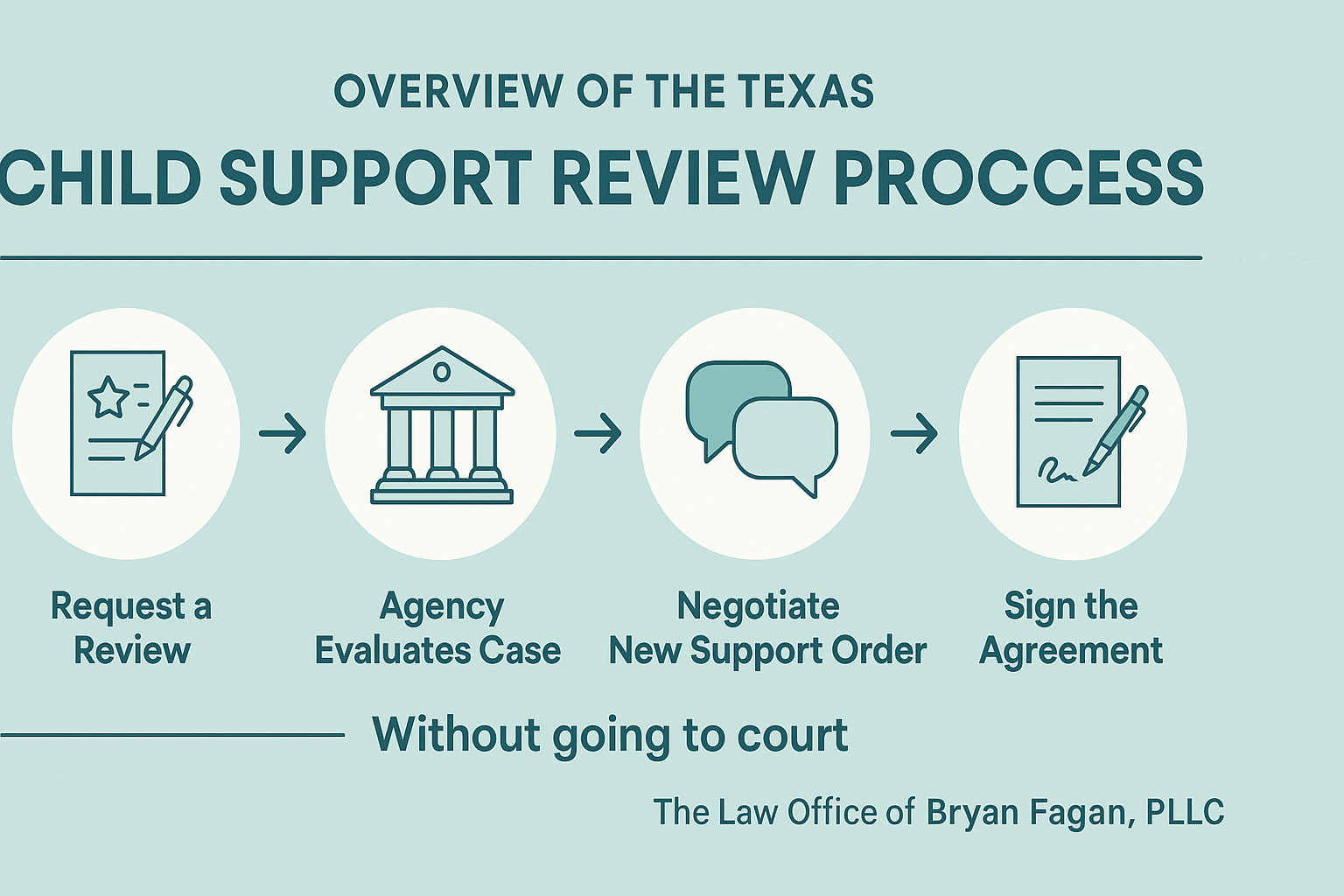
Requesting a child support review in Texas is a straightforward process. First, you must complete the official paperwork. After that, send it to the Office of the Texas Attorney General. This paperwork typically includes a Child Support Order Modification Request form, where you will detail your current financial status and the grounds for requesting a modification.
When requesting a change to a child support order, it is crucial to:
- Submit proof that the original order is insufficient due to changes in circumstances, such as job loss or increased expenses.
- Provide supporting documents, such as pay stubs, tax returns, and proof of any significant changes in your financial situation, to strengthen your case.
- Ensure that all information is accurate and comprehensive to improve the likelihood of a favorable review outcome to modify child support.
Consulting with an attorney experienced in the Texas court system can help you understand your case’s nuances, ensure your paperwork is correct, and assist in providing guidance on presenting your request effectively to the Texas Attorney General’s Office.
Parents who agree on the proposed changes should sign the Final Order to modify the one parent-Child relationship agreements as requested to expedite the modified process.
Preparing for Your Child Support Review Meeting
Preparation is key to navigating the Texas Child Support Review Process successfully. Before your meeting with the Office of the Attorney General, take time to gather all relevant financial documentation. This includes recent pay stubs, tax returns, bank statements, proof of healthcare premiums, and receipts for any major expenses related to your child. A complete financial picture not only supports your request for modification but also helps ensure the final order reflects your current reality and your child’s best interests.
According to Texas Family Code §156.401, a parent may seek modification if it has been at least three years since the last order was entered or there has been a material and substantial change in circumstances. This might include job loss, significant income fluctuation, or a change in custody arrangements. At your review meeting, you will need to clearly demonstrate how your circumstances have changed. Being organized can make all the difference.
Consulting with a family law attorney before the review can give you a strategic edge. At this stage, your attorney can explain your rights under the Texas Family Code, help clarify income disclosures, and prepare you for what to expect. From reviewing your documents for accuracy to anticipating key questions from the Legal Support Officer, legal guidance ensures you don’t miss important details that could delay or jeopardize your outcome. Be ready to discuss not only income but also medical and dental support, visitation, and other parenting responsibilities.
To dive deeper into review timelines and eligibility, read our in-depth guide: Understanding the Texas Child Support Three-Year Review Rule for Modifications. At The Law Office of Bryan Fagan, PLLC, we help parents approach the child support review process with clarity, confidence, and the legal tools necessary to protect their families. Whether you’re pursuing modification through a CSRP meeting or preparing for court, our team is here to ensure your voice is heard and your future is secure.

The Role of Legal Representation in Ensuring Fair Outcomes
Legal representation is essential in navigating the complexities of the child support review process. Many parents have shared success stories where an experienced attorney made a significant difference. For example, one divorce father overcame significant legal hurdles and secured child custody of his kids with his attorney’s support and expertise. Similarly, a single mother expressed gratitude for her attorney’s clear guidance and support during a custody case, leading to a positive outcome.
An attorney provides critical guidance beyond just representing you in meetings, helping parents overcome complex legal hurdles associated with child support modifications. Whether understanding family law subtleties, preparing robust documentation, or negotiating effectively, an experienced attorney can significantly influence your case’s outcome.
Overall, hiring a qualified attorney enhances the likelihood of achieving fair and accurate outcomes during child support reviews. They ensure that all legal avenues are explored and that your case is presented in the most compelling manner possible, ultimately working towards the best interests of your child.
Common Mistakes to Avoid During the Child Support Review Process
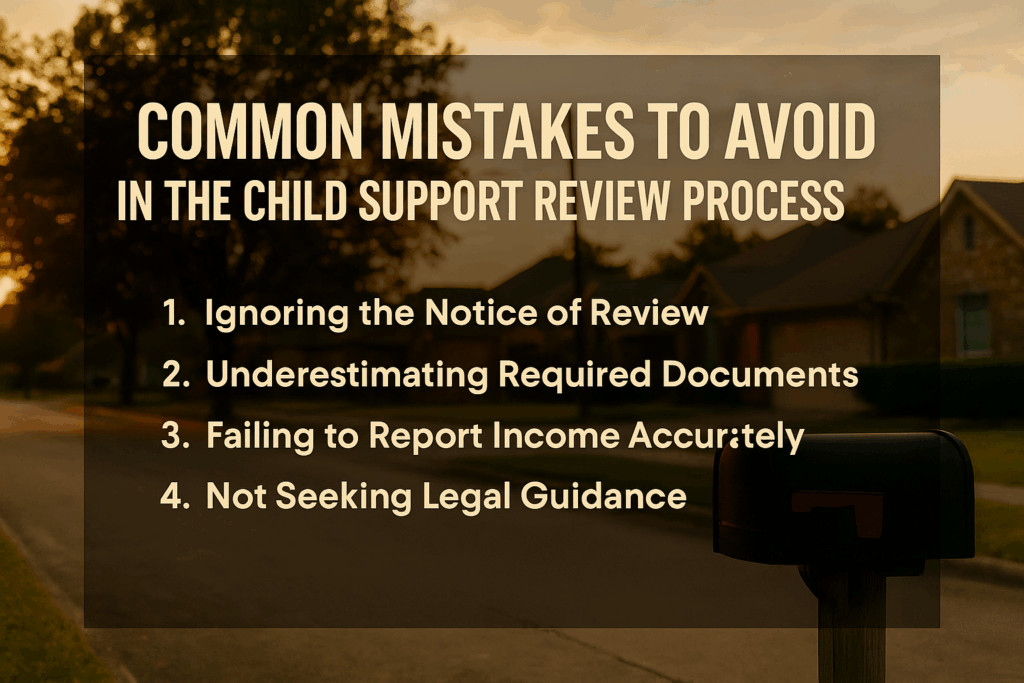
One of the most important steps in navigating the Texas Child Support Review Process is avoiding common mistakes that could delay or jeopardize your request for modification. A frequent—and costly—error is failing to clearly identify and document the financial changes that justify a review, such as job loss, reduced income, increased childcare expenses, or unexpected medical costs. According to Texas Family Code §156.401, such changes may qualify as a material and substantial change in circumstances, which is the legal threshold for seeking a modification.
Another common issue is poor recordkeeping. Parents often fail to retain accurate documentation of child support payments made or received, medical reimbursements, or communication with the other parent. To present a credible and organized case, it’s crucial to maintain copies of pay stubs, tax returns, healthcare bills, parenting schedules, and bank statements. These documents form the foundation of your request and are often reviewed in administrative and legal settings to validate claims.
It’s also essential to understand the current terms of your child support order before requesting changes. Examine the agreement carefully and identify exactly what aspects need to be updated. Is the support amount no longer feasible due to reduced income? Has the parenting time arrangement shifted significantly? Ensure that the requested changes are specific and legally justifiable. Deviating from the existing court order without first securing a formal modification can reflect poorly on your case and may limit your ability to obtain a favorable outcome.
To formally request a review, we recommend using the Request for Administrative Review form, available directly from our site. At The Law Office of Bryan Fagan, PLLC, our experienced attorneys routinely assist parents throughout this process—from preparing review requests to representing clients in negotiations or court if necessary. For more insights on what to expect, visit our Texas Child Support Resource Center, where you’ll find free forms, guides, and compassionate legal guidance tailored to protect your child’s future and your peace of mind.
What Happens During the Child Support Review Meeting
The Texas Child Support Review Process (CSRP) allows parents to resolve child support issues without going to court by meeting with a Legal Support Officer from the Office of the Attorney General. During the review meeting, both parents have the opportunity to evaluate and potentially modify existing child support orders based on updated financial circumstances. This setting is more collaborative than a formal hearing and typically less stressful, with a focus on reaching agreements that reflect the child’s current needs and the financial realities of both parents.
To prepare for the meeting, it’s crucial to understand how Texas calculates child support. The guidelines set forth in Texas Family Code §154.125 determine the percentage of net resources owed based on the number of children involved. Parents should come prepared with clear, organized documentation such as recent pay stubs, proof of health insurance, and records of expenses. If the parents reach an agreement, the proposed order is reviewed by an attorney and then sent to a judge for approval and signature, which finalizes the modification.
However, not all review meetings end in agreement. If a resolution cannot be reached during the CSRP, the matter may be referred to court. A judge will then conduct a formal hearing where each party can present their case, and a final ruling will be made. This ensures that the child’s best interests are still protected under judicial oversight if necessary, especially in more complex or contested situations.
In rare cases, if there are concerns about how a prior order was handled—such as fraud, lack of proper notice, or clerical error—parents may be able to pursue relief through a Bill of Review. To learn more about this post-judgment remedy, visit our dedicated resource on the Bill of Review. At The Law Office of Bryan Fagan, PLLC, our team is committed to guiding parents through every step of the review process with clarity and compassion. Whether you need help preparing for your CSRP meeting or exploring post-judgment options, we’re here to advocate for your family’s future.

Post-Review: Implementing Changes to Child Support Orders
Once the Texas Child Support Review Process (CSRP) is complete, implementing the changes to the support order is a critical final step. If both parents reach an agreement during the review meeting, a new child support order is created based on that agreement. Under Texas Family Code §156.401, that order typically becomes legally binding 30 days after formal notice has been provided to all parties. This grace period allows time to prepare for any adjustments in payment amounts, custody logistics, or healthcare responsibilities.
If an agreement is not reached, the Attorney General’s office may refer the case to court, where a judge will review the evidence and issue a final ruling. During this hearing, each parent has the opportunity to present documentation and testimony, and the court will determine an appropriate child support arrangement in the best interest of the child. Judges consider multiple factors—including net resources, parenting time, medical needs, and the standard child support guidelines outlined in Texas Family Code §154.125.
Following the issuance of a new order—whether by agreement or court ruling—both parents must carefully follow the instructions outlined in the order and any guidance from the Attorney General’s office. This may include updating payment methods through the State Disbursement Unit (SDU), adjusting wage withholding orders, or modifying visitation exchanges to reflect the new custody plan. Compliance is essential to ensure the enforceability of the order and to avoid future enforcement actions.
To learn more about your responsibilities after modification and to avoid common delays, visit our in-depth guide: Efficient Texas Child Support Agreement Review Services: What You Need to Know. At The Law Office of Bryan Fagan, PLLC, we help parents navigate the transition from review to implementation with confidence. Whether you’re finalizing a mutual agreement or preparing for court, our team is here to guide you every step of the way—protecting your family, your future, and your child’s stability.

Success Stories from Our Clients
At The Law Office of Bryan Fagan, PLLC, we’ve seen firsthand how strategic legal support can make a meaningful difference in the lives of Texas families navigating the Texas Child Support Review Process. Clients regularly share how our attorneys’ negotiation strategies helped them reach fair, balanced support agreements—without unnecessary conflict or delays. In one case, a parent who had recently moved to Texas and was overwhelmed by post-divorce responsibilities found clarity and control with the help of our team. By focusing on the child’s long-term well-being and preparing thoroughly for the review meeting, we helped her secure an order that reflected her updated financial situation.
Other clients have praised our firm’s commitment to compassionate, personalized service. One father recalled how his attorney’s clear communication and tailored approach turned a high-stress experience into a manageable one. From ensuring accurate income disclosure to presenting financial hardships in a legally persuasive manner, our attorneys work to help clients avoid common pitfalls—such as failing to document substantial changes in income or not understanding the details of their existing support orders. Under Texas Family Code §156.401, a material and substantial change in circumstances—such as job loss, increased expenses, or a shift in custody—can justify a support modification, but only if it’s presented correctly.
Beyond legal arguments, we emphasize the importance of mindset and preparation. Clients who center the discussion around their child’s best interests and maintain respectful communication with the other parent tend to see more favorable, long-lasting outcomes. Mediation—when supported by legal counsel—can be a powerful tool for reaching agreements without escalating the situation into a court battle. These practical, real-world strategies, combined with our legal advocacy, give our clients the confidence to move forward and protect their family’s future.
If you’re considering a modification or preparing for a review, visit our Child Support in Texas page to understand your rights, responsibilities, and next steps. You can also access free resources and checklists through our Texas Child Support Resource Center. Whether you’re preparing for a review meeting, dealing with enforcement issues, or need help filing a modification request, our team is here to guide you with clarity and care—because your child’s future deserves nothing less.
Additional Resources for Texas Parents
Additional resources are crucial for Texas parents navigating the child support review process. TexasLawHelp.org offers a variety of legal forms and resources specifically designed for parents seeking guidance on custody and support matters. This platform is a valuable tool for understanding the legal landscape and preparing for various aspects of the child support process.
The Texas Office of the Attorney General’s website provides vital information and assistance for child support cases. It includes detailed instructions on how to request a review, forms to fill out, and answers to common questions parents might have. Knowing the Texas Family Code, which outlines the laws and regulations governing child support in Texas, is crucial for informed decision-making. The texas oag is a valuable resource for navigating these processes.
By utilizing these resources, parents can better navigate the complexities of child support and ensure that they are taking the right steps to secure their child’s well-being. Whether you are the custodial or non-custodial parent, having access to the right information and medical support can make a significant difference.
Conclusion:
Every family’s story changes over time — jobs shift, expenses rise, and kids grow faster than the budget seems to allow. When those changes start to stretch your peace of mind, knowing your options under Texas law can make all the difference. The Texas Child Support Review Process isn’t just a legal formality; it’s a lifeline for parents who want to create balance and stability without the strain of a courtroom fight.
At The Law Office of Bryan Fagan, PLLC, we believe that clarity is power. Our team helps parents understand their rights, navigate the review process with confidence, and find solutions that truly fit their family’s needs. Whether you’re seeking a modification, facing financial stress, or simply trying to do right by your child, you don’t have to face the system alone — we’re here to guide you every step of the way.
If you’ve been thinking about reviewing your child support order, consider this your sign to take the next step. Sometimes peace of mind starts with a single conversation — one that turns questions into answers and uncertainty into action. Reach out to our experienced Texas family law attorneys today, and let’s work together to protect what matters most: your family, your future, and your freedom to move forward.
FAQ: What is Child Support in Texas?
Child support is a court-ordered payment made by one parent to help cover the costs of raising a child. This includes housing, food, clothing, medical care, daycare, and school expenses. The Texas Family Code §154.001 states that parents have a duty to financially support their children, even if they do not have custody.
Typically, the non-custodial parent (the parent who does not primarily live with the child) is ordered to pay child support to the custodial parent. The amount is determined based on income and the number of children.
Yes, parents can reach their own agreement, but the judge must approve it and determine it is in the child’s best interest (Texas Family Code §154.124). This agreement must be formalized in writing.
Texas orders can be enforced in other states under the Uniform Interstate Family Support Act (UIFSA). Child support across state lines must be coordinated, but it is enforceable nationally.
No. Texas law requires all payments to be processed through the State Disbursement Unit (SDU) for tracking and enforcement purposes (Texas Family Code §154.004).