
Navigating child custody decisions during a divorce or separation can be one of life’s most difficult transitions—but understanding your rights under Texas law can make it less overwhelming. It’s all about creating a stable, loving, and predictable future for your children, and we are here to help you understand how to achieve that.
Here in Texas, what most people call shared custody is officially known as a Joint Managing Conservatorship. It’s the default starting point for courts because the law presumes it’s what's best for the child. This setup is less about a perfect 50/50 time split and more about ensuring both parents share the rights and responsibilities of raising their children, working together for their well-being.
Understanding Joint Managing Conservatorship in Texas

When you're going through a divorce or separation, the legal terminology around "custody" can be confusing and intimidating. We want to demystify it for you. Texas law uses specific language to define parental roles and duties, but the goal is always the same: to create a supportive environment where both parents can remain deeply involved in their child's life.
The Texas Family Code is built on the strong belief that naming both parents as Joint Managing Conservators is in the child’s best interest. This means a judge starts every case with the assumption that children do best when both parents have a meaningful say in the big decisions that shape their lives.
Even when custody is shared, the court will designate two specific roles. This isn't about picking a "winner" or a "better" parent. It’s a practical way to create clarity and make day-to-day life smoother for your child.
Here is a step-by-step breakdown of the two primary roles:
- The Primary Managing Conservator: This is the parent who has the exclusive right to decide where the child lives (their primary residence). You might hear people call this the "custodial parent." They are also typically the one who receives child support payments to help with the child’s daily expenses.
- The Possessory Conservator: This parent, often called the "non-custodial parent," has a set visitation schedule (a possession order) and shares in all the major decision-making rights. This is the parent who is generally ordered to pay child support.
It's so important to remember that these labels don't make one parent more important than the other. At its core, a Joint Managing Conservatorship is about both parents having the authority to make critical decisions for their child. That’s the real heart of shared custody in Texas.
Under Texas Family Code § 153.131, a court shall appoint the parents of a child as joint managing conservators unless it finds that the appointment would not be in the best interest of the child. This legal standard shows just how committed the state is to co-parenting.
The true essence of joint managing conservatorship is found in the rights and duties that parents share. This structure is designed to ensure one parent can't make huge, life-altering decisions for a child on their own. For a closer look at how this works in practice, you can get more details in our guide on what joint custody is.
This collaborative model encourages communication and teamwork, which are absolutely essential for a child's well-being after their parents separate. While it requires effort, it empowers both parents to remain a vital part of their child's growth and life milestones. The objective is to build a new family dynamic where both parents, despite living in different homes, act as a united team for their child.
Here’s a clear look at the core parental rights and duties that are typically shared, ensuring both parents have a voice in their child's upbringing.
Core Parental Rights in a Joint Managing Conservatorship
| Parental Right or Responsibility | How It's Shared Under Texas Law |
|---|---|
| Medical Decisions | Both parents typically have the right to consent to medical, dental, and surgical treatments, especially for invasive procedures. |
| Educational Decisions | Parents usually share the right to make decisions about the child's schooling, including enrollment and educational programs. |
| Psychological/Psychiatric Treatment | The right to consent to psychological or psychiatric care for the child is often shared. |
| Moral & Religious Training | Both parents can direct the moral and religious upbringing of the child. |
| Access to Records | Both have the right to access the child's medical, dental, psychological, and educational records. |
| Consultation | Each parent has the right to consult with the child's physicians, dentists, or psychologists. |
| School Activities | Both parents can attend school activities and consult with school officials concerning the child's welfare and education. |
This shared responsibility framework really pushes parents to work together, which ultimately creates a more stable and supportive environment for the child to thrive in.
How Texas Courts Decide Custody Arrangements
When parents reach an impasse and cannot agree on a custody plan, the decision ultimately falls to a Texas judge. Handing over your family's future to a stranger in a black robe can feel incredibly daunting, but we want to reassure you that judges don't make these life-altering decisions based on gut feelings or personal biases.
Every choice they make is guided by one single, powerful principle straight from the Texas Family Code: the best interest of the child. This isn't just a suggestion; it's the legal standard and the cornerstone of every custody ruling in Texas. Every piece of evidence, every testimony, and every argument is filtered through this lens. The court has one mission: to create a safe, stable, and nurturing environment for the child.
The Holley Factors: What Judges Really Look For
So, what does "best interest of the child" actually look like in a courtroom? It's not as vague as it sounds. The Texas Supreme Court laid out a clear framework in a landmark case, Holley v. Adams, that judges still rely on today. This case established a list of factors—now famously known as the Holley Factors—that help guide their evaluation.
Think of these factors as a checklist the judge uses to build a complete picture of your child's life. No single factor decides the case, but together, they help the court make a well-rounded and informed decision on parental rights and possession schedules.
Judges will carefully consider things like:
- The Child’s Needs: What does this specific child need to thrive? This covers their emotional, physical, and developmental needs, both now and in the future. For example, is one parent better equipped to handle a child's specific medical condition or educational challenges?
- Parental Abilities: The court takes a hard look at each parent's ability to provide a safe and stable home. This isn't just about love; it's about practical parenting skills, emotional stability, and the proven capacity to put the child's needs ahead of their own.
- The Child’s Wishes: Once a child is 12 years or older, the judge can meet with them privately to hear their preference. While this isn't the deciding vote, a mature child's wishes are given serious weight.
- Stability of the Home: Courts value consistency. A parent who can offer a stable home environment, free from chaos and constant change, is often seen in a very positive light.
- Acts or Omissions by a Parent: This is where parental conduct comes under the microscope. Has a parent's actions—or failure to act—put the child's well-being at risk? This can cover a lot of ground, from positive involvement to negative behaviors.
Understanding these factors is practical, actionable guidance. It shows you exactly what the court cares about and highlights the importance of demonstrating that you are a stable, loving, and responsible parent from day one.
Proving You Are a Fit Parent
The Holley Factors provide the roadmap, but your actions provide the proof. Everything you do, both before and during your custody case, speaks volumes about your parental fitness. A judge is looking for a parent who is child-focused, cooperative, and actively involved in their kid's life.
A huge takeaway for any parent heading into a custody battle is this: Texas courts want to see cooperation. A parent who shows they are willing to co-parent effectively and actively encourages the child's relationship with the other parent is almost always seen as acting in the child’s best interest.
For instance, a parent who consistently gets the child to school on time, never misses a doctor's appointment, and shows up for soccer games is demonstrating deep involvement. On the flip side, a parent who constantly bad-mouths the other parent in front of the child is likely to be seen as undermining the child's emotional health—a major red flag for any judge.
The Dangers to the Child
Unfortunately, courts also have the heavy burden of considering any potential dangers to a child. The Holley Factors specifically require an evaluation of any emotional or physical danger the child might face, now or in the future. This is where serious issues like a history of domestic violence, substance abuse, or neglect become critical.
If there is credible evidence of this kind of behavior, it will drastically shape the outcome. A court won't hesitate to limit a parent's rights, order supervised visitation, or take other protective measures if it believes a child's safety is on the line. At the end of the day, presenting yourself as a stable, child-focused co-parent is the most powerful thing you can do to achieve a positive outcome.
Decoding Possession Orders and Visitation Schedules
Once the court decides you and your co-parent will be Joint Managing Conservators, the first big question is usually, "So, when do I actually get to see my kids?" This is where the Possession Order comes in.
Think of it as the detailed roadmap for your co-parenting life. It's the calendar that spells out the specific days, holidays, and vacations each of you will have with the children, providing much-needed predictability for everyone.
While parents are free to create any custom schedule they believe is best, Texas law provides a default plan for when they can't agree. This framework is called the Standard Possession Order (SPO), and it serves as the foundation for most shared custody arrangements in the state.
The Texas Standard Possession Order Explained
The Standard Possession Order is the go-to schedule in Texas family law. It's designed to give both parents regular and meaningful time with their child and is legally presumed to be in the child's best interest. The goal is to create a predictable rhythm that both parents and, most importantly, the children can count on.
Here is a step-by-step breakdown of the SPO for the parent who doesn't designate the child's primary residence (the possessory conservator):
- Weekends: Possession on the first, third, and fifth weekends of the month. A "weekend" usually kicks off when school lets out on Friday and wraps up when school starts again on Monday morning.
- Holidays: Major holidays like Thanksgiving and Christmas are split between the parents, usually alternating each year. This system ensures both parents have the chance to build those precious holiday memories.
- Summer Vacation: The non-primary parent generally gets 30 days of possession during the summer. This can be taken as one long stretch or broken up into smaller visits, depending on what the parents agree to or what the judge orders.
This structure is meant to minimize conflict by leaving very little to interpretation. If you want to dig deeper into the nuances, our detailed guide on possession orders in Texas family law has you covered.
What Is an Expanded Standard Possession Order?
Over the years, Texas law has increasingly recognized just how vital it is for both parents to be deeply involved in a child's daily life. This led to the Expanded Standard Possession Order (ESPO), which is now the default schedule for parents who live 50 miles or less from each other. The ESPO adds critical overnight visits during the school week, which can make a world of difference in strengthening the parent-child bond.
Here’s what makes the ESPO different:
- Earlier Weekend Pickup: The possessory conservator's weekend starts when school is dismissed on the Thursday before their designated weekend.
- Later Weekend Drop-off: The child is returned directly to school on Monday morning, instead of on Sunday evening.
- Overnight Mid-Week Visits: The possessory conservator also gets an overnight visit during the weeks when they don't have their regular weekend possession.
This expanded time allows the non-primary parent to be part of the everyday routine—helping with homework, managing school night bedtimes, and participating in weekday activities.
Texas law continues to evolve to promote more balanced parenting. The courts increasingly favor arrangements that allow both parents to actively share in the daily responsibilities of raising their children, acknowledging the profound benefits this brings to a child's development and well-being.
Customizing a Schedule That Works for Your Family
The SPO and ESPO are excellent starting points, but they are far from one-size-fits-all. The Texas Family Code actually encourages parents to work together to create custom possession schedules tailored to their family's unique needs. As long as you both agree and the judge confirms it's in your child’s best interest, the court will almost certainly approve your plan.
For example, a family with a firefighter parent might need a schedule based on shifts rather than weekends. Or, parents living very close might opt for a "week-on, week-off" 50/50 plan. The ultimate goal is always to create a stable, predictable, and loving environment for your child. Whether you stick with a standard order or design your own, clarity and consistency are what will help your child thrive through the transition.
Recent legislative changes further support this flexible approach. For instance, Senate Bill 1936, effective September 1, 2025, gives non-primary parents living within 50 miles stronger legal ground to request expanded time, often leading to schedules that are much closer to a 50/50 split. While not a mandate for 50/50, it reflects a clear trend toward ensuring both parents are deeply involved in their children's lives.
It's one of the biggest points of confusion for parents: how does child support work when we share custody? Many people walk into our office assuming that if they have the kids for nearly the same amount of time, child support just goes away. That's actually one of the most common myths about shared custody in Texas.
Here’s the reality: even when parents are named Joint Managing Conservators, a judge will almost always order one parent to pay child support to the other. The purpose of child support is to ensure the child enjoys a similar standard of living in both homes and that both parents contribute financially to their upbringing.
The Texas Child Support Guideline Formula
Texas doesn't leave child support up to guesswork. The courts start with a specific formula laid out in the Texas Family Code, which is presumed to be in the child's best interest. This gives judges a consistent, predictable starting point.
Here's a step-by-step look at how it generally works:
- Identify the Obligor: The court identifies the parent who will pay support. Usually, this is the parent who doesn't have the exclusive right to decide where the child lives (the possessory conservator).
- Calculate Net Resources: The court calculates that parent's monthly net resources by taking their gross income and subtracting taxes, health insurance premiums for the child, and other specific deductions.
- Apply Percentage: A set percentage is applied to the net resources based on the number of children. For one child, it's 20%; for two, it's 25%, and so on.
It's so important to remember this: in the eyes of Texas law, your possession schedule and your child support obligation are two separate things. Having more time with your kids doesn't automatically wipe out your financial duty, but it can definitely play a role in the final number.
If you want to see exactly how these numbers get crunched, we've put together a detailed child support overview for Texas families. It's a great resource for getting a clearer picture of what a court might order in your situation.
How More Possession Time Can Impact Support
So, if child support is almost always on the table, what’s the point of fighting for an Expanded Standard Possession Order (ESPO) or a true 50/50 schedule? It matters—a lot. While it won't automatically zero out your child support bill, having more time with your kids is a powerful argument for adjusting the final amount.
The Texas Family Code gives judges the authority to deviate from the standard guidelines if sticking to them would be unfair or inappropriate given the specific facts of the case.
A judge can tweak the support amount based on several things, such as:
- The amount of time the obligor has possession of the child. A 50/50 schedule is a very compelling reason to argue for a lower payment.
- Each parent's ability to contribute to the child's support.
- Any extraordinary expenses for the child, like special medical treatments or private school tuition.
- The financial resources available to both parents.
For example, if a dad has an ESPO and is handling daily school drop-offs, after-school snacks, and homework several extra nights each month, his attorney can make a strong case that his direct financial contributions justify a child support payment that's lower than the state guideline. The court will look at the entire financial picture to make sure the final order is fair to everyone and, most importantly, serves the child's best interests.
This infographic shows the timeline of legislative changes in Texas that impact custody arrangements.
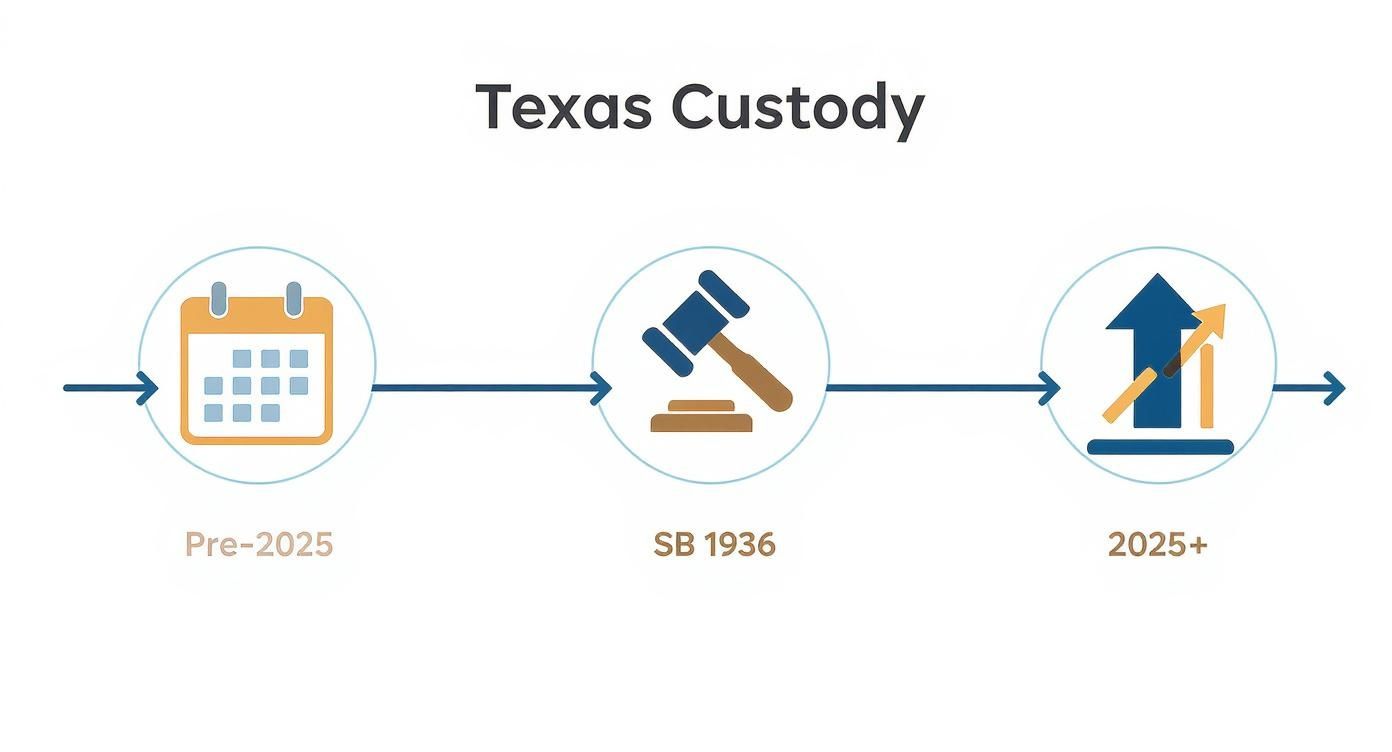
The timeline highlights how recent laws like SB 1936 are pushing Texas custody arrangements toward more equitable time-sharing, which in turn influences child support discussions.
Modifying or Enforcing Your Custody Order
Think of your Texas custody order as the blueprint for your co-parenting life. It provides a solid framework, but it's not carved in stone. Life happens. What worked perfectly for a toddler might be completely impractical for a teenager, and as your family’s circumstances change, that old blueprint may no longer fit. When that happens, Texas law gives you two powerful tools: modification and enforcement.
Knowing when and how to use these legal paths is key to protecting both your child's stability and your rights as a parent. Whether you need to update the schedule to reflect a new reality or hold the other parent accountable for following the current rules, it all starts with understanding what a court needs to see.
When Can You Modify a Custody Order?
You can't just ask a judge to change a custody order because you’ve had a minor disagreement. To get a court to consider a modification, you must follow a clear two-step process:
- Prove that there has been a material and substantial change in the circumstances of your child or one of the parents.
- Show that changing the order would be in the best interest of the child.
The "material and substantial change" is a high bar. It must be a significant life event that truly alters the family's situation in a meaningful way.
Here are some real-world examples:
- A parent is relocating. A move to a new city for a job can make the current visitation schedule impossible.
- A major shift in income. If the parent paying child support involuntarily loses their job, that could justify revisiting the support amount.
- The child's needs have changed. A teenager with complex extracurricular activities might need a more flexible schedule.
- A parent gets remarried. Bringing a new stepparent into the home is a significant change to the family dynamic.
- A parent's lifestyle becomes a danger. If one parent develops a substance abuse problem that puts the child at risk, that’s an urgent reason for a modification.
After proving a change in circumstances, you still must convince the judge that your proposed new arrangement is what's best for your child.
What to Do When Your Co-Parent Violates the Order
Few things are more frustrating than when the other parent decides not to follow the custody order. Maybe they consistently deny your scheduled time with the kids, stop paying child support, or make major decisions without consulting you. You are not helpless. Your legal remedy is a Petition for Enforcement.
An enforcement action is exactly what it sounds like: you're asking a judge to step in and force the other parent to comply with the court's orders. To win an enforcement case, meticulous documentation is your most powerful tool.
As a practical tip, keep a detailed log of every single violation. Write down the date, time, what part of the order was broken, and save any relevant texts or emails. This evidence turns a "he said, she said" argument into a clear, factual record of non-compliance.
If the judge agrees that the other parent has violated the order, they have a range of options to set things right, including:
- Ordering make-up possession time to compensate you for the visits you missed.
- Holding the non-compliant parent in contempt of court, which can lead to hefty fines or even jail time for serious or repeated offenses.
- Ordering them to pay for your attorney's fees and court costs.
While Texas courts favor shared custody, the reality on the ground can still be uneven. Fathers in Texas, for instance, receive about 33% of parenting time, which is right in line with the national average of 35%. Although the law encourages joint arrangements, old biases can sometimes lead to situations where one parent feels the other isn't holding up their end of the bargain. You can find more divorce and custody statistics in Texas to see the broader trends.
As you work through a custody plan, it’s completely normal for a flood of questions to arise. Family law can feel complex, but getting straight answers can bring a much-needed sense of calm and control.
Let's address some of the most common questions we hear from Texas parents navigating the details of shared custody.
Can My Child Decide Which Parent to Live With in Texas?
This is one of the most frequent—and emotionally loaded—questions we get. While a child's feelings are incredibly important, Texas law is clear: a child cannot legally choose which parent they live with until they turn 18. The final decision always rests with the judge.
However, the law recognizes a child's growing maturity. The Texas Family Code gives children who are 12 or older the right to speak directly with the judge in private, in what's called an "in-chambers interview." It's a confidential conversation where the child can express their wishes about where they want to live.
It's critical to understand that the child's preference is just one piece of a much larger puzzle. The judge will consider the child's maturity and their reasons, but this is weighed against all the other "best interest" factors. The child’s voice is heard and given serious weight, but it isn't the deciding vote.
What Is the Right of First Refusal in a Custody Order?
The "Right of First Refusal" is a practical provision you can add to a Texas custody order. It is a way to maximize the time your child spends with their parents and reduce the need for babysitters.
Here is a simple step-by-step example:
- Parent A needs childcare for a four-hour period during their scheduled possession time.
- Before calling a babysitter or family member, Parent A must first offer that four-hour block to Parent B.
- Parent B can then accept the time with the child or decline, at which point Parent A is free to arrange other childcare.
The beauty of this provision is that it's completely customizable. You and your co-parent can agree on the specifics, such as the minimum time that triggers the right (e.g., more than four hours) and how the offer should be made (e.g., by text message). Including this clause in your order can prevent future arguments and reinforces the idea that you are both the primary caregivers.
How Does a Parent Relocating Affect Our Custody Arrangement?
When one parent decides to move, it can throw a major wrench into a custody arrangement. A relocation can completely upend a possession schedule and strain the child's bond with the parent left behind. For this reason, nearly all Texas custody orders contain a geographic restriction.
This provision sets boundaries on where the primary parent can establish the child's home. Usually, it's limited to the current county and sometimes its bordering counties.
If the primary parent wants to move with the child outside this restricted area, they have two options:
- Get written, notarized permission from the other parent.
- File a formal modification lawsuit and get a new court order from a judge approving the move.
A judge will not automatically approve a relocation. The moving parent must prove that the move is in the child's best interest. The court will look closely at the reason for the move, the potential benefits for the child, and most importantly, how the move will impact the child’s ability to have a close, continuous relationship with the other parent.
If you need help navigating divorce, custody, or estate planning in Texas, contact The Law Office of Bryan Fagan today for a free consultation.