
Most parents don’t think about child support law during life’s quiet moments, but everything changes the day you’re staring at an unexpected bill with the refrigerator door open, wondering how you’re going to stretch groceries through the weekend. It’s in moments like these—when the house is finally quiet, the kids are asleep, and the weight of responsibility settles in—that many parents ask themselves a difficult question: Are There Options for Low-Income Clients Seeking a Texas Child Support Attorney when money is tight and legal issues can’t wait? The answer is yes, and understanding your options can be the start of regaining the peace and stability you deserve.
At The Law Office of Bryan Fagan, PLLC, we see these real-life moments every day. Led by Bryan Joseph Fagan, a South Texas College of Law graduate and recognized authority in Texas divorce and custody law, our firm has helped countless parents navigate the complex rules of the Texas Family Code, including how §153.002 protects the best interest of the child and how Chapters 154 and 156 govern child support obligations and modifications. These laws can feel overwhelming when you’re already stretched thin, but the right guidance can turn confusion into clarity.
We understand the emotional and financial pressure that builds during these transitions because we’ve walked shoulder-to-shoulder with Texas families facing them. Our “How” has always been rooted in compassionate counsel, education, and innovative legal solutions designed to simplify complexity. Our “What”—family law services that protect what matters most—comes to life when we help a parent move from fear and uncertainty back to confidence and control.
In this article, you’ll learn exactly what affordable legal options exist for low-income parents in Texas, how the child support system works, and how to take practical steps that protect your rights and your family’s stability. Most importantly, you’ll see that you are not alone—and that options do exist, even when life feels overwhelming. Let’s explore your path forward, together.
Key Takeaways
- Texas parents facing financial hardship do have multiple affordable options for legal help in child support cases, including the OAG, legal aid programs, sliding-scale attorneys, and flexible payment plans.
- Understanding child support laws—especially Chapters 154 and 156 of the Texas Family Code—helps parents make informed decisions and avoid costly mistakes.
- Low-income parents may qualify for reduced support, deviations from guideline amounts, or modifications after job loss or major life changes.
- The Law Office of Bryan Fagan, PLLC offers compassionate, accessible representation designed to reduce stress and simplify complex legal issues.
- Skilled legal guidance protects not only your finances but also your household’s emotional stability and long-term well-being.
- No parent should have to navigate Texas child support alone—affordable help exists, and early action can prevent bigger problems later.
If you’d like, I can format this specifically for placement after your introduction or before your conclusion.

Your Family’s Future Starts Here
Don’t navigate your legal journey alone. Schedule a consultation now and get the clarity and support you deserve.
Yes – Multiple Affordable Legal Options Exist for Texas Parents
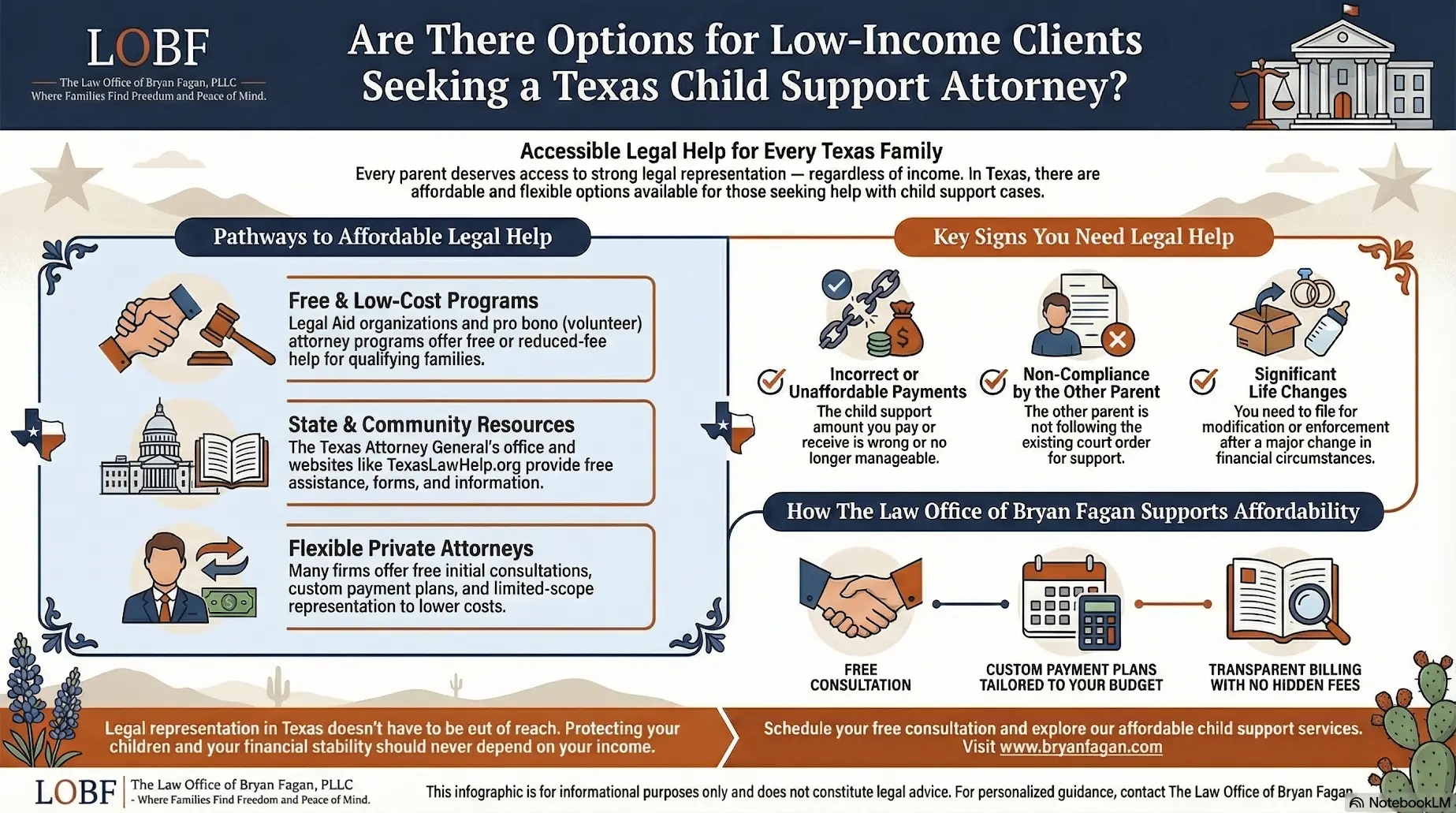
Texas offers one of the most robust networks of affordable legal services in the nation, which is particularly reassuring for parents asking Are There Options for Low-Income Clients Seeking a Texas Child Support Attorney. Across all 254 counties, Texans have access to free legal aid organizations, state-supported child support services, and flexible private attorney options. These resources ensure families receive guidance rooted in the protections outlined in the Texas Family Code, including child support guidelines under Chapter 154 and modification standards updated in Chapter 156.
Legal aid organizations across the state provide no-cost representation to income-qualified families, assisting with matters such as enforcement actions, support orders, and custody issues. The Texas Office of the Attorney General’s Child Support Division also offers free assistance with establishing, enforcing, and modifying orders, giving parents a clearer understanding of their rights and responsibilities under state law. For families who may not qualify for full legal aid services—but still cannot manage traditional legal fees—many private attorneys now provide reduced-cost arrangements, including sliding-scale fees and flat-fee services. Parents who want to understand the differences between hourly billing and fixed-fee models can review our detailed guide on Texas child support attorney fees.
As a trusted family-focused practice, the team at the Law Office of Bryan Fagan understands the financial challenges many parents face. That’s why our firm offers free consultations, budget-friendly payment plans, lowered retainer options for qualifying clients, and tailored sliding-scale arrangements. These flexible models help ensure that even complex legal matters—such as proving a material and substantial change under Texas Family Code §156.401—receive the thorough legal attention they require.
Exploring your options begins with recognizing that Texas provides multiple pathways to affordable, high-quality legal representation. Whether you qualify for legal aid, depend on the services of the Attorney General, or choose to work with a private attorney offering accessible pricing, every route is designed to support families through difficult transitions. For additional guidance on navigating Texas child support obligations, you can visit our comprehensive resource on Texas child support law.

Free Legal Aid Organizations Across Texas
Texas families often ask Are There Options for Low-Income Clients Seeking a Texas Child Support Attorney, and fortunately, the answer is yes. Texas maintains one of the strongest legal aid networks in the nation, with organizations specifically trained in family law matters governed by the Texas Family Code. These include child support establishment under Chapter 154 and modification standards updated under Chapter 156, both of which represent the most current legal frameworks guiding support obligations and changes in circumstances. For low-income residents, these legal aid organizations remain a vital resource for navigating complex child support issues with clarity and protection.
Lone Star Legal Aid provides comprehensive representation across the Houston region and East Texas, assisting income-qualified families with child support enforcement, modification, and related family law challenges. Legal Aid of Northwest Texas serves a broad stretch of North and West Texas, including the Dallas–Fort Worth metroplex, and offers family law clinics and direct services to parents facing legal hardships. Texas RioGrande Legal Aid (TRLA), one of the largest providers of free legal services in the country, supports families throughout Central, South, and West Texas, including those dealing with complicated cross-border child support matters or unique financial pressures.
Eligibility for these services is generally determined by federal poverty guidelines, but providers may also prioritize cases involving domestic violence, older adults, individuals with disabilities, or situations requiring immediate legal intervention. While these organizations cannot accept every case due to limited funding and high demand, they remain the most comprehensive no-cost legal support system available to Texans seeking help with child support obligations, modification needs, or enforcement defense.
For families who do not qualify for free legal aid but still need affordable representation, many private attorneys now offer sliding-scale options, reduced retainers, and predictable flat-fee services. To help parents better understand these cost structures, our firm provides additional guidance in this article on the key factors influencing Texas child support attorney fees. As a client-centered practice committed to protecting Texas families, the team at the Law Office of Bryan Fagan continues to prioritize accessible, compassionate representation so parents can move forward with confidence and the legal support they deserve.

Government Resources for Child Support Cases
The Texas Office of the Attorney General Child Support Division provides comprehensive free services for child support case establishment, modification, and enforcement throughout the state. These government-provided services represent a crucial resource for low income clients who need professional assistance with child support matters but may not qualify for legal aid or cannot afford private counsel.
The Attorney General’s office handles child support enforcement at the state level and provides information about child support obligations, collection procedures, and modification processes without charge. Their services include establishing paternity, calculating support amounts based on Texas Family Code Chapter 154 guidelines, collecting and distributing payments, and enforcing support orders through various mechanisms including wage garnishment and asset seizure.
Online applications for Attorney General services can be submitted through their website, with local office locations throughout Texas providing in-person assistance. The office maintains specialized staff trained in complex child support calculations and modification procedures under Texas Family Code Chapter 156, ensuring that government-provided services maintain professional standards comparable to private legal representation.
However, Attorney General representation has limitations that parents should understand. While excellent for straightforward establishment and enforcement cases, government attorneys may not be able to provide the individualized strategic advice and comprehensive family law representation that complex cases require. Additionally, parents cannot choose their assigned attorney and may experience longer processing times due to high caseloads.
The Tarrant County Domestic Relations Office (DRO) serves as another government resource for child support matters in North Texas. The DRO encompasses child support services, legal support services, family court services, and community supervision, accessible at 817-884-1742. This local government agency works to ensure compliance with state and local child support laws and provides direct program operations throughout the county.
Understanding when government services are sufficient versus when private legal counsel becomes necessary requires careful evaluation of your case’s complexity, the cooperation level between parents, and any complicating factors such as interstate issues, domestic violence, or significant asset considerations.
Private Attorney Options for Low-Income Families
Sliding-Scale Fee Attorneys
Private family law attorneys increasingly recognize the need to serve clients across economic circumstances through sliding-scale fee structures based on income and family size. The Austin Community Law Center provides sliding-scale legal services statewide, adjusting fees according to verified financial circumstances while maintaining full professional representation standards.
Many private attorneys offer income-based fee structures that calculate costs according to your ability to pay rather than standard hourly rates. These arrangements require financial documentation but can reduce legal costs by 30-60% compared to standard fees. When negotiating sliding-scale arrangements, prepare to provide tax returns, pay stubs, bank statements, and documentation of monthly expenses to qualify for reduced rates.
The key to successful sliding-scale arrangements is transparency about your financial situation and realistic expectations about payment capabilities. Attorneys offering these services understand that low income clients need the same quality representation as higher-income families and structure their practices to accommodate various economic circumstances while maintaining professional standards.
Payment Plans and Flexible Retainers
Monthly payment plans represent another significant option for spreading legal costs over time, making professional representation accessible to families who cannot pay large retainer fees upfront. Many Texas family law attorneys offer structured payment arrangements that divide total legal costs into manageable monthly installments, typically ranging from 6-18 months depending on case complexity.
Reduced retainer options allow clients to begin representation with lower upfront costs, typically 25-50% of standard retainer amounts, with additional payments made as the case progresses. This arrangement works particularly well for child support modification cases under Texas Family Code Chapter 156, where the scope of work can be defined more precisely than in complex divorce proceedings.
Unbundled legal services provide another cost-effective option where attorneys handle specific tasks rather than full representation. For child support matters, this might include drafting modification petitions, reviewing proposed settlement agreements, or providing coaching for self-represented parents preparing for court hearings. Unbundled services allow clients to obtain professional assistance for the most critical aspects of their case while handling routine tasks independently.
The Law Office of Bryan Fagan PLLC offers comprehensive flexible payment arrangements that include extended payment plans, reduced retainer options for qualifying clients, and unbundled services tailored to specific client needs. These arrangements ensure that financial constraints do not prevent families from accessing experienced legal representation for critical child support matters.
Pro Bono and Reduced-Fee Programs
Texas parents often wonder Are There Options for Low-Income Clients Seeking a Texas Child Support Attorney, especially when legal fees feel out of reach. Fortunately, the State Bar of Texas maintains a strong pro bono referral system designed to connect low-income residents with volunteer attorneys who can provide free or significantly reduced-cost assistance. These programs ensure families facing child support challenges still have access to knowledgeable advocates who can help them understand and assert their rights under the Texas Family Code, including child support obligations outlined in Chapter 154 and modification standards updated in Chapter 156.
Across the state, local bar associations also offer volunteer lawyer initiatives that focus specifically on family law matters. The Houston Volunteer Lawyers Program provides free civil legal services to qualifying Harris County residents, while the Dallas Volunteer Attorney Program offers clinics and case assignments for families needing help with child support enforcement, modification requests, or understanding guideline changes affecting their orders. These programs prioritize child support issues because they recognize how essential stable support arrangements are for a child’s well-being and a parent’s financial stability.
Many Texas attorneys participate in pro bono work not only to fulfill their professional obligations but also to deepen their experience in family law. Through continuing legal education and mentorship, volunteer lawyers develop meaningful competency in handling child support cases, giving low-income parents access to high-quality representation even when traditional attorney fees may be out of reach. This commitment to service reflects the broader legal community’s recognition that every parent deserves a fair opportunity to navigate the child support process with confidence.
Although pro bono placements often require income verification and case screening—and availability can vary based on demand—they remain a valuable path for families seeking no-cost legal help. For parents exploring all possible financial options, the team at the Law Office of Bryan Fagan also provides guidance on affordability, including an in-depth discussion of attorney costs in this article on the average costs associated with hiring a senior attorney. Families can also explore our broader Texas Child Support Resource Center for additional support. As a client-focused practice, the firm remains committed to helping parents understand their options and access the legal protection they deserve.

How the Law Office of Bryan Fagan PLLC Ensures Accessible Representation
Families often ask Are There Options for Low-Income Clients Seeking a Texas Child Support Attorney, especially when legal fees feel overwhelming during an already stressful transition. One of the key commitments of the team at the Law Office of Bryan Fagan has always been ensuring that quality representation is accessible, regardless of economic circumstances. This begins with free initial consultations, giving parents the chance to understand their rights and responsibilities under the Texas Family Code, including support guidelines outlined in Chapter 154 and modification standards updated in Chapter 156. These conversations give clients a clear view of their options, their case strengths, and what legal strategies may be available to protect their family’s stability.
To support families with different financial needs, the firm offers flexible payment plans that allow qualified clients to distribute legal costs over time—often between six and twenty-four months depending on case complexity. These plans are structured with real-life budgets in mind so that no parent is forced to choose between legal guidance and essential family expenses. Clients seeking clarity on common fee structures can explore our in-depth explanation of Texas attorney fees in this guide to understanding child support lawyer costs, which breaks down how different arrangements work and what affects the overall cost of a case.
For parents who need even greater financial flexibility, the firm also provides reduced retainer options and sliding-scale arrangements for qualifying families. Reduced retainers—often lowered by 25–50% for eligible clients—allow parents to begin their case with less upfront financial strain. Sliding-scale pricing, based on documented financial need, ensures that legal services remain aligned with a client’s ability to pay while still receiving the full benefit of a highly experienced family law team. This approach is especially valuable in child support modifications where a clear scope of work can often be established early.
Most importantly, the firm’s experience in navigating complex child support matters—especially modification cases governed by Texas Family Code §156.401—means clients receive the same level of strategic planning and legal protection regardless of fee structure. Affordable representation should never mean lesser representation, and the attorneys at this Houston-based family law firm continue to prove that financial hardship should not limit a parent’s ability to protect their rights or their child’s future. Families seeking more guidance can also explore our detailed Texas Child Support Resource Center, created to help parents better understand the law and move forward with confidence.
Community and Nonprofit Resources
Beyond direct legal representation, Texas offers extensive community and nonprofit resources that support families navigating child support issues while connecting them with affordable legal assistance. TexasLawHelp.org serves as the central hub for self help resources and legal forms, providing comprehensive information specifically designed for low income residents facing family law challenges.
The website offers step-by-step guides for common child support procedures, including modification requests under Texas Family Code Chapter 156, enforcement actions, and income documentation requirements. These resources help parents understand legal processes and prepare necessary documentation, potentially reducing the amount of attorney time required for their cases.
Texas Access and Visitation Hotline provides free telephone consultation services for parents dealing with child support and custody issues. Trained staff can explain basic legal concepts, provide referrals to appropriate resources, and help parents understand their rights and responsibilities under Texas Family Code. This service is particularly valuable for parents in rural areas who may not have easy access to in-person legal assistance.
Local family service organizations throughout Texas often maintain relationships with legal aid providers and can facilitate referrals for clients needing legal assistance. Many faith-based organizations operate legal aid programs or can connect families with volunteer attorneys willing to handle child support cases at reduced rates.
University legal clinics represent another valuable resource for affordable legal assistance. Texas Southern University’s Earl Carl Institute and other law school clinical programs provide free legal services through law students working under licensed attorney supervision. While these clinics may have limited capacity and specific eligibility requirements, they offer high-quality representation for qualifying families.
The Texas Legal Services Center (TLSC) empowers underserved Texans through legal education, advocacy, advice, and representation, with all services provided free to income-eligible residents. TLSC’s focus on helping families access healthcare, safety, stability, housing, government benefits, and employment often intersects with child support matters, particularly when modifications are needed due to changing circumstances.
These community resources create a comprehensive support network that extends beyond direct legal representation, helping families address the underlying issues that often complicate child support cases while ensuring access to professional legal guidance when needed.
Finding the Right Attorney Within Your Budget
Selecting the right attorney—especially when you’re wondering Are There Options for Low-Income Clients Seeking a Texas Child Support Attorney—means looking beyond price alone and focusing on experience, transparency, and trust. During an initial consultation, it’s important to ask specific questions about fee structures, payment options, and the services included. Parents should also feel comfortable asking how the attorney handles matters governed by the Texas Family Code, including child support calculation requirements under Chapter 154 and modification standards outlined in Chapter 156, both of which reflect the most recent legislative updates. These conversations not only help you evaluate cost but also ensure the attorney has the knowledge needed to protect your rights and your child’s financial stability.
When discussing fees, ask about payment plans, reduced retainer options, or sliding-scale arrangements designed for families working within tight budgets. It is also helpful to clarify what services are included in the quoted price and whether additional charges may arise if unexpected complications occur. Many parents find it useful to review an attorney’s background through the State Bar of Texas, looking for consistent experience with child support establishment, enforcement, and modification. For guidance on identifying hidden costs or fee structures to be aware of, our firm provides a detailed resource here: what to know about hidden fees when hiring a Texas child custody or support attorney.
Because cost and quality don’t always move together, it’s important not to assume that the lowest fee guarantees a good outcome. An inexpensive option that lacks experience with Texas child support laws can lead to long-term financial consequences, while the most expensive attorney might not be necessary for a straightforward modification request. Instead, focus on finding someone who offers both competency in the law and flexibility in their pricing. The State Bar of Texas Lawyer Referral Service can also serve as a helpful starting point, offering a low-cost consultation that allows parents to compare attorneys who are willing to work with a range of economic circumstances.
Just as important as the right questions are the red flags parents should watch for. Be cautious of attorneys who promise specific case outcomes, refuse to offer payment options, cannot clearly explain how Texas Family Code Chapters 154 and 156 apply to your situation, or pressure you to sign a retainer before you fully understand the terms. A trustworthy lawyer will provide a written fee agreement, welcome your questions, and explain the scope of services in plain language. Parents seeking additional support can explore our firm’s Texas Child Support Resource Center, which was created to help families make informed decisions with confidence.

Checklist of Affordable Child Support Legal Options
When families begin asking Are There Options for Low-Income Clients Seeking a Texas Child Support Attorney, the first step is understanding the full range of affordable legal pathways available in Texas. Parents can explore free legal services through regional legal aid providers, pro bono programs offered by local bar associations, university legal clinics, and volunteer attorney initiatives that assist with child support establishment and modification issues governed by Texas Family Code Chapter 154 and Chapter 156. These no-cost resources are especially valuable for those facing urgent financial strain, domestic violence, or sudden changes in employment, and can provide meaningful support while families work toward more long-term solutions.
Government resources also play a major role in supporting low-income parents. The Texas Office of the Attorney General’s Child Support Division helps with establishing, enforcing, and modifying child support orders, while local Domestic Relations Offices offer additional programs that guide parents through the procedures set out in the Texas Family Code. Parents considering these options should assess whether government representation is sufficient for their case or whether the complexity of their situation requires individualized advice from a private child support attorney.
For families who need more personalized legal representation, speaking with multiple attorneys during free consultations is an important step in finding an advocate who fits both the legal needs and the financial realities of their case. Many attorneys offer sliding-scale arrangements, flexible retainer structures, monthly payment plans, and unbundled services that allow parents to pay only for specific tasks. To better understand how pricing works and what typical legal fees look like, our firm provides a helpful breakdown in this guide to Texas child support lawyer fees. For additional legal insight, parents can also explore our broader Texas Child Support Resource Center.
Regardless of which path a parent chooses, preparing the right documentation—such as tax returns, pay stubs, bank statements, expense records, and evidence of changed circumstances—is essential for presenting a strong case under Texas Family Code §156.401. Parents should also be mindful of the expected timelines for legal aid responses, Attorney General services, and court proceedings, as these factors may influence when and how representation is secured. Reviewing fee agreements carefully, comparing the long-term financial impact of different representation options, and understanding the potential savings associated with skilled legal advocacy all empower families to make informed decisions that protect their financial stability and their children’s well-being.
With this structured approach, parents gain the clarity and confidence needed to choose a legal path that truly meets their needs. Whether assistance comes from legal aid, government resources, or a private attorney offering flexible payment options, every family deserves accessible support during one of the most important legal processes affecting their future.
Common Mistakes to Avoid When Hiring Budget-Friendly Attorneys
When parents begin exploring Are There Options for Low-Income Clients Seeking a Texas Child Support Attorney, it can be tempting to choose the lowest-priced lawyer available. But in child support matters governed by Texas Family Code Chapter 154 (support calculations) and Chapter 156 (modification standards), experience matters far more than price alone. Inadequate representation can lead to incorrect guideline calculations, missed opportunities for modification, or enforcement errors—issues that often cost families far more in the long run than hiring a skilled attorney at the outset. Understanding the true cost of representation, including potential hidden fees, is an important part of protecting your financial stability and your child’s well-being.
Before hiring an attorney, parents should always confirm that the lawyer is licensed in Texas, in good standing with the State Bar, and has substantial experience handling child support cases. Verifying this helps avoid serious risks such as disciplinary problems, ineffective representation, or even procedural mistakes that could jeopardize your case. It is equally important to insist on a written fee agreement that clearly outlines rates, scope of representation, payment schedules, and what happens if your case becomes more complex. Families looking to better understand potential add-on expenses can review our detailed guide: additional costs involved in hiring a Texas child support attorney.
One of the most common pitfalls for parents is overlooking hidden fees or failing to ask about additional costs beyond the attorney’s hourly rate or retainer. Filing fees, process service costs, expert witness expenses, and potential appellate fees can all impact your total financial commitment. Asking about these items early helps you evaluate whether a fee structure is genuinely affordable. Our family law team also encourages clients to compare payment plan terms carefully, including interest rates, late payment penalties, and the consequences of missing an installment. A payment plan should support you—not increase financial stress during an already challenging time.
Parents should also take their time before signing a retainer agreement. Rushing this step can cause families to commit to arrangements that don’t fit their needs or budget. Comparing multiple attorneys allows you to identify someone who combines compassion with legal skill, offers transparent pricing, and understands the complexities of child support under the Texas Family Code’s most recent updates. Sometimes paying slightly more for an experienced attorney prevents far greater problems in the future, especially when dealing with nuanced issues like modifications under Texas Family Code §156.401. For those who need further clarity on fee structures or affordable representation models, our Texas Child Support Resource Center offers additional guidance designed to support families through every step of the process.
Why You Need a Child Support Attorney Despite Financial Constraints
Navigating Texas child support laws can feel overwhelming, especially for parents asking Are There Options for Low-Income Clients Seeking a Texas Child Support Attorney. The truth is that Chapters 154 and 156 of the Texas Family Code are detailed, technical statutes that determine how support is calculated, when it may be modified, and what counts as a material and substantial change in circumstances. These sections—updated regularly by the Legislature—require careful interpretation to avoid costly errors. For many families, having knowledgeable legal guidance is not a luxury but a necessity, particularly when child support decisions directly affect long-term financial stability and a child’s well-being.
Child support under Texas Family Code Chapter 154 involves far more than simply applying a percentage to income. Courts consider multiple factors, including imputed income, bonus structures, overtime, self-employment earnings, medical support obligations, and multiple-family adjustments. Misunderstanding any of these components can lead to incorrect support amounts—either overpayment that strains a parent’s resources or underpayment that jeopardizes a child’s needs. These mistakes often require additional litigation to correct, creating unnecessary financial strain for low-income families.
Modification cases under Texas Family Code Chapter 156 demand even greater precision. Parents must demonstrate a qualifying material and substantial change, provide proper documentation, and follow the correct procedural steps. Filing a modification prematurely, incorrectly, or without the required evidence can cause a valid request to be denied. These errors can delay financial relief for months or even years. A knowledgeable family law attorney can help ensure these cases are filed correctly and strategically, avoiding preventable setbacks that impact both parent and child.
Professional representation is also critical when child support intersects with other family law matters, such as enforcement actions, visitation disputes, or custody modifications. Cases involving domestic violence, interstate complications, military deployment, disability, or significant financial disparities add further complexity that self-represented parents often cannot navigate alone. The long-term financial impact of proceeding without experienced counsel far outweighs the upfront cost of proper representation. Families wanting to better understand the financial side of hiring an attorney can review our guide on additional costs involved in hiring a Texas child support lawyer, as well as our comprehensive Texas Child Support Resource. For parents exploring affordable legal options, our firm also provides a helpful breakdown in this beginner’s guide to finding legal aid in Texas, offering practical paths forward for families facing financial challenges.

Client Success Stories: Accessible Representation Works
Many parents begin their search for support by asking Are There Options for Low-Income Clients Seeking a Texas Child Support Attorney, and the experiences of families who have worked with our firm show how life-changing accessible representation can be. Maria, a single mother from Fort Worth, needed help responding to a child support modification request while working two part-time jobs. With a traditional retainer out of reach, she used the firm’s flexible payment plan to spread her costs over 12 months. By gathering accurate financial evidence under Texas Family Code Chapter 154, her attorney demonstrated that the other parent’s increased income justified a higher support amount—resulting in an additional $400 per month for her child, far outweighing her total legal investment.
James, a father from the Dallas area, faced a sudden layoff and needed his child support order modified to reflect an unexpected drop in income. Through a sliding-scale fee arrangement based on his unemployment benefits, our team helped him document the “material and substantial change” required under Texas Family Code Chapter 156. His attorney secured a temporary support reduction, and once he entered a new field of employment, the firm assisted again to update the order so that it accurately reflected his long-term earning capacity—ensuring compliance and fairness on both sides.
Sandra, a Houston teacher, learned that her support obligations had been miscalculated for almost three years due to errors involving imputed income. Leveraging our unbundled service options, her attorney corrected the miscalculation and recovered nearly $8,000 in overpaid support. Because unbundled services focus on targeted tasks, her fees stayed under $2,000—allowing her to regain financial stability quickly and with confidence. Parents who want to better understand how support is calculated or modified can explore our comprehensive Texas Child Support overview to learn how these issues unfold under Texas law.
These real client experiences show that accessible, affordable legal representation is more than possible—it is transformative. Families using flexible fee arrangements consistently report satisfaction equal to those paying standard rates, and long-term outcomes demonstrate clear benefits: more accurate support calculations, fewer future modifications, and reduced conflict between parents. For families comparing cost options, our firm also provides guidance in this article on typical Texas child support attorney fees, offering transparency to help parents move forward with clarity and peace of mind.
Schedule Your Free Consultation Today
Parents who come to our firm often begin by asking Are There Options for Low-Income Clients Seeking a Texas Child Support Attorney, and the answer is yes. Our team is committed to making quality legal representation accessible to every Texas family, regardless of financial circumstances. That commitment begins with free initial consultations, where parents can talk through their situation, ask questions, and gain a clearer understanding of their rights under the Texas Family Code, including support guidelines established in Chapter 154 and modification standards outlined in Chapter 156. These consultations are designed to empower families with the information they need—not pressure them into decisions they’re not ready to make.
During your consultation, an experienced attorney will evaluate the facts of your case, explain how Texas child support laws apply to your situation, and offer an honest assessment of your legal options. Because every family’s financial circumstances are different, we take the time to explain each available fee structure, including traditional retainers, extended payment plans, reduced retainer options, unbundled services, and sliding-scale arrangements for qualifying clients. You will receive transparent information about anticipated costs, the scope of services included, and how different arrangements can support you as you move through the legal process. Families seeking deeper insight into service models and expert legal guidance can also explore our comprehensive resource on Texas child support lawyer services.
Because many parents juggle busy schedules, we offer flexible appointment options—including evenings and weekends—to ensure everyone has equal access to legal support. Our office understands that financial strain often occurs alongside parenting responsibilities, work demands, and the stress of navigating unfamiliar laws. That is why our free consultation process is built around comfort, clarity, and collaboration, allowing you to explore your options at your own pace with no pressure to commit on the spot.
Your children deserve child support arrangements that are fair, accurate, and enforceable, and you deserve representation that protects your family’s future. Whether you are establishing support, seeking enforcement, or requesting a modification due to a material and substantial change, proper guidance can make all the difference. For more information about how Texas child support works or to continue exploring your options, visit our detailed Texas Child Support Resource. When you’re ready to take the next step, contact our team to schedule your free consultation and discover how accessible, high-quality advocacy can help you move forward with confidence.
Conclusion
When you’re facing legal issues and financial pressure at the same time, it’s easy to feel like the system is stacked against you. But as you’ve seen, Texas gives low-income parents more options than most people realize—and having the right guidance can turn a stressful situation into a manageable one. Whether you’re navigating child support, seeking a modification, or just trying to understand your rights under the Texas Family Code, you don’t have to walk that road alone.
At The Law Office of Bryan Fagan, PLLC, our goal has always been simple: to help families move forward with clarity, confidence, and peace of mind. When you understand your options, you’re better equipped to protect your future and your family’s stability. And when you partner with an experienced Texas family law attorney, you gain an advocate who can translate complicated rules into real-world solutions that fit your life.
If you’ve been wondering what steps to take next, this is a good moment to breathe, gather your thoughts, and consider reaching out for support. Sometimes the hardest part isn’t the paperwork or the court dates—it’s giving yourself permission to ask for help. And if you’re anything like most parents we meet, you’ve already been solving problems and keeping your family afloat far longer than you give yourself credit for.
Whenever you’re ready, we’re here to listen, guide, and help you build a more secure path forward.
Frequently Asked Questions
Many Texas parents are surprised to learn how many resources exist for people who can’t afford a lawyer. Depending on your situation, you may qualify for legal aid, pro bono representation, reduced-fee attorneys, or flexible payment plans. For civil matters like child support, you can also explore limited-scope representation, where an attorney helps with specific parts of your case at a lower cost. It’s always worth reaching out—you may have more options than you think.
The legal term is “indigent.” In criminal cases, indigent defendants may be entitled to a court-appointed lawyer. In civil cases—like divorce or child support—there is no automatic right to a free attorney, but indigent status often determines eligibility for legal aid or reduced-fee legal services.
Pro bono programs generally help individuals with low income and limited assets. Eligibility often depends on household size, income compared to federal poverty guidelines, and specific circumstances like domestic violence or disability. Each organization sets its own rules, but most require a brief intake to determine whether you qualify.
The cost varies depending on the complexity of the case and the attorney’s experience. Some lawyers charge hourly; others require a retainer. However, many firms—including The Law Office of Bryan Fagan, PLLC—offer flexible payment plans, reduced retainers for qualified clients, or unbundled services so you only pay for the help you need. A consultation is the best way to understand what your unique case may cost.
The landmark Supreme Court case Gideon v. Wainwright (1963) held that people facing criminal charges have the right to an attorney—even if they cannot afford one. This right applies to criminal cases, not civil matters like child support. That’s why legal aid programs and pro bono services are crucial resources for parents navigating family law issues.
Income guidelines vary depending on the legal aid provider and your family size. Many programs use percentages of the federal poverty level, and some consider special factors like high medical expenses, disability, or domestic violence. Because the numbers change regularly, it’s best to contact your local legal aid organization to check the most current eligibility requirements.
Start with your local legal aid office or bar association’s pro bono program. Law school clinics, nonprofits, and domestic violence agencies may also offer help. In Texas, many attorneys provide limited-scope or reduced-cost services that make legal representation more affordable. Reaching out early helps you access more options.
Yes. Several legal aid programs, law school clinics, and nonprofit legal services statewide provide free assistance to qualifying individuals. Online resources like TexasLawHelp.org also offer free forms, guides, and step-by-step instructions for common family law issues—helpful even if you don’t have an attorney.
If you’re sued, it’s crucial to respond by the deadline listed in the papers you receive. Failing to respond can result in an automatic judgment against you. You may qualify for fee waivers, legal aid assistance, or limited-scope services. Even if you can’t afford a full attorney, speaking with a lawyer early can help you understand your rights and avoid serious consequences.