
Have you ever had one of those evenings where life hits you all at once? Maybe you’re standing in your kitchen, staring at a stack of bills, a half-finished dinner, and a deployment schedule on the counter—wondering how you’re supposed to hold everything together when your family is shifting beneath your feet. For military parents, moments like these are common, especially when a divorce or custody case adds pressure to an already demanding life. That’s why understanding Military Pay and Net Resources Under Texas Law becomes more than a financial exercise—it becomes a lifeline for creating stability during a season that feels anything but stable.
At The Law Office of Bryan Fagan, PLLC, we’ve walked alongside countless service members facing those exact moments. We’ve seen how the complexity of BAH, BAS, hazard pay, COLA, deployments, and Texas Family Code requirements can leave even the strongest parents feeling unsure about what comes next. Texas law, particularly §153.002 and §154.062, looks carefully at a parent’s financial resources and responsibilities when determining support, and military income isn’t always as straightforward as a civilian paycheck. Our mission has always been to empower families to reclaim freedom and peace of mind during life’s hardest transitions by helping them understand these nuances with clarity and compassion.
Founded by Bryan Joseph Fagan, a South Texas College of Law graduate and trusted authority in Texas divorce and custody law, our firm blends deep legal knowledge with real-world understanding of military life. When you know how your income will be evaluated, how allowances are treated, and how Texas courts approach military family challenges, you can move forward with confidence instead of confusion. Let’s take the next steps together and break down what you need to know to protect your future—and what matters most.
Key Takeaways
- Military Pay and Net Resources Under Texas Law determine how child support and financial obligations are calculated for service members, and these rules differ significantly from civilian income guidelines.
- Texas courts include many forms of military compensation—such as BAH, BAS, COLA, OHA, and hazard pay—when determining net resources under Texas Family Code §154.062.
- Deployment, PCS moves, and special pays can change a service member’s financial picture, and courts may average or adjust income to ensure fairness.
- VA disability, CRDP, and certain military-specific benefits are treated differently, and misunderstanding these rules can lead to incorrect child support orders.
- Texas Family Code §153.002 requires judges to prioritize the child’s best interest, which includes maintaining stability during major family transitions.
- Accurate pay calculations help prevent financial strain and reduce conflict during divorce or custody proceedings.
- The Law Office of Bryan Fagan, PLLC provides military families with compassionate guidance, clear explanations, and innovative legal strategies rooted in the firm’s mission to empower families through education and support.

Talk to a Family Law Attorney
Have questions? We have answers. Schedule an appointment today and get personalized legal advice tailored to your situation.
Understanding Military Pay as Net Resources Under Texas Family Code
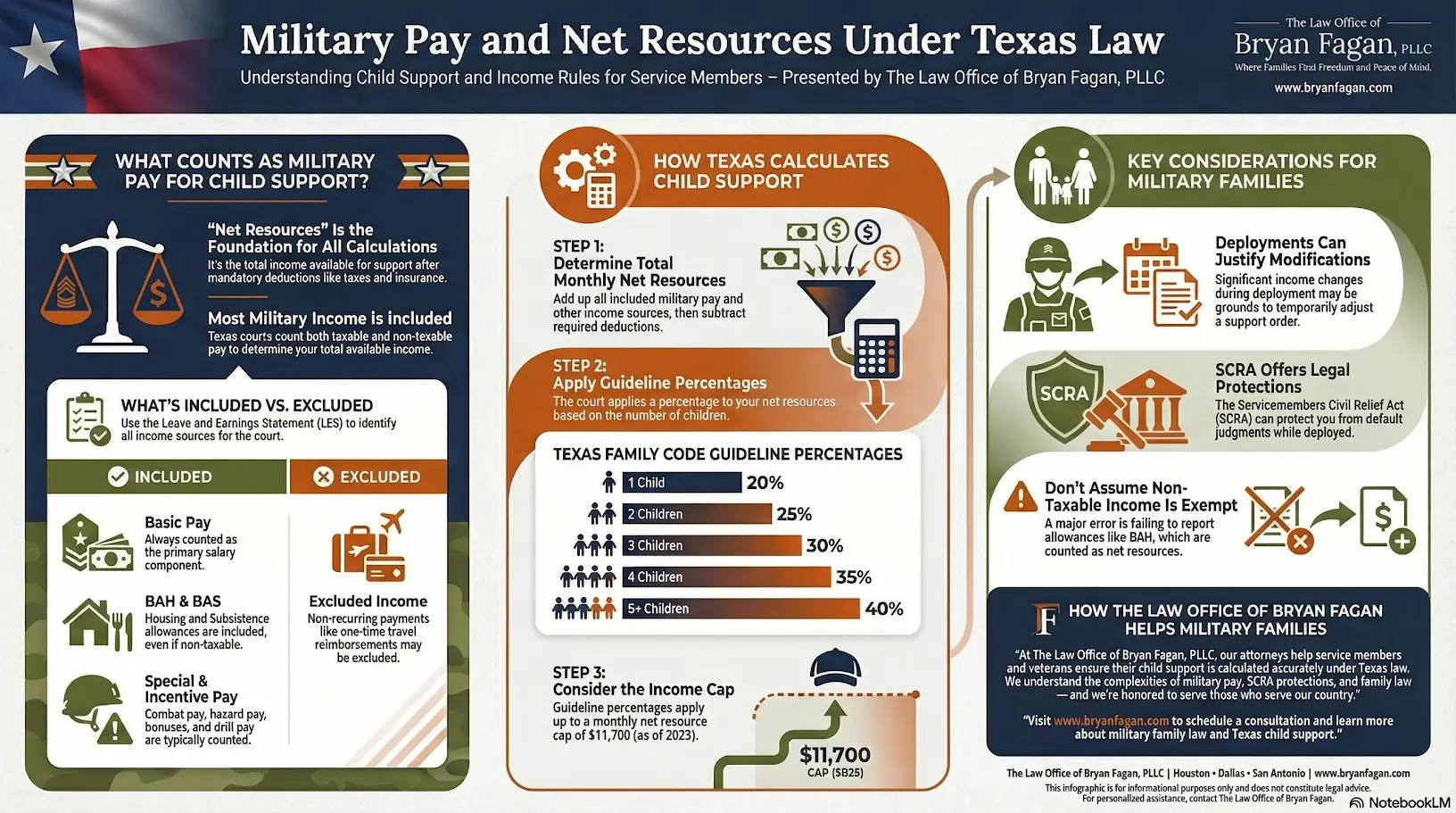
Understanding Military Pay and Net Resources Under Texas Law is essential for service members navigating child support or custody issues. Under Texas Family Code §154.062, “net resources” include all income available for support after required deductions, but military families often face added complexity because their compensation includes both taxable pay and non-taxable allowances. Texas courts typically treat recurring allowances—such as BAH and BAS—as income because they provide genuine financial benefit, not merely reimbursement for duty-related expenses.
The 2025 update to Texas Family Code §154.125(a-1) raised the maximum monthly net resources cap to $11,700 for child support calculations. This update affects many higher-earning service members, especially senior NCOs and officers whose total compensation may exceed that threshold due to housing allowances, special duty pay, or overseas benefits. Even when a service member’s earnings surpass the cap, courts retain the discretion under §154.123 to deviate from guideline amounts if doing so supports a child’s best interest.
Because military income includes unique elements—such as non-taxable allowances, cost-of-living adjustments, and deployment-related special pays—misunderstanding how these components are evaluated can lead to inaccurate support orders. For families juggling deployments and financial responsibilities, clarity matters. If you’re facing changes in duty status or preparing for deployment, the firm’s guide, Can Wives Go On Deployment?, offers additional insight into how military life intersects with family law obligations.
The attorneys at The Law Office of Bryan Fagan work closely with service members to ensure their pay is interpreted correctly and their rights are protected. Whether you need guidance on child support calculations, custody modifications, or understanding how military income fits into Texas law, resources such as the firm’s Texas Child Support Resource Center can help you make informed decisions. With the right support, military parents can navigate legal requirements with confidence and protect what matters most—their families and their future.

Forms of Military Pay That Count as Net Resources
Base pay serves as the foundation of military compensation and is always included in net resources calculations. This taxable income appears on the service member’s Leave and Earnings Statement (LES) and forms the primary component for determining child support obligations. Base pay rates are standardized across all branches of the united states armed forces and increase with rank and years of service.
Basic allowance for housing (BAH) represents one of the most significant components of military compensation for most service members. Despite being non-taxable, Texas courts generally include BAH in net resources calculations because it represents actual financial benefit to the service member. BAH rates vary based on geographic location, rank, and dependency status, with higher rates for service members with dependents.
Basic allowance for subsistence (BAS) provides funds for meals and is typically included in net resources calculations. This allowance is standardized across the military services and is designed to offset the cost of food. Like BAH, BAS is non-taxable but represents a measurable financial benefit to the service member and their family.
Special and incentive pays encompass a wide range of additional compensation for specific duties or circumstances. Hazardous duty pay, proficiency pay, and other special pays are generally included in net resources when they represent regular, ongoing compensation. However, temporary or one-time special pays may be excluded depending on their nature and frequency.
Family separation allowance becomes relevant when service members are separated from their families due to military duty. This allowance is typically included in net resources calculations during periods when it’s being received, though its temporary nature may affect how courts consider it for ongoing support obligations.
Service-connected VA disability compensation presents a unique situation under Texas Family Code §154.062(b)(5). While federal law generally protects disability benefits from collection, Texas law specifically includes service-connected disability pay in net resources for child support calculations, recognizing the ongoing nature of these payments.
Military retirement pay and pension benefits are consistently included in net resources calculations. These payments represent earned income that continues throughout retirement and provide a stable income source for ongoing support obligations. The calculation may involve both the military retirement pay and any civilian income earned post-retirement.
Military Pay Excluded from Net Resources Calculations
Combat-related income presents unique challenges when evaluating Military Pay and Net Resources Under Texas Law, particularly because federal policies treat combat service differently from standard military earnings. Under Texas Family Code §154.062, courts must determine which portions of a service member’s compensation qualify as “net resources” for child support purposes. When a parent serves in a designated combat zone, certain types of pay may be excluded from federal taxation, and Texas courts generally honor these exclusions. This approach reflects both the extraordinary demands placed on deployed service members and the federal policy supporting these tax protections. For additional context on how deployment affects military families, the firm offers a helpful resource: Challenges Facing Military Families During Deployment.
Some forms of military-related income are excluded entirely because they are not considered true financial resources. Non–service-connected VA pension benefits, for example, are typically excluded under §154.062 because they are need-based rather than compensation for active military duty. Texas courts avoid counting these pensions in support calculations because doing so would undermine the intent of these programs, which exist to protect low-income veterans and their families.
Other types of compensation—such as one-time enlistment or re-enlistment bonuses—require a more nuanced approach. While these bonuses may create a temporary spike in income, their non-recurring nature often leads courts to remove them from ongoing support calculations or average them over the length of the enlistment contract. Similarly, Temporary Duty (TDY) per diem, travel reimbursements, and other expense-based payments are excluded because they are designed to offset mission-related costs rather than provide spendable financial benefit. Clothing allowances and other non-recurring payments are treated the same way, as they do not represent income available to support a child.
Certain categories of military benefits are intentionally excluded due to their humanitarian purpose. Death gratuity payments, for example, are provided to surviving family members as immediate financial support following a service member’s passing. Texas courts do not consider these payments as part of net resources because they reflect compensation for profound sacrifice rather than income. Families seeking deeper guidance on military-related benefits and support obligations may also find value in the firm’s educational materials, including the Texas Child Support Resource Center. With knowledgeable legal support, service members and their families can navigate these exclusions with clarity and confidence.

Why Accurate Military Pay Calculation Matters for Service Members
Accurate calculation of military pay and net resources under texas law directly impacts child support obligations and the frequency of modifications under Texas Family Code §156.401. When military income is incorrectly calculated, it can result in support orders that are either too high or too low, creating financial hardship for one party while potentially shortchanging the other parent and the children involved.
The consequences of understating military income can include contempt of court proceedings for underpaying support, while overstating income can result in unreasonable financial burdens that may affect a service member’s ability to maintain security clearances or perform military duties effectively. Both scenarios can trigger costly legal proceedings and ongoing disputes between parents.
Incorrect calculations also affect enforcement and contempt proceedings when actual income differs significantly from court-ordered calculations. Service members may face wage garnishment, asset seizure, or other enforcement actions based on inaccurate income assessments, creating unnecessary legal and financial complications.
Protection of parental rights and children’s best interests requires accurate income calculations that reflect the true financial resources available for support. Children deserve support that matches their parent’s actual ability to pay, while service members deserve calculations that consider the unique nature of military compensation.
Long-term financial planning for military families becomes impossible when support obligations are based on incorrect income calculations. Military careers involve frequent changes in pay due to promotions, deployments, and assignment changes, making accurate baseline calculations essential for predictable support arrangements.
The impact extends beyond immediate support obligations to affect retirement planning, VA disability claims, and post-military career decisions. Service members need accurate legal guidance to understand how different forms of military pay will affect their long-term family law obligations.
How Texas Courts Calculate Net Resources from Military Pay
Leave and Earnings Statements (LES) serve as the primary documentation for determining military pay components in Texas family law proceedings. Courts rely on these official documents from the Defense Finance and Accounting Service (DFAS) to identify all forms of military compensation received during relevant time periods. The LES provides detailed breakdowns of base pay, allowances, special pays, and deductions.
Federal income taxes, Social Security, and Medicare deductions are subtracted from gross military pay to determine net resources, following the same principles applied to civilian income. These mandatory deductions reduce the available income for support calculations and ensure that tax obligations are considered in support determinations.
Allowable deductions include union dues where applicable, health insurance premiums, and other authorized voluntary deductions that reduce available income. Military-specific deductions might include contributions to the Servicemembers Group Life Insurance program or other mandatory military programs.
Pre-tax deductions like Thrift Savings Plan contributions are generally allowed, reducing the net resources available for support calculations. These retirement contributions represent prudent financial planning and are typically encouraged by courts as long as they don’t unreasonably reduce support availability.
Monthly averaging of irregular military payments helps create stable support calculations despite the variable nature of some military compensation. Courts may average bonuses, special pays, or deployment-related income over appropriate time periods to establish consistent support obligations.
The calculation process requires careful attention to timing, as military pay schedules may differ from civilian payroll systems. Service members are typically paid twice monthly, and courts must consider these payment schedules when establishing support due dates and calculation periods.
Impact of Deployment and PCS Moves on Net Resources
Deployment and relocation can dramatically reshape a service member’s financial picture, which is why understanding Military Pay and Net Resources Under Texas Law is essential when child support obligations are involved. Under Texas Family Code §154.062, courts must distinguish between temporary income changes and true modifications to a parent’s earning capacity. During deployment, service members may receive family separation allowance, hazardous duty pay, or other temporary special pays. These additions can elevate income for a limited period, and courts must determine whether they represent a short-term fluctuation or something that should factor into ongoing support. Families navigating these changes may also find it helpful to review the firm’s resource, Child Support, Military Entitlements, and Calculation Challenges, which explores how military compensation interacts with Texas support laws.
Permanent Change of Station (PCS) moves also affect income calculations by altering Basic Allowance for Housing (BAH) rates. Because BAH varies significantly between duty stations, Texas courts—guided by Texas Family Code §154.125(a-1) and its 2025 updated cap on net resources—must determine whether a change in BAH reflects a long-term shift or merely a transitional adjustment. When the fluctuation is temporary, courts generally avoid modifying child support unless the change materially impacts the parent’s ability to meet obligations. This measured approach helps prevent unnecessary legal hardship for families already navigating the stresses of relocation.
Overseas assignments add another layer of complexity. Temporary boosts such as tax exclusions, foreign post allowances, or currency exchange benefits may elevate take-home pay for a limited duration. Likewise, combat zone tax exclusions can reduce taxable income for net-resource purposes, creating situations where a service member’s “calculable income” appears lower even when their gross pay remains unchanged. Under Texas Family Code §154.123, courts are required to consider the child’s best interest and must evaluate whether these temporary changes warrant guideline deviation or should be disregarded as short-term fluctuations.
To help courts make accurate determinations, service members must provide clear documentation—including deployment orders, updated Leave and Earnings Statements (LES), and projected income changes. When deployments or PCS moves are anticipated, timely notice is critical, as courts prefer to modify obligations proactively rather than retroactively. The legal team at The Law Office of Bryan Fagan understands how challenging these transitions can be and works closely with military families to ensure income changes are properly evaluated and reflected in support orders. Additional educational tools, such as the firm’s Texas Child Support Resource Center, offer further guidance for families seeking clarity and confidence during periods of military transition.

Servicemembers Civil Relief Act (SCRA) Protections
The Servicemembers Civil Relief Act provides essential protections for military members in family law proceedings, including the right to request stays of court proceedings during periods when military duty prevents participation in hearings or trials. These protections ensure that service members aren’t disadvantaged by their military obligations when defending their interests in family law cases.
SCRA provisions for staying court proceedings during deployment require service members to demonstrate that their military duties materially affect their ability to participate in legal proceedings. Courts must grant reasonable stays when proper requests are made, though these protections are not unlimited and require good faith participation when military duties permit.
Protection against default judgments for deployed service members prevents courts from entering judgments when service members cannot appear due to military duty. This protection requires proper notice and demonstration that military service prevents participation, but provides crucial safeguards against unfair legal proceedings.
The right to postpone hearings due to military duty requirements extends beyond deployment to include other military obligations that prevent participation in legal proceedings. Service members must provide adequate notice and documentation of military duties that conflict with scheduled proceedings.
SCRA protections apply specifically to child support and family law cases in Texas, though their application requires proper invocation and may not excuse indefinite delays in legal proceedings. Service members must balance their military obligations with their family law responsibilities and seek reasonable accommodations rather than indefinite postponements.
Limitations and exceptions to SCRA protections include situations where military duties don’t materially affect the ability to participate in proceedings or where service members fail to provide proper notice of military obligations. Courts retain discretion to determine whether SCRA protections apply to specific circumstances.
Checklist for Military Parents Before Child Support or Divorce Cases
Gathering the last 12 months of Leave and Earnings Statements (LES) provides courts with comprehensive information about military pay and net resources under texas law. These documents should include all regular pay periods as well as any special pays or bonuses received during the calculation period.
Federal tax returns and W-2 forms for the past two years offer additional verification of military income and help courts understand the broader financial picture. These documents may reveal income sources beyond basic military pay, such as civilian employment or investment income.
Documentation of all military allowances and special pay received includes not only current payments but also projections of future changes based on upcoming deployments, PCS moves, or changes in military status. This information helps courts make informed decisions about ongoing support obligations.
VA disability rating letters and payment records provide essential information about service-connected disability compensation that may be included in net resources calculations. These documents should include current ratings and any pending claims that might affect future income.
Deployment orders and upcoming military duty schedules help courts understand potential changes in military pay and the service member’s ability to participate in proceedings. This information should include both current assignments and any known future deployments or training requirements.
Current custody arrangements and parenting time documentation provides context for support calculations and helps courts understand the practical aspects of military family life, including the impact of military duties on parent-child relationships.
Contacting an experienced military family law attorney for consultation ensures that service members understand their rights and obligations under both state and federal law before proceedings begin. Early legal consultation can prevent costly mistakes and ensure proper protection of service member rights.
Essential Tips for Military Parents in Family Law Cases
Timely communication is essential when navigating Military Pay and Net Resources Under Texas Law, especially when deployment or Permanent Change of Station (PCS) orders arise. Under Texas Family Code §154.062 and the updated guideline cap in §154.125(a-1), courts rely on accurate information to determine appropriate child support obligations. When service members notify the court promptly about upcoming deployments or PCS moves, it allows legal proceedings to be adjusted in a way that honors both the service member’s duties and the child’s best interests. This proactive approach also helps prevent misunderstandings or unnecessary conflict, a topic further explored in the firm’s resource, How Is Texas Divorce Different for Service Members?.
Keeping thorough records of military pay is equally important. Because allowances, special pays, and temporary duty compensation can change frequently, maintaining organized documentation—such as LES statements, tax returns, and DFAS summaries—gives courts a clear picture of a service member’s financial reality. These documents help distinguish between temporary pay fluctuations and long-term income changes, a distinction Texas courts must evaluate carefully under §154.123, which allows deviation from child support guidelines when necessary to serve the child’s best interest.
Understanding the difference between temporary and permanent changes in pay empowers military parents to seek modifications at the right time. Not every shift in military income warrants a modification, but significant or long-term changes—such as a new duty assignment, a recurring special pay, or a change in dependency status—may justify revisiting the support order. Promptly requesting a modification when circumstances change demonstrates good faith compliance with court orders and prevents support obligations from accumulating based on outdated figures. Families looking for additional clarity can also consult the firm’s Texas Child Support Resource Center.
Finally, using official channels to verify income and maintaining open communication with the other party both reduce conflict and promote fairness. DFAS and military personnel offices can provide authoritative verification of pay and benefits, helping courts avoid errors in calculating net resources. Being transparent about upcoming deployments or military duties encourages cooperation and helps ensure that legal proceedings remain respectful of the unique demands placed on military families. As advocates for Texas service members, the attorneys at The Law Office of Bryan Fagan, PLLC remain committed to guiding families through these challenges with clarity, compassion, and an unwavering focus on protecting their future.

Common Mistakes Military Parents Make in Child Support Calculations
Failing to include non-taxable allowances like BAH and BAS in net resources calculations represents one of the most frequent errors in military family law cases. Service members may assume that non-taxable income doesn’t count for support purposes, but Texas law generally includes these allowances in net resources.
Incorrectly excluding service-connected VA disability compensation from net resources calculations can result in artificially low support obligations. Texas Family Code specifically includes this compensation in net resources despite federal protections for other types of disability benefits.
Not updating child support when military pay increases or decreases through promotions, demotions, or changes in assignment can result in support obligations that don’t reflect current income levels. Military careers involve frequent pay changes that may warrant modifications.
Overlooking temporary duty pay and special allowances in income calculations can lead to understated net resources during periods when service members receive additional compensation. These payments may be significant and should be included in support calculations when appropriate.
Misunderstanding combat zone pay exclusions and their effect on net resources can result in incorrect calculations during deployment periods. While federal law provides tax exclusions, the impact on Texas child support calculations requires careful legal analysis.
Not seeking modifications during deployment or PCS moves can result in support obligations that don’t reflect changed circumstances. Service members should proactively address known changes in income or circumstances rather than waiting for enforcement actions.
Attempting to handle complex military pay issues without legal counsel often results in costly errors and unfavorable outcomes. The complexity of military compensation requires specialized knowledge and experience to ensure accurate calculations and fair results.
How the Law Office of Bryan Fagan PLLC Helps Military Families
Military families deserve legal support from advocates who understand both Military Pay and Net Resources Under Texas Law and the realities of life in uniform. At times, that means navigating the unique financial landscape outlined in Texas Family Code §154.062 and the updated resource cap in §154.125(a-1) while balancing federal military regulations. The attorneys at the firm bring deep experience to these cases, offering strategic guidance rooted in real-world military challenges—from complex LES interpretation to understanding how deployments, special pays, and allowances affect long-term family law outcomes. Families exploring how divorce specifically impacts service members may also find the firm’s resource, How Is Texas Divorce Different for Service Members?, helpful.
Accurately evaluating military compensation requires more than simply reviewing a pay stub. Service members often receive base pay, BAH, BAS, special pays, and non-taxable allowances that courts must assess under Texas law. The legal team conducts detailed reviews of Leave and Earnings Statements, DFAS documentation, and relevant case law to ensure calculations reflect current statutory requirements. This careful approach helps prevent incorrect support orders and safeguards both the service member’s rights and the child’s financial stability. For families seeking clarity about support obligations, the firm’s Texas Child Support Resource Center offers additional educational tools.
When deployments or Permanent Change of Station (PCS) orders arise, timely action is critical. The attorneys help service members anticipate income changes and prepare child support modification requests when appropriate, ensuring compliance with Texas Family Code §156.401 regarding material and substantial change. They also assist with invoking protections under the Servicemembers Civil Relief Act (SCRA), allowing military parents to fulfill their duties without facing unfair legal disadvantages. Beyond support issues, the firm provides guidance on custody and visitation arrangements tailored to the realities of military life, such as virtual visitation schedules, long-distance parenting plans, and deployment-ready conservatorship provisions.
Above all, the Legal Team at The Law Office of Bryan Fagan, PLLC understands the sacrifices military families make every day. Their commitment to compassion, education, and legal precision ensures service members receive the knowledgeable representation necessary to protect their families and their future. Whether you are navigating child support, a modification, custody planning, or any issue involving Military Pay and Net Resources Under Texas Law, the firm stands ready to help you move forward with confidence.
Conclusion
When military life and Texas family law collide, it can feel like you’re trying to read a map with half the landmarks missing. But now that you understand how military pay fits into Texas net resources rules—and how those numbers shape the financial stability of your family—you’re already in a stronger position than most. Clarity brings confidence, and confidence is exactly what families need when navigating moments that feel unpredictable.
Whether you’re dealing with deployments, shifting income, or the emotional weight of a family transition, you don’t have to handle it alone. Working with an experienced Texas family law attorney—especially one who understands the realities of military service—can help you protect your rights while also protecting what matters most at home. That’s what our team at The Law Office of Bryan Fagan, PLLC is here for: to offer guidance that’s not only legally sound, but human, compassionate, and centered on your family’s future.
If you ever find yourself staring at an LES or a stack of legal paperwork and thinking, “There has to be an easier way to understand this,” that’s your sign to reach out. We’re always ready to help you make sense of the details, steady the path ahead, and move forward with peace of mind.
Whenever you feel ready, we’re here to talk, answer questions, and help you take the next step—one that leads toward clarity, stability, and a future you feel confident about.
Frequently Asked Questions
The “military clause” typically refers to Texas Property Code §92.017. It allows certain servicemembers to end a residential lease early if they enter active duty or receive PCS or deployment orders. To qualify, the service member must give written notice and provide a copy of their orders. This protection prevents military families from being financially trapped in housing they can no longer use due to military obligations.
USERRA—the Uniformed Services Employment and Reemployment Rights Act—is a federal law that applies in all states, including Texas. It protects servicemembers from job discrimination based on their military service and ensures the right to return to their civilian job with the same status, seniority, and benefits. Texas also provides additional protections for state military forces, but the core rights come directly from USERRA.
Texas uses the same child support guidelines for military and civilian parents. Military child support is based on “net resources” under Texas Family Code §154.062, which typically includes base pay, BAH, BAS, and most recurring allowances. Guideline support is usually 20% of net resources for one child, 25% for two, and increases with additional children, up to the statutory cap. Judges may adjust the amount if special military circumstances justify a deviation.
Texas offers a wide range of benefits for veterans, including the Hazlewood Act (up to 150 credit hours of free tuition at public colleges), property tax exemptions for disabled veterans, employment and job-training programs, certain fee waivers, and access to state-sponsored services and resources. Eligibility varies by residency, disability rating, service history, and discharge status.
Texas Property Code §92.016 allows tenants who are victims of family violence to terminate their lease early without future rent liability. They must provide proper written notice and documentation, such as a protective order or law enforcement report. This statute helps survivors leave unsafe environments without facing financial penalties.
Different legislative sessions have introduced different bills labeled SB 1596, so the answer depends on the specific year and subject matter. For example, in the 88th Legislature (2023), SB 1596 related to recycling did not pass. A separate SB 1596 in a later session addressing short-barrel firearms did pass. Always verify the session and topic to know whether a particular SB 1596 became law.
The “7-minute rule” refers to federal time-rounding guidelines under the Fair Labor Standards Act, which also apply in Texas. Employers may round employee time entries to the nearest 15 minutes as long as the rounding is neutral over time—not consistently resulting in underpayment. Typically, 1–7 minutes may round down and 8–14 minutes round up, but practices must be fair and consistent.
Texas Labor Code §207.044 deals with unemployment eligibility when a person is fired for misconduct. Individuals discharged for misconduct connected with their job are generally disqualified from receiving unemployment benefits until they meet specific requalification requirements. This law is focused on unemployment compensation, not family law or military issues.
A USERRA violation occurs when an employer denies a servicemember the rights guaranteed under the law. Examples include refusing to rehire a returning service member, reducing their seniority or benefits, firing or disciplining someone because of military duties, denying promotions due to service obligations, or retaliating against someone for asserting USERRA rights. Essentially, any action that penalizes service because of military membership or duties may violate USERRA.