
Gestational Agreements Attorneys in Humble, Texas: Do You Qualify for a Valid Agreement?

One afternoon, a couple walked into our Humble-area office carrying a folder filled with fertility clinic paperwork, agency documents, and handwritten notes from months of planning. They were excited, hopeful, and finally beginning to see their dream of becoming parents come within reach. Yet one question kept resurfacing during our conversation: had they done everything necessary to legally protect their future family? That uncertainty is exactly why Gestational Agreements Attorneys in Humble Texas play such an important role in helping intended parents navigate the surrogacy process with confidence and peace of mind.
What many families discover is that building a family through a gestational carrier involves more than medical planning. Texas has specific legal requirements that must be satisfied before a pregnancy is established, and overlooking even one step can create unnecessary complications regarding parentage, birth certificates, and legal rights after a child is born. A properly structured and court-validated agreement helps create certainty at a time when families need it most.
At the Law Office of Bryan Fagan, PLLC, we believe every family deserves clear answers and compassionate guidance during life’s most significant transitions. Founded by Bryan Joseph Fagan, a South Texas College of Law graduate and recognized authority on Texas family law, our firm is committed to empowering people through education, practical legal solutions, and experienced representation. We understand that intended parents are not simply navigating a legal process—they are preparing to welcome a child into their lives.
In this article, you’ll learn how gestational agreements work under Texas law, who qualifies for a valid agreement, what happens during the court validation process, how intended parents’ rights are protected, and the common mistakes that can place a family’s future at risk. Most importantly, you’ll gain a clearer understanding of how thoughtful legal planning can help create the stability, security, and peace of mind that every growing family deserves.
Let’s start by examining what a gestational agreement is under Texas law and why the validation process is one of the most important steps in the journey to parenthood.
In Texas, a gestational agreement is valid only when a court validates it before embryo transfer. Under Texas Family Code §160.754 (2025), the intended parents must show medical need, the carrier should have had at least one prior birth, and all parties must enter voluntarily. Sign first, transfer second, validate never — and your parentage is not protected.
Key Takeaways
- Court validation is the trigger, not the signature. A signed gestational agreement carries no automatic parentage effect in Texas until a court validates it under Texas Family Code §160.756 (2025).
- Marriage is effectively required for the cleanest path. Texas Family Code §160.754 (2025) is written around married intended parents; unmarried intended parents face a harder, less predictable validation road.
- Validation must come before embryo transfer. Validate after transfer and the court can refuse to enforce the agreement, leaving parentage to be litigated.
- The carrier’s medical history matters to the court. Texas asks that the gestational carrier have had at least one previous pregnancy and delivery — a real eligibility checkpoint, not a formality.
- Residency and venue are gating items. A party must have resided in Texas for the required period, and Harris County filing rules differ from Montgomery and Liberty counties next door.
- Agency paperwork is not a court order. The document an agency provides is a starting draft; only a Texas court’s validation order protects you.
- Compensation terms can sink an agreement. Poorly drafted payment language invites challenge — structure it correctly the first time.

Your Family’s Future Starts Here
Don’t navigate your legal journey alone. Schedule a consultation now and get the clarity and support you deserve.
Our Humble Texas family lawyers and attorneys for wills advise our clients of the immediate aftermath as well as the long-term effects of divorce-related issues, such as the following:
Trust us to help you with your Family Law Attorneys in Humble, Texas. Call 281-817-1827 or contact us online today to schedule a free consultation with your Family Law Attorney in Humble, Texas.
What a Gestational Agreement Is Under Texas Law
For families pursuing surrogacy, understanding the legal process is just as important as understanding the medical process. Gestational Agreements Attorneys in Humble Texas help intended parents protect their rights by ensuring their agreement complies with Texas law before a pregnancy begins.
Under Texas Family Code Chapter 160, Subchapter I, a gestational agreement is a written contract between intended parents and a gestational carrier. Once validated by a court under §§160.754–160.756, the intended parents become the child’s legal parents. Unlike traditional surrogacy, the gestational carrier is not genetically related to the child, allowing the arrangement to qualify for statutory protections under surrogacy law Texas.
One of the most important requirements is timing. Texas law requires gestational agreement validation before embryo transfer. Many families mistakenly believe agency or clinic paperwork is enough. In reality, the court’s validation order is what protects intended parent rights Texas and helps establish a future parentage order Texas.
In straightforward gestational agreement cases, the validation process is often smooth. In more complex parentage situations involving donor embryos, donor sperm, donor eggs, LGBTQ+ family-building arrangements, or international intended parents, additional legal planning may be necessary. A properly structured gestational carrier agreement Texas helps prevent future disputes and provides clarity regarding parentage, birth certificates, and parental responsibilities.
For families in Humble and throughout the Houston area, understanding these requirements early can make the surrogacy journey more predictable and secure. Because building a family often involves long-term legal and financial planning, many intended parents also benefit from reviewing resources related to retirement planning in Humble, Texas as they prepare for their family’s future.
The bottom line is simple: a gestational agreement is more than a contract. It is the legal foundation that protects your parental rights, secures your child’s legal status, and provides peace of mind before your child is born.
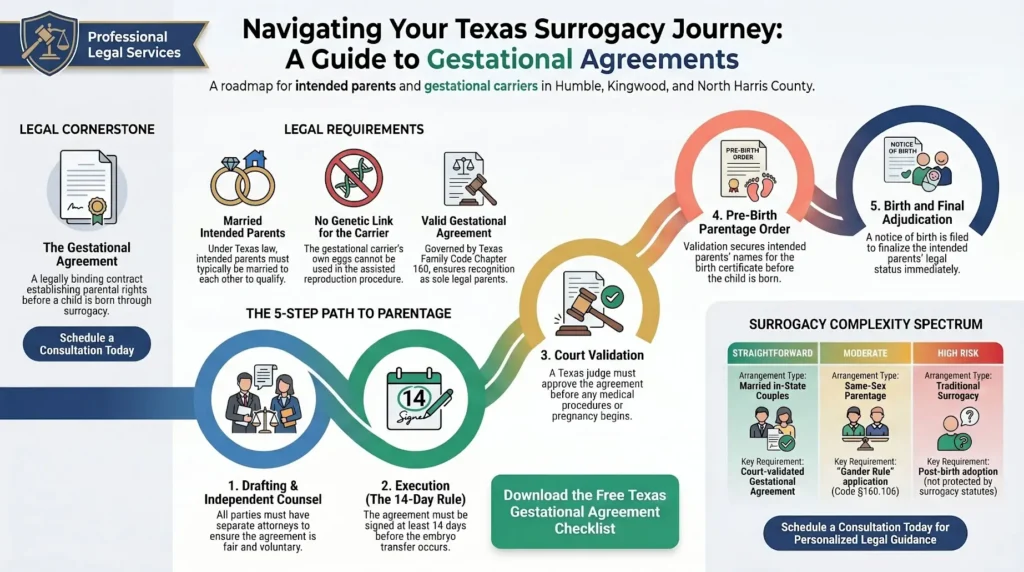
Strategy insight: The single most valuable thing you can do is reverse the order most people assume. The court order comes before the medical procedure, not after the baby arrives. I have clients calendar the validation hearing before the clinic schedules transfer — that one sequencing decision prevents the most expensive problems I see.
Who Qualifies to Enter a Valid Gestational Agreement
To enter a valid gestational agreement in Texas, the intended parents must generally be married to each other, the gestational carrier should have already given birth to at least one child, and there must be a medical reason the intended mother cannot carry a pregnancy or cannot do so without unreasonable risk. These are the core eligibility pathways under Texas Family Code §160.754 (2025).
Most gestational agreement cases in Harris County depend on three checkpoints. First, the relationship status of the intended parents: the statute is built around married couples, and while unmarried intended parents are not categorically barred, the validation path is materially harder and judges scrutinize it more closely. Second, the carrier’s pregnancy history: Texas expects her to have carried and delivered before, which is both a health safeguard and an eligibility requirement the court examines. Third, medical necessity: there must be a documented reason the intended mother cannot safely carry.
Residency is the quiet fourth checkpoint. A party to the agreement needs to have resided in Texas for at least the statutory period before filing, and the case is filed in the county of residence. For Humble residents that means Harris County, which carries its own procedural rhythm covered below.
Helpful to know: If you are married, working with a carrier who has delivered before, and you have a documented medical need, you are squarely inside the statute. That is the cleanest validation profile Texas offers, and those cases move predictably when the paperwork is built right from day one.
Signing the agreement feels like the milestone. It isn’t. The validation order is the milestone — everything before it is just preparation.
How Court Validation Works in Harris County
For many intended parents, court validation is the step that transforms a signed agreement into a legally enforceable foundation for their family’s future. Gestational Agreements Attorneys in Humble Texas frequently help families navigate this process because Texas law requires more than simply signing paperwork. Under Texas Family Code §160.756, a Harris County judge must review and approve the gestational agreement before embryo transfer occurs.
The validation process begins with filing a petition in the appropriate Harris County district court. During the proceeding, the court examines whether the requirements outlined in Texas Family Code §§160.754 and 160.755 have been satisfied. This includes reviewing residency requirements, confirming that all parties voluntarily entered into the agreement, and ensuring that the intended parents and gestational carrier meet the statutory qualifications. The judge’s role is to verify that the arrangement complies with surrogacy law Texas and that the legal rights of everyone involved are properly protected.
In straightforward gestational agreement cases, the validation hearing may be relatively routine. In more complex parentage situations—such as those involving donor embryos, donor sperm, donor eggs, LGBTQ+ family-building arrangements, international intended parents, or questions regarding eligibility—additional documentation and legal analysis may be required. Where questions about legal parentage arise, obtaining court approval before pregnancy is established can help avoid disputes that may become far more complicated after a child is born.
Once approved, the court issues an order that serves as the legal basis for recognizing the intended parents as the child’s parents. This validated order helps protect intended parent rights Texas, supports future birth certificate procedures, and lays the groundwork for a legally recognized parentage order Texas. Without proper gestational agreement validation, intended parents may face unnecessary uncertainty regarding parentage and parental responsibilities.
Timing is one of the most important factors in the entire process. Many families make the mistake of scheduling embryo transfer based on medical timelines alone. In reality, the legal timeline must be considered as well. Harris County courts handle a significant volume of family law matters, and delays can occur. Whether you are working through an agency-assisted match or an independent arrangement, planning ahead can help prevent scheduling conflicts that jeopardize compliance with Texas law.
Families exploring assisted reproduction often find that surrogacy planning intersects with broader financial and family planning goals. For those evaluating long-term asset protection and future family security, resources related to high-net-worth divorce representation in Humble may also provide valuable insight into protecting what matters most. The key takeaway is simple: court validation is not merely a procedural requirement. It is the legal safeguard that protects your parental rights, confirms compliance with Texas law, and helps create certainty before your child is born.
| Eligibility Status | What Texas Law Says | What It Means for You |
|---|---|---|
| Married intended parents | §160.754 (2025) frames the agreement around marriage | Cleanest validation path; most predictable outcome |
| Carrier has prior birth | Carrier expected to have delivered before | Health and eligibility checkpoint the judge reviews |
| Documented medical need | Intended mother unable to carry safely | Supporting medical records strengthen validation |
| Validated before transfer | §160.756 (2025) requires pre-pregnancy order | Protects parentage at birth; reverse this and you litigate |
Listen to Our Texas Family Law Podcast
Prefer listening? In this episode, we discuss gestational agreements in Humble, Texas, including how these agreements work, the legal protections they provide, and how they can help protect your family’s future.
Do You Qualify for a Valid Texas Gestational Agreement?
1. Are the intended parents married to each other?
2. Is there a documented medical reason the intended mother cannot safely carry a pregnancy?
5. Will the agreement be reviewed and validated by a court BEFORE embryo transfer?
6. Have all parties (including the carrier’s spouse, if any) entered the agreement voluntarily?
You fit the cleanest validation profile Texas offers
Married intended parents, documented medical need, an experienced carrier, Texas residency, voluntary consent, and validation before transfer — that is exactly what Harris County courts look for under §160.754 and §160.756. The work now is building the petition correctly and locking the hearing before your clinic’s transfer window.
Most clients hear back within 5 minutes during business hours (8 AM–10 PM CT, 7 days a week).
You likely qualify — but one condition needs to be cleared first
Unmarried intended parents and uncertain validation timing are the two conditions that most often complicate an otherwise-eligible case. Texas does not categorically bar you, but the path is more demanding and the order has to be structured carefully. This is exactly the situation worth a focused conversation before you commit to a transfer date.
Most clients hear back within 5 minutes during business hours (8 AM–10 PM CT, 7 days a week).
Your parentage may not be protected yet — act before it gets harder
If the agreement was never validated, or transfer already happened without a court order, Texas may not enforce the agreement and parentage can become a contested matter. This is the situation I most want to catch early. There are corrective steps, but they are time-sensitive and depend on exactly where you are in the process.
Most clients hear back within 5 minutes during business hours (8 AM–10 PM CT, 7 days a week).
Run the qualifier and want a real answer for your situation?
The tool tells you where you likely land. A Legal Strategy Session tells you exactly what to file, when, and in which court.
Schedule a Strategy SessionMistakes That Invalidate Gestational Agreements
The most common mistake that invalidates a Texas gestational agreement is establishing the pregnancy before the court validates the agreement. Once transfer happens without an order, the protective framework of Texas Family Code §160.756 (2025) may no longer apply, and parentage can be litigated rather than recognized automatically.
The second mistake is treating agency or clinic paperwork as legally sufficient. Those documents are drafting starting points, not court orders. The third is compensation language that a court views as improper, which can taint the agreement. The fourth is overlooking the carrier’s spouse, whose consent is part of a valid agreement when the carrier is married.
Costly mistake to avoid: Do not let a clinic schedule embryo transfer until the validation order is in hand. I have seen well-meaning intended parents lose months and thousands of dollars unwinding a transfer that happened before the court ever reviewed their agreement. The sequence is the whole game.
How Procedure Differs in Nearby Counties
Although Texas gestational agreement laws are consistent statewide, the court procedures used to obtain approval can vary by county. Families working with Gestational Agreements Attorneys in Humble Texas should understand that while the legal requirements remain the same, filing timelines, scheduling practices, and local court procedures may differ.
For intended parents in Humble, Kingwood, and Atascocita, gestational agreement cases are typically filed in Harris County district courts. Families in nearby communities such as New Caney, Porter, and Conroe may fall under Montgomery County jurisdiction, while Liberty, Fort Bend, Brazoria, and Galveston counties have their own court systems and procedures.
In straightforward gestational agreement cases, determining the correct venue is often simple. In more complex parentage situations involving donor embryos, international intended parents, or multiple residences, additional planning may be necessary. Because gestational agreement validation must occur before embryo transfer under surrogacy law Texas, filing in the wrong county can create delays that affect important medical timelines.
Understanding venue requirements early helps protect intended parent rights Texas, supports a future parentage order Texas, and keeps the surrogacy process moving forward smoothly. Families interested in related parental rights issues can also learn more about CPS defense in Humble, Texas.
Checklist: What to Do If You’re Dealing With a Gestational Agreement
Confirm marital status and its effect. Identify whether you file as married intended parents or need the more demanding unmarried path before drafting anything.
Gather the medical-need documentation. Collect records establishing why the intended mother cannot safely carry — this supports validation.
Verify the carrier’s birth history. Confirm she has delivered at least one child before; this is an eligibility checkpoint, not a formality.
Establish Texas residency and venue. Confirm the residency period is met and pin down the correct county — Harris for Humble, Montgomery for New Caney or Conroe.
Do not let the clinic schedule transfer yet. The validation order comes first. Hold the medical timeline until the court reviews the agreement.
Include the carrier’s spouse. If the carrier is married, the spouse must be a consenting party to the agreement.
Treat agency paperwork as a draft. Have the agreement built or reviewed for Texas validation requirements, not just signed as handed to you.
File the petition to validate and calendar the hearing. Build the timeline backward from the hearing to your clinic’s transfer window.
Secure the validation order before transfer. Only the signed order protects parentage at birth — confirm it is in hand first.
Ready to build your agreement the right way?
Start the validation sequence before the clinic does. A Legal Strategy Session gets you the filing plan and timeline today.
Schedule a Strategy SessionWhat I Tell Every Client Who Calls About Gestational Agreements
One pattern stands out after helping families navigate surrogacy arrangements throughout the Greater Houston area: the smoothest journeys usually begin long before a fertility clinic schedules an embryo transfer. Families who work with Gestational Agreements Attorneys in Humble Texas early in the process often view court approval as the first major milestone—not the final paperwork step. That mindset helps prevent many of the legal complications that can arise later.
Under Texas Family Code Chapter 160, a signed agreement alone does not establish parentage. The protection comes from successful gestational agreement validation under §§160.754–160.756 before a pregnancy is established. In straightforward gestational agreement cases, this process may be relatively predictable. In more complex parentage situations involving donor embryos, donor gametes, LGBTQ+ family-building arrangements, international intended parents, or independent carrier matches, additional legal planning may be necessary. Where questions about legal parentage arise, early preparation can help avoid disputes that become significantly more difficult to resolve after birth.
One of the most common mistakes intended parents make is waiting until a transfer date is approaching before addressing the legal requirements. By that point, scheduling pressures can create unnecessary stress and increase the risk of delays. A properly structured gestational carrier agreement Texas helps protect intended parent rights Texas, supports future birth certificate procedures, and lays the foundation for a legally recognized parentage order Texas.
For families in Humble, Kingwood, Atascocita, and throughout Harris County, understanding the legal timeline before medical treatment begins can provide greater clarity and peace of mind. Those interested in learning more about how Texas courts enforce legal obligations and court orders may also find value in our guide to enforcing a delinquent Texas child support order. The key takeaway is simple: the earlier you understand your rights and responsibilities under surrogacy law Texas, the more options you have to protect your family’s future. Thoughtful planning today can help create certainty, stability, and confidence throughout the surrogacy journey.
Get the validation sequence right from day one.
Don’t sign what an agency hands you and hope. Map your path to court-validated parentage in a Legal Strategy Session.
Schedule a Strategy SessionConclusion:
Building a family through a gestational carrier is one of life’s most meaningful journeys, but it is also one that benefits from thoughtful legal planning. The protections provided by Texas Family Code Chapter 160 are designed to create certainty for intended parents, gestational carriers, and, most importantly, the child. Working with Gestational Agreements Attorneys in Humble Texas can help families understand the requirements for gestational agreement validation, protect intended parent rights Texas, and establish a clear legal foundation before embryo transfer occurs. When the process is handled correctly from the beginning, families can focus less on legal uncertainty and more on preparing to welcome a child into their lives.
In straightforward gestational agreement cases, such as those involving a qualified gestational carrier, clear eligibility, and a predictable timeline, the path to court approval may be relatively smooth. In more complex parentage situations involving donor embryos, donor gametes, LGBTQ+ family-building arrangements, international intended parents, or questions regarding residency and parentage, additional legal strategy may be necessary. Where questions about legal parentage arise, proactive planning often helps prevent disputes that can become significantly more difficult after a child is born. Families seeking to better understand Texas family law issues can also explore resources such as our guide on navigating the legal landscape of divorce in Texas.
The key takeaway is simple: timing matters, preparation matters, and understanding your rights matters. Whether you are just beginning to explore surrogacy or preparing for an upcoming embryo transfer, taking the time to understand Texas gestational agreement requirements today can help create the clarity, stability, and peace of mind your growing family deserves tomorrow.
Questions My Clients Ask About Gestational Agreements in Humble
It is a written contract among intended parents and a gestational carrier that, once validated by a Texas court before embryo transfer, makes the intended parents the legal parents at birth. Texas Family Code Chapter 160 governs it. The carrier in a gestational agreement is not the genetic mother.
Yes — gestational surrogacy agreements are legal and enforceable in Texas when validated by a court under Chapter 160. Traditional surrogacy, where the carrier is also the egg donor, does not receive the same statutory protection, which is why nearly all Texas arrangements are structured as gestational agreements.
The statute is written around married intended parents, and marriage gives you the cleanest validation path. Unmarried intended parents are not categorically barred, but the path is harder and judges examine it more closely. If you are unmarried, plan for a more careful, well-documented filing.
Before embryo transfer — before any pregnancy is established. Validating after transfer risks the court declining to enforce the agreement, which converts a settled matter into a contested one. Build your timeline backward from the validation hearing.
Legal costs for drafting and validating the agreement are only one slice; carrier compensation, agency fees, and medical costs are separate and larger. Because cost varies with how your arrangement is structured, the honest answer comes from reviewing your specific situation in a Legal Strategy Session.
Under a properly validated agreement, no — the carrier relinquishes parental rights and the intended parents assume them by court order. That protection exists only because of the validation order, which is why skipping validation reopens exactly this question.
Her spouse is a party whose consent is part of a valid agreement. Leaving the spouse out is a common drafting gap that can undermine validation, so the spouse is included and consents from the start.
Treat it as a starting draft, not a finished legal instrument. Agency paperwork is not a court order and is not tailored to Texas validation requirements or to your county’s procedure. The document that protects you is the validation order a Texas court signs.
Harris County district court, because Humble is in Harris County. If you live near New Caney, Porter, or Conroe you may be in Montgomery County instead, and the venue determines the procedure you follow.
Your parentage may not be automatically protected, and the matter can become contested. There are corrective steps, but they are time-sensitive — the sooner we review where you are, the more options remain open.
Have a question the qualifier didn’t answer?
Bring it to a Legal Strategy Session. You’ll leave knowing your filing path, your venue, and your timeline.
Schedule a Strategy Session