
Annulment Divorce Attorneys in Humble, Texas: How to Know If You Qualify (and What to Do If You Don’t)

A woman sat quietly in our office one afternoon twisting her wedding ring back and forth while trying to explain what had happened. Just six months earlier, she believed she had married someone who shared her goals, values, and plans for the future. Then she discovered her spouse had hidden a prior marriage that was never legally dissolved. Suddenly, the questions came fast: Was the marriage even valid? Could it be annulled? What would happen to the property they bought together? And most importantly, how could she protect her child from the chaos unfolding at home? Families searching for Annulment Divorce Attorneys in Humble Texas are often facing moments exactly like this — painful discoveries, overwhelming uncertainty, and urgent questions about what happens next.
At The Law Office of Bryan Fagan, PLLC, we understand that family law problems rarely arrive neatly packaged. They show up during sleepless nights, uncomfortable conversations, and difficult moments when parents are trying to hold their lives together while protecting the people they love most. Whether someone is considering annulment, divorce, or a custody action in Harris County, the legal process can feel intimidating without clear guidance and compassionate support.
Texas law draws important distinctions between divorce, annulment, void marriages, and voidable marriages. Under Texas Family Code Chapter 6, annulments are only available under specific legal grounds, including fraud, duress, force, intoxication, mental incapacity, concealed divorce, and underage marriage. Courts do not grant annulments simply because a relationship ended quickly or painfully. Understanding those distinctions early can save families months of stress, unnecessary litigation, and financial strain.
Bryan Joseph Fagan, founder of The Law Office of Bryan Fagan, PLLC and a graduate of South Texas College of Law, has spent years helping Texas families navigate emotionally charged legal transitions with clarity, strategy, and empathy. Our mission is rooted in empowering people to reclaim peace of mind during some of the hardest moments of their lives. That means educating clients, simplifying legal complexity, and helping families make informed decisions that protect their future.
In this article, you will learn how Texas annulment laws work, the difference between void and voidable marriages, how custody and child support issues are handled in annulment cases, and how divorce-related conflict can affect children emotionally and academically. Most importantly, you will gain practical guidance for protecting your family, preserving stability, and moving forward with confidence during a difficult transition.
Texas annulment is only available in eight specific situations defined by the Texas Family Code: underage marriage, marriage under intoxication, impotency, fraud or duress, mental incapacity, concealed divorce, marriages performed within 72 hours of license issuance, and certain stepfamily relationships. Each ground has its own deadline and proof standard. Outside these grounds, divorce is the legal remedy — and for most Humble-area clients I see, it’s the faster and cleaner path.
Key Takeaways
- Annulment is grounds-based, divorce is no-fault. Texas requires you to prove one of eight specific statutory grounds for annulment. Divorce requires no proof of fault if you don’t want to allege it.
- Time limits are short and unforgiving. Most Texas annulment grounds carry deadlines measured in days from the wedding or from discovering the issue — not years. Miss the window and the ground is gone.
- “Annulment” in church is not annulment in court. A religious annulment has no legal effect on your marital status. You still need either a civil annulment or a divorce.
- Community property analysis still happens. Even when a court grants an annulment, the court still divides property accumulated during the marriage. Annulment does not erase property rights.
- Fraud is the most contested ground. Fraud annulments require proving the other spouse misrepresented something material that goes to the essence of the marriage — and the case law is narrower than most clients expect.
- Filing in Harris County has its own procedural quirks. Humble residents file at the Harris County Civil Courthouse, and judges in family courts here apply Texas Family Code §6.102–6.111 strictly. New Caney and Porter clients file in Montgomery County, which moves on a different docket.
- The wrong filing costs you months. Annulment petitions filed without one of the eight grounds get dismissed, and you start the divorce process from scratch.

Your Family’s Future Starts Here
Don’t navigate your legal journey alone. Schedule a consultation now and get the clarity and support you deserve.
Our Humble Texas family lawyers and attorneys for wills advise our clients of the immediate aftermath as well as the long-term effects of divorce-related issues, such as the following:
Trust us to help you with your Family Law Attorneys in Humble, Texas. Call 281-817-1827 or contact us online today to schedule a free consultation with your Family Law Attorney in Humble, Texas.
What an Annulment Actually Is in Texas

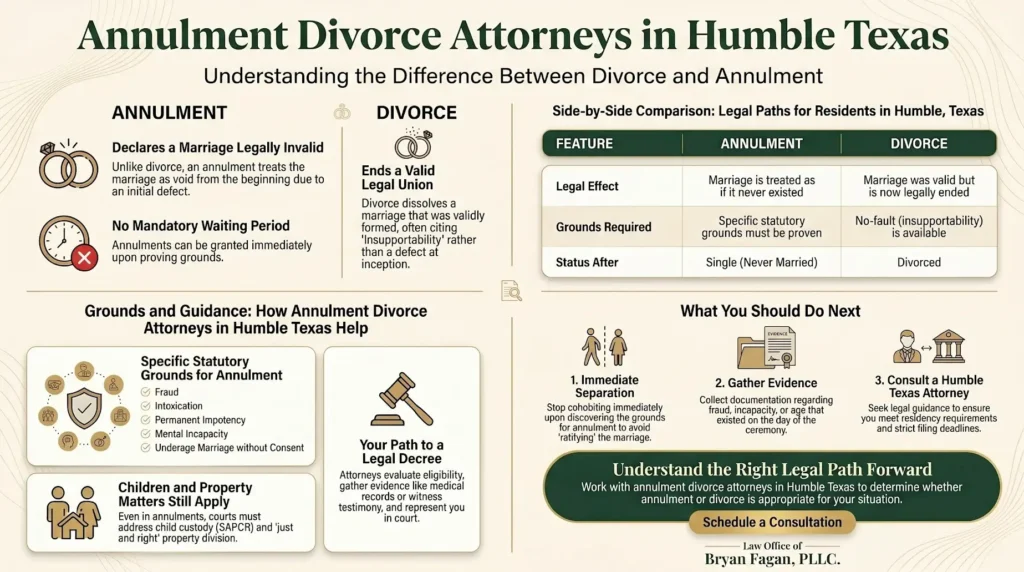
A Texas annulment is very different from a traditional divorce, and understanding that distinction early can prevent costly legal mistakes later. While a divorce legally ends a valid marriage, an annulment is a court order declaring the marriage was either void from the beginning or legally voidable under specific circumstances recognized by Texas law. Families searching for Annulment Divorce Attorneys in Humble Texas are often surprised to learn that Texas courts do not grant annulments simply because a marriage was short, emotionally difficult, or regretted afterward. Under Texas Family Code §§6.102 through 6.111, annulments are limited to specific statutory grounds such as fraud, duress, force, intoxication, concealed divorce, mental incapacity, underage marriage, and impotency.
The distinction matters because the legal strategy, burden of proof, and courtroom expectations are entirely different from a no-fault divorce proceeding. In a Texas annulment case, the spouse requesting the annulment must file a petition in the appropriate district court, identify a valid statutory ground, and present evidence proving why the marriage should legally be treated as invalid. Judges often evaluate credibility, diligence, and the timeline of events very closely in these cases, particularly when allegations involve fraud or disputed facts. In straightforward situations, an annulment may involve relatively limited factual disputes and move efficiently through the court system. In more complex cases — especially where custody disputes, CPS concerns under Texas Family Code Chapter 262, hidden financial issues, immigration-related allegations, or contested testimony are involved — courts may require a far more structured litigation strategy and substantial evidence before granting relief.
Texas courts also distinguish between void and voidable marriages, which can significantly affect how a case proceeds. A void marriage may involve circumstances such as bigamy or prohibited familial relationships and may require a suit to declare the marriage void rather than a traditional annulment action. A voidable marriage, on the other hand, remains legally valid unless and until the court grants an annulment. This distinction becomes especially important when property division, child custody, support obligations, or parental rights are involved. Courts applying the “best interest of the child” standard under Texas Family Code §153.002 may still need to address conservatorship, possession schedules, and long-term stability for children even when the marriage itself is later declared invalid.
Compared to some other states, Texas applies annulment law more narrowly and more strictly. California courts, for example, often interpret fraud-based annulment claims more broadly, while Texas courts typically require evidence that the alleged misrepresentation went directly to the essence of the marital relationship itself. That means issues involving legal identity, concealed prior marriages, immigration fraud, hidden criminal conduct, or intentional deception about children or fertility may receive greater scrutiny than ordinary marital disagreements. Where disputes are contested, delays, inconsistent testimony, continued cohabitation after discovering the issue, or weak documentation can significantly weaken an annulment claim.
For many families, the challenge is not simply understanding the law — it is understanding which legal path actually fits their circumstances. Some situations may only require basic legal guidance and procedural clarity. Others involve substantial emotional conflict, high-stakes litigation, child custody disputes, or concerns about long-term financial consequences that benefit from experienced legal representation and strategic planning. Families dealing with related issues involving family law mediation attorneys in Humble Texas may also need to evaluate whether mediation, negotiation, or litigation is the most effective route forward depending on the complexity of the dispute.
At The Law Office of Bryan Fagan, PLLC, we believe informed families make stronger legal decisions. Whether someone is exploring annulment, evaluating dismissal risks, navigating custody concerns, or trying to understand how Texas courts approach family law disputes, clear guidance can help reduce uncertainty and protect long-term stability. Additional information about protecting parental rights and navigating child custody in Texas can help families better understand how these legal issues may affect their future.
Strategic Insight
When someone calls my office asking about annulment, the first question I ask isn’t whether they want one — it’s whether they qualify for one. If the facts don’t fit one of the eight statutory grounds, talking about annulment any longer wastes time. We move directly to the divorce strategy. This is the single biggest difference between a productive intake call and an unproductive one.
The Eight Grounds for Annulment Under Texas Family Code §6.102–6.111
Texas law recognizes exactly eight grounds for annulment, and every petition must rest on at least one. Each ground has its own elements, its own proof standard, and its own time limit. Most Humble-area annulment cases in Harris County depend on whether the filer can match their facts to one of these statutory pathways — and most cases I review involve fraud, intoxication, or the 72-hour rule.
| Ground | Texas Family Code § | Core Element |
|---|---|---|
| Underage marriage (under 18 without court order) | §6.102 | One spouse was 16 or 17 without proper court order, or under 16 |
| Marriage under influence of alcohol or narcotics | §6.105 | Petitioner was intoxicated at the ceremony and didn’t voluntarily live with spouse since |
| Impotency | §6.106 | Permanent inability to consummate, unknown to petitioner at marriage |
| Fraud, duress, or force | §6.107 | Material misrepresentation or coercion that induced the marriage, no voluntary cohabitation after discovery |
| Mental incapacity | §6.108 | Petitioner lacked capacity to consent or appreciate the marriage |
| Concealed divorce | §6.109 | Other spouse had been divorced within 30 days of the marriage and concealed it |
| Marriage within 72 hours of license | §6.110 | Ceremony performed in violation of the 72-hour waiting period and petition filed within 30 days |
| Death of spouse before annulment | §6.111 | Limited circumstances where the marriage is void by relationship |
The grounds I see most often in Humble intake calls
Fraud (§6.107) is the most common reason people call about annulment. The fraud has to be material — meaning it goes to the essence of the marriage relationship. Misrepresentation about citizenship, hidden criminal history, concealed inability or refusal to have children, or fraud about identity itself can qualify. Misrepresentation about wealth, personality, or general suitability typically does not. The petitioner must also stop living with the spouse as a married couple immediately upon discovering the fraud, or the ground is lost.
Marriage under influence (§6.105) applies to clients who got married in Las Vegas, on a cruise, or after a Houston-area bar night and want out. Texas courts will annul on this ground if the petitioner was genuinely intoxicated at the ceremony to the point of being unable to consent — and if the petitioner has not voluntarily lived with the spouse since sobering up. The voluntary cohabitation rule kills more of these cases than anything else.
The 72-hour rule (§6.110) is narrow but absolute. Texas law requires couples to wait 72 hours after issuance of a marriage license before getting married, with limited exceptions for active military and pre-marital counseling waivers. If the ceremony happened too soon and the petition is filed within 30 days, annulment is available almost as a matter of right.
Warning: The Voluntary Cohabitation Trap
Six of the eight Texas annulment grounds become unavailable the moment the petitioner voluntarily lives with the spouse after learning the truth or becoming able to consent. If you discovered the fraud on Monday and stayed in the marital home through Friday “to figure things out,” the State of Texas may consider you to have ratified the marriage. This is the single most common reason I have to tell a client they no longer have an annulment case — and it’s almost always avoidable with quick legal counsel.
Listen to Our Texas Family Law Podcast
Prefer listening? In this episode, we discuss annulment in Humble, Texas, including when a marriage may be legally voided, the legal grounds required, and what you need to know before pursuing this option.
Time Limits and Why They’re Shorter Than You Think

One of the biggest mistakes people make in Texas annulment cases is assuming they have more time than they actually do. Most annulment grounds under Texas Family Code §§6.102–6.111 operate on extremely short deadlines, and once that deadline expires, the right to pursue annulment may disappear completely. Families searching for Annulment Divorce Attorneys in Humble Texas are often already dealing with emotional stress, confusion, and rapidly changing circumstances when they first discover that annulment may apply to their situation. Unfortunately, Texas law does not pause those deadlines simply because someone is uncertain about what to do next.
The pattern throughout Texas annulment law is intentional. Courts expect annulment petitions to be filed close in time to the marriage itself or shortly after the discovery of the alleged issue, whether that issue involves fraud, concealed divorce, intoxication, force, duress, or lack of legal capacity. From a courtroom perspective, judges often view delays as important evidence. Memories fade, documents disappear, witnesses become harder to locate, and continued cohabitation after discovering the issue can significantly weaken an annulment claim. In straightforward situations, quickly gathering documents and filing the appropriate pleadings may be enough to preserve the case. In more complex cases — especially where disputes are contested, financial issues exist, children are involved, or credibility becomes central to the case — delay can create substantial procedural and strategic problems.
Texas courts also evaluate whether the parties acted diligently once they became aware of the issue supporting annulment. That diligence can directly affect credibility, case progression, and ultimately whether the court believes the request is legitimate. Where disputes involve child custody concerns under Texas Family Code §§153.002 and 153.134, judges may additionally evaluate whether delaying the case impacts the child’s emotional stability, living arrangements, schooling, or long-term best interests. In higher-conflict matters involving contested allegations, CPS concerns under Chapters 262 or 263, or substantial financial disputes, procedural timing becomes even more important because dismissal risks and litigation costs can increase quickly if the case stalls.
For many Humble-area families, the practical reality is simple: the window between “I think I may qualify for an annulment” and “I can still legally pursue one” is often measured in weeks or months — not years. Some situations may only require basic legal clarification and prompt filing guidance. Others may require a far more strategic approach involving litigation preparation, evidence preservation, temporary orders, or negotiation. Families dealing with high-conflict divorce or contested litigation issues may also benefit from understanding how contested divorce lawyers in Humble Texas approach disputes where procedural timing and courtroom strategy significantly affect the outcome.
At The Law Office of Bryan Fagan, PLLC, we believe informed decisions create stronger futures. Whether someone is trying to determine if annulment still remains available, facing dismissal risks tied to procedural deadlines, or navigating related concerns involving child custody in Texas, early legal guidance can help families protect their options, reduce uncertainty, and move forward with greater confidence and clarity.
Annulment vs. Divorce: When Each One Wins
For most clients calling my office in Humble, divorce is the faster and cleaner option even when annulment is technically available. Annulment offers symbolic and occasionally practical advantages — the marriage is legally treated as void rather than dissolved, which matters for some immigration cases, some religious considerations, and some inheritance scenarios. Divorce avoids the proof requirement and the deadlines.
| Factor | Annulment | Divorce |
|---|---|---|
| Proof required | One of eight statutory grounds | None (insupportability is no-fault) |
| Time pressure | Statutory deadlines, often 30 days to 1 year | None — file when ready |
| Property division | Yes — court divides community estate | Yes — court divides community estate |
| Spousal maintenance | Limited availability | Available under §8.051 standards |
| Name change | Available in decree | Available in decree |
| Effect on marital status | Marriage legally voided | Marriage legally dissolved |
| Average timeline (uncontested, Harris County) | 2–4 months | ~60-day minimum waiting period, then 1–3 months |
| Typical attorney fee range | $3,500–$8,500 contested | $3,500–$15,000 contested |
Most Humble-area clients who think they want an annulment actually want a divorce — they just want the marriage to feel like it never happened. I can’t give you that emotionally. What I can give you is the fastest legal path to the outcome you actually need.— Bryan Fagan, J.D.
The Humble and Harris County Filing Process
Families searching for Annulment Divorce Attorneys in Humble Texas are often surprised to learn that annulment cases move very differently than standard no-fault divorces. Unlike divorce, annulments require the petitioner to plead and prove a specific statutory ground under Texas Family Code §§6.102–6.111. That means Texas courts closely evaluate credibility, diligence, evidence, and overall case progression from the beginning of the case.
Where Annulment Cases Are Filed
Most Humble-area annulment cases are filed in the Harris County family courts in downtown Houston. Families in New Caney, Porter, or parts of Kingwood may file in Montgomery County, while some eastern portions of the area may file in Liberty County. Although the law itself remains consistent statewide, local court procedures, scheduling timelines, and docket congestion can vary significantly between counties.
How the Process Usually Works
In straightforward situations, the process may involve confirming the applicable annulment ground, filing the Original Petition for Annulment, serving the opposing party, and presenting evidence at a hearing. In more complex cases — especially where disputes are contested, children are involved, or fraud allegations exist — courts often expect a far more strategic and litigation-focused approach.
Most cases move through several stages, including legal assessment, filing, service, discovery, evidence preparation, and ultimately a hearing or trial. Because annulments require proof, witness preparation and documentation are often far more important than in an uncontested divorce proceeding.
When Legal Strategy Matters Most
Some annulment cases can be resolved with relatively straightforward legal guidance. Others involve child custody disputes, financial complications, CPS concerns under Texas Family Code Chapters 262 or 263, or highly contested allegations that significantly raise the stakes. Where disputes become more adversarial, delays and procedural mistakes can quickly create dismissal risks or unnecessary litigation costs.
Families exploring alternatives when annulment may no longer be available can also benefit from understanding the cheapest way to get a divorce in Texas. Additional guidance about protecting parental rights and maintaining stability during litigation can also be found through resources on child custody in Texas.
Practical Note for Humble Clients
If you live in Humble, Kingwood, or Atascocita, your case is assigned to one of the Harris County Family District Courts. Filing fees run roughly $350 plus service costs. Most uncontested annulments in Harris County resolve within 90 to 120 days from filing. Contested fraud annulments can extend to six months or longer if the other spouse fights the case.
Fraud Annulments: The Most Contested Ground
Fraud-based annulments under Texas Family Code §6.107 are some of the most legally complex and heavily contested family law cases filed in Texas courts. Families searching for Annulment Divorce Attorneys in Humble Texas are often dealing with emotionally charged situations involving hidden information, broken trust, and uncertainty about whether the marriage was legally valid in the first place. Unlike a standard no-fault divorce, fraud annulments require the petitioner to prove specific legal elements before the court will grant relief.
To succeed, the petitioner generally must establish three things: that the other spouse made a material misrepresentation, that the petitioner relied on that misrepresentation when agreeing to the marriage, and that the petitioner did not voluntarily continue living with the other spouse after discovering the truth. Texas judges often evaluate credibility, timing, evidence preservation, and the overall progression of the case very carefully because fraud allegations are frequently disputed.
What Texas Courts Consider “Material” Fraud
One of the biggest misunderstandings in these cases is what Texas law actually considers “material” fraud. In straightforward situations, people often assume dishonesty about finances, employment, personality traits, or past relationships automatically qualifies for annulment. In reality, Texas courts apply a much narrower standard.
Fraud claims become stronger when the alleged deception goes directly to the core structure of the marriage itself. Courts have historically given greater weight to issues involving concealed prior marriages, immigration-related fraud, hidden criminal convictions, undisclosed children, incurable diseases known at the time of marriage, or intentional deception about legal identity or the ability to have children. The closer the misrepresentation is to the foundation of the marital relationship, the more seriously courts tend to evaluate the claim.
Why Timing and Conduct Matter
In many fraud annulment cases, the defense focuses less on whether a misrepresentation occurred and more on what happened after the truth was discovered. Texas courts often examine whether the petitioner voluntarily continued cohabiting with the other spouse after learning of the alleged fraud. Even relatively short periods of continued marital conduct can weaken the argument that the marriage should be annulled.
Where disputes are contested, judges may closely evaluate text messages, financial records, witness testimony, living arrangements, and the timeline of events to determine whether the petitioner acted diligently after discovering the issue. Delays, inconsistent testimony, or continued marital behavior can create significant credibility concerns and may increase dismissal risks or litigation complications later in the case.
When Strategic Legal Guidance Becomes Important
Some fraud annulment cases involve relatively limited factual disputes and can be resolved with focused procedural guidance and evidence preparation. In more complex cases — especially where custody disputes, CPS concerns under Texas Family Code Chapters 262 or 263, financial complications, or highly contested testimony exist — the legal strategy often becomes significantly more important.
Texas courts applying the “best interest of the child” standard under Texas Family Code §§153.002 and 153.134 may also need to evaluate how instability, ongoing conflict, or litigation delays affect children involved in the case. Families facing overlapping issues involving financial support may also benefit from understanding how spousal maintenance in Texas can affect long-term planning during contested proceedings.
At The Law Office of Bryan Fagan, PLLC, we believe families deserve clear answers and informed guidance when navigating difficult legal situations. Whether someone is trying to determine if fraud-based annulment is legally available or facing broader concerns involving child custody in Texas, understanding the legal standards early can help families protect their rights, reduce uncertainty, and move forward with greater confidence.
Think You Have a Fraud Annulment Case?
Fraud annulments require fast action, careful witness preparation, and a clean factual record. I conduct a candid evaluation in your Legal Strategy Session and tell you whether the case is winnable or whether divorce is the better play.
Schedule a Legal Strategy SessionEligibility Qualifier: Do You Qualify for Annulment in Texas?
Answer six questions and I’ll show you which of the four possible outcomes applies to your situation. This is not legal advice — it’s the same triage I run on every annulment intake call, structured so you can see the framework before you call.
The 6-Question Qualifier
Used in every annulment intake call at our firm — built around Texas Family Code §6.102–6.111.
Did the marriage take place within the last 30 days of getting your Texas marriage license, with no military or counseling waiver?
Texas requires a 72-hour waiting period between license and ceremony. The 30-day annulment window after this kind of violation is the cleanest ground available.
Were you under 18 at the time of the marriage, without a proper court order authorizing it?
Texas Family Code §6.102 allows annulment for underage marriage, with deadlines tied to reaching age 18.
← BackWere you intoxicated at the ceremony to the point of being unable to give legal consent — and you have NOT voluntarily lived with your spouse since sobering up?
Texas Family Code §6.105 covers marriage under influence. Voluntary cohabitation after sobering kills this ground.
← BackDid your spouse fraudulently misrepresent something material about themselves to induce you into the marriage — citizenship, hidden criminal history, concealed inability or refusal to have children, identity, or similar?
Fraud must be material under Texas Family Code §6.107. Misrepresentation about wealth, personality, or general suitability typically does not qualify.
← BackIf your answer to Q4 was Yes — did you stop living with your spouse as a married couple as soon as you discovered the misrepresentation?
Voluntary cohabitation after discovery defeats the fraud ground. This is the most common reason fraud annulments fail in Texas.
← BackDid your spouse have a prior divorce finalized within 30 days of marrying you, AND conceal it from you?
Texas Family Code §6.109 allows annulment when a spouse concealed a recent divorce. The petition must generally be filed within one year of the marriage.
← BackYour facts likely fit a clean statutory ground.
Based on your answers, your case appears to qualify under either the 72-hour rule (§6.110) or the underage marriage statute (§6.102) — two of the most straightforward annulment grounds in Texas. These are time-sensitive. The 30-day filing window on the 72-hour violation runs from the ceremony date and does not extend. Call my office today so we can verify the timeline and file before the window closes.
Most clients hear back within 5 minutes during business hours (8 AM–10 PM CT, 7 days a week).
Restart the qualifierYou may have grounds, but the case will require evidence.
Your answers suggest a viable annulment under fraud (§6.107), marriage under influence (§6.105), or concealed divorce (§6.109). These grounds require proof — meaning witnesses, documents, and a contested hearing. The case is winnable, but it is not automatic, and the wrong move on cohabitation timing can defeat it. I review the facts in a Legal Strategy Session and tell you candidly whether annulment or divorce is the stronger play for your situation.
Most clients hear back within 5 minutes during business hours (8 AM–10 PM CT, 7 days a week).
Restart the qualifierThe ground existed — but cohabitation may have ratified the marriage.
Texas law treats voluntary cohabitation after discovery (in the fraud context) or after sobering up (in the intoxication context) as ratification of the marriage. The annulment ground likely existed at one point in your case, but living together as a married couple after the triggering event significantly weakens it. There may still be argument room depending on the length and nature of the cohabitation — and divorce is always available as an alternative. Call so we can analyze whether any path to annulment remains.
Most clients hear back within 5 minutes during business hours (8 AM–10 PM CT, 7 days a week).
Restart the qualifierYour facts do not appear to match a Texas annulment ground.
Your answers don’t fit one of the eight statutory grounds under Texas Family Code §6.102–6.111. That doesn’t mean you’re stuck in the marriage — it means divorce is the legal remedy for ending it. Divorce in Texas is no-fault and faster than most contested annulments. I handle uncontested and contested divorces across Harris and Montgomery counties, and I can outline the timeline and cost in a strategy session.
Most clients hear back within 5 minutes during business hours (8 AM–10 PM CT, 7 days a week).
Restart the qualifierGet a Legal Read on Your Specific Facts
The qualifier gives you the framework. A Legal Strategy Session gives you the answer. I review the facts, identify the strongest filing path, and tell you exactly what to expect in Harris or Montgomery County.
Schedule a Legal Strategy SessionWhat Annulment Costs in the Humble Area
Annulment in Harris and Montgomery County typically costs less than a contested divorce but more than an uncontested no-fault divorce. The cost drivers are filing fees, service of process, attorney time on evidence preparation, and whether the other spouse contests the case. Most Humble-area annulment cases in our practice fall between $3,500 and $8,500 in total attorney fees, with court costs adding $350 to $500 on top.
| Cost Component | Typical Range (Harris/Montgomery County) | What Affects It |
|---|---|---|
| Court filing fee | $300–$400 | County of filing; Harris is on the higher end |
| Service of process | $75–$200 | Whether spouse waives service or must be served |
| Attorney fees — uncontested | $2,500–$5,000 | Complexity of property division, presence of children |
| Attorney fees — contested fraud annulment | $6,500–$15,000 | Depositions, witness preparation, hearing time |
| Discovery costs | $500–$2,500 | Volume of documents and depositions needed |
| Total typical range | $3,500–$18,000 | Contested vs. uncontested is the biggest driver |
Mistakes That Kill Annulment Petitions
Most failed annulment cases in Texas die from the same handful of preventable mistakes. After handling annulment cases across Harris, Montgomery, and Fort Bend counties, these are the patterns I see repeatedly — and the ones I screen for in every intake call.
Mistake #1: Voluntary Cohabitation After Discovery
Six of the eight grounds are defeated by voluntary cohabitation after the triggering event. Discover the fraud, stop living together. Sober up after the intoxicated marriage, do not move back in. There is no negotiation window with the statute.
Mistake #2: Filing Past the Deadline
The 72-hour rule annulment has a 30-day window. The concealed divorce ground has a one-year window. The underage statute runs against age. Missing the deadline doesn’t just weaken the case — it eliminates the ground entirely.
Mistake #3: Pleading the Wrong Ground
Petitions that plead “fraud” without specifying the misrepresentation, or plead “duress” when the facts actually support intoxication, get dismissed or have to be amended. Pleading the right ground from the start saves months.
Mistake #4: Confusing Religious Annulment with Civil Annulment
A church annulment has no legal effect in Texas. You need a civil decree from a Texas district court or a civil divorce. The religious tribunal cannot end the marriage in the eyes of the state.
Checklist: What to Do If You’re Dealing With an Annulment Question in Humble, Texas
Stop voluntary cohabitation if a triggering event has occurred
If you’ve discovered fraud or you sobered up after an intoxicated marriage, the legal clock is running. Voluntary cohabitation after the triggering event ratifies the marriage and kills most annulment grounds.
Write down the timeline of events
Date of marriage, date of license, date you discovered the issue, date you separated. Annulment cases are timeline-driven and your memory will fade. Get it on paper this week.
Gather documents proving the ground
Marriage license, any communications showing the misrepresentation, photos or witnesses establishing intoxication, prior divorce decree of the other spouse if relevant. Evidence wins annulment cases.
Identify witnesses while their memory is fresh
Annulment hearings often turn on what someone else saw or was told. Family members, ceremony attendees, and people who knew about the concealed fact need to be identified now, not later.
Check the statutory deadline for your specific ground
The 30-day window on the 72-hour rule. The one-year window on concealed divorce. The age-based window on underage marriage. Know which deadline applies before you do anything else.
Inventory marital property and debt
Annulment courts still divide property and debt accumulated during the marriage. List bank accounts, vehicles, retirement accounts, and any debt incurred since the wedding date.
Do not file pro se unless you’ve consulted with an attorney first
A pleading that fails to plead the correct ground correctly can be dismissed, eating your filing fee and your deadline. The cost of one strategy session is far less than the cost of a refile.
Decide whether annulment or divorce is the better path
This is the question I run with every client. Annulment carries symbolic and occasional practical advantages. Divorce is faster and requires no proof. The right answer depends on your facts and your goals.
Schedule a Legal Strategy Session before the deadline runs
The single highest-value action in any annulment-curious situation is a candid 30-minute conversation with an attorney who handles these cases in Harris and Montgomery counties. Same-week availability is standard at our office.
Do not discuss the case with your spouse beyond logistics
Anything you say to the other spouse about the situation can become evidence in a contested annulment hearing. Keep communication civil but minimal until you have legal counsel.
Ready to Find Out Where You Actually Stand?
A Legal Strategy Session is the fastest path from confusion to clarity. I’ll review your timeline, identify the statutory ground (or confirm there isn’t one), and lay out the filing strategy in plain language.
Schedule a Legal Strategy SessionWhat I Tell Every Client Who Calls About Annulment in Humble, Texas
The first thing I explain to families searching for Annulment Divorce Attorneys in Humble Texas is that annulment is a very limited legal remedy under Texas law. Texas Family Code §§6.102–6.111 recognizes only specific statutory grounds for annulment, and courts cannot simply grant one because the marriage was short, emotionally painful, or regretted afterward. That clarity is important because it allows families to quickly determine whether annulment is actually available or whether another legal path makes more sense. In straightforward situations, a focused legal review may identify the correct procedural direction relatively quickly. In more complex cases involving contested facts, fraud allegations, child custody disputes, or financial complications, the legal strategy often requires much deeper analysis and evidence preparation.
The second thing I tell clients is that timing often affects outcomes just as much as the underlying facts themselves. Texas courts closely evaluate diligence, credibility, and how quickly a party acted after discovering the issue supporting annulment. A strong fraud-based annulment claim brought shortly after discovery may be viewed very differently than the same facts presented months later after continued cohabitation or delay. Where disputes are contested, procedural timing can also affect dismissal risks, evidence preservation, and overall case progression. If children are involved, courts applying the “best interest of the child” standard under Texas Family Code §§153.002 and 153.134 may additionally examine how instability, conflict, or delayed litigation affects the child’s long-term well-being and stability.
The third thing I tell clients is that divorce is not a failure if annulment ultimately does not apply. In many situations, divorce is simply the more practical and legally appropriate remedy. Some cases can be resolved through relatively straightforward filings and negotiation. Others involve high-conflict litigation, CPS concerns under Chapters 262 or 263, substantial financial disputes, or contested testimony that requires a far more strategic approach. Families trying to better understand procedural risks and common filing mistakes may also benefit from reviewing guidance on how to get a divorce in Texas without a lawyer and avoid common mistakes.
At The Law Office of Bryan Fagan, PLLC, we believe informed decisions create stronger futures. Whether someone is evaluating annulment, facing dismissal concerns tied to a Texas Motion to Retain, or navigating related issues involving child custody in Texas, understanding the legal landscape early can help families protect their options, reduce uncertainty, and move forward with greater clarity and confidence.
Schedule Your Legal Strategy Session Today
Same-week availability for Humble, Kingwood, Atascocita, Spring, and surrounding Harris and Montgomery County residents. Most clients leave the session knowing exactly what to do next.
Schedule a Legal Strategy SessionConclusion:
Family law cases rarely fit into neat categories, especially when annulment, custody concerns, property division, or questions about the validity of a marriage all intersect at the same time. Whether you are researching your legal options after discovering fraud, trying to protect stability for your children, or simply looking for clarity about what Texas law actually allows, understanding the difference between annulment and divorce can help you make stronger decisions for your future. Families searching for Annulment Divorce Attorneys in Humble Texas are often not just looking for legal answers — they are looking for a path forward that feels manageable, informed, and grounded in real guidance.
In straightforward situations, a focused legal strategy may help families resolve matters efficiently and move forward with less conflict and uncertainty. In more complex cases, especially those involving children, contested fraud claims, common law marriage disputes, immigration-related issues, high-conflict custody concerns, or significant property questions, having the right level of legal experience becomes even more important. If your case involves emotional strain, complicated family dynamics, or questions about how Texas courts may evaluate your circumstances, working with attorneys who understand both the legal and human side of family law can make a meaningful difference.
At The Law Office of Bryan Fagan, PLLC, our goal is not simply to process cases. We believe in educating families, simplifying complex legal issues, and helping people regain peace of mind during difficult transitions. Through compassionate guidance, strategic planning, and decades of Texas family law experience, our team works to protect what matters most while helping clients move forward with greater confidence, clarity, and stability.
Questions My Clients Ask About Annulment in Humble, Texas
It depends on the ground. The 72-hour rule annulment requires filing within 30 days of the ceremony. The underage marriage annulment must generally be filed within 90 days after the petitioner turns 18 or, in some cases, by the spouse’s parent before the underage spouse turns 18. The concealed divorce annulment under §6.109 must be filed within one year of the marriage. Fraud and intoxication grounds don’t have hard time limits in the statute, but cohabitation after discovery effectively creates one.
Uncontested annulments in Harris County typically run $3,500 to $5,000 in attorney fees plus $350 to $500 in court costs. Contested fraud annulments range from $6,500 to $15,000 depending on the complexity of the evidence and the number of depositions needed. Compared to a fully contested divorce, annulment can be cheaper when the facts are clean and the other spouse doesn’t contest — and more expensive when fraud has to be proved at a hearing.
Yes, but only if your facts fit one of the eight statutory grounds in Texas Family Code §6.102 through §6.111. The court will not annul a marriage simply because the parties want it annulled. If the facts don’t fit a ground, divorce is the only legal path to end the marriage.
An annulment is a court order declaring a marriage void or voidable under one of the statutory grounds in the Texas Family Code. Unlike divorce, which ends a valid marriage, an annulment treats the marriage as legally never having had full effect. Property division and other family law issues still get resolved within the annulment proceeding.
You file an Original Petition for Annulment in the district court of the county where either spouse resides. The petition must plead a specific statutory ground from §6.102–6.111. The other spouse is served, evidence is gathered, and the court hears the case. If the petitioner proves the ground, the court enters a decree of annulment. For Humble residents, the filing happens in Harris County Family District Court.
Annulment doesn’t require the other spouse’s agreement. You file the petition, plead a statutory ground, and prove it at a hearing. The spouse may contest the case — and in fraud annulments, they often do — but the court decides based on the evidence, not on consent. Your spouse cannot block the annulment by refusing to cooperate.
The eight grounds are underage marriage (§6.102), marriage under influence of alcohol or narcotics (§6.105), impotency (§6.106), fraud, duress, or force (§6.107), mental incapacity (§6.108), concealed divorce (§6.109), marriage within 72 hours of license issuance (§6.110), and certain death-before-annulment scenarios (§6.111). Each ground has its own elements and deadlines.
There is no single “annulment period” in Texas — the deadlines vary by ground. The 72-hour rule has a 30-day window. The underage marriage statute runs by age. The concealed divorce ground has a one-year window. Fraud and intoxication grounds don’t have explicit time bars but are gated by cohabitation rules. The right answer for your case depends on which ground applies.
No. Annulment requires a petition filed in a Texas district court, service on the other spouse, and a hearing before a judge. Online services may help with document preparation, but the case itself moves through the court system the same way any contested family law matter does.
Texas annulment law is codified in Texas Family Code Chapter 6, Subchapter B, sections 6.102 through 6.111 (Tex. Fam. Code 2025). The chapter defines the eight grounds, the elements required to prove each, and the limits on who may file and when. Case law from Texas appellate courts has interpreted the materiality requirement in fraud annulments and the cohabitation defense in some detail.
Got a Question That Wasn’t Answered Here?
Annulment cases turn on facts. A 30-minute Legal Strategy Session gives me enough information to tell you whether you qualify, what filing will involve, and whether divorce is the better path.
Schedule a Legal Strategy Session