
Child Support Attorneys in Humble, Texas: What You Need to Know Before You File, Modify, or Defend a Case

One Friday evening, a father in Humble stood in the grocery store staring at his phone after receiving a text from his spouse that simply said, “We need to talk about the kids and the house.” By Sunday, he was sleeping in the guest room, trying to explain to his children why everyone suddenly felt tense, and wondering how child support, custody, and finances were about to change his family’s future. Moments like these are why families often begin searching for Child Support Attorneys in Humble Texas — not because they expected life to unravel so quickly, but because they need answers, stability, and a plan they can trust.
At The Law Office of Bryan Fagan, PLLC, we know divorce rarely begins with a courtroom. It begins around kitchen tables, during uncomfortable conversations, and in quiet moments when parents realize the future they imagined is changing. The legal process can feel overwhelming, especially when questions about custody, financial support, medical expenses, and parenting schedules all collide at once. Texas courts are required under Texas Family Code §153.002 to make decisions based on the best interest of the child, which means judges closely examine stability, parental involvement, consistency, and the overall well-being of the family before entering custody and support orders.
Bryan Joseph Fagan, founder of the firm and graduate of South Texas College of Law, built The Law Office of Bryan Fagan, PLLC around a simple but important mission: helping families reclaim peace of mind during life’s hardest transitions. Families throughout Humble, Kingwood, Atascocita, and the greater Houston area turn to the firm for guidance because they want more than technical legal advice. They want compassionate counsel, practical solutions, and a legal strategy designed to protect what matters most.
In this article, you will learn how Texas child support laws work, how custody arrangements can affect children emotionally and financially, what judges look for in Harris County family courts, and how thoughtful legal planning can help parents create stability during uncertain times. Most importantly, you will see how the right legal guidance can help your family move forward with greater clarity, confidence, and security.
Child support attorneys in Humble, Texas handle four case types governed by the Texas Family Code: establishment under §154.001, modification under §156.401, enforcement under §157.001, and defense against OAG actions. Humble-area cases file in Harris County district courts (247th, 308th, 309th, 310th, 311th). Most contested matters resolve in 4–9 months. The presumptive support amount comes from the guideline percentages in §154.125, but exceptions, deviations, and offsets are where a competent attorney earns the fee.
Key Takeaways
- Texas Family Code §154.125 sets the guideline support percentage — 20% of net monthly resources for one child, scaling up to 40% for five or more. Above $9,200/month net resources, the cap applies unless the court finds the child has proven needs above guideline.
- Modification requires a material and substantial change OR a 20% / $100 deviation from the guideline. Without one of those triggers under §156.401, the court has no jurisdiction to change the order.
- Enforcement runs faster than parents expect. Under §157.001, motions for contempt can be set in 30–45 days in Harris County. Wage withholding orders are administrative and can issue without a hearing.
- The OAG represents the State, not you. If the Office of the Attorney General opened your case, your interests and the OAG’s interests are not the same. You need your own attorney.
- Humble cases file in Harris County, not Montgomery — even though the city sits at the county line. Confirm the residence address determines venue before you file in the wrong court (it costs months).
- Net resources is not gross income. Federal income tax, social security, Medicare, state income tax (n/a in Texas), and union dues come out before the guideline percentage applies. Misunderstanding this number is the most common pro se mistake.
- The 18th birthday is not the end. Support continues until the child graduates high school. For a child with a disability, support can extend indefinitely under §154.302.

Your Family’s Future Starts Here
Don’t navigate your legal journey alone. Schedule a consultation now and get the clarity and support you deserve.
Our Humble Texas family lawyers and attorneys for wills advise our clients of the immediate aftermath as well as the long-term effects of divorce-related issues, such as the following:
Trust us to help you with your Family Law Attorneys in Humble, Texas. Call 281-817-1827 or contact us online today to schedule a free consultation with your Family Law Attorney in Humble, Texas.
How Child Support Gets Established in Harris County

For many families, the process of establishing child support begins long before anyone walks into a courtroom. It often starts with a separation, a disagreement about parenting time, a sudden financial change, or uncertainty about how a child’s expenses will be handled moving forward. That is why families searching for Child Support Attorneys in Humble Texas are usually looking for more than legal paperwork — they are looking for stability, clarity, and a practical plan that protects their children while reducing future conflict.
Under Texas law, child support is typically established through one of three legal paths: a divorce proceeding, a Suit Affecting the Parent-Child Relationship (SAPCR), or an Office of the Attorney General Title IV-D case. Which process applies can significantly affect the timeline, courtroom procedures, negotiation leverage, and long-term strategy involved in the case. In Harris County family courts, procedural details matter. Missing documentation, filing in the wrong court, or waiting too long to respond can create avoidable delays that affect both financial outcomes and custody-related issues.
When parents are married, child support is generally addressed within the divorce itself alongside conservatorship, possession schedules, and property division. Texas courts evaluate these issues under the “best interest of the child” standard found in Texas Family Code §153.002. Judges are not simply reviewing financial numbers. They are also evaluating parental consistency, stability for the child, communication between parents, and each parent’s ability to comply with court orders moving forward. In more complex situations — especially those involving contested custody, business ownership, hidden income, or significant assets — support calculations may intersect with issues commonly seen in high net worth divorce cases in Humble.
For unmarried parents, child support is often established through a SAPCR, sometimes combined with a paternity action if parentage has not yet been legally established. These cases are heard in the same Harris County family district courts that handle divorce and custody matters. In straightforward situations, parents may simply need help formalizing support, conservatorship, and possession terms into a legally enforceable order. Where disputes become contested, however, issues involving paternity testing, parental rights, visitation schedules, relocation concerns, or disagreements over financial disclosures can quickly require a more structured legal strategy.
Many Humble-area families also encounter the Office of the Attorney General child support system. Title IV-D cases often begin when a parent requests state assistance or applies for certain public benefits. These matters move through dedicated Title IV-D courts inside the Harris County Family Law Center. One of the most important things parents should understand is that the OAG attorney represents the State of Texas — not either parent individually. This misunderstanding creates problems in many enforcement and modification cases, especially when one parent assumes the State is protecting their personal interests. Parents dealing with enforcement issues, arrears, or contested support disputes often benefit from understanding how modifying child support orders may affect both current obligations and long-term financial stability.
Texas Family Code §154.125 establishes guideline child support percentages, while §156.401 governs modifications and §157.001 addresses enforcement actions. In practice, Harris County judges expect parents to arrive prepared with credible financial records, tax returns, pay stubs, health insurance information, childcare costs, and documentation supporting their position. If your case involves self-employment income, fluctuating commissions, cash businesses, interstate jurisdiction, CPS concerns, or contested custody issues under Texas Family Code §153.134, the level of preparation becomes even more important.
In straightforward child support matters, parents may be able to resolve issues efficiently through negotiated agreements and focused legal guidance. In more complex cases — particularly where litigation, enforcement exposure, hidden income, or custody disputes are involved — delays and procedural mistakes can become expensive very quickly. Experienced legal representation can help parents avoid common errors, protect financial credibility in court, and create parenting and support arrangements designed around the real needs of the child rather than short-term conflict.
At The Law Office of Bryan Fagan, PLLC, the focus is not simply on obtaining a court order. The goal is to help Texas families create sustainable legal solutions that protect children, reduce uncertainty, and provide a clearer path forward during difficult transitions.
Strategic Note
The first 30 days after a petition is filed are where the most leverage exists. Temporary orders set the financial baseline that often becomes the final order. If you wait until the final hearing to fight the support number, you’ve already lost the anchoring battle. Get an attorney involved before the temporary orders hearing — not after.
How Texas Calculates the Support Amount Under §154.125
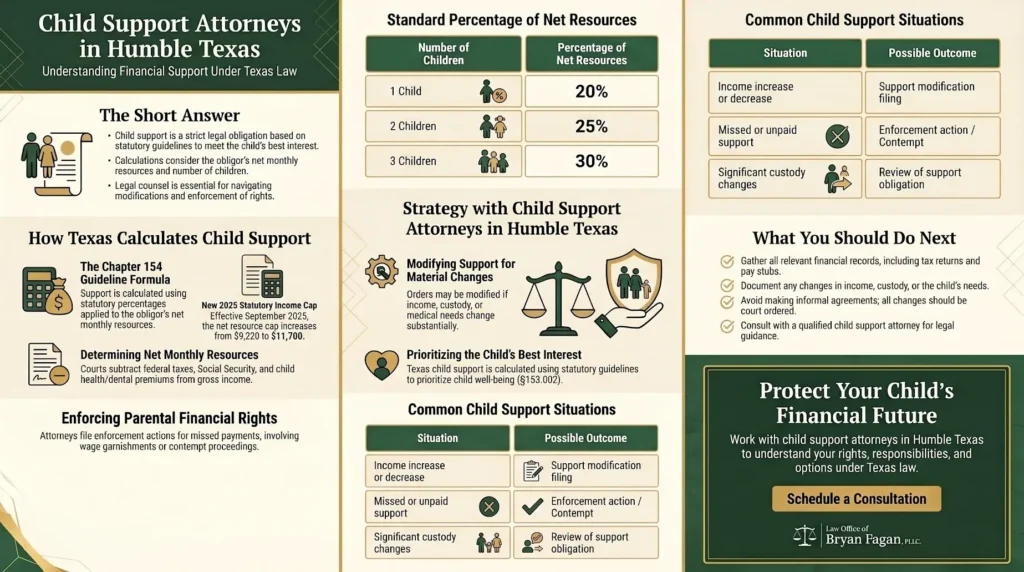
Many parents searching for Child Support Attorneys in Humble Texas are surprised to learn that Texas child support is based on far more than a simple paycheck. Under Texas Family Code §154.125, support is calculated as a percentage of the obligor parent’s net monthly resources, typically 20% for one child, 25% for two, and increasing from there. Effective September 1, 2025, Texas raised the net resource cap to $11,700 per month, though courts can order additional support when a child has proven needs above the guideline amount.
Texas courts look closely at financial credibility and documentation. Under §154.062, “net resources” may include overtime, bonuses, commissions, self-employment income, retirement benefits, unemployment income, and certain disability payments — not just salary. In Harris County family courts, judges regularly review tax returns, pay stubs, bank statements, insurance costs, and employment history to determine whether the reported income accurately reflects a parent’s earning ability.
This becomes especially important in Humble-area cases involving refinery workers, contractors, healthcare professionals, business owners, or parents with fluctuating income. In straightforward situations, guideline support may be relatively easy to calculate. In more complex cases — especially those involving self-employment, hidden income, high-asset divorce issues, or contested custody disputes under Texas Family Code §153.134 — careful financial analysis and strategic preparation can significantly affect the outcome. Parents facing substantial financial disputes may also benefit from understanding the cheapest way to get a divorce in Texas and when litigation becomes necessary.
Texas courts may also deviate from standard guideline support under §154.123 when applying the formula would be unjust or inappropriate. Judges may consider childcare costs, medical needs, private school expenses, disabilities, or unusual financial circumstances affecting the child’s stability and well-being. Under §153.002, every support decision ultimately centers on the best interest of the child.
Where disputes become contested, delays can become expensive. If income changes significantly, filing a modification under §156.401 quickly may help prevent avoidable arrears and future enforcement exposure under §157.001. Whether the issue involves a straightforward support calculation or a more complex financial dispute, informed legal guidance can help parents protect both their financial future and their child’s long-term stability.
| Number of Children | Guideline % of Net Resources (§154.125) | Practical Impact |
|---|---|---|
| 1 child | 20% | On $5,000 net/month → $1,000/month support |
| 2 children | 25% | On $5,000 net/month → $1,250/month support |
| 3 children | 30% | On $5,000 net/month → $1,500/month support |
| 4 children | 35% | On $5,000 net/month → $1,750/month support |
| 5+ children | 40% | On $5,000 net/month → $2,000/month support |
| Low-income obligor (under $1,000 net) | Reduced percentages per §154.125(b) | Court applies low-income chart, not standard guideline |
Costly Mistake
The number-one error pro se parents make is calculating support on gross income instead of net resources. The second-most-common error is forgetting that the obligee’s income is irrelevant in Texas — only the obligor’s net resources determine the guideline amount. If you walked into a hearing expecting your ex’s $90,000 salary to offset your support obligation, you walked in unprepared.
When and How to Modify an Existing Order Under §156.401
Many parents assume a child support order is permanent once the judge signs it. In reality, Texas law recognizes that life changes. Families searching for Child Support Attorneys in Humble Texas are often dealing with situations where income has changed, parenting schedules no longer match the original order, or a child’s financial and medical needs have evolved over time.
Under Texas Family Code §156.401, a child support order may be modified when there has been a material and substantial change in circumstances or when at least three years have passed and the guideline amount differs from the current order by either 20% or $100 per month. In Harris County family courts, judges expect parents to support these requests with clear documentation, financial records, and credible evidence explaining why the modification is necessary.
A “material and substantial change” can include job loss, a major increase or decrease in income, the birth of another child, serious medical issues, changes in custody arrangements under §153.134, or increased needs affecting the child’s stability and well-being. Courts also examine whether the income change is legitimate. If a parent voluntarily leaves a high-paying job or intentionally reduces income, the court may impute earning capacity under §154.066 rather than lowering support obligations.
In straightforward situations, modifications may involve updated pay stubs, insurance costs, or parenting schedules that no longer reflect reality. In more complex cases — especially those involving self-employment income, contested custody disputes, interstate jurisdiction issues, or enforcement exposure under §157.001 — careful preparation becomes critical. Delays can become expensive because Texas courts generally do not retroactively reduce support before a modification request is formally filed.
Harris County modification cases are typically filed in the court with continuing exclusive jurisdiction, meaning the same court that issued the original order unless venue has properly transferred. Families in Humble sometimes encounter venue complications after moves to Porter, Conroe, or New Caney, which may require additional procedural steps before the court can address the modification itself.
Texas judges also evaluate consistency and compliance with existing court orders. A parent seeking relief while ignoring current obligations often faces credibility issues in court. Whether the case involves a routine adjustment or a contested dispute, preparation matters. Parents trying to navigate these issues on their own may benefit from learning more about finalizing and completing your divorce as a pro and how post-divorce financial obligations continue evolving long after the final decree is signed.
At The Law Office of Bryan Fagan, PLLC, the focus is helping parents understand when modification is appropriate, what documentation courts expect, and how to protect both financial stability and the long-term best interests of the child under §153.002.
What to Document Before You File
Before filing a modification petition, gather: the last 24 months of pay stubs (or 1099s and bank statements if self-employed), the last 2 years of tax returns, current health insurance documentation for the children, proof of any new dependents, and the original order. Modifications are won on documentation, not testimony.
Enforcing a Delinquent Child Support Order Under §157.001

When child support stops being paid consistently, the effects usually reach far beyond finances. Missed payments can disrupt housing stability, medical care, childcare arrangements, and the overall consistency children depend on after divorce or separation. Many parents searching for Child Support Attorneys in Humble Texas are not looking for conflict — they are trying to restore stability and enforce orders that were already meant to protect their children.
Texas Family Code §157.001 gives courts several enforcement tools when a parent falls behind on support obligations, including contempt proceedings, judgments for arrears, wage withholding, and license suspension. In Harris County family courts, enforcement actions move faster than many parents expect. Hearings are often scheduled within 30 to 45 days after filing, and judges closely examine payment history, financial records, prior compliance with court orders, and the credibility of both parties before making decisions.
One of the most important procedural steps in enforcement cases is proper service. If the responding parent cannot be personally served, the case may stall while attorneys pursue skip-tracing or alternative service options. In straightforward situations, enforcement may involve correcting missed payments or updating withholding orders after a job change. In more complex cases — especially where disputes become contested, income is hidden, or self-employment complicates collection — enforcement litigation can quickly become more strategic and documentation-heavy.
Texas law does provide defenses under §157.008, but courts set a high bar. Simply claiming unemployment is rarely enough. Judges typically expect detailed proof showing the parent lacked funds, had no assets available to sell, actively searched for work, and attempted to borrow money or otherwise comply with the order. Harris County judges often focus heavily on documentation, consistency, and whether the parent made genuine efforts to meet their obligations.
Wage withholding under §158.001 remains the most common enforcement tool in Texas. Once withholding is ordered, employers must deduct support directly from wages and send payments to the State Disbursement Unit. Problems frequently arise when parents change jobs without updating the court or when income comes from contract work, cash businesses, or self-employment. In those cases, enforcement may involve liens, bank levies, or additional court intervention. Parents dealing with contested support disputes tied to divorce or custody litigation may also benefit from understanding how contested divorce cases in Humble can affect long-term financial obligations and enforcement exposure.
Texas also authorizes license suspension under §232.003 for significant arrears, including driver’s licenses, professional licenses, and recreational licenses. Many parents do not realize how quickly enforcement pressure can escalate once arrears begin accumulating. Delays become risky because unpaid support may continue growing with interest while enforcement remedies become more aggressive over time.
In cases involving custody disputes under §153.134, modification requests under §156.401, or allegations affecting the child’s stability under §153.002, enforcement proceedings may overlap with broader family law issues. Where disputes involve high-income earners, interstate jurisdiction, CPS concerns, or Office of the Attorney General proceedings, experienced legal guidance can materially affect both strategy and outcome.
At The Law Office of Bryan Fagan, PLLC, the goal is not simply to pursue enforcement or defend against it. The focus is helping families understand their legal options, protect their children’s financial stability, and move forward with a clearer plan during difficult transitions.
Enforcement Reality Check
The most overlooked enforcement tool is the cumulative money judgment under §157.263. Once granted, it becomes a debt that survives until paid — including past the child’s 18th birthday — and accrues 6% interest under §157.265. Arrears judgments are the leverage that drives lump-sum settlements years later.
Listen to Our Texas Family Law Podcast
Prefer listening? In this episode, we discuss child support in Humble, Texas, including how support is calculated, what factors courts consider, and what parents need to know about their legal rights and responsibilities.
Timeline Estimator: How Long Will Your Child Support Case Take?
The interactive tool below estimates how long your specific Humble-area child support case will take to resolve, based on case type, contestedness, and procedural factors. Answer six questions. No email gate, no contact form — just the estimate.
How long will your child support case take?
What type of child support case do you have?
Pick the category that best fits. If the OAG sent you papers, choose “Enforcement / OAG action.”
Is the other parent expected to contest the case?
Contested means they will fight the support amount, the conservatorship terms, or both. If they’ve already hired an attorney, assume contested.
Where do the children primarily live?
This determines venue. Humble cases generally file in Harris County, but moves north to Porter, Conroe, or New Caney can shift the case to Montgomery County.
Is the obligor parent’s income straightforward?
Straightforward = W-2 wage earner with consistent income. Complex = self-employed, 1099, oilfield with heavy overtime, multiple jobs, or suspected hidden income.
Has paternity already been legally established?
Paternity is established by marriage, by signed Acknowledgment of Paternity (AOP), or by court order. If you were never married and never signed an AOP, paternity must be adjudicated first.
Is there urgency — pending hearing, immediate enforcement, or imminent move?
Tells us whether emergency or expedited procedures apply. A hearing within 30 days qualifies as urgent.
Your case needs attorney involvement this week
Your answers indicate a hearing or enforcement deadline within 30 days. That’s the highest-leverage and highest-risk window in any Texas child support matter. Temporary orders or contempt findings entered during this period will shape the rest of your case — and often become the de facto final outcome.
What we’d do in the next 7 days: review the petition or motion, prepare a financial information statement, draft proposed orders, identify procedural objections available under the Texas Family Code, and ensure you walk into the courtroom with a complete documentary record. Most Humble-area emergency cases are resolved or stabilized within the first two attorney meetings.
Most clients hear back within 5 minutes during business hours (8 AM–10 PM CT, 7 days a week).
Plan for a 4–9 month resolution
Your answers point to a contested or moderately complex case on a standard Harris County family court timeline. Most cases in this category resolve in 4–9 months, with temporary orders typically entered within the first 60–90 days and final hearings set 4–7 months after filing depending on court docket.
The biggest leverage point in your case is the temporary orders hearing — the financial baseline set there often becomes the final number. We’d start by reviewing the original order or petition, mapping income documentation, and building the timeline strategy backwards from your expected final hearing date.
Most clients hear back within 5 minutes during business hours (8 AM–10 PM CT, 7 days a week).
You have time to build the case correctly
Your answers indicate no immediate hearing or deadline. That’s the best position to be in — you have time to document income, prepare a clean modification or establishment petition, and avoid the procedural traps that catch parents who file in a hurry.
Most planning-stage cases benefit from a single Legal Strategy Session to map the path: which petition to file, what venue applies, what documentation to gather over the next 30–60 days, and how to time the filing for maximum leverage. The session is a flat fee and includes a written summary you can act on.
Most clients hear back within 5 minutes during business hours (8 AM–10 PM CT, 7 days a week).
Get your case mapped by a Texas family law attorney
A Legal Strategy Session gives you a written game plan: which filing, which court, what documentation, what timeline, and what the realistic dollar outcome looks like.
Schedule a Strategy SessionDefending Against an OAG or Private Enforcement Action
Parents searching for Child Support Attorneys in Humble Texas are often dealing with one of the most stressful moments in a family law case: receiving notice that the Office of the Attorney General or the other parent has filed an enforcement action. These cases move quickly in Harris County, and failing to respond properly can lead to serious consequences, including wage withholding, judgments for arrears, license suspension, contempt findings, and even jail time under Texas Family Code §157.001.
One of the biggest mistakes parents make is assuming they can simply explain the situation to the judge at the hearing without preparation. In reality, Texas courts expect documentation, credible financial records, and procedural compliance long before anyone walks into the courtroom. Missing a hearing, failing to file an answer, or appearing without evidence can severely limit your options. In straightforward situations, enforcement disputes may involve correcting payment records or resolving misunderstandings about arrears. Where disputes become contested, however, the case may require a much more strategic approach involving financial evidence, employment history, prior court orders, and procedural defenses under §157.008.
Texas law does provide defenses to enforcement, but courts apply them carefully. Common issues include improper service, inaccurate arrearage calculations, pending modification requests under §156.401, or legitimate inability-to-pay claims supported by documentation. Harris County judges generally expect parents to prove they actively searched for work, exhausted available financial resources, attempted to borrow funds, and complied with court orders to the extent possible. Simply saying “I lost my job” is rarely enough. Financial credibility and preparation matter heavily in these hearings.
If your case involves self-employment income, cash-based work, interstate enforcement issues, contested custody disputes under §153.134, or allegations tied to a child’s stability under §153.002, the complexity increases significantly. In more complex cases, delays can become risky because arrears continue growing while enforcement exposure expands. Parents facing high-conflict family law disputes may also benefit from understanding how to get a divorce in Texas without a lawyer and avoid common mistakes and when experienced legal guidance becomes critical instead of optional.
Parents should also understand an important reality about Office of the Attorney General child support cases: the OAG attorney does not represent either parent individually. Their role is to enforce the State’s interest in collecting support. In Harris County Title IV-D courts, attorneys often manage dozens of hearings in a single docket, which means individualized attention to defenses or custody-related concerns is limited.
At The Law Office of Bryan Fagan, PLLC, the goal is to help parents understand their legal options before procedural mistakes create long-term financial consequences. Whether the issue involves correcting inaccurate records, responding to enforcement allegations, or defending against a contested child support action, informed preparation and timely action can materially affect both the process and the outcome.
The biggest mistake I see in OAG enforcement cases isn’t legal — it’s procedural. Obligors show up to court thinking they’ll explain their situation to the judge. The judge doesn’t want an explanation. The judge wants documents. Walk in with the documents organized by defense element, and the conversation shifts.
Humble-Specific: Harris County Procedure and Local Court Differences
Humble, Texas sits in Harris County, which means child support cases for Humble residents file in Harris County family district courts located at 201 Caroline Street in downtown Houston. The drive from Humble to the family law center runs 25–40 minutes depending on traffic — plan for an hour-plus on hearing days. This is meaningfully different from how cases are handled in neighboring counties.
Most Humble-area child support cases in Harris County are heard by the family district courts (245th, 247th, 257th, 280th, 308th, 309th, 310th, 311th, 312th) or by the associate judges assigned to those courts. The 308th, 309th, 310th, and 311th handle the largest volume of contested family matters. Title IV-D cases (OAG cases) are heard by Title IV-D associate judges in dedicated courtrooms with their own dockets.
Compared to Montgomery County (where families who move to Porter, New Caney, or Conroe end up), Harris County tends to run a heavier docket with associate judges who hear most temporary orders. Montgomery County has fewer family courts and a more compressed timeline — final hearings in Montgomery often set 30–60 days faster than Harris County equivalents. Liberty County (where some east-of-Humble families have moved) runs a much smaller docket, which means faster hearings but fewer specialized family-law judges.
Humble’s geography matters in another way: the city straddles the FM 1960 corridor with significant residential growth pushing north into Atascocita, Kingwood, and beyond into Montgomery County. If one parent has moved across the county line within the last six months, venue may need to transfer under §155.201, which adds 60–90 days to any modification or enforcement action. Confirming the correct county for filing is the first step — not the last.
Typical contested establishment timeline, Harris County
Contempt motion hearing setting, Harris County family courts
Monthly net resources cap under §154.125 (above this, court applies needs-based analysis)
Three-year modification threshold under §156.401
The Five Mistakes That Sink Child Support Cases

After years of watching Humble-area child support cases run through Harris County family courts, the same five mistakes account for the majority of bad outcomes. They’re avoidable. They’re also subtle enough that most parents don’t see them until the order is final and the leverage is gone.
Mistake one: treating temporary orders as throwaway. The temporary orders hearing sets the financial baseline that the court will lean on at final trial. Show up with bad numbers at temporary orders, you’ll spend the rest of the case fighting uphill. Show up with documented, clean numbers, and the temporary order often becomes the final order with minor adjustments.
Mistake two: filing in the wrong county. Humble residents file in Harris County. Period. Even if the case involves a child living temporarily with grandparents in Montgomery County, even if one parent works in Houston and the other in Conroe — venue follows the child’s primary residence over the last six months. Filing in the wrong county costs a motion to transfer, an order, and 60–90 days.
Mistake three: relying on verbal agreements. “We agreed I’d pay $800 a month directly” carries no weight against an OAG enforcement action that says you owe the order amount through the State Disbursement Unit. Payments made outside the official channel are not credited unless the receiving parent acknowledges them in writing — and even then, the court may not honor informal arrangements that bypassed the order.
Mistake four: ignoring income changes. An obligor whose income drops should file a modification within 30–60 days of the change. Waiting six months means six months of arrears accumulated at the old rate, with no retroactive relief available. Texas does not modify support backward — modification orders are prospective only under §156.401(b), with very narrow exceptions.
Mistake five: hiring the wrong attorney. General-practice attorneys handle child support cases occasionally. Family-law attorneys handle them constantly. The procedural shortcuts, the documentary expectations of each Harris County associate judge, the negotiation patterns with the OAG — these are learned by repetition, not by reading the statute. Hire someone who lives in the Harris County family courts, not someone who visits.
Checklist: What to Do in the Next 72 Hours
Locate and read the existing order, if one exists
Pull the current order, divorce decree, or SAPCR judgment. Confirm the case number, the issuing court, and the support amount on its face. If you cannot locate it, request a copy from the Harris County District Clerk’s office or pull it from the OAG’s portal if a Title IV-D case is open.
Gather 24 months of income documentation
Pay stubs, W-2s, 1099s, the last two federal tax returns, and bank statements covering the same period. If self-employed, add profit-and-loss statements and business bank records. This is the documentary foundation for any establishment, modification, or defense.
Confirm venue: which county filed (or should file)
Check the children’s primary residence over the last six months. Humble cases typically file in Harris County, but moves to Porter, Conroe, or New Caney shift venue to Montgomery County under §155.201. Filing in the wrong county costs 60–90 days.
Calculate your net resources using §154.062
Start with gross income, deduct federal income tax (computed as single with one exemption), social security, Medicare, union dues, and the child’s health insurance. The result is net monthly resources. The guideline percentage applies to this number — not to gross pay.
Document any change in circumstances
If you’re seeking modification, build the file proving material and substantial change: job loss letters, medical records, custody arrangement changes, birth of additional children, or income change documentation. Modifications are won on documentation, not testimony.
Identify the deadline
If you’ve been served, the deadline to file an answer is the Monday following the 20th day after service. Miss it, and a default judgment can issue. If you have a hearing date, mark backward 14 days for evidentiary deadlines under Harris County local rules.
Pull your OAG payment history if a Title IV-D case is open
The OAG portal shows the official record of payments and arrears. If the number doesn’t match what you’ve actually paid, dispute it in writing before the next hearing. Arrearage disputes are won by documentation cross-referenced against the OAG ledger.
Avoid common errors that will hurt you
Do not stop paying support without a court order, even if you believe the order is wrong. Do not move out of state with the children without proper court permission. Do not negotiate directly with the OAG without understanding what you’re agreeing to. Do not show up to a hearing without an attorney or, at minimum, a Legal Strategy Session.
Book a Legal Strategy Session
A 45-minute session with a Texas family law attorney maps your specific path: filing strategy, venue, documentation gaps, timeline, and realistic dollar outcome. Most clients walk out with a written action plan and clarity on next steps.
Get your action plan in writing
The Legal Strategy Session is a fixed-fee meeting that ends with a written summary of next steps — what to file, when to file, what to gather, and what the realistic outcome looks like.
Schedule a Strategy SessionWhat I Tell Every Client Who Calls About Child Support in Humble
Texas child support runs on the statute, not on what feels fair. The guideline percentage in §154.125, the modification triggers in §156.401, and the enforcement tools in §157.001 are not flexible in the abstract. They are flexible only in how they’re applied to your specific income, your specific custody arrangement, and your specific procedural posture. The job of a Humble-area child support attorney is to translate your facts into the statutory framework that produces the best legal outcome — and to prevent the procedural mistakes that lock in bad outcomes before the merits are even reached.
The threshold where you need an attorney is simple. If a hearing is set, if the OAG has filed anything against you, if your income has changed by more than 20%, if the other parent has hired counsel, or if the order amount feels meaningfully wrong — get representation. The cost of an attorney is almost always less than the cost of a bad order that runs for the next decade. Child support orders are long-lived; the difference between a properly calculated number and a sloppy one compounds over years.
If you’re reading this, you’re already past the point where this is just a research question. Pick up the phone or book the session. A 45-minute conversation will tell you what your case actually looks like, what it will cost, and what the realistic path looks like. That’s not a sales pitch — that’s the fastest way to convert uncertainty into a plan.
The next step is one phone call or one click
A Legal Strategy Session ends with a written plan for your child support case. Same-week availability across all Humble-serving offices.
Schedule a Strategy SessionConclusion:
Divorce and child support decisions rarely affect just one part of a family’s life. The financial terms of a case can influence housing stability, medical care, parenting schedules, emotional well-being, and a child’s ability to feel secure during a difficult transition. That is why working with experienced Child Support Attorneys in Humble Texas is about more than calculating numbers under the Texas Family Code. It is about building a practical plan that protects your child’s future while helping your family move forward with greater clarity and confidence.
In straightforward situations, parents may simply need help calculating guideline support, preparing paperwork, or finalizing an agreed order that keeps routines stable for their children. In more complex cases, the strategy often changes significantly. If your case involves disputed income, self-employment, enforcement actions, high-conflict custody issues, relocation, special-needs children, or concerns about educational and emotional stability, the details matter. The right legal guidance can help you avoid procedural mistakes, protect long-term financial stability, and create parenting arrangements designed around how your family actually lives—not just what works on paper.
At The Law Office of Bryan Fagan, PLLC, our goal has always been to educate families, simplify complex legal problems, and help parents regain peace of mind during uncertain seasons of life. Whether you are establishing child support for the first time, responding to an Office of the Attorney General action, or trying to modify an order after major life changes, having a thoughtful legal strategy can make a meaningful difference for both you and your children.
Questions My Clients Ask About Child Support in Humble
For straightforward establishment or modification cases, most Humble-area child support attorneys offer flat fees ranging from $2,500 to $5,000 depending on whether the case involves paternity, conservatorship disputes, or complex income. Contested cases — particularly those involving self-employment income, hidden assets, or interstate jurisdiction — move to hourly billing with retainers typically $3,500 to $7,500. Enforcement defense varies widely depending on the alleged arrearage. The flat-fee Legal Strategy Session at our firm is a fixed price and gives you the scope and number before you commit.
Texas Family Code §154.125 sets the guideline percentage on the obligor parent’s net monthly resources: 20% for one child, 25% for two, 30% for three, 35% for four, and 40% for five or more children. Net resources are gross income minus federal income tax, social security, Medicare, union dues, and the cost of the child’s health insurance. The cap on net resources used in the guideline is $9,200/month. Above the cap, the court can order additional support based on the proven needs of the child.
Yes, under §156.401, child support can be modified when there is a material and substantial change in circumstances OR when three years have passed and the current guideline amount differs from the current order by 20% or $100/month (whichever is greater). Without one of these two triggers, the court has no jurisdiction to modify. Modifications are prospective only — you cannot reduce support retroactively for months that have already passed.
Under §157.001, non-payment can result in contempt proceedings (up to 180 days jail per missed payment), a cumulative money judgment for arrears with 6% statutory interest, wage withholding, license suspension (driver’s, professional, and recreational), interception of tax refunds, and reporting to credit bureaus. Most enforcement cases in Harris County resolve without jail time, but contempt findings remain on record and the arrearage judgment survives until paid in full.
Uncontested establishment cases typically resolve in 60–120 days. Contested establishment cases run 4–9 months from filing to final hearing. Modification cases take 3–6 months on average. Enforcement contempt motions are typically set for hearing within 30–45 days of filing. OAG Title IV-D cases run on parallel dockets and can be faster or slower depending on the specific Title IV-D associate judge’s schedule.
Yes, in most cases. The OAG attorney represents the State of Texas, not either parent. They are not your advocate and are not negotiating on your behalf. In contested matters — disputed income, conservatorship disagreements, paternity challenges, enforcement defense — the OAG attorney’s high caseload makes individualized representation impossible. Hiring your own attorney is the most common improvement parents make to their OAG cases.
Yes. Texas Family Code §160 governs paternity adjudication, and once paternity is established (by marriage, by Acknowledgment of Paternity, or by court order), the unmarried parent has the same right to child support as a divorced parent. If paternity has not been established, the first step is a paternity suit, which can be combined with a SAPCR for support and conservatorship in the same filing.
This is one of the most common complications in Humble-area cases. Texas law allows the court to impute income under §154.066 if it finds the obligor is intentionally unemployed or underemployed. Discovery tools — interrogatories, requests for production, depositions, subpoenas to banks and customers — can surface income that doesn’t appear on tax returns. Forensic accounting may be needed in cases involving cash businesses, contractor work, or interstate income.
Generally yes, but with two important exceptions under §154.001 and §154.302. Support continues until the child graduates high school, even if that’s after the 18th birthday. For a child with a physical or mental disability that requires substantial care and personal supervision, support can be ordered indefinitely — for life, in many cases. Disability-extension support requires a separate finding before the child turns 18.
In limited circumstances, yes. Under §102.004, grandparents who have actual care, control, and possession of a child for at least six months may have standing to file a SAPCR, which includes child support against both biological parents. This applies most often when grandparents are raising grandchildren due to parental incapacity, incarceration, or abandonment. The standing analysis is fact-specific and requires careful review before filing.
Get answers specific to your Humble-area case
FAQs cover the general rules. A Legal Strategy Session covers your specific facts, court, and timeline.
Schedule a Strategy Session